
Master Copy for IRTMTCALD by IRICEN BALLAST CLEANING
Master Copy for IRTMTC/ALD by IRICEN
BALLAST CLEANING MACHINE Ø INTRODUCTION: Ø Ballast cleaning machine is to carry out cleaning of ballast by removing muck , thereby improving drainage of track and elasticity of the ballast bed. basically the machine its excavates and picks up ballast by means of cutter chain and carries it to a set of vibrating screens where muck is separated and thrown out. three types of ballast cleaning machines are available on indian railways Plain Track Ballast Cleaning Machine – RM 80 Point And Crossing Ballast Cleaning Machine – RM 76 Shoulder Ballast Cleaning Machine – SBCM (FRM 80) Ø Ø
BALLAST CLEANING MACHINE § Ballast gets pulverized due to hammering action of passing loads raising the level of fines in the ballast. § Sand dust gets mixed up due to vagaries of weather and materials falling down from freight wagons, keep on contaminating the ballast, its load distribution angle reduces, diminishing its load dispersing function, ballast looses elasticity causing rapid deterioration of track geometry.
BALLAST CLEANING MACHINE Ø Due to presence of bad formation, ballast attrition, excessive rainfall and dropping of ashes and ore, ballast gets choked up and track drainage is impaired. in such situation it becomes necessary to screen the ballast right up to the formation level/sub ballast level. Ø Deep screening should be carried out in the following situations by providing full ballast cushion.
BALLAST CLEANING MACHINE Ø Prior to CTR Ø Prior to TSR Ø Where the caking of ballast has resulted in unsatisfactory riding Ø Before converting existing track, fish plated or SWR into LWR or CWR. Ø The entire track must be deep screened at least once in 10 years.

BALLAST CLEANING MACHINE Ø Therefore as a general principle, ballast cleaning become due when there is 25% pollution and necessary when it is more than 40%. For mechanized ballast cleaning, various types of machines are available in world market. Indian Railways have procured the following machines from M/s Plasser & Theurer Austria.
Point And Crossing Ballast Cleaning Machine – RM 76 Ø Technical DATA: Ø ENGINES DEUTZ-BF 12 L 513 C 396 HP AND 221 HP LENGTH OVER BUFFERS 24730 MM WIDTH 3130 MM HEIGHT ABOVE RAIL TOP 4015 MM BOGIE PIVOTS SPACING 19500 MM WHEEL DIA 900 MM TOTAL WEIGHT 71 TONNES SPEED 40 KMPH Ø Ø Ø Ø
Point And Crossing Ballast Cleaning Machine – RM 76 Ø Technical DATA: Ø ENGINES DEUTZ-BF 12 L 513 C 396 HP AND 221 HP LENGTH OVER BUFFERS 24730 MM WIDTH 3130 MM HEIGHT ABOVE RAIL TOP 4015 MM BOGIE PIVOTS SPACING 19500 MM WHEEL DIA 900 MM TOTAL WEIGHT 71 TONNES SPEED 40 KMPH Ø Ø Ø Ø
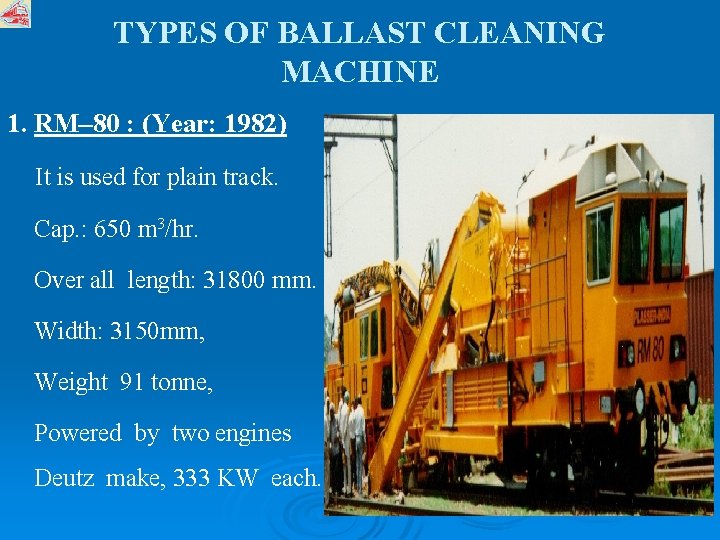
TYPES OF BALLAST CLEANING MACHINE 1. RM– 80 : (Year: 1982) It is used for plain track. Cap. : 650 m 3/hr. Over all length: 31800 mm. Width: 3150 mm, Weight 91 tonne, Powered by two engines Deutz make, 333 KW each.
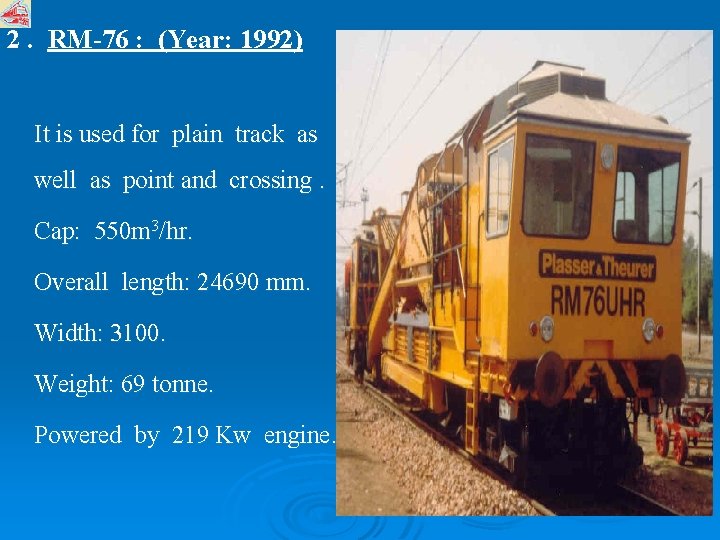
2. RM-76 : (Year: 1992) It is used for plain track as well as point and crossing. Cap: 550 m 3/hr. Overall length: 24690 mm. Width: 3100. Weight: 69 tonne. Powered by 219 Kw engine.
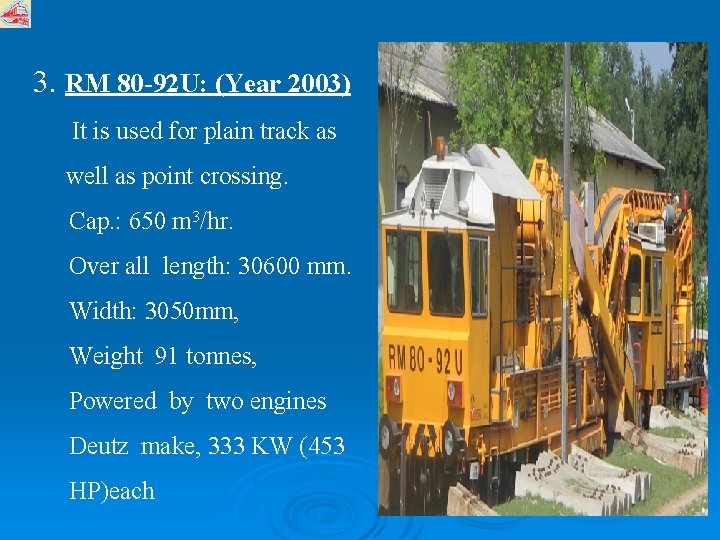
3. RM 80 -92 U: (Year 2003) It is used for plain track as well as point crossing. Cap. : 650 m 3/hr. Over all length: 30600 mm. Width: 3050 mm, Weight 91 tonnes, Powered by two engines Deutz make, 333 KW (453 HP)each

PRINCIPLE OF BALLAST CLEANING MACHINE Ø When a guided endless chain with cutting tools is passed under the bottom of sleeper with speed, it cuts caked up ballast and muck and carry it away along with it to a set of vibrating screens for cleaning. Muck is thrown out through conveyors and cleaned ballast is put back in track. In this process machine also moves forward as the work progresses. Due to paucity of space, salient features of rm-80 are discussed here, which constitute the largest numbers on Indian railways.
MAIN UNITS Ø Excavation unit Ø Screening unit Ø Conveyor system for distribution of ballast and waste disposal Ø Track lifting & slewing unit Ø Engines
PARTS OF EXCAVATION UNIT § § § § § Main Shovel Intermediate Shovel Chain bolt Special headed bolt with double nut and One spring washer Chain fingers Lock washer & fixing pin Corner rollers Dredger Drum Chain guides/trough : 82 nos. : 82 : 2 in each link : 1 per chain bolt : 5 per link : 5 nos : 1 no. : ascending 1 no descending 1 no
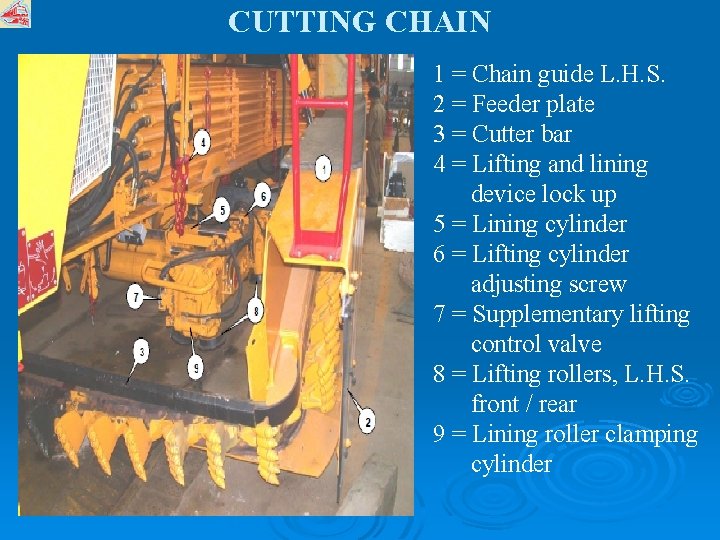
CUTTING CHAIN 1 = Chain guide L. H. S. 2 = Feeder plate 3 = Cutter bar 4 = Lifting and lining device lock up 5 = Lining cylinder 6 = Lifting cylinder adjusting screw 7 = Supplementary lifting control valve 8 = Lifting rollers, L. H. S. front / rear 9 = Lining roller clamping cylinder
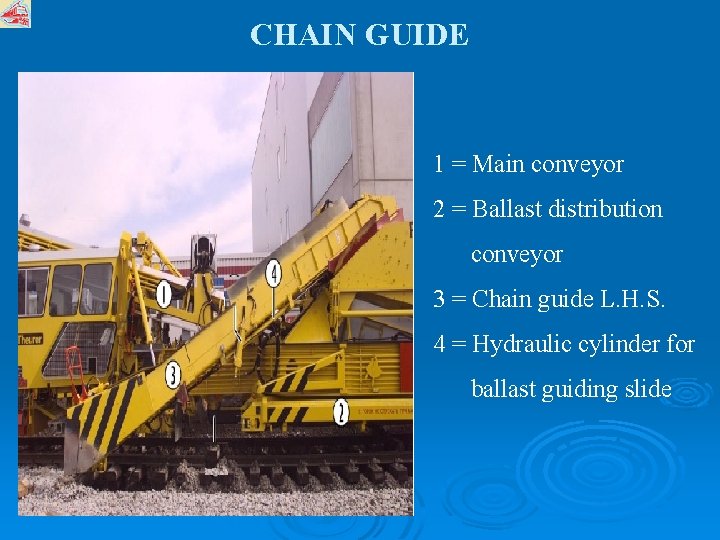
CHAIN GUIDE 1 = Main conveyor 2 = Ballast distribution conveyor 3 = Chain guide L. H. S. 4 = Hydraulic cylinder for ballast guiding slide
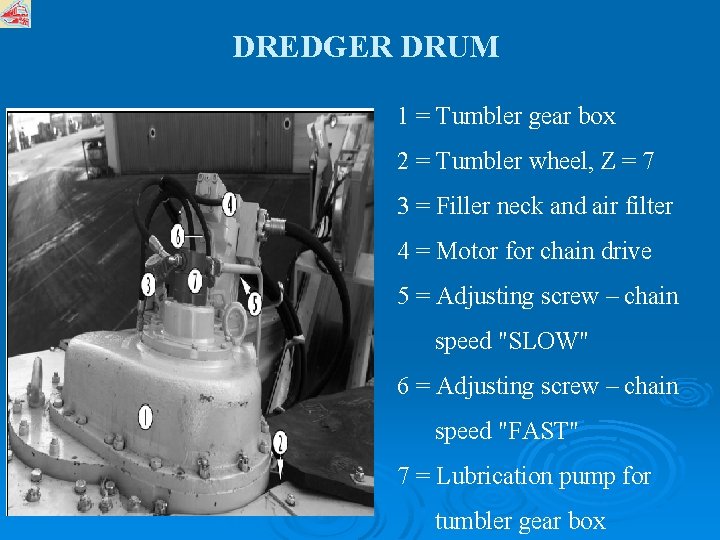
DREDGER DRUM 1 = Tumbler gear box 2 = Tumbler wheel, Z = 7 3 = Filler neck and air filter 4 = Motor for chain drive 5 = Adjusting screw – chain speed "SLOW" 6 = Adjusting screw – chain speed "FAST" 7 = Lubrication pump for tumbler gear box
PARTS OF EXCAVATION UNIT Ø Chain guides/ trough 1 no ascending & 1 no descending Wear plates & Wear strip, Chain rotation 1. Hydraulic motor 335 hp 2. Turret gear speed 1. 8 to 3. 4 m/sec 3. Speed of turret 2. 7 m/sec Gear normally adopted….
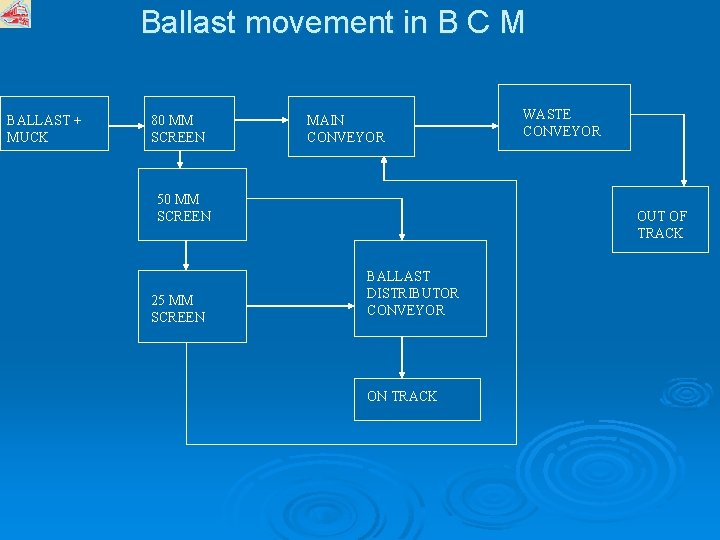
Ballast movement in B C M BALLAST + MUCK 80 MM SCREEN MAIN CONVEYOR 50 MM SCREEN 25 MM SCREEN WASTE CONVEYOR OUT OF TRACK BALLAST DISTRIBUTOR CONVEYOR ON TRACK
BCM Ø The chain becomes loose as it becomes old & ovality in pin holes develops. This can be tightened hydraulically. Ø At the time of starting work a trench has to be dug between two sleepers, long enough to accommodate cutter bar and deep enough that top most portion of cutter bar is inserted from one side along with chain link in it. After each day of work the chain is disconnected near the ends of cutter bar and left at site. Next day work is started by joining the chain.
MAINTENANCE OF EXCAVATION CHAIN l Guide rollers, wear arcs, fingers , wear plates, wear strips, cutter bar, main & intermediate link, turret gear etc. Constitute fast wearing components. Adequate stocks of these parts must be maintained for uninterrupted working.
SCREENING UNIT l It is a three grade screening unit with metal screen providing a total screening surface of 30 m 2 These screens are vibrated linearly with the help of eccentric masses. l Originally the manufacturer had provided three types of screens viz 80 mm on top, 50 mm in the middle and 36 mm at the bottom. Over sized material is dropped from top screen through chutes on the waste conveyer belt, for disposing off out side track.
SCREENING UNIT Ø Both sides of screening unit have adjustable out lets for depositing excess ballast to the desired side of the track. Screening unit can be kept level on super elevated track by operating concerned hydraulic cylinder. Ø Keeping economics of operation in mind, the proposed size of ballast screens are 80 mm, 50 mm and 30 mm.
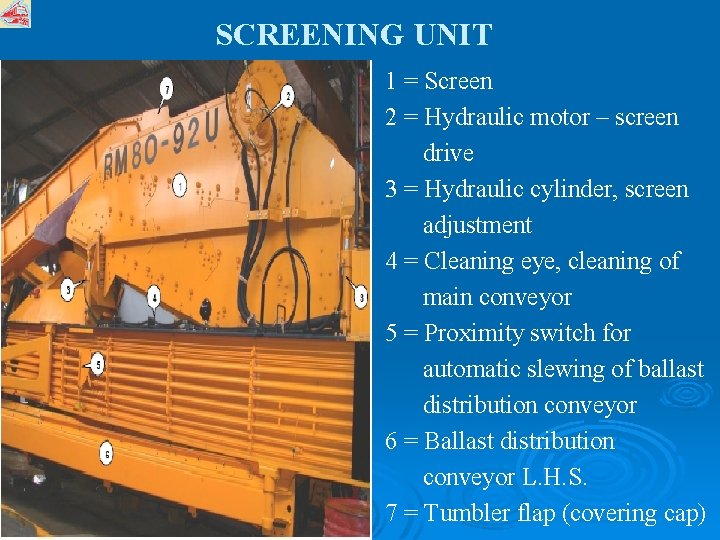
SCREENING UNIT 1 = Screen 2 = Hydraulic motor – screen drive 3 = Hydraulic cylinder, screen adjustment 4 = Cleaning eye, cleaning of main conveyor 5 = Proximity switch for automatic slewing of ballast distribution conveyor 6 = Ballast distribution conveyor L. H. S. 7 = Tumbler flap (covering cap)
CONVEYOR SYSTEM There are four conveyors in BCM 1. Ballast distribution – 1 for left & 1 for right ( clean ballast). 2. Main conveyor – 1 no. For carrying waste up to spoil / waste conveyor. 3. Waste conveyor – 1 no. To carry spoil or waste ( it can be fixed left or right & can be folded and fastened when not in use and traveling)
TRACK LIFTING AND SLEWING UNIT Ø It is provided near excavation unit , it can be lifted up to 25 cms. And slewed up to ± 30 cms this is useful to decrease the cutting depth and to avoid obstacles like platform walls etc.
ENGINES Ø Two engines are provided in BCM- Ø Model no. Bf 12 l 513 c Ø Make – DEUTZ Ø Air cooled Ø H. P. 453 of each engine @ 2300 rpm Ø Firing order : - 1 -8 -5 -10 -3 -7 -6 -11 -2 -9 -4 -12
FUNCTION OF FIRST ENGINE Ø Travel drive Ø Work drive Ø Op. of chain guides Ø Ballast distributing conveyors LHS, RHS Ø Operation of main conveyor Ø Operation of waste conveyor Ø Operation of clutch pump for drive axle 1&2 Ø Cooling of main gear box (front) oil Ø Chain guides (LHS, RHS) up & down , left – right Ø Chain tensioning cyl. , lifting device Ø Additional cutter chain pump
FUNCTION OF SECOND ENGINE Ø Travel drive Ø Work drive Ø Chain drive Ø Screen drive Ø Op. Of clutch pump for drive axle 3&4 Ø Cooling of main gear box (rear) oil
ATTENTIONS FOR WORKING OF BCM Ø Frequent shifting of BCM is not conductive to good work and adequate progress. Ø Adequate stock of cutter chains, wear plates and other fast wearing parts for uninterrupted working of BCM is must. Ø A joint plan with operating dept. For a min. 2. 5 - 3 hrs block everyday for working of BCM. Ø Before work by BCM it is necessary to survey the section and decide about the proposed profile of track. Ø For free running of cutter bar and to avoid cutting of formation a min. cushion of 250 -270 mm be ensured.
BCM Ø No obstruction should lie in a width of 4100 mm (2050 mm on either side of centre of track) to avoid infringement to the cutter chain. Ø In electrified sections foundation distance to be accurately measured to ensure free movement of chain. Ø Permanent obstructions such as cables signaling rods etc. Be temporarily disconnected. Ø Embedded rail pieces, tie-bars etc. Be removed in advance. Ø On girder bridges the guard rail at approaches be removed in advance.
BCM Ø No obstruction should lie in a width of 4100 mm (2050 mm on either side of centre of track) to avoid infringement to the cutter chain. Ø In electrified sections foundation distance to be accurately measured to ensure free movement of chain. Ø Permanent obstructions such as cables signaling rods etc. be temporarily disconnected. Ø Embedded rail pieces, tie-bars etc. be removed in advance. Ø On girder bridges the guard rail at approaches be removed in advance.
BCM Ø In case of level X- ing it should be opened so as to enable the m/c to work. Ø 100% fittings be intact so that no sleeper becomes loose and comes in the way of the cutter chain. Ø A set of gas cutting m/c should be kept with the m/c. Ø A trench of 30 cm depth and 1 m width should be made for setting of cutter bar and chain by removing one sleeper.
BCM Ø Utmost caution should be observed for waste conveyor to avoid hitting against electrical mast/signal post. Safety switch to sense the mast should be kept on. Ø All the staff should wear safety helmets and masks. Ø Screening should be stooped well before expiry of traffic block to permit proper closing of the work and packing before resumption of traffic. Ø One person on either should move with the m/c to watch any obstruction to cutter chain. Ø The vertical and lateral clearances for OHE, signal post etc. Should be checked adjusted before clearing of block.
BCM Ø Ballast recoupment activity should synchronize with deep screening activity so as to enable raising speed to normal after packing Ø One round of tamping along with DTS should be carried out immediately after deep screening to resume traffic at a speed of 40 kmph. Ø One watchman should be posted at the location where cutter bar chain are left.
BCM Problems occur during working- excavation unit Ø Ø Ø Ø Ø Any obstruction entangle with the chain Breakage of chain – bolt so chain becomes part Entanglement of wear plates with chain Chain fell down from turret Chain too loose Chain finger worn out Chain speed is not proper Hard bed or wet soil Motor for turret gear not working properly Cleaning is done without track lifting
SCREENING UNIT Ø Vibration screen may be choked Ø Screens should be of proper mesh size Ø Reconditioning of screens shall be done Ø Vibration of shaft is improper Ø Screening unit is not in horizontal position Ø Hood closed Ø Flapper should be in centre position
CONVEYOR UNIT Ø Ø Ø Alignment of conveyor shall be proper Conveyor rollers shall function properly Belts run to one side throughout entire length Belt not tight enough Material built up on belts Frozen idlers Belts slip on starting Belts improperly spliced Material between belt pulley Belts become brittle or crack due to abrasive, heat, oil, entanglement of tie bars etc. Belt tear off to its full length Puncturing of belt by ballast trapped bet. Roller and belt
LIFTING UNIT Ø Lifting not take place due to no pressure Ø Up position switch is defective Ø Clamping pressure is not sufficient Ø Worn out rollers
- Slides: 39