
Massively Parallel Algorithm for Evolution Rules Application in
![RELATED WORKS ( I ) Ciobanu et al [WMC’ 2003] r 1 r 2](https://slidetodoc.com/presentation_image_h2/7c9e4aff3a19e1798639bd4dfbf490dc/image-3.jpg "RELATED WORKS ( I ) Ciobanu et al [WMC’ 2003] r 1 r 2")
![RELATED WORKS ( I ) Fernandez et al [BIOCOMP’ 2006] m ¿? ¿? ω…](https://slidetodoc.com/presentation_image_h2/7c9e4aff3a19e1798639bd4dfbf490dc/image-4.jpg "RELATED WORKS ( I ) Fernandez et al [BIOCOMP’ 2006] m ¿? ¿? ω…")
![MASSIVELY PARALLEL ALGORITHM ( I ) Fernandez et al. [WMC’ 2006] r 1 r](https://slidetodoc.com/presentation_image_h2/7c9e4aff3a19e1798639bd4dfbf490dc/image-5.jpg "MASSIVELY PARALLEL ALGORITHM ( I ) Fernandez et al. [WMC’ 2006] r 1 r")
![MASSIVELY PARALLEL ALGORITHM ( III ) Processes Membrane Process BEGIN [1] Membrane initialization REPEAT](https://slidetodoc.com/presentation_image_h2/7c9e4aff3a19e1798639bd4dfbf490dc/image-7.jpg "MASSIVELY PARALLEL ALGORITHM ( III ) Processes Membrane Process BEGIN [1] Membrane initialization REPEAT")
- Slides: 10
Massively Parallel Algorithm for Evolution Rules Application in Transition P System Luís Fernández Fernando Arroyo Jorge A. Tejedor Juan Castellanos Grupo de Computación Natural Universidad Politécnica de Madrid Seventh Workshop on Membrane Computing, WMC'07
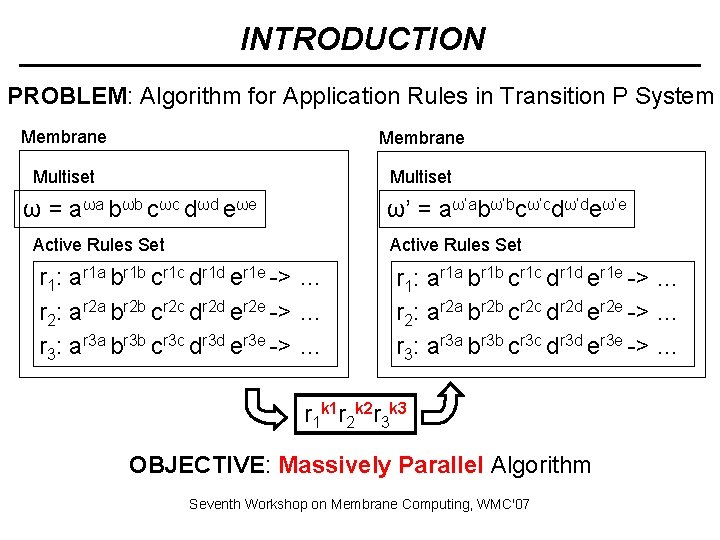
INTRODUCTION PROBLEM: Algorithm for Application Rules in Transition P System Membrane Multiset ω = aωa bωb cωc dωd eωe ω’ = aω’abω’bcω’cdω’deω’e Active Rules Set r 1: ar 1 a br 1 b cr 1 c dr 1 d er 1 e -> … r 2: ar 2 a br 2 b cr 2 c dr 2 d er 2 e -> … r 3: ar 3 a br 3 b cr 3 c dr 3 d er 3 e -> … r 1 k 1 r 2 k 2 r 3 k 3 OBJECTIVE: Massively Parallel Algorithm Seventh Workshop on Membrane Computing, WMC'07
RELATED WORKS ( I ) Ciobanu et al [WMC’ 2003] r 1 r 2 r 3 ¿? ¿? ¿? ¿? ¿? ω… ω… ω m ω… ω… … • Rules Parallel applicability checking • Concurrent, NO PARALLEL, rules application O(|w|) Seventh Workshop on Membrane Computing, WMC'07
RELATED WORKS ( I ) Fernandez et al [BIOCOMP’ 2006] m ¿? ¿? ω… ω … ω … ¿? ¿? ω… ω… ¿? ¿? ω … • Sequential, NO PARALLEL, rules application O ( log 2 | w | ) Seventh Workshop on Membrane Computing, WMC'07
MASSIVELY PARALLEL ALGORITHM ( I ) Fernandez et al. [WMC’ 2006] r 1 r 2 r 3 ¿? ¿? ¿? ¿? ¿? ω… ω m ω… ω… … • Rules Parallel applicability checking • Rules Parallel application • Mutual Exclusion over rules indexes Seventh Workshop on Membrane Computing, WMC'07
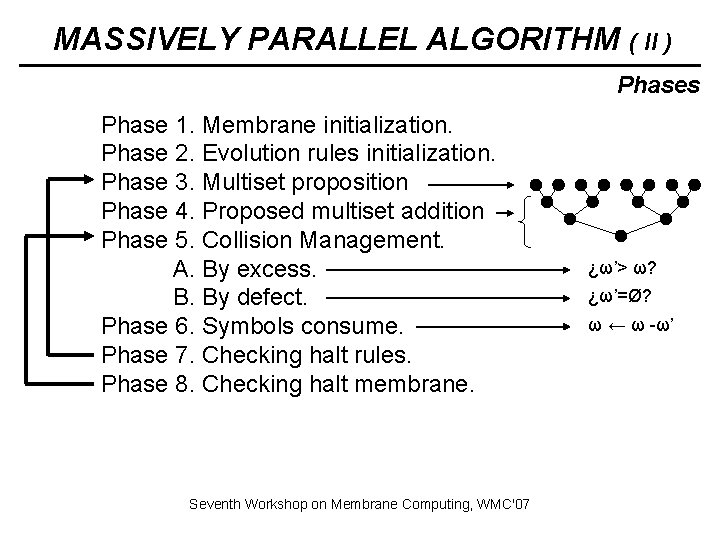
MASSIVELY PARALLEL ALGORITHM ( II ) Phases Phase 1. Membrane initialization. Phase 2. Evolution rules initialization. Phase 3. Multiset proposition Phase 4. Proposed multiset addition Phase 5. Collision Management. A. By excess. B. By defect. Phase 6. Symbols consume. Phase 7. Checking halt rules. Phase 8. Checking halt membrane. Seventh Workshop on Membrane Computing, WMC'07 ¿ω’> ω? ¿ω’=Ø? ω ← ω -ω’
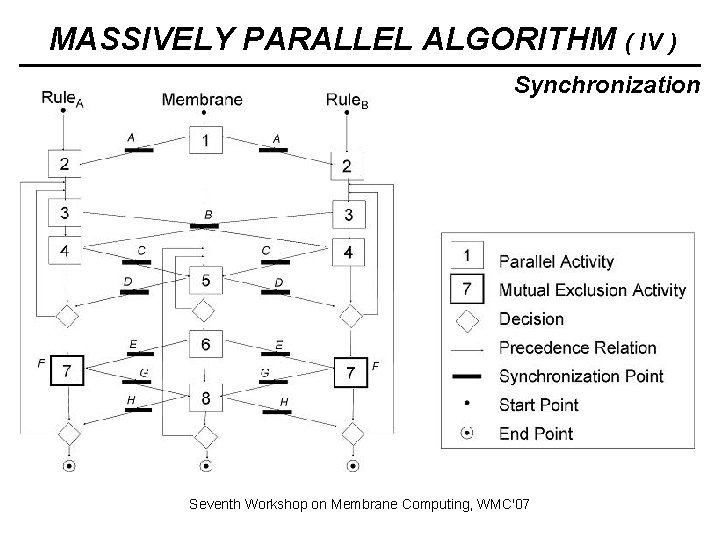
MASSIVELY PARALLEL ALGORITHM ( III ) Processes Membrane Process BEGIN [1] Membrane initialization REPEAT [5] Collision management - By excess. - By defect. UNTIL NOT Collision; [6] Symbols consume [8] Checking halt membrane UNTIL End END Rule Process BEGIN [2] Rules initialization REPEAT [3] Multisets proposition [4] Proposed multisets addition UNTIL NOT Collision [7] Checking halt rules UNTIL End END Seventh Workshop on Membrane Computing, WMC'07
MASSIVELY PARALLEL ALGORITHM ( IV ) Synchronization Seventh Workshop on Membrane Computing, WMC'07
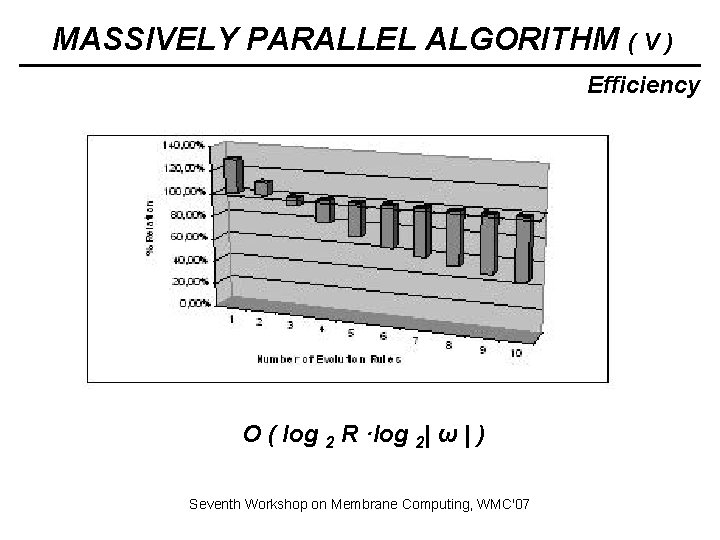
MASSIVELY PARALLEL ALGORITHM ( V ) Efficiency O ( log 2 R ·log 2| ω | ) Seventh Workshop on Membrane Computing, WMC'07
CONCLUSIONS • The Massively Parallel Algorithm is “PARALLEL” • Parallel rules execution in the 50 % of the phases • Simultaneity in the application of rules • Fined-grained critical sections. • Empirical results exhibits better behaviour than other parallel algorithms. • It gives a real chance to parallel implementation of Transition P systems. • In Hardware Architectures specifically designed it is possible to obtain a 100 % parallelism degree when the conditions are appropriates. Seventh Workshop on Membrane Computing, WMC'07