
Massachusetts Right To Know Law Global Harmonized System

Massachusetts Right To Know Law Global Harmonized System Training Worcester Public Schools School Nutrition Department October 6, 2017 Developed and Provided by Lynn Rose 413 -522 -5525 With information from the MA Department of Labor Standards, specifically Hilary Eustace and Nancy Comeau
Presentation Overview • What is the RTK law and how does it protect me? • What is a hazardous material? • How do I get exposed to hazardous materials? • How can I use information in Safety Data Sheets (SDSs) to use and manage products, and respond to product incidents? • What are the hazards of the products I work with?
What law governs the use of chemicals in the workplace? Massachusetts Right to Know Law What agency oversees RTK Law? • Governed by the MA Department of Labor Standards Who does the law apply to? • Applies to public sector employees working in Massachusetts: people working in state, county or municipal jobs.

What is the Purpose of the RTK Program? To ensure that employers and employees: • Are aware of the dangers from hazardous products. • Know how to protect yourselves to prevent exposure and injuries from hazardous products. • Know how to respond if there is an exposure or accident.
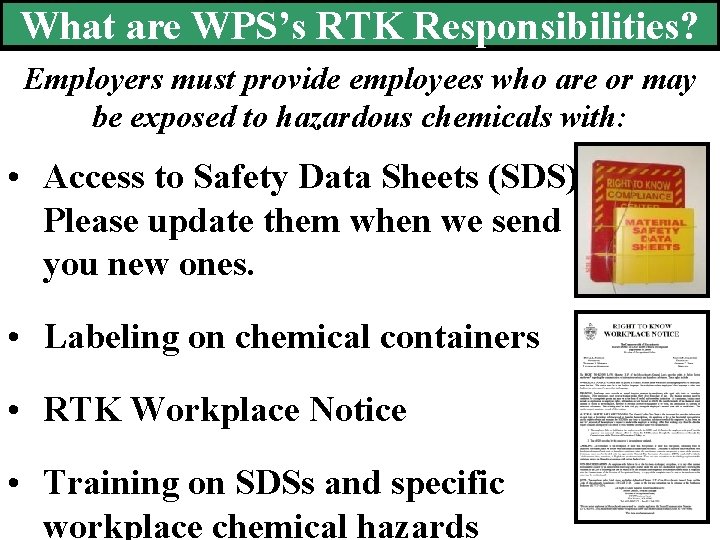
What are WPS’s RTK Responsibilities? Employers must provide employees who are or may be exposed to hazardous chemicals with: • Access to Safety Data Sheets (SDS). Please update them when we send you new ones. • Labeling on chemical containers • RTK Workplace Notice • Training on SDSs and specific workplace chemical hazards
Where can I get assistance on RTK? • An employee has the right not to be discriminated against for exercising his or her rights under the law. • You may file a complaint within 180 days with the Commissioner of DLS. Contact: RTK Program Manager MA Department of Labor Standards Westborough, MA 508 -616 -0461
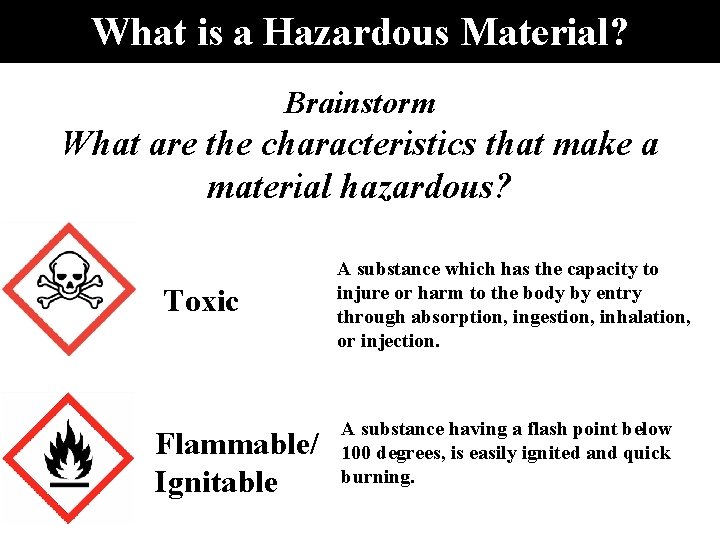
What is a Hazardous Material? Brainstorm What are the characteristics that make a material hazardous? Toxic Flammable/ Ignitable A substance which has the capacity to injure or harm to the body by entry through absorption, ingestion, inhalation, or injection. A substance having a flash point below 100 degrees, is easily ignited and quick burning.
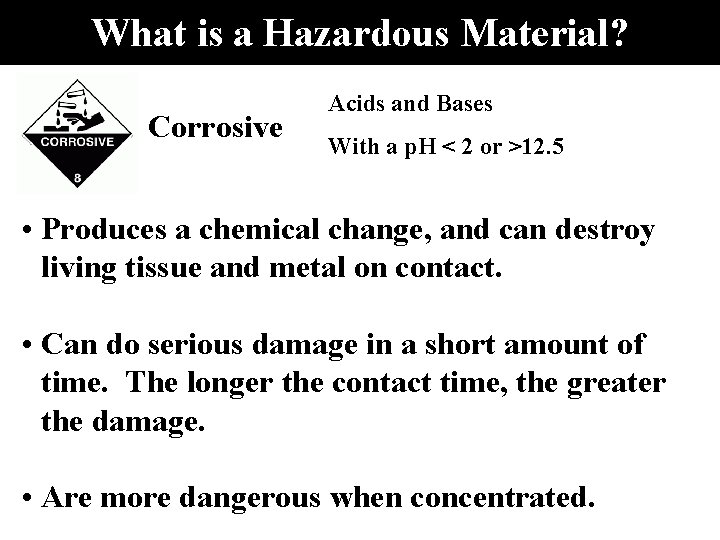
What is a Hazardous Material? Corrosive Acids and Bases With a p. H < 2 or >12. 5 • Produces a chemical change, and can destroy living tissue and metal on contact. • Can do serious damage in a short amount of time. The longer the contact time, the greater the damage. • Are more dangerous when concentrated.
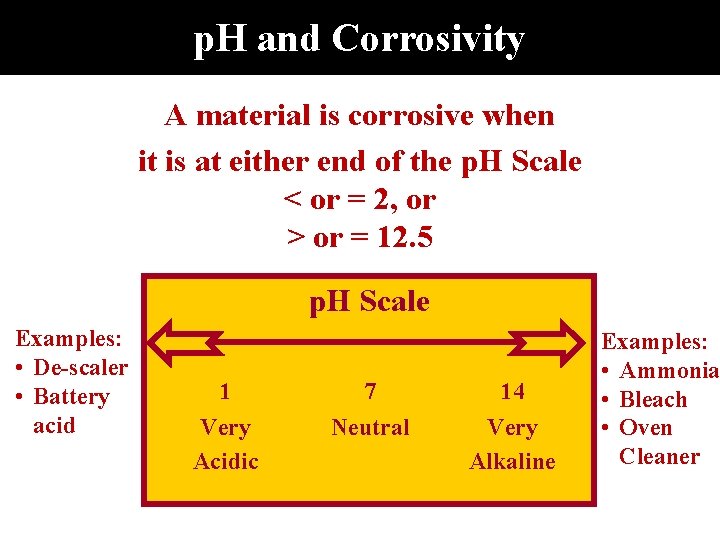
p. H and Corrosivity A material is corrosive when it is at either end of the p. H Scale < or = 2, or > or = 12. 5 p. H Scale Examples: • De-scaler • Battery acid 1 Very Acidic 7 Neutral 14 Very Alkaline Examples: • Ammonia • Bleach • Oven Cleaner
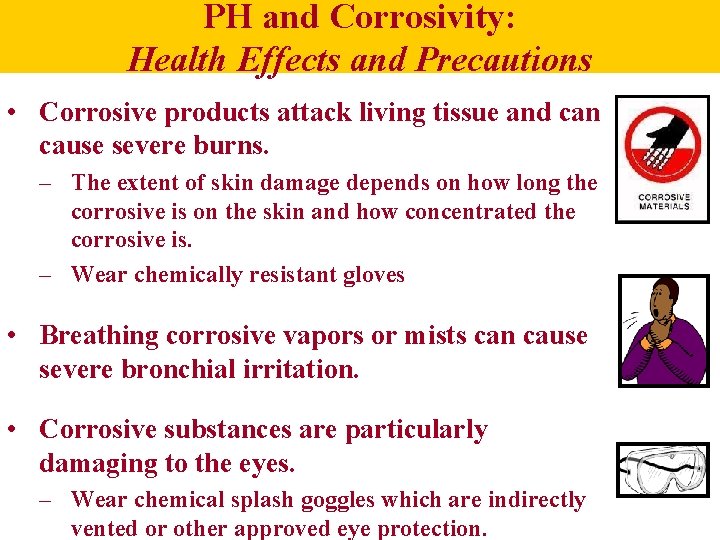
PH and Corrosivity: Health Effects and Precautions • Corrosive products attack living tissue and can cause severe burns. – The extent of skin damage depends on how long the corrosive is on the skin and how concentrated the corrosive is. – Wear chemically resistant gloves • Breathing corrosive vapors or mists can cause severe bronchial irritation. • Corrosive substances are particularly damaging to the eyes. – Wear chemical splash goggles which are indirectly vented or other approved eye protection.
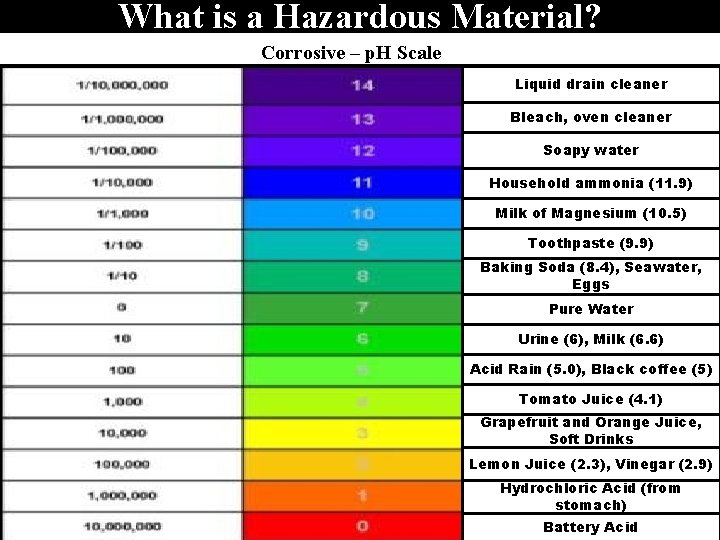
What is a Hazardous Material? Corrosive – p. H Scale Liquid drain cleaner Bleach, oven cleaner Soapy water Household ammonia (11. 9) Milk of Magnesium (10. 5) Toothpaste (9. 9) Baking Soda (8. 4), Seawater, Eggs Pure Water Urine (6), Milk (6. 6) Acid Rain (5. 0), Black coffee (5) Tomato Juice (4. 1) Grapefruit and Orange Juice, Soft Drinks Lemon Juice (2. 3), Vinegar (2. 9) Hydrochloric Acid (from stomach) Battery Acid
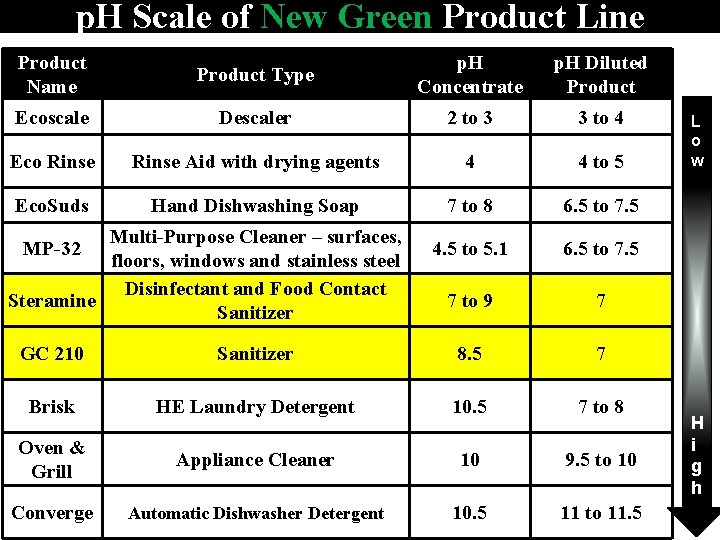
p. H Scale of New Green Product Line Product Name Product Type p. H Concentrate p. H Diluted Product Ecoscale Descaler 2 to 3 3 to 4 Eco Rinse Aid with drying agents 4 4 to 5 Eco. Suds Hand Dishwashing Soap 7 to 8 6. 5 to 7. 5 4. 5 to 5. 1 6. 5 to 7. 5 7 to 9 7 Multi-Purpose Cleaner – surfaces, floors, windows and stainless steel Disinfectant and Food Contact Steramine Sanitizer MP-32 GC 210 Sanitizer 8. 5 7 Brisk HE Laundry Detergent 10. 5 7 to 8 Oven & Grill Appliance Cleaner 10 9. 5 to 10 Converge Automatic Dishwasher Detergent 10. 5 11 to 11. 5 L o w H i g h
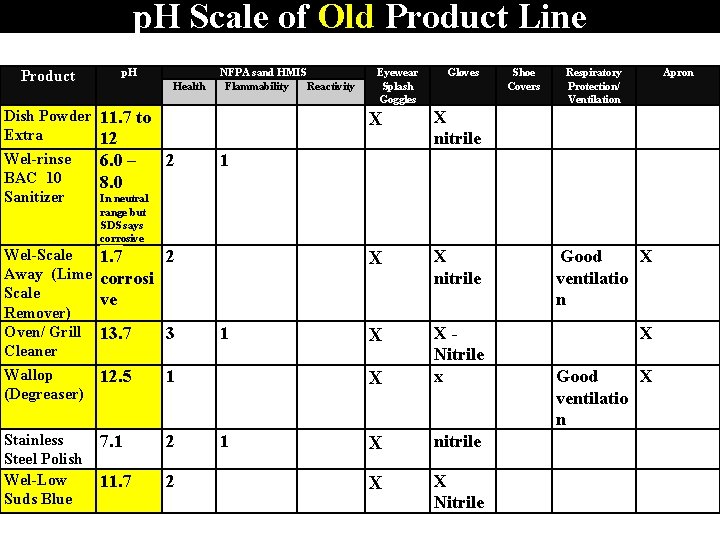
p. H Scale of Old Product Line Product p. H Health NFPA sand HMIS Flammability Reactivity Eyewear Splash Goggles Dish Powder 11. 7 to Extra 12 X Wel-rinse 6. 0 – 2 BAC 10 8. 0 Sanitizer In neutral 1 Wel-Scale 1. 7 2 Away (Lime corrosi Scale ve Remover) Oven/ Grill 13. 7 3 Cleaner 1 Wallop 12. 5 (Degreaser) Gloves Shoe Covers Respiratory Protection/ Ventilation Apron X nitrile X X nitrile Good X ventilatio n X X X - Nitrile x X nitrile X X Nitrile range but SDS says corrosive 1 Stainless 7. 1 2 1 Steel Polish Wel-Low 11. 7 2 Suds Blue X Good X ventilatio n
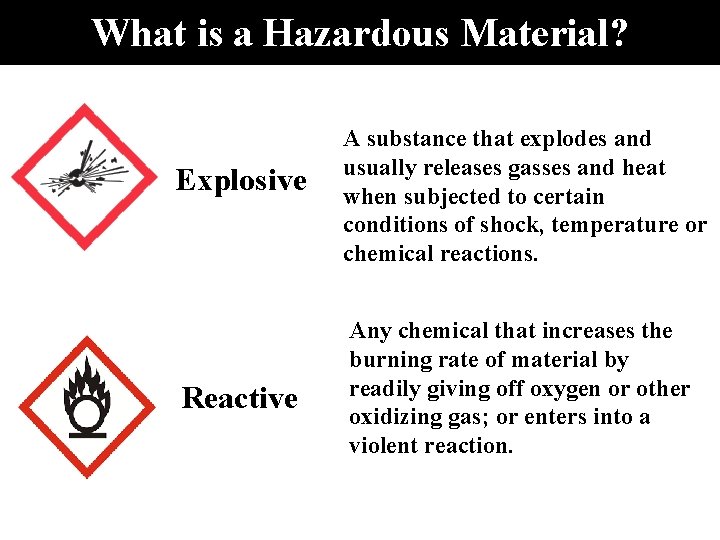
What is a Hazardous Material? Explosive Reactive A substance that explodes and usually releases gasses and heat when subjected to certain conditions of shock, temperature or chemical reactions. Any chemical that increases the burning rate of material by readily giving off oxygen or other oxidizing gas; or enters into a violent reaction.
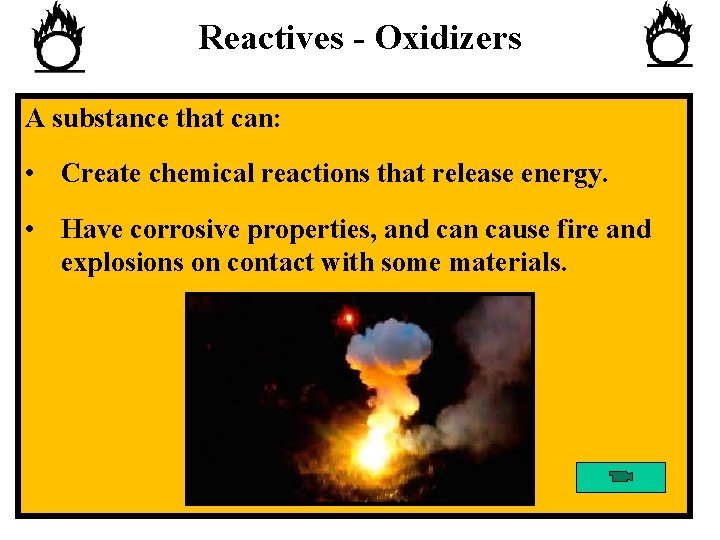
Reactives - Oxidizers A substance that can: • Create chemical reactions that release energy. • Have corrosive properties, and can cause fire and explosions on contact with some materials.

Oxidizers: Storage Store well away from: • Flammable and combustible materials as they can: – initiate a fire, and – can exacerbate an existing fire. • Acids and bases. Example of new product that is an oxidizer
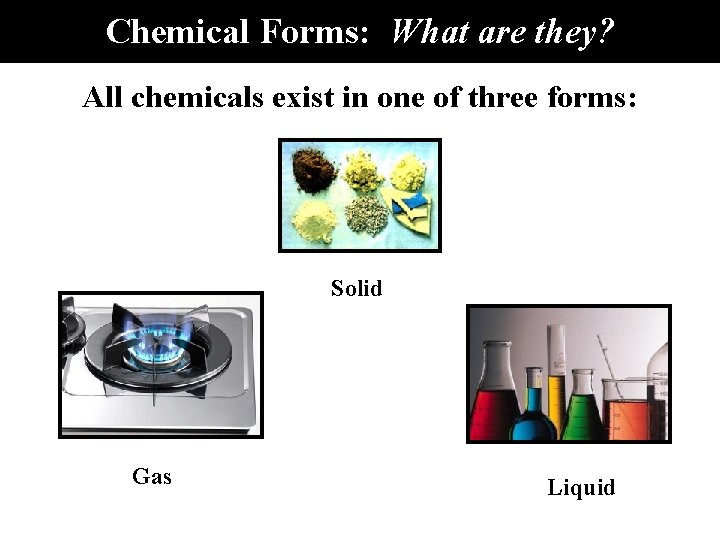
Chemical Forms: What are they? All chemicals exist in one of three forms: Solid Gas Liquid
Chemical Forms: How do they change? • Chemicals are often present in more than one form. – You can change the form of a chemical by controlling its temperature and pressure. – They can change as you use and store them, which can make them more dangerous. – When they change in form, their ability to get into your body also changes.
Where do I get information on chemicals hazards?
Global Harmonized System (OSHA and MA Department of Labor Standards have adopted) Uniformats for chemical information from across the world: • Labels • Pictograms and hazard information • Safety Data Sheets (SDS) • RTK Training
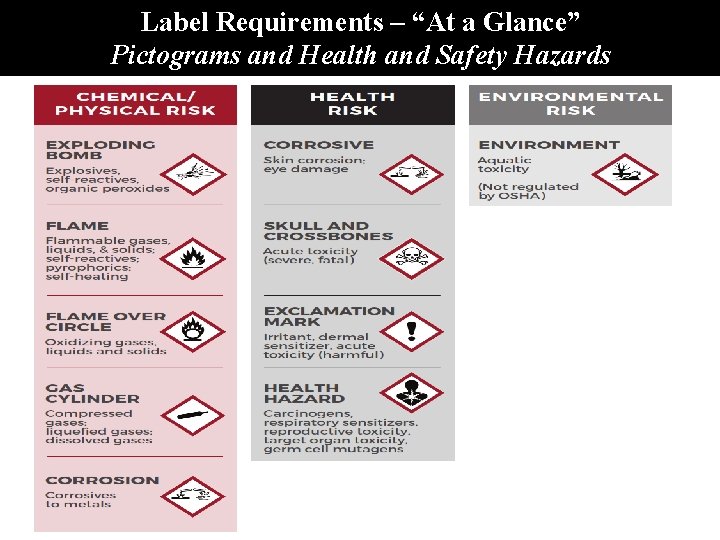
Label Requirements – “At a Glance” Pictograms and Health and Safety Hazards
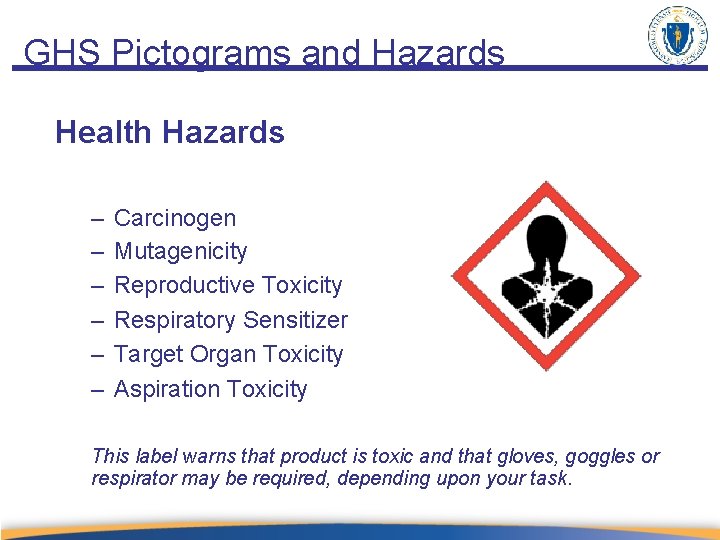
GHS Pictograms and Hazards Health Hazards – – – Carcinogen Mutagenicity Reproductive Toxicity Respiratory Sensitizer Target Organ Toxicity Aspiration Toxicity This label warns that product is toxic and that gloves, goggles or respirator may be required, depending upon your task.
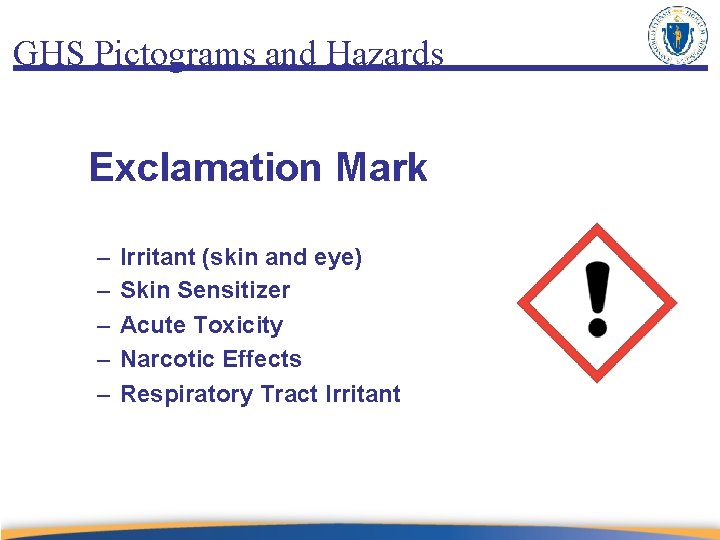
GHS Pictograms and Hazards Exclamation Mark – – – Irritant (skin and eye) Skin Sensitizer Acute Toxicity Narcotic Effects Respiratory Tract Irritant
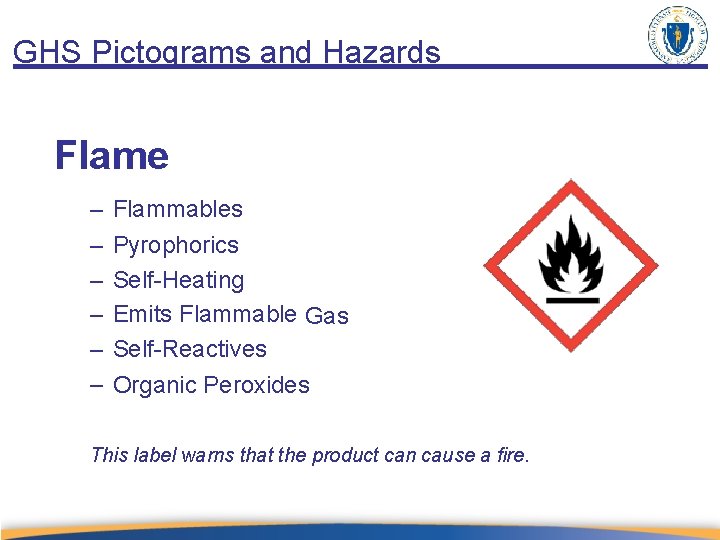
GHS Pictograms and Hazards Flame – Flammables – – – Pyrophorics Self-Heating Emits Flammable Gas Self-Reactives Organic Peroxides This label warns that the product can cause a fire.
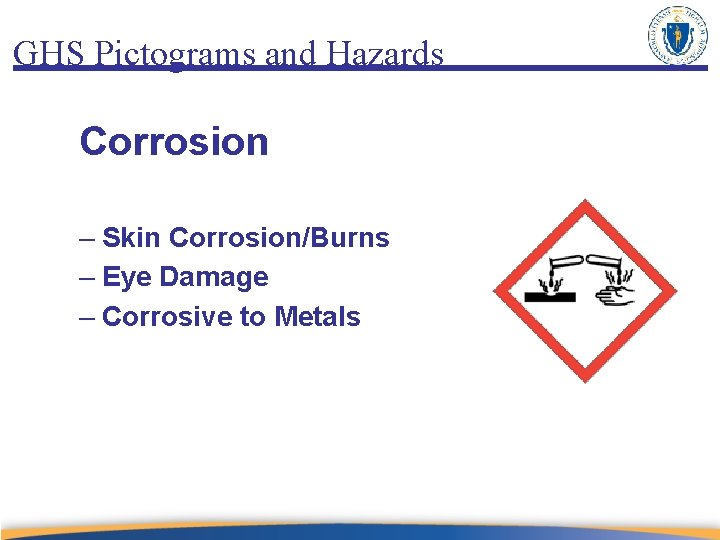
GHS Pictograms and Hazards Corrosion – Skin Corrosion/Burns – Eye Damage – Corrosive to Metals
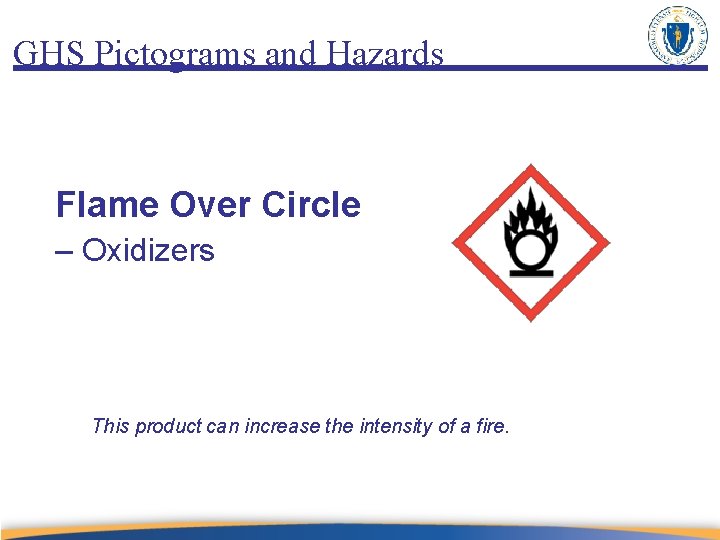
GHS Pictograms and Hazards Flame Over Circle – Oxidizers This product can increase the intensity of a fire.
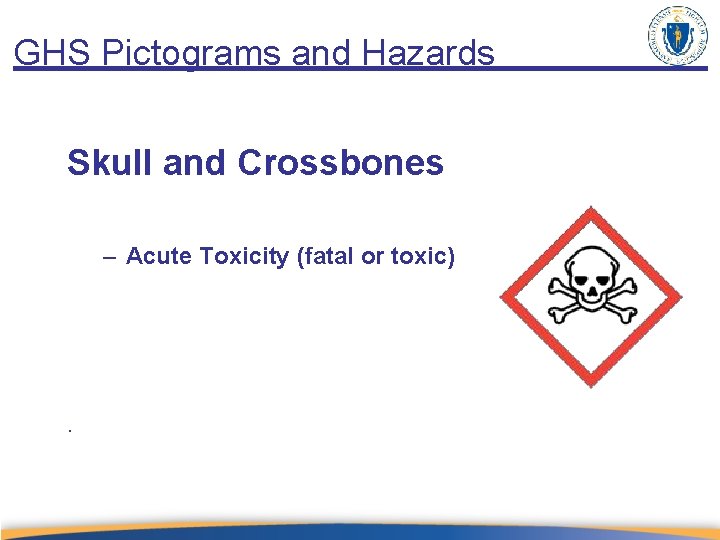
GHS Pictograms and Hazards Skull and Crossbones – Acute Toxicity (fatal or toxic) .
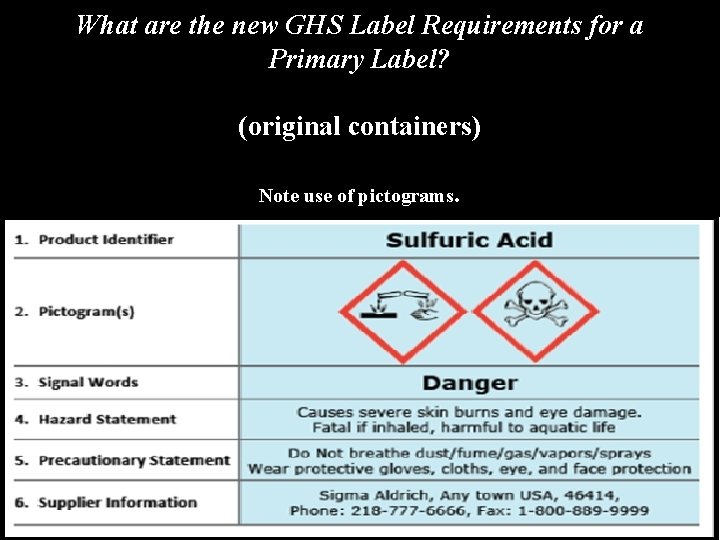
What are the new GHS Label Requirements for a Primary Label? (original containers) Note use of pictograms.
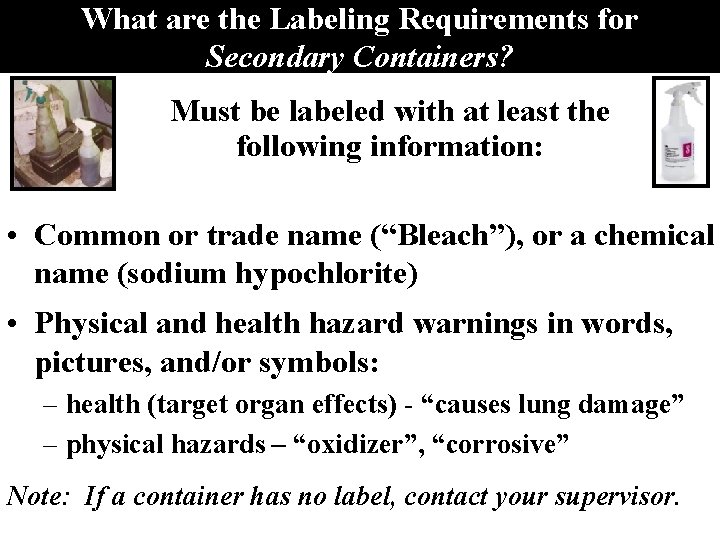
What are the Labeling Requirements for Secondary Containers? Must be labeled with at least the following information: • Common or trade name (“Bleach”), or a chemical name (sodium hypochlorite) • Physical and health hazard warnings in words, pictures, and/or symbols: – health (target organ effects) - “causes lung damage” – physical hazards – “oxidizer”, “corrosive” Note: If a container has no label, contact your supervisor.
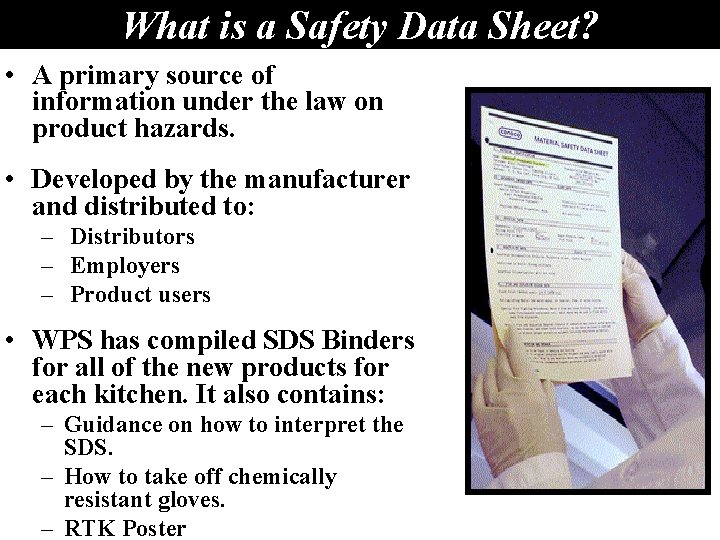
What is a Safety Data Sheet? • A primary source of information under the law on product hazards. • Developed by the manufacturer and distributed to: – Distributors – Employers – Product users • WPS has compiled SDS Binders for all of the new products for each kitchen. It also contains: – Guidance on how to interpret the SDS. – How to take off chemically resistant gloves. – RTK Poster
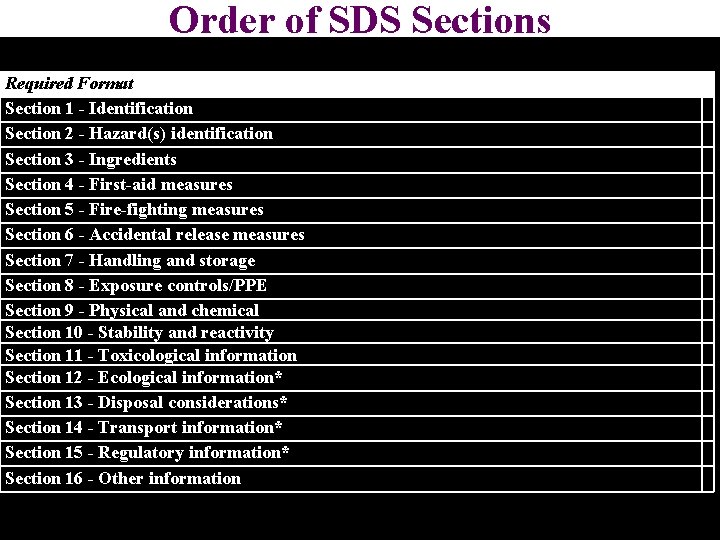
Order of SDS Sections Required Format Section 1 - Identification Section 2 - Hazard(s) identification Section 3 - Ingredients Section 4 - First-aid measures Section 5 - Fire-fighting measures Section 6 - Accidental release measures Section 7 - Handling and storage Section 8 - Exposure controls/PPE Section 9 - Physical and chemical Section 10 - Stability and reactivity Section 11 - Toxicological information Section 12 - Ecological information* Section 13 - Disposal considerations* Section 14 - Transport information* Section 15 - Regulatory information* Section 16 - Other information
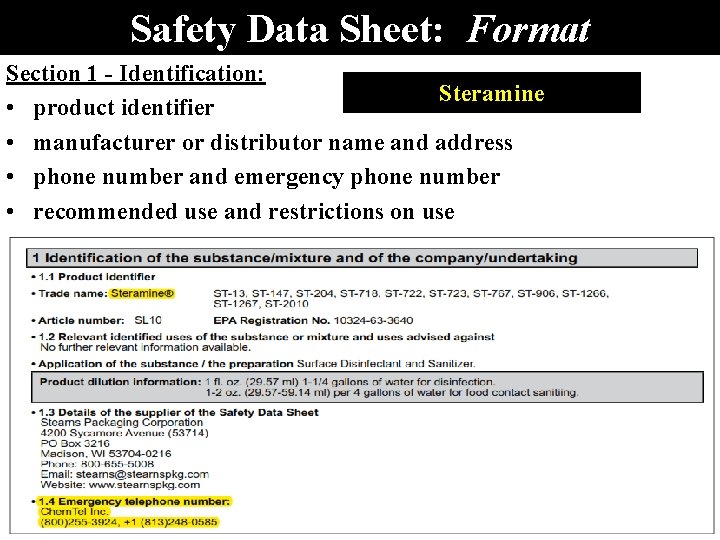
Safety Data Sheet: Format Section 1 - Identification: Steramine • product identifier • manufacturer or distributor name and address • phone number and emergency phone number • recommended use and restrictions on use
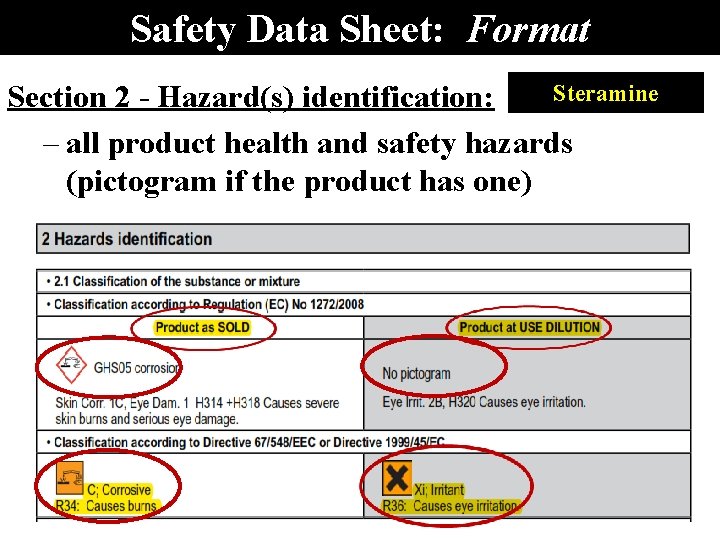
Safety Data Sheet: Format Steramine Section 2 - Hazard(s) identification: – all product health and safety hazards (pictogram if the product has one)
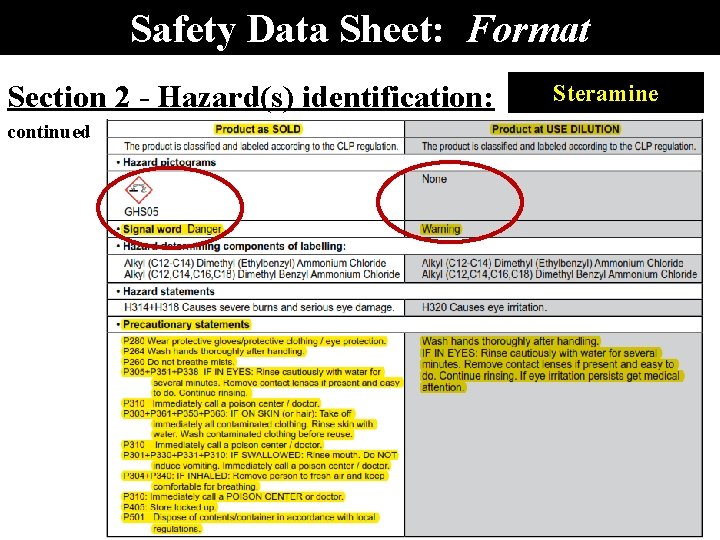
Safety Data Sheet: Format Section 2 - Hazard(s) identification: continued Steramine
Safety Data Sheet: Format Section 2 - Hazard(s) identification: What types of hazards am I looking out for? There are two types of Chemical Hazards: • Health Hazards – can cause injury or illness when you are exposed. • Physical Hazards – can create a fire or explosion when mismanaged.
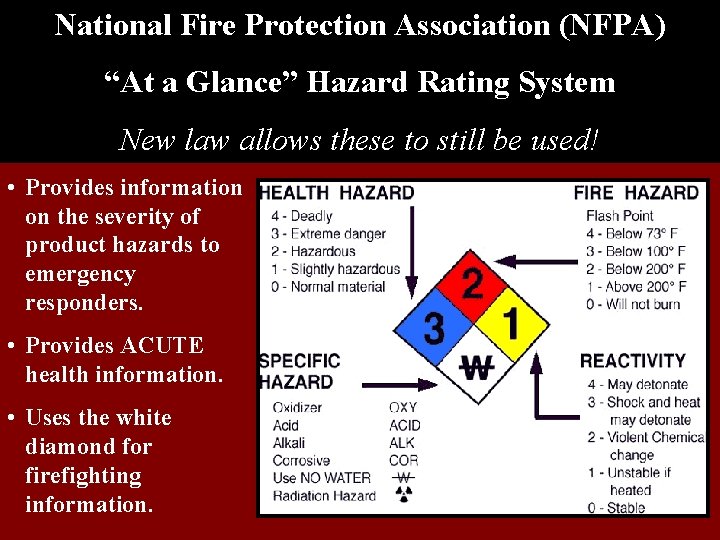
National Fire Protection Association (NFPA) “At a Glance” Hazard Rating System New law allows these to still be used! • Provides information on the severity of product hazards to emergency responders. • Provides ACUTE health information. • Uses the white diamond for firefighting information.
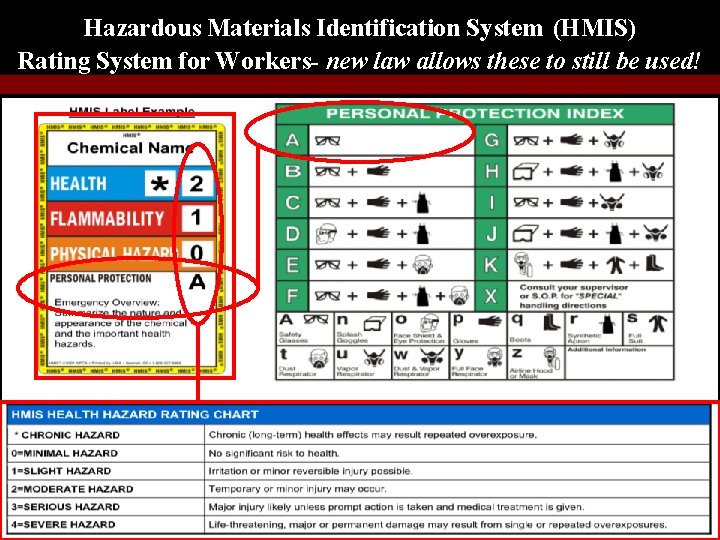
Hazardous Materials Identification System (HMIS) Rating System for Workers- new law allows these to still be used!
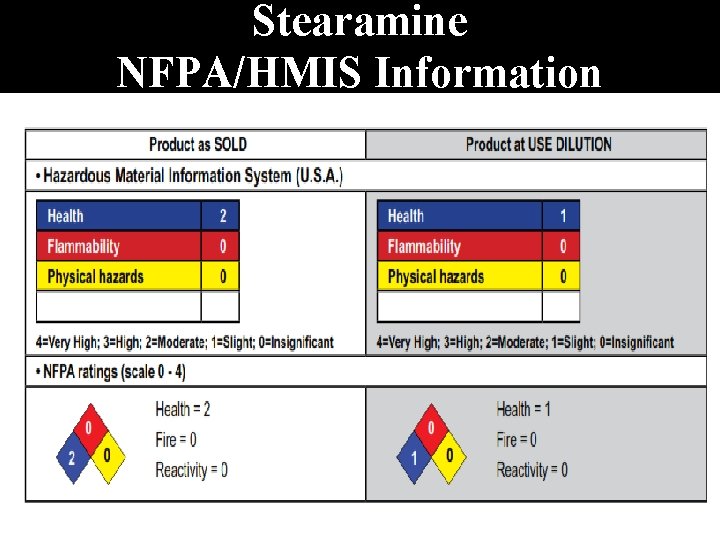
Stearamine NFPA/HMIS Information
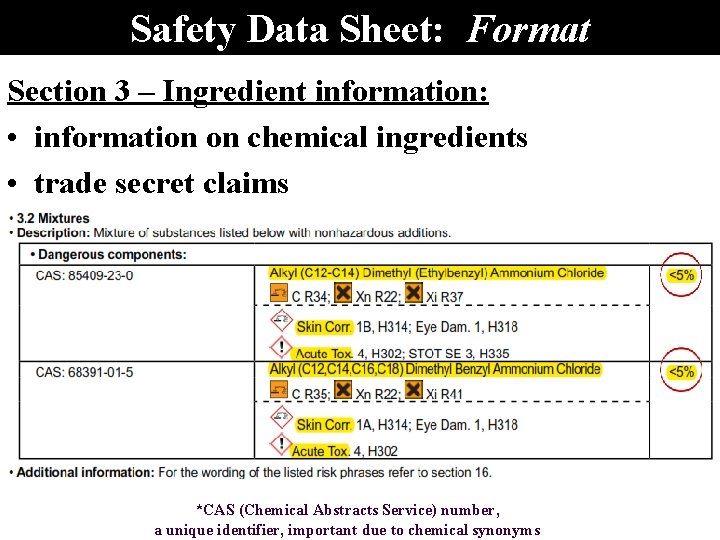
Safety Data Sheet: Format Section 3 – Ingredient information: • information on chemical ingredients • trade secret claims *CAS (Chemical Abstracts Service) number, a unique identifier, important due to chemical synonyms
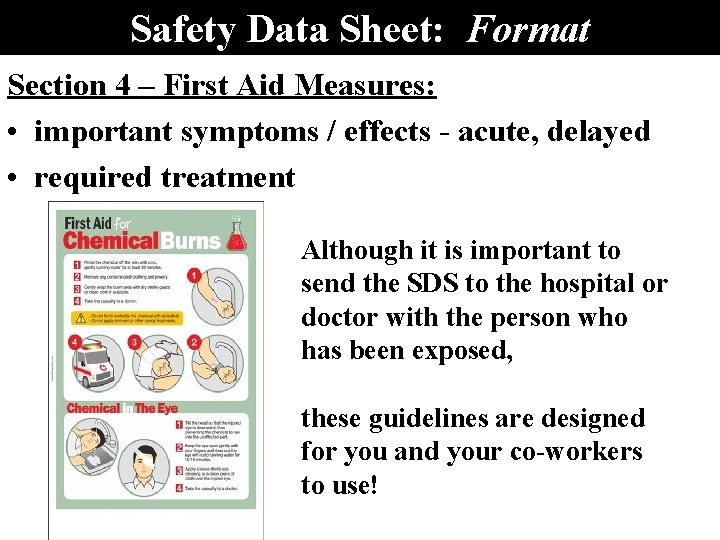
Safety Data Sheet: Format Section 4 – First Aid Measures: • important symptoms / effects - acute, delayed • required treatment Although it is important to send the SDS to the hospital or doctor with the person who has been exposed, these guidelines are designed for you and your co-workers to use!

Safety Data Sheet: Format Section 4 – First Aid Measures: Steramine
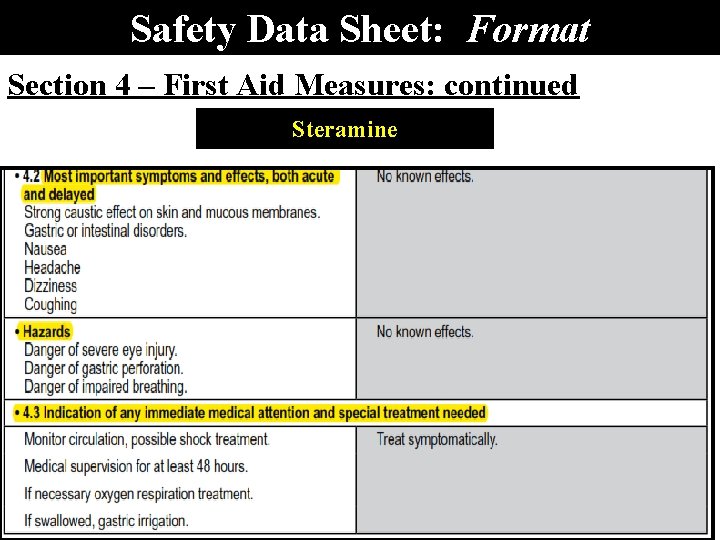
Safety Data Sheet: Format Section 4 – First Aid Measures: continued Steramine
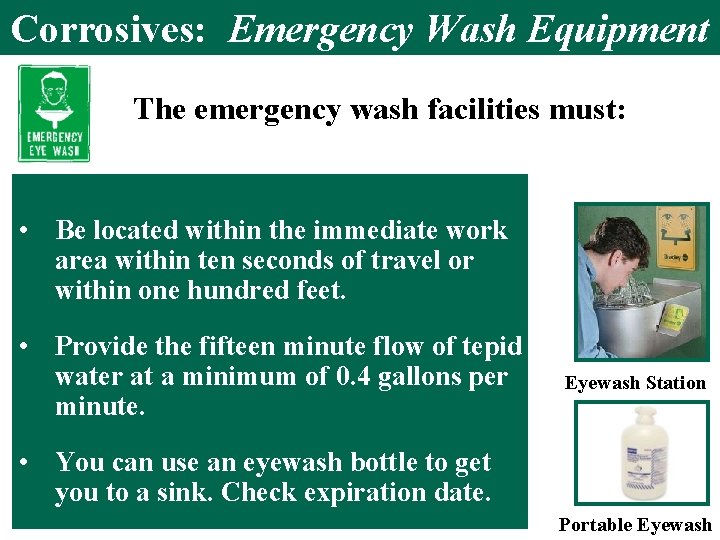
Corrosives: Emergency Wash Equipment The emergency wash facilities must: • Be located within the immediate work area within ten seconds of travel or within one hundred feet. • Provide the fifteen minute flow of tepid water at a minimum of 0. 4 gallons per minute. Eyewash Station • You can use an eyewash bottle to get you to a sink. Check expiration date. Portable Eyewash
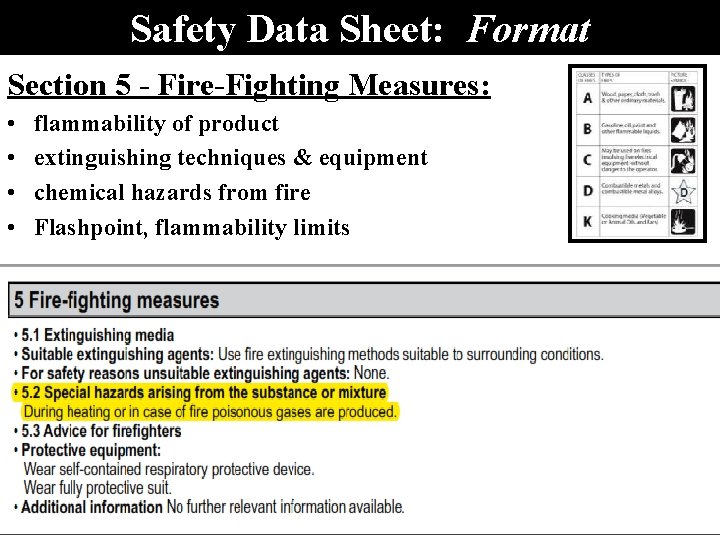
Safety Data Sheet: Format Section 5 - Fire-Fighting Measures: • • flammability of product extinguishing techniques & equipment chemical hazards from fire Flashpoint, flammability limits
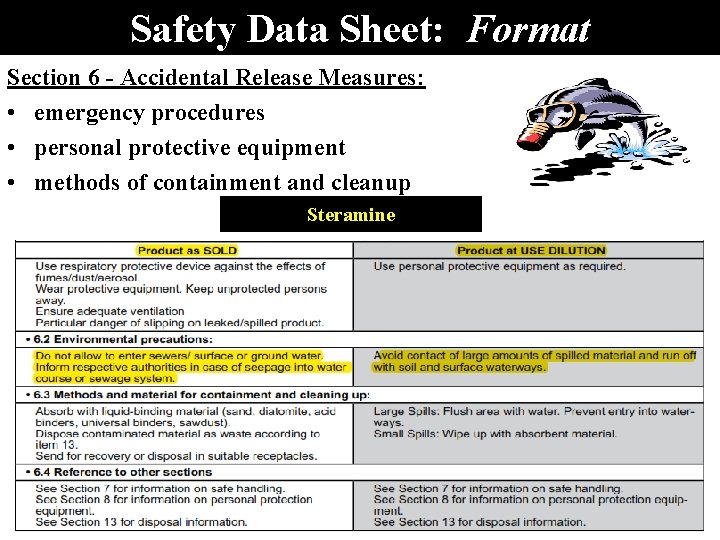
Safety Data Sheet: Format Section 6 - Accidental Release Measures: • emergency procedures • personal protective equipment • methods of containment and cleanup Steramine
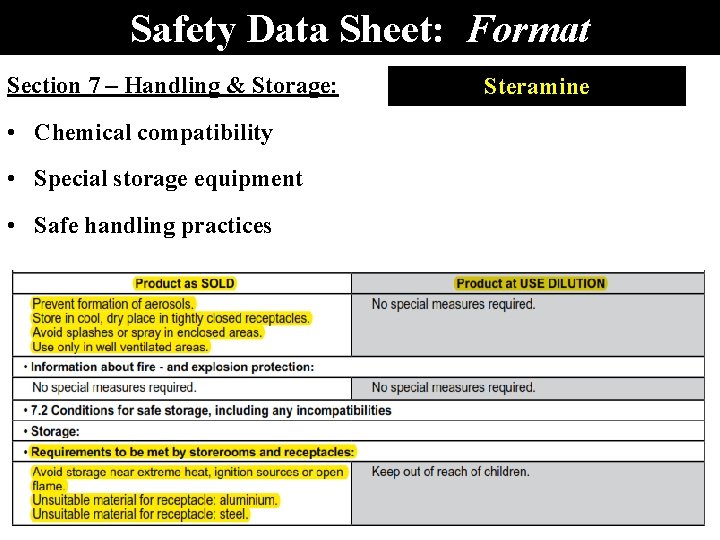
Safety Data Sheet: Format Section 7 – Handling & Storage: • Chemical compatibility • Special storage equipment • Safe handling practices Steramine
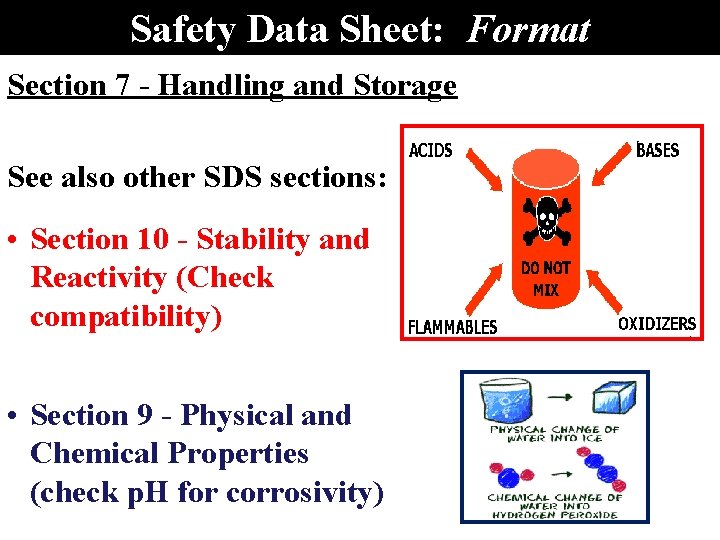
Safety Data Sheet: Format Section 7 - Handling and Storage See also other SDS sections: • Section 10 - Stability and Reactivity (Check compatibility) • Section 9 - Physical and Chemical Properties (check p. H for corrosivity)
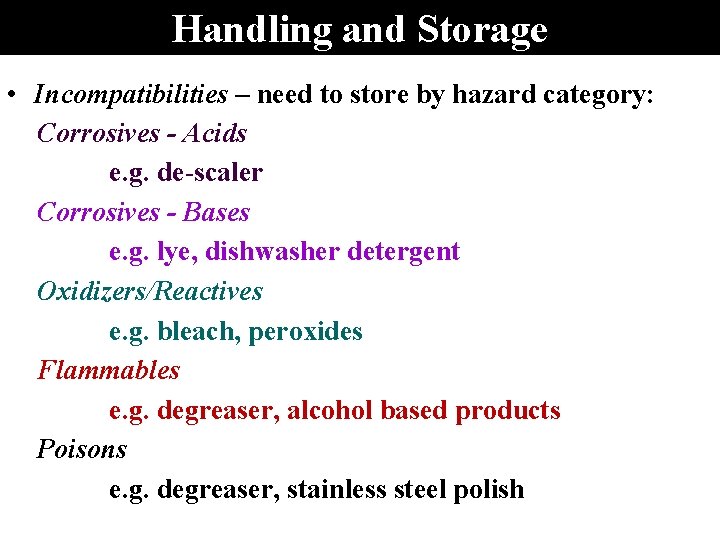
Handling and Storage • Incompatibilities – need to store by hazard category: Corrosives - Acids e. g. de-scaler Corrosives - Bases e. g. lye, dishwasher detergent Oxidizers/Reactives e. g. bleach, peroxides Flammables e. g. degreaser, alcohol based products Poisons e. g. degreaser, stainless steel polish
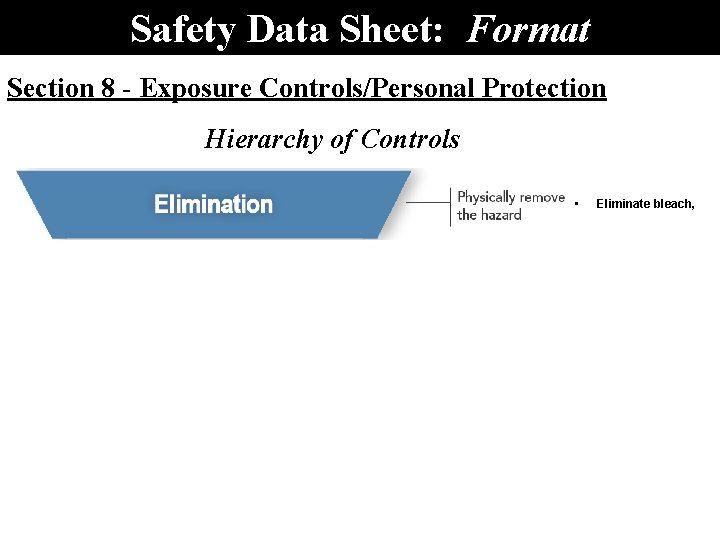
Safety Data Sheet: Format Section 8 - Exposure Controls/Personal Protection Hierarchy of Controls • Eliminate bleach, • Use less hazardous sanitizer, oven cleaner • Use vent on the stove to remove smoke • Dilute products according to directions • Use gloves, goggles, apron, etc.

Safety Data Sheet: Format Section 8 - Exposure Controls/Personal Protection Hierarchy of Controls 1. Engineering Controls (ventilation equipment) 2. Work practices Steramine 3. Personal protective equipment
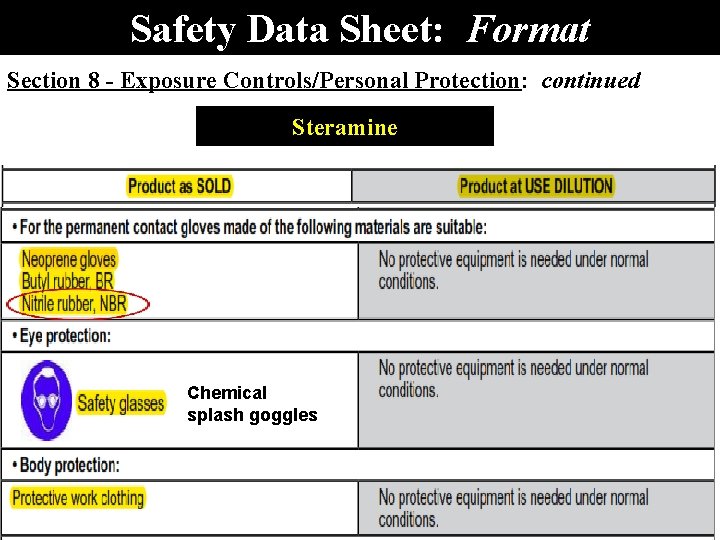
Safety Data Sheet: Format Section 8 - Exposure Controls/Personal Protection: continued Steramine Chemical splash goggles
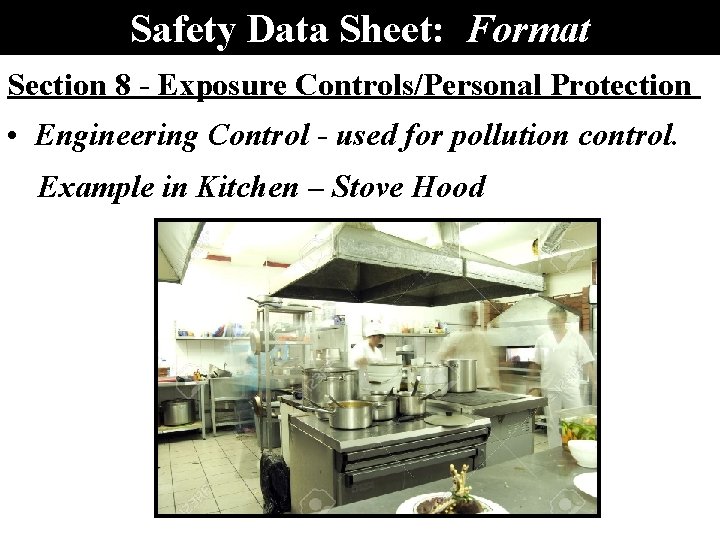
Safety Data Sheet: Format Section 8 - Exposure Controls/Personal Protection • Engineering Control - used for pollution control. Example in Kitchen – Stove Hood
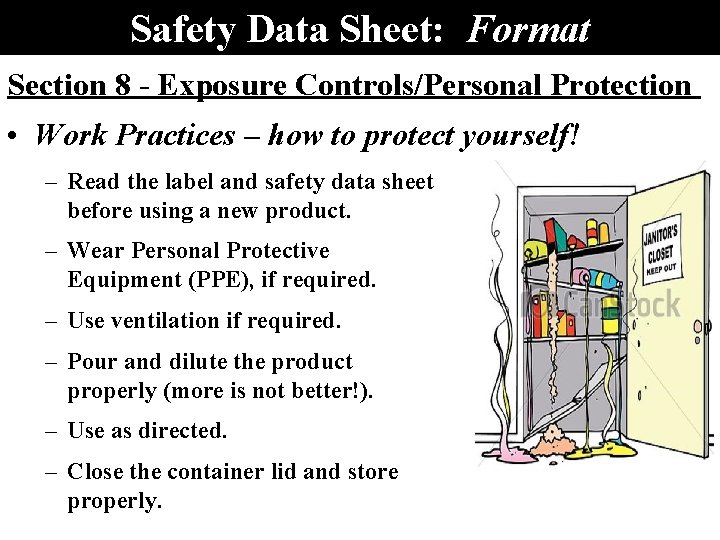
Safety Data Sheet: Format Section 8 - Exposure Controls/Personal Protection • Work Practices – how to protect yourself! – Read the label and safety data sheet before using a new product. – Wear Personal Protective Equipment (PPE), if required. – Use ventilation if required. – Pour and dilute the product properly (more is not better!). – Use as directed. – Close the container lid and store properly.

Safety Data Sheet: Format Section 8 - Exposure Controls/Personal Protection • Personal Protective Equipment (PPE) – Gloves – Booties/Boots – Respiratory protection – Face shields – Aprons/Suits – Goggles/Safety Glasses
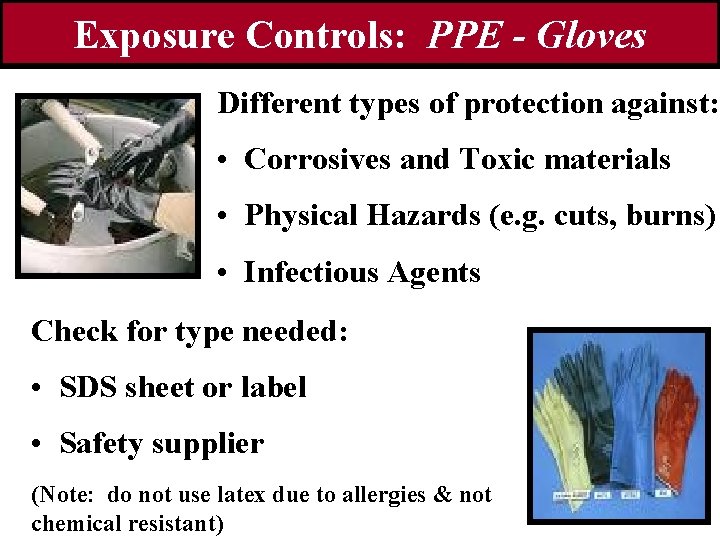
Exposure Controls: PPE - Gloves Different types of protection against: • Corrosives and Toxic materials • Physical Hazards (e. g. cuts, burns) • Infectious Agents Check for type needed: • SDS sheet or label • Safety supplier (Note: do not use latex due to allergies & not chemical resistant)
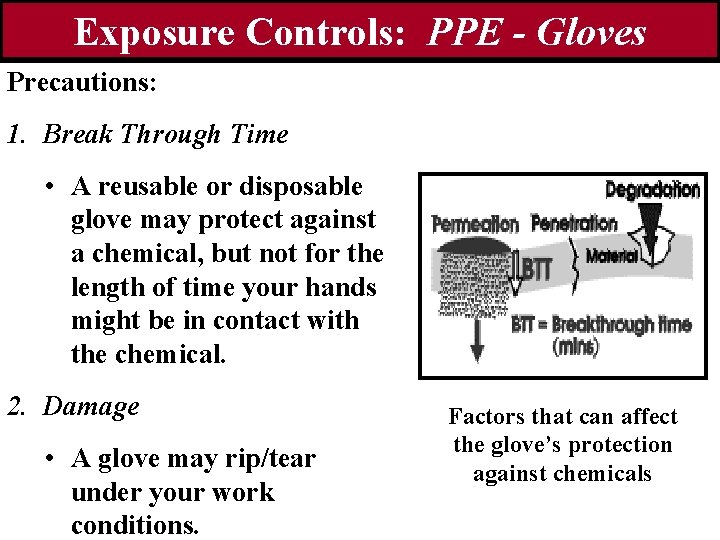
Exposure Controls: PPE - Gloves Precautions: 1. Break Through Time • A reusable or disposable glove may protect against a chemical, but not for the length of time your hands might be in contact with the chemical. 2. Damage • A glove may rip/tear under your work conditions. Factors that can affect the glove’s protection against chemicals
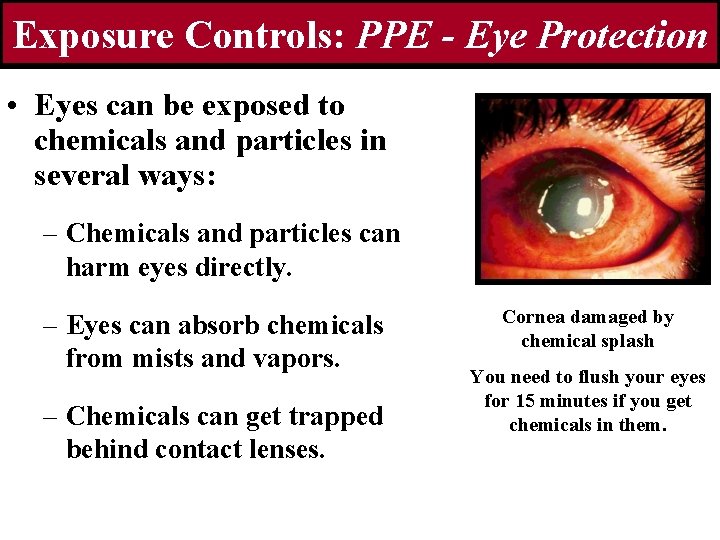
Exposure Controls: PPE - Eye Protection • Eyes can be exposed to chemicals and particles in several ways: – Chemicals and particles can harm eyes directly. – Eyes can absorb chemicals from mists and vapors. – Chemicals can get trapped behind contact lenses. Cornea damaged by chemical splash You need to flush your eyes for 15 minutes if you get chemicals in them.
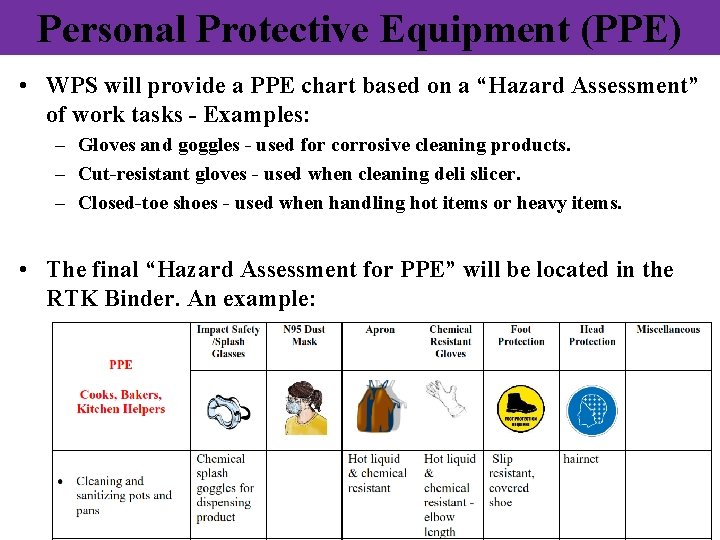
Personal Protective Equipment (PPE) • WPS will provide a PPE chart based on a “Hazard Assessment” of work tasks - Examples: – Gloves and goggles - used for corrosive cleaning products. – Cut-resistant gloves - used when cleaning deli slicer. – Closed-toe shoes - used when handling hot items or heavy items. • The final “Hazard Assessment for PPE” will be located in the RTK Binder. An example:
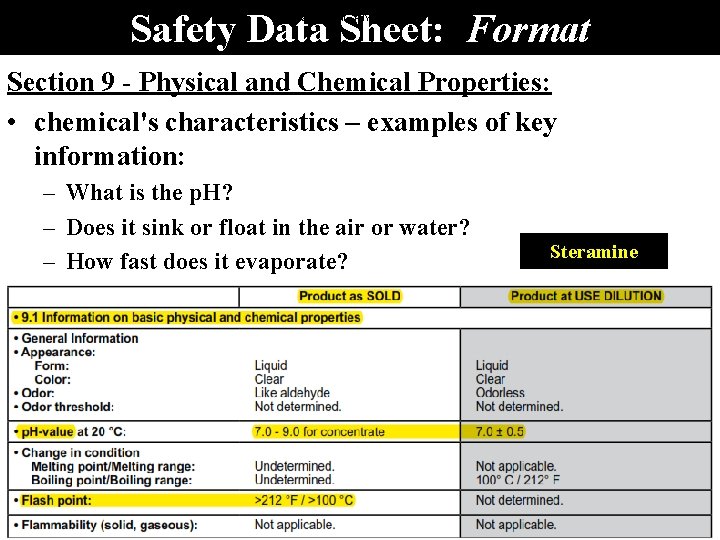
Safety Data Sheet: Format SECTION III – PHYSICAL DATA Section 9 - Physical and Chemical Properties: • chemical's characteristics – examples of key information: – What is the p. H? – Does it sink or float in the air or water? – How fast does it evaporate? Steramine
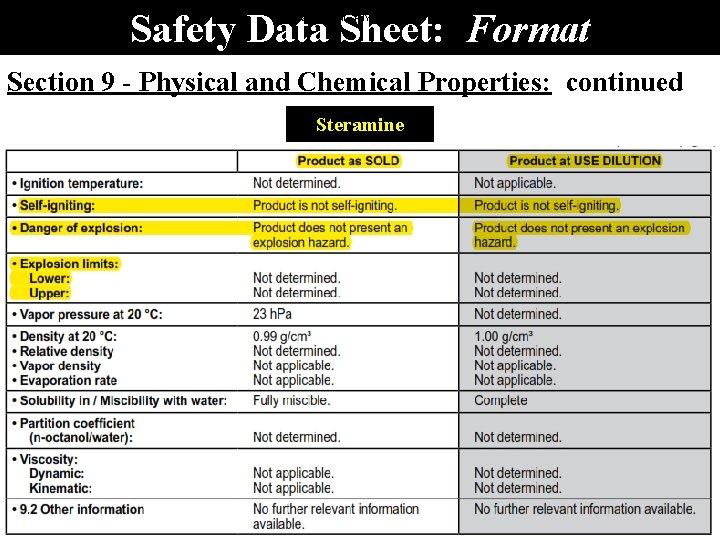
Safety Data Sheet: Format SECTION III – PHYSICAL DATA Section 9 - Physical and Chemical Properties: continued Steramine
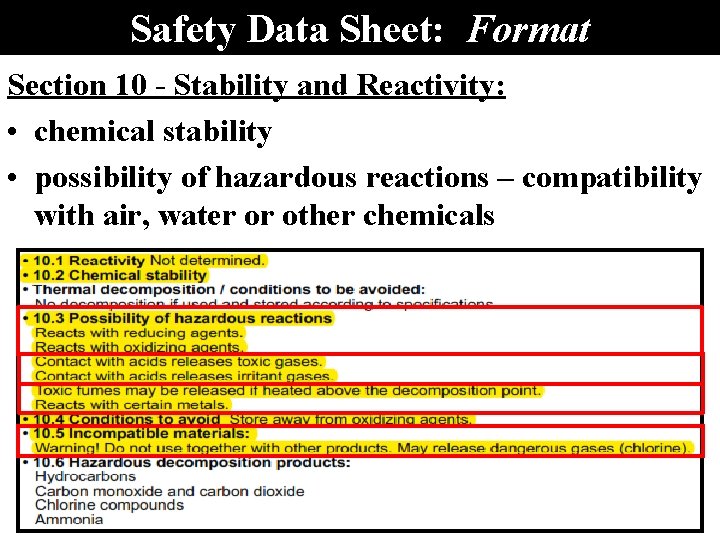
Safety Data Sheet: Format Section 10 - Stability and Reactivity: • chemical stability • possibility of hazardous reactions – compatibility with air, water or other chemicals
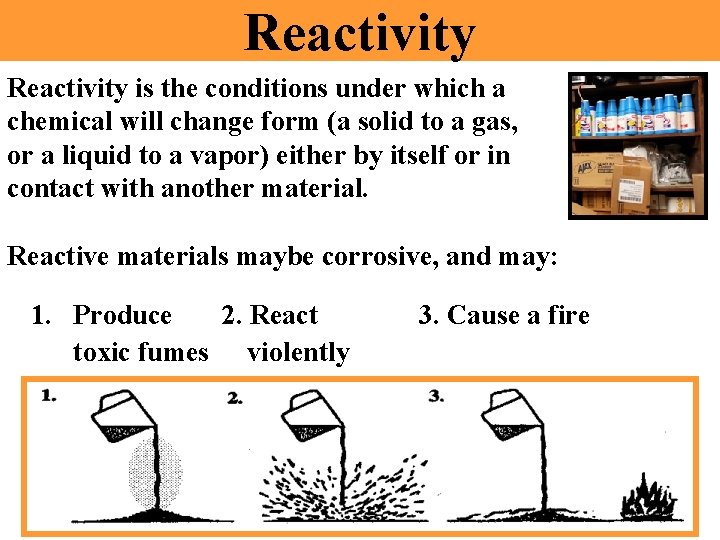
Reactivity is the conditions under which a chemical will change form (a solid to a gas, or a liquid to a vapor) either by itself or in contact with another material. Reactive materials maybe corrosive, and may: 1. Produce 2. React toxic fumes violently 3. Cause a fire
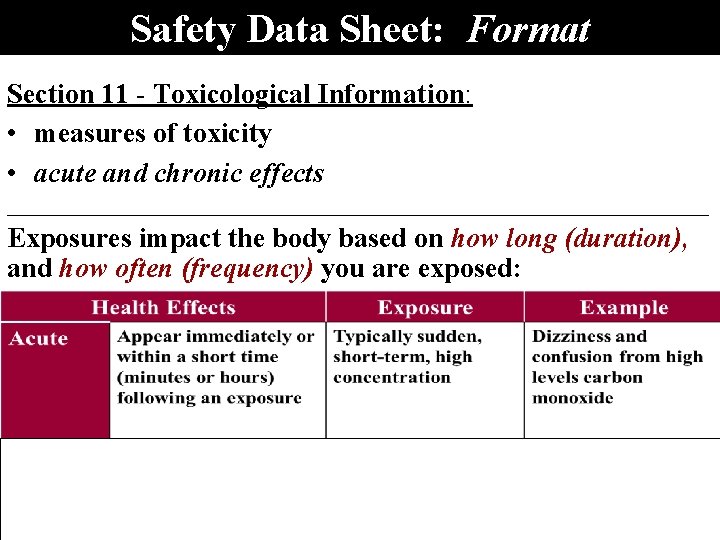
Safety Data Sheet: Format Section 11 - Toxicological Information: • measures of toxicity • acute and chronic effects _______________________________________ Exposures impact the body based on how long (duration), and how often (frequency) you are exposed:
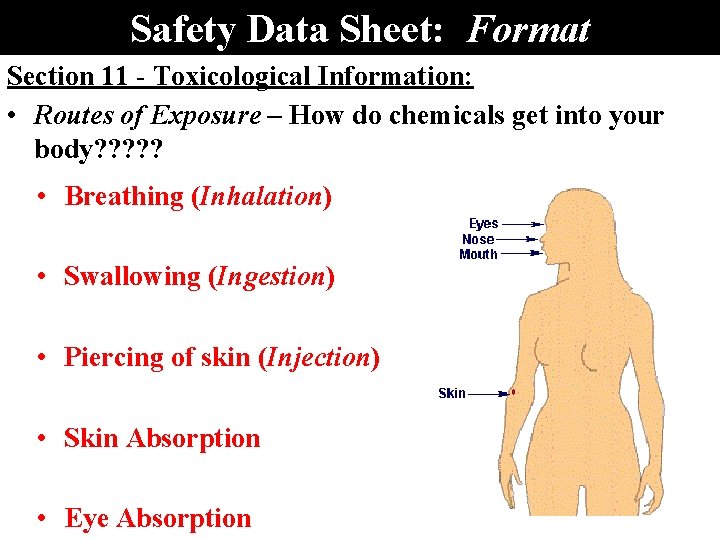
Safety Data Sheet: Format Section 11 - Toxicological Information: • Routes of Exposure – How do chemicals get into your body? ? ? • Breathing (Inhalation) • Swallowing (Ingestion) • Piercing of skin (Injection) • Skin Absorption • Eye Absorption
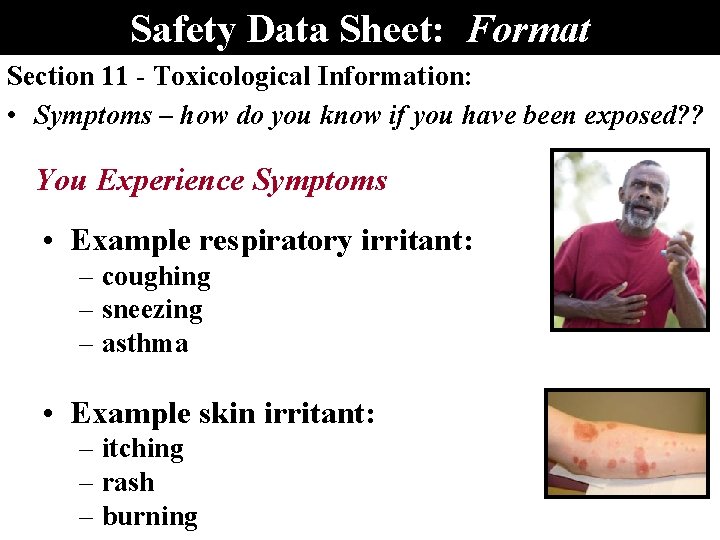
Safety Data Sheet: Format Section 11 - Toxicological Information: • Symptoms – how do you know if you have been exposed? ? You Experience Symptoms • Example respiratory irritant: – coughing – sneezing – asthma • Example skin irritant: – itching – rash – burning
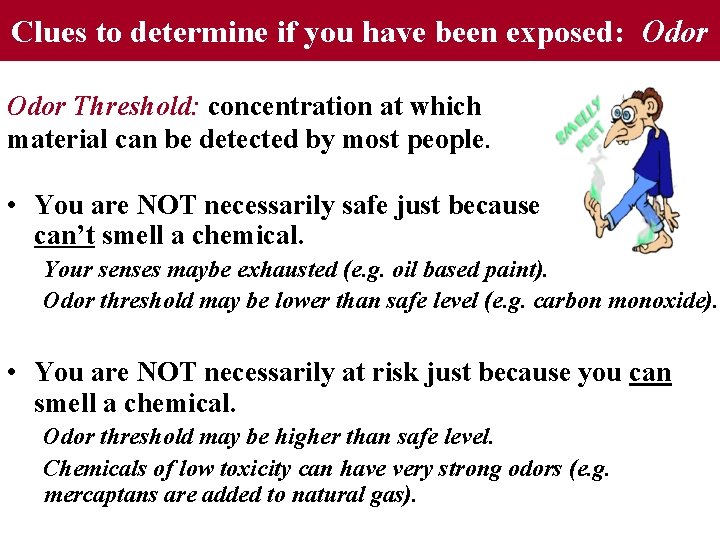
Clues to determine if you have been exposed: Odor Threshold: concentration at which material can be detected by most people. • You are NOT necessarily safe just because you can’t smell a chemical. Your senses maybe exhausted (e. g. oil based paint). Odor threshold may be lower than safe level (e. g. carbon monoxide). • You are NOT necessarily at risk just because you can smell a chemical. Odor threshold may be higher than safe level. Chemicals of low toxicity can have very strong odors (e. g. mercaptans are added to natural gas).
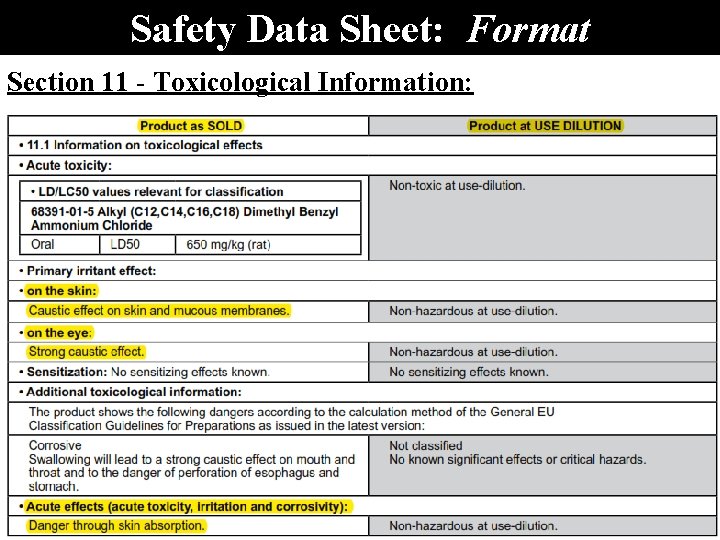
Safety Data Sheet: Format Section 11 - Toxicological Information:
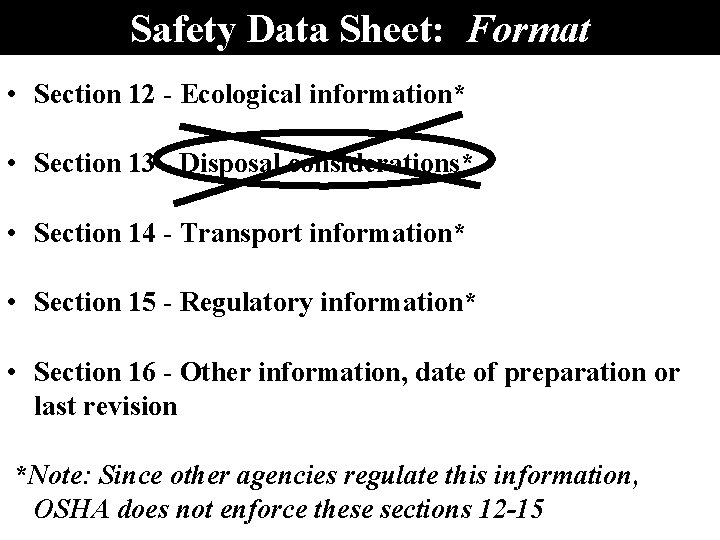
Safety Data Sheet: Format • Section 12 - Ecological information* • Section 13 - Disposal considerations* • Section 14 - Transport information* • Section 15 - Regulatory information* • Section 16 - Other information, date of preparation or last revision *Note: Since other agencies regulate this information, OSHA does not enforce these sections 12 -15
Questions? ? • One last note – Under RTK Law, employees may not bring their own chemical products to the workplace without cooperation of their employer because it would require training, proper labels and Safety Data Sheets.
- Slides: 69