
Massachusetts Institute of Technology Laser Safety Training William
- Slides: 39
Massachusetts Institute of Technology Laser Safety Training William B. Mc. Carthy, Ph. D. Radiation Protection Office
Laser Safety at MIT • Massachusetts State Regulations • ANSI Standard for Laser Use • MIT Radiation Protection Office • MIT Laser Safety Policies • Laser Safety Officer • Laser Safety Liaison for each department
MIT Radiation Protection Office and the Laser Safety Officer • Register laser systems with the State • Register laser workers • Instruct as to laser hazards and safe use of lasers • Perform hazard analysis for all Class 3 b and 4 lasers • Provide safety related information to laser users such as proper eyewear • Coordinate eye exams for laser users
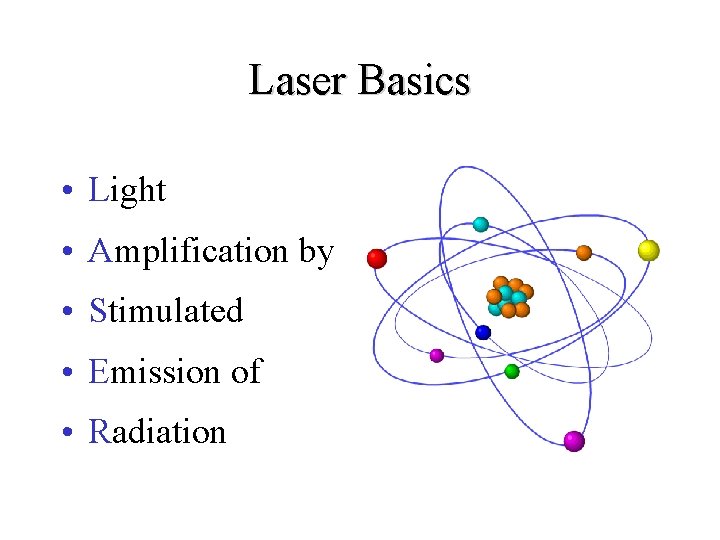
Laser Basics • Light • Amplification by • Stimulated • Emission of • Radiation
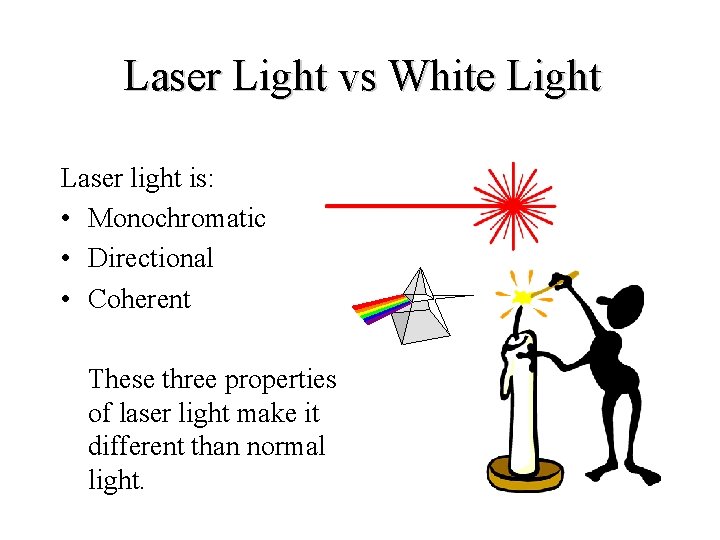
Laser Light vs White Light Laser light is: • Monochromatic • Directional • Coherent These three properties of laser light make it different than normal light.
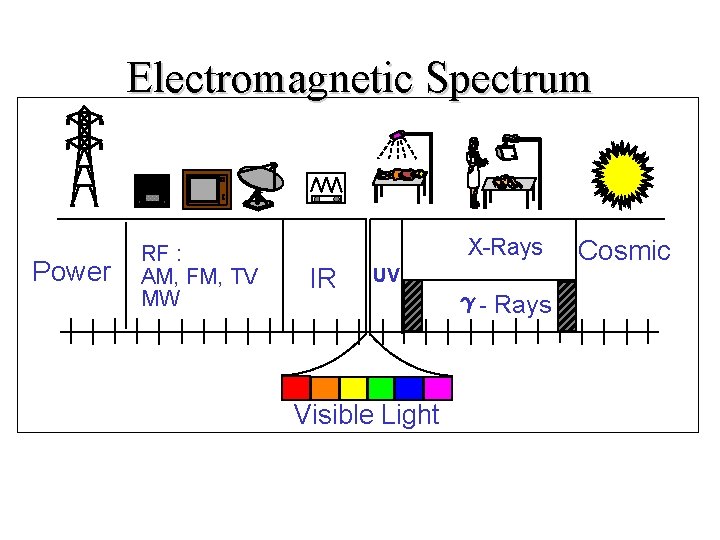
Electromagnetic Spectrum Power RF : AM, FM, TV MW X-Rays IR UV Visible Light - Rays Cosmic
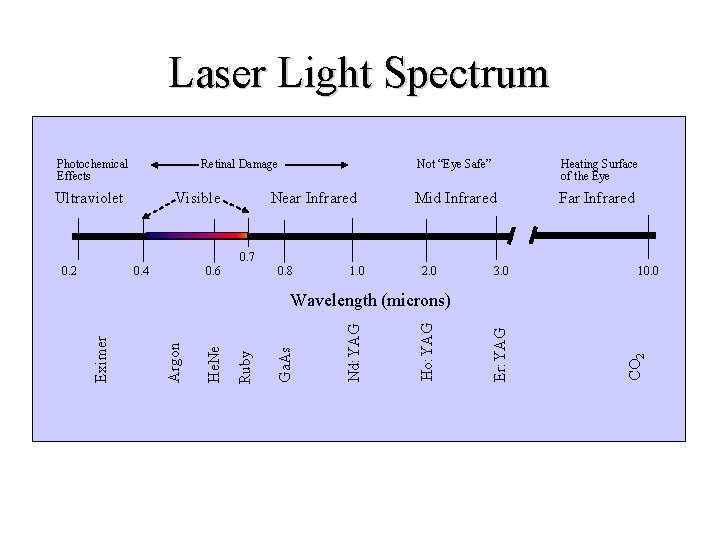
Laser Light Spectrum Photochemical Effects Retinal Damage Ultraviolet Visible Near Infrared Not “Eye Safe” Heating Surface of the Eye Mid Infrared Far Infrared 0. 7 0. 2 0. 4 0. 6 0. 8 1. 0 2. 0 3. 0 10. 0 CO 2 Er: YAG Ho: YAG Nd: YAG Ga. As Ruby He. Ne Argon Eximer Wavelength (microns)
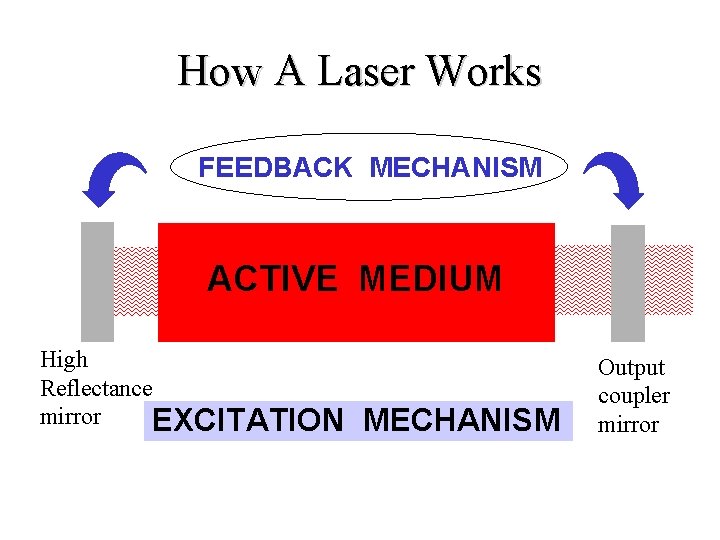
How A Laser Works FEEDBACK MECHANISM ACTIVE MEDIUM High Reflectance mirror EXCITATION MECHANISM Output coupler mirror
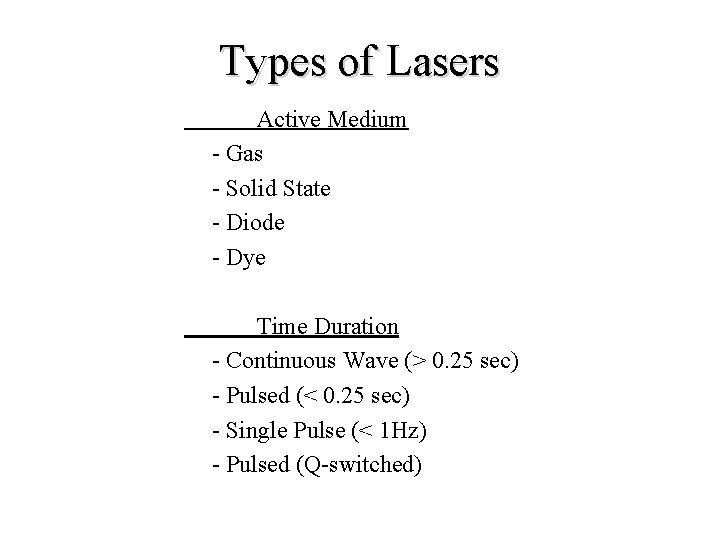
Types of Lasers Active Medium - Gas - Solid State - Diode - Dye Time Duration - Continuous Wave (> 0. 25 sec) - Pulsed (< 0. 25 sec) - Single Pulse (< 1 Hz) - Pulsed (Q-switched)
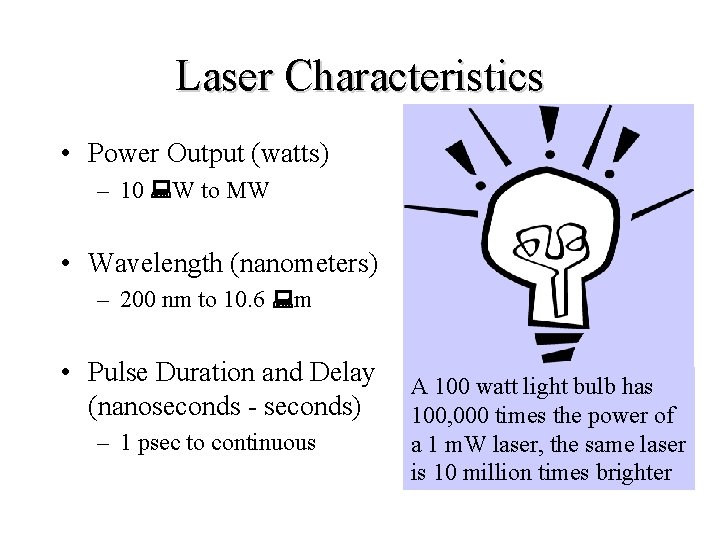
Laser Characteristics • Power Output (watts) – 10 W to MW • Wavelength (nanometers) – 200 nm to 10. 6 m • Pulse Duration and Delay (nanoseconds - seconds) – 1 psec to continuous A 100 watt light bulb has 100, 000 times the power of a 1 m. W laser, the same laser is 10 million times brighter
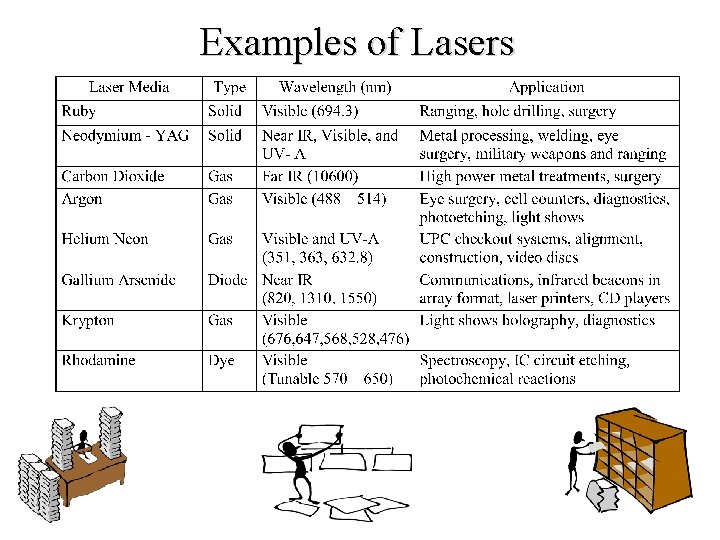
Examples of Lasers
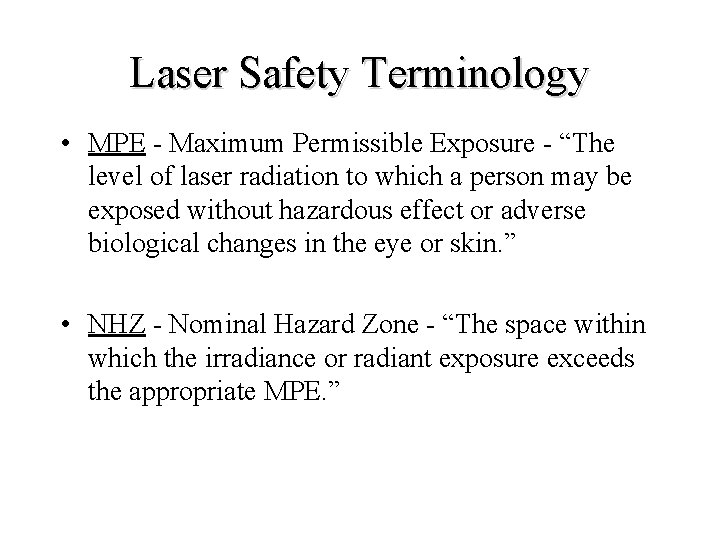
Laser Safety Terminology • MPE - Maximum Permissible Exposure - “The level of laser radiation to which a person may be exposed without hazardous effect or adverse biological changes in the eye or skin. ” • NHZ - Nominal Hazard Zone - “The space within which the irradiance or radiant exposure exceeds the appropriate MPE. ”
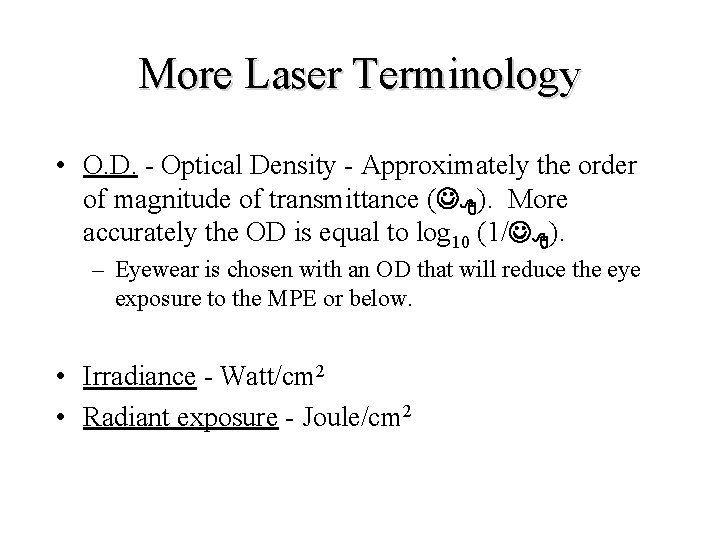
More Laser Terminology • O. D. - Optical Density - Approximately the order of magnitude of transmittance ( ). More accurately the OD is equal to log 10 (1/ ). – Eyewear is chosen with an OD that will reduce the eye exposure to the MPE or below. • Irradiance - Watt/cm 2 • Radiant exposure - Joule/cm 2
Laser Hazards laser safety is no joke
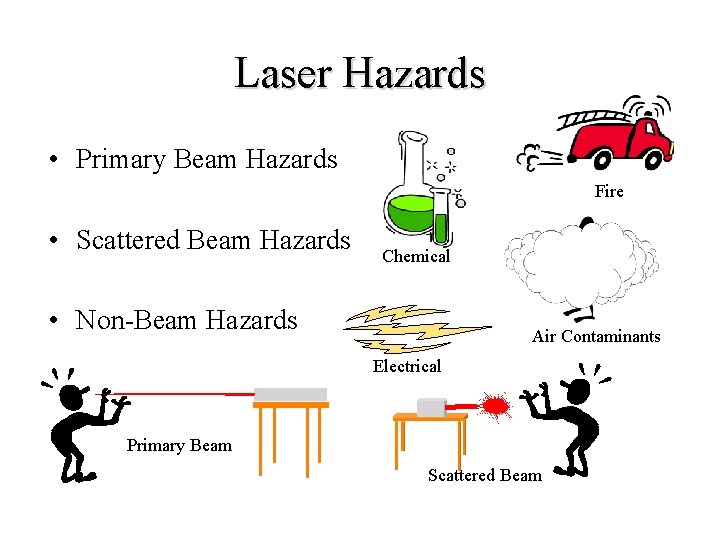
Laser Hazards • Primary Beam Hazards Fire • Scattered Beam Hazards Chemical • Non-Beam Hazards Air Contaminants Electrical Primary Beam Scattered Beam
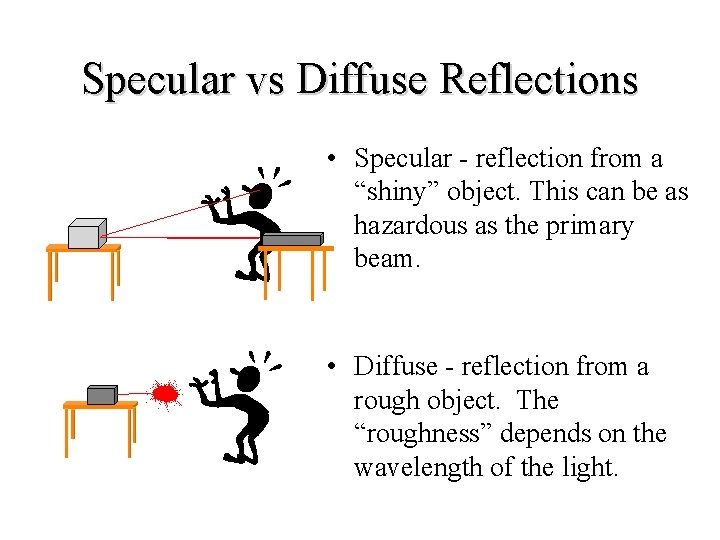
Specular vs Diffuse Reflections • Specular - reflection from a “shiny” object. This can be as hazardous as the primary beam. • Diffuse - reflection from a rough object. The “roughness” depends on the wavelength of the light.
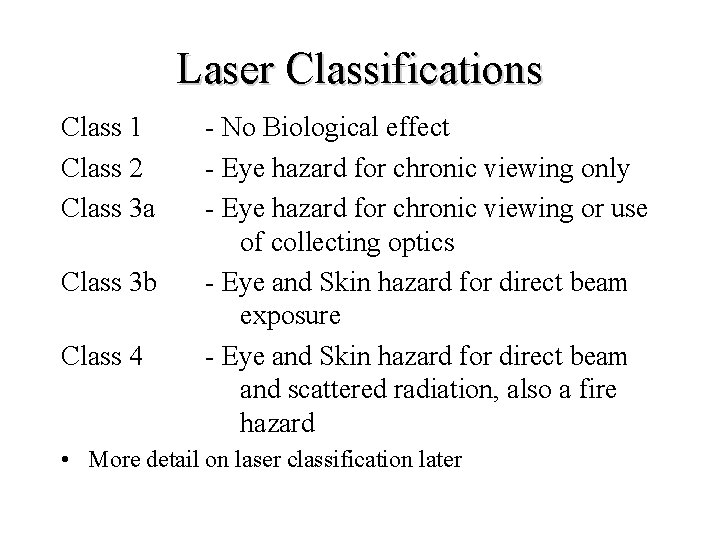
Laser Classifications Class 1 Class 2 Class 3 a Class 3 b Class 4 - No Biological effect - Eye hazard for chronic viewing only - Eye hazard for chronic viewing or use of collecting optics - Eye and Skin hazard for direct beam exposure - Eye and Skin hazard for direct beam and scattered radiation, also a fire hazard • More detail on laser classification later
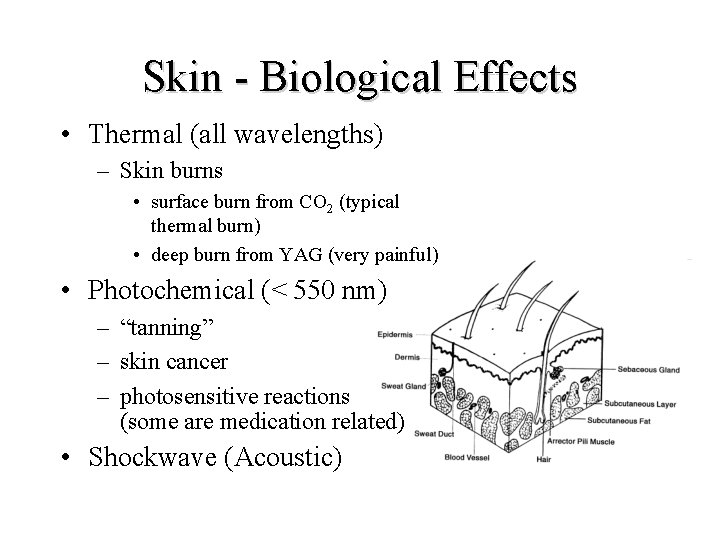
Skin - Biological Effects • Thermal (all wavelengths) – Skin burns • surface burn from CO 2 (typical thermal burn) • deep burn from YAG (very painful) • Photochemical (< 550 nm) – “tanning” – skin cancer – photosensitive reactions (some are medication related) • Shockwave (Acoustic)
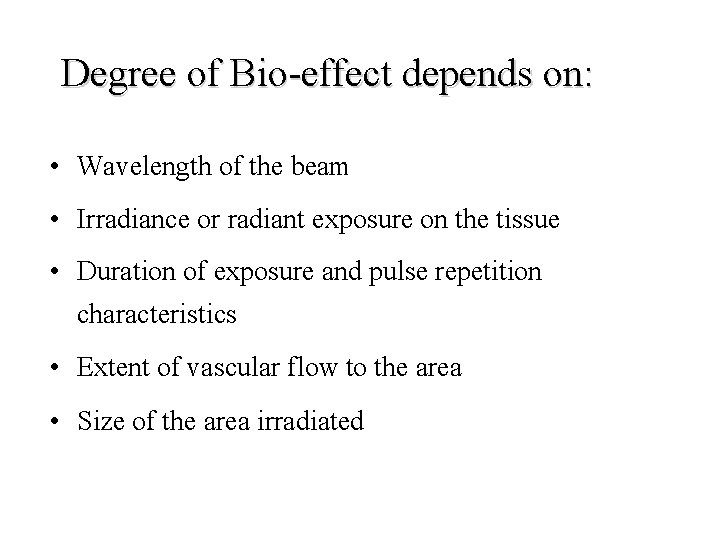
Degree of Bio-effect depends on: • Wavelength of the beam • Irradiance or radiant exposure on the tissue • Duration of exposure and pulse repetition characteristics • Extent of vascular flow to the area • Size of the area irradiated
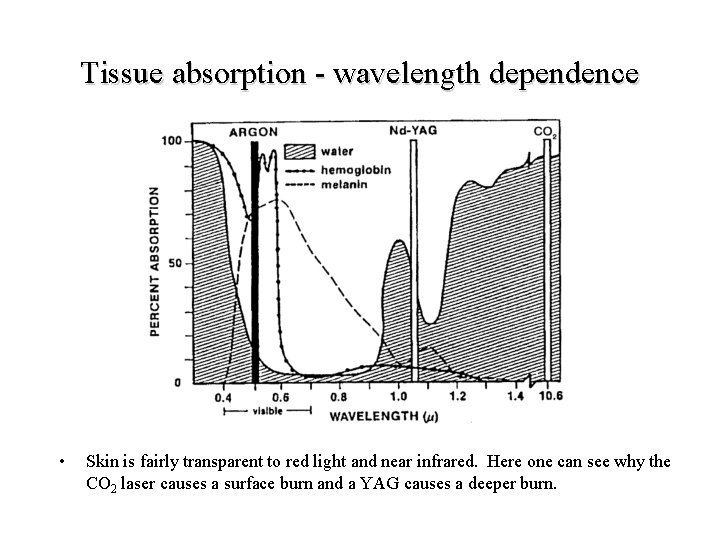
Tissue absorption - wavelength dependence • Skin is fairly transparent to red light and near infrared. Here one can see why the CO 2 laser causes a surface burn and a YAG causes a deeper burn.
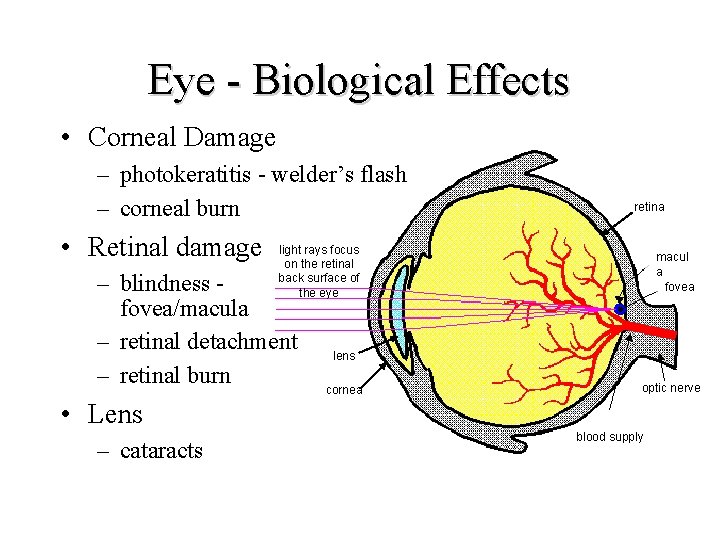
Eye - Biological Effects • Corneal Damage – photokeratitis - welder’s flash – corneal burn • Retinal damage retina light rays focus on the retinal back surface of the eye – blindness fovea/macula – retinal detachment – retinal burn macul a fovea lens cornea optic nerve • Lens – cataracts blood supply
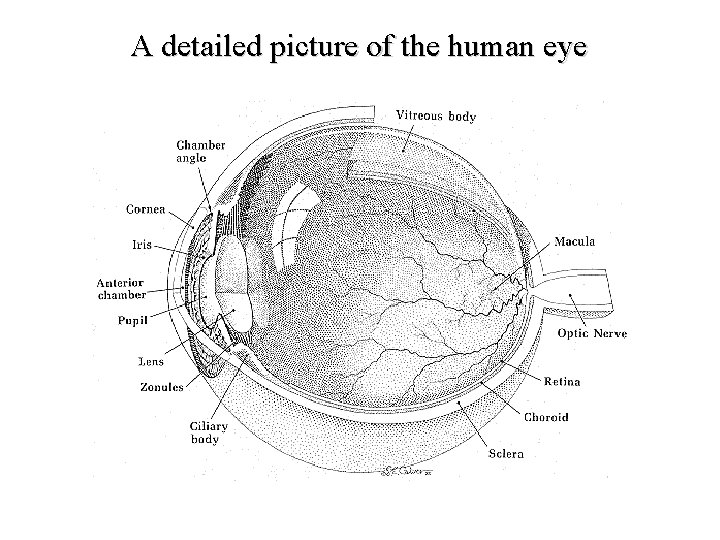
A detailed picture of the human eye
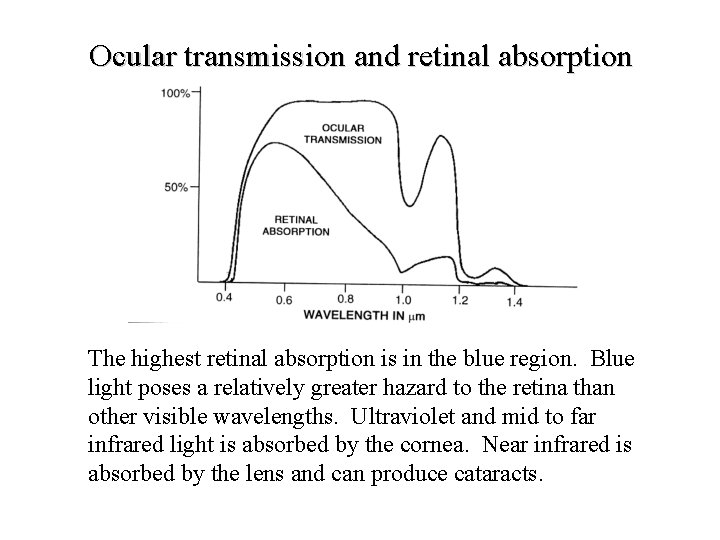
Ocular transmission and retinal absorption The highest retinal absorption is in the blue region. Blue light poses a relatively greater hazard to the retina than other visible wavelengths. Ultraviolet and mid to far infrared light is absorbed by the cornea. Near infrared is absorbed by the lens and can produce cataracts.
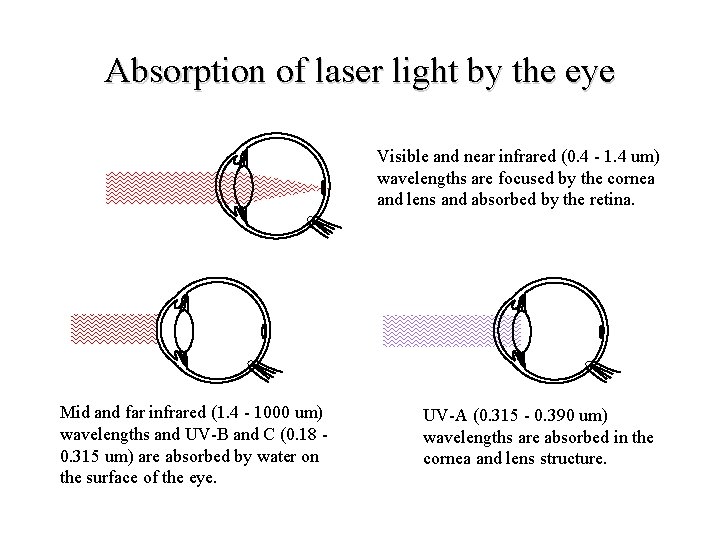
Absorption of laser light by the eye Visible and near infrared (0. 4 - 1. 4 um) wavelengths are focused by the cornea and lens and absorbed by the retina. Mid and far infrared (1. 4 - 1000 um) wavelengths and UV-B and C (0. 18 0. 315 um) are absorbed by water on the surface of the eye. UV-A (0. 315 - 0. 390 um) wavelengths are absorbed in the cornea and lens structure.
Laser Eye Exam • Eye exams are required of all personnel directly involved with the use of Class 3 b and 4 lasers. The eye exam is done by the MIT Medical Department. • • Baseline Incident Periodic Termination
A Multiple Choice Question How Do You Avoid Laser Eye Injuries? a) Always keep your eyes closed when working with lasers or b) Wear the proper eyewear for your laser system
Laser Eyewear • Laser eyewear should be readily available and worn whenever a hazardous condition exists. • RPO recommends and approves the appropriate protective eyewear. • Eyewear should let as much visible light through while still blocking the laser light. • Special Alignment eyewear should be used during alignments. • Also, eyewear should fit comfortably.
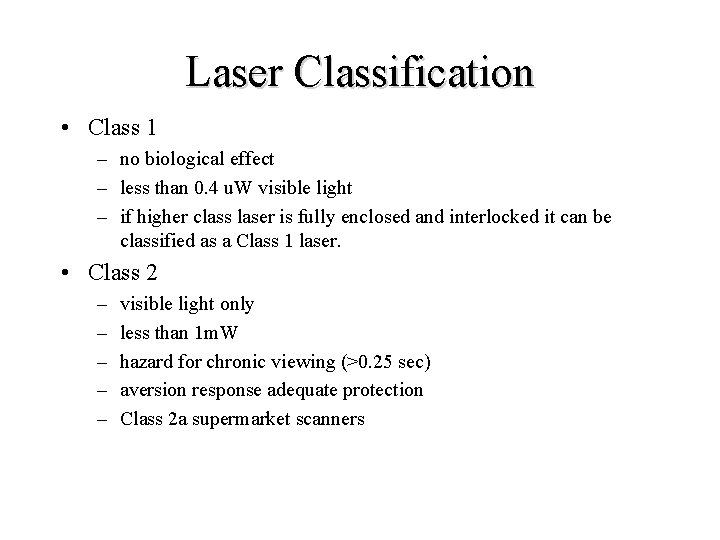
Laser Classification • Class 1 – no biological effect – less than 0. 4 u. W visible light – if higher class laser is fully enclosed and interlocked it can be classified as a Class 1 laser. • Class 2 – – – visible light only less than 1 m. W hazard for chronic viewing (>0. 25 sec) aversion response adequate protection Class 2 a supermarket scanners
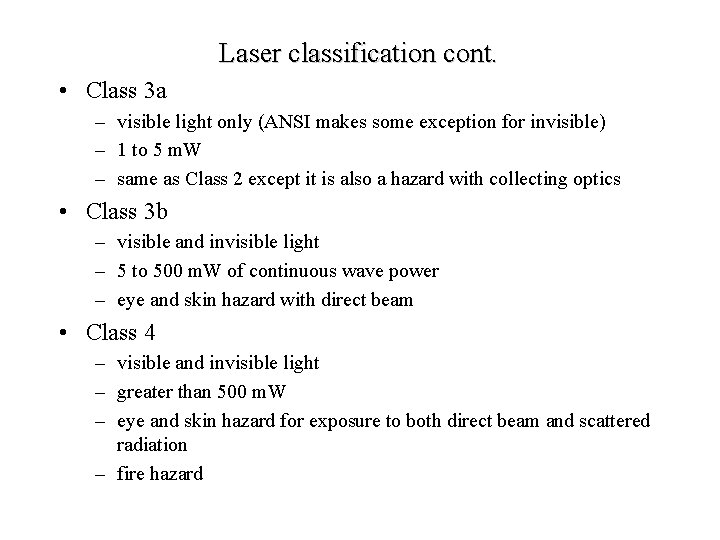
Laser classification cont. • Class 3 a – visible light only (ANSI makes some exception for invisible) – 1 to 5 m. W – same as Class 2 except it is also a hazard with collecting optics • Class 3 b – visible and invisible light – 5 to 500 m. W of continuous wave power – eye and skin hazard with direct beam • Class 4 – visible and invisible light – greater than 500 m. W – eye and skin hazard for exposure to both direct beam and scattered radiation – fire hazard
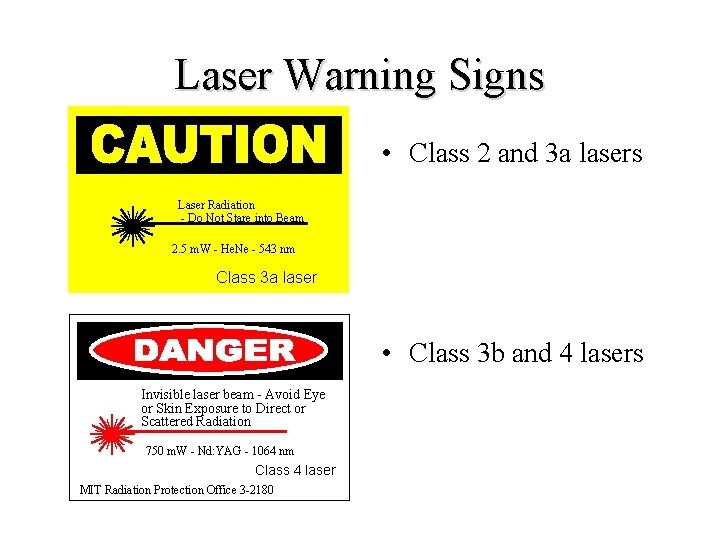
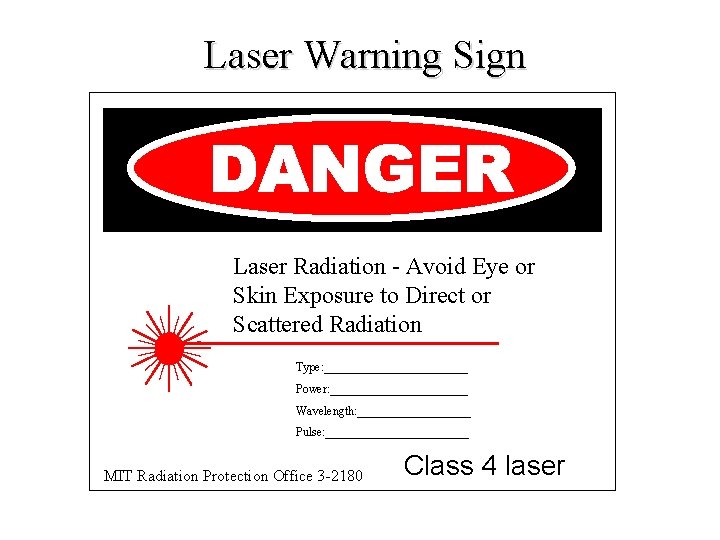
Laser Warning Signs • Class 2 and 3 a lasers Laser Radiation - Do Not Stare into Beam 2. 5 m. W - He. Ne - 543 nm Class 3 a laser • Class 3 b and 4 lasers Invisible laser beam - Avoid Eye or Skin Exposure to Direct or Scattered Radiation 750 m. W - Nd: YAG - 1064 nm Class 4 laser MIT Radiation Protection Office 3 -2180
Laser Safety Controls • Engineering Controls • Administrative Controls • Procedural Controls • Use appropriate controls
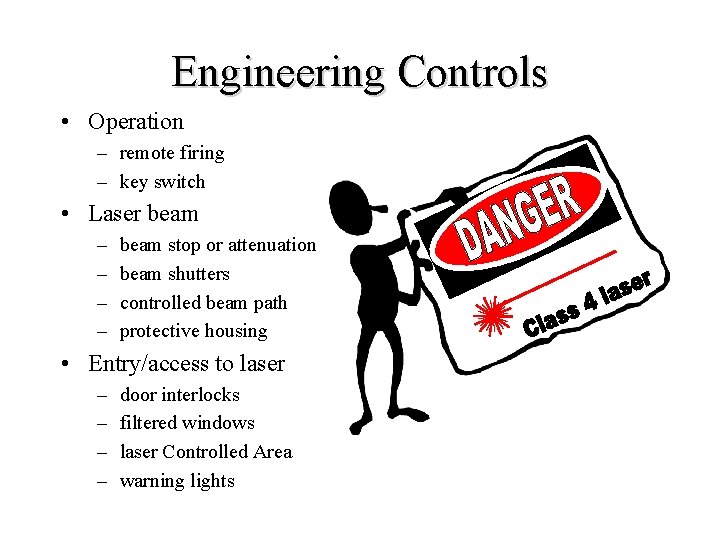
Engineering Controls • Operation – remote firing – key switch • Laser beam – – beam stop or attenuation beam shutters controlled beam path protective housing • Entry/access to laser – – door interlocks filtered windows laser Controlled Area warning lights
Administrative Controls • Standard operating procedures – startup - shutdown - specific operations - emergencies • Administrative procedures – limitations on use of laser according to classification • training: Class 3 b and 4 lasers must be operated by experienced and trained operators. Spectators are subject to entry requirements • operating manuals • eyewear labeling • Laser warning signs
Using Appropriate Controls • Class 1 - No warning signs are required • Class 2 - Caution signs/labels are required • Class 3 a - Warning (Caution or Danger) signs/labels are required, eyewear required if laser beam can not be controlled
Appropriate controls cont. • Class 3 b - Danger signs/labels, beam path control, and protective eyewear required, plus the following are recommended: – – – – protective housing key switch area interlocks beam stops/attenuators activation warning system Class 3 b laser controlled area establish Nominal Hazard Zone (NHZ)
Appropriate controls cont. • Class 4 - Those items recommended for Class 3 b are required for Class 4 lasers. The following are recommended: – – – – supervised by an individual knowledgeable in laser safety require approved entry for all non-involved personnel use diffusely reflecting materials near the beam light tight room remote firing or remote viewing beam stops made of fire resistant materials CPR training (strongly recommended)
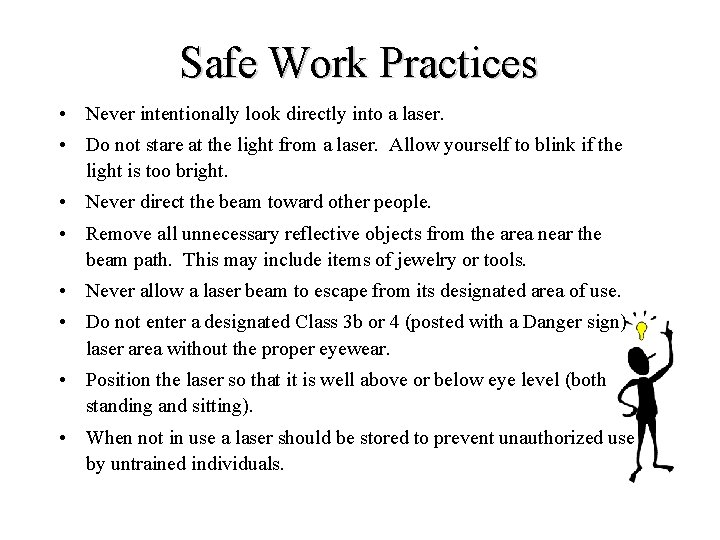
Safe Work Practices • Never intentionally look directly into a laser. • Do not stare at the light from a laser. Allow yourself to blink if the light is too bright. • Never direct the beam toward other people. • Remove all unnecessary reflective objects from the area near the beam path. This may include items of jewelry or tools. • Never allow a laser beam to escape from its designated area of use. • Do not enter a designated Class 3 b or 4 (posted with a Danger sign) laser area without the proper eyewear. • Position the laser so that it is well above or below eye level (both standing and sitting). • When not in use a laser should be stored to prevent unauthorized use by untrained individuals.
Laser Accidents • Electrocution at MIT • “Accident Victim's View” page 19 of the MIT Laser Safety Program manual. • Over 1/2 of the reported incidents have been with graduate students. • Visiting Professor removes his eyewear so he can see better. Retinal burn, permanent damage. • Bystander not wearing eyewear during an alignment procedure. Immediate retinal burn, lesion at edge of macula • Professor measuring output, reflected beam into his eye. Permanent damage to macula (blind spot). No eyewear.
Laser Warning Sign Laser Radiation - Avoid Eye or Skin Exposure to Direct or Scattered Radiation Type: ____________ Power: ____________ Wavelength: __________ Pulse: ____________ MIT Radiation Protection Office 3 -2180 Class 4 laser