
Massachusetts Digital Literacy and Computer Science Framework Anne
- Slides: 49
Massachusetts Digital Literacy and Computer Science Framework Anne De. Mallie
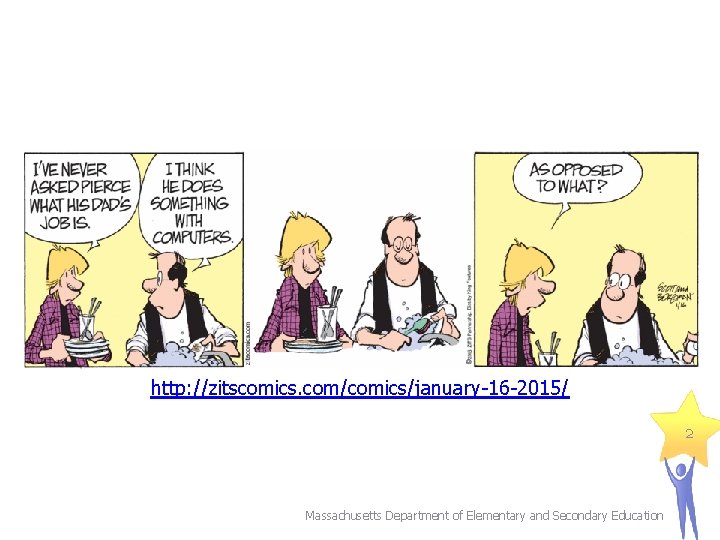
http: //zitscomics. com/comics/january-16 -2015/ 2 Massachusetts Department of Elementary and Secondary Education
Goals The Need Vision Overview of 2016 DLCS Framework Implementation 3 Massachusetts Department of Elementary and Secondary Education
The Need for Digital Literacy and Computer Science Skills
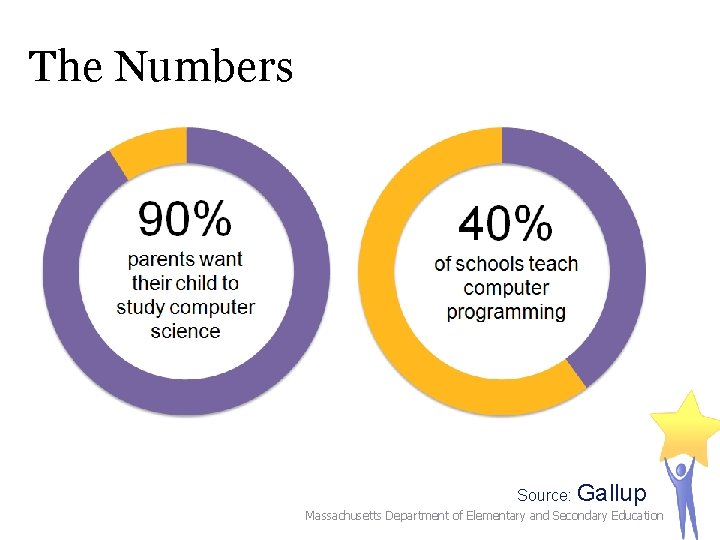
The Numbers Source: Gallup Massachusetts Department of Elementary and Secondary Education
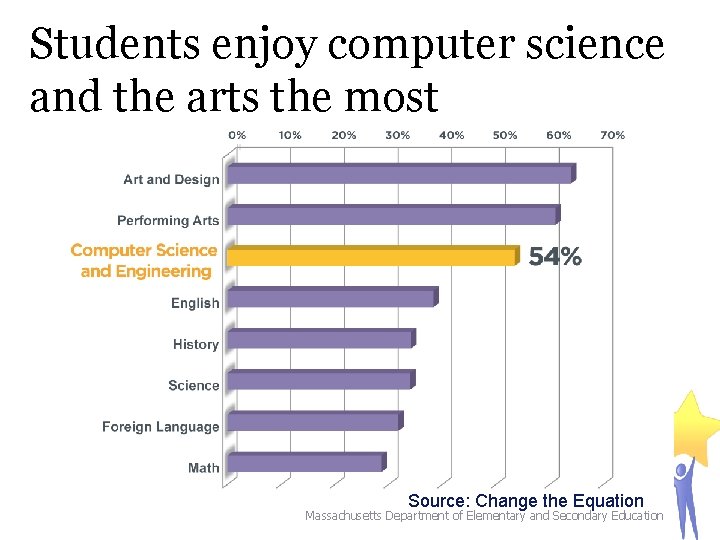
Students enjoy computer science and the arts the most Source: Change the Equation Massachusetts Department of Elementary and Secondary Education
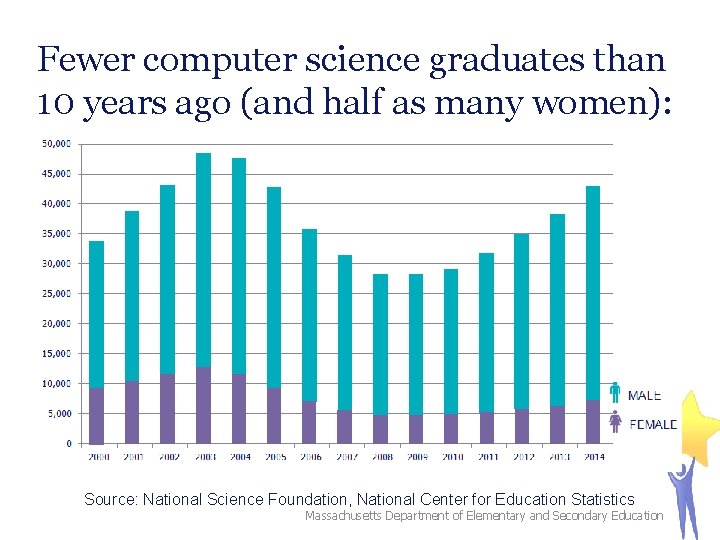
Fewer computer science graduates than 10 years ago (and half as many women): Source: National Science Foundation, National Center for Education Statistics Massachusetts Department of Elementary and Secondary Education
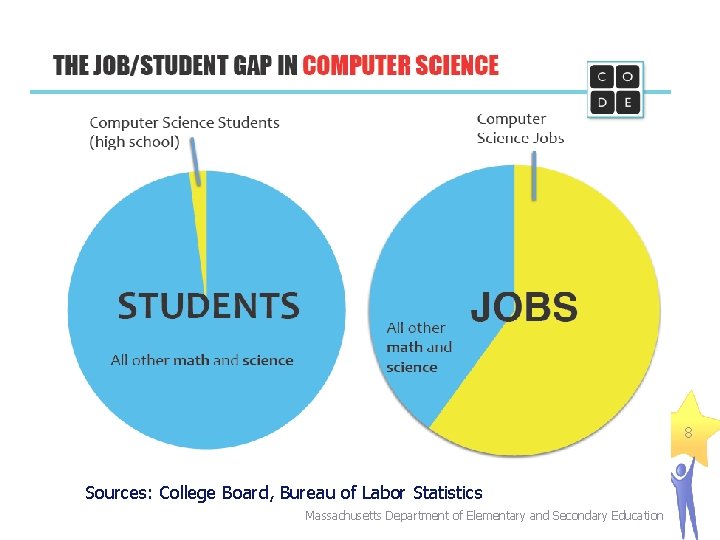
8 Sources: College Board, Bureau of Labor Statistics Massachusetts Department of Elementary and Secondary Education
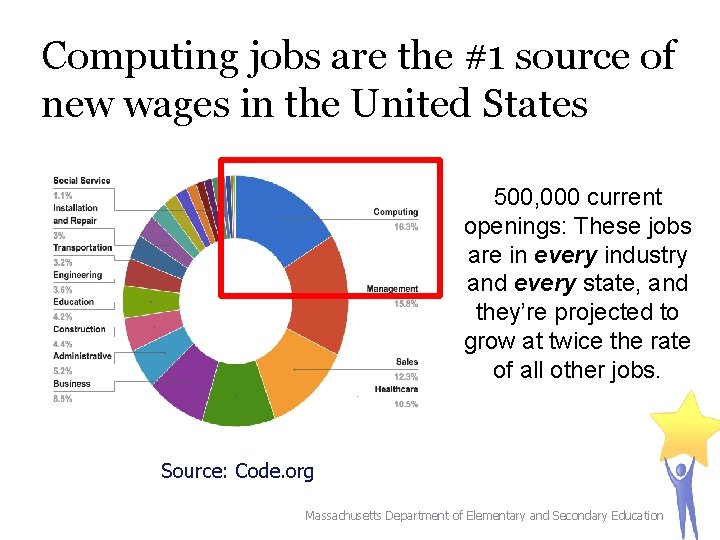
Computing jobs are the #1 source of new wages in the United States 500, 000 current openings: These jobs are in every industry and every state, and they’re projected to grow at twice the rate of all other jobs. Source: Code. org Massachusetts Department of Elementary and Secondary Education
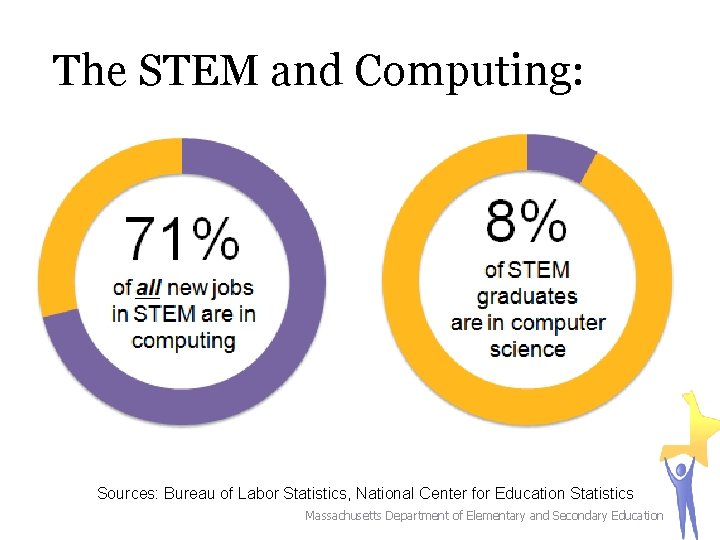
The STEM and Computing: Sources: Bureau of Labor Statistics, National Center for Education Statistics Massachusetts Department of Elementary and Secondary Education
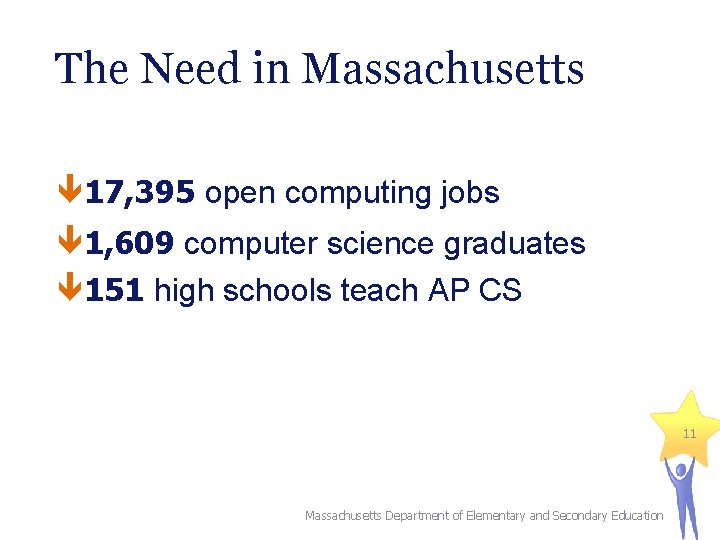
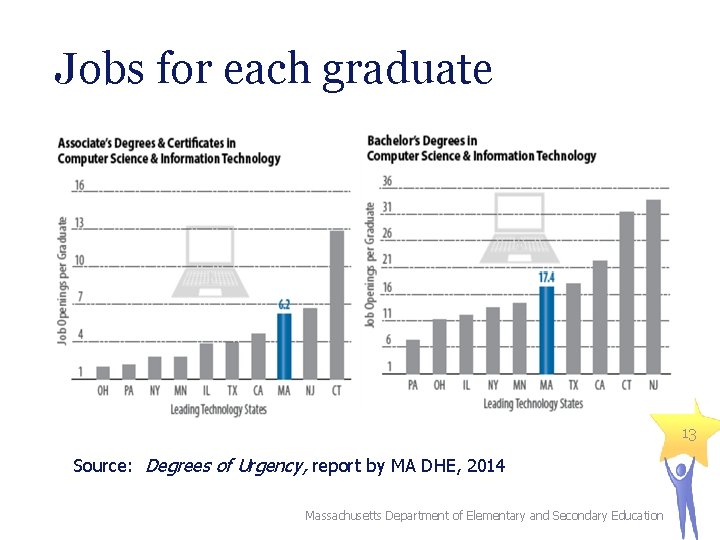
The Need in Massachusetts 17, 395 open computing jobs 1, 609 computer science graduates 151 high schools teach AP CS 11 Massachusetts Department of Elementary and Secondary Education
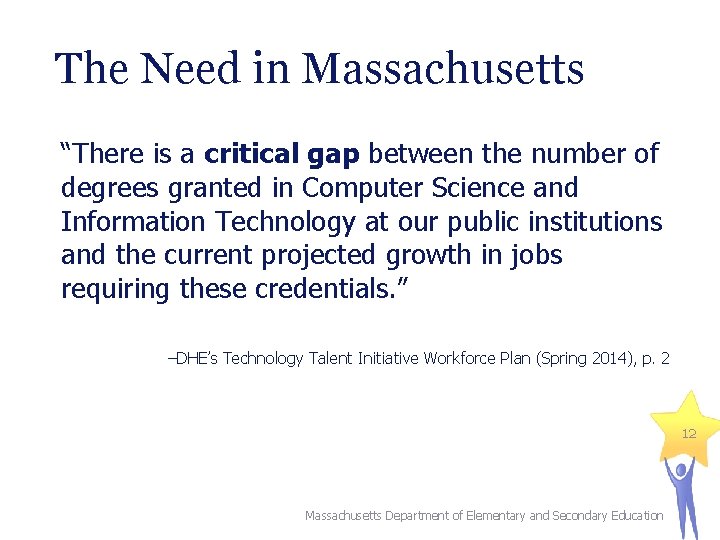
The Need in Massachusetts “There is a critical gap between the number of degrees granted in Computer Science and Information Technology at our public institutions and the current projected growth in jobs requiring these credentials. ” –DHE’s Technology Talent Initiative Workforce Plan (Spring 2014), p. 2 12 Massachusetts Department of Elementary and Secondary Education
Jobs for each graduate 13 Source: Degrees of Urgency, report by MA DHE, 2014 Massachusetts Department of Elementary and Secondary Education
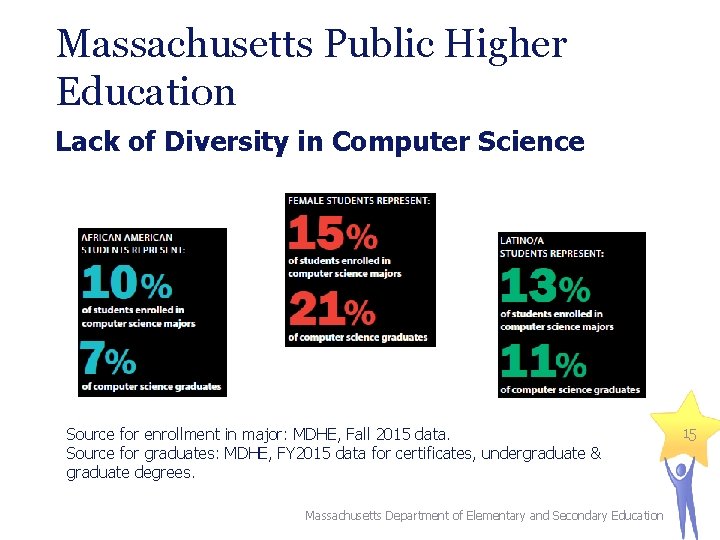
Low enrollment of minorities “These statistics indicate both a social justice mandate and an economic development mandate. “ –DHE’s Technology Talent Initiative Workforce Plan (Spring 2014), p. 17 Massachusetts Department of Elementary and Secondary Education 14
Massachusetts Public Higher Education Lack of Diversity in Computer Science Source for enrollment in major: MDHE, Fall 2015 data. Source for graduates: MDHE, FY 2015 data for certificates, undergraduate & graduate degrees. Massachusetts Department of Elementary and Secondary Education 15
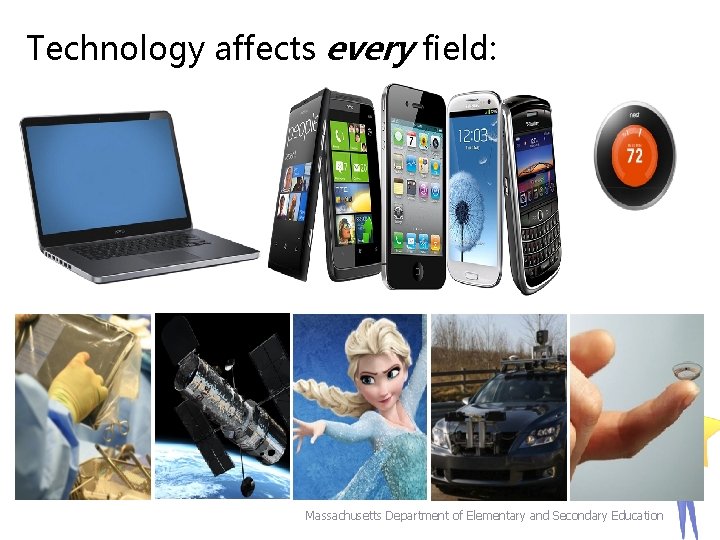
Technology affects every field: Massachusetts Department of Elementary and Secondary Education
Vision
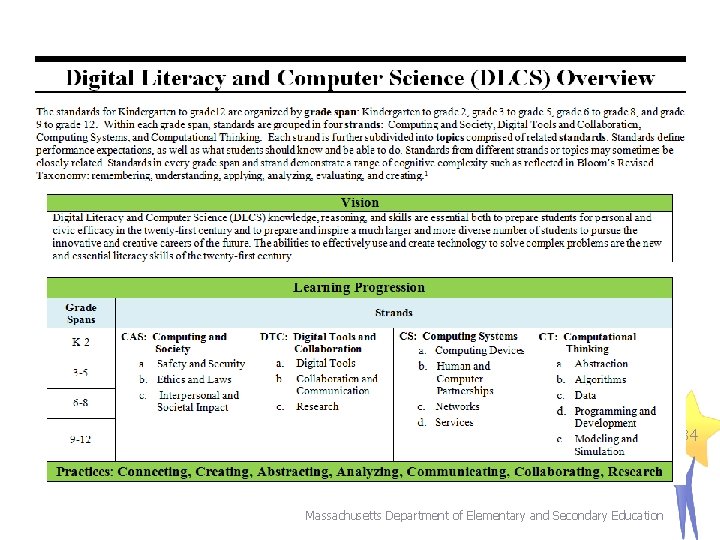
Vision Digital Literacy and Computer Science (DLCS) knowledge, reasoning, and skills are essential both to prepare students for personal and civic efficacy in the twenty-first century and to prepare and inspire a much larger and more diverse number of students to pursue the innovative and creative careers of the future. The abilities to effectively use and create technology to solve complex problems are the new and essential literacy skills of the twenty-first century. 18 Massachusetts Department of Elementary and Secondary Education
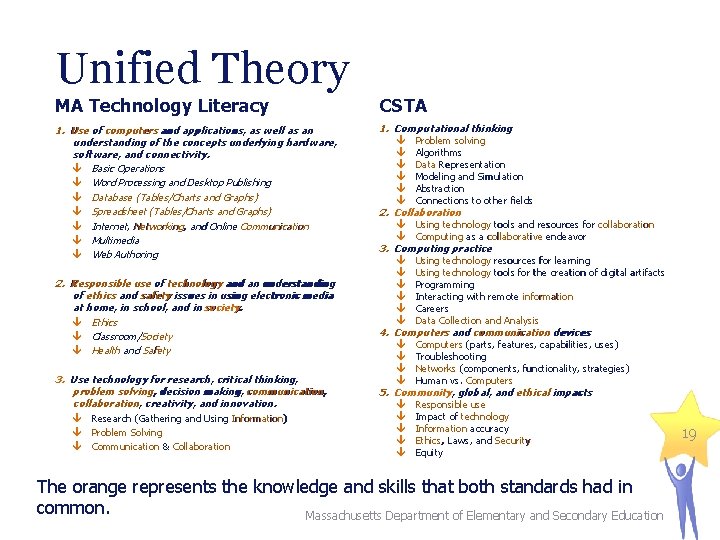
Unified Theory MA Technology Literacy CSTA 1. Use of computers and applications, as well as an understanding of the concepts underlying hardware, software, and connectivity. Basic Operations Word Processing and Desktop Publishing Database (Tables/Charts and Graphs) Spreadsheet (Tables/Charts and Graphs) Internet, Networking, and Online Communication Multimedia Web Authoring 1. Computational thinking Problem solving Algorithms Data Representation Modeling and Simulation Abstraction Connections to other fields 2. Collaboration Using technology tools and resources for collaboration Computing as a collaborative endeavor 3. Computing practice Using technology resources for learning Using technology tools for the creation of digital artifacts Programming Interacting with remote information Careers Data Collection and Analysis 4. Computers and communication devices Computers (parts, features, capabilities, uses) Troubleshooting Networks (components, functionality, strategies) Human vs. Computers 5. Community, global, and ethical impacts Responsible use Impact of technology Information accuracy Ethics, Laws, and Security Equity 2. Responsible use of technology and an understanding of ethics and safety issues in using electronic media at home, in school, and in society. Ethics Classroom/Society Health and Safety 3. Use technology for research, critical thinking, problem solving, decision making, communication, collaboration, creativity, and innovation. Research (Gathering and Using Information) Problem Solving Communication & Collaboration The orange represents the knowledge and skills that both standards had in common. Massachusetts Department of Elementary and Secondary Education 19
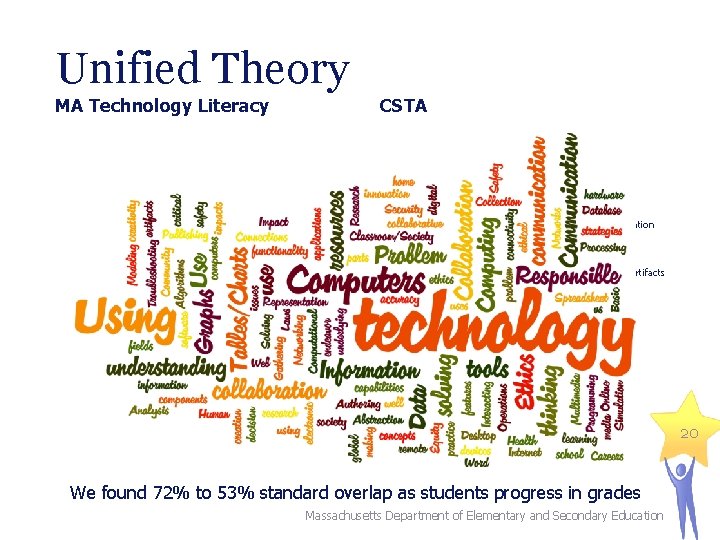
Unified Theory MA Technology Literacy CSTA 1. Computational thinking Problem solving Algorithms Data Representation Modeling and Simulation Abstraction Connections to other fields 2. Collaboration Using technology tools and resources for collaboration Computing as a collaborative endeavor 3. Computing practice Using technology resources for learning Using technology tools for the creation of digital artifacts Programming Interacting with remote information Careers Data Collection and Analysis 4. Computers and communication devices Computers (parts, features, capabilities, uses) Troubleshooting Networks (components, functionality, strategies) Human vs. Computers 5. Community, global, and ethical impacts Responsible use Impact of technology Information accuracy Ethics, Laws, and Security Equity We found 72% to 53% standard overlap as students progress in grades Massachusetts Department of Elementary and Secondary Education 20
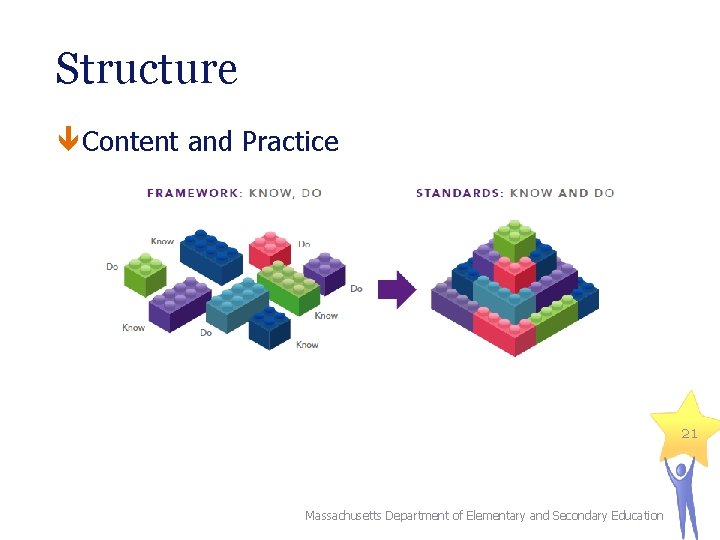
Structure Content and Practice 21 Massachusetts Department of Elementary and Secondary Education
Overview of 2016 DLCS Framework
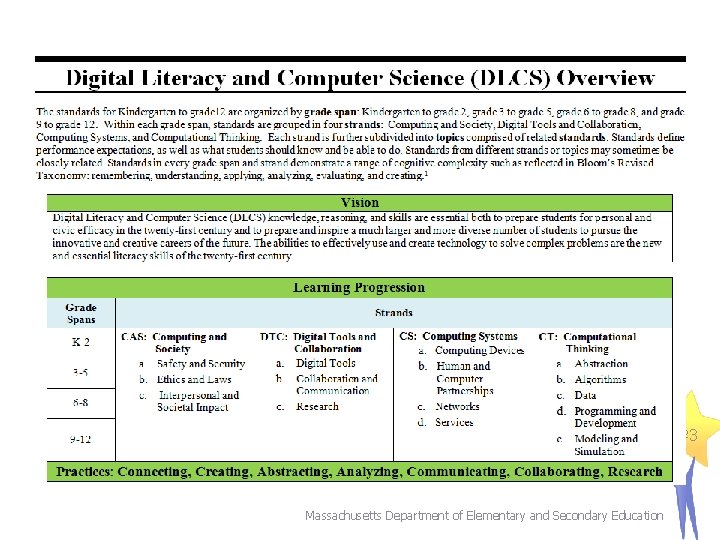
DLCS Model 23 Massachusetts Department of Elementary and Secondary Education
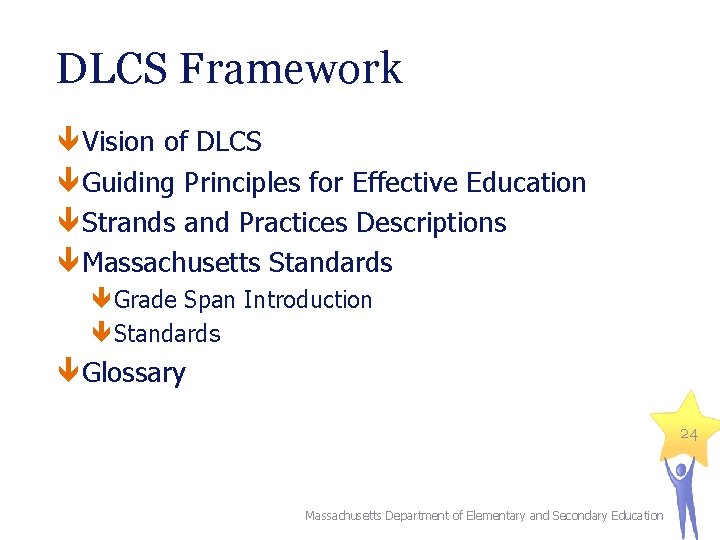
DLCS Framework Vision of DLCS Guiding Principles for Effective Education Strands and Practices Descriptions Massachusetts Standards Grade Span Introduction Standards Glossary 24 Massachusetts Department of Elementary and Secondary Education
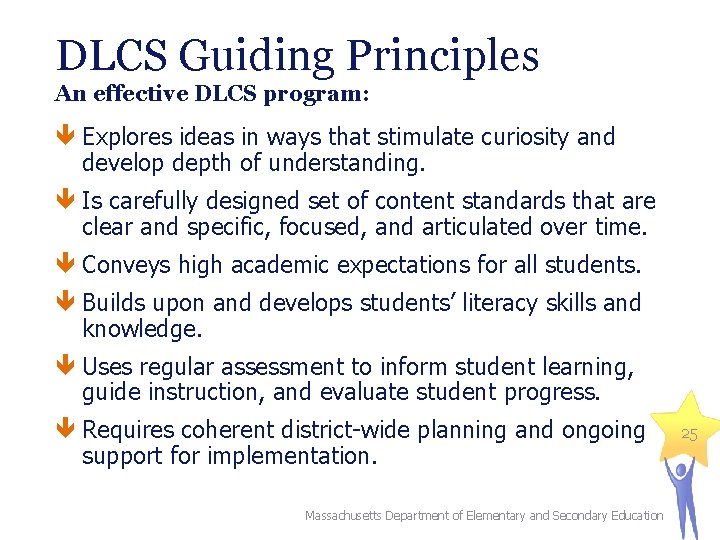
DLCS Guiding Principles An effective DLCS program: Explores ideas in ways that stimulate curiosity and develop depth of understanding. Is carefully designed set of content standards that are clear and specific, focused, and articulated over time. Conveys high academic expectations for all students. Builds upon and develops students’ literacy skills and knowledge. Uses regular assessment to inform student learning, guide instruction, and evaluate student progress. Requires coherent district-wide planning and ongoing support for implementation. Massachusetts Department of Elementary and Secondary Education 25
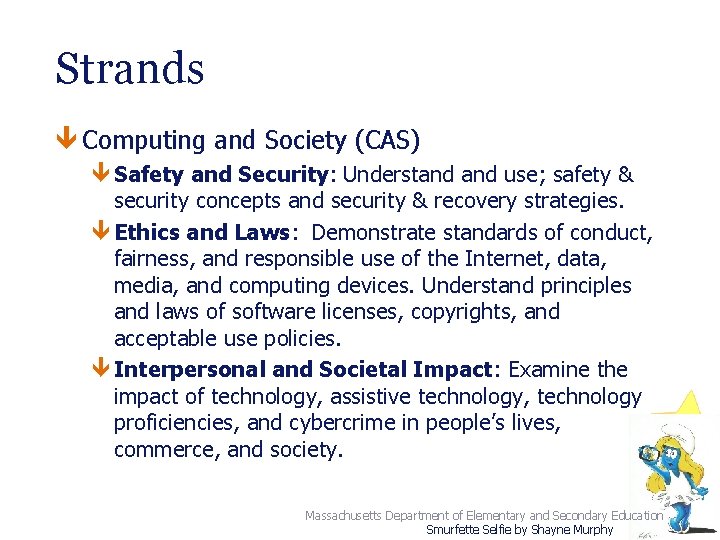
Strands Computing and Society (CAS) Safety and Security: Understand use; safety & security concepts and security & recovery strategies. Ethics and Laws: Demonstrate standards of conduct, fairness, and responsible use of the Internet, data, media, and computing devices. Understand principles and laws of software licenses, copyrights, and acceptable use policies. Interpersonal and Societal Impact: Examine the impact of technology, assistive technology, technology proficiencies, and cybercrime in people’s lives, commerce, and society. Massachusetts Department of Elementary and Secondary Education Smurfette Selfie by Shayne Murphy 26
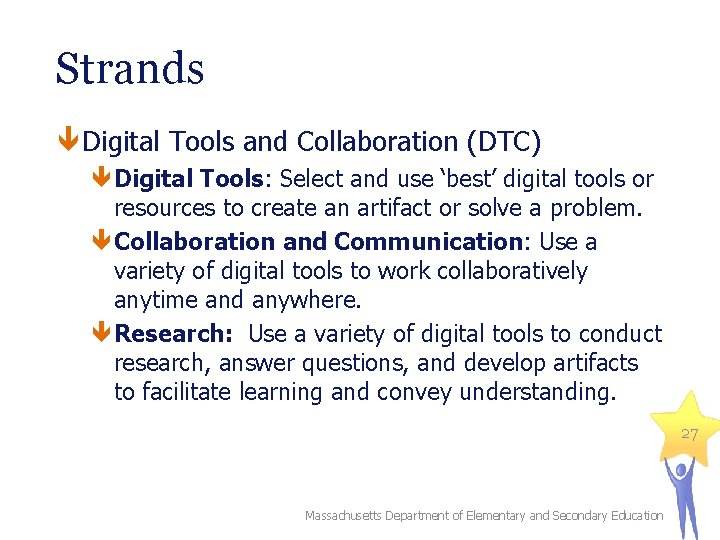
Strands Digital Tools and Collaboration (DTC) Digital Tools: Select and use ‘best’ digital tools or resources to create an artifact or solve a problem. Collaboration and Communication: Use a variety of digital tools to work collaboratively anytime and anywhere. Research: Use a variety of digital tools to conduct research, answer questions, and develop artifacts to facilitate learning and convey understanding. 27 Massachusetts Department of Elementary and Secondary Education
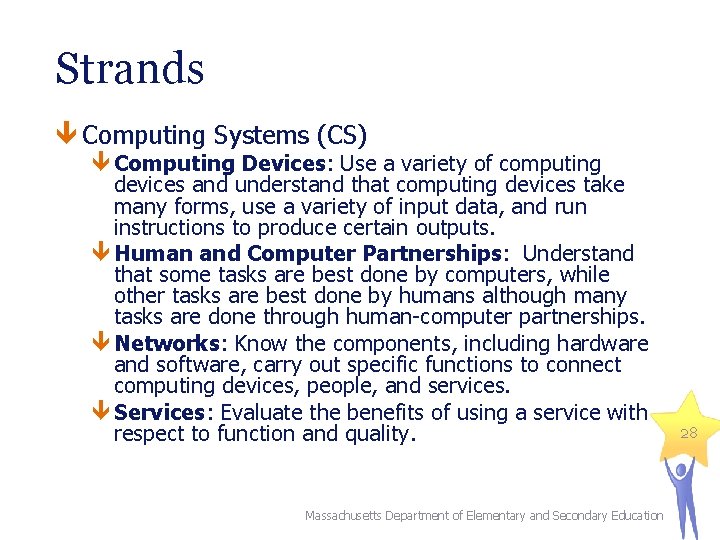
Strands Computing Systems (CS) Computing Devices: Use a variety of computing devices and understand that computing devices take many forms, use a variety of input data, and run instructions to produce certain outputs. Human and Computer Partnerships: Understand that some tasks are best done by computers, while other tasks are best done by humans although many tasks are done through human-computer partnerships. Networks: Know the components, including hardware and software, carry out specific functions to connect computing devices, people, and services. Services: Evaluate the benefits of using a service with respect to function and quality. Massachusetts Department of Elementary and Secondary Education 28
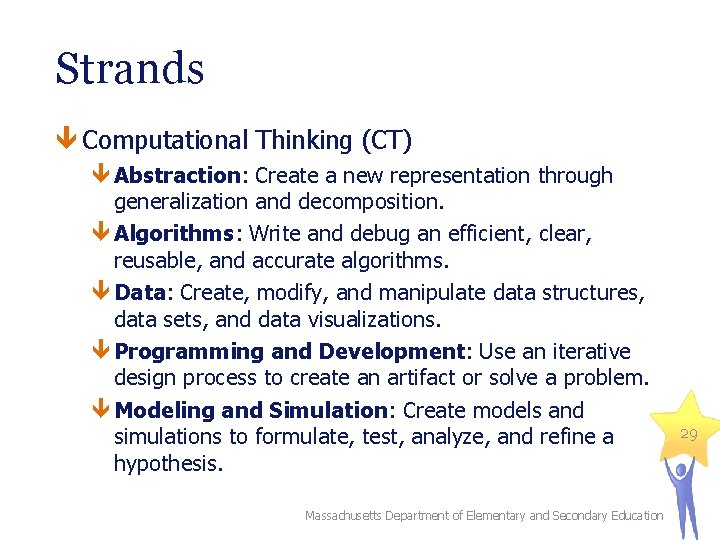
Strands Computational Thinking (CT) Abstraction: Create a new representation through generalization and decomposition. Algorithms: Write and debug an efficient, clear, reusable, and accurate algorithms. Data: Create, modify, and manipulate data structures, data sets, and data visualizations. Programming and Development: Use an iterative design process to create an artifact or solve a problem. Modeling and Simulation: Create models and simulations to formulate, test, analyze, and refine a hypothesis. Massachusetts Department of Elementary and Secondary Education 29
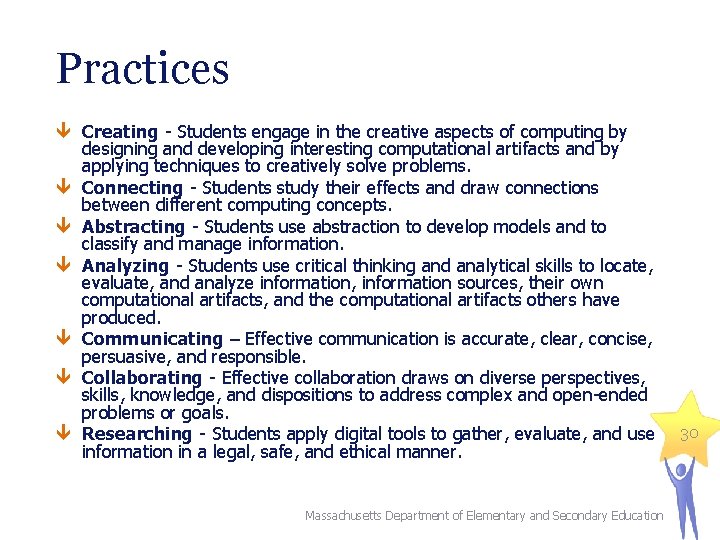
Practices Creating - Students engage in the creative aspects of computing by designing and developing interesting computational artifacts and by applying techniques to creatively solve problems. Connecting - Students study their effects and draw connections between different computing concepts. Abstracting - Students use abstraction to develop models and to classify and manage information. Analyzing - Students use critical thinking and analytical skills to locate, evaluate, and analyze information, information sources, their own computational artifacts, and the computational artifacts others have produced. Communicating – Effective communication is accurate, clear, concise, persuasive, and responsible. Collaborating - Effective collaboration draws on diverse perspectives, skills, knowledge, and dispositions to address complex and open-ended problems or goals. Researching - Students apply digital tools to gather, evaluate, and use information in a legal, safe, and ethical manner. Massachusetts Department of Elementary and Secondary Education 30
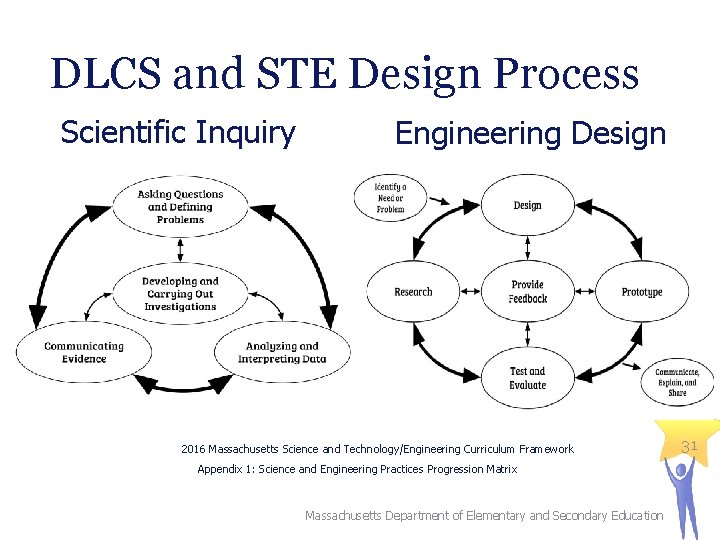
DLCS and STE Design Process Scientific Inquiry Engineering Design 2016 Massachusetts Science and Technology/Engineering Curriculum Framework Appendix 1: Science and Engineering Practices Progression Matrix Massachusetts Department of Elementary and Secondary Education 31
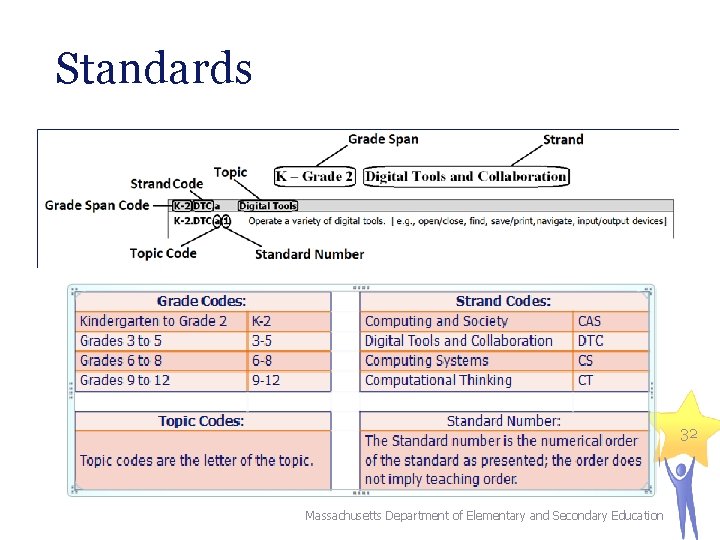
Standards 32 Massachusetts Department of Elementary and Secondary Education
Grade Span Introductions The grade span introduction pages describe what the student should know and be able to do by the end of that grade span. It is a great quick reference guide to that grade span. Take a minute and find your grade span page. 33 Massachusetts Department of Elementary and Secondary Education
DLCS Model 34 Massachusetts Department of Elementary and Secondary Education
Implementation
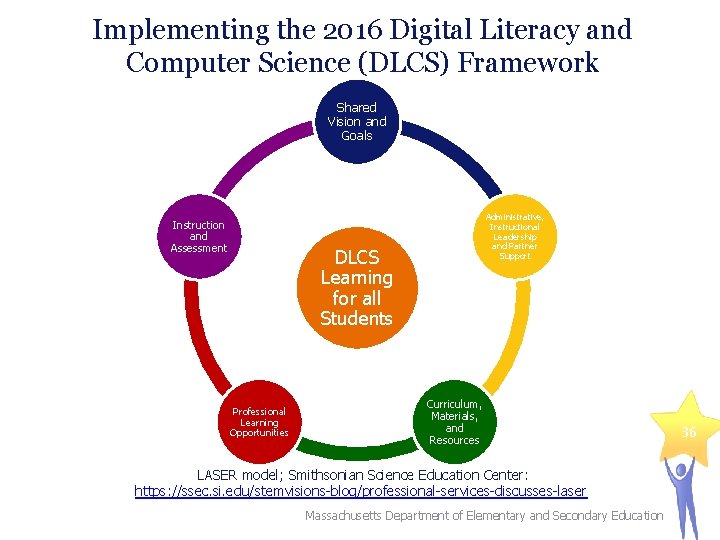
Implementing the 2016 Digital Literacy and Computer Science (DLCS) Framework Shared Vision and Goals Instruction and Assessment Administrative, Instructional Leadership and Partner Support DLCS Learning for all Students Professional Learning Opportunities Curriculum, Materials, and Resources LASER model; Smithsonian Science Education Center: https: //ssec. si. edu/stemvisions-blog/professional-services-discusses-laser Massachusetts Department of Elementary and Secondary Education 36
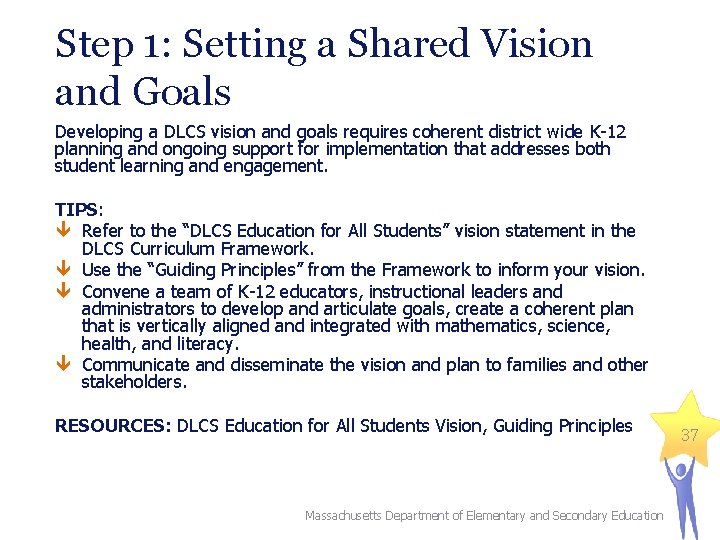
Step 1: Setting a Shared Vision and Goals Developing a DLCS vision and goals requires coherent district wide K-12 planning and ongoing support for implementation that addresses both student learning and engagement. TIPS: Refer to the “DLCS Education for All Students” vision statement in the DLCS Curriculum Framework. Use the “Guiding Principles” from the Framework to inform your vision. Convene a team of K-12 educators, instructional leaders and administrators to develop and articulate goals, create a coherent plan that is vertically aligned and integrated with mathematics, science, health, and literacy. Communicate and disseminate the vision and plan to families and other stakeholders. RESOURCES: DLCS Education for All Students Vision, Guiding Principles Massachusetts Department of Elementary and Secondary Education 37
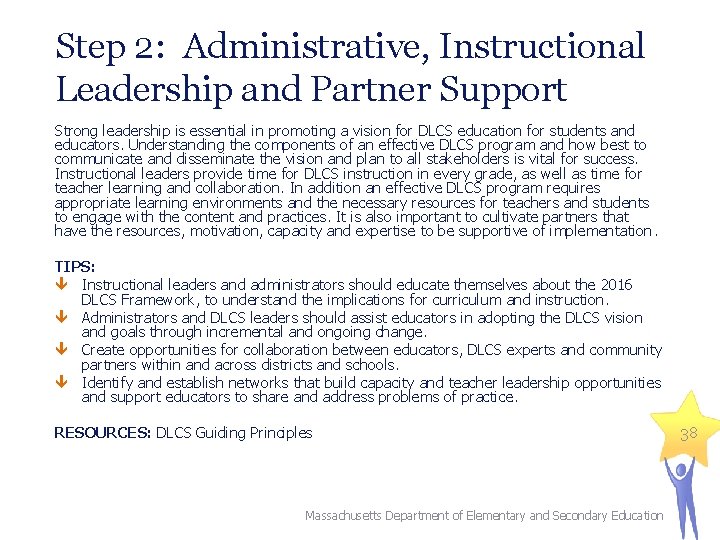
Step 2: Administrative, Instructional Leadership and Partner Support Strong leadership is essential in promoting a vision for DLCS education for students and educators. Understanding the components of an effective DLCS program and how best to communicate and disseminate the vision and plan to all stakeholders is vital for success. Instructional leaders provide time for DLCS instruction in every grade, as well as time for teacher learning and collaboration. In addition an effective DLCS program requires appropriate learning environments and the necessary resources for teachers and students to engage with the content and practices. It is also important to cultivate partners that have the resources, motivation, capacity and expertise to be supportive of implementation. TIPS: Instructional leaders and administrators should educate themselves about the 2016 DLCS Framework, to understand the implications for curriculum and instruction. Administrators and DLCS leaders should assist educators in adopting the DLCS vision and goals through incremental and ongoing change. Create opportunities for collaboration between educators, DLCS experts and community partners within and across districts and schools. Identify and establish networks that build capacity and teacher leadership opportunities and support educators to share and address problems of practice. RESOURCES: DLCS Guiding Principles Massachusetts Department of Elementary and Secondary Education 38
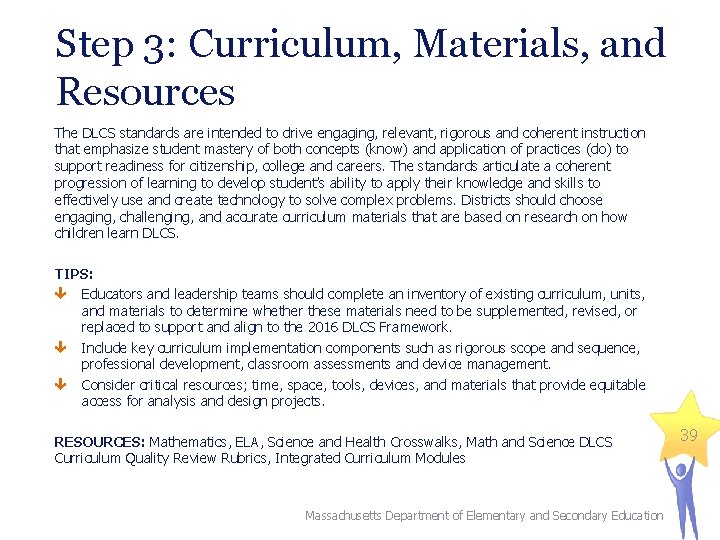
Step 3: Curriculum, Materials, and Resources The DLCS standards are intended to drive engaging, relevant, rigorous and coherent instruction that emphasize student mastery of both concepts (know) and application of practices (do) to support readiness for citizenship, college and careers. The standards articulate a coherent progression of learning to develop student’s ability to apply their knowledge and skills to effectively use and create technology to solve complex problems. Districts should choose engaging, challenging, and accurate curriculum materials that are based on research on how children learn DLCS. TIPS: Educators and leadership teams should complete an inventory of existing curriculum, units, and materials to determine whether these materials need to be supplemented, revised, or replaced to support and align to the 2016 DLCS Framework. Include key curriculum implementation components such as rigorous scope and sequence, professional development, classroom assessments and device management. Consider critical resources; time, space, tools, devices, and materials that provide equitable access for analysis and design projects. RESOURCES: Mathematics, ELA, Science and Health Crosswalks, Math and Science DLCS Curriculum Quality Review Rubrics, Integrated Curriculum Modules Massachusetts Department of Elementary and Secondary Education 39
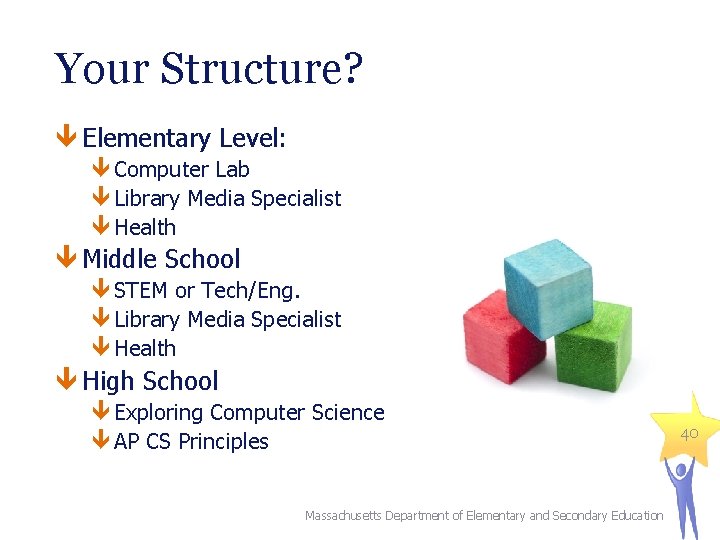
Your Structure? Elementary Level: Computer Lab Library Media Specialist Health Middle School STEM or Tech/Eng. Library Media Specialist Health High School Exploring Computer Science AP CS Principles Massachusetts Department of Elementary and Secondary Education 40
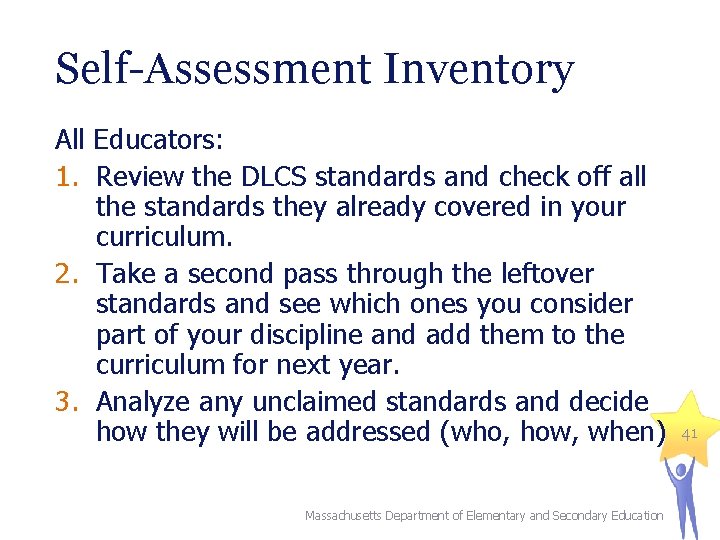
Self-Assessment Inventory All Educators: 1. Review the DLCS standards and check off all the standards they already covered in your curriculum. 2. Take a second pass through the leftover standards and see which ones you consider part of your discipline and add them to the curriculum for next year. 3. Analyze any unclaimed standards and decide how they will be addressed (who, how, when) Massachusetts Department of Elementary and Secondary Education 41
Resources Crosswalk – opportunities to integrate Integrated Curriculum Modules – Summer 2017 Quality Review Rubric for evaluating Curriculum 42 Massachusetts Department of Elementary and Secondary Education
Step 4: Professional Learning Opportunities Develop learning experiences that support the DLCS vision and goals while addressing the needs of students, teachers, and administrators. These active learning experiences need to focus on specific DLCS content, connection to classroom practice, collaboration, equity and must be ongoing and sustainable. Learning opportunities should be differentiated to address the needs of individual teachers (i. e. , moving from novice to competent and from competent to expert). TIPS: Design DLCS learning opportunities that identify and prioritize needs and examine values and beliefs of educators and administrators. DLCS learning opportunities may take place on or offsite and can include multi-day trainings, one-on-one instruction, coaching/mentoring, professional learning communities and cross district and community collaborations. RESOURCES: MA High Quality Professional Development Planning and Assessing Resources Massachusetts Department of Elementary and Secondary Education 43
Step 5: Instruction and Assessment Research on student learning indicates that students need explicit help to connect new ideas to ideas that have been learned previously (Marzano, 2004). Further research shows that “to develop a coherent understanding of scientific explanations of the world, students need sustained opportunities to engage in the practices, work with the underlying science ideas and appreciate the interconnections among these practices and ideas over a period of years, not weeks or months. ” (National Research Council, 2007). DLCS instructional approaches must engage all students and offer opportunities for them to collaborate and communicate their ideas. Assessment assists teachers in improving classroom practice, planning curricula, developing self directed learners, reporting student progress, and evaluating programs. A strong system of assessment includes project-based, portfolio-based and formative and summative assessments; and reinforces consistent instruction and learning for students to achieve the rigorous performance expectations set forth in the standards. TIPS: Develop a classroom culture that supports the vision for DLCS education by aligning teaching approaches, curricular resources and student tasks with the vision. Ensure that assessment is ongoing and an integral part of instruction. Collect assessment data for a variety of purposes; diagnose student needs, monitor progress, elicit preconceptions and misconceptions, and evaluate both student progress and teacher instruction. Be clear from the start how the data will be used so the right data can be collected analyzed. Resources: 2016 DLCS standards, K 12 Computer Science Framework, National Science Teachers Association (NSTA) Classroom Resources Massachusetts Department of Elementary and Secondary Education 44
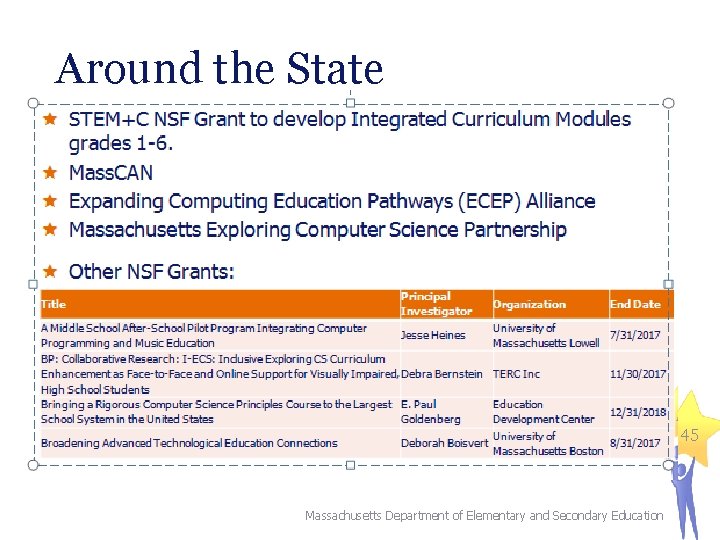
Around the State 45 Massachusetts Department of Elementary and Secondary Education
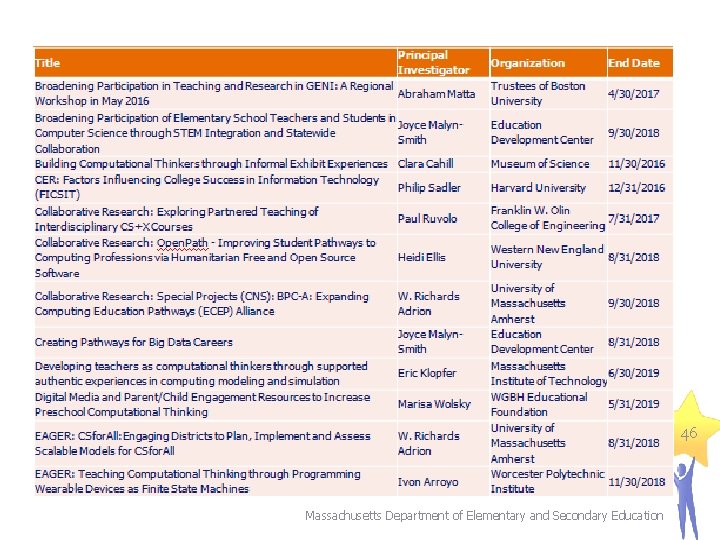
46 Massachusetts Department of Elementary and Secondary Education
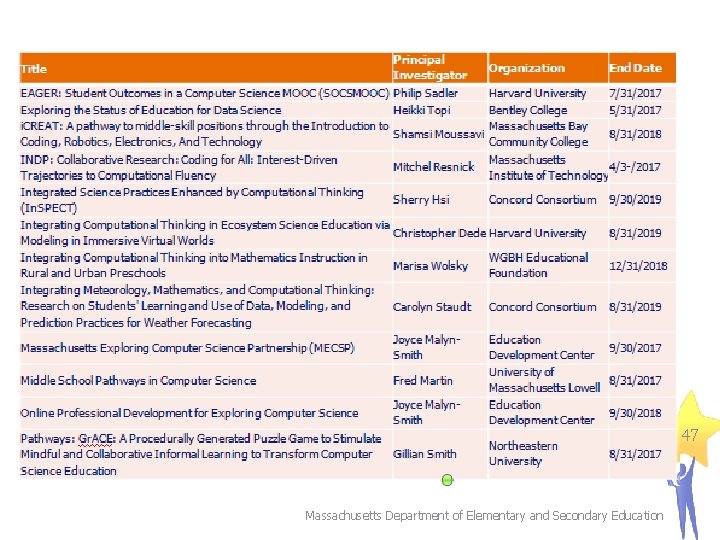
47 Massachusetts Department of Elementary and Secondary Education
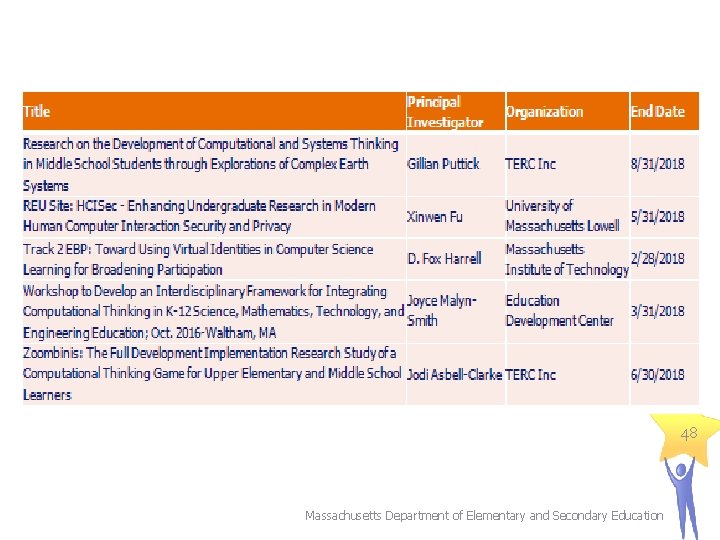
48 Massachusetts Department of Elementary and Secondary Education
To offer suggestions, pose questions, or receive files, please email STEM@doe. mass. edu Thank you! 49 Massachusetts Department of Elementary and Secondary Education