
Massachusetts Department of Public Health PUBLIC HEALTH COUNCIL
Massachusetts Department of Public Health PUBLIC HEALTH COUNCIL February 17, 2021 Please standby – the meeting will begin shortly Today’s presentation is available on the mass. gov/dph website under “Upcoming Events” by clicking on the February 17 Public Health Council listing

Massachusetts Department of Public Health PUBLIC HEALTH COUNCIL February 17, 2021 Today’s presentation is available on the mass. gov/dph website under “Upcoming Events” by clicking on the February 17 Public Health Council listing
Vaccine rollout 3
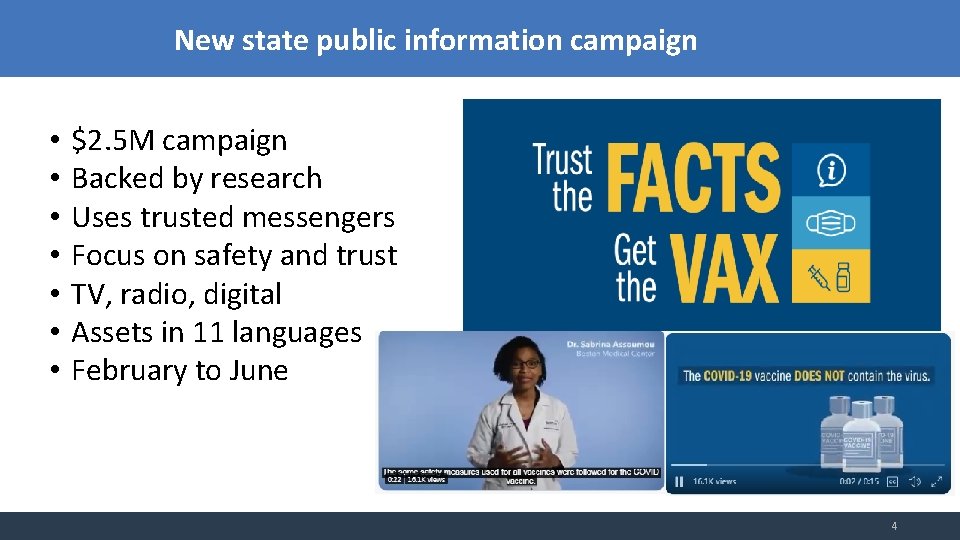
New state public information campaign • • $2. 5 M campaign Backed by research Uses trusted messengers Focus on safety and trust TV, radio, digital Assets in 11 languages February to June 4
COVID Communications Advisory Group Marlishia Aho Justin Auguste Jennifer Berryman Isabel Gonzales-Webster Kathleen Jeanty Juan Lopera Nick Martin Sam Melnick Yadires Nova-Salcedo Kerin O’Toole Christina Peaslee Colette Phillips Bec Rollins Dawn Sibor Tanisha Sullivan Sharon Torgerson Katherine (Swift) Udden Gwendolyn Vansant Judith Ward 1199 SEIU Massachusetts The Castle Group UMASS Medical School Worcester Interfaith Boston Public Health Commission Tufts Health Plan Office of Mayor Marty Walsh Mass Health & Hospital Association TV Producer and Host MA League of Community Health Centers Cape Cod Healthcare Colette Phillips Communications Pathfinder International MA Health Officers Association NAACP – Boston Branch Mass General Brigham Massachusetts Medical Society BRIDGE of the Berkshires Baystate Health
Increasing Equity in Vaccine Awareness & Access February 17, 2021 Public Health Council
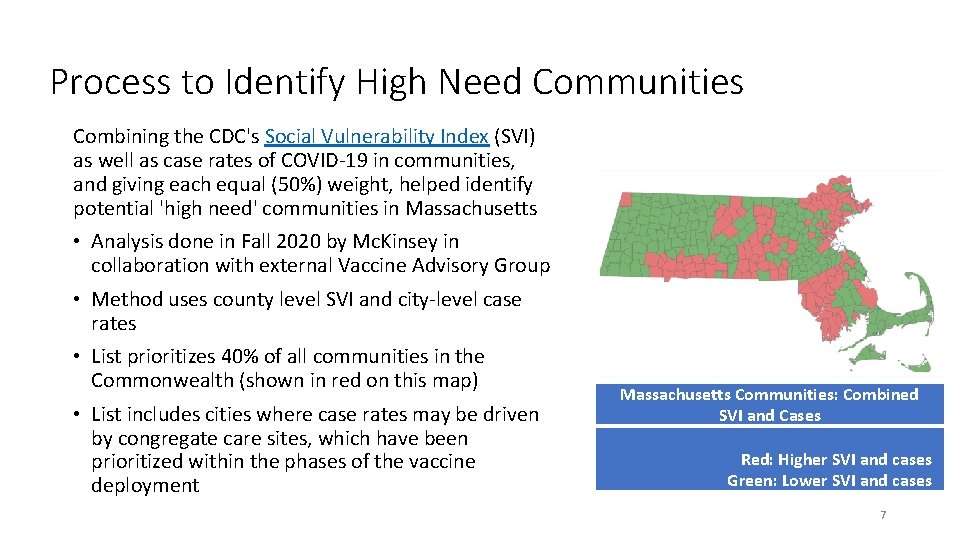
Process to Identify High Need Communities Combining the CDC's Social Vulnerability Index (SVI) as well as case rates of COVID-19 in communities, and giving each equal (50%) weight, helped identify potential 'high need' communities in Massachusetts • Analysis done in Fall 2020 by Mc. Kinsey in collaboration with external Vaccine Advisory Group • Method uses county level SVI and city-level case rates • List prioritizes 40% of all communities in the Commonwealth (shown in red on this map) • List includes cities where case rates may be driven by congregate care sites, which have been prioritized within the phases of the vaccine deployment Massachusetts Communities: Combined SVI and Cases Red: Higher SVI and cases Green: Lower SVI and cases 7
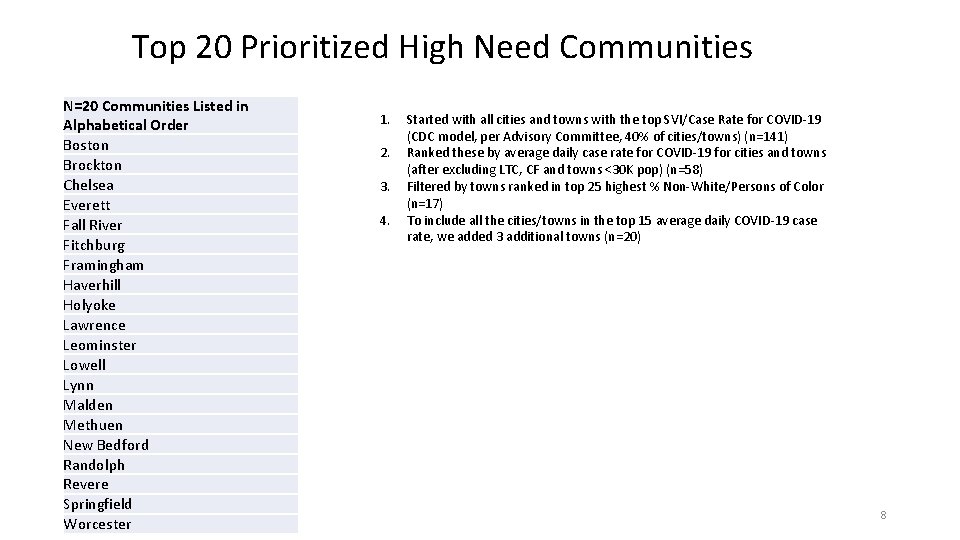
Top 20 Prioritized High Need Communities N=20 Communities Listed in Alphabetical Order Boston Brockton Chelsea Everett Fall River Fitchburg Framingham Haverhill Holyoke Lawrence Leominster Lowell Lynn Malden Methuen New Bedford Randolph Revere Springfield Worcester 1. 2. 3. 4. Started with all cities and towns with the top SVI/Case Rate for COVID-19 (CDC model, per Advisory Committee, 40% of cities/towns) (n=141) Ranked these by average daily case rate for COVID-19 for cities and towns (after excluding LTC, CF and towns <30 K pop) (n=58) Filtered by towns ranked in top 25 highest % Non-White/Persons of Color (n=17) To include all the cities/towns in the top 15 average daily COVID-19 case rate, we added 3 additional towns (n=20) 8
Invest in Community Context: The pandemic is exacerbating pre-existing public health concerns; vaccine confidence relates to mistrust in the health system and differs by race/ethnicity and income. Engaging trusted messengers and reducing barriers (ability to receive vaccine from a trusted source, reducing transportation and language access barriers, etc. ) will increase confidence. Goal: To increase vaccine trust, and access, engage communities most affected by COVID-19 in the development, testing, and delivery of vaccine messaging, and use feedback to inform targeted community engagement, public awareness campaign, FAQs, social media, and other communications materials. Utilize CHWs and other trusted community members to address barriers to access. Develop tailored vaccination approaches to address logistical and operational requirements for vaccinations, including focus on cross-cutting populations, such as: indigenous people, individuals with disabilities and access and functional needs, those living in rural settings. • Communications Campaign: Trust the Facts. Get the Vax. • Community Guide to increase of access to educational materials and encourage community organizations to conduct their own vaccine education/outreach • Training webinars scheduled this & next week (~400 participants) • Vaccine Ambassador program to support community-led education • Partnership with Community & Faith Based Organizations in hardest hit communities to conduct tailored priority population outreach/education (HRi. A-led; currently $300 k for 20 organizations) • Partnership with Mass League of Community Health Centers: CHW Vaccine Ambassador program ($1 M); COVID-19 vaccine community engagement campaign ($50 k) 9
Community-Driven Model • Implement a community-based and driven system, designed around needs and assets for each individual community • Focused on priority populations • Designed to address equity needs and efficiency goals • Introductory calls made 2/16 • Coordination through a DPH Community Liaison for each community (beginning Feb 22, 2021) • Leverage and coordinate resources; existing and growing menu to customize support to address vaccine confidence, access and barriers 10
DPH Liaison As part of the outreach, a DPH Community Liaison will work to leverage and coordinate state resources and customize a menu of options to be offered to each community, which may include: • Identifying gaps and mapping available resources to reduce barriers to vaccination • Coordinating and supporting key stakeholders to maximize and align efforts, while synchronizing outreach, working closely with the Local Board of Health, local Community and Faith Based Organizations, Community Health Centers, and Community Health Workers who can support grassroots outreach to priority populations • Developing population specific outreach activities and engagement strategies to help increase vaccine confidence • Deploying DPH Vaccine Ambassadors to provide support for town-halls and other community forums to share information and materials, including a DPH forum guide and toolkit • Disseminating culturally appropriate translations of communications campaign materials, including: Trust the Facts. Get the Vax. campaign materials and vaccine FAQs in multiple languages. • Hiring local residents to provide “boots on the ground” for neighborhood and local business outreach, which may include a door-knocking campaign to provide information and answer questions about vaccine efficacy and safety. 11
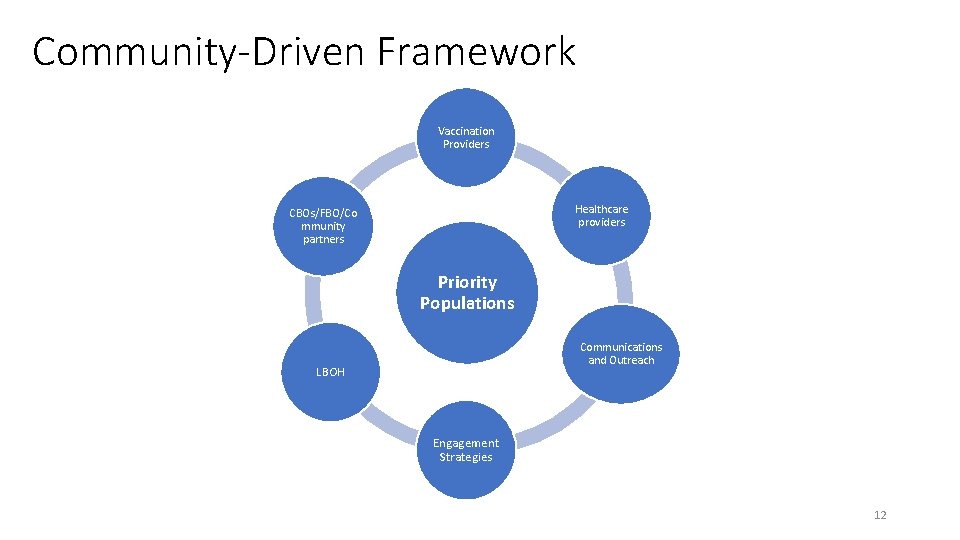
Community-Driven Framework Vaccination Providers Healthcare providers CBOs/FBO/Co mmunity partners Priority Populations Communications and Outreach LBOH Engagement Strategies 12
DPH Community Liaison Role • Meets regularly with representatives from priority communities • Assesses needs & identifies gaps • Leverages and coordinates DPH, Command, and community resources to fill gaps • Facilitates requests for any communication material development/review needs • Identify barriers to vaccine access (transportation, scheduling, etc. ) and inform solutions • Connect priority populations with available vaccine 13

Massachusetts Department of Public Health Determination of Need: Request by Emerson Endoscopy and Digestive Health Center, LLC for Substantial Change in Service

Massachusetts Department of Public Health COVID-19 Community Impact Survey(CCIS) Preliminary Analysis Results February 17, 2021 15
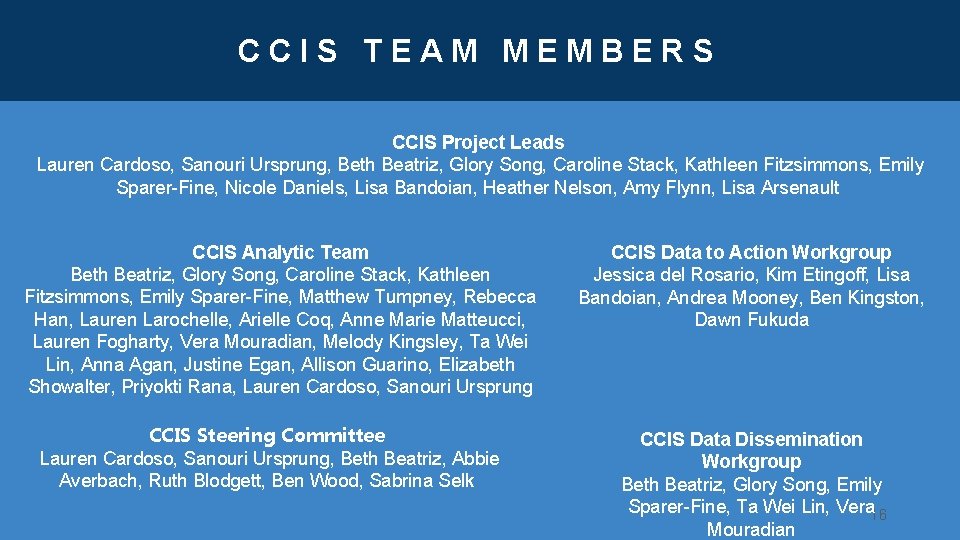
CCIS TEAM MEMBERS CCIS Project Leads Lauren Cardoso, Sanouri Ursprung, Beth Beatriz, Glory Song, Caroline Stack, Kathleen Fitzsimmons, Emily Sparer-Fine, Nicole Daniels, Lisa Bandoian, Heather Nelson, Amy Flynn, Lisa Arsenault CCIS Analytic Team Beth Beatriz, Glory Song, Caroline Stack, Kathleen Fitzsimmons, Emily Sparer-Fine, Matthew Tumpney, Rebecca Han, Lauren Larochelle, Arielle Coq, Anne Marie Matteucci, Lauren Fogharty, Vera Mouradian, Melody Kingsley, Ta Wei Lin, Anna Agan, Justine Egan, Allison Guarino, Elizabeth Showalter, Priyokti Rana, Lauren Cardoso, Sanouri Ursprung CCIS Steering Committee Lauren Cardoso, Sanouri Ursprung, Beth Beatriz, Abbie Averbach, Ruth Blodgett, Ben Wood, Sabrina Selk CCIS Data to Action Workgroup Jessica del Rosario, Kim Etingoff, Lisa Bandoian, Andrea Mooney, Ben Kingston, Dawn Fukuda CCIS Data Dissemination Workgroup Beth Beatriz, Glory Song, Emily Sparer-Fine, Ta Wei Lin, Vera 16 Mouradian
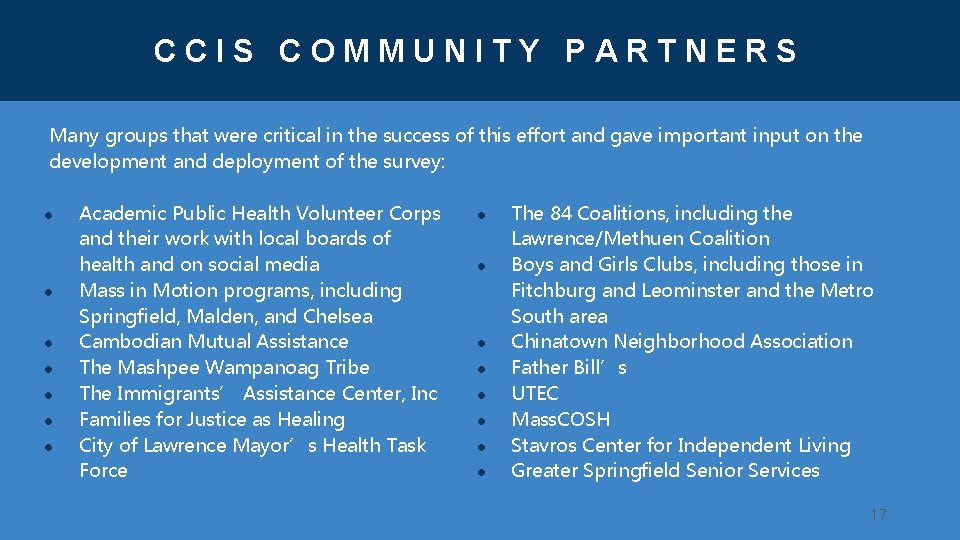
CCIS COMMUNITY PARTNERS Many groups that were critical in the success of this effort and gave important input on the development and deployment of the survey: ● ● ● ● Academic Public Health Volunteer Corps and their work with local boards of health and on social media Mass in Motion programs, including Springfield, Malden, and Chelsea Cambodian Mutual Assistance The Mashpee Wampanoag Tribe The Immigrants’ Assistance Center, Inc Families for Justice as Healing City of Lawrence Mayor’s Health Task Force ● ● ● ● The 84 Coalitions, including the Lawrence/Methuen Coalition Boys and Girls Clubs, including those in Fitchburg and Leominster and the Metro South area Chinatown Neighborhood Association Father Bill’s UTEC Mass. COSH Stavros Center for Independent Living Greater Springfield Senior Services 17
OVERVIEW 1. Purpose and Approach of the Covid-19 Community Impact Survey (CCIS) 2. Preliminary Findings ○ ○ Ability to mitigate individual risk of infection Access to Testing Access to Healthcare Impact on Basic Needs 3. Converting these Data to Action with our partners 4. Appendix 18
PURPOSE AND APPROACH 19
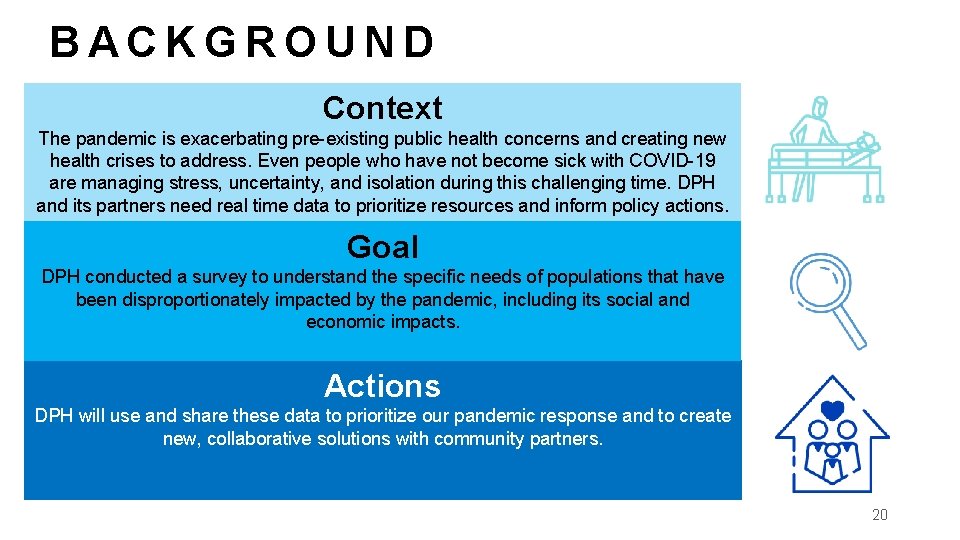
BACKGROUND Context The pandemic is exacerbating pre-existing public health concerns and creating new health crises to address. Even people who have not become sick with COVID-19 are managing stress, uncertainty, and isolation during this challenging time. DPH and its partners need real time data to prioritize resources and inform policy actions. Goal DPH conducted a survey to understand the specific needs of populations that have been disproportionately impacted by the pandemic, including its social and economic impacts. Actions DPH will use and share these data to prioritize our pandemic response and to create new, collaborative solutions with community partners. 20
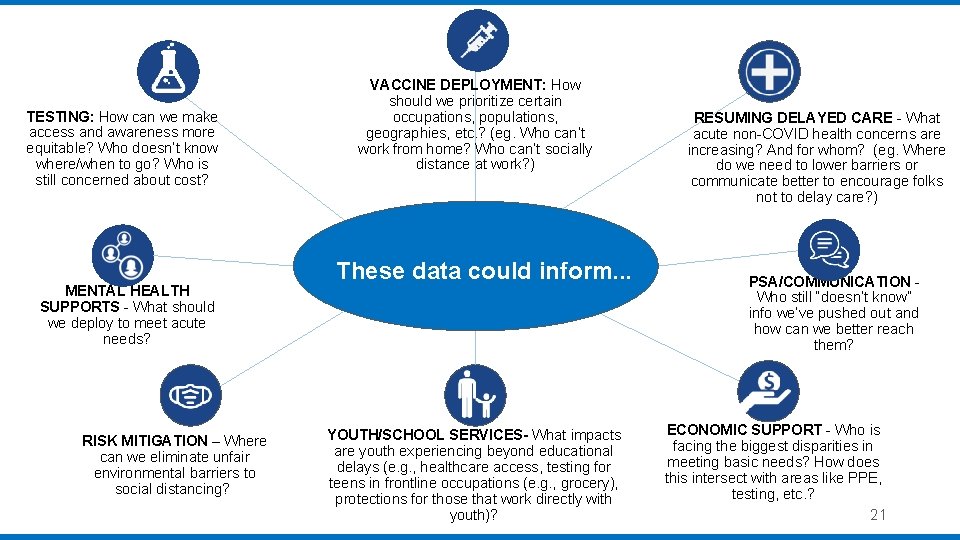
TESTING: How can we make access and awareness more equitable? Who doesn’t know where/when to go? Who is still concerned about cost? MENTAL HEALTH SUPPORTS - What should we deploy to meet acute needs? RISK MITIGATION – Where can we eliminate unfair environmental barriers to social distancing? VACCINE DEPLOYMENT: How should we prioritize certain occupations, populations, geographies, etc. ? (eg. Who can’t work from home? Who can’t socially distance at work? ) These data could inform. . . YOUTH/SCHOOL SERVICES- What impacts are youth experiencing beyond educational delays (e. g. , healthcare access, testing for teens in frontline occupations (e. g. , grocery), protections for those that work directly with youth)? RESUMING DELAYED CARE - What acute non-COVID health concerns are increasing? And for whom? (eg. Where do we need to lower barriers or communicate better to encourage folks not to delay care? ) PSA/COMMUNICATION Who still “doesn’t know” info we’ve pushed out and how can we better reach them? ECONOMIC SUPPORT - Who is facing the biggest disparities in meeting basic needs? How does this intersect with areas like PPE, testing, etc. ? 21
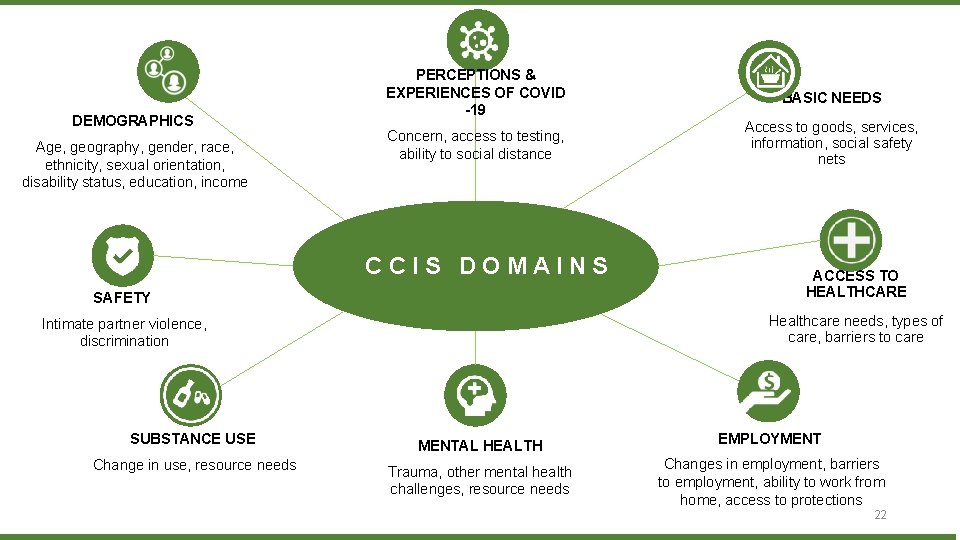
DEMOGRAPHICS Age, geography, gender, race, ethnicity, sexual orientation, disability status, education, income PERCEPTIONS & EXPERIENCES OF COVID -19 BASIC NEEDS Concern, access to testing, ability to social distance Access to goods, services, information, social safety nets CCIS DOMAINS SAFETY ACCESS TO HEALTHCARE Intimate partner violence, discrimination Healthcare needs, types of care, barriers to care SUBSTANCE USE MENTAL HEALTH EMPLOYMENT Change in use, resource needs Trauma, other mental health challenges, resource needs Changes in employment, barriers to employment, ability to work from home, access to protections 22
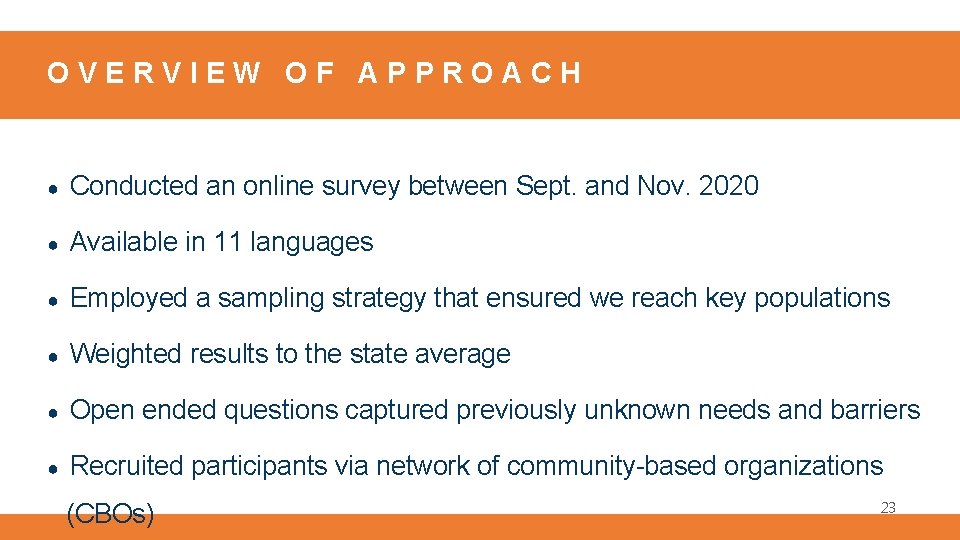
OVERVIEW OF APPROACH ● Conducted an online survey between Sept. and Nov. 2020 ● Available in 11 languages ● Employed a sampling strategy that ensured we reach key populations ● Weighted results to the state average ● Open ended questions captured previously unknown needs and barriers ● Recruited participants via network of community-based organizations (CBOs) 23
We intentionally worked to reach these Priority Populations: ● ● ● ● People of color LGBTQ+ individuals People with disabilities Essential workers People experiencing housing instability Older adults Individuals living in areas hardest hit by COVID 19 24 Preliminary data - 1. 7. 21 - Not for external distribution
Recruitment efforts were overwhelmingly successful ● ● ● Over 33, 000 adult respondents in the final sample More respondents from western and central MA, than in the entire statewide samples of past surveillance surveys* (eg. BRFSS). Compared to past surveillance surveys, CCIS priority population samples reached: ○ 10 x as many Alaska Native/Native Americans ○ 10 x as many LGBTQ respondents ○ 5 x as many residents who speak languages other than English ○ 5 x as many Hispanic residents ○ 5 x as many Asian residents ○ Over twice as many respondents in other populations including the deaf/hard of hearing and Black community • Additional Focus Groups were conducted with the Deaf/Hard of Hearing community *example comparison rates were calculated in comparison to the 2019 Behavioral Risk Factor Surveillance Survey (BRFSS) sample sizes 25
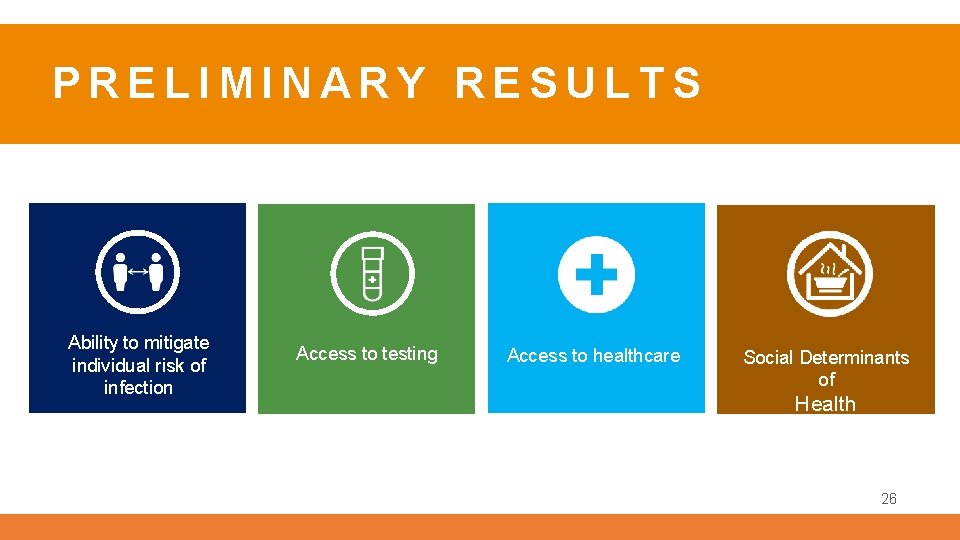
PRELIMINARY RESULTS Ability to mitigate individual risk of infection Access to testing Access to healthcare Social Determinants of Health 26
ABILITY TO MITIGATE INDIVIDUAL RISK OF INFECTION 2 7
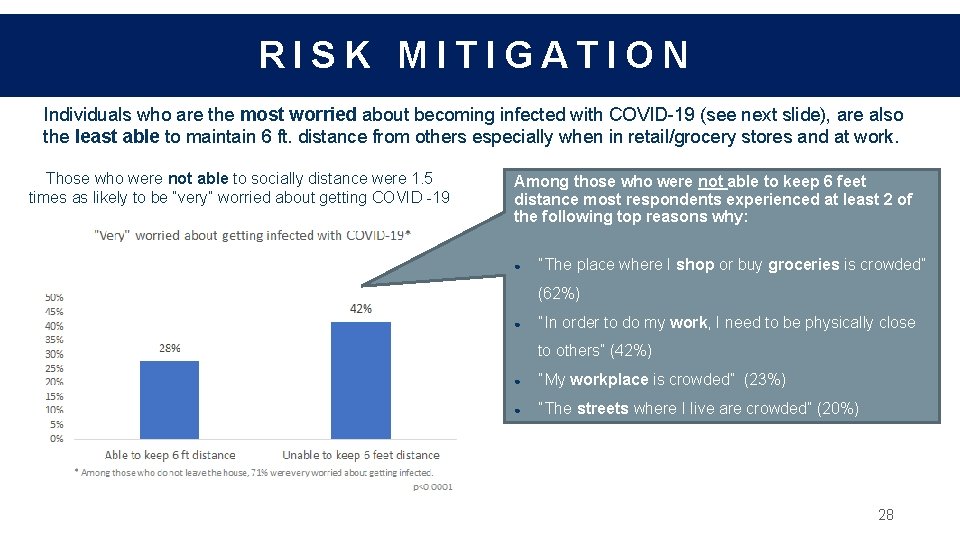
RISK MITIGATION Individuals who are the most worried about becoming infected with COVID-19 (see next slide), are also the least able to maintain 6 ft. distance from others especially when in retail/grocery stores and at work. Those who were not able to socially distance were 1. 5 times as likely to be “very” worried about getting COVID -19 Among those who were not able to keep 6 feet distance most respondents experienced at least 2 of the following top reasons why: ● “The place where I shop or buy groceries is crowded” (62%) ● “In order to do my work, I need to be physically close to others” (42%) ● “My workplace is crowded” (23%) ● “The streets where I live are crowded” (20%) 28
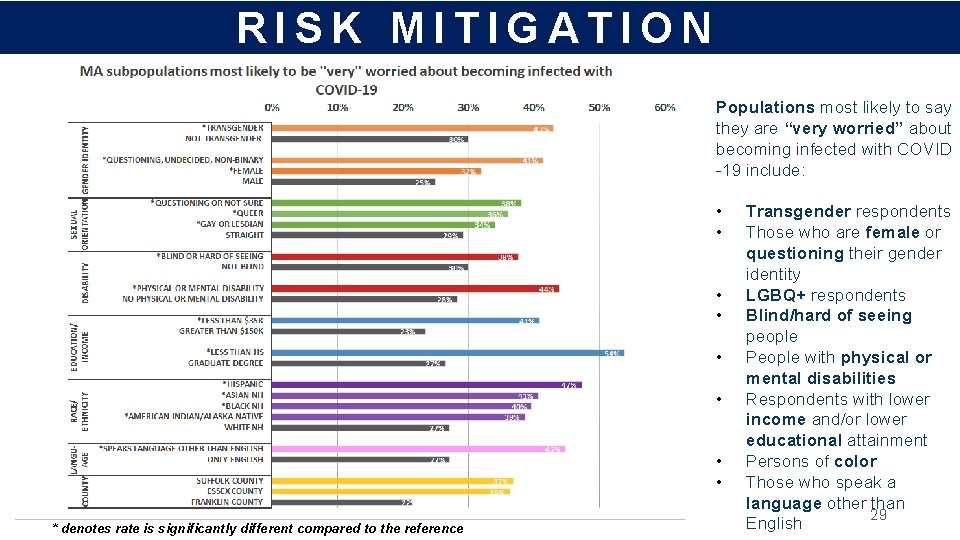
RISK MITIGATION Populations most likely to say they are “very worried” about becoming infected with COVID -19 include: • • * denotes rate is significantly different compared to the reference Transgender respondents Those who are female or questioning their gender identity LGBQ+ respondents Blind/hard of seeing people People with physical or mental disabilities Respondents with lower income and/or lower educational attainment Persons of color Those who speak a language other than 29 English
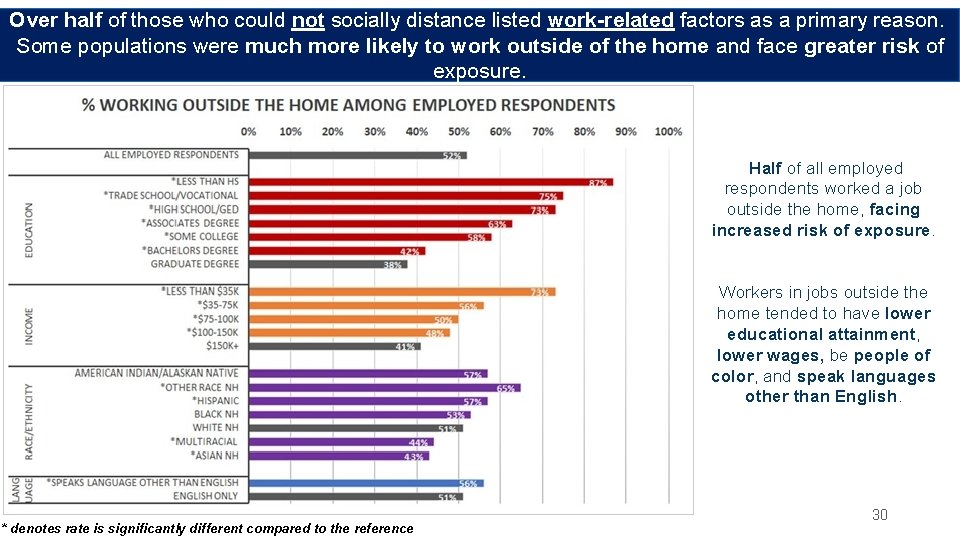
Over half of those who could not socially distance listed work-related factors as a primary reason. Some populations were much more likely to work outside of the home and face greater risk of exposure. Half of all employed respondents worked a job outside the home, facing increased risk of exposure. Workers in jobs outside the home tended to have lower educational attainment, lower wages, be people of color, and speak languages other than English. * denotes rate is significantly different compared to the reference 30
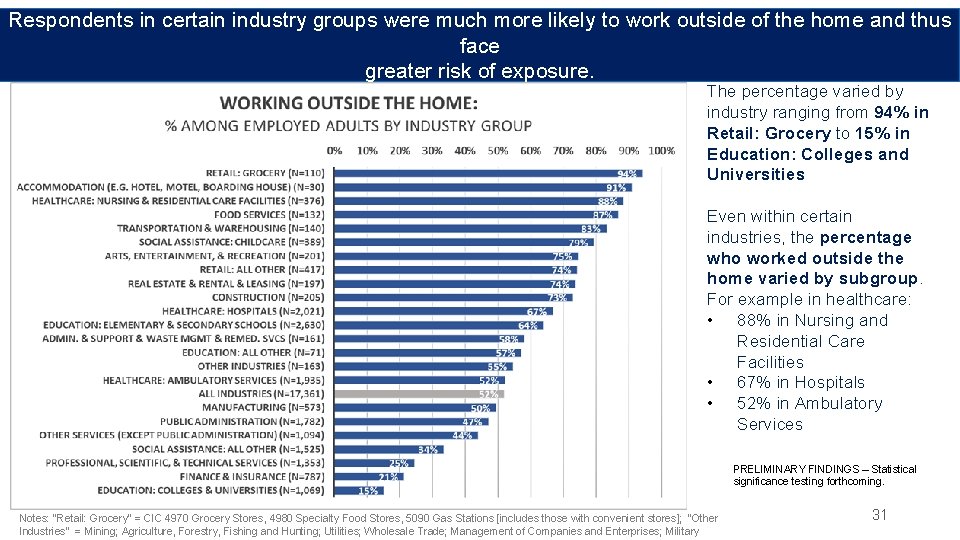
Respondents in certain industry groups were much more likely to work outside of the home and thus face greater risk of exposure. The percentage varied by industry ranging from 94% in Retail: Grocery to 15% in Education: Colleges and Universities Even within certain industries, the percentage who worked outside the home varied by subgroup. For example in healthcare: • 88% in Nursing and Residential Care Facilities • 67% in Hospitals • 52% in Ambulatory Services PRELIMINARY FINDINGS – Statistical significance testing forthcoming. Notes: "Retail: Grocery" = CIC 4970 Grocery Stores, 4980 Specialty Food Stores, 5090 Gas Stations [includes those with convenient stores]; "Other Industries" = Mining; Agriculture, Forestry, Fishing and Hunting; Utilities; Wholesale Trade; Management of Companies and Enterprises; Military 31
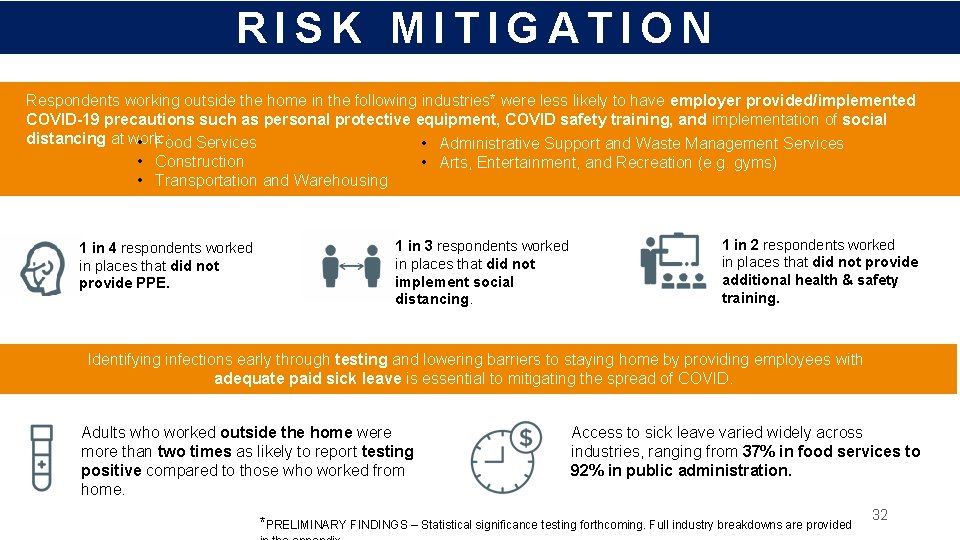
RISK MITIGATION Respondents working outside the home in the following industries* were less likely to have employer provided/implemented COVID-19 precautions such as personal protective equipment, COVID safety training, and implementation of social distancing at work : • Food Services • Administrative Support and Waste Management Services • Construction • Arts, Entertainment, and Recreation (e. g. gyms) • Transportation and Warehousing 1 in 4 respondents worked in places that did not provide PPE. 1 in 3 respondents worked in places that did not implement social distancing. 1 in 2 respondents worked in places that did not provide additional health & safety training. Identifying infections early through testing and lowering barriers to staying home by providing employees with adequate paid sick leave is essential to mitigating the spread of COVID. Adults who worked outside the home were more than two times as likely to report testing positive compared to those who worked from home. Access to sick leave varied widely across industries, ranging from 37% in food services to 92% in public administration. *PRELIMINARY FINDINGS – Statistical significance testing forthcoming. Full industry breakdowns are provided 32
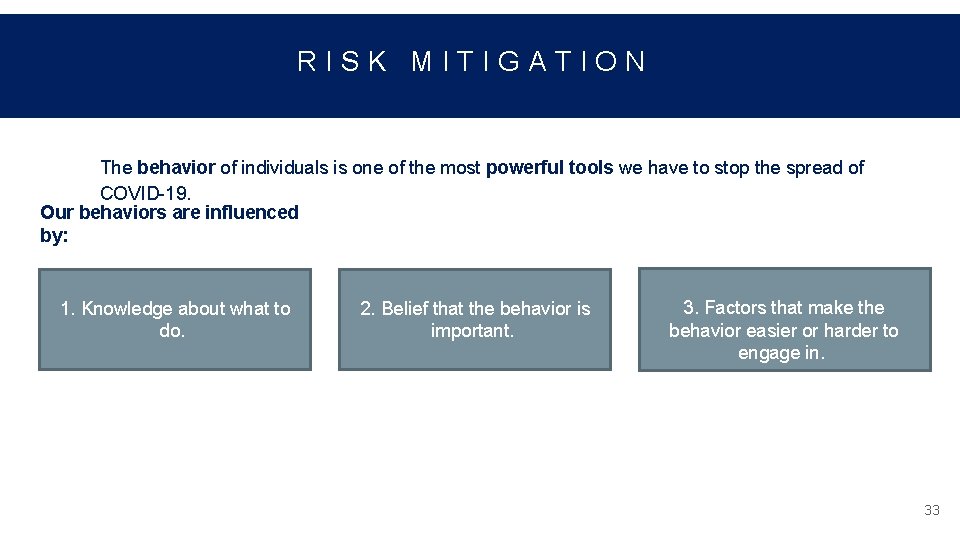
RISK MITIGATION The behavior of individuals is one of the most powerful tools we have to stop the spread of COVID-19. Our behaviors are influenced by: 1. Knowledge about what to do. 2. Belief that the behavior is important. 3. Factors that make the behavior easier or harder to engage in. 33
TESTING ACCESS 34
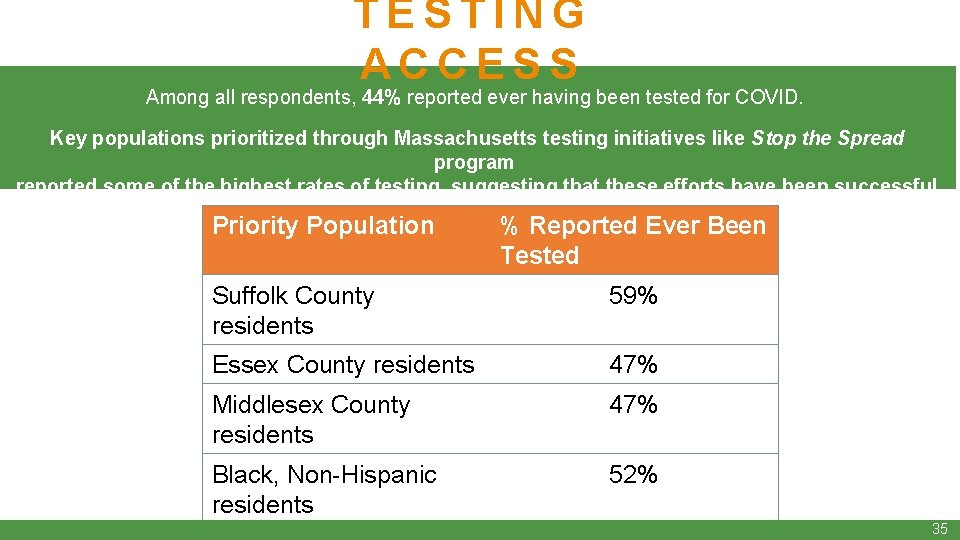
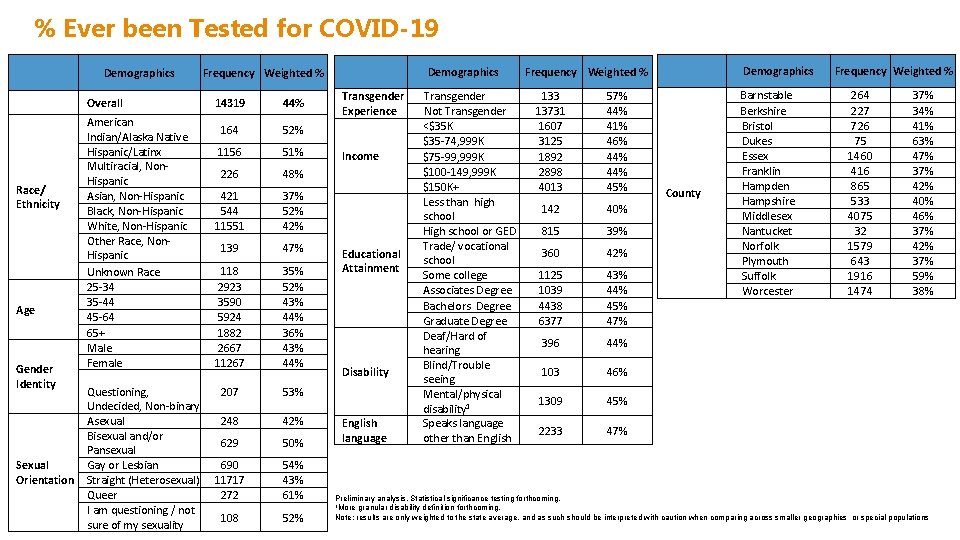
TESTING ACCESS Among all respondents, 44% reported ever having been tested for COVID. Key populations prioritized through Massachusetts testing initiatives like Stop the Spread program reported some of the highest rates of testing, suggesting that these efforts have been successful. Priority Population % Reported Ever Been Tested Suffolk County residents 59% Essex County residents 47% Middlesex County residents 47% Black, Non-Hispanic residents 52% Preliminary data - 1. 7. 21 - Not for external distribution 35
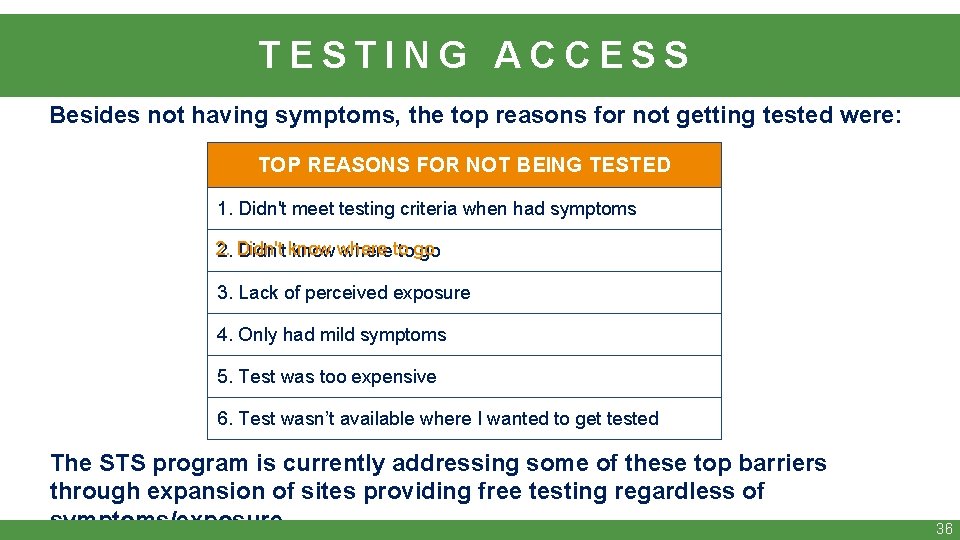
TESTING ACCESS Besides not having symptoms, the top reasons for not getting tested were: TOP REASONS FOR NOT BEING TESTED 1. Didn't meet testing criteria when had symptoms 2. 2. Didn't know whereto togo go 3. Lack of perceived exposure 4. Only had mild symptoms 5. Test was too expensive 6. Test wasn’t available where I wanted to get tested The STS program is currently addressing some of these top barriers through expansion of sites providing free testing regardless of symptoms/exposure. Preliminary data - 1. 7. 21 - Not for external distribution 36
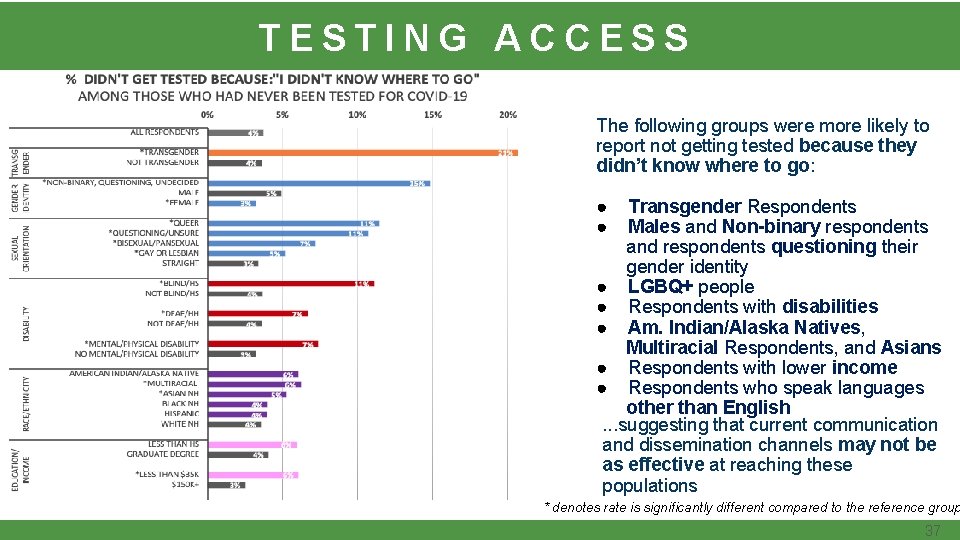
TESTING ACCESS Preliminary data - 1. 7. 21 - Not for external distribution The following groups were more likely to report not getting tested because they didn’t know where to go: ● ● Transgender Respondents Males and Non-binary respondents and respondents questioning their gender identity ● LGBQ+ people ● Respondents with disabilities ● Am. Indian/Alaska Natives, Multiracial Respondents, and Asians ● Respondents with lower income ● Respondents who speak languages other than English. . . suggesting that current communication and dissemination channels may not be as effective at reaching these populations * denotes rate is significantly different compared to the reference group 37
HEALTH CARE ACCESS & DELAYS 38
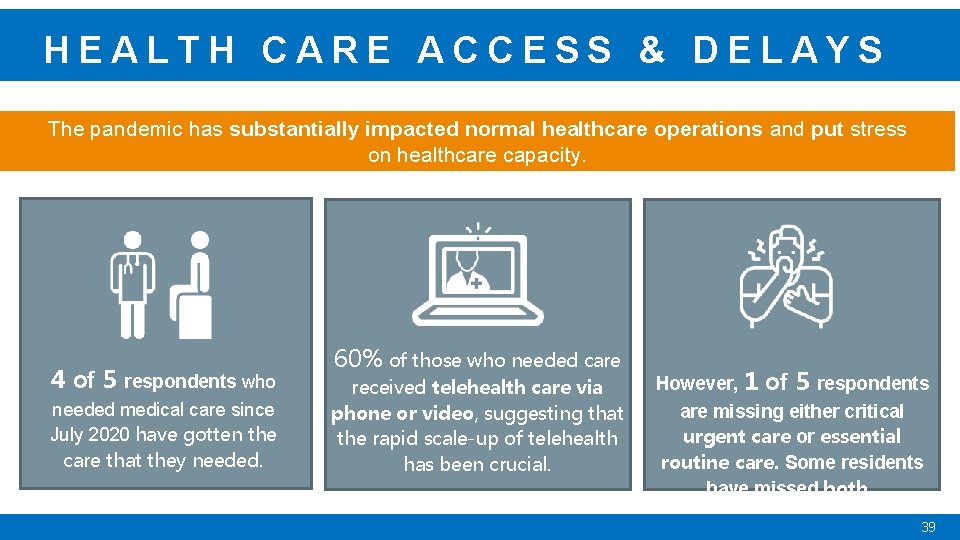
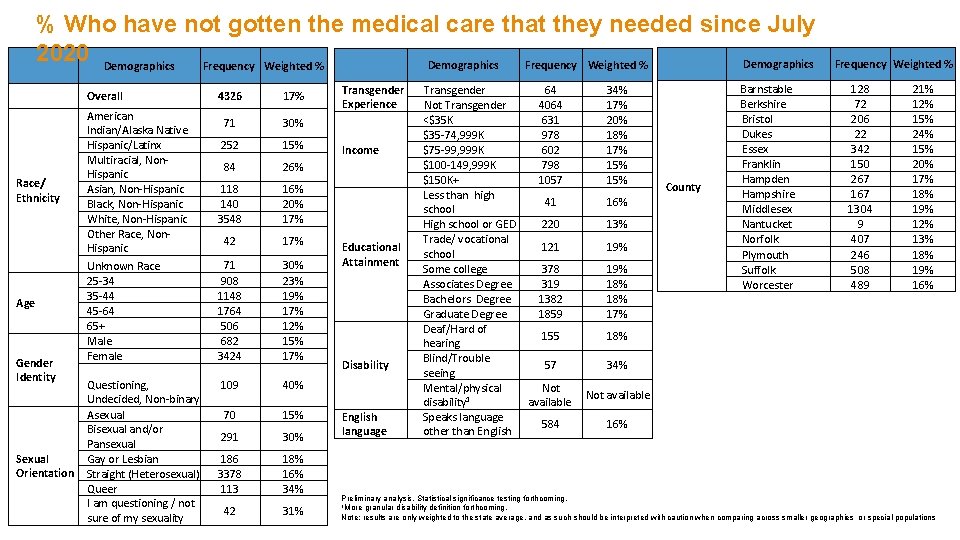
HEALTH CARE ACCESS & DELAYS The pandemic has substantially impacted normal healthcare operations and put stress on healthcare capacity. 4 of 5 respondents who needed medical care since July 2020 have gotten the care that they needed. 60% of those who needed care received telehealth care via phone or video, suggesting that the rapid scale-up of telehealth has been crucial. However, 1 of 5 respondents are missing either critical urgent care or essential routine care. Some residents have missed both. 39
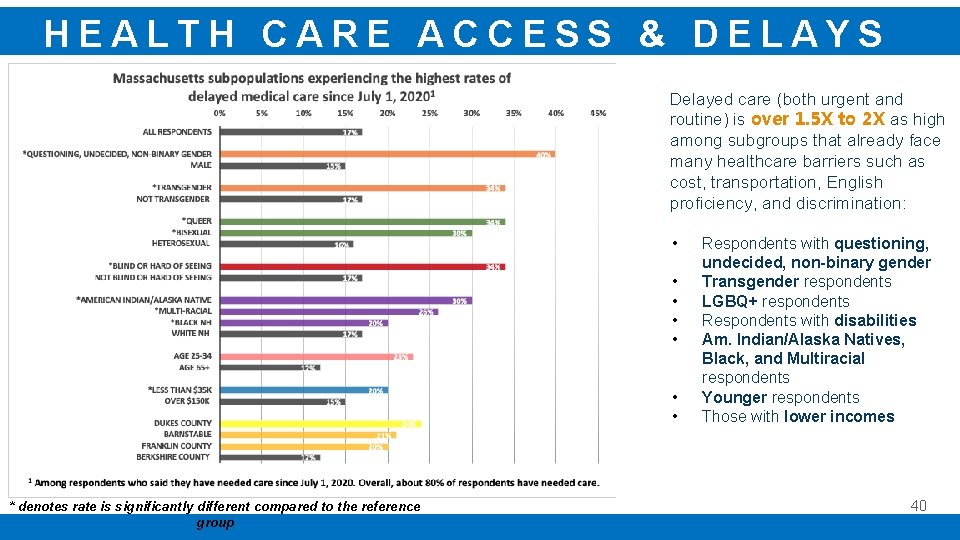
HEALTH CARE ACCESS & DELAYS Delayed care (both urgent and routine) is over 1. 5 X to 2 X as high among subgroups that already face many healthcare barriers such as cost, transportation, English proficiency, and discrimination: • • * denotes rate is significantly different compared to the reference group Respondents with questioning, undecided, non-binary gender Transgender respondents LGBQ+ respondents Respondents with disabilities Am. Indian/Alaska Natives, Black, and Multiracial respondents Younger respondents Those with lower incomes 40
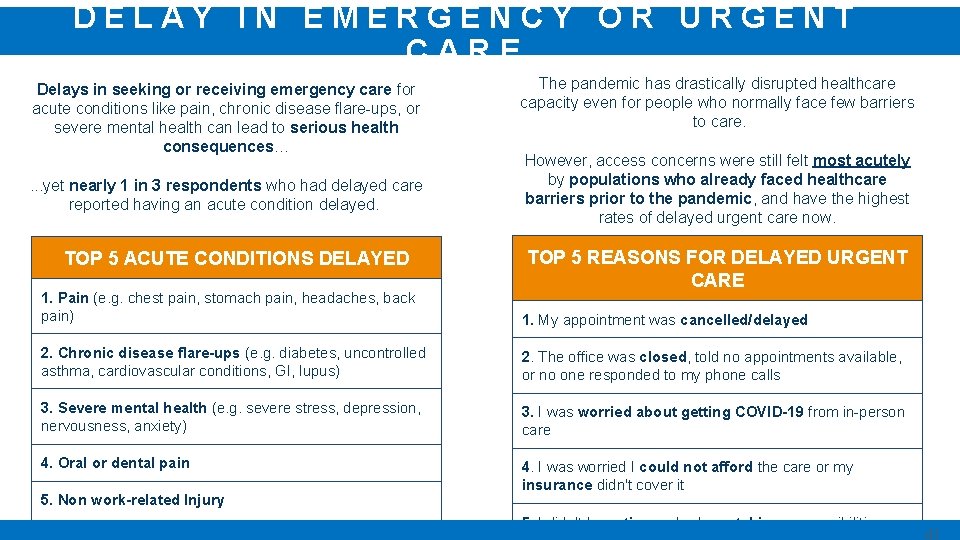
DELAY IN EMERGENCY OR URGENT CARE Delays in seeking or receiving emergency care for acute conditions like pain, chronic disease flare-ups, or severe mental health can lead to serious health consequences…. . . yet nearly 1 in 3 respondents who had delayed care reported having an acute condition delayed. TOP 5 ACUTE CONDITIONS DELAYED The pandemic has drastically disrupted healthcare capacity even for people who normally face few barriers to care. However, access concerns were still felt most acutely by populations who already faced healthcare barriers prior to the pandemic, and have the highest rates of delayed urgent care now. TOP 5 REASONS FOR DELAYED URGENT CARE 1. Pain (e. g. chest pain, stomach pain, headaches, back pain) 1. My appointment was cancelled/delayed 2. Chronic disease flare-ups (e. g. diabetes, uncontrolled asthma, cardiovascular conditions, GI, lupus) 2. The office was closed, told no appointments available, or no one responded to my phone calls 3. Severe mental health (e. g. severe stress, depression, nervousness, anxiety) 3. I was worried about getting COVID-19 from in-person care 4. Oral or dental pain 4. I was worried I could not afford the care or my insurance didn't cover it 5. Non work-related Injury 5. I didn’t have time or had caretaking responsibilities
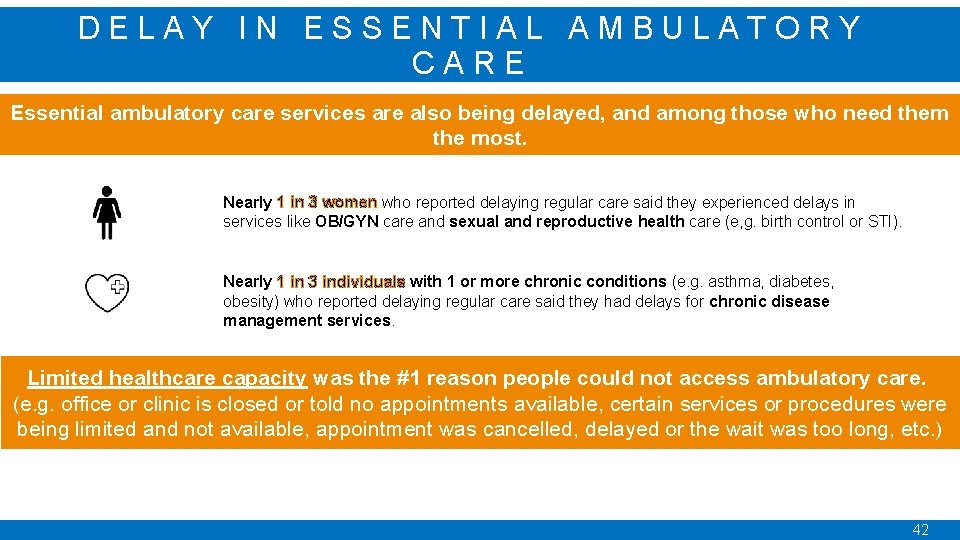
DELAY IN ESSENTIAL AMBULATORY CARE Essential ambulatory care services are also being delayed, and among those who need them the most. Nearly 1 in 3 women who reported delaying regular care said they experienced delays in services like OB/GYN care and sexual and reproductive health care (e, g. birth control or STI). Nearly 1 in 3 individuals with 1 or more chronic conditions (e. g. asthma, diabetes, obesity) who reported delaying regular care said they had delays for chronic disease management services. Limited healthcare capacity was the #1 reason people could not access ambulatory care. (e. g. office or clinic is closed or told no appointments available, certain services or procedures were being limited and not available, appointment was cancelled, delayed or the wait was too long, etc. ) 42
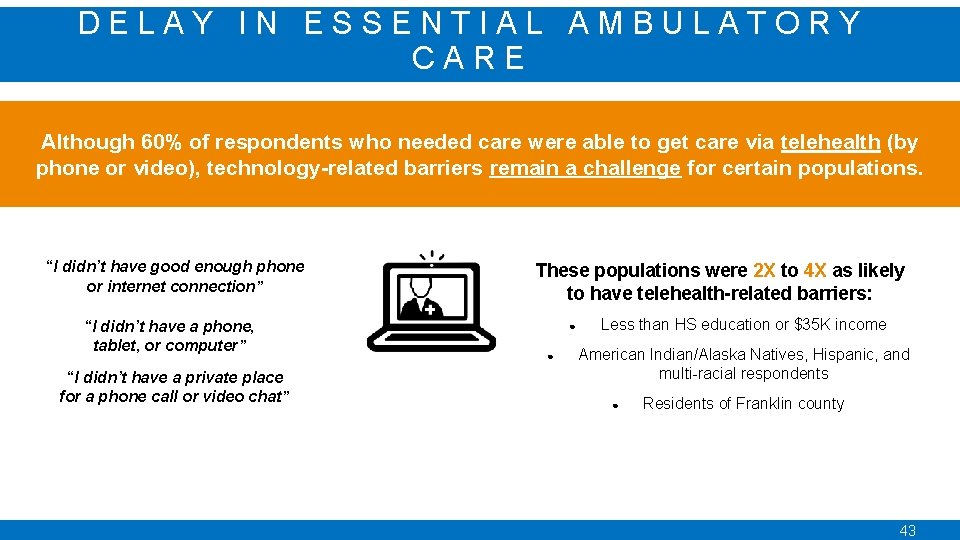
DELAY IN ESSENTIAL AMBULATORY CARE Although 60% of respondents who needed care were able to get care via telehealth (by phone or video), technology-related barriers remain a challenge for certain populations. “I didn’t have good enough phone or internet connection” “I didn’t have a phone, tablet, or computer” “I didn’t have a private place for a phone call or video chat” Preliminary data - 1. 7. 21 - Not for external distribution These populations were 2 X to 4 X as likely to have telehealth-related barriers: ● ● Less than HS education or $35 K income American Indian/Alaska Natives, Hispanic, and multi-racial respondents ● Residents of Franklin county 43
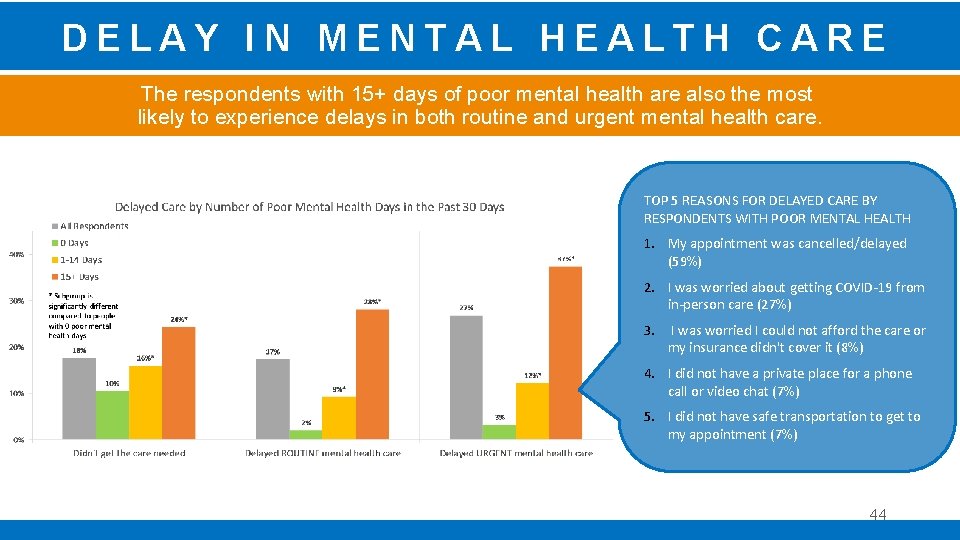
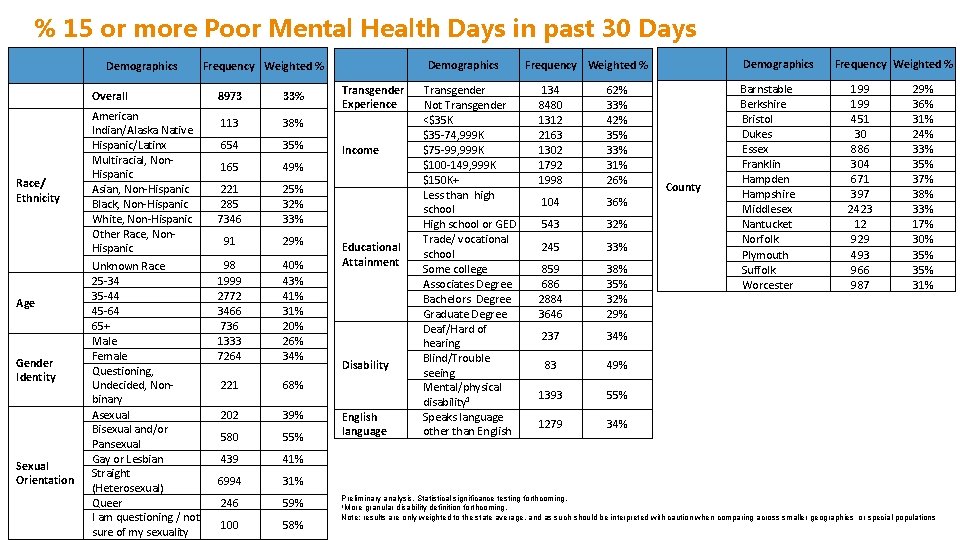
DELAY IN MENTAL HEALTH CARE The respondents with 15+ days of poor mental health are also the most likely to experience delays in both routine and urgent mental health care. Preliminary data - 1. 7. 21 - Not for external distribution TOP 5 REASONS FOR DELAYED CARE BY RESPONDENTS WITH POOR MENTAL HEALTH 1. My appointment was cancelled/delayed (59%) 2. I was worried about getting COVID-19 from in-person care (27%) 3. I was worried I could not afford the care or my insurance didn't cover it (8%) 4. I did not have a private place for a phone call or video chat (7%) 5. I did not have safe transportation to get to my appointment (7%) 44
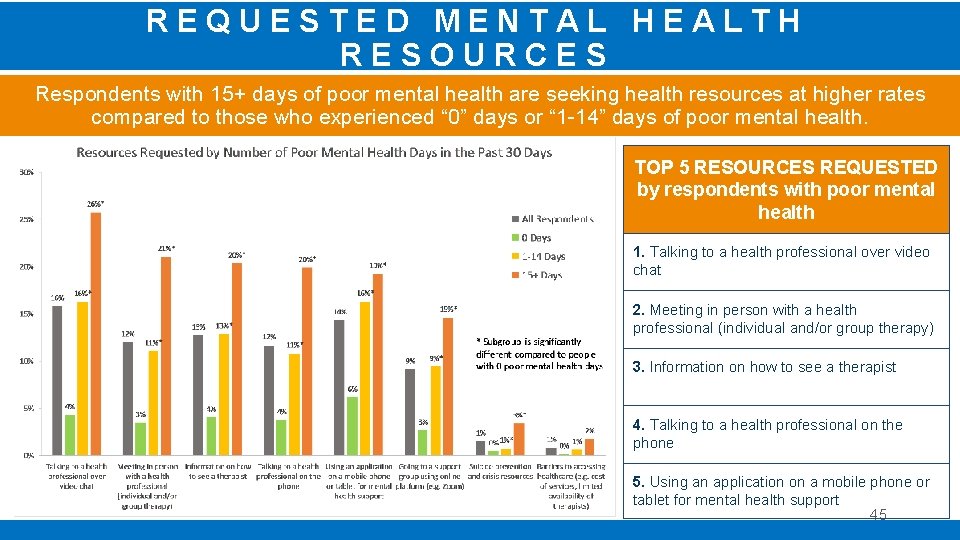
REQUESTED MENTAL HEALTH RESOURCES Respondents with 15+ days of poor mental health are seeking health resources at higher rates compared to those who experienced “ 0” days or “ 1 -14” days of poor mental health. Preliminary data - 1. 7. 21 - Not for external distribution TOP 5 RESOURCES REQUESTED by respondents with poor mental health 1. Talking to a health professional over video chat 2. Meeting in person with a health professional (individual and/or group therapy) 3. Information on how to see a therapist 4. Talking to a health professional on the phone 5. Using an application on a mobile phone or tablet for mental health support 45
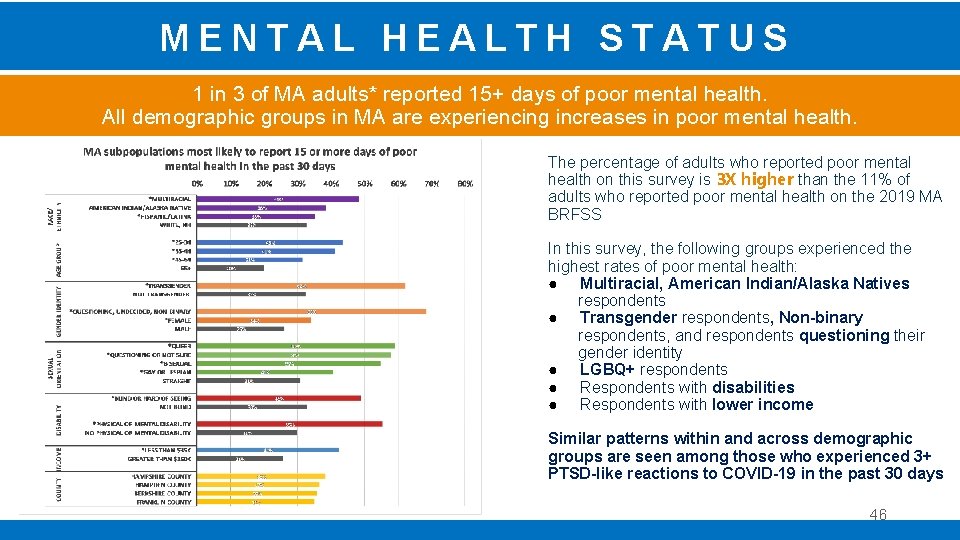
MENTAL HEALTH STATUS 1 in 3 of MA adults* reported 15+ days of poor mental health. All demographic groups in MA are experiencing increases in poor mental health. Preliminary data - 1. 7. 21 - Not for external distribution The percentage of adults who reported poor mental health on this survey is 3 X higher than the 11% of adults who reported poor mental health on the 2019 MA BRFSS In this survey, the following groups experienced the highest rates of poor mental health: ● Multiracial, American Indian/Alaska Natives respondents ● Transgender respondents, Non-binary respondents, and respondents questioning their gender identity ● LGBQ+ respondents ● Respondents with disabilities ● Respondents with lower income Similar patterns within and across demographic groups are seen among those who experienced 3+ PTSD-like reactions to COVID-19 in the past 30 days 46
SOCIAL DETERMINANTS OF HEALTH 4 7
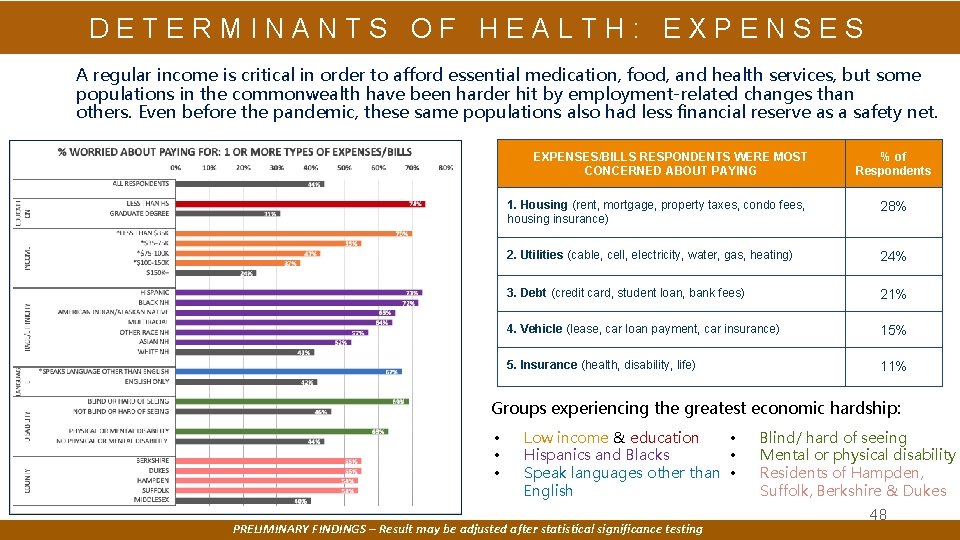
DETERMINANTS OF HEALTH: EXPENSES A regular income is critical in order to afford essential medication, food, and health services, but some populations in the commonwealth have been harder hit by employment-related changes than others. Even before the pandemic, these same populations also had less financial reserve as a safety net. EXPENSES/BILLS RESPONDENTS WERE MOST CONCERNED ABOUT PAYING % of Respondents 1. Housing (rent, mortgage, property taxes, condo fees, housing insurance) 28% 2. Utilities (cable, cell, electricity, water, gas, heating) 24% 3. Debt (credit card, student loan, bank fees) 21% 4. Vehicle (lease, car loan payment, car insurance) 15% 5. Insurance (health, disability, life) 11% Groups experiencing the greatest economic hardship: • • Low income & education • Hispanics and Blacks Speak languages other than • English PRELIMINARY FINDINGS – Result may be adjusted after statistical significance testing Blind/ hard of seeing Mental or physical disability Residents of Hampden, Suffolk, Berkshire & Dukes 48
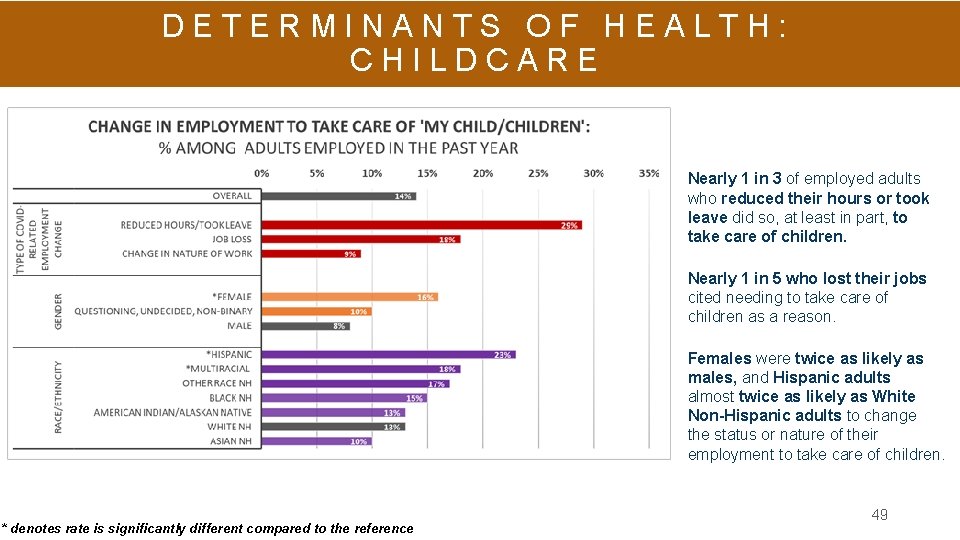
D E TR E IRSMK I NM A NI T T SI GOAF THI EOANL T H : CHILDCARE Nearly 1 in 3 of employed adults who reduced their hours or took leave did so, at least in part, to take care of children. Nearly 1 in 5 who lost their jobs cited needing to take care of children as a reason. Females were twice as likely as males, and Hispanic adults almost twice as likely as White Non-Hispanic adults to change the status or nature of their employment to take care of children. * denotes rate is significantly different compared to the reference 49
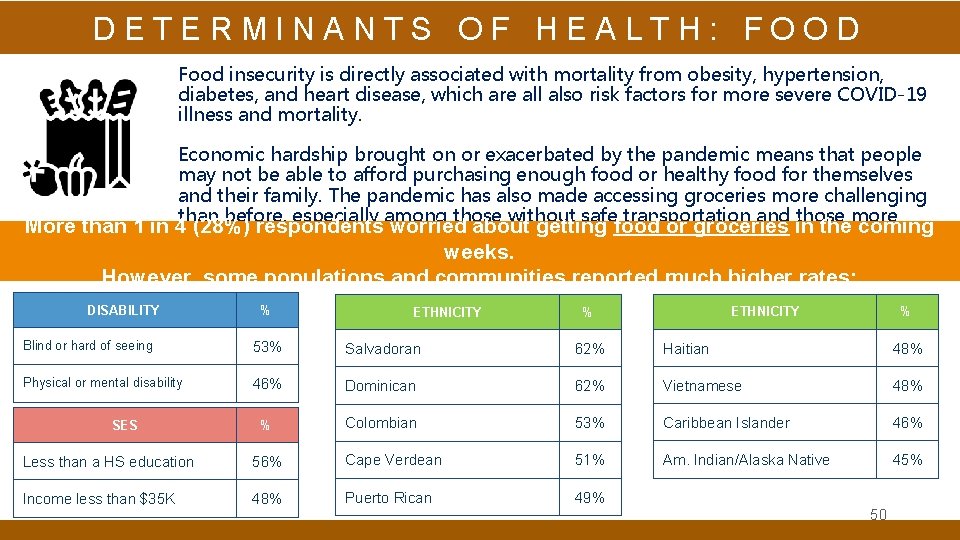
DETERMINANTS OF HEALTH: FOOD Food insecurity is directly associated with mortality from obesity, hypertension, diabetes, and heart disease, which are all also risk factors for more severe COVID-19 illness and mortality. Economic hardship brought on or exacerbated by the pandemic means that people may not be able to afford purchasing enough food or healthy food for themselves and their family. The pandemic has also made accessing groceries more challenging than before, especially among those without safe transportation and those more More than 1 in 4 vulnerable (28%) respondents to COVID-19. worried about getting food or groceries in the coming weeks. However, some populations and communities reported much higher rates: DISABILITY % ETHNICITY % % Blind or hard of seeing 53% Salvadoran 62% Haitian 48% Physical or mental disability 46% Dominican 62% Vietnamese 48% % Colombian 53% Caribbean Islander 46% Am. Indian/Alaska Native 45% SES Less than a HS education 56% Cape Verdean 51% Income less than $35 K 48% Puerto Rican 49% 50
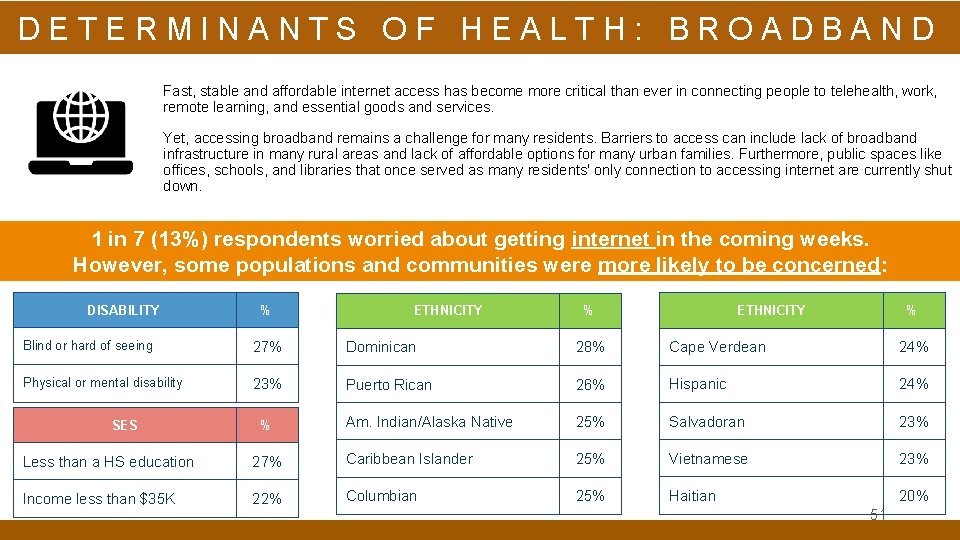
DETERMINANTS OF HEALTH: BROADBAND Fast, stable and affordable internet access has become more critical than ever in connecting people to telehealth, work, remote learning, and essential goods and services. Yet, accessing broadband remains a challenge for many residents. Barriers to access can include lack of broadband infrastructure in many rural areas and lack of affordable options for many urban families. Furthermore, public spaces like offices, schools, and libraries that once served as many residents' only connection to accessing internet are currently shut down. 1 in 7 (13%) respondents worried about getting internet in the coming weeks. However, some populations and communities were more likely to be concerned: DISABILITY % ETHNICITY % % Blind or hard of seeing 27% Dominican 28% Cape Verdean 24% Physical or mental disability 23% Puerto Rican 26% Hispanic 24% Am. Indian/Alaska Native 25% Salvadoran 23% SES % Less than a HS education 27% Caribbean Islander 25% Vietnamese 23% Income less than $35 K 22% Columbian 25% Haitian 20% 51
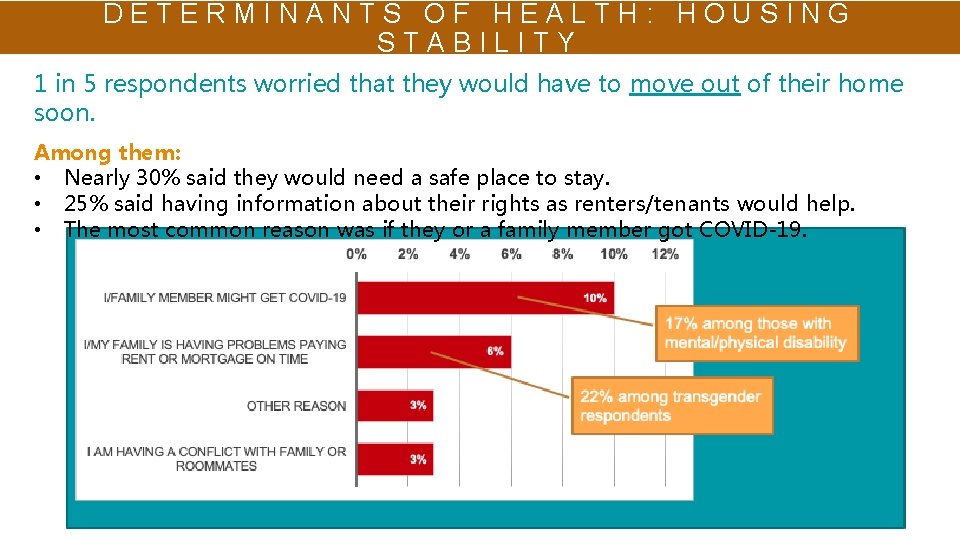
DETERMINANTS OF HEALTH: HOUSING STABILITY 1 in 5 respondents worried that they would have to move out of their home soon. Among them: • Nearly 30% said they would need a safe place to stay. • 25% said having information about their rights as renters/tenants would help. • The most common reason was if they or a family member got COVID-19. 52

DATA TO ACTION 5 3
ENGAGEMENT - OVERVIEW We are getting input from both internal and external stakeholders in order to identify changes needed now and in future efforts. • • Internal = Bureaus, Offices, work groups External = engaged partners (i. e. , HEAG, community partners) Share findings and ask: ● How does this play out for you? ● How to overcome barriers? ● Actions to take now? Focus on priority populations and geographies with racial justice reframing: ● Who benefits? ● Who decides? Who influences? ● Who could be harmed? How to 54
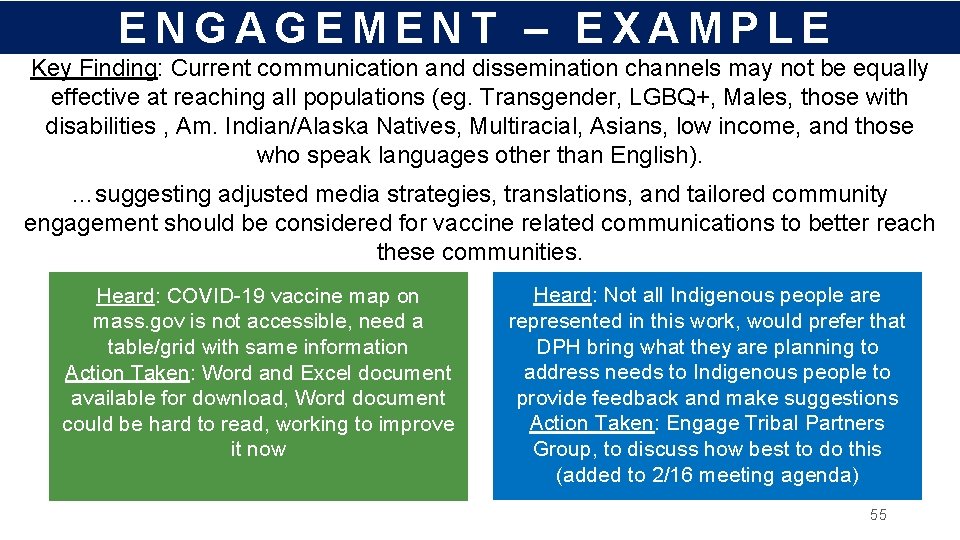
ENGAGEMENT – EXAMPLE Key Finding: Current communication and dissemination channels may not be equally effective at reaching all populations (eg. Transgender, LGBQ+, Males, those with disabilities , Am. Indian/Alaska Natives, Multiracial, Asians, low income, and those who speak languages other than English). …suggesting adjusted media strategies, translations, and tailored community engagement should be considered for vaccine related communications to better reach these communities. Heard: COVID-19 vaccine map on mass. gov is not accessible, need a table/grid with same information Action Taken: Word and Excel document available for download, Word document could be hard to read, working to improve it now Heard: Not all Indigenous people are represented in this work, would prefer that DPH bring what they are planning to address needs to Indigenous people to provide feedback and make suggestions Action Taken: Engage Tribal Partners Group, to discuss how best to do this (added to 2/16 meeting agenda) 55
QUESTIONS & FEEDBACK? 56
APPENDIX Note: results are only weighted to the state average, and as such should be interpreted with caution when comparing across smaller geographies or special populations 57
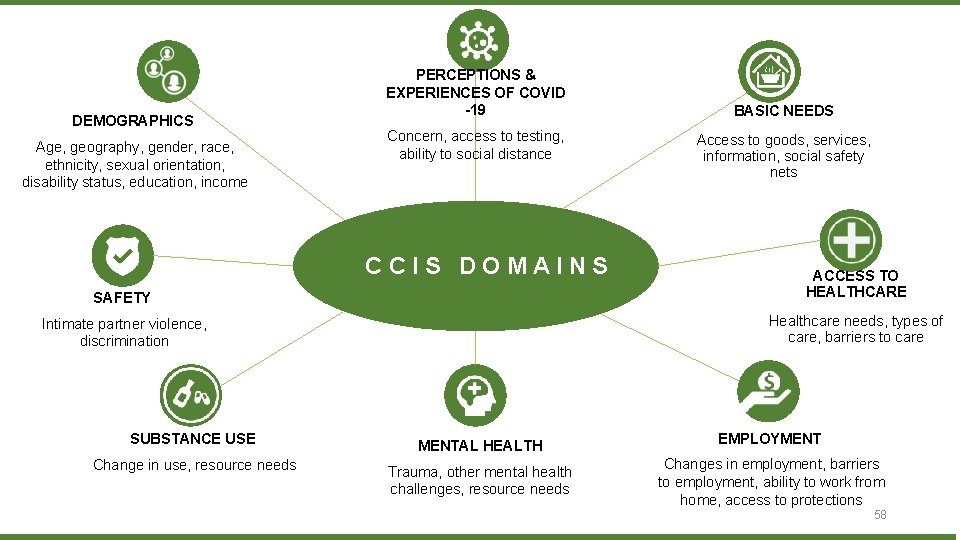
DEMOGRAPHICS Age, geography, gender, race, ethnicity, sexual orientation, disability status, education, income PERCEPTIONS & EXPERIENCES OF COVID -19 Concern, access to testing, ability to social distance CCIS DOMAINS BASIC NEEDS Access to goods, services, information, social safety nets SAFETY ACCESS TO HEALTHCARE Intimate partner violence, discrimination Healthcare needs, types of care, barriers to care SUBSTANCE USE MENTAL HEALTH EMPLOYMENT Change in use, resource needs Trauma, other mental health challenges, resource needs Changes in employment, barriers to employment, ability to work from home, access to protections 58
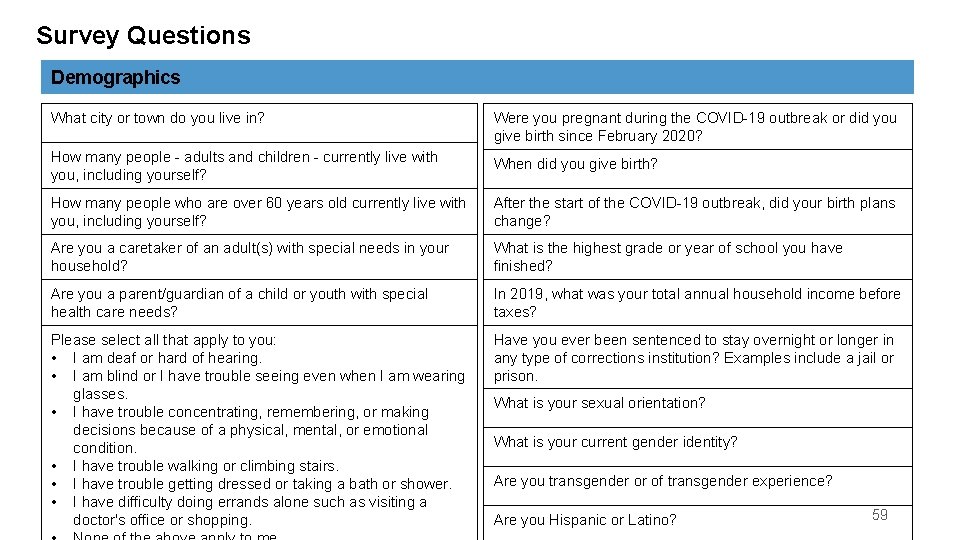
Survey Questions Demographics What city or town do you live in? Were you pregnant during the COVID-19 outbreak or did you give birth since February 2020? How many people - adults and children - currently live with you, including yourself? When did you give birth? How many people who are over 60 years old currently live with you, including yourself? After the start of the COVID-19 outbreak, did your birth plans change? Are you a caretaker of an adult(s) with special needs in your household? What is the highest grade or year of school you have finished? Are you a parent/guardian of a child or youth with special health care needs? In 2019, what was your total annual household income before taxes? Please select all that apply to you: • I am deaf or hard of hearing. • I am blind or I have trouble seeing even when I am wearing glasses. • I have trouble concentrating, remembering, or making decisions because of a physical, mental, or emotional condition. • I have trouble walking or climbing stairs. • I have trouble getting dressed or taking a bath or shower. • I have difficulty doing errands alone such as visiting a doctor's office or shopping. Have you ever been sentenced to stay overnight or longer in any type of corrections institution? Examples include a jail or prison. What is your sexual orientation? What is your current gender identity? Are you transgender or of transgender experience? Are you Hispanic or Latino? 59
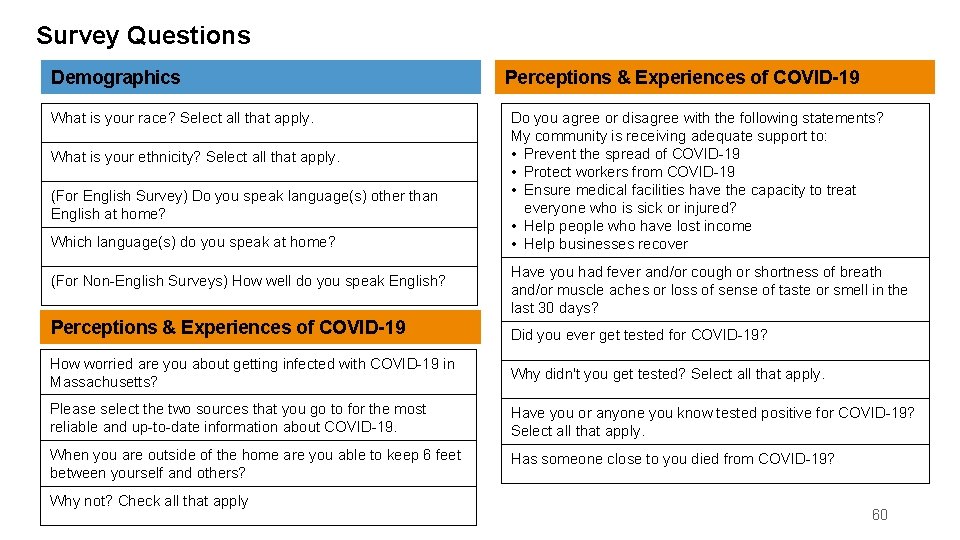
Survey Questions Demographics What is your race? Select all that apply. What is your ethnicity? Select all that apply. (For English Survey) Do you speak language(s) other than English at home? Which language(s) do you speak at home? (For Non-English Surveys) How well do you speak English? Perceptions & Experiences of COVID-19 Do you agree or disagree with the following statements? My community is receiving adequate support to: • Prevent the spread of COVID-19 • Protect workers from COVID-19 • Ensure medical facilities have the capacity to treat everyone who is sick or injured? • Help people who have lost income • Help businesses recover Have you had fever and/or cough or shortness of breath and/or muscle aches or loss of sense of taste or smell in the last 30 days? Perceptions & Experiences of COVID-19 Did you ever get tested for COVID-19? How worried are you about getting infected with COVID-19 in Massachusetts? Why didn't you get tested? Select all that apply. Please select the two sources that you go to for the most reliable and up-to-date information about COVID-19. Have you or anyone you know tested positive for COVID-19? Select all that apply. When you are outside of the home are you able to keep 6 feet between yourself and others? Has someone close to you died from COVID-19? Why not? Check all that apply 60
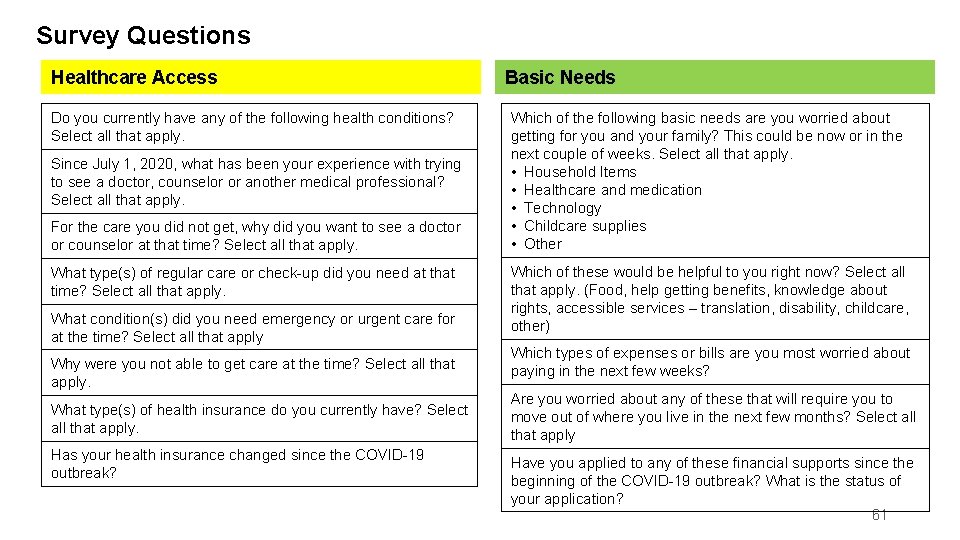
Survey Questions Healthcare Access Do you currently have any of the following health conditions? Select all that apply. Since July 1, 2020, what has been your experience with trying to see a doctor, counselor or another medical professional? Select all that apply. For the care you did not get, why did you want to see a doctor or counselor at that time? Select all that apply. What type(s) of regular care or check-up did you need at that time? Select all that apply. What condition(s) did you need emergency or urgent care for at the time? Select all that apply Why were you not able to get care at the time? Select all that apply. What type(s) of health insurance do you currently have? Select all that apply. Has your health insurance changed since the COVID-19 outbreak? Basic Needs Which of the following basic needs are you worried about getting for you and your family? This could be now or in the next couple of weeks. Select all that apply. • Household Items • Healthcare and medication • Technology • Childcare supplies • Other Which of these would be helpful to you right now? Select all that apply. (Food, help getting benefits, knowledge about rights, accessible services – translation, disability, childcare, other) Which types of expenses or bills are you most worried about paying in the next few weeks? Are you worried about any of these that will require you to move out of where you live in the next few months? Select all that apply Have you applied to any of these financial supports since the beginning of the COVID-19 outbreak? What is the status of your application? 61
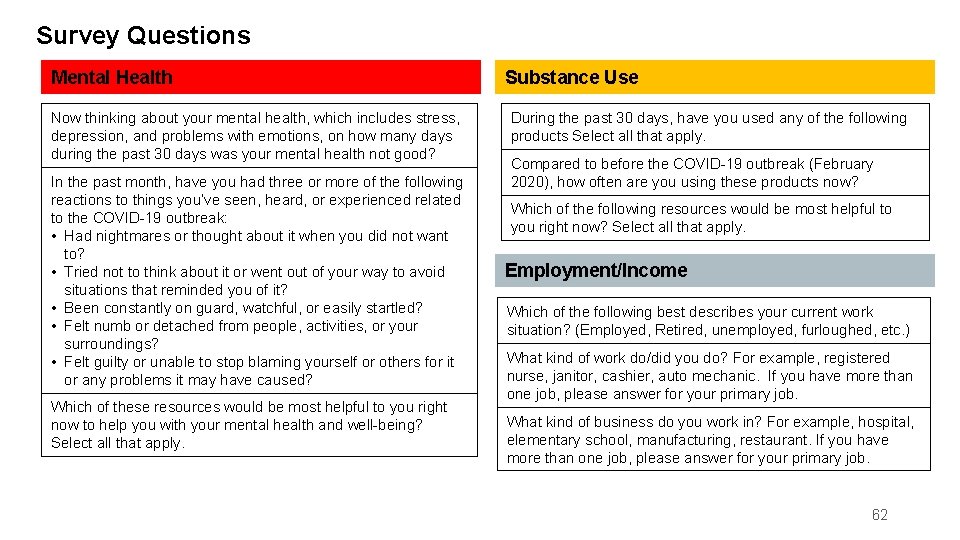
Survey Questions Mental Health Now thinking about your mental health, which includes stress, depression, and problems with emotions, on how many days during the past 30 days was your mental health not good? In the past month, have you had three or more of the following reactions to things you’ve seen, heard, or experienced related to the COVID-19 outbreak: • Had nightmares or thought about it when you did not want to? • Tried not to think about it or went out of your way to avoid situations that reminded you of it? • Been constantly on guard, watchful, or easily startled? • Felt numb or detached from people, activities, or your surroundings? • Felt guilty or unable to stop blaming yourself or others for it or any problems it may have caused? Which of these resources would be most helpful to you right now to help you with your mental health and well-being? Select all that apply. Substance Use During the past 30 days, have you used any of the following products Select all that apply. Compared to before the COVID-19 outbreak (February 2020), how often are you using these products now? Which of the following resources would be most helpful to you right now? Select all that apply. Employment/Income Which of the following best describes your current work situation? (Employed, Retired, unemployed, furloughed, etc. ) What kind of work do/did you do? For example, registered nurse, janitor, cashier, auto mechanic. If you have more than one job, please answer for your primary job. What kind of business do you work in? For example, hospital, elementary school, manufacturing, restaurant. If you have more than one job, please answer for your primary job. 62
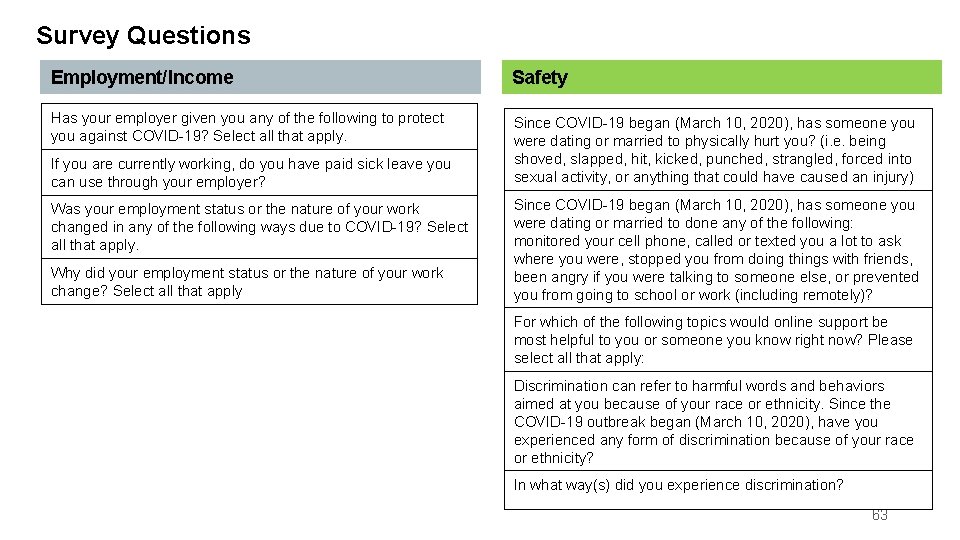
Survey Questions Employment/Income Safety Has your employer given you any of the following to protect you against COVID-19? Select all that apply. Since COVID-19 began (March 10, 2020), has someone you were dating or married to physically hurt you? (i. e. being shoved, slapped, hit, kicked, punched, strangled, forced into sexual activity, or anything that could have caused an injury) If you are currently working, do you have paid sick leave you can use through your employer? Was your employment status or the nature of your work changed in any of the following ways due to COVID-19? Select all that apply. Why did your employment status or the nature of your work change? Select all that apply Since COVID-19 began (March 10, 2020), has someone you were dating or married to done any of the following: monitored your cell phone, called or texted you a lot to ask where you were, stopped you from doing things with friends, been angry if you were talking to someone else, or prevented you from going to school or work (including remotely)? For which of the following topics would online support be most helpful to you or someone you know right now? Please select all that apply: Discrimination can refer to harmful words and behaviors aimed at you because of your race or ethnicity. Since the COVID-19 outbreak began (March 10, 2020), have you experienced any form of discrimination because of your race or ethnicity? In what way(s) did you experience discrimination? 63
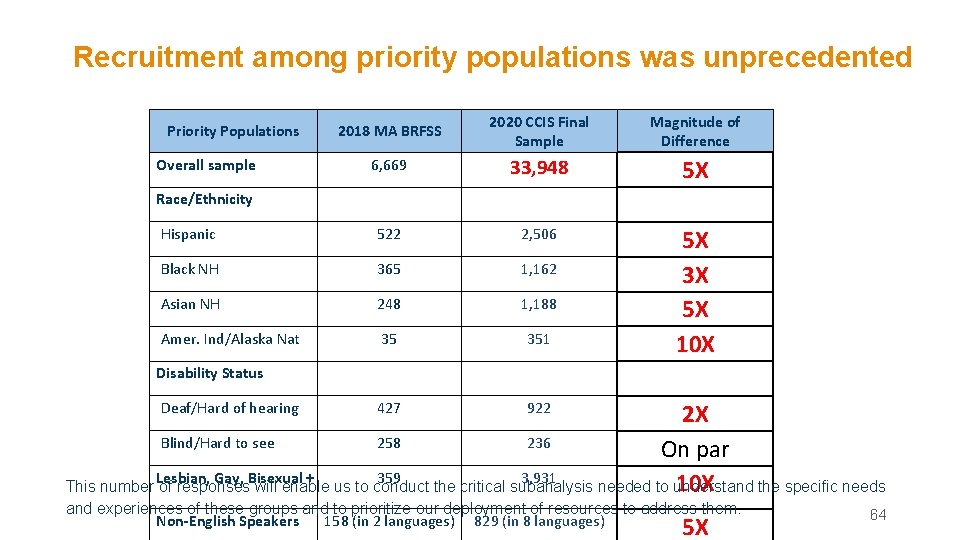
Recruitment among priority populations was unprecedented 2018 MA BRFSS 2020 CCIS Final Sample Magnitude of Difference 6, 669 33, 948 5 X Hispanic 522 2, 506 Black NH 365 1, 162 Asian NH 248 1, 188 Amer. Ind/Alaska Nat 35 351 5 X 3 X 5 X 10 X Priority Populations Overall sample Race/Ethnicity Disability Status 2 X Blind/Hard to see 258 236 On par Lesbian, Gay, Bisexual + 359 3, 931 10 X This number of responses will enable us to conduct the critical subanalysis needed to understand the specific needs Deaf/Hard of hearing 427 922 and experiences of these groups and to prioritize our deployment of resources to address them. Non-English Speakers 158 (in 2 languages) 829 (in 8 languages) 5 X 64
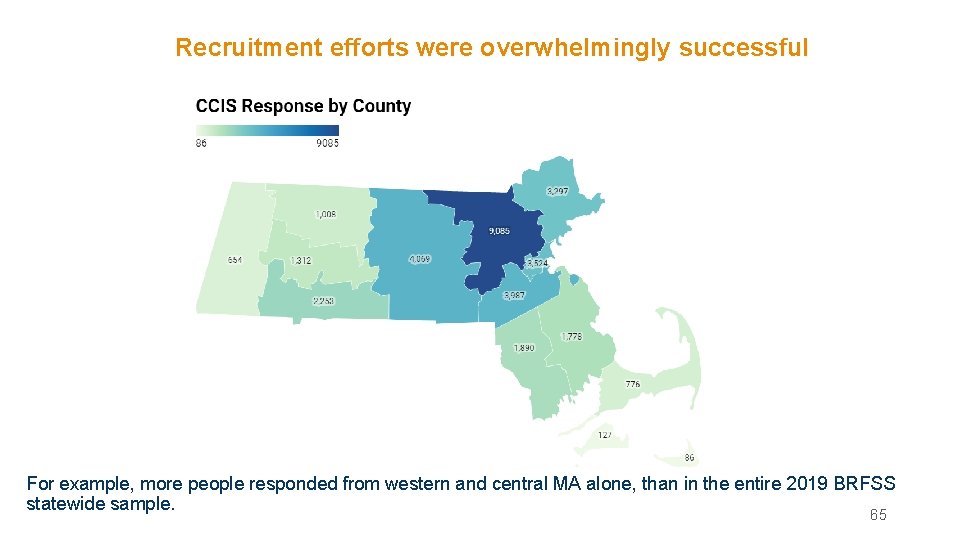
Recruitment efforts were overwhelmingly successful For example, more people responded from western and central MA alone, than in the entire 2019 BRFSS statewide sample. 65
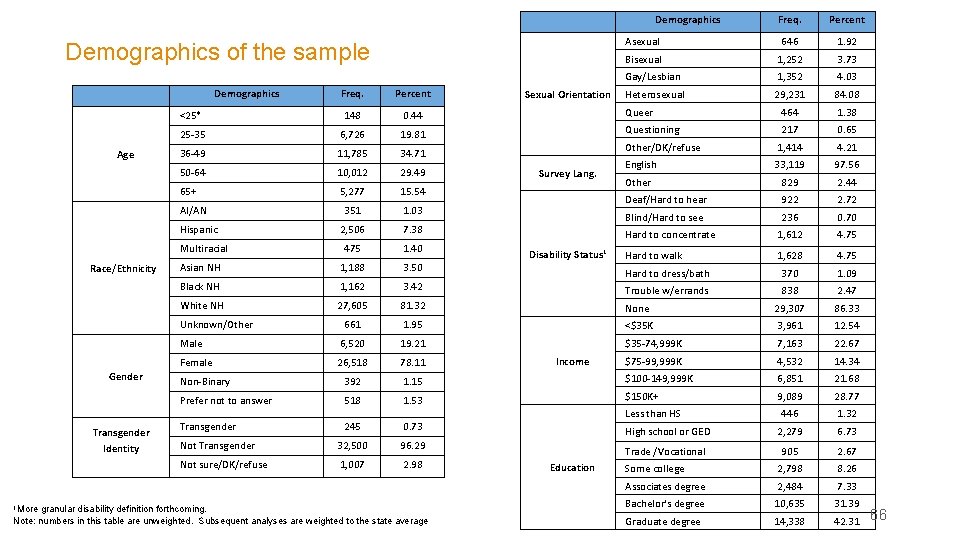
Demographics of the sample Demographics Age 1. 92 Bisexual 1, 252 3. 73 Gay/Lesbian 1, 352 4. 03 Heterosexual 29, 231 84. 08 148 0. 44 Queer 464 1. 38 25 -35 6, 726 19. 81 Questioning 217 0. 65 36 -49 11, 785 34. 71 Other/DK/refuse 1, 414 4. 21 50 -64 10, 012 29. 49 English 33, 119 97. 56 65+ 5, 277 15. 54 Other 829 2. 44 351 1. 03 Deaf/Hard to hear 922 2. 72 2, 506 7. 38 Blind/Hard to see 236 0. 70 Hard to concentrate 1, 612 4. 75 475 1. 40 Asian NH 1, 188 3. 50 Hard to walk 1, 628 4. 75 Hard to dress/bath 370 1. 09 Black NH 1, 162 3. 42 Trouble w/errands 838 2. 47 White NH 27, 605 81. 32 None 29, 307 86. 33 661 1. 95 <$35 K 3, 961 12. 54 Male 6, 520 19. 21 $35 -74, 999 K 7, 163 22. 67 Female 26, 518 78. 11 $75 -99, 999 K 4, 532 14. 34 Non-Binary 392 1. 15 $100 -149, 999 K 6, 851 21. 68 Prefer not to answer 518 1. 53 $150 K+ 9, 089 28. 77 Transgender 245 0. 73 446 1. 32 High school or GED 2, 279 6. 73 Not Transgender 32, 500 96. 29 Trade /Vocational 905 2. 67 Not sure/DK/refuse 1, 007 2. 98 Some college 2, 798 8. 26 Associates degree 2, 484 7. 33 Bachelor's degree 10, 635 31. 39 Graduate degree 14, 338 42. 31 Unknown/Other 1 More 646 <25* Multiracial Transgender Identity Asexual Percent Hispanic Gender Percent Freq. AI/AN Race/Ethnicity Freq. granular disability definition forthcoming. Note: numbers in this table are unweighted. Subsequent analyses are weighted to the state average Sexual Orientation Survey Lang. Disability Status 1 Income Less than HS Education 66
ABILITY TO MITIGATE INDIVIDUAL RISK OF INFECTION 6 7
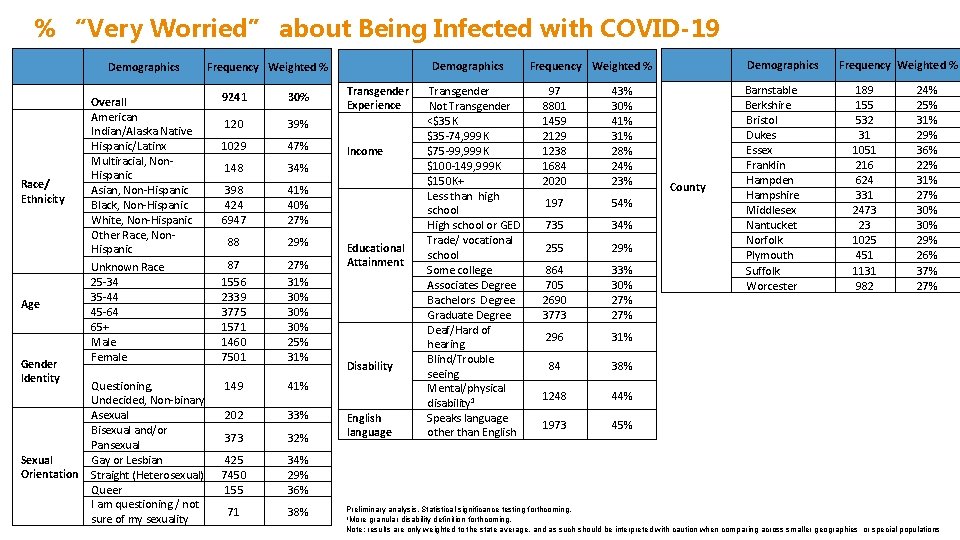
% “Very Worried” about Being Infected with COVID-19 Demographics Race/ Ethnicity Age Gender Identity Sexual Orientation Demographics Frequency Weighted % Overall American Indian/Alaska Native Hispanic/Latinx Multiracial, Non. Hispanic Asian, Non-Hispanic Black, Non-Hispanic White, Non-Hispanic Other Race, Non. Hispanic Unknown Race 25 -34 35 -44 45 -64 65+ Male Female 9241 30% 120 39% 1029 47% 148 34% 398 424 6947 41% 40% 27% 88 29% 87 1556 2339 3775 1571 1460 7501 27% 31% 30% 30% 25% 31% Questioning, Undecided, Non-binary Asexual Bisexual and/or Pansexual Gay or Lesbian Straight (Heterosexual) Queer I am questioning / not sure of my sexuality 149 41% 202 33% 373 32% 425 7450 155 34% 29% 36% 71 38% Transgender Experience Income Educational Attainment Disability English language Transgender Not Transgender <$35 K $35 -74, 999 K $75 -99, 999 K $100 -149, 999 K $150 K+ Less than high school High school or GED Trade/ vocational school Some college Associates Degree Bachelors Degree Graduate Degree Deaf/Hard of hearing Blind/Trouble seeing Mental/physical disability 1 Speaks language other than English Demographics Frequency Weighted % 97 8801 1459 2129 1238 1684 2020 43% 30% 41% 31% 28% 24% 23% 197 54% 735 34% 255 29% 864 705 2690 3773 33% 30% 27% 296 31% 84 38% 1248 44% 1973 45% County Barnstable Berkshire Bristol Dukes Essex Franklin Hampden Hampshire Middlesex Nantucket Norfolk Plymouth Suffolk Worcester Frequency Weighted % 189 155 532 31 1051 216 624 331 2473 23 1025 451 1131 982 24% 25% 31% 29% 36% 22% 31% 27% 30% 29% 26% 37% 27% Preliminary analysis. Statistical significance testing forthcoming. 1 More granular disability definition forthcoming. Note: results are only weighted to the state average, and as such should be interpreted with caution when comparing across smaller geographies or special populations
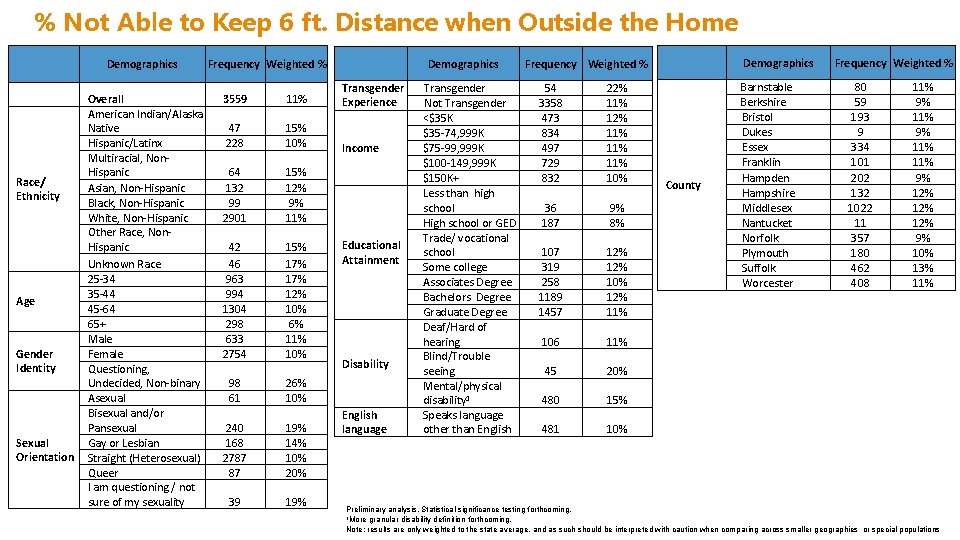
% Not Able to Keep 6 ft. Distance when Outside the Home Demographics Race/ Ethnicity Age Gender Identity Sexual Orientation Overall American Indian/Alaska Native Hispanic/Latinx Multiracial, Non. Hispanic Asian, Non-Hispanic Black, Non-Hispanic White, Non-Hispanic Other Race, Non. Hispanic Unknown Race 25 -34 35 -44 45 -64 65+ Male Female Questioning, Undecided, Non-binary Asexual Bisexual and/or Pansexual Gay or Lesbian Straight (Heterosexual) Queer I am questioning / not sure of my sexuality Demographics Frequency Weighted % 3559 11% Transgender Experience 47 228 15% 10% Income 64 132 99 2901 15% 12% 9% 11% 42 46 963 994 1304 298 633 2754 15% 17% 12% 10% 6% 11% 10% 98 61 26% 10% 240 168 2787 87 19% 14% 10% 20% 39 19% Educational Attainment Disability English language Transgender Not Transgender <$35 K $35 -74, 999 K $75 -99, 999 K $100 -149, 999 K $150 K+ Less than high school High school or GED Trade/ vocational school Some college Associates Degree Bachelors Degree Graduate Degree Deaf/Hard of hearing Blind/Trouble seeing Mental/physical disability 1 Speaks language other than English Demographics Frequency Weighted % 54 3358 473 834 497 729 832 22% 11% 11% 10% 36 187 9% 8% 107 319 258 1189 1457 12% 10% 12% 11% 106 11% 45 20% 480 15% 481 10% County Barnstable Berkshire Bristol Dukes Essex Franklin Hampden Hampshire Middlesex Nantucket Norfolk Plymouth Suffolk Worcester Frequency Weighted % 80 59 193 9 334 101 202 132 1022 11 357 180 462 408 11% 9% 12% 12% 9% 10% 13% 11% Preliminary analysis. Statistical significance testing forthcoming. 1 More granular disability definition forthcoming. Note: results are only weighted to the state average, and as such should be interpreted with caution when comparing across smaller geographies or special populations
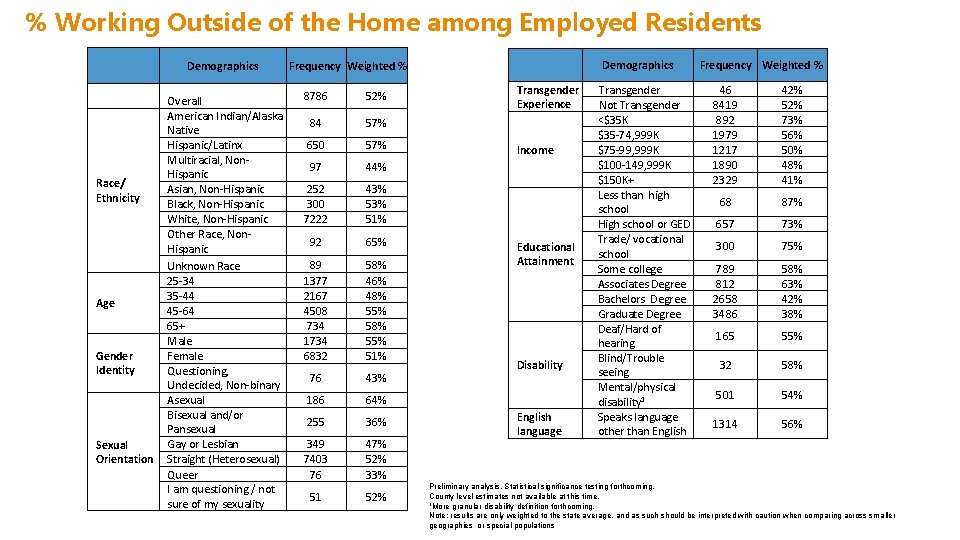
% Working Outside of the Home among Employed Residents Demographics Race/ Ethnicity Age Gender Identity Sexual Orientation Overall American Indian/Alaska Native Hispanic/Latinx Multiracial, Non. Hispanic Asian, Non-Hispanic Black, Non-Hispanic White, Non-Hispanic Other Race, Non. Hispanic Unknown Race 25 -34 35 -44 45 -64 65+ Male Female Questioning, Undecided, Non-binary Asexual Bisexual and/or Pansexual Gay or Lesbian Straight (Heterosexual) Queer I am questioning / not sure of my sexuality Demographics Frequency Weighted % 8786 52% 84 57% 650 57% 97 44% 252 300 7222 43% 51% 92 65% 89 1377 2167 4508 734 1734 6832 58% 46% 48% 55% 51% 76 43% 186 64% 255 36% 349 7403 76 47% 52% 33% 51 52% Transgender Experience Income Educational Attainment Disability English language Transgender Not Transgender <$35 K $35 -74, 999 K $75 -99, 999 K $100 -149, 999 K $150 K+ Less than high school High school or GED Trade/ vocational school Some college Associates Degree Bachelors Degree Graduate Degree Deaf/Hard of hearing Blind/Trouble seeing Mental/physical disability 1 Speaks language other than English Frequency Weighted % 46 8419 892 1979 1217 1890 2329 42% 52% 73% 56% 50% 48% 41% 68 87% 657 73% 300 75% 789 812 2658 3486 58% 63% 42% 38% 165 55% 32 58% 501 54% 1314 56% Preliminary analysis. Statistical significance testing forthcoming. County level estimates not available at this time. 1 More granular disability definition forthcoming. Note: results are only weighted to the state average, and as such should be interpreted with caution when comparing across smaller geographies or special populations
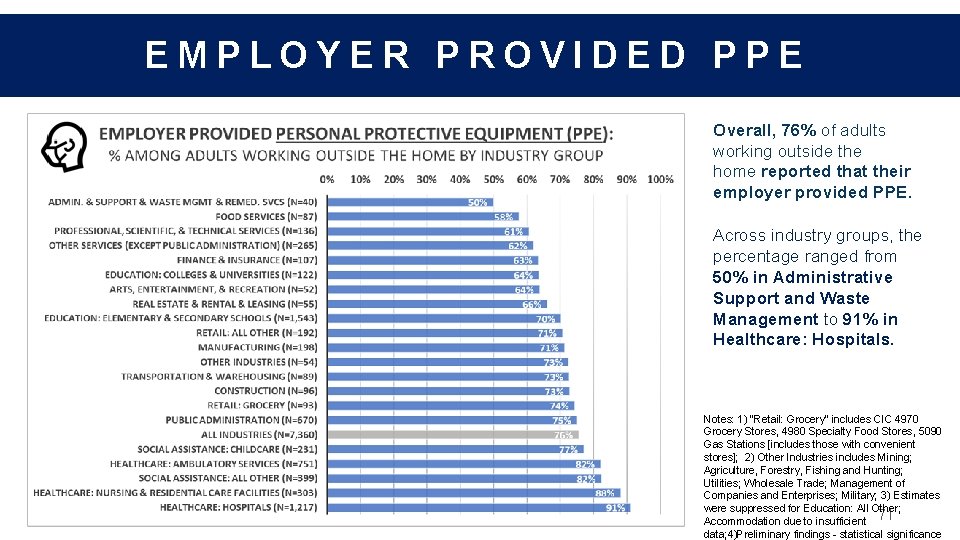
RISK MITIGATION EMPLOYER PROVIDED PPE Overall, 76% of adults working outside the home reported that their employer provided PPE. Across industry groups, the percentage ranged from 50% in Administrative Support and Waste Management to 91% in Healthcare: Hospitals. Notes: 1) "Retail: Grocery" includes CIC 4970 Grocery Stores, 4980 Specialty Food Stores, 5090 Gas Stations [includes those with convenient stores]; 2) Other Industries includes Mining; Agriculture, Forestry, Fishing and Hunting; Utilities; Wholesale Trade; Management of Companies and Enterprises; Military; 3) Estimates were suppressed for Education: All Other; Accommodation due to insufficient 71 data; 4)Preliminary findings - statistical significance
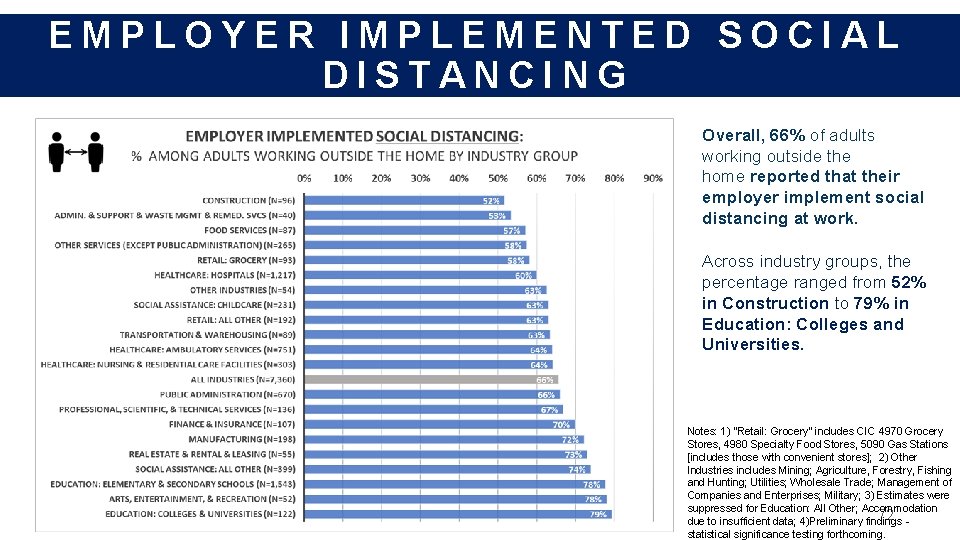
GA E M P L O Y E RR IISMK PMLI TEI M ETNI OTNE D S O C I A L DISTANCING Overall, 66% of adults working outside the home reported that their employer implement social distancing at work. Across industry groups, the percentage ranged from 52% in Construction to 79% in Education: Colleges and Universities. Notes: 1) "Retail: Grocery" includes CIC 4970 Grocery Stores, 4980 Specialty Food Stores, 5090 Gas Stations [includes those with convenient stores]; 2) Other Industries includes Mining; Agriculture, Forestry, Fishing and Hunting; Utilities; Wholesale Trade; Management of Companies and Enterprises; Military; 3) Estimates were suppressed for Education: All Other; Accommodation 72 due to insufficient data; 4)Preliminary findings statistical significance testing forthcoming.
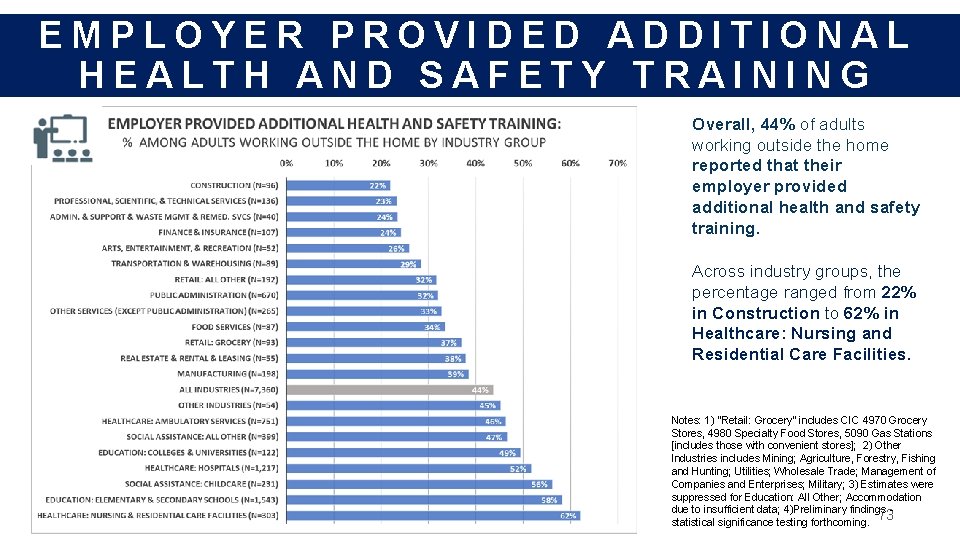
I SR K OMV I TI IDGE AD T I OAND D I T I O N A L E M P L O Y E RR P HEALTH AND SAFETY TRAINING Overall, 44% of adults working outside the home reported that their employer provided additional health and safety training. Across industry groups, the percentage ranged from 22% in Construction to 62% in Healthcare: Nursing and Residential Care Facilities. Notes: 1) "Retail: Grocery" includes CIC 4970 Grocery Stores, 4980 Specialty Food Stores, 5090 Gas Stations [includes those with convenient stores]; 2) Other Industries includes Mining; Agriculture, Forestry, Fishing and Hunting; Utilities; Wholesale Trade; Management of Companies and Enterprises; Military; 3) Estimates were suppressed for Education: All Other; Accommodation due to insufficient data; 4)Preliminary findings 73 statistical significance testing forthcoming.
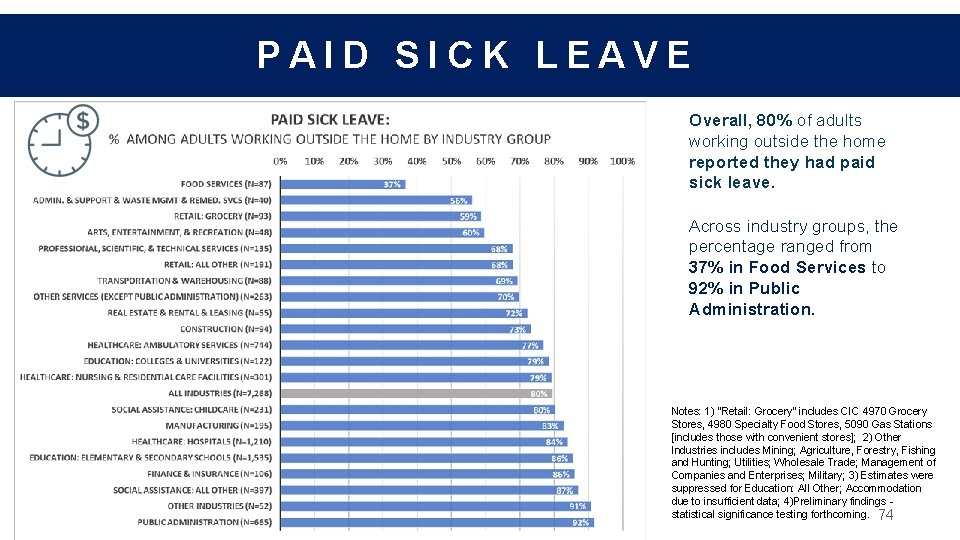
RISK MITIGATION PAID SICK LEAVE Overall, 80% of adults working outside the home reported they had paid sick leave. Across industry groups, the percentage ranged from 37% in Food Services to 92% in Public Administration. Notes: 1) "Retail: Grocery" includes CIC 4970 Grocery Stores, 4980 Specialty Food Stores, 5090 Gas Stations [includes those with convenient stores]; 2) Other Industries includes Mining; Agriculture, Forestry, Fishing and Hunting; Utilities; Wholesale Trade; Management of Companies and Enterprises; Military; 3) Estimates were suppressed for Education: All Other; Accommodation due to insufficient data; 4)Preliminary findings statistical significance testing forthcoming. 74
TESTING ACCESS 75
% Ever been Tested for COVID-19 Demographics Overall Race/ Ethnicity Age Gender Identity Sexual Orientation American Indian/Alaska Native Hispanic/Latinx Multiracial, Non. Hispanic Asian, Non-Hispanic Black, Non-Hispanic White, Non-Hispanic Other Race, Non. Hispanic Unknown Race 25 -34 35 -44 45 -64 65+ Male Female Questioning, Undecided, Non-binary Asexual Bisexual and/or Pansexual Gay or Lesbian Straight (Heterosexual) Queer I am questioning / not sure of my sexuality Demographics Frequency Weighted % 14319 44% 164 52% 1156 51% 226 48% 421 544 11551 37% 52% 42% 139 47% 118 2923 3590 5924 1882 2667 11267 35% 52% 43% 44% 36% 43% 44% 207 53% 248 42% 629 50% 690 11717 272 54% 43% 61% 108 52% Transgender Experience Income Educational Attainment Disability English language Transgender Not Transgender <$35 K $35 -74, 999 K $75 -99, 999 K $100 -149, 999 K $150 K+ Less than high school High school or GED Trade/ vocational school Some college Associates Degree Bachelors Degree Graduate Degree Deaf/Hard of hearing Blind/Trouble seeing Mental/physical disability 1 Speaks language other than English Demographics Frequency Weighted % 133 13731 1607 3125 1892 2898 4013 57% 44% 41% 46% 44% 45% 142 40% 815 39% 360 42% 1125 1039 4438 6377 43% 44% 45% 47% 396 44% 103 46% 1309 45% 2233 47% County Barnstable Berkshire Bristol Dukes Essex Franklin Hampden Hampshire Middlesex Nantucket Norfolk Plymouth Suffolk Worcester Frequency Weighted % 264 227 726 75 1460 416 865 533 4075 32 1579 643 1916 1474 37% 34% 41% 63% 47% 37% 42% 40% 46% 37% 42% 37% 59% 38% Preliminary analysis. Statistical significance testing forthcoming. 1 More granular disability definition forthcoming. Note: results are only weighted to the state average, and as such should be interpreted with caution when comparing across smaller geographies or special populations
HEALTH CARE ACCESS & DELAYS 77
% Who have not gotten the medical care that they needed since July 2020 Demographics Frequency Weighted % Overall Race/ Ethnicity Age Gender Identity Sexual Orientation American Indian/Alaska Native Hispanic/Latinx Multiracial, Non. Hispanic Asian, Non-Hispanic Black, Non-Hispanic White, Non-Hispanic Other Race, Non. Hispanic Unknown Race 25 -34 35 -44 45 -64 65+ Male Female Questioning, Undecided, Non-binary Asexual Bisexual and/or Pansexual Gay or Lesbian Straight (Heterosexual) Queer I am questioning / not sure of my sexuality 4326 17% 71 30% 252 15% 84 26% 118 140 3548 16% 20% 17% 42 17% 71 908 1148 1764 506 682 3424 30% 23% 19% 17% 12% 15% 17% 109 40% 70 15% 291 30% 186 3378 113 18% 16% 34% 42 31% Transgender Experience Income Educational Attainment Disability English language Transgender Not Transgender <$35 K $35 -74, 999 K $75 -99, 999 K $100 -149, 999 K $150 K+ Less than high school High school or GED Trade/ vocational school Some college Associates Degree Bachelors Degree Graduate Degree Deaf/Hard of hearing Blind/Trouble seeing Mental/physical disability 1 Speaks language other than English 64 4064 631 978 602 798 1057 34% 17% 20% 18% 17% 15% 41 16% 220 13% 121 19% 378 319 1382 1859 19% 18% 17% 155 18% 57 34% Not available 584 16% County Barnstable Berkshire Bristol Dukes Essex Franklin Hampden Hampshire Middlesex Nantucket Norfolk Plymouth Suffolk Worcester Frequency Weighted % 128 72 206 22 342 150 267 1304 9 407 246 508 489 21% 12% 15% 24% 15% 20% 17% 18% 19% 12% 13% 18% 19% 16% Preliminary analysis. Statistical significance testing forthcoming. 1 More granular disability definition forthcoming. Note: results are only weighted to the state average, and as such should be interpreted with caution when comparing across smaller geographies or special populations
% 15 or more Poor Mental Health Days in past 30 Days Demographics Overall Race/ Ethnicity Age Gender Identity Sexual Orientation American Indian/Alaska Native Hispanic/Latinx Multiracial, Non. Hispanic Asian, Non-Hispanic Black, Non-Hispanic White, Non-Hispanic Other Race, Non. Hispanic Unknown Race 25 -34 35 -44 45 -64 65+ Male Female Questioning, Undecided, Nonbinary Asexual Bisexual and/or Pansexual Gay or Lesbian Straight (Heterosexual) Queer I am questioning / not sure of my sexuality Demographics Frequency Weighted % 8973 33% 113 38% 654 35% 165 49% 221 285 7346 25% 32% 33% 91 29% 98 1999 2772 3466 736 1333 7264 40% 43% 41% 31% 20% 26% 34% 221 68% 202 39% 580 55% 439 41% 6994 31% 246 59% 100 58% Transgender Experience Income Educational Attainment Disability English language Transgender Not Transgender <$35 K $35 -74, 999 K $75 -99, 999 K $100 -149, 999 K $150 K+ Less than high school High school or GED Trade/ vocational school Some college Associates Degree Bachelors Degree Graduate Degree Deaf/Hard of hearing Blind/Trouble seeing Mental/physical disability 1 Speaks language other than English Demographics Frequency Weighted % 134 8480 1312 2163 1302 1792 1998 62% 33% 42% 35% 33% 31% 26% 104 36% 543 32% 245 33% 859 686 2884 3646 38% 35% 32% 29% 237 34% 83 49% 1393 55% 1279 34% County Barnstable Berkshire Bristol Dukes Essex Franklin Hampden Hampshire Middlesex Nantucket Norfolk Plymouth Suffolk Worcester Frequency Weighted % 199 451 30 886 304 671 397 2423 12 929 493 966 987 29% 36% 31% 24% 33% 35% 37% 38% 33% 17% 30% 35% 31% Preliminary analysis. Statistical significance testing forthcoming. 1 More granular disability definition forthcoming. Note: results are only weighted to the state average, and as such should be interpreted with caution when comparing across smaller geographies or special populations
DETERMINANTS OF HEALTH 8 0
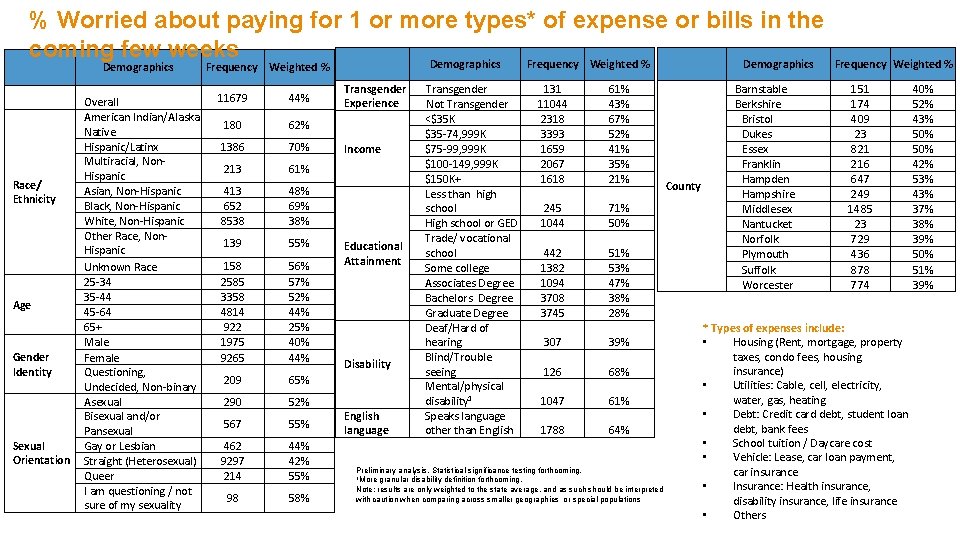
% Worried about paying for 1 or more types* of expense or bills in the coming few weeks Demographics Frequency Weighted % Demographics Race/ Ethnicity Age Gender Identity Sexual Orientation Overall American Indian/Alaska Native Hispanic/Latinx Multiracial, Non. Hispanic Asian, Non-Hispanic Black, Non-Hispanic White, Non-Hispanic Other Race, Non. Hispanic Unknown Race 25 -34 35 -44 45 -64 65+ Male Female Questioning, Undecided, Non-binary Asexual Bisexual and/or Pansexual Gay or Lesbian Straight (Heterosexual) Queer I am questioning / not sure of my sexuality Frequency Weighted % 11679 44% 180 62% 1386 70% 213 61% 413 652 8538 48% 69% 38% 139 55% 158 2585 3358 4814 922 1975 9265 56% 57% 52% 44% 25% 40% 44% 209 65% 290 52% 567 55% 462 9297 214 44% 42% 55% 98 58% Transgender Experience Income Educational Attainment Disability English language Transgender Not Transgender <$35 K $35 -74, 999 K $75 -99, 999 K $100 -149, 999 K $150 K+ Less than high school High school or GED Trade/ vocational school Some college Associates Degree Bachelors Degree Graduate Degree Deaf/Hard of hearing Blind/Trouble seeing Mental/physical disability 1 Speaks language other than English 131 11044 2318 3393 1659 2067 1618 61% 43% 67% 52% 41% 35% 21% 245 1044 71% 50% 442 1382 1094 3708 3745 51% 53% 47% 38% 28% 307 39% 126 68% 1047 61% 1788 64% Preliminary analysis. Statistical significance testing forthcoming. 1 More granular disability definition forthcoming. Note: results are only weighted to the state average, and as such should be interpreted with caution when comparing across smaller geographies or special populations County Barnstable Berkshire Bristol Dukes Essex Franklin Hampden Hampshire Middlesex Nantucket Norfolk Plymouth Suffolk Worcester Frequency Weighted % 151 174 409 23 821 216 647 249 1485 23 729 436 878 774 * Types of expenses include: • Housing (Rent, mortgage, property taxes, condo fees, housing insurance) • Utilities: Cable, cell, electricity, water, gas, heating • Debt: Credit card debt, student loan debt, bank fees • School tuition / Daycare cost • Vehicle: Lease, car loan payment, car insurance • Insurance: Health insurance, disability insurance, life insurance • Others 40% 52% 43% 50% 42% 53% 43% 37% 38% 39% 50% 51% 39%
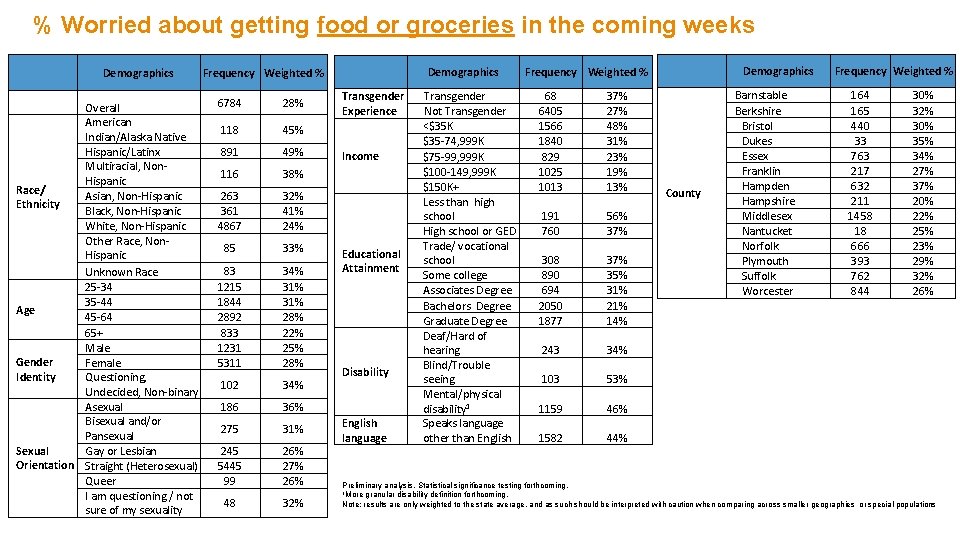
% Worried about getting food or groceries in the coming weeks Demographics Overall American Indian/Alaska Native Hispanic/Latinx Multiracial, Non. Hispanic Race/ Asian, Non-Hispanic Ethnicity Black, Non-Hispanic White, Non-Hispanic Other Race, Non. Hispanic Unknown Race 25 -34 35 -44 Age 45 -64 65+ Male Gender Female Identity Questioning, Undecided, Non-binary Asexual Bisexual and/or Pansexual Gay or Lesbian Sexual Orientation Straight (Heterosexual) Queer I am questioning / not sure of my sexuality Demographics Frequency Weighted % 6784 28% 118 45% 891 49% 116 38% 263 361 4867 32% 41% 24% 85 33% 83 1215 1844 2892 833 1231 5311 34% 31% 28% 22% 25% 28% 102 34% 186 36% 275 31% 245 5445 99 26% 27% 26% 48 32% Transgender Experience Income Educational Attainment Disability English language Transgender Not Transgender <$35 K $35 -74, 999 K $75 -99, 999 K $100 -149, 999 K $150 K+ Less than high school High school or GED Trade/ vocational school Some college Associates Degree Bachelors Degree Graduate Degree Deaf/Hard of hearing Blind/Trouble seeing Mental/physical disability 1 Speaks language other than English Demographics Frequency Weighted % 68 6405 1566 1840 829 1025 1013 37% 27% 48% 31% 23% 19% 13% 191 760 56% 37% 308 890 694 2050 1877 37% 35% 31% 21% 14% 243 34% 103 53% 1159 46% 1582 44% County Barnstable Berkshire Bristol Dukes Essex Franklin Hampden Hampshire Middlesex Nantucket Norfolk Plymouth Suffolk Worcester Frequency Weighted % 164 165 440 33 763 217 632 211 1458 18 666 393 762 844 30% 32% 30% 35% 34% 27% 37% 20% 22% 25% 23% 29% 32% 26% Preliminary analysis. Statistical significance testing forthcoming. 1 More granular disability definition forthcoming. Note: results are only weighted to the state average, and as such should be interpreted with caution when comparing across smaller geographies or special populations
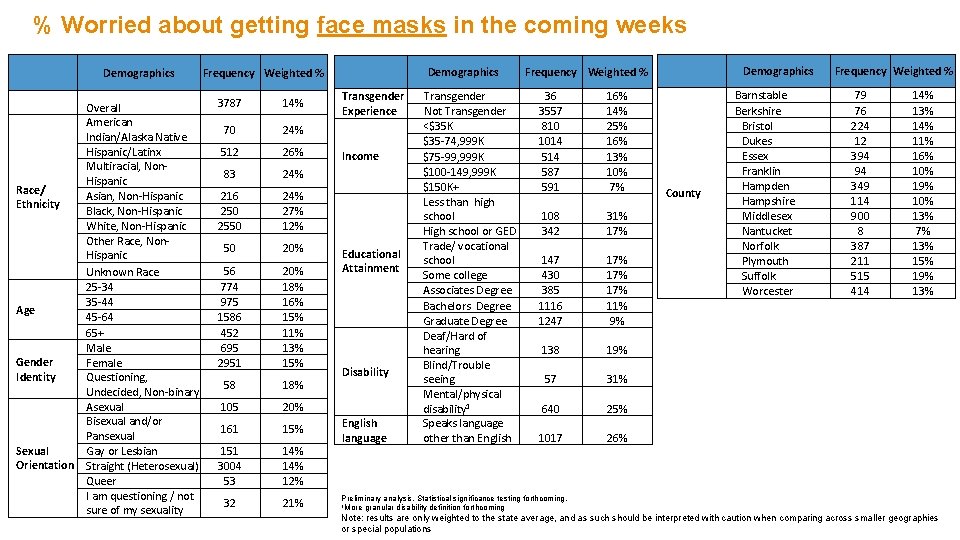
% Worried about getting face masks in the coming weeks Demographics Overall American Indian/Alaska Native Hispanic/Latinx Multiracial, Non. Hispanic Race/ Asian, Non-Hispanic Ethnicity Black, Non-Hispanic White, Non-Hispanic Other Race, Non. Hispanic Unknown Race 25 -34 35 -44 Age 45 -64 65+ Male Gender Female Identity Questioning, Undecided, Non-binary Asexual Bisexual and/or Pansexual Gay or Lesbian Sexual Orientation Straight (Heterosexual) Queer I am questioning / not sure of my sexuality Demographics Frequency Weighted % 3787 14% 70 24% 512 26% 83 24% 216 250 2550 24% 27% 12% 50 20% 56 774 975 1586 452 695 2951 20% 18% 16% 15% 11% 13% 15% 58 18% 105 20% 161 15% 151 3004 53 14% 12% 32 21% Transgender Experience Income Educational Attainment Disability English language Transgender Not Transgender <$35 K $35 -74, 999 K $75 -99, 999 K $100 -149, 999 K $150 K+ Less than high school High school or GED Trade/ vocational school Some college Associates Degree Bachelors Degree Graduate Degree Deaf/Hard of hearing Blind/Trouble seeing Mental/physical disability 1 Speaks language other than English Demographics Frequency Weighted % 36 3557 810 1014 587 591 16% 14% 25% 16% 13% 10% 7% 108 342 31% 17% 147 430 385 1116 1247 17% 17% 11% 9% 138 19% 57 31% 640 25% 1017 26% County Barnstable Berkshire Bristol Dukes Essex Franklin Hampden Hampshire Middlesex Nantucket Norfolk Plymouth Suffolk Worcester Frequency Weighted % 79 76 224 12 394 94 349 114 900 8 387 211 515 414 14% 13% 14% 11% 16% 10% 19% 10% 13% 7% 13% 15% 19% 13% Preliminary analysis. Statistical significance testing forthcoming. 1 More granular disability definition forthcoming Note: results are only weighted to the state average, and as such should be interpreted with caution when comparing across smaller geographies or special populations
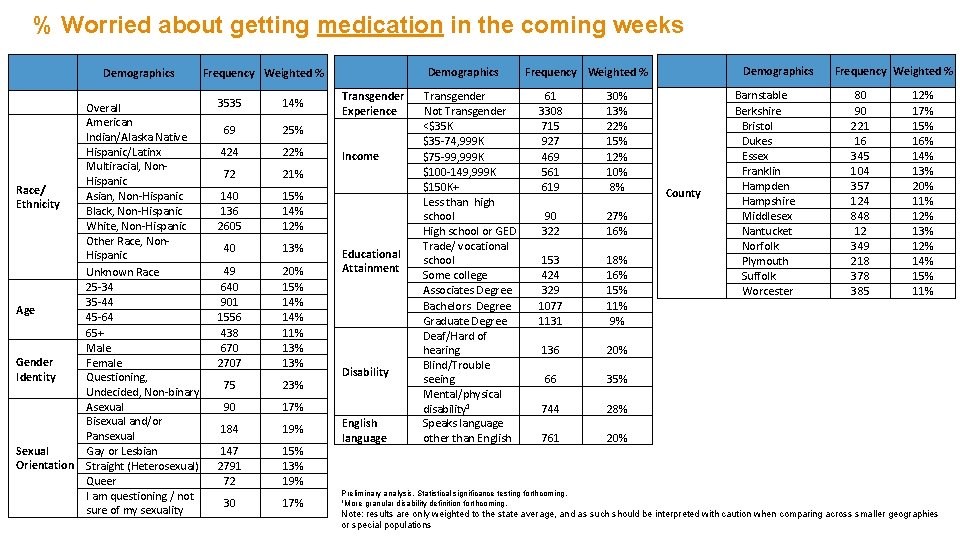
% Worried about getting medication in the coming weeks Demographics Overall American Indian/Alaska Native Hispanic/Latinx Multiracial, Non. Hispanic Race/ Asian, Non-Hispanic Ethnicity Black, Non-Hispanic White, Non-Hispanic Other Race, Non. Hispanic Unknown Race 25 -34 35 -44 Age 45 -64 65+ Male Gender Female Identity Questioning, Undecided, Non-binary Asexual Bisexual and/or Pansexual Gay or Lesbian Sexual Orientation Straight (Heterosexual) Queer I am questioning / not sure of my sexuality Demographics Frequency Weighted % 3535 14% 69 25% 424 22% 72 21% 140 136 2605 15% 14% 12% 40 13% 49 640 901 1556 438 670 2707 20% 15% 14% 11% 13% 75 23% 90 17% 184 19% 147 2791 72 15% 13% 19% 30 17% Transgender Experience Income Educational Attainment Disability English language Transgender Not Transgender <$35 K $35 -74, 999 K $75 -99, 999 K $100 -149, 999 K $150 K+ Less than high school High school or GED Trade/ vocational school Some college Associates Degree Bachelors Degree Graduate Degree Deaf/Hard of hearing Blind/Trouble seeing Mental/physical disability 1 Speaks language other than English Demographics Frequency Weighted % 61 3308 715 927 469 561 619 30% 13% 22% 15% 12% 10% 8% 90 322 27% 16% 153 424 329 1077 1131 18% 16% 15% 11% 9% 136 20% 66 35% 744 28% 761 20% County Barnstable Berkshire Bristol Dukes Essex Franklin Hampden Hampshire Middlesex Nantucket Norfolk Plymouth Suffolk Worcester Frequency Weighted % 80 90 221 16 345 104 357 124 848 12 349 218 378 385 12% 17% 15% 16% 14% 13% 20% 11% 12% 13% 12% 14% 15% 11% Preliminary analysis. Statistical significance testing forthcoming. 1 More granular disability definition forthcoming. Note: results are only weighted to the state average, and as such should be interpreted with caution when comparing across smaller geographies or special populations
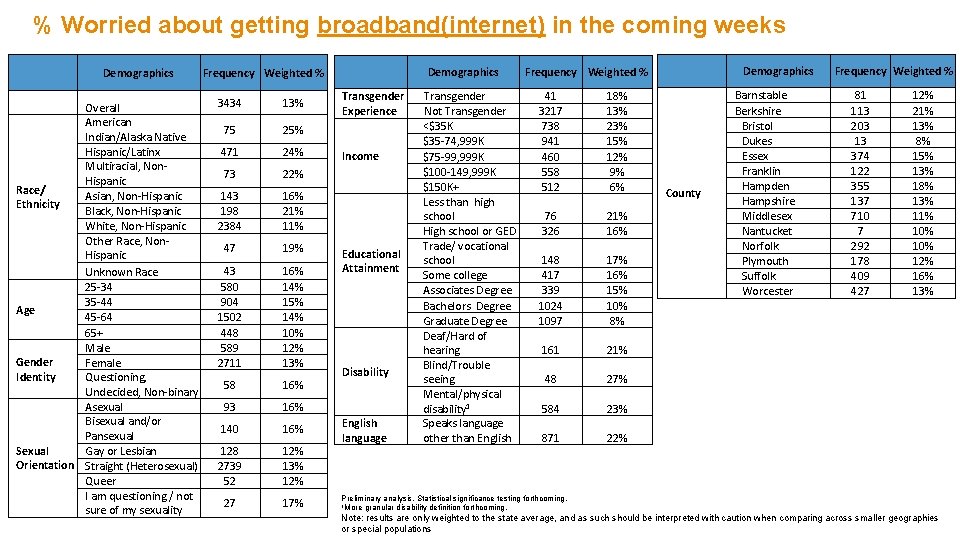
% Worried about getting broadband(internet) in the coming weeks Demographics Overall American Indian/Alaska Native Hispanic/Latinx Multiracial, Non. Hispanic Race/ Asian, Non-Hispanic Ethnicity Black, Non-Hispanic White, Non-Hispanic Other Race, Non. Hispanic Unknown Race 25 -34 35 -44 Age 45 -64 65+ Male Gender Female Identity Questioning, Undecided, Non-binary Asexual Bisexual and/or Pansexual Gay or Lesbian Sexual Orientation Straight (Heterosexual) Queer I am questioning / not sure of my sexuality Demographics Frequency Weighted % 3434 13% 75 25% 471 24% 73 22% 143 198 2384 16% 21% 11% 47 19% 43 580 904 1502 448 589 2711 16% 14% 15% 14% 10% 12% 13% 58 16% 93 16% 140 16% 128 2739 52 12% 13% 12% 27 17% Transgender Experience Income Educational Attainment Disability English language Transgender Not Transgender <$35 K $35 -74, 999 K $75 -99, 999 K $100 -149, 999 K $150 K+ Less than high school High school or GED Trade/ vocational school Some college Associates Degree Bachelors Degree Graduate Degree Deaf/Hard of hearing Blind/Trouble seeing Mental/physical disability 1 Speaks language other than English Demographics Frequency Weighted % 41 3217 738 941 460 558 512 18% 13% 23% 15% 12% 9% 6% 76 326 21% 16% 148 417 339 1024 1097 17% 16% 15% 10% 8% 161 21% 48 27% 584 23% 871 22% County Barnstable Berkshire Bristol Dukes Essex Franklin Hampden Hampshire Middlesex Nantucket Norfolk Plymouth Suffolk Worcester Frequency Weighted % 81 113 203 13 374 122 355 137 710 7 292 178 409 427 12% 21% 13% 8% 15% 13% 18% 13% 11% 10% 12% 16% 13% Preliminary analysis. Statistical significance testing forthcoming. 1 More granular disability definition forthcoming. Note: results are only weighted to the state average, and as such should be interpreted with caution when comparing across smaller geographies or special populations
Massachusetts Department of Public Health Next Meeting: March 10, 2021
- Slides: 86