
Massachusetts Department of Developmental Services Employment First Overview

- Slides: 21
Massachusetts Department of Developmental Services Employment First! Overview of Employment & Day Services 1 TRANSITION TO ADULT LIFE CREATING A VISION FOR THE FUTURE SEPTEMBER 20, 2014 WORCESTER, MA
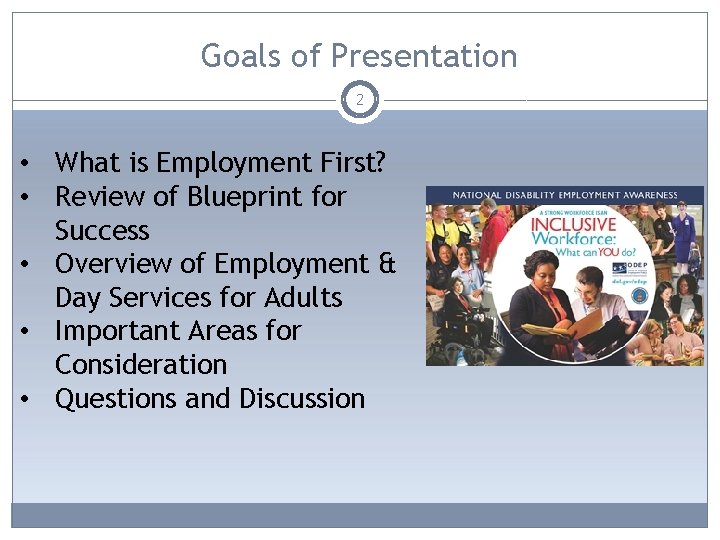
Goals of Presentation 2 • What is Employment First? • Review of Blueprint for Success • Overview of Employment & Day Services for Adults • Important Areas for Consideration • Questions and Discussion
WHAT IS EMPLOYMENT FIRST? 3 Supports Department’s mission of supporting people to live and work and enjoy fully integrated lives in the community The belief that everyone can work and gives everyone a chance to get a job Starts with the presumption that employment should be the first and preferred goal and service option for working age adults More job opportunities in the community: � Real Jobs for Real Pay- hired at a business earning same pay as other workers More opportunities for meaningful involvement in inclusive community activities and experiences
Why This New Direction? People with Disabilities Are Asking for Real Jobs… 4 �Having a job is an important and valued role in people’s lives �Everyone has the right to have a job �Everyone has the right to get paid fairly for the work they do
Why is Having A Job So Important 5 • • Way to Earn Money - $ Feel proud of accomplishments Builds confidence Meet new people and make new friends Chance to learn new things & develop skills Way to be helpful and productive Status: People respect you for the work you do
Blueprint for Success: Employing Individuals with Intellectual Disabilities November 2013 6 Department of Developmental Services (DDS)
A Plan for Jobs and Community Inclusion 7 • Commissioner Howe asked a team of people to develop a 4 year plan called the Blueprint for Success. Goals are: • More job opportunities • Individual planning of service options for every person • Community-based day activities, in addition to job training • Phase out use of sheltered workshop services
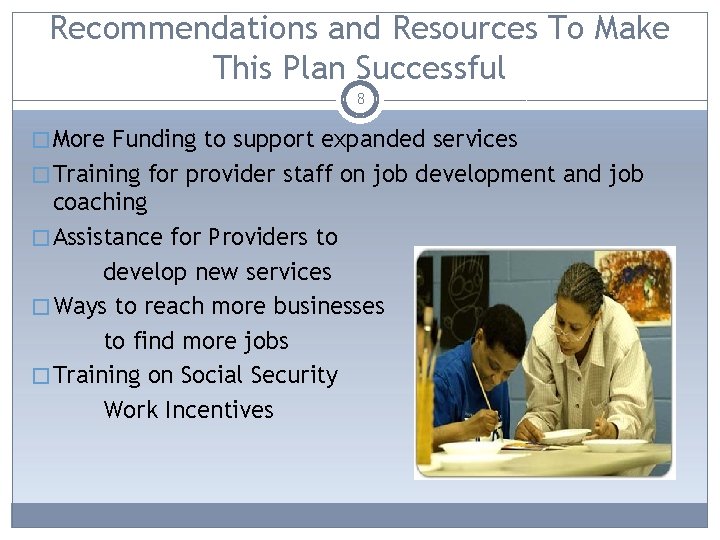
Recommendations and Resources To Make This Plan Successful 8 � More Funding to support expanded services � Training for provider staff on job development and job coaching � Assistance for Providers to develop new services � Ways to reach more businesses to find more jobs � Training on Social Security Work Incentives
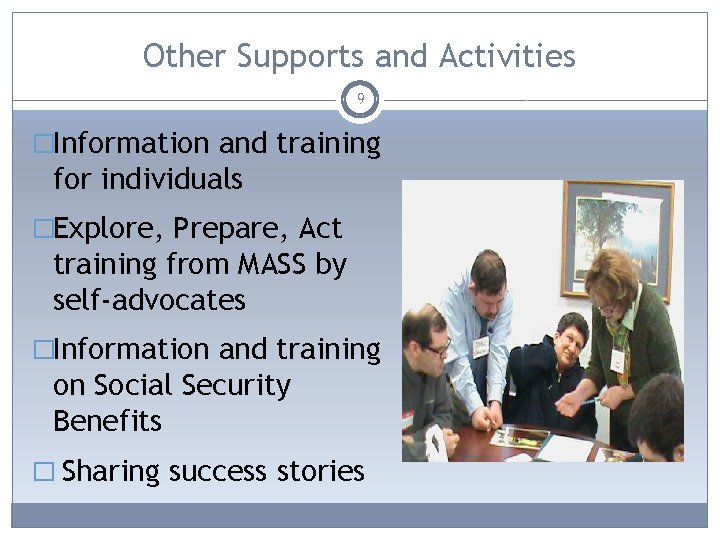
Other Supports and Activities 9 �Information and training for individuals �Explore, Prepare, Act training from MASS by self-advocates �Information and training on Social Security Benefits � Sharing success stories
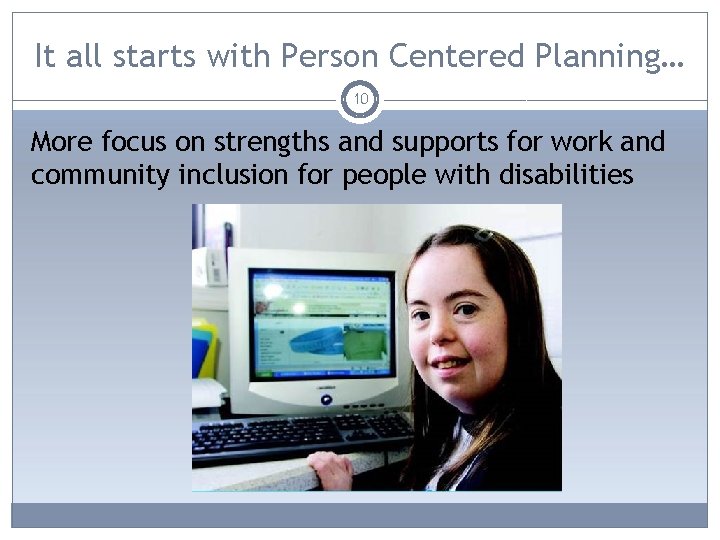
It all starts with Person Centered Planning… 10 More focus on strengths and supports for work and community inclusion for people with disabilities
Developing A Positive Personal Profile 11 � Dreams and Goals � Your Learning Style � Interests � Positive personality traits � Talents/skills and knowledge � Dislikes � What you value-what is important � Your Support System to you � Settings/places you prefer � Work and Life Experiences � Specific challenges you need help with � Solutions and supports to help you be successful
What Supports are Helpful to Get on the Road to Employment: 12 � Ways to explore and discover interests- through volunteer work, job tours and try-outs � Developing a career plan that is right for each person: based on each person’s interests, skills, and settings where you will be successful � Job developer who finds the right job match for you � Job coach who provides training and follow-up support on the job site � Help with transportation and other things to help achieve success
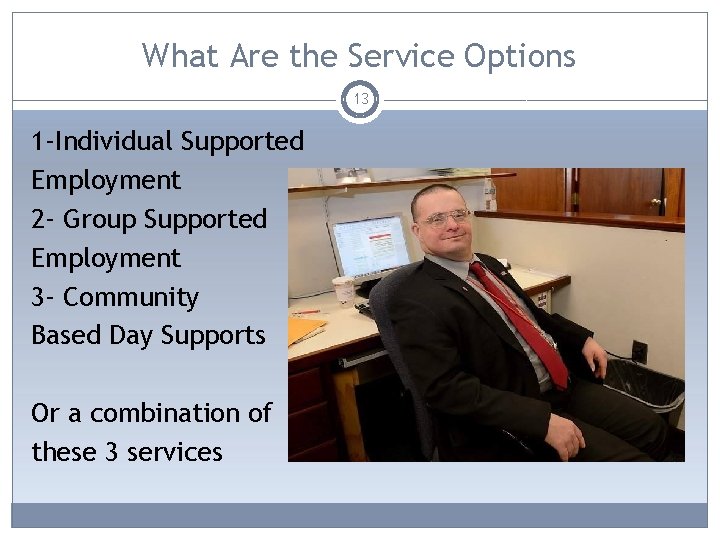
What Are the Service Options 13 1 -Individual Supported Employment 2 - Group Supported Employment 3 - Community Based Day Supports Or a combination of these 3 services
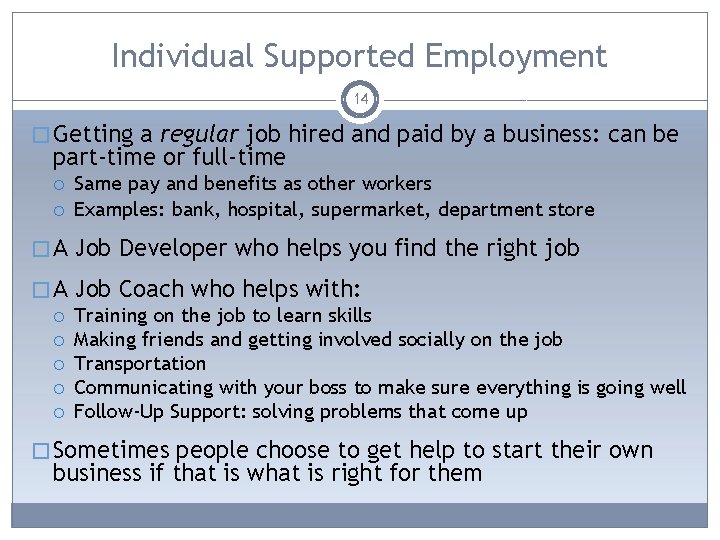
Individual Supported Employment 14 � Getting a regular job hired and paid by a business: can be part-time or full-time Same pay and benefits as other workers Examples: bank, hospital, supermarket, department store � A Job Developer who helps you find the right job � A Job Coach who helps with: Training on the job to learn skills Making friends and getting involved socially on the job Transportation Communicating with your boss to make sure everything is going well Follow-Up Support: solving problems that come up � Sometimes people choose to get help to start their own business if that is what is right for them
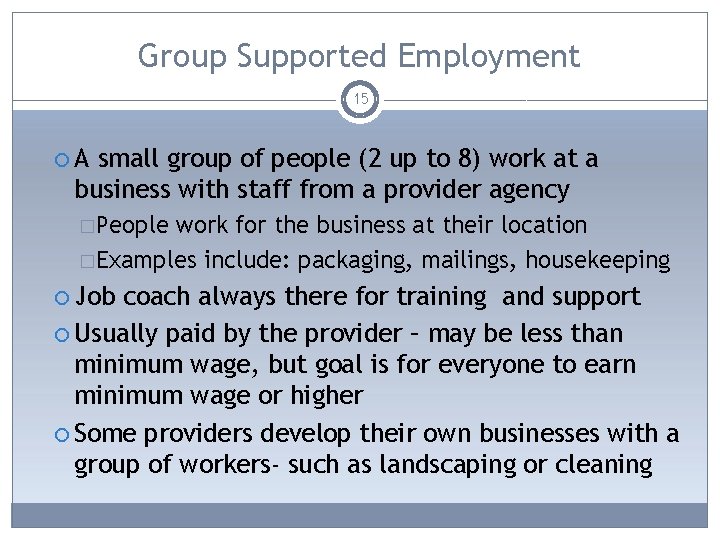
Group Supported Employment 15 A small group of people (2 up to 8) work at a business with staff from a provider agency �People work for the business at their location �Examples include: packaging, mailings, housekeeping Job coach always there for training and support Usually paid by the provider – may be less than minimum wage, but goal is for everyone to earn minimum wage or higher Some providers develop their own businesses with a group of workers- such as landscaping or cleaning
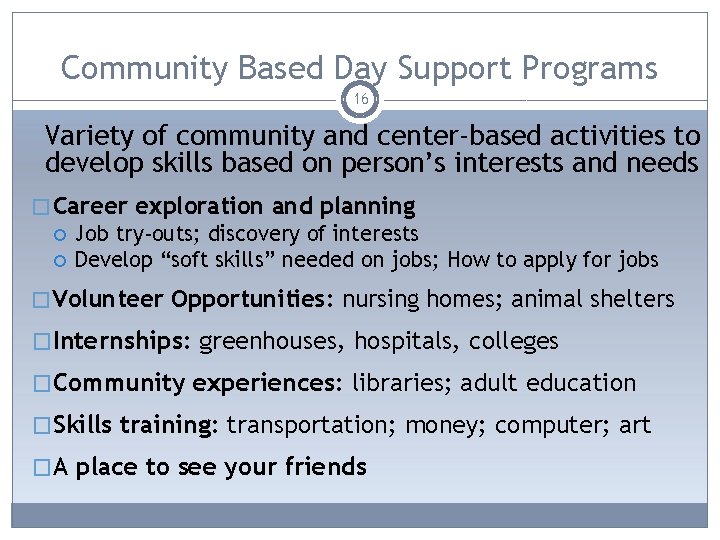
Community Based Day Support Programs 16 Variety of community and center-based activities to develop skills based on person’s interests and needs � Career exploration and planning Job try-outs; discovery of interests Develop “soft skills” needed on jobs; How to apply for jobs � Volunteer Opportunities: nursing homes; animal shelters �Internships: greenhouses, hospitals, colleges �Community experiences: libraries; adult education �Skills training: transportation; money; computer; art �A place to see your friends
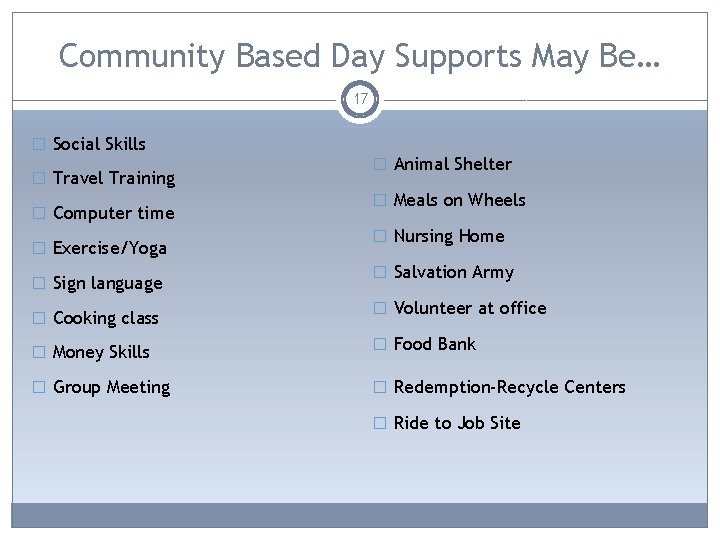
Community Based Day Supports May Be… 17 � Social Skills � Travel Training � Computer time � Exercise/Yoga � Sign language � Cooking class � Money Skills � Group Meeting � Animal Shelter � Meals on Wheels � Nursing Home � Salvation Army � Volunteer at office � Food Bank � Redemption-Recycle Centers � Ride to Job Site
DAY HABILITATION PROGRAMS 18 �Funded by Mass. Health not DDS �Medical Model of services- meet medical necessity �Therapeutic Focus- Includes specialized services such as PT, OT, speech, nursing �Active Treatment/Habilitation Focus: Developmental skills training; Improve level of independence; Socialization �Cannot provide vocational, prevocational or any other employment related service
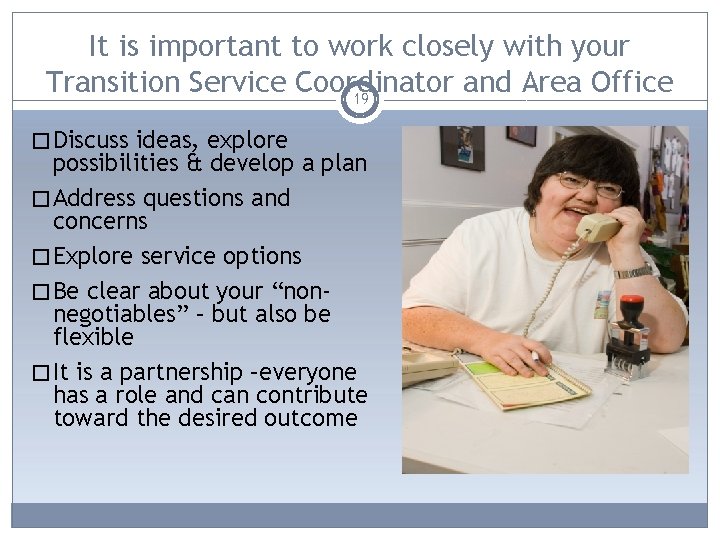
It is important to work closely with your Transition Service Coordinator and Area Office 19 � Discuss ideas, explore possibilities & develop a plan � Address questions and concerns � Explore service options � Be clear about your “nonnegotiables” – but also be flexible � It is a partnership –everyone has a role and can contribute toward the desired outcome
Why Work is Important to Me… 20 �“Work makes me feel good, it’s freedom… I meet new people every day. ” �“ I like it because I’m getting paid and it makes me feel independent. ” �“It gives you a sense of respect. ” {Quotes from adults with an Intellectual Disability who are working}
Thank You for coming today! 21 For more information: Margaret Van Gelder, DDS Margaret. van. gelder@state. ma. us 617. 624. 7764