
mass vol Solution Stoichiometry mol M L mass
- Slides: 5
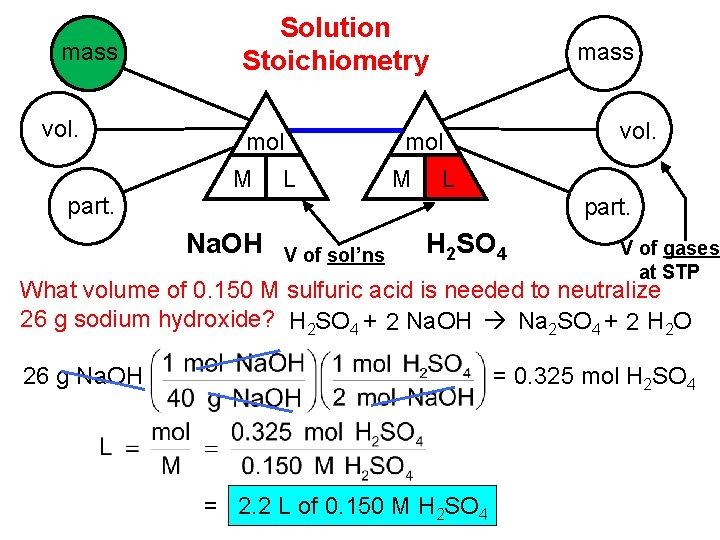
mass vol. Solution Stoichiometry mol M L mass vol. mol M L part. Na. OH V of sol’ns H 2 SO 4 V of gases at STP What volume of 0. 150 M sulfuric acid is needed to neutralize 26 g sodium hydroxide? H 2 SO 4 + 2 Na. OH Na 2 SO 4 + 2 H 2 O 26 g Na. OH = 0. 325 mol H 2 SO 4 = 2. 2 L of 0. 150 M H 2 SO 4
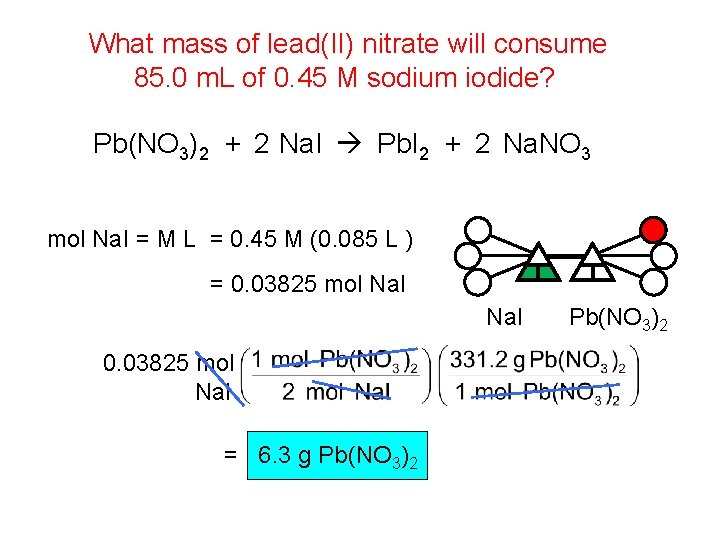
What mass of lead(II) nitrate will consume 85. 0 m. L of 0. 45 M sodium iodide? Pb(NO 3)2 + 2 Na. I Pb. I 2 + 2 Na. NO 3 mol Na. I = M L = 0. 45 M (0. 085 L ) = 0. 03825 mol Na. I = 6. 3 g Pb(NO 3)2
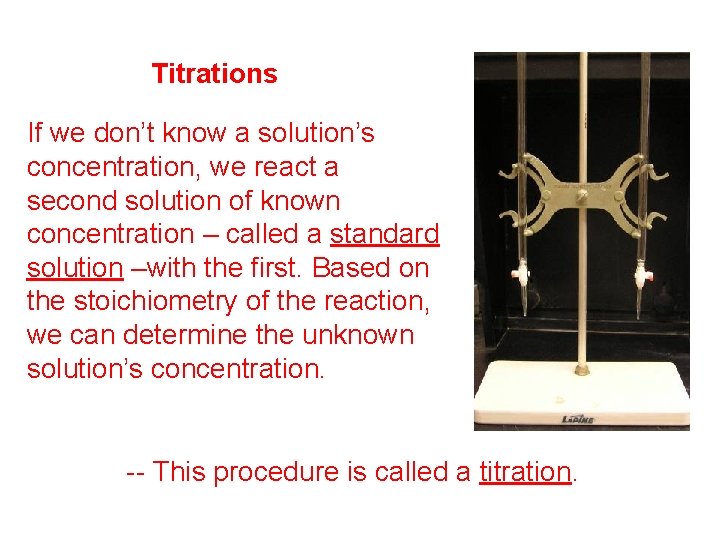
Titrations If we don’t know a solution’s concentration, we react a second solution of known concentration – called a standard solution –with the first. Based on the stoichiometry of the reaction, we can determine the unknown solution’s concentration. -- This procedure is called a titration.
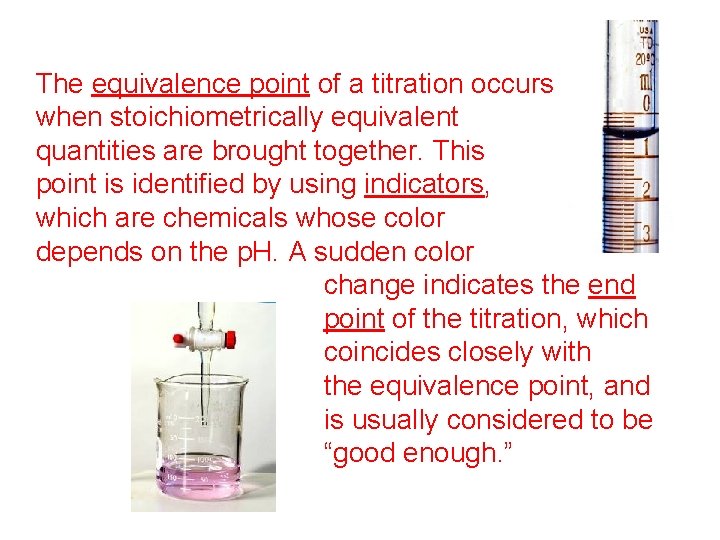
The equivalence point of a titration occurs when stoichiometrically equivalent quantities are brought together. This point is identified by using indicators, which are chemicals whose color depends on the p. H. A sudden color change indicates the end point of the titration, which coincides closely with the equivalence point, and is usually considered to be “good enough. ”
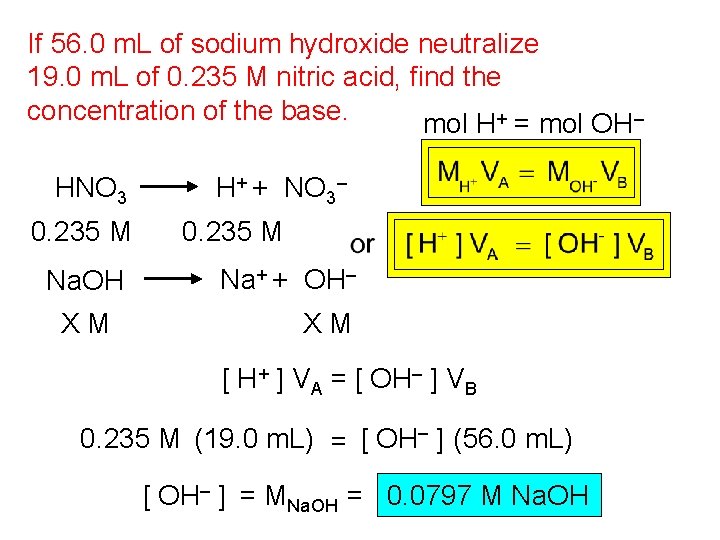
If 56. 0 m. L of sodium hydroxide neutralize 19. 0 m. L of 0. 235 M nitric acid, find the concentration of the base. mol H+ = mol OH– HNO 3 0. 235 M Na. OH XM H+ + NO 3– 0. 235 M Na+ + OH– XM [ H+ ] VA = [ OH– ] VB 0. 235 M (19. 0 m. L) = [ OH– ] (56. 0 m. L) [ OH– ] = MNa. OH = 0. 0797 M Na. OH