
Mass transfer in binary systems Mass transfer occurs

Mass transfer in binary systems • Mass transfer occurs when – star expands to fill Roche-lobe – due to stellar evolution – orbit, and thus Roche-lobe, shrinks till R* < RL – due to orbital evolution: magnetic braking, gravitational radiation etc • Three cases – Case A: – Case B: – Case C: Mass transfer while donor is on main sequence donor star is in (or evolving to) Red Giant phase Super. Giant phase • Mass transfer changes mass ratios – changes Roche-lobe sizes – can drive further mass transfer AS 3004 Stellar Dynamics
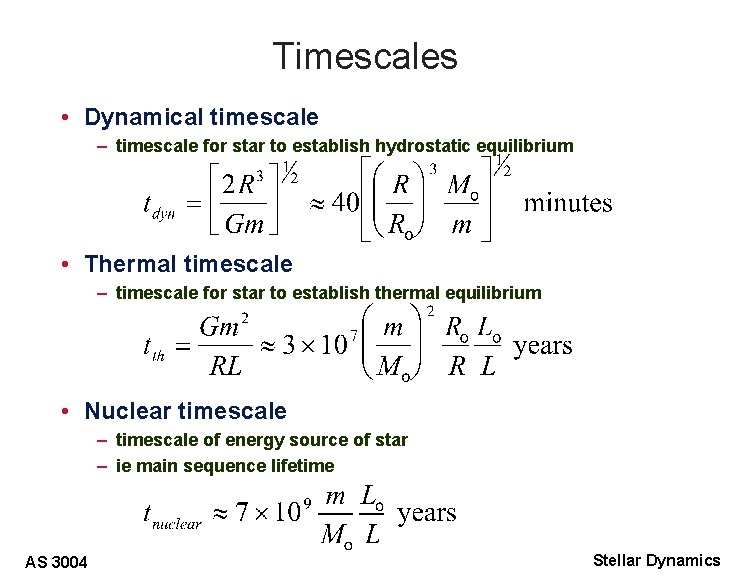
Timescales • Dynamical timescale – timescale for star to establish hydrostatic equilibrium • Thermal timescale – timescale for star to establish thermal equilibrium • Nuclear timescale – timescale of energy source of star – ie main sequence lifetime AS 3004 Stellar Dynamics
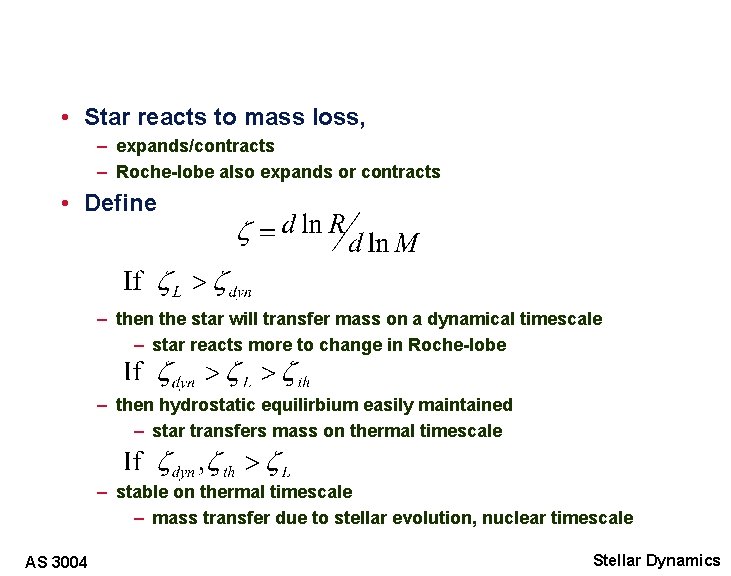
• Star reacts to mass loss, – expands/contracts – Roche-lobe also expands or contracts • Define – then the star will transfer mass on a dynamical timescale – star reacts more to change in Roche-lobe – then hydrostatic equilirbium easily maintained – star transfers mass on thermal timescale – stable on thermal timescale – mass transfer due to stellar evolution, nuclear timescale AS 3004 Stellar Dynamics
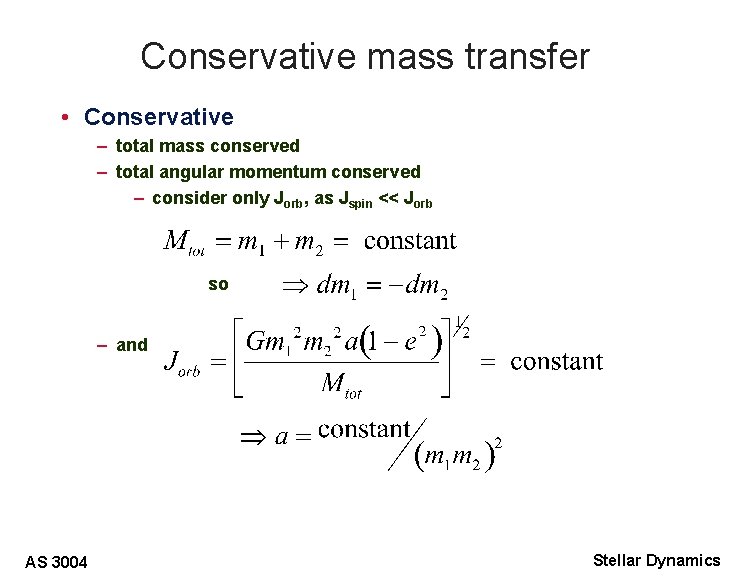
Conservative mass transfer • Conservative – total mass conserved – total angular momentum conserved – consider only Jorb, as Jspin << Jorb so – and AS 3004 Stellar Dynamics
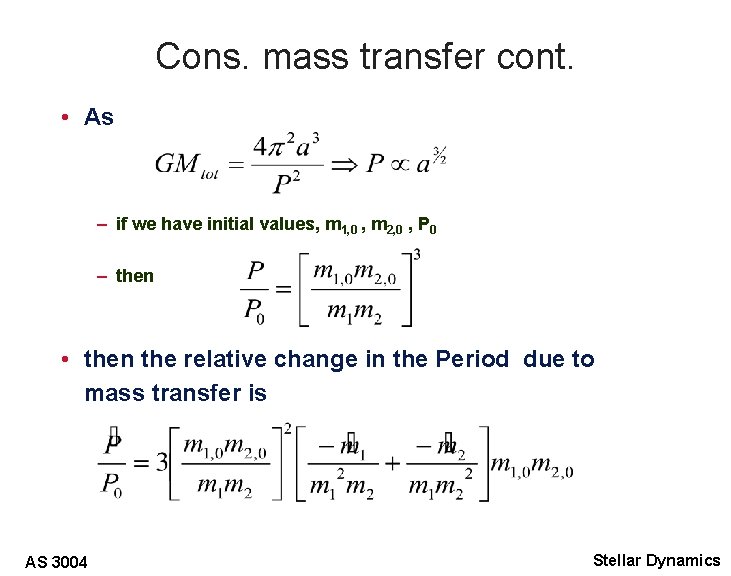
Cons. mass transfer cont. • As – if we have initial values, m 1, 0 , m 2, 0 , P 0 – then • then the relative change in the Period due to mass transfer is AS 3004 Stellar Dynamics
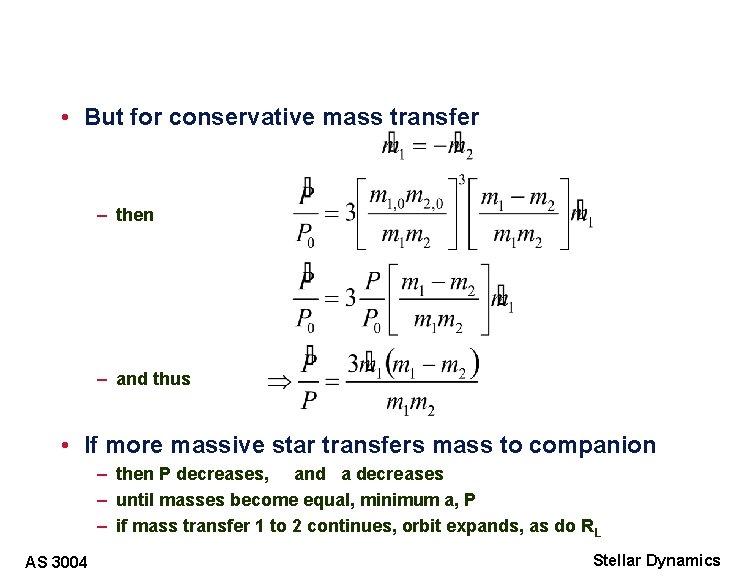
• But for conservative mass transfer – then – and thus • If more massive star transfers mass to companion – then P decreases, and a decreases – until masses become equal, minimum a, P – if mass transfer 1 to 2 continues, orbit expands, as do RL AS 3004 Stellar Dynamics
Non-conservative mass transfer • General case • What happens if either mass, or angular moment are not conserved • mass not conserved when – mass transfer / loss through stellar wind – rapid Roche-lobe overflow – receiving star can’t accrete all mass / angular momentum – mass loss through L 2 point • Angular momentum not conserved – magnetic braking through stellar wind – forced to corotate at large distance – gravitational radiation for close neutron stars AS 3004 Stellar Dynamics
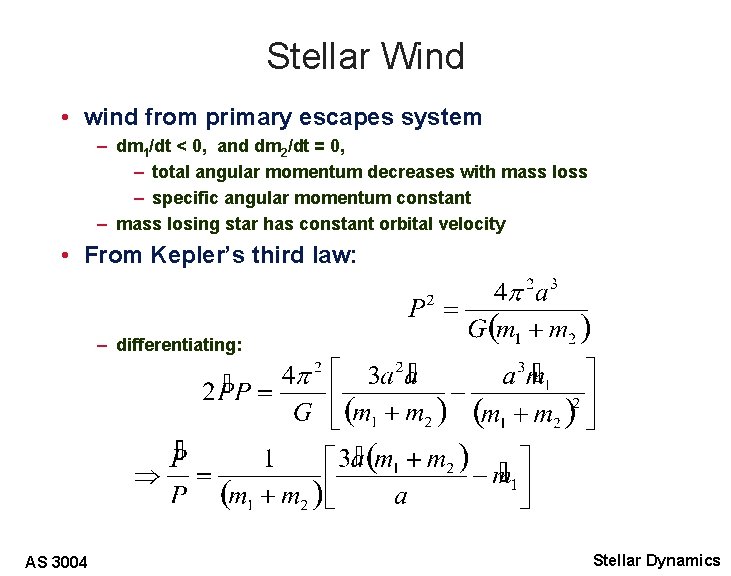
Stellar Wind • wind from primary escapes system – dm 1/dt < 0, and dm 2/dt = 0, – total angular momentum decreases with mass loss – specific angular momentum constant – mass losing star has constant orbital velocity • From Kepler’s third law: – differentiating: AS 3004 Stellar Dynamics
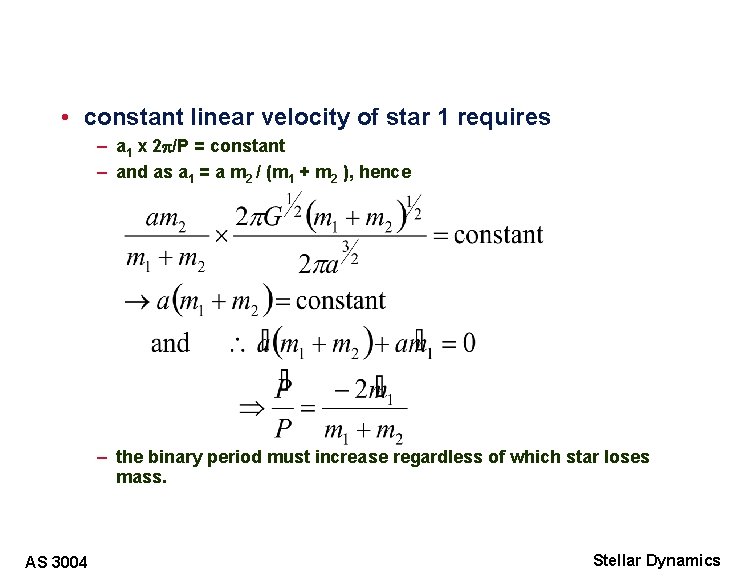
• constant linear velocity of star 1 requires – a 1 x 2 p/P = constant – and as a 1 = a m 2 / (m 1 + m 2 ), hence – the binary period must increase regardless of which star loses mass. AS 3004 Stellar Dynamics
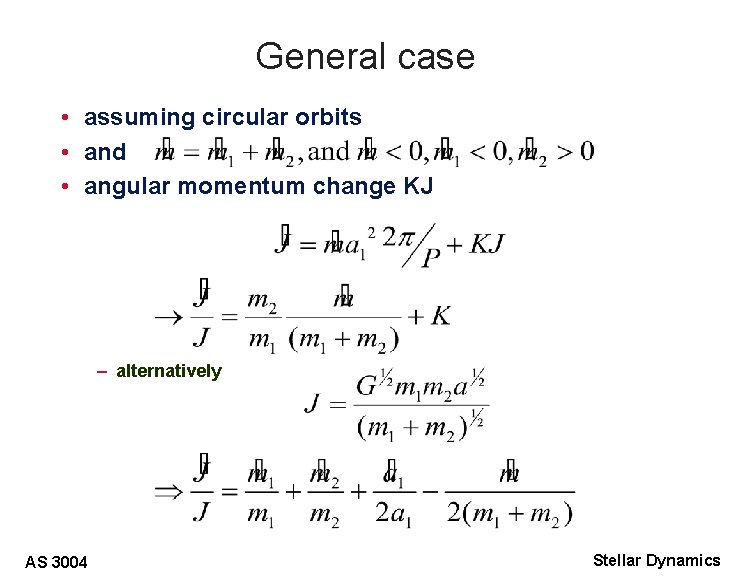
General case • assuming circular orbits • and • angular momentum change KJ – alternatively AS 3004 Stellar Dynamics
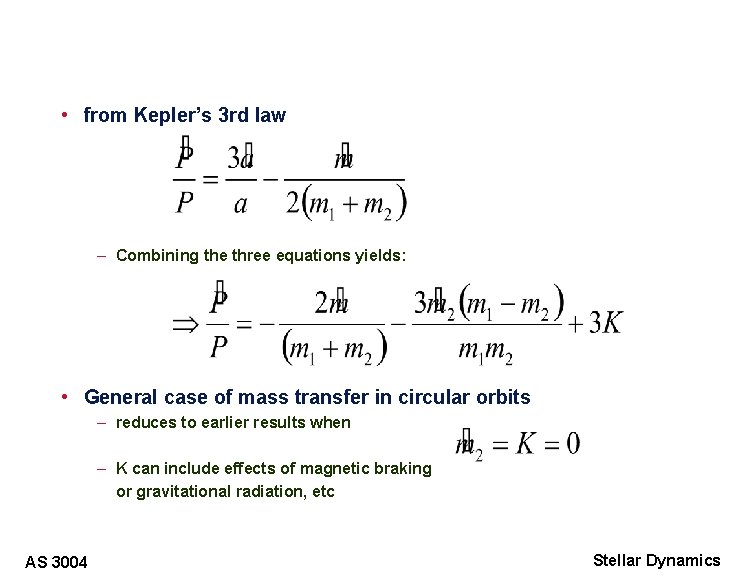
• from Kepler’s 3 rd law – Combining the three equations yields: • General case of mass transfer in circular orbits – reduces to earlier results when – K can include effects of magnetic braking or gravitational radiation, etc AS 3004 Stellar Dynamics
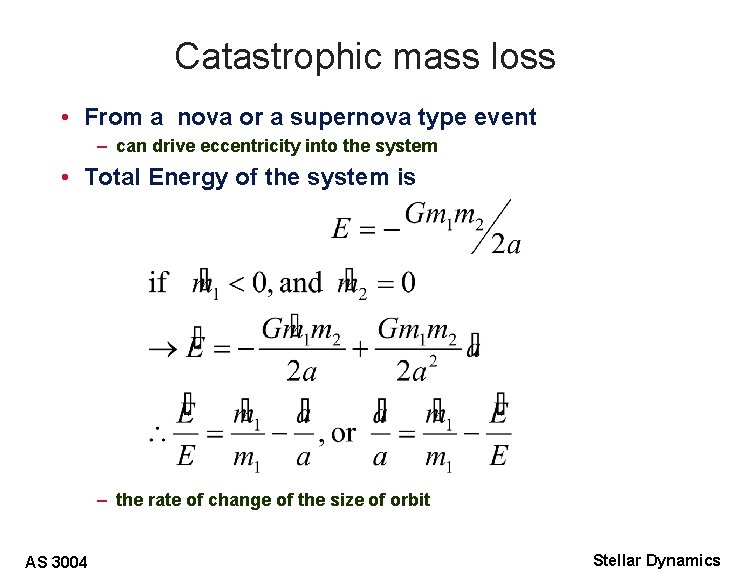
Catastrophic mass loss • From a nova or a supernova type event – can drive eccentricity into the system • Total Energy of the system is – the rate of change of the size of orbit AS 3004 Stellar Dynamics
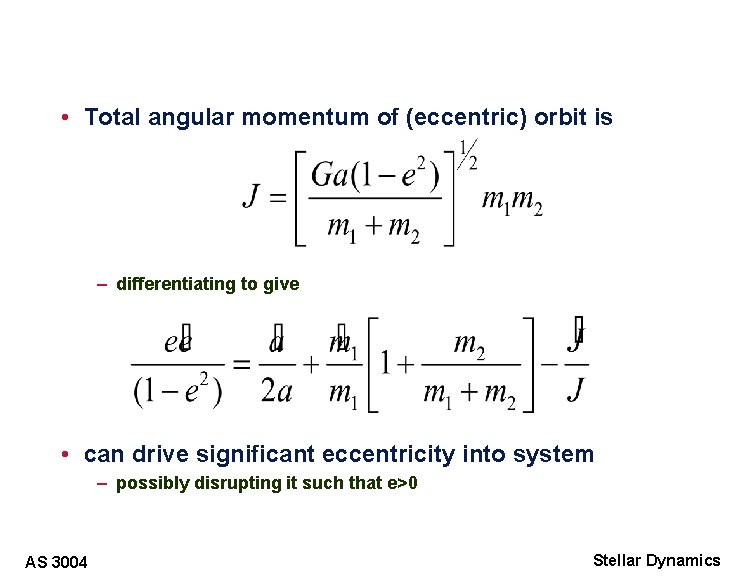
• Total angular momentum of (eccentric) orbit is – differentiating to give • can drive significant eccentricity into system – possibly disrupting it such that e>0 AS 3004 Stellar Dynamics
- Slides: 13