
Mass Spectrometry sample ion plot intensity I vs
![ex. dissociation of complex [Fe(h 5 C 5 H 5)(CO)L(MX 3)] [MX]+ appearance MX](https://slidetodoc.com/presentation_image/569f04c671c5358fa6eacd0b63f78d13/image-10.jpg "ex. dissociation of complex [Fe(h 5 C 5 H 5)(CO)L(MX 3)] [MX]+ appearance MX")
- Slides: 13
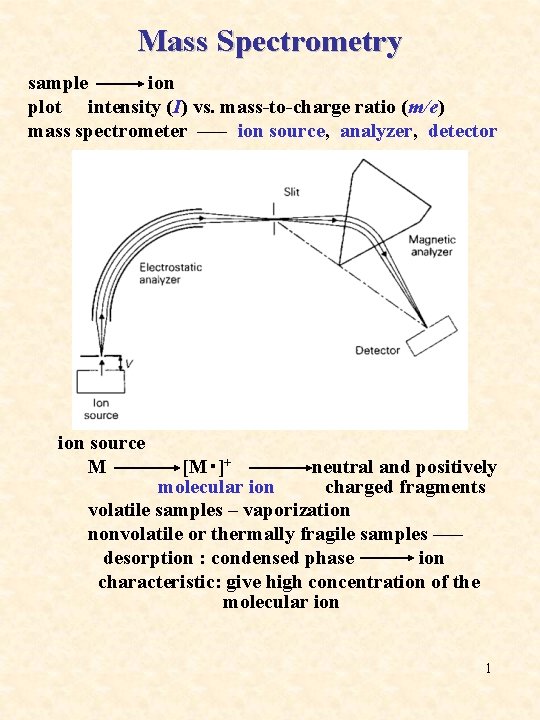
Mass Spectrometry sample ion plot intensity (I) vs. mass-to-charge ratio (m/e) mass spectrometer ––– ion source, analyzer, detector ion source M [M‧]+ neutral and positively molecular ion charged fragments volatile samples – vaporization nonvolatile or thermally fragile samples ––– desorption : condensed phase ion characteristic: give high concentration of the molecular ion 1
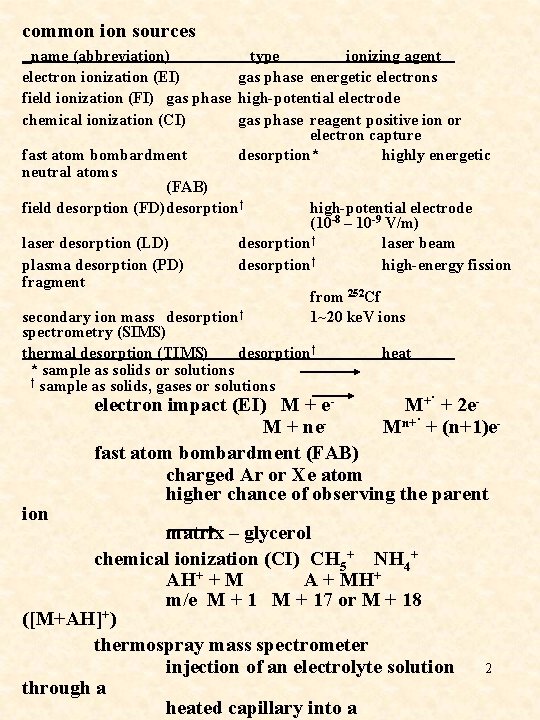
common ion sources name (abbreviation) type ionizing agent electron ionization (EI) gas phase energetic electrons field ionization (FI) gas phase high-potential electrode chemical ionization (CI) gas phase reagent positive ion or electron capture fast atom bombardment desorption* highly energetic neutral atoms (FAB) field desorption (FD)desorption† high-potential electrode (10 -8 – 10 -9 V/m) laser desorption (LD) desorption† laser beam plasma desorption (PD) desorption† high-energy fission fragment from 252 Cf secondary ion mass desorption† 1~20 ke. V ions spectrometry (SIMS) thermal desorption (TIMS) desorption† heat * sample as solids or solutions † sample as solids, gases or solutions ion electron impact (EI) M + e- M+˙ + 2 e M + ne- Mn+˙ + (n+1)efast atom bombardment (FAB) charged Ar or Xe atom higher chance of observing the parent matrix – glycerol chemical ionization (CI) CH 5+ NH 4+ AH+ + M A + MH+ m/e M + 17 or M + 18 + ([M+AH] ) thermospray mass spectrometer injection of an electrolyte solution through a heated capillary into a 2
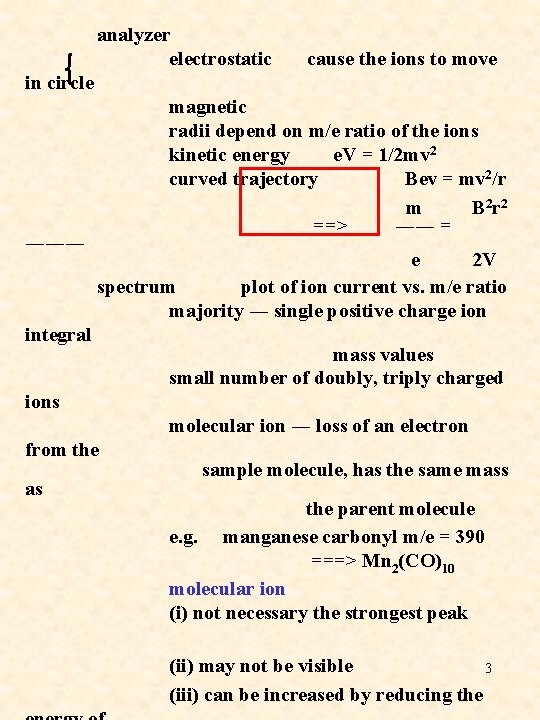
analyzer electrostatic cause the ions to move in circle ――― integral magnetic radii depend on m/e ratio of the ions kinetic energy e. V = 1/2 mv 2 curved trajectory Bev = mv 2/r m B 2 r 2 ==> ―― = e 2 V spectrum plot of ion current vs. m/e ratio majority ― single positive charge ion mass values small number of doubly, triply charged ions molecular ion ― loss of an electron from the sample molecule, has the same mass as the parent molecule e. g. manganese carbonyl m/e = 390 ===> Mn 2(CO)10 molecular ion (i) not necessary the strongest peak (ii) may not be visible 3 (iii) can be increased by reducing the
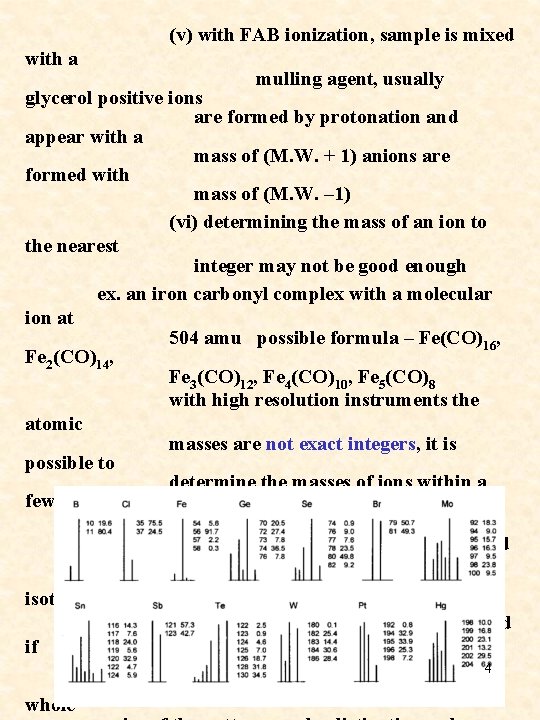
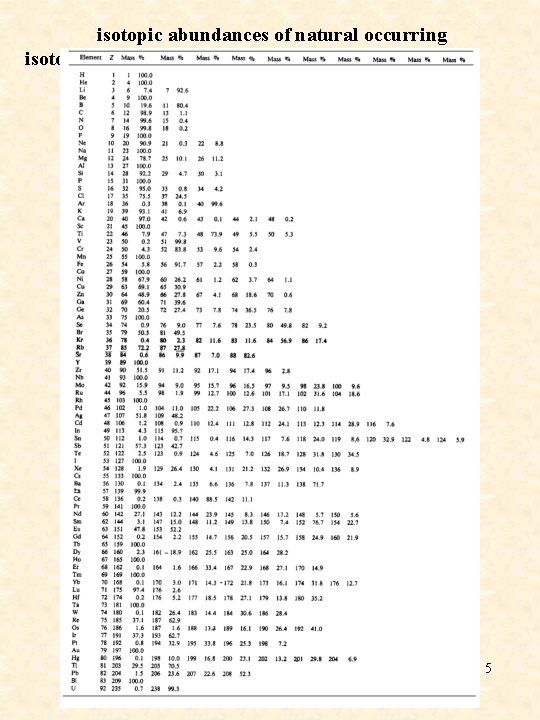
(v) with FAB ionization, sample is mixed with a mulling agent, usually glycerol positive ions are formed by protonation and appear with a mass of (M. W. + 1) anions are formed with mass of (M. W. – 1) (vi) determining the mass of an ion to the nearest integer may not be good enough ex. an iron carbonyl complex with a molecular ion at 504 amu possible formula – Fe(CO)16, Fe 2(CO)14, Fe 3(CO)12, Fe 4(CO)10, Fe 5(CO)8 with high resolution instruments the atomic masses are not exact integers, it is possible to determine the masses of ions within a few ppm the exact masses for Fe 3(CO)12 503. 7438 amu and Fe 4(CO)10 503. 6889 amu isotope abundance pattern many elements have more than one isotopes, and if such elements are present in a compound ==> 4 there will be not just one molecular ion, but a whole
isotopic abundances of natural occurring isotopes 5
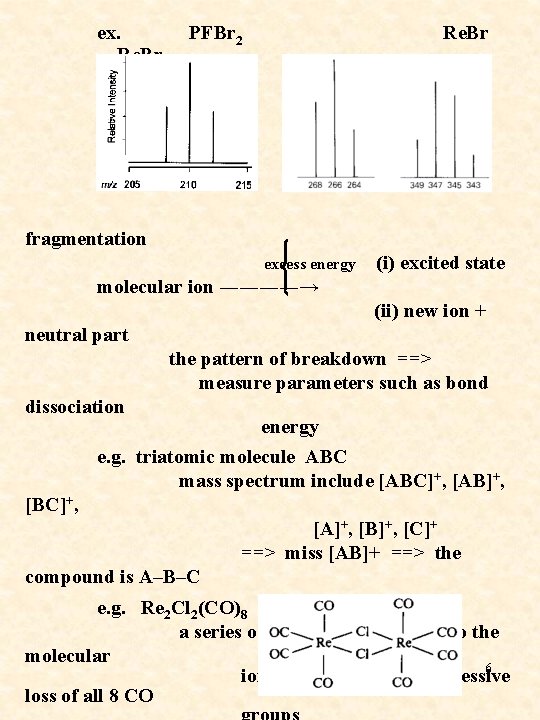
ex. PFBr 2 Re. Br 2 Re. Br fragmentation excess energy (i) excited state molecular ion ――――→ (ii) new ion + neutral part the pattern of breakdown ==> measure parameters such as bond dissociation energy e. g. triatomic molecule ABC mass spectrum include [ABC]+, [AB]+, [BC]+, [A]+, [B]+, [C]+ ==> miss [AB]+ ==> the compound is A–B–C e. g. Re 2 Cl 2(CO)8 a series of peaks corresponding to the molecular 6 ion and ions showing successive loss of all 8 CO
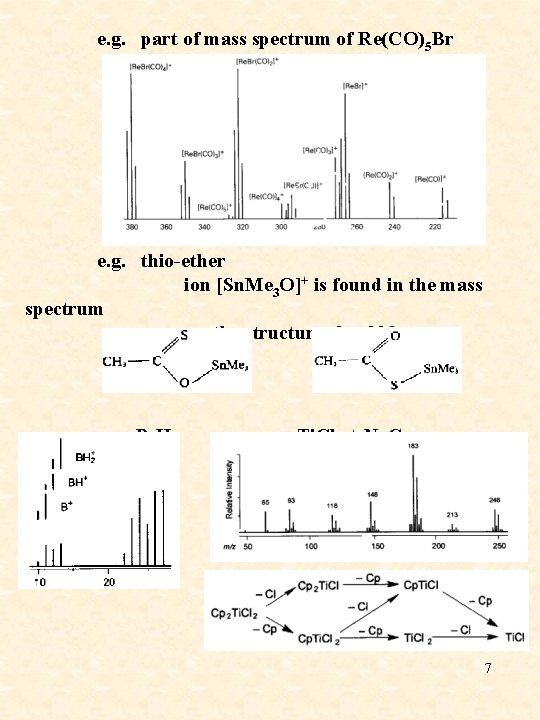
e. g. part of mass spectrum of Re(CO)5 Br e. g. thio-ether ion [Sn. Me 3 O]+ is found in the mass spectrum ==> the structure should be not e. g. B 2 H 6 e. g. Ti. Cl 4 + Na. Cp ―→ product 7
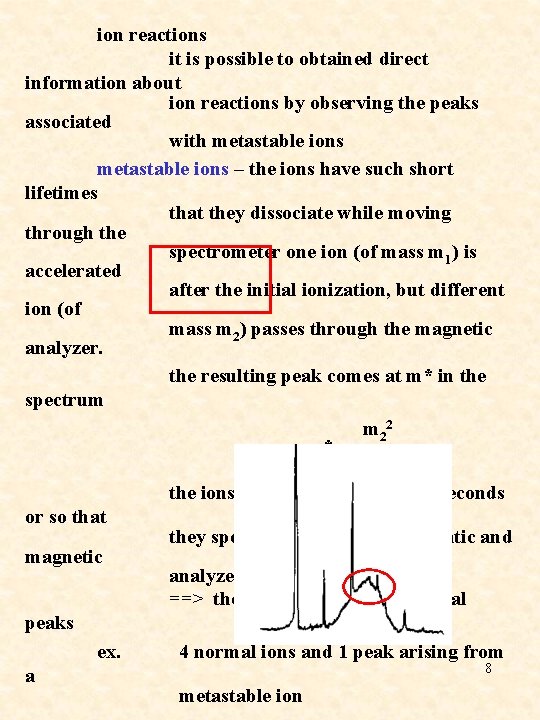
ion reactions it is possible to obtained direct information about ion reactions by observing the peaks associated with metastable ions – the ions have such short lifetimes that they dissociate while moving through the spectrometer one ion (of mass m 1) is accelerated after the initial ionization, but different ion (of mass m 2) passes through the magnetic analyzer. the resulting peak comes at m* in the spectrum m 22 m* = —— m 1 the ions are formed during 10 -5 seconds or so that they spend between the electrostatic and magnetic analyzers ==> they give quite broad spectral peaks ex. 4 normal ions and 1 peak arising from 8 a metastable ion
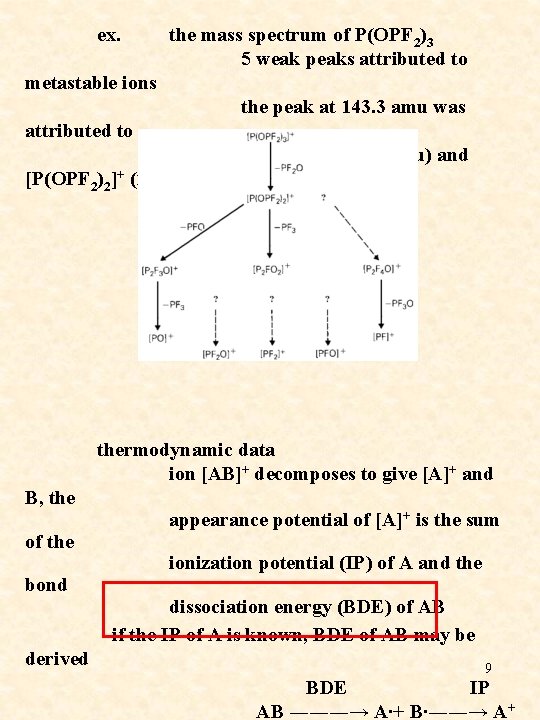
ex. the mass spectrum of P(OPF 2)3 5 weak peaks attributed to metastable ions the peak at 143. 3 amu was attributed to [P(OPF 2)2]+ (201 amu) [P(OPF 2)3]+ (286 amu) and thermodynamic data ion [AB]+ decomposes to give [A]+ and B, the of the bond appearance potential of [A]+ is the sum ionization potential (IP) of A and the dissociation energy (BDE) of AB if the IP of A is known, BDE of AB may be derived BDE 9 IP AB ―――→ A∙+ B∙――→ A+
ex. dissociation of complex [Fe(h 5 C 5 H 5)(CO)L(MX 3)] [MX]+ appearance MX 3 IP Fe- M BDE potential (e. V) (k. J/mol) [Fe(C 5 H 5)(CO)2(Si. Me 3)] 9. 22 7. 25 1. 97 190 [Fe(C 5 H 5)(CO)2(Sn. Me 3)] 9. 12 6. 81 2. 31 223 [Fe(C 5 H 5)(CO)2(Sn. Ph 3)] 8. 87 6. 29 2. 58 249 [Fe(C 5 H 5)(CO)(PPh 3)(Si. Me 3) 9. 48 7. 25 2. 23 215 ex. DHfo = ? 0. 2 e. V k. J/mol D Cl. CH 2 PH 2 CH 2=PH + HCl C + H 2 + P CH 2=PH IP of CH 2=PH : 10. 3 0. 2 e. V AP of [CH 2=PH]+ from Cl. CH 2 PH 2: 11. 0 DHfo (HCl) = -92 k. J/mol DHfo (Cl. CH 2 PH 2) = -44 4 k. J/mol standard heat of atomization: H, 218; C, 717; P, 315 standard single bond energy: C—H, 413; P—H, 321 estimate C=P bond energy 10 Cl. CH 2 PH 2 [CH 2=PH]+ + e- + HCl DH = 11. 0 0. 2 e. V (1061
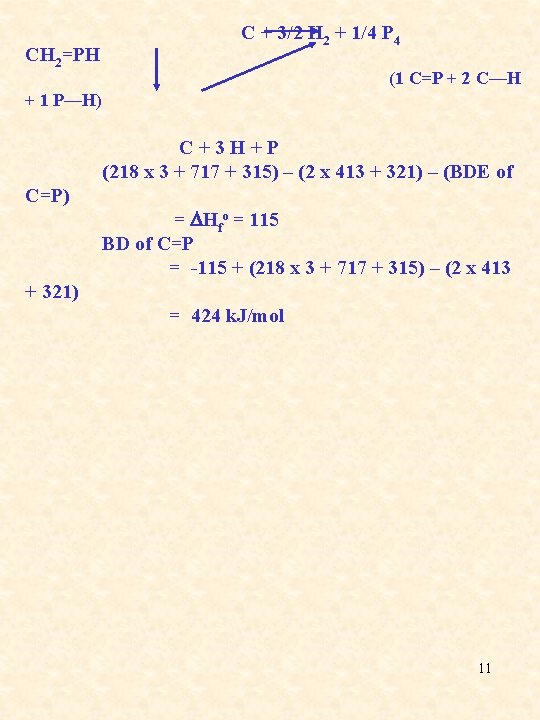
CH 2=PH C + 3/2 H 2 + 1/4 P 4 (1 C=P + 2 C—H + 1 P—H) C + 3 H + P (218 x 3 + 717 + 315) – (2 x 413 + 321) – (BDE of C=P) = DHfo = 115 BD of C=P = -115 + (218 x 3 + 717 + 315) – (2 x 413 + 321) = 424 k. J/mol 11
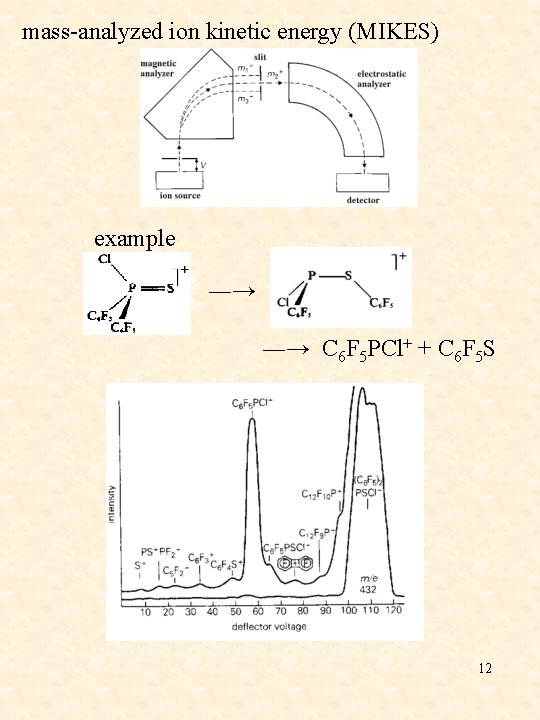
mass-analyzed ion kinetic energy (MIKES) example ―→ ―→ C 6 F 5 PCl+ + C 6 F 5 S 12
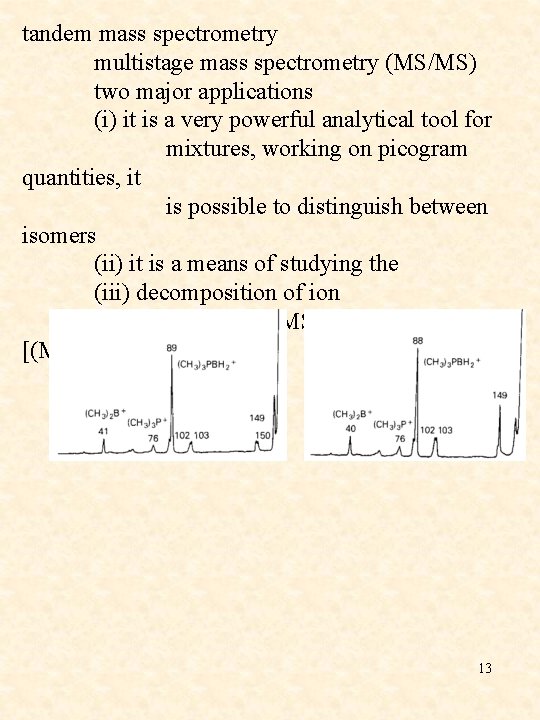
tandem mass spectrometry multistage mass spectrometry (MS/MS) two major applications (i) it is a very powerful analytical tool for mixtures, working on picogram quantities, it is possible to distinguish between isomers (ii) it is a means of studying the (iii) decomposition of ion example MS/MS spectra for [(Me 3 P)2 BH]+ (a) with 11 B and (b) with 10 B 13