
Mass Spectrometry CHEM HONORS Mass Spectrometry This is
- Slides: 10
Mass Spectrometry CHEM HONORS
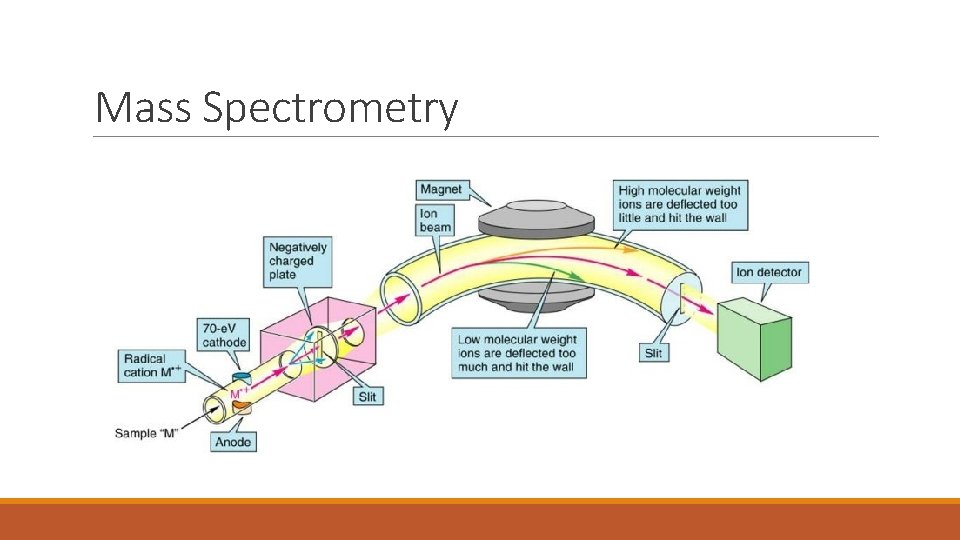
Mass Spectrometry • This is an analytical technique that helps identify how much of a given substance (chemical) is present in a sample by measuring the mass to charge ratio • A sample is bombarded by electrons, this causes the sample to fragment and form ions. • These ions are separated by their mass to charge ratio via an electric or magnetic field and are then detected. • Results are displayed in a spectrum containing the relative abundance of the detected ions. • The atoms or molecules can be determined by comparing them to known masses
Mass Spectrometry
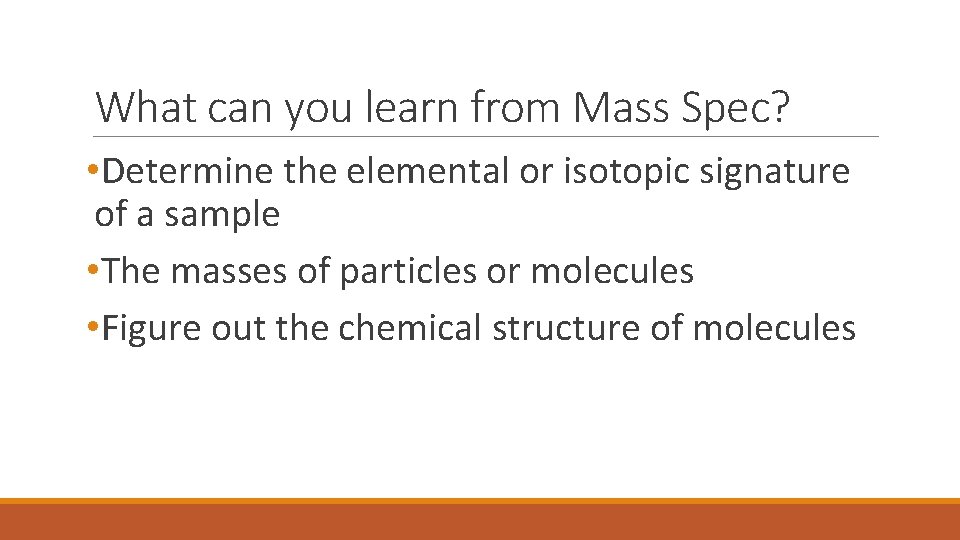
What can you learn from Mass Spec? • Determine the elemental or isotopic signature of a sample • The masses of particles or molecules • Figure out the chemical structure of molecules
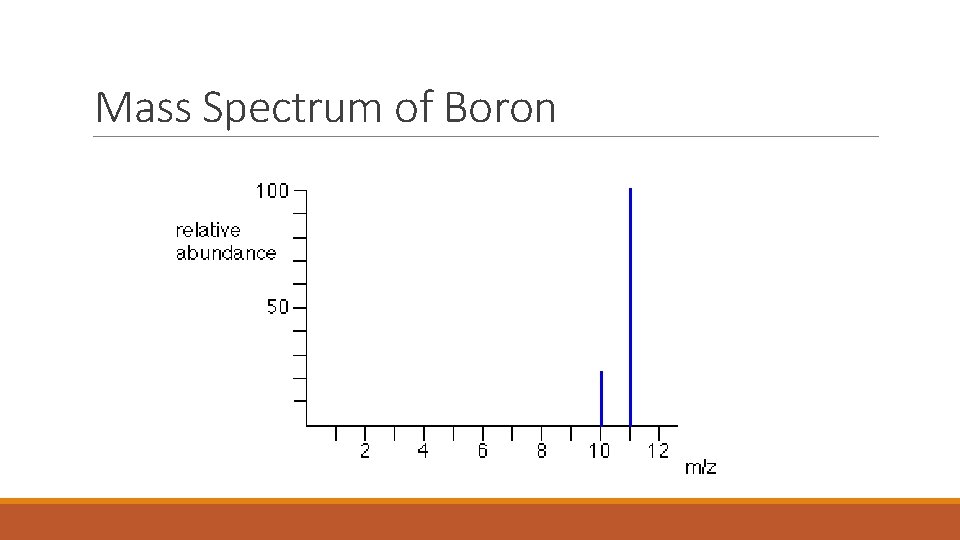
Mass Spectrum of Boron
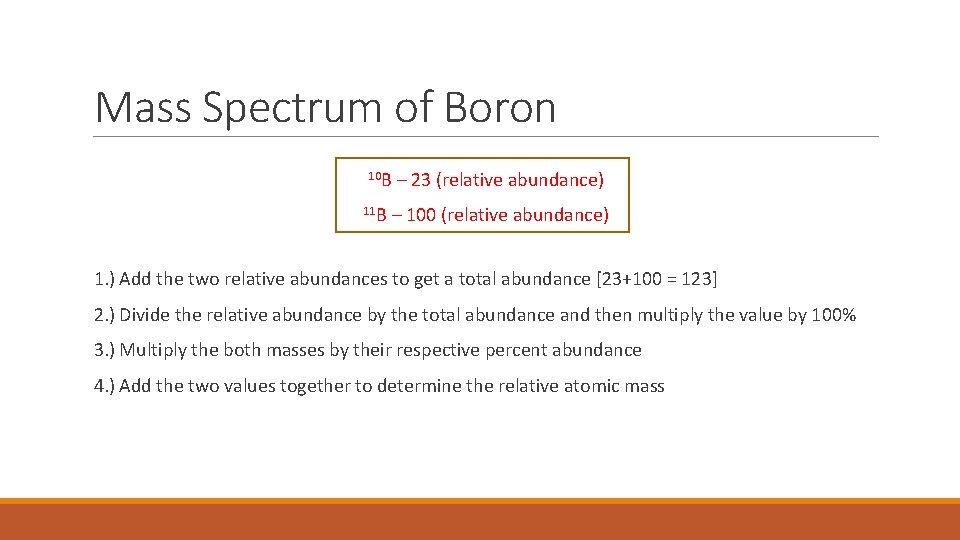
Mass Spectrum of Boron 10 B 11 B – 23 (relative abundance) – 100 (relative abundance) 1. ) Add the two relative abundances to get a total abundance [23+100 = 123] 2. ) Divide the relative abundance by the total abundance and then multiply the value by 100% 3. ) Multiply the both masses by their respective percent abundance 4. ) Add the two values together to determine the relative atomic mass
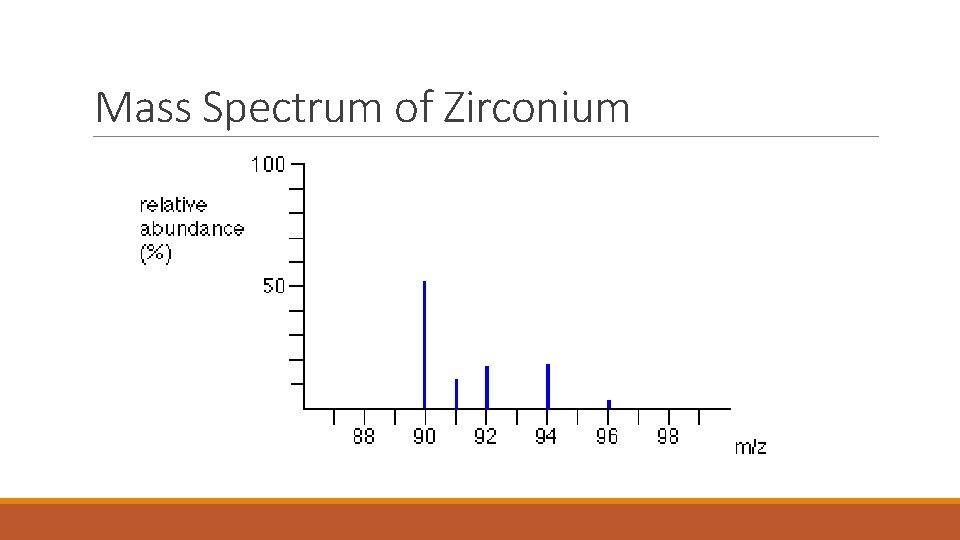
Mass Spectrum of Zirconium
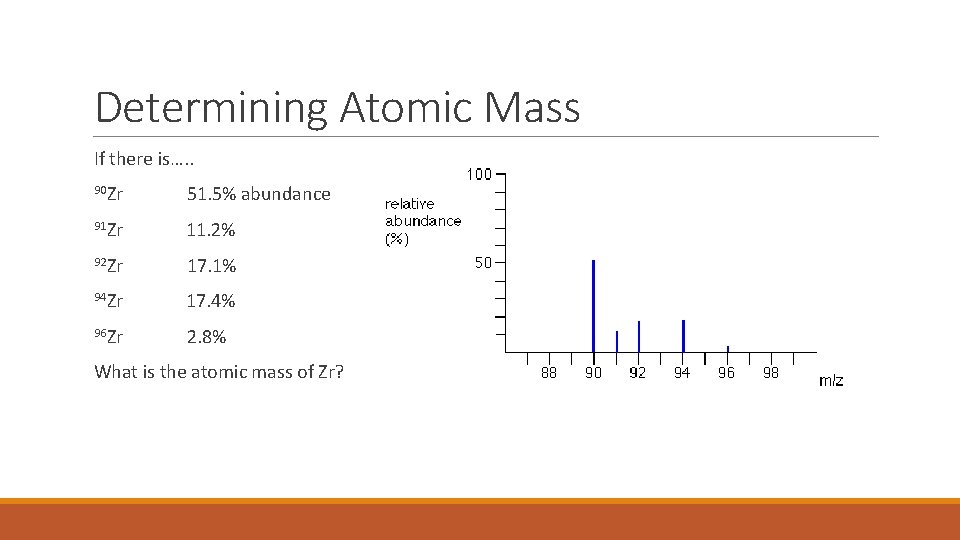
Determining Atomic Mass If there is…. . 90 Zr 51. 5% abundance 91 Zr 11. 2% 92 Zr 17. 1% 94 Zr 17. 4% 96 Zr 2. 8% What is the atomic mass of Zr?
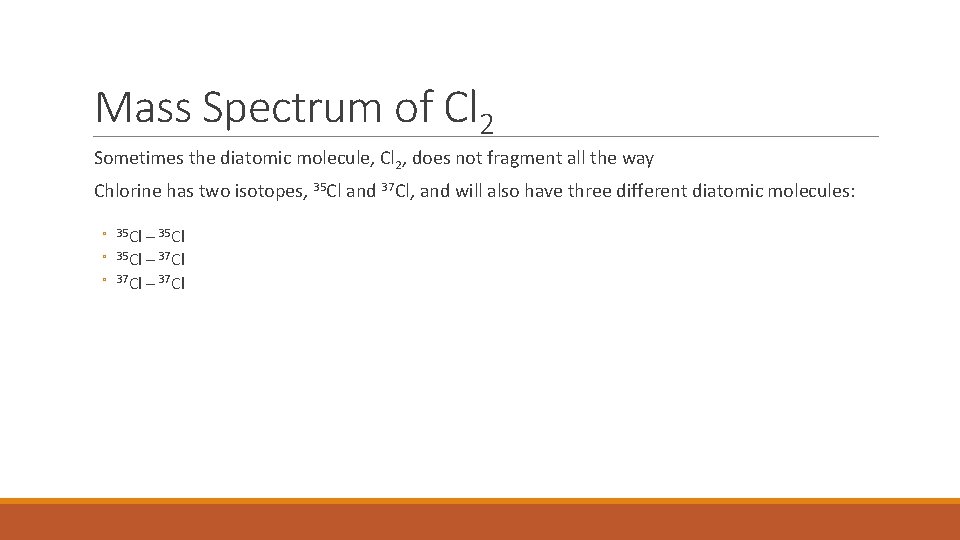
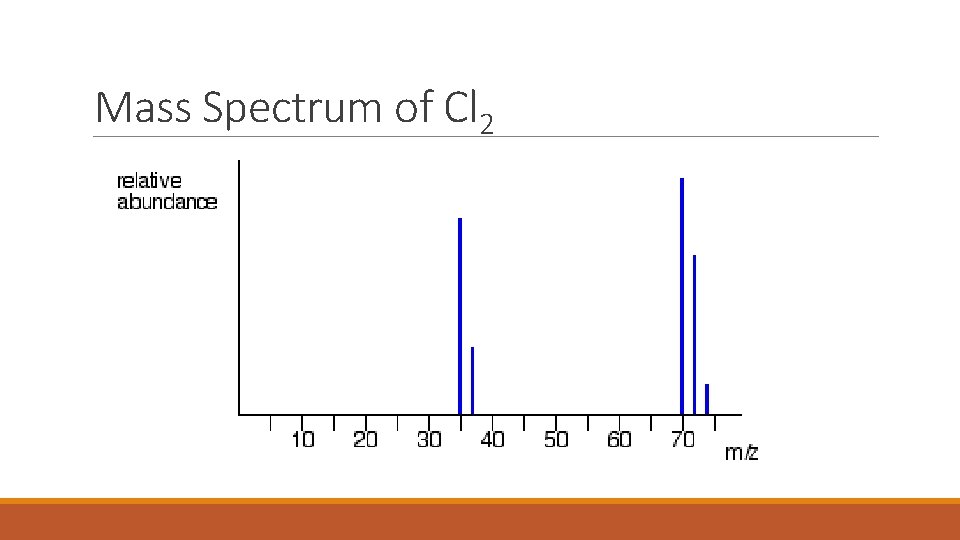
Mass Spectrum of Cl 2 Sometimes the diatomic molecule, Cl 2, does not fragment all the way Chlorine has two isotopes, 35 Cl and 37 Cl, and will also have three different diatomic molecules: ◦ 35 Cl ◦ ◦ – 35 Cl – 37 Cl
Mass Spectrum of Cl 2