
MASS SPECTROMETRY A guide for A level students


- Slides: 28
MASS SPECTROMETRY A guide for A level students KNOCKHARDY PUBLISHING 2008 SPECIFICATIONS
KNOCKHARDY PUBLISHING MASS SPECTROMETRY INTRODUCTION This Powerpoint show is one of several produced to help students understand selected topics at AS and A 2 level Chemistry. It is based on the requirements of the AQA and OCR specifications but is suitable for other examination boards. Individual students may use the material at home for revision purposes or it may be used for classroom teaching if an interactive white board is available. Accompanying notes on this, and the full range of AS and A 2 topics, are available from the KNOCKHARDY SCIENCE WEBSITE at. . . www. knockhardy. org. uk/sci. htm Navigation is achieved by. . . either clicking on the grey arrows at the foot of each page or using the left and right arrow keys on the keyboard
MASS SPECTROMETRY CONTENTS • Prior knowledge • Background information • The basic parts of a mass spectrometer • The four stages of obtaining a spectrum • How different ions are deflected • Calculating molecular masses using mass spectra • Example questions • Test questions • Other uses of mass spectrometry • Check list
MASS SPECTROMETRY Before you start it would be helpful to… • know that atoms are made up of protons, neutrons and electrons • know that like charges repel
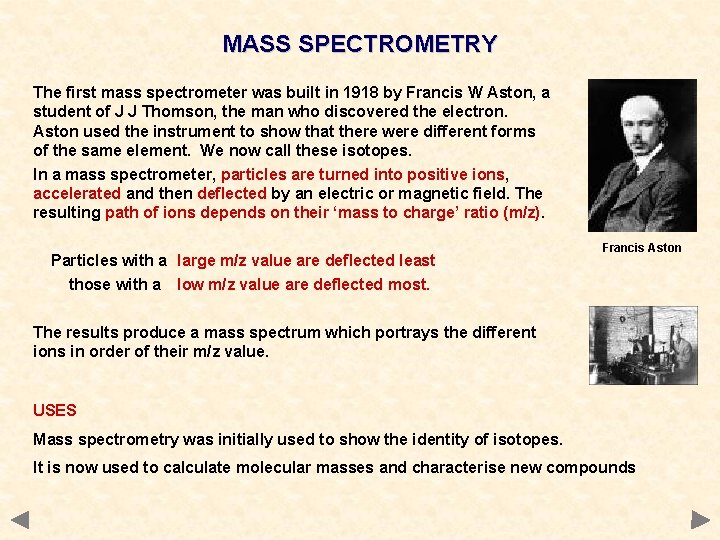
MASS SPECTROMETRY The first mass spectrometer was built in 1918 by Francis W Aston, a student of J J Thomson, the man who discovered the electron. Aston used the instrument to show that there were different forms of the same element. We now call these isotopes. In a mass spectrometer, particles are turned into positive ions, accelerated and then deflected by an electric or magnetic field. The resulting path of ions depends on their ‘mass to charge’ ratio (m/z). Particles with a large m/z value are deflected least those with a low m/z value are deflected most. Francis Aston The results produce a mass spectrum which portrays the different ions in order of their m/z value. USES Mass spectrometry was initially used to show the identity of isotopes. It is now used to calculate molecular masses and characterise new compounds
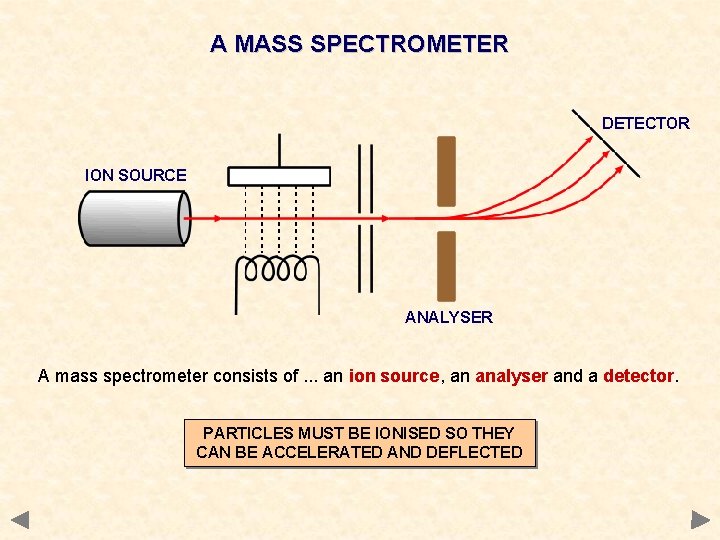
A MASS SPECTROMETER DETECTOR ION SOURCE ANALYSER A mass spectrometer consists of. . . an ion source, an analyser and a detector. PARTICLES MUST BE IONISED SO THEY CAN BE ACCELERATED AND DEFLECTED
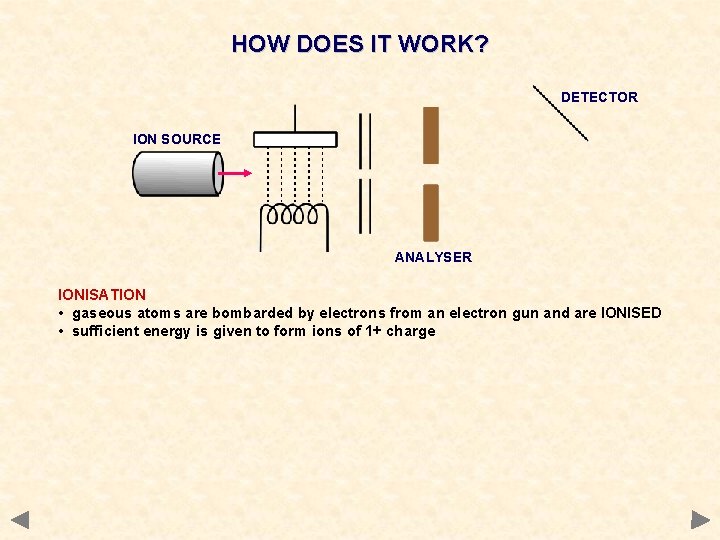
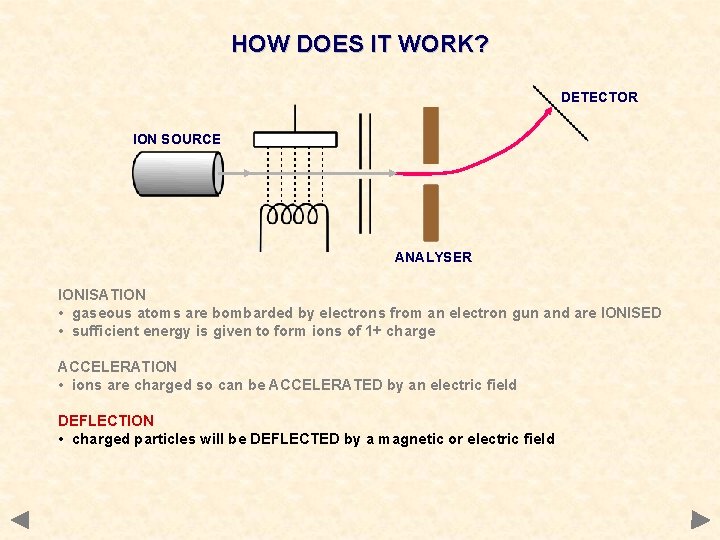
HOW DOES IT WORK? DETECTOR ION SOURCE ANALYSER IONISATION • gaseous atoms are bombarded by electrons from an electron gun and are IONISED • sufficient energy is given to form ions of 1+ charge
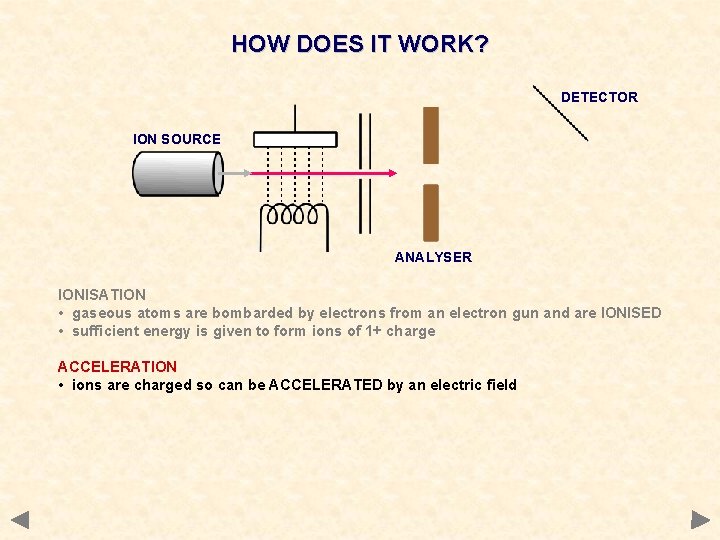
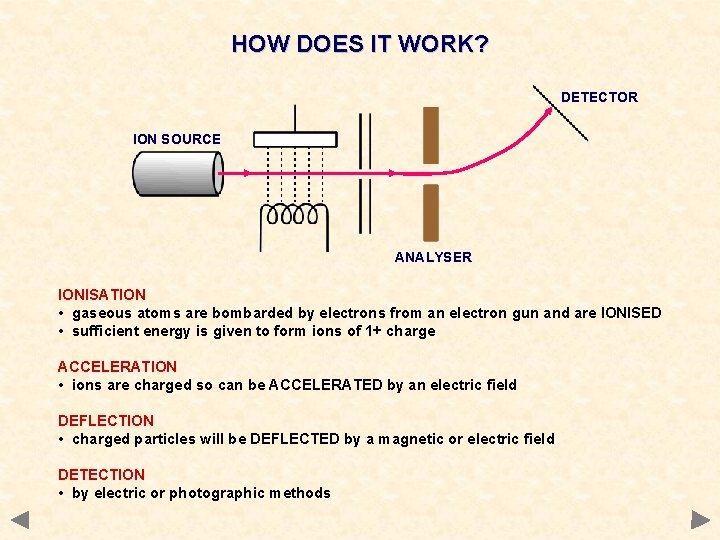
HOW DOES IT WORK? DETECTOR ION SOURCE ANALYSER IONISATION • gaseous atoms are bombarded by electrons from an electron gun and are IONISED • sufficient energy is given to form ions of 1+ charge ACCELERATION • ions are charged so can be ACCELERATED by an electric field
HOW DOES IT WORK? DETECTOR ION SOURCE ANALYSER IONISATION • gaseous atoms are bombarded by electrons from an electron gun and are IONISED • sufficient energy is given to form ions of 1+ charge ACCELERATION • ions are charged so can be ACCELERATED by an electric field DEFLECTION • charged particles will be DEFLECTED by a magnetic or electric field
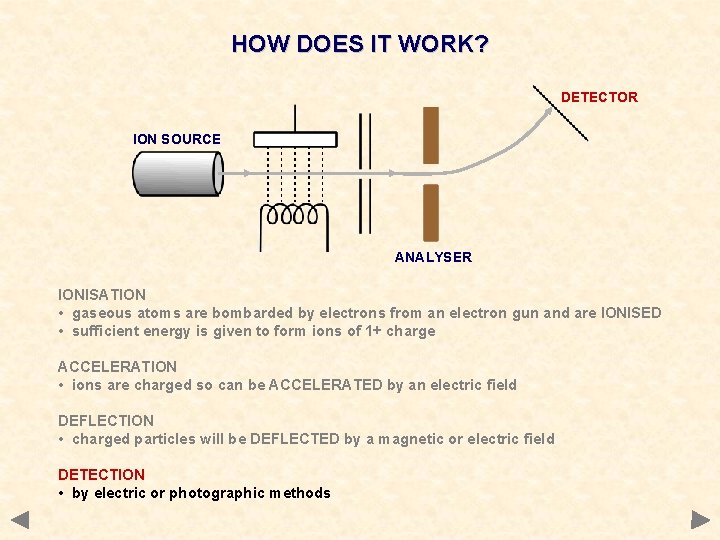
HOW DOES IT WORK? DETECTOR ION SOURCE ANALYSER IONISATION • gaseous atoms are bombarded by electrons from an electron gun and are IONISED • sufficient energy is given to form ions of 1+ charge ACCELERATION • ions are charged so can be ACCELERATED by an electric field DEFLECTION • charged particles will be DEFLECTED by a magnetic or electric field DETECTION • by electric or photographic methods
HOW DOES IT WORK? DETECTOR ION SOURCE ANALYSER IONISATION • gaseous atoms are bombarded by electrons from an electron gun and are IONISED • sufficient energy is given to form ions of 1+ charge ACCELERATION • ions are charged so can be ACCELERATED by an electric field DEFLECTION • charged particles will be DEFLECTED by a magnetic or electric field DETECTION • by electric or photographic methods
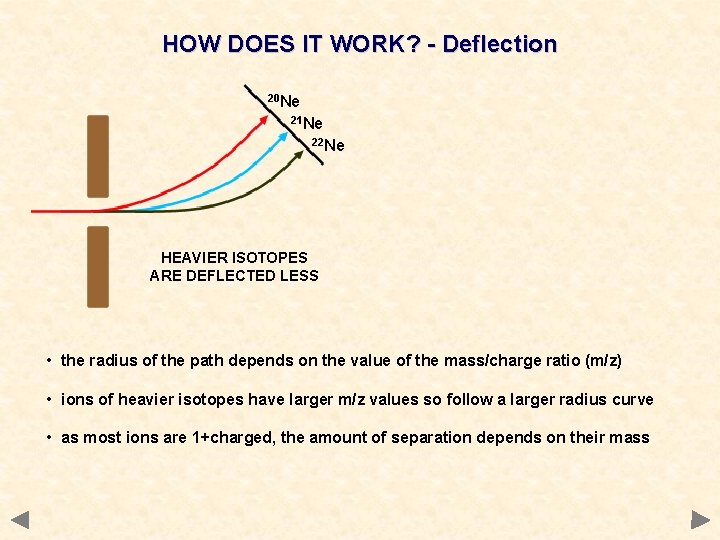
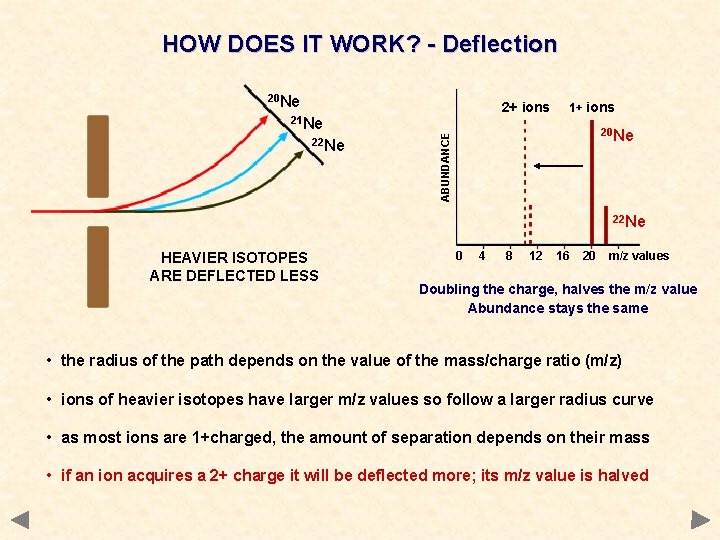
HOW DOES IT WORK? - Deflection 20 Ne 21 Ne 22 Ne HEAVIER ISOTOPES ARE DEFLECTED LESS • the radius of the path depends on the value of the mass/charge ratio (m/z) • ions of heavier isotopes have larger m/z values so follow a larger radius curve • as most ions are 1+charged, the amount of separation depends on their mass
HOW DOES IT WORK? - Deflection 20 Ne 22 Ne 2+ ions 1+ ions 20 Ne ABUNDANCE 21 Ne 22 Ne HEAVIER ISOTOPES ARE DEFLECTED LESS 0 4 8 12 16 20 m/z values Doubling the charge, halves the m/z value Abundance stays the same • the radius of the path depends on the value of the mass/charge ratio (m/z) • ions of heavier isotopes have larger m/z values so follow a larger radius curve • as most ions are 1+charged, the amount of separation depends on their mass • if an ion acquires a 2+ charge it will be deflected more; its m/z value is halved
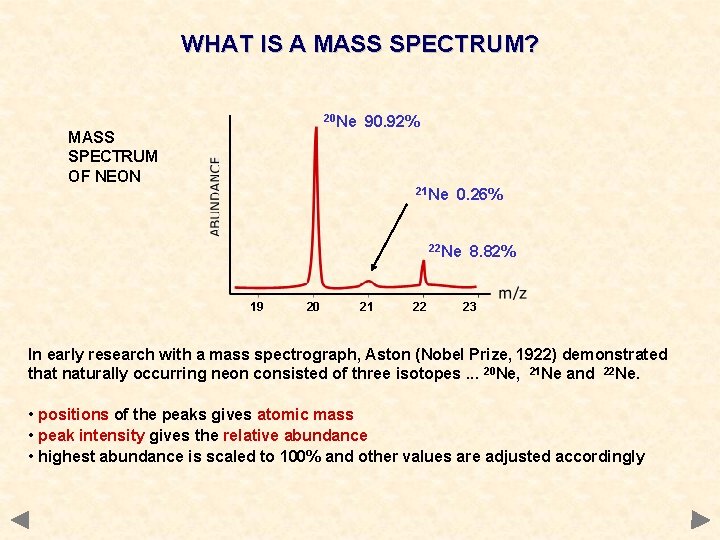
WHAT IS A MASS SPECTRUM? 20 Ne MASS SPECTRUM OF NEON 90. 92% 21 Ne 0. 26% 22 Ne 19 20 21 22 8. 82% 23 In early research with a mass spectrograph, Aston (Nobel Prize, 1922) demonstrated that naturally occurring neon consisted of three isotopes. . . 20 Ne, 21 Ne and 22 Ne. • positions of the peaks gives atomic mass • peak intensity gives the relative abundance • highest abundance is scaled to 100% and other values are adjusted accordingly
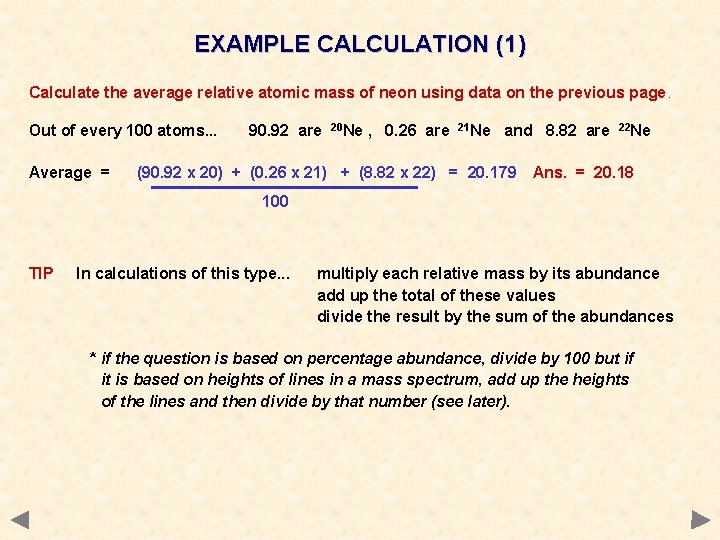
EXAMPLE CALCULATION (1) Calculate the average relative atomic mass of neon using data on the previous page. Out of every 100 atoms. . . Average = 90. 92 are 20 Ne , 0. 26 are 21 Ne and 8. 82 are (90. 92 x 20) + (0. 26 x 21) + (8. 82 x 22) = 20. 179 22 Ne Ans. = 20. 18 100 TIP In calculations of this type. . . multiply each relative mass by its abundance add up the total of these values divide the result by the sum of the abundances * if the question is based on percentage abundance, divide by 100 but if it is based on heights of lines in a mass spectrum, add up the heights of the lines and then divide by that number (see later).
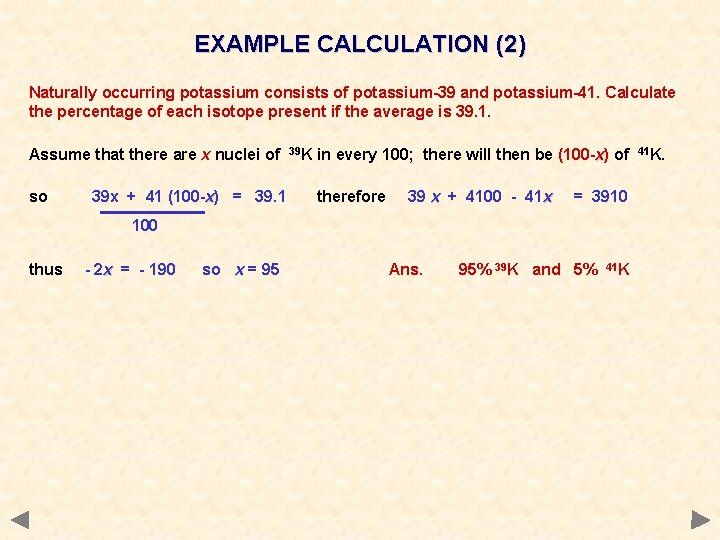
EXAMPLE CALCULATION (2) Naturally occurring potassium consists of potassium-39 and potassium-41. Calculate the percentage of each isotope present if the average is 39. 1. Assume that there are x nuclei of so 39 x + 41 (100 -x) = 39. 1 39 K in every 100; there will then be (100 -x) of therefore 39 x + 4100 - 41 x = 3910 100 thus - 2 x = - 190 so x = 95 Ans. 95% 39 K and 5% 41 K.
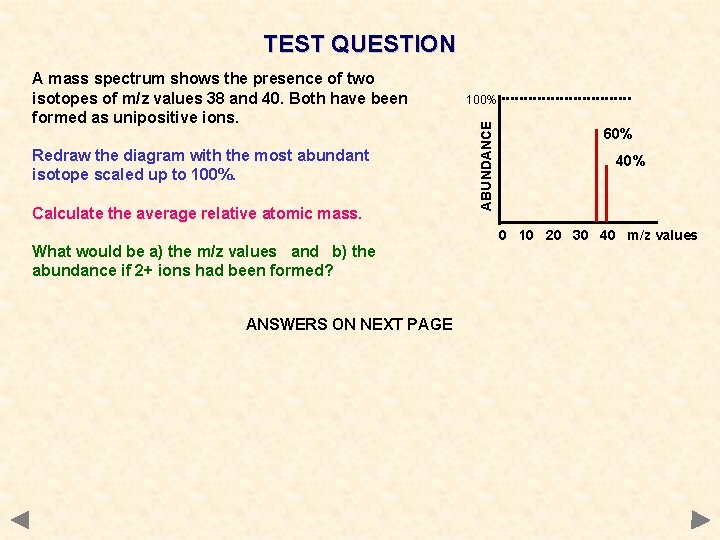
TEST QUESTION Redraw the diagram with the most abundant isotope scaled up to 100%. Calculate the average relative atomic mass. What would be a) the m/z values and b) the abundance if 2+ ions had been formed? ANSWERS ON NEXT PAGE 100% ABUNDANCE A mass spectrum shows the presence of two isotopes of m/z values 38 and 40. Both have been formed as unipositive ions. 60% 40% 0 10 20 30 40 m/z values
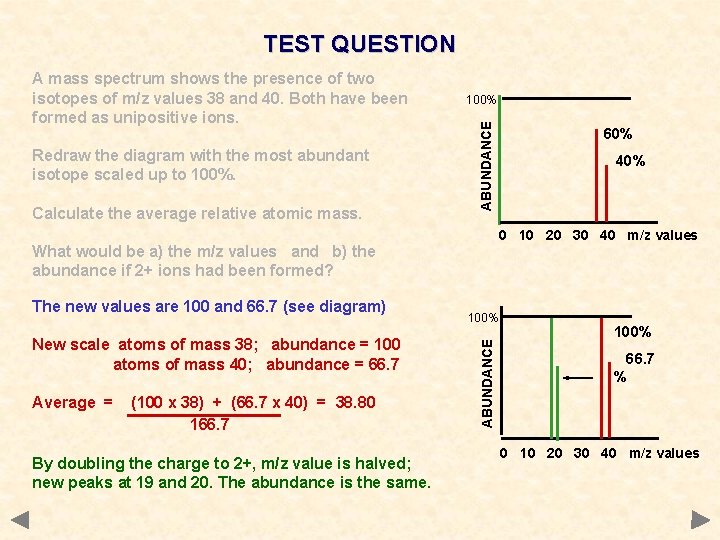
TEST QUESTION Redraw the diagram with the most abundant isotope scaled up to 100%. Calculate the average relative atomic mass. 100% ABUNDANCE A mass spectrum shows the presence of two isotopes of m/z values 38 and 40. Both have been formed as unipositive ions. Average = (100 x 38) + (66. 7 x 40) = 38. 80 166. 7 By doubling the charge to 2+, m/z value is halved; new peaks at 19 and 20. The abundance is the same. 100% ABUNDANCE New scale atoms of mass 38; abundance = 100 atoms of mass 40; abundance = 66. 7 40% 0 10 20 30 40 m/z values What would be a) the m/z values and b) the abundance if 2+ ions had been formed? The new values are 100 and 66. 7 (see diagram) 60% 100% 66. 7 % 0 10 20 30 40 m/z values
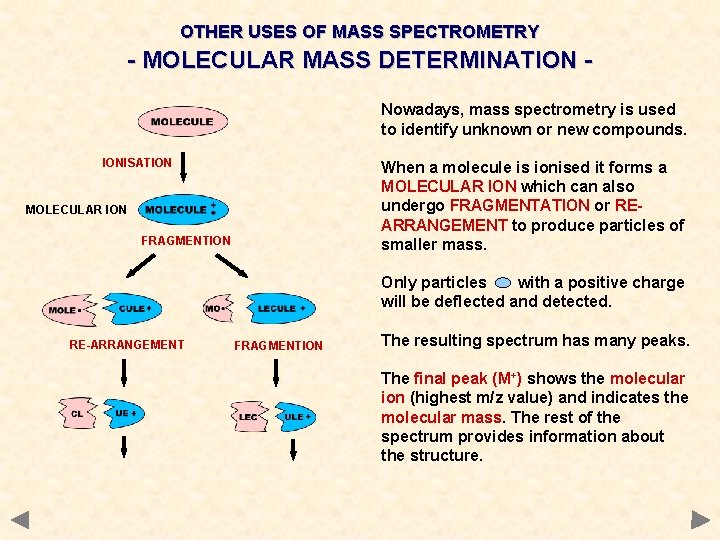
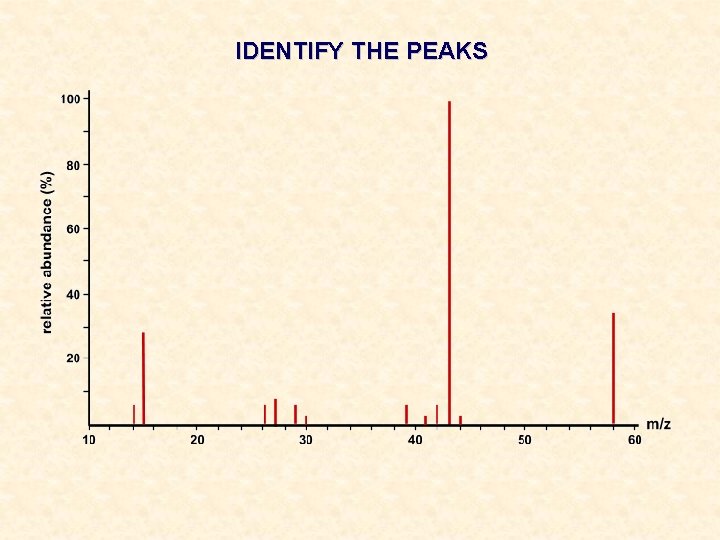
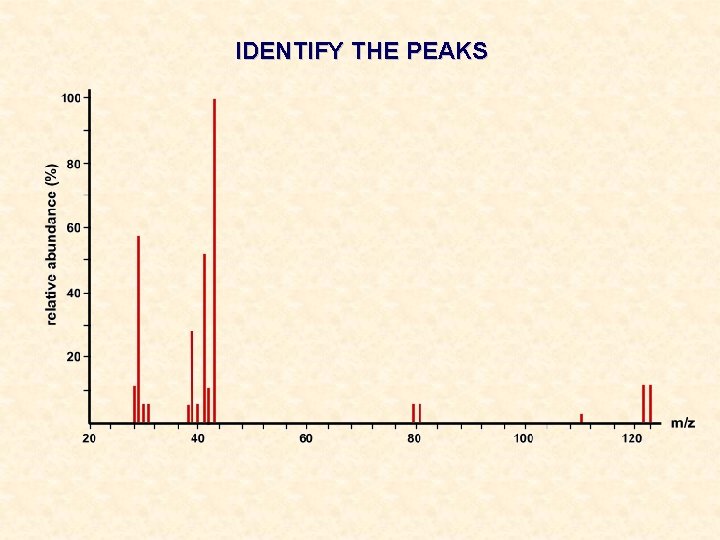
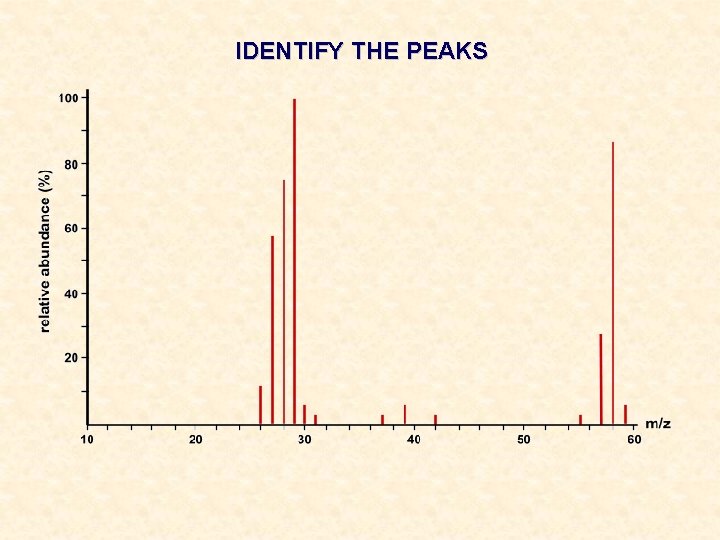
OTHER USES OF MASS SPECTROMETRY - MOLECULAR MASS DETERMINATION Nowadays, mass spectrometry is used to identify unknown or new compounds. IONISATION When a molecule is ionised it forms a MOLECULAR ION which can also undergo FRAGMENTATION or REARRANGEMENT to produce particles of smaller mass. MOLECULAR ION FRAGMENTION Only particles with a positive charge will be deflected and detected. RE-ARRANGEMENT FRAGMENTION The resulting spectrum has many peaks. The final peak (M+) shows the molecular ion (highest m/z value) and indicates the molecular mass. The rest of the spectrum provides information about the structure.
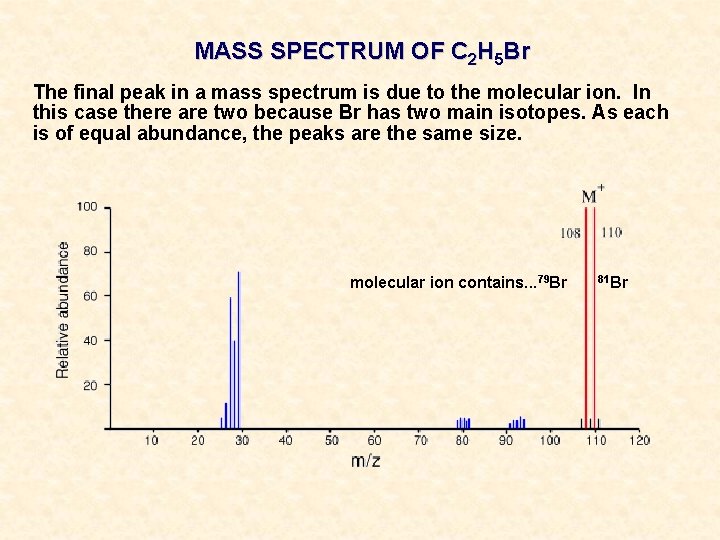
MASS SPECTRUM OF C 2 H 5 Br The final peak in a mass spectrum is due to the molecular ion. In this case there are two because Br has two main isotopes. As each is of equal abundance, the peaks are the same size. molecular ion contains. . . 79 Br 81 Br
IDENTIFY THE PEAKS
IDENTIFY THE PEAKS
IDENTIFY THE PEAKS
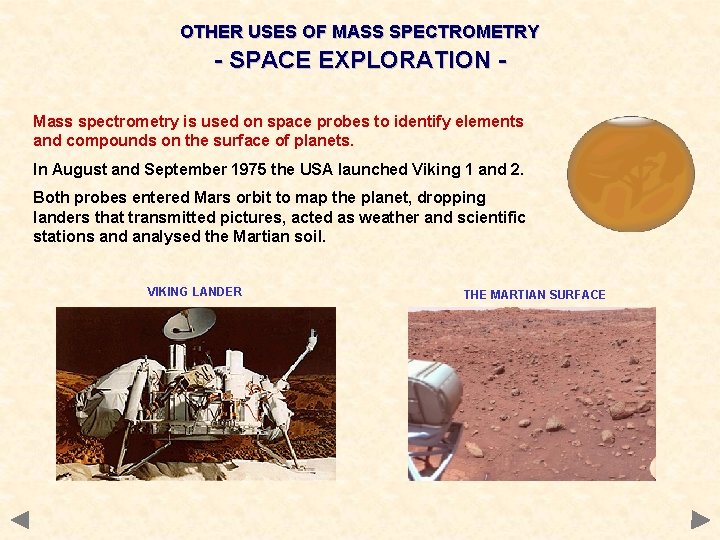
OTHER USES OF MASS SPECTROMETRY - SPACE EXPLORATION Mass spectrometry is used on space probes to identify elements and compounds on the surface of planets. In August and September 1975 the USA launched Viking 1 and 2. Both probes entered Mars orbit to map the planet, dropping landers that transmitted pictures, acted as weather and scientific stations and analysed the Martian soil. VIKING LANDER THE MARTIAN SURFACE
REVISION CHECK What should you be able to do? Recall the four basic stages in obtaining a mass spectrum Understand what happens during each of the above four stages Understand why particles need to be in the form of ions Recall the meaning of mass to charge ratio (m/z) Explain how the mass/charge value affects the path of a deflected ion Interpret a simple mass spectrum and calculate the average atomic mass Understand how mass spectrometry can be used to calculate molecular mass Recall that mass spectrometry can be used to in space exploration Recall other uses of mass spectrometry CAN YOU DO ALL OF THESE? YES NO
You need to go over the relevant topic(s) again Click on the button to return to the menu
WELL DONE! Try some past paper questions
MASS SPECTROMETRY The End © 2008 KNOCKHARDY PUBLISHING