
Mass of the Vector Meson in Quantum Chromodynamics
- Slides: 27
Mass of the Vector Meson in Quantum Chromodynamics in the limit of large number of colors Rahul Patel With Carlos Prays and Ari Hietanen Mentor: Dr. Rajamani Narayanan Department of Physics Florida International University
OUTLINE • Quantum Chromodynamics • Feynman Path Integral (Quantum) • Parallel Transport (Gauge Theory) - Abelian (EM) and Non-Abelian (Color) • Particle Propagation - Meson and Quark propagation - Vector Meson Propagation • Computer Simulation
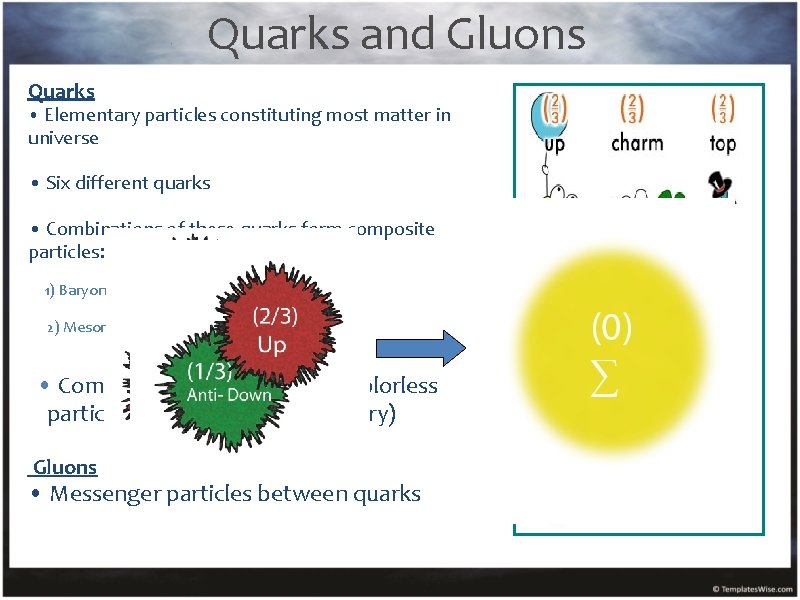
Quarks and Gluons Quarks • Elementary particles constituting most matter in universe • Six different quarks • Combinations of these quarks form composite particles: 1) Baryons (3 quark combination): ex: Protons, Neutrons 2) Mesons (quark, anti-quark combo): ex: pion, rho • Combinations must produce colorless particles (due to Gauge symmetry) Gluons • Messenger particles between quarks
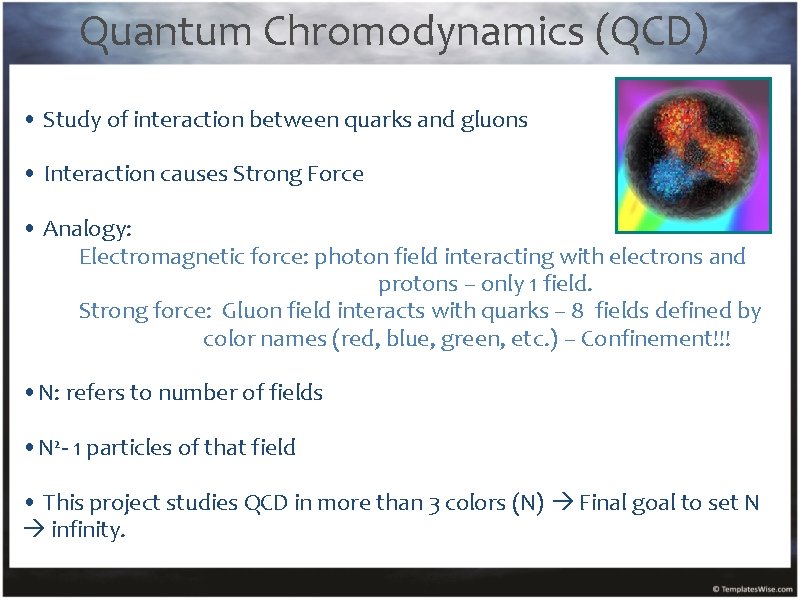
Quantum Chromodynamics (QCD) • Study of interaction between quarks and gluons • Interaction causes Strong Force • Analogy: Electromagnetic force: photon field interacting with electrons and protons – only 1 field. Strong force: Gluon field interacts with quarks – 8 fields defined by color names (red, blue, green, etc. ) – Confinement!!! • N: refers to number of fields • N 2 - 1 particles of that field • This project studies QCD in more than 3 colors (N) Final goal to set N infinity.
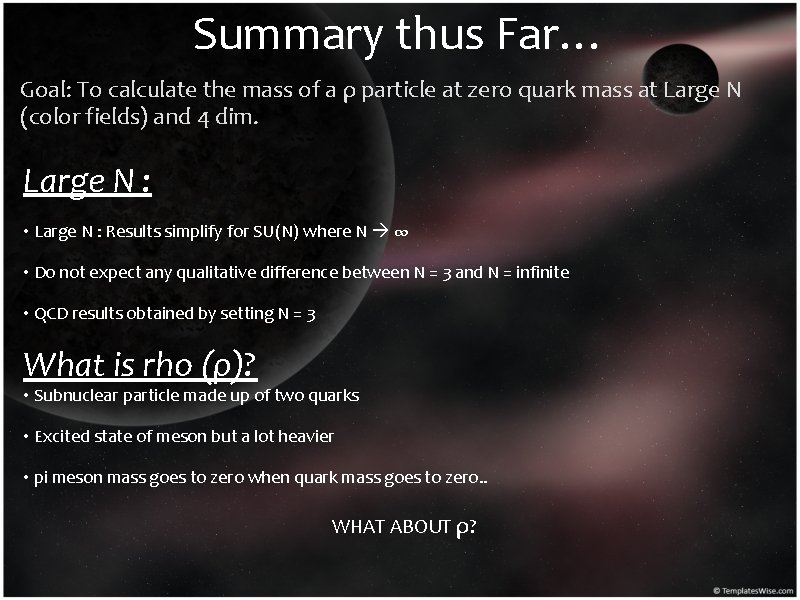
Summary thus Far… Goal: To calculate the mass of a ρ particle at zero quark mass at Large N (color fields) and 4 dim. Large N : • Large N : Results simplify for SU(N) where N ∞ • Do not expect any qualitative difference between N = 3 and N = infinite • QCD results obtained by setting N = 3 What is rho (ρ)? • Subnuclear particle made up of two quarks • Excited state of meson but a lot heavier • pi meson mass goes to zero when quark mass goes to zero. . WHAT ABOUT ρ?
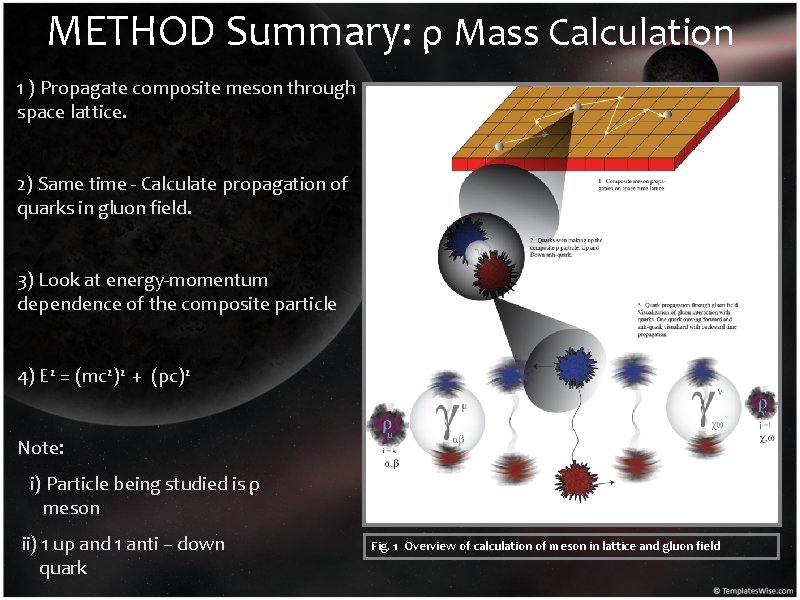
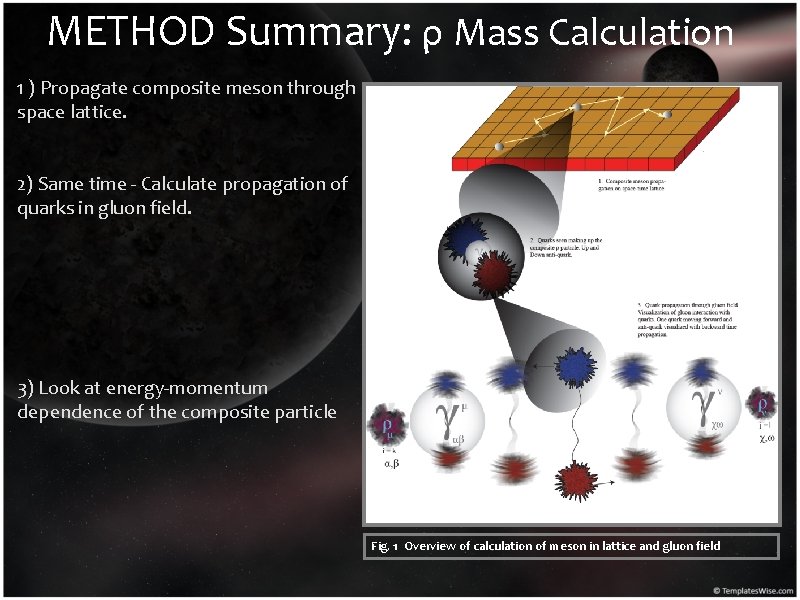
METHOD Summary: ρ Mass Calculation 1 ) Propagate composite meson through space lattice. 2) Same time - Calculate propagation of quarks in gluon field. 3) Look at energy-momentum dependence of the composite particle 4) E 2 = (mc 2)2 + (pc)2 Note: i) Particle being studied is ρ meson ii) 1 up and 1 anti – down quark Fig. 1 Overview of calculation of meson in lattice and gluon field
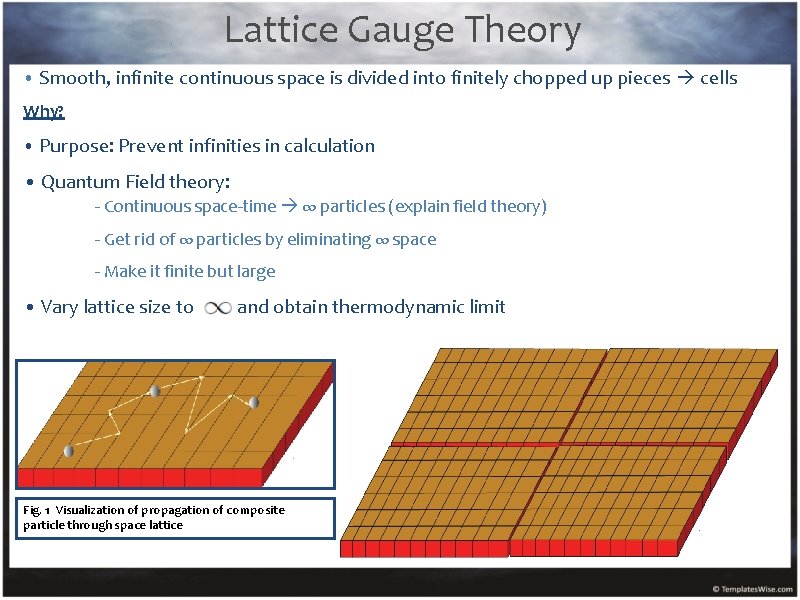
Lattice Gauge Theory • Smooth, infinite continuous space is divided into finitely chopped up pieces cells Why? • Purpose: Prevent infinities in calculation • Quantum Field theory: - Continuous space-time ∞ particles (explain field theory) - Get rid of ∞ particles by eliminating ∞ space - Make it finite but large • Vary lattice size to and obtain thermodynamic limit Fig. 1 Visualization of propagation of composite particle through space lattice
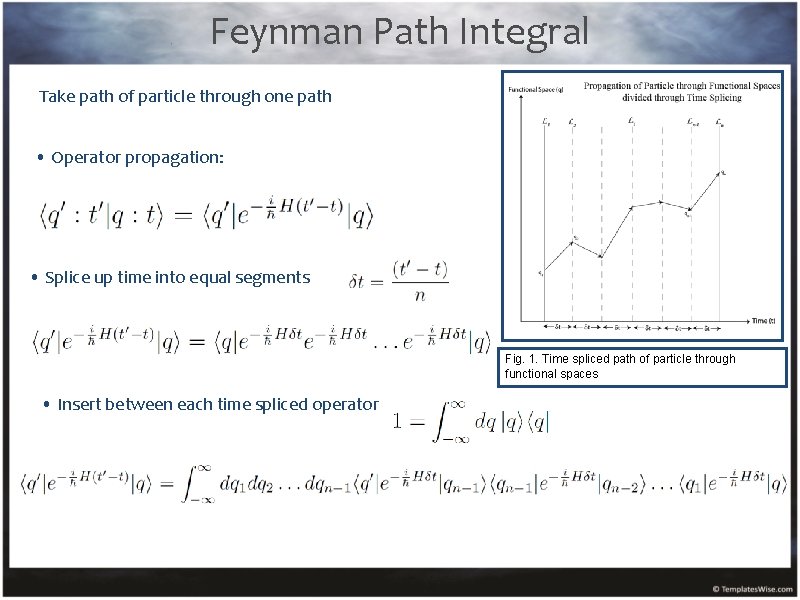
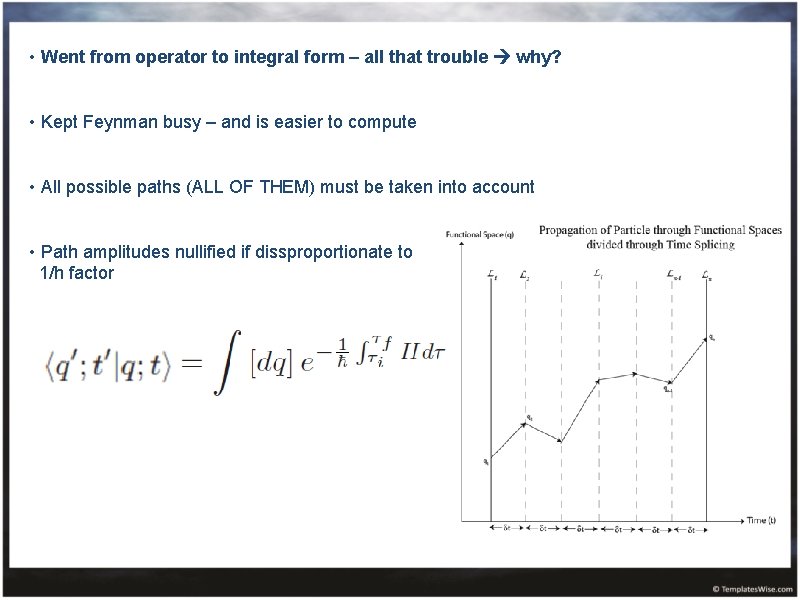
Feynman Path Integral Take path of particle through one path • Operator propagation: • Splice up time into equal segments Fig. 1. Time spliced path of particle through functional spaces • Insert between each time spliced operator
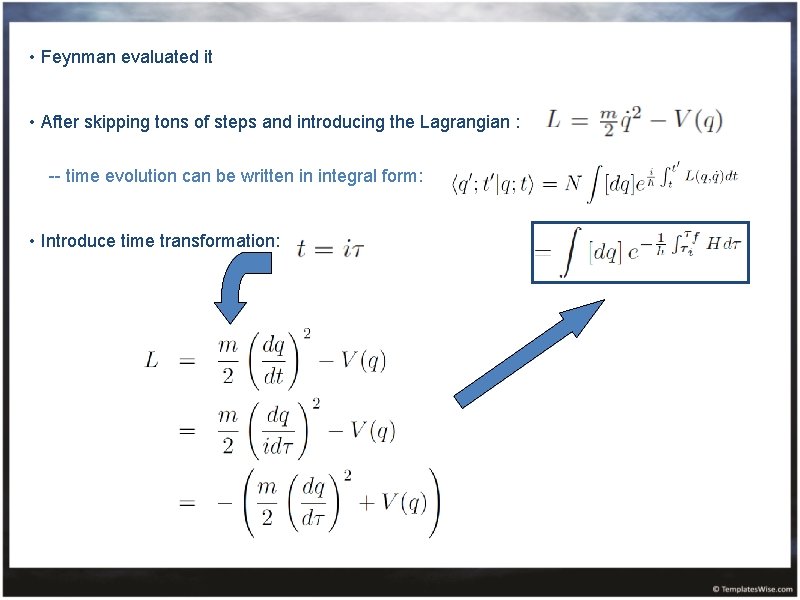
• Feynman evaluated it • After skipping tons of steps and introducing the Lagrangian : -- time evolution can be written in integral form: • Introduce time transformation:
• Went from operator to integral form – all that trouble why? • Kept Feynman busy – and is easier to compute • All possible paths (ALL OF THEM) must be taken into account • Path amplitudes nullified if dissproportionate to 1/h factor
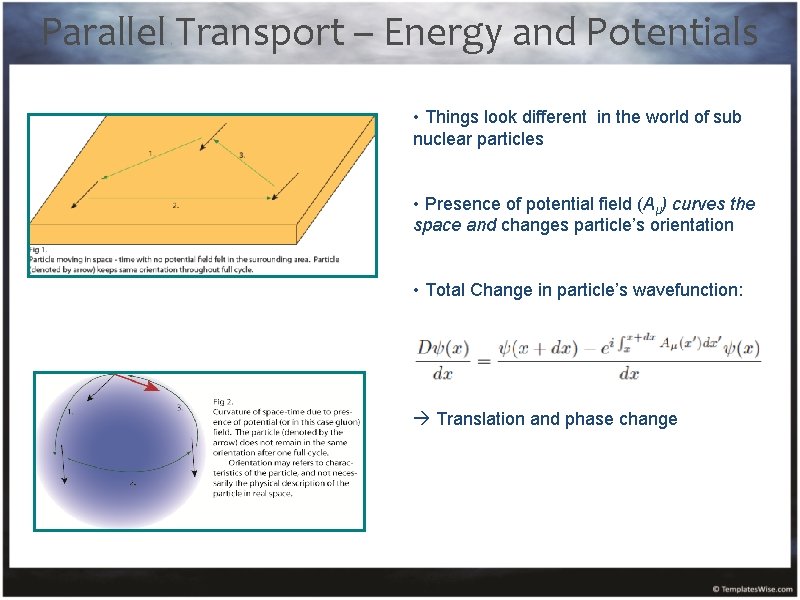
Parallel Transport – Energy and Potentials • Things look different in the world of sub nuclear particles • Presence of potential field (Aμ) curves the space and changes particle’s orientation • Total Change in particle’s wavefunction: Translation and phase change
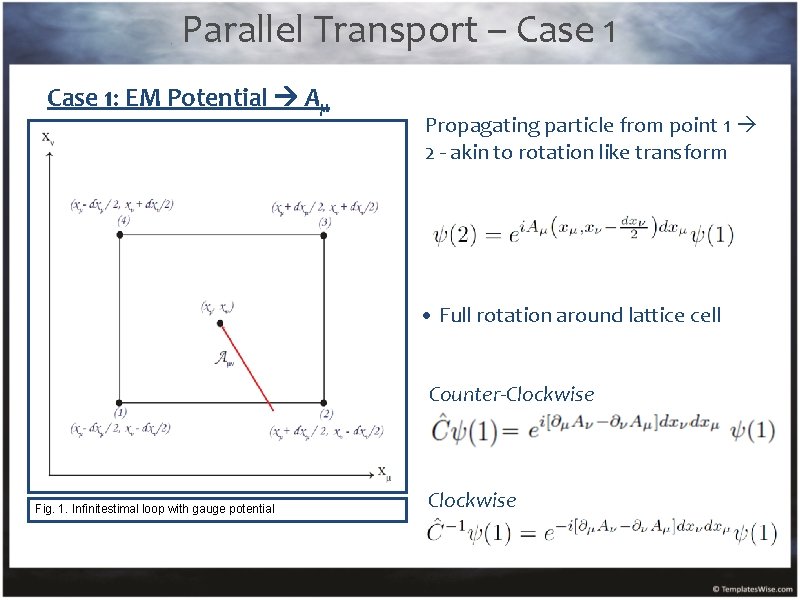
Parallel Transport – Case 1: EM Potential Aμ Propagating particle from point 1 2 - akin to rotation like transform • Full rotation around lattice cell Counter-Clockwise Fig. 1. Infinitestimal loop with gauge potential Clockwise
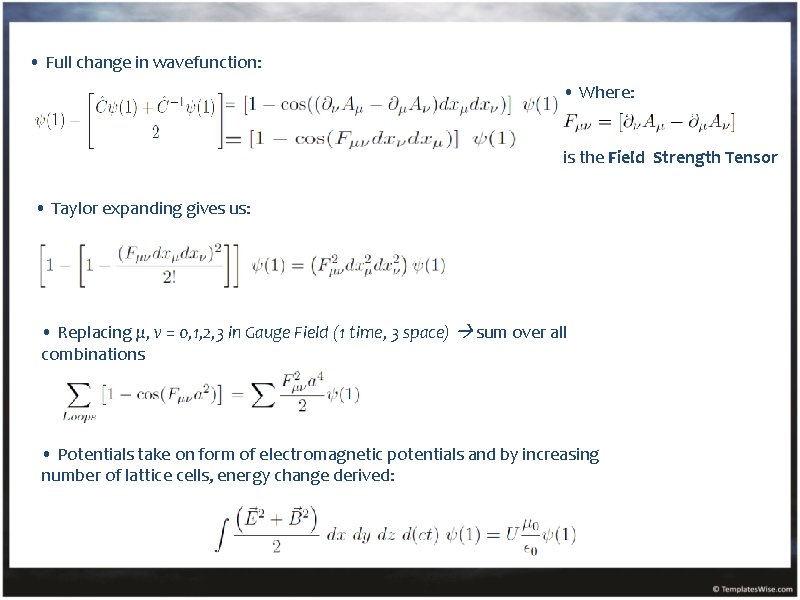
• Full change in wavefunction: • Where: is the Field Strength Tensor • Taylor expanding gives us: • Replacing μ, ν = 0, 1, 2, 3 in Gauge Field (1 time, 3 space) sum over all combinations • Potentials take on form of electromagnetic potentials and by increasing number of lattice cells, energy change derived:
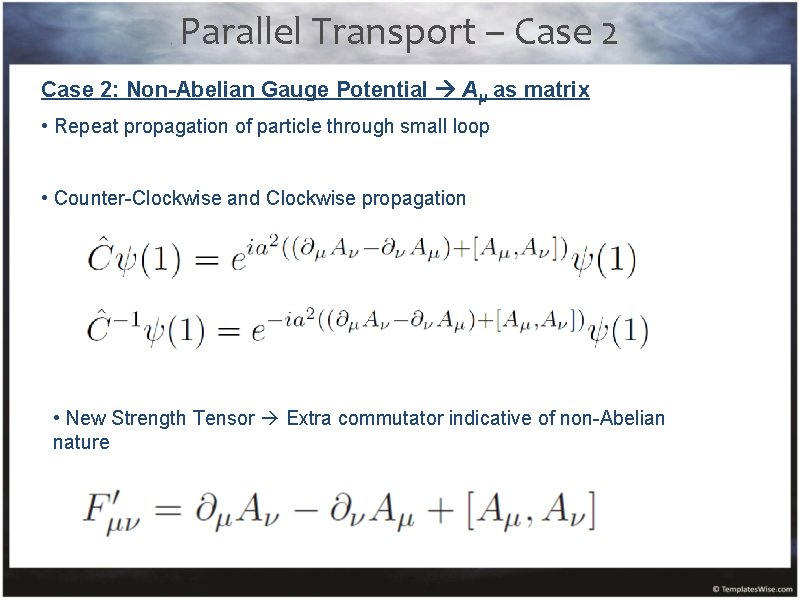
Parallel Transport – Case 2: Non-Abelian Gauge Potential Aμ as matrix • Repeat propagation of particle through small loop • Counter-Clockwise and Clockwise propagation • New Strength Tensor Extra commutator indicative of non-Abelian nature
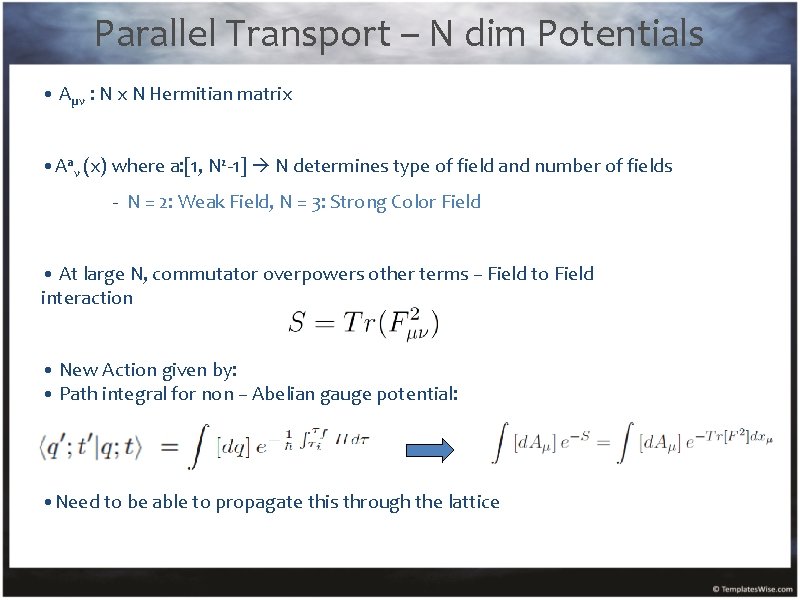
Parallel Transport – N dim Potentials • Aμν : N x N Hermitian matrix • Aaν (x) where a: [1, N 2 -1] N determines type of field and number of fields - N = 2: Weak Field, N = 3: Strong Color Field • At large N, commutator overpowers other terms – Field to Field interaction • New Action given by: • Path integral for non – Abelian gauge potential: • Need to be able to propagate this through the lattice
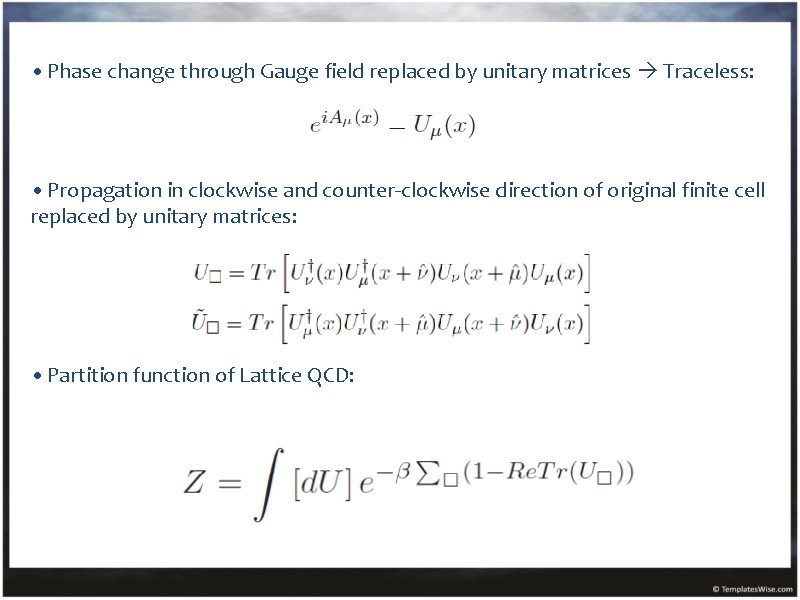
• Phase change through Gauge field replaced by unitary matrices Traceless: • Propagation in clockwise and counter-clockwise direction of original finite cell replaced by unitary matrices: • Partition function of Lattice QCD:
METHOD Summary: ρ Mass Calculation 1 ) Propagate composite meson through space lattice. 2) Same time - Calculate propagation of quarks in gluon field. 3) Look at energy-momentum dependence of the composite particle Fig. 1 Overview of calculation of meson in lattice and gluon field
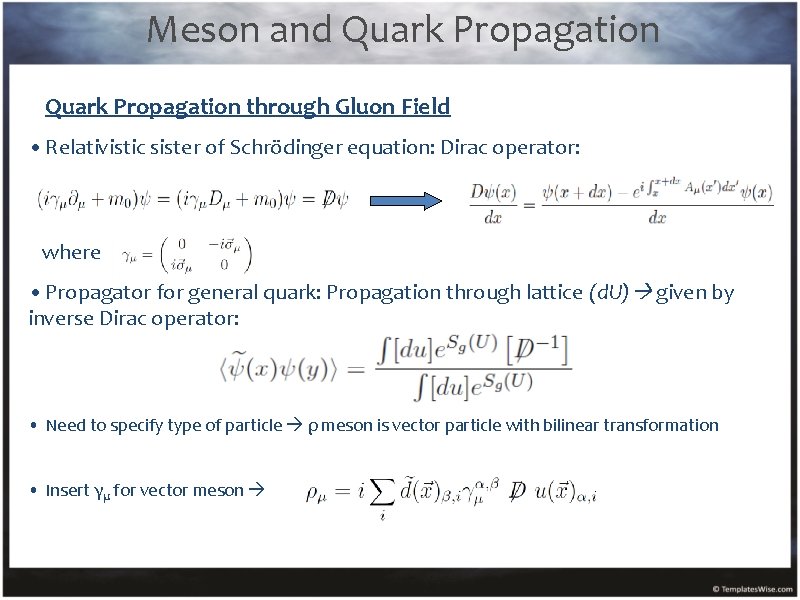
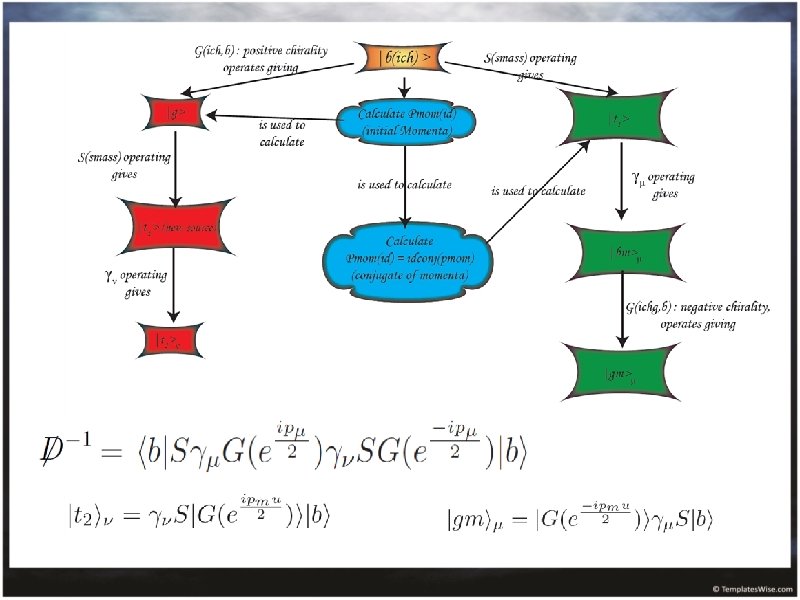
Meson and Quark Propagation through Gluon Field • Relativistic sister of Schrödinger equation: Dirac operator: where • Propagator for general quark: Propagation through lattice (d. U) given by inverse Dirac operator: • Need to specify type of particle ρ meson is vector particle with bilinear transformation • Insert γμ for vector meson
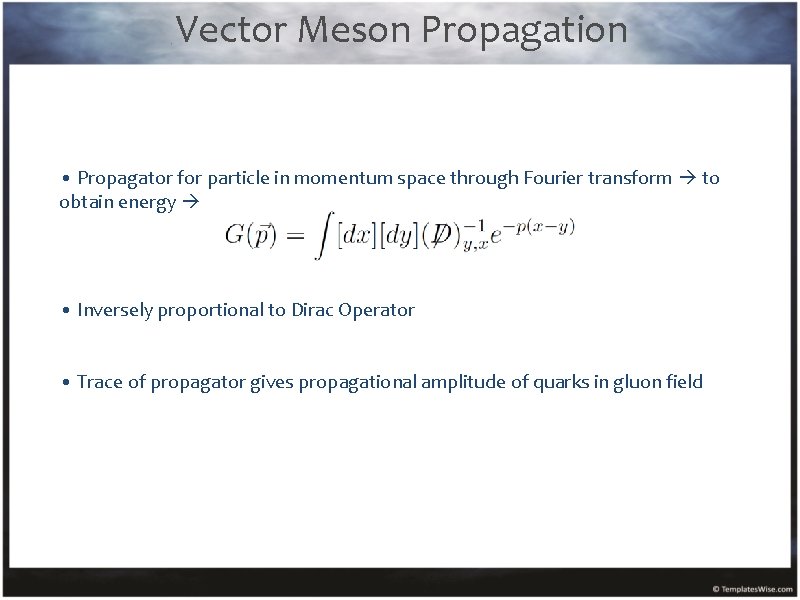
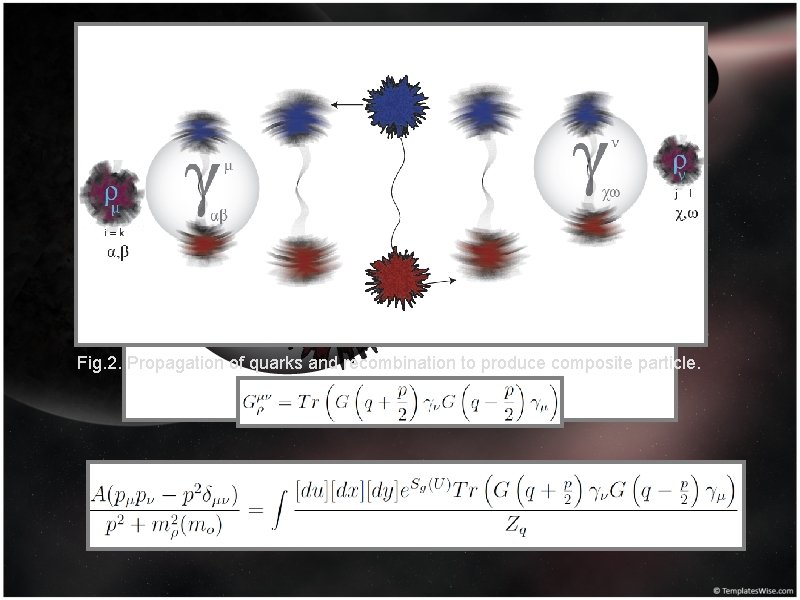
Vector Meson Propagation • Propagator for particle in momentum space through Fourier transform to obtain energy • Inversely proportional to Dirac Operator • Trace of propagator gives propagational amplitude of quarks in gluon field
Fig. 2. Propagation of quarks and recombination to produce composite particle.
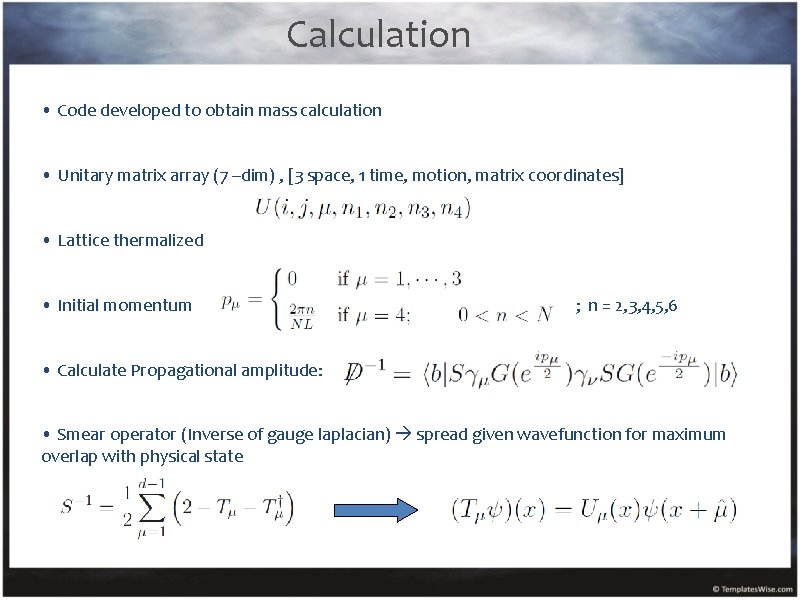
Calculation • Code developed to obtain mass calculation • Unitary matrix array (7 –dim) , [3 space, 1 time, motion, matrix coordinates] • Lattice thermalized • Initial momentum ; n = 2, 3, 4, 5, 6 • Calculate Propagational amplitude: • Smear operator (Inverse of gauge laplacian) spread given wavefunction for maximum overlap with physical state
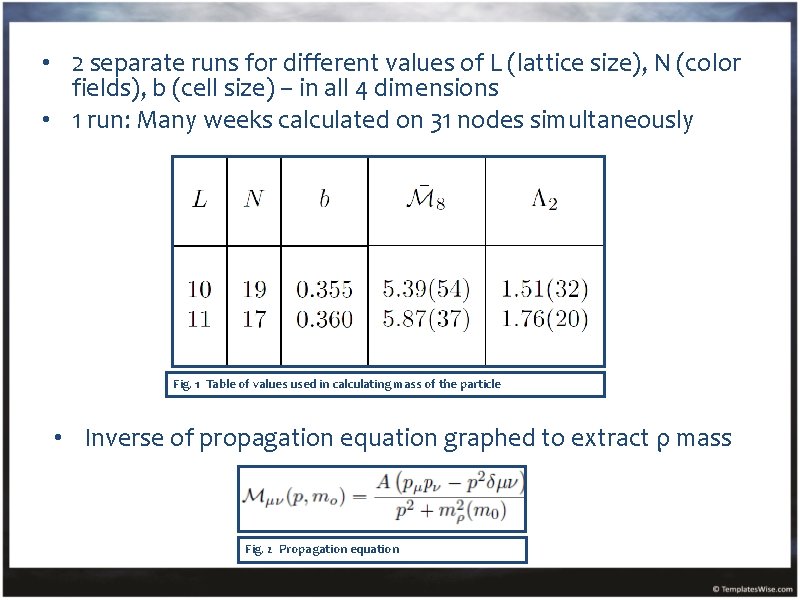
• 2 separate runs for different values of L (lattice size), N (color fields), b (cell size) – in all 4 dimensions • 1 run: Many weeks calculated on 31 nodes simultaneously Fig. 1 Table of values used in calculating mass of the particle • Inverse of propagation equation graphed to extract ρ mass Fig. 2 Propagation equation
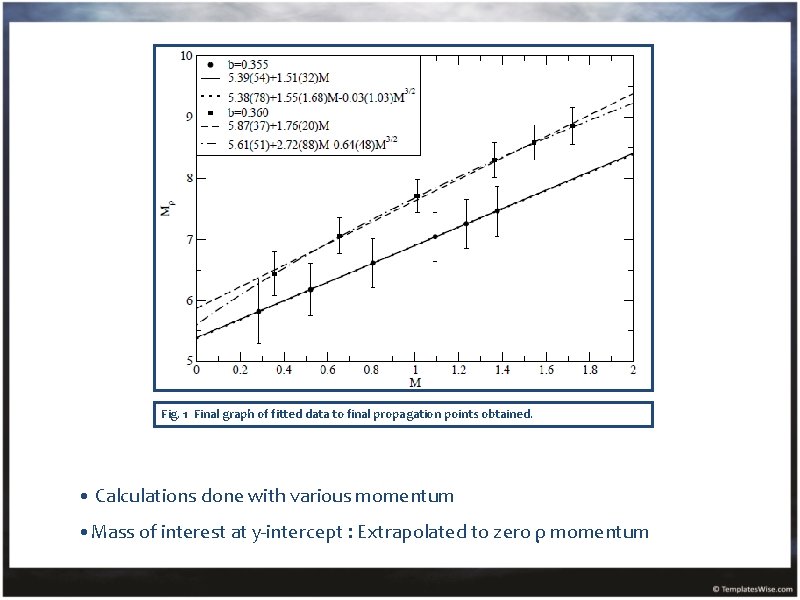
Fig. 1 Final graph of fitted data to final propagation points obtained. • Calculations done with various momentum • Mass of interest at y-intercept : Extrapolated to zero ρ momentum
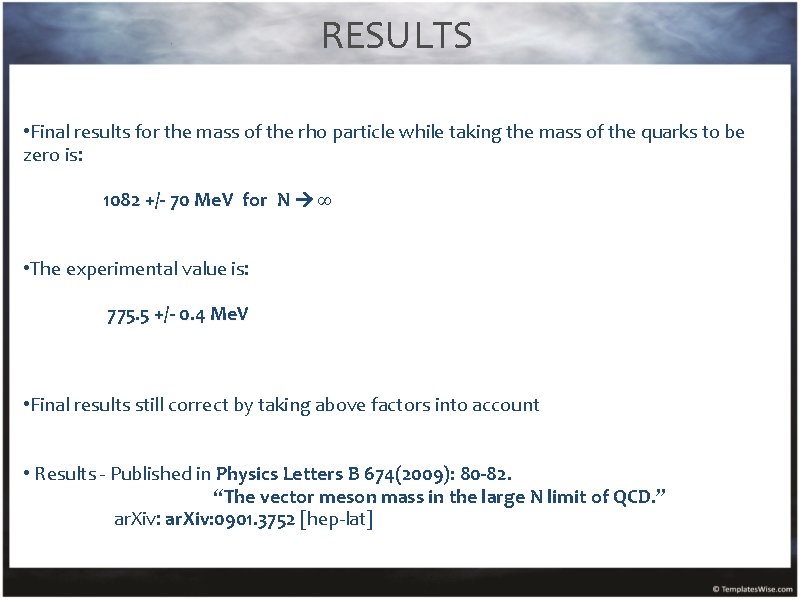
RESULTS • Final results for the mass of the rho particle while taking the mass of the quarks to be zero is: 1082 +/- 70 Me. V for N ∞ • The experimental value is: 775. 5 +/- 0. 4 Me. V • Final results still correct by taking above factors into account • Results - Published in Physics Letters B 674(2009): 80 -82. “The vector meson mass in the large N limit of QCD. ” ar. Xiv: 0901. 3752 [hep-lat]
REFERENCES • Cheng, Ta-Pei and Li, Ling-Fong. Gauge Theory of Elementary Particle Physics. New York: Oxford UP, USA, 1988 • M. Creutz, Quarks, Gluons, and Lattices, Cambridge University Press, 1985 • M. Leon, Particle Physics: An Introduction, Academic Press, 1973 • R. Narayanan, H. Neuberger, Phys. Lett. B 616 (2005) 76 -84 • J. Marion, S. Thornton, Classical Dynamics of Particles and Systems, Thomson Brooks/Cole, 2004 • G. Arfken, H, Weber, Mathematical Methods for Physicists 6 e. , Elevier Academic Press, 2005 • A. V. Manohar, in Les Houches 1997, Probing the standard model of particle interactions, Pt. 2, ar. Xiv: hep-ph/9802419
Thank You • • • Dr. Rajamani Narayanan Carlos Prays Dr. Ari Hietenan Richard Galvez Dr. Rodriguez, Ricardo Leante All the wonderful people in this room.