
MASS MOVEMENTS WIND GLACIERS mass movement when gravity



- Slides: 37
MASS MOVEMENTS, WIND, & GLACIERS mass movement = when gravity alone causes loose sediments and weathered rock to move downslope 1. climate determines which materials and how much is available for movement 2. all occur on slopes a. most common on slopes greater than 25 o that have annual rainfall of over 90 cm b. occur more often after heavy rains
3. range from very slow motion to sudden slides, fall, & flows 4. factors that affect a. material’s weight b. material’s resistance to sliding or flowing c. trigger that works to shake material loose from slope such as earthquakes & heavy rains d. amount of water on slope: too much water loosens sediments as well as makes these heavier & easier to move 5. categories: a. slides = move as block of Earth material b. flows = movement involves mixing of particles within moving mass c. falls = free fall of Earth material
TYPES: RAPID MASS MOVEMENTS: 1. mudflows = rapid movement of a large mass of mud and water a. occur in dry, mountainous areas and sloped, semi-arid regions that have intense, short-lived rainstorms b. usually after heavy rains, earthquakes, or volcanic eruptions c. spreads out in large fan shape at base of slope d. mud avalanche = fast and large mudflow e. can move down stream channels at speeds up to 100 km/h
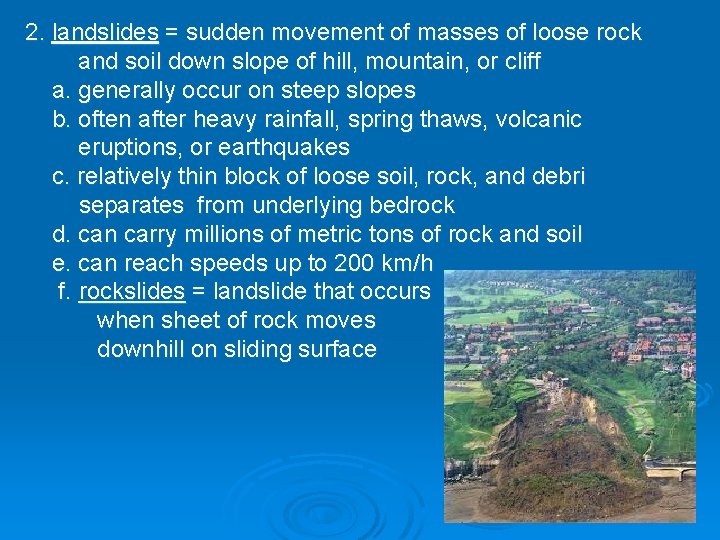
2. landslides = sudden movement of masses of loose rock and soil down slope of hill, mountain, or cliff a. generally occur on steep slopes b. often after heavy rainfall, spring thaws, volcanic eruptions, or earthquakes c. relatively thin block of loose soil, rock, and debri separates from underlying bedrock d. can carry millions of metric tons of rock and soil e. can reach speeds up to 200 km/h f. rockslides = landslide that occurs when sheet of rock moves downhill on sliding surface
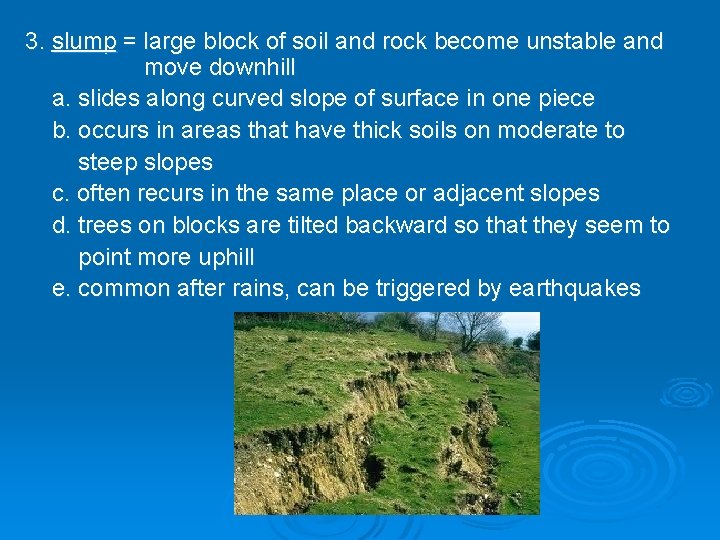
3. slump = large block of soil and rock become unstable and move downhill a. slides along curved slope of surface in one piece b. occurs in areas that have thick soils on moderate to steep slopes c. often recurs in the same place or adjacent slopes d. trees on blocks are tilted backward so that they seem to point more uphill e. common after rains, can be triggered by earthquakes
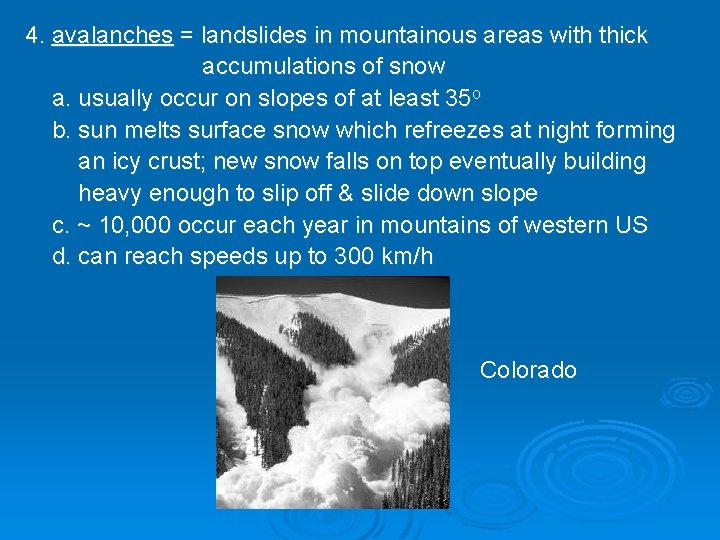
4. avalanches = landslides in mountainous areas with thick accumulations of snow a. usually occur on slopes of at least 35 o b. sun melts surface snow which refreezes at night forming an icy crust; new snow falls on top eventually building heavy enough to slip off & slide down slope c. ~ 10, 000 occur each year in mountains of western US d. can reach speeds up to 300 km/h Colorado
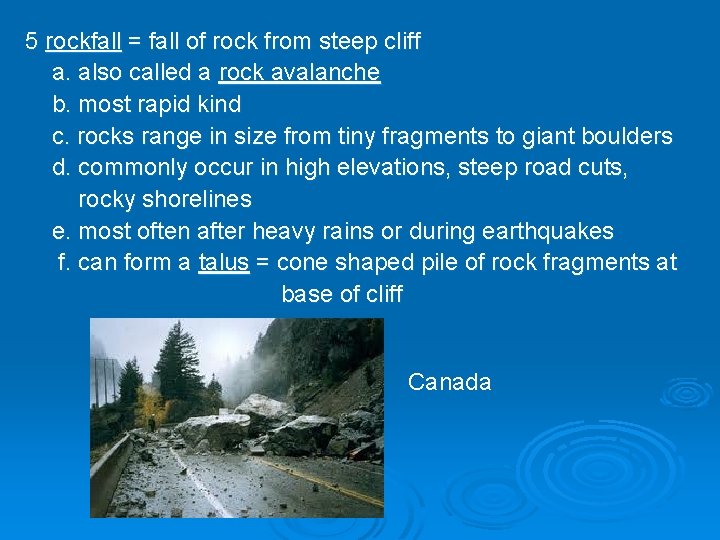
5 rockfall = fall of rock from steep cliff a. also called a rock avalanche b. most rapid kind c. rocks range in size from tiny fragments to giant boulders d. commonly occur in high elevations, steep road cuts, rocky shorelines e. most often after heavy rains or during earthquakes f. can form a talus = cone shaped pile of rock fragments at base of cliff Canada
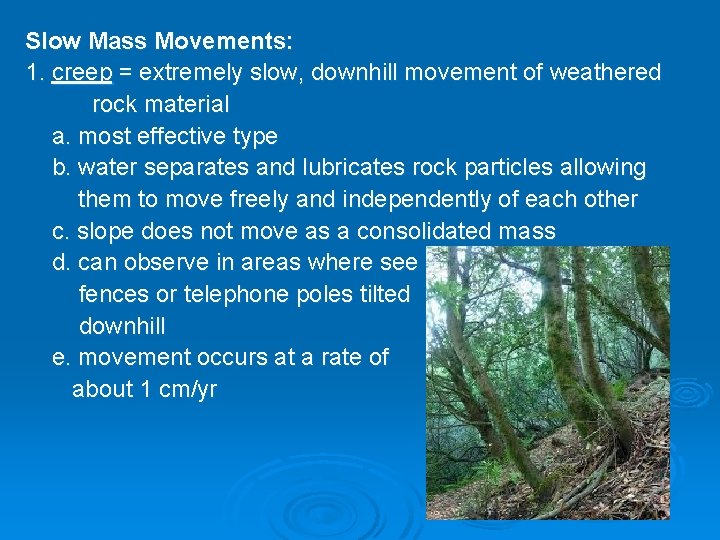
Slow Mass Movements: 1. creep = extremely slow, downhill movement of weathered rock material a. most effective type b. water separates and lubricates rock particles allowing them to move freely and independently of each other c. slope does not move as a consolidated mass d. can observe in areas where see fences or telephone poles tilted downhill e. movement occurs at a rate of about 1 cm/yr
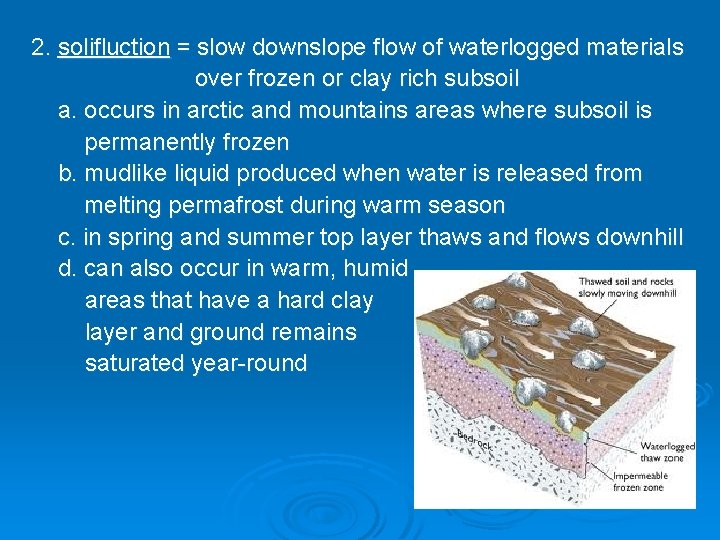
2. solifluction = slow downslope flow of waterlogged materials over frozen or clay rich subsoil a. occurs in arctic and mountains areas where subsoil is permanently frozen b. mudlike liquid produced when water is released from melting permafrost during warm season c. in spring and summer top layer thaws and flows downhill d. can also occur in warm, humid areas that have a hard clay layer and ground remains saturated year-round
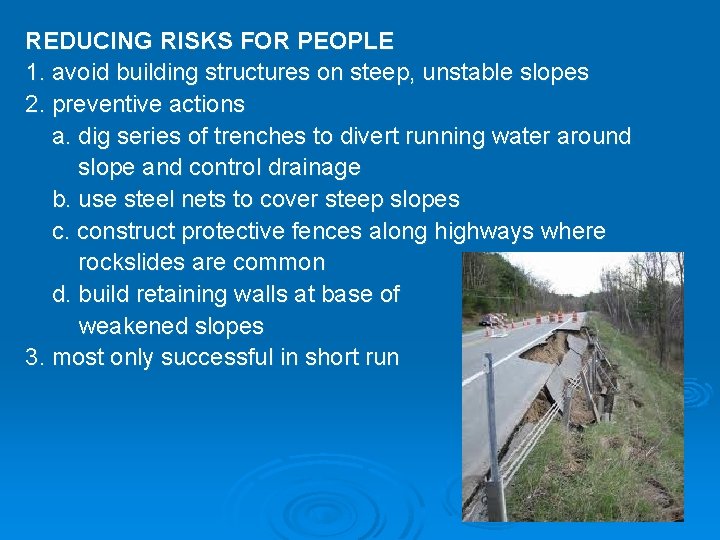
REDUCING RISKS FOR PEOPLE 1. avoid building structures on steep, unstable slopes 2. preventive actions a. dig series of trenches to divert running water around slope and control drainage b. use steel nets to cover steep slopes c. construct protective fences along highways where rockslides are common d. build retaining walls at base of weakened slopes 3. most only successful in short run
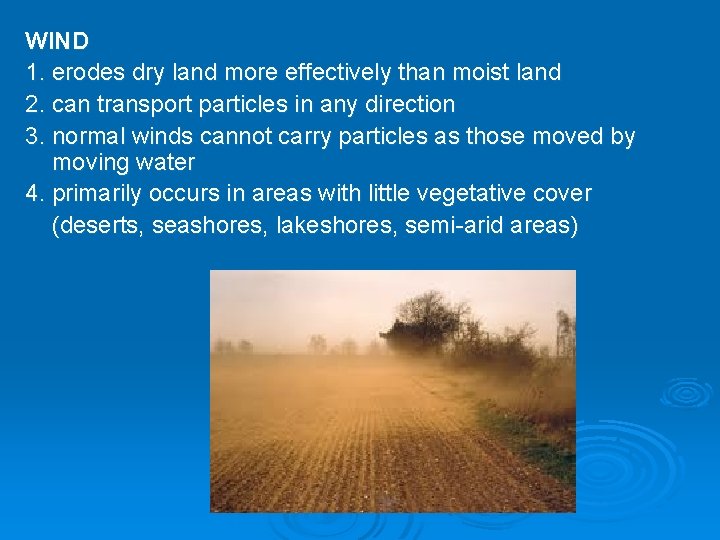
WIND 1. erodes dry land more effectively than moist land 2. can transport particles in any direction 3. normal winds cannot carry particles as those moved by moving water 4. primarily occurs in areas with little vegetative cover (deserts, seashores, lakeshores, semi-arid areas)
WIND EROSION: Carries rock particles of various sizes 1. sand = loose fragments of weathered rocks and minerals a. mostly quartz b. range in diameter from 0. 06 to 2 mm 2. dust = particles smaller than sand grains a. less than 0. 06 mm diameter b. mostly silt and clay c. usually from soil or volcanic eruption
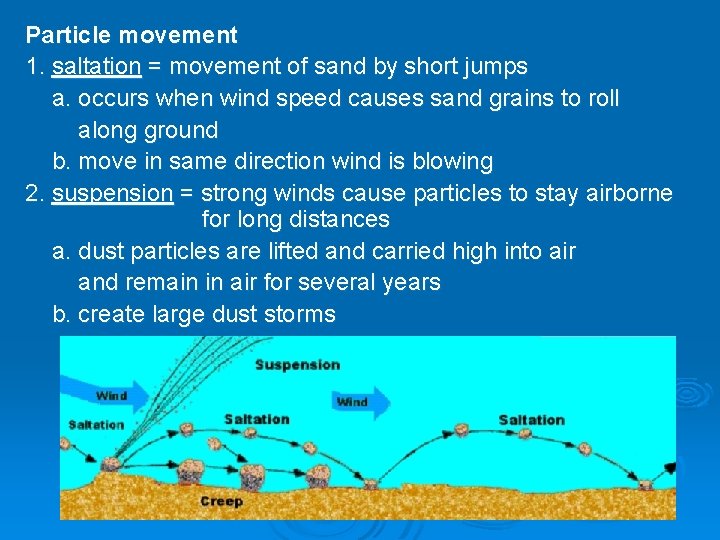
Particle movement 1. saltation = movement of sand by short jumps a. occurs when wind speed causes sand grains to roll along ground b. move in same direction wind is blowing 2. suspension = strong winds cause particles to stay airborne for long distances a. dust particles are lifted and carried high into air and remain in air for several years b. create large dust storms
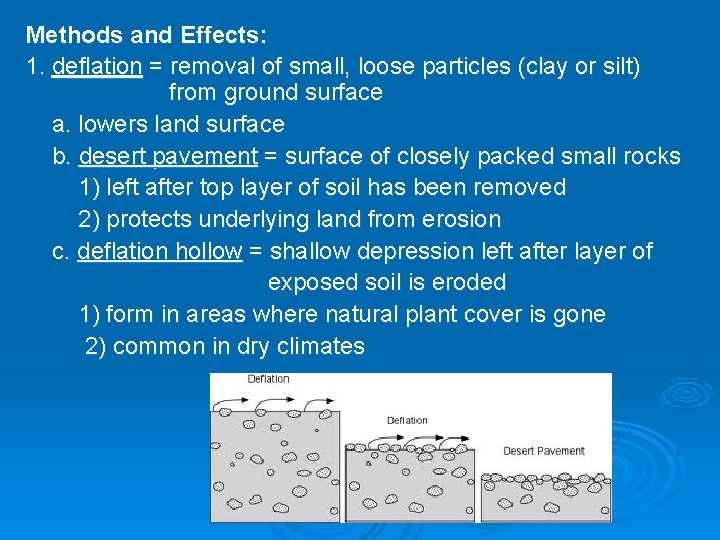
Methods and Effects: 1. deflation = removal of small, loose particles (clay or silt) from ground surface a. lowers land surface b. desert pavement = surface of closely packed small rocks 1) left after top layer of soil has been removed 2) protects underlying land from erosion c. deflation hollow = shallow depression left after layer of exposed soil is eroded 1) form in areas where natural plant cover is gone 2) common in dry climates
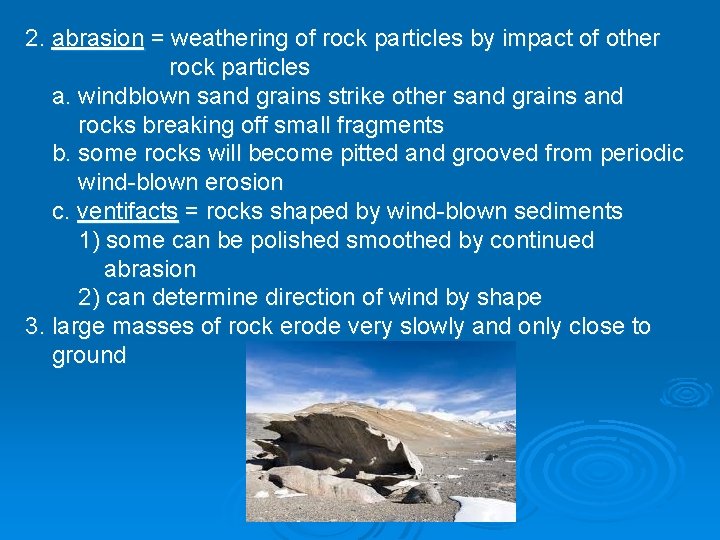
2. abrasion = weathering of rock particles by impact of other rock particles a. windblown sand grains strike other sand grains and rocks breaking off small fragments b. some rocks will become pitted and grooved from periodic wind-blown erosion c. ventifacts = rocks shaped by wind-blown sediments 1) some can be polished smoothed by continued abrasion 2) can determine direction of wind by shape 3. large masses of rock erode very slowly and only close to ground
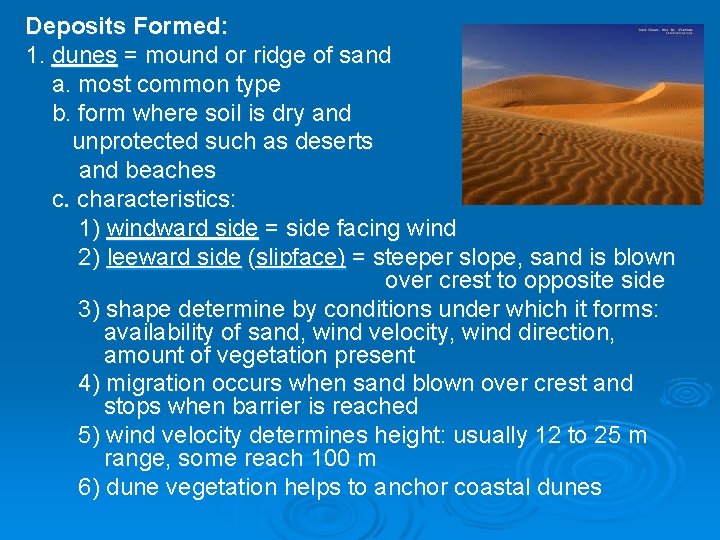
Deposits Formed: 1. dunes = mound or ridge of sand a. most common type b. form where soil is dry and unprotected such as deserts and beaches c. characteristics: 1) windward side = side facing wind 2) leeward side (slipface) = steeper slope, sand is blown over crest to opposite side 3) shape determine by conditions under which it forms: availability of sand, wind velocity, wind direction, amount of vegetation present 4) migration occurs when sand blown over crest and stops when barrier is reached 5) wind velocity determines height: usually 12 to 25 m range, some reach 100 m 6) dune vegetation helps to anchor coastal dunes
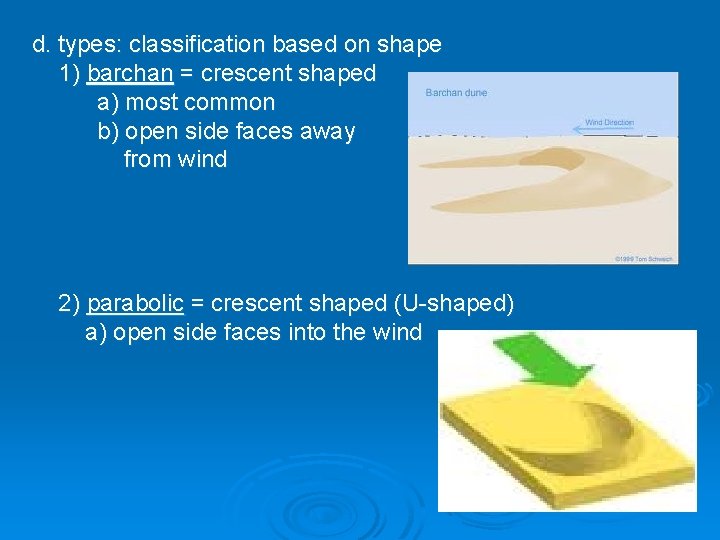
d. types: classification based on shape 1) barchan = crescent shaped a) most common b) open side faces away from wind 2) parabolic = crescent shaped (U-shaped) a) open side faces into the wind
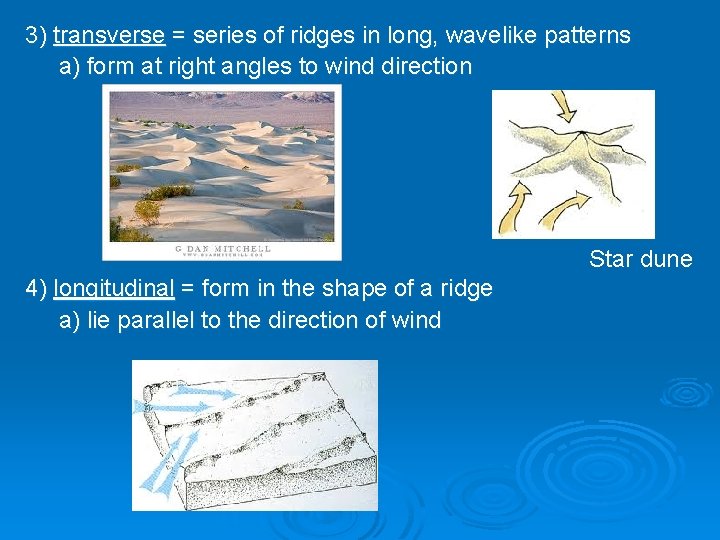
3) transverse = series of ridges in long, wavelike patterns a) form at right angles to wind direction Star dune 4) longitudinal = form in the shape of a ridge a) lie parallel to the direction of wind
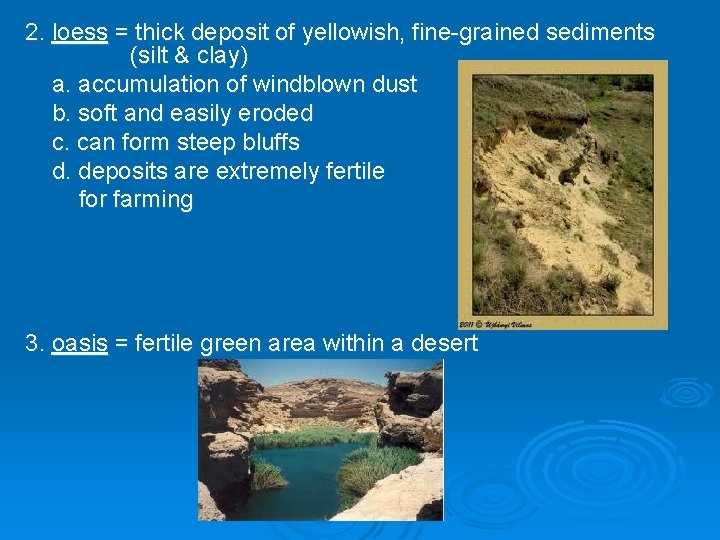
2. loess = thick deposit of yellowish, fine-grained sediments (silt & clay) a. accumulation of windblown dust b. soft and easily eroded c. can form steep bluffs d. deposits are extremely fertile for farming 3. oasis = fertile green area within a desert
GLACIERS glaciers = masses of moving ice that shape landscape by eroding, transporting, and depositing huge volumes of rocks and sediments 1. formation: a. amount of snowfall in winter exceeds amount that melts in summer b. as snow accumulates pressure increases on bottom of snow pile and snow compacts c. any snow that melts quickly refreezes, forming glacial ice d. when snow and ice accumulate to a great enough thickness, ice will start move downslope due to gravity e. greatest in regions where temperatures are low and snow fall amounts are high
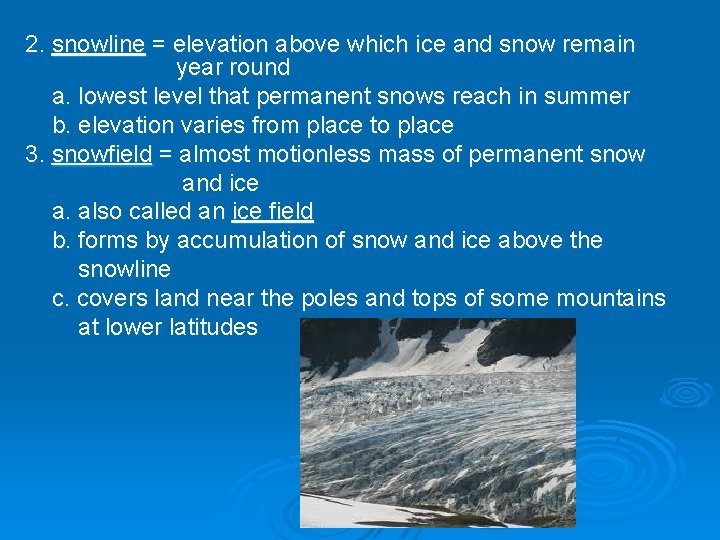
2. snowline = elevation above which ice and snow remain year round a. lowest level that permanent snows reach in summer b. elevation varies from place to place 3. snowfield = almost motionless mass of permanent snow and ice a. also called an ice field b. forms by accumulation of snow and ice above the snowline c. covers land near the poles and tops of some mountains at lower latitudes
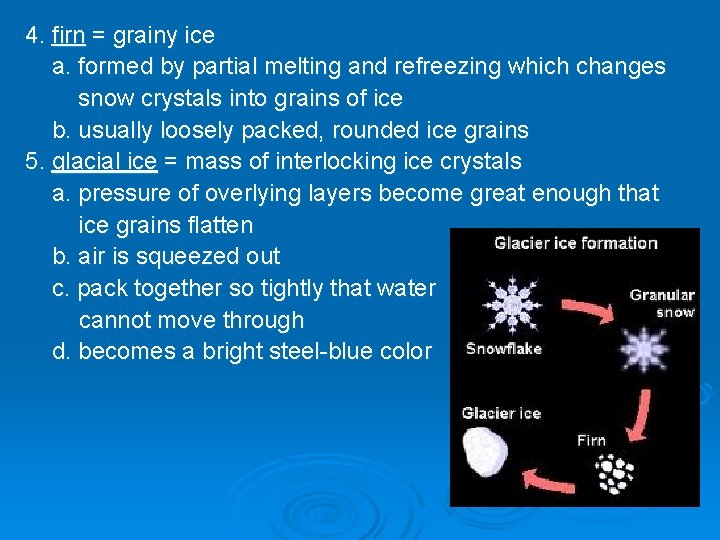
4. firn = grainy ice a. formed by partial melting and refreezing which changes snow crystals into grains of ice b. usually loosely packed, rounded ice grains 5. glacial ice = mass of interlocking ice crystals a. pressure of overlying layers become great enough that ice grains flatten b. air is squeezed out c. pack together so tightly that water cannot move through d. becomes a bright steel-blue color
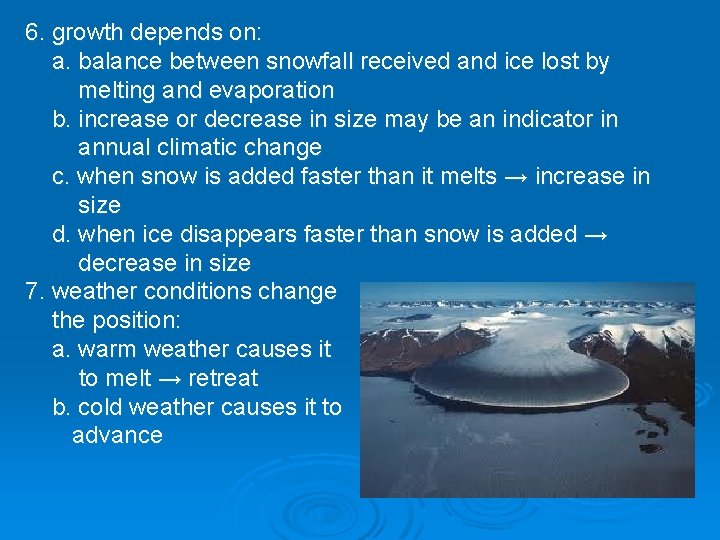
6. growth depends on: a. balance between snowfall received and ice lost by melting and evaporation b. increase or decrease in size may be an indicator in annual climatic change c. when snow is added faster than it melts → increase in size d. when ice disappears faster than snow is added → decrease in size 7. weather conditions change the position: a. warm weather causes it to melt → retreat b. cold weather causes it to advance
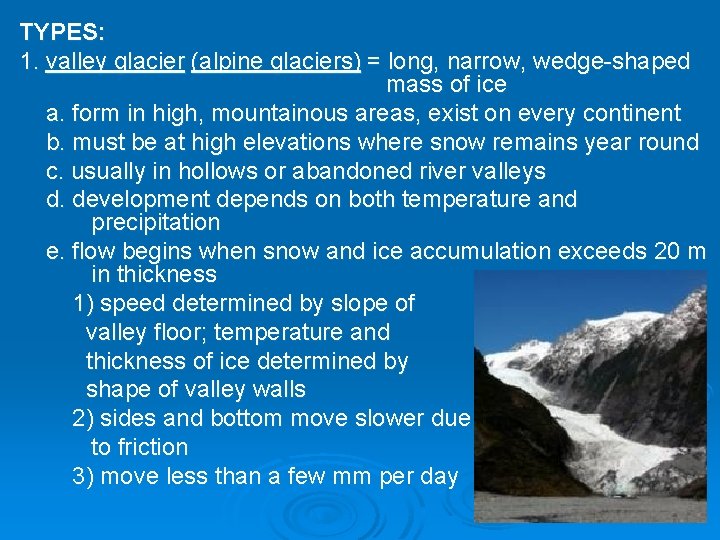
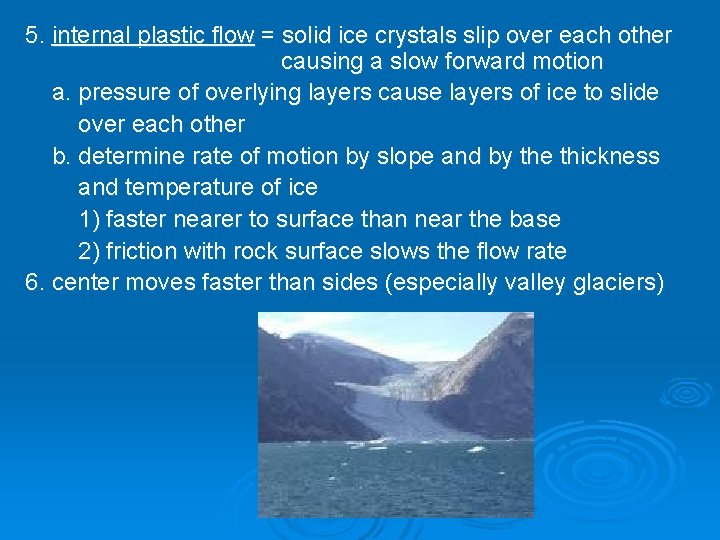
TYPES: 1. valley glacier (alpine glaciers) = long, narrow, wedge-shaped mass of ice a. form in high, mountainous areas, exist on every continent b. must be at high elevations where snow remains year round c. usually in hollows or abandoned river valleys d. development depends on both temperature and precipitation e. flow begins when snow and ice accumulation exceeds 20 m in thickness 1) speed determined by slope of valley floor; temperature and thickness of ice determined by shape of valley walls 2) sides and bottom move slower due to friction 3) move less than a few mm per day
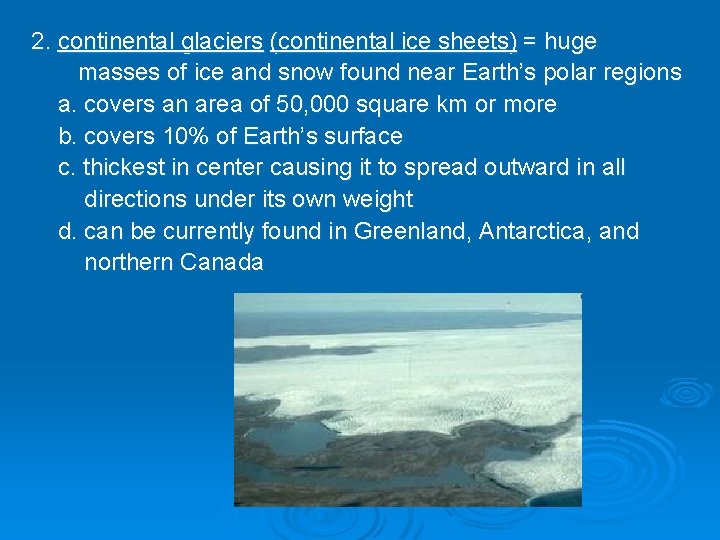
2. continental glaciers (continental ice sheets) = huge masses of ice and snow found near Earth’s polar regions a. covers an area of 50, 000 square km or more b. covers 10% of Earth’s surface c. thickest in center causing it to spread outward in all directions under its own weight d. can be currently found in Greenland, Antarctica, and northern Canada
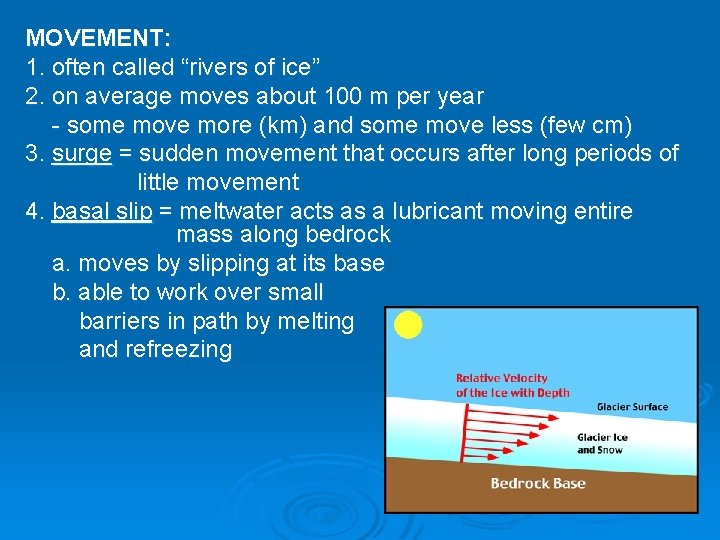
MOVEMENT: 1. often called “rivers of ice” 2. on average moves about 100 m per year - some move more (km) and some move less (few cm) 3. surge = sudden movement that occurs after long periods of little movement 4. basal slip = meltwater acts as a lubricant moving entire mass along bedrock a. moves by slipping at its base b. able to work over small barriers in path by melting and refreezing
5. internal plastic flow = solid ice crystals slip over each other causing a slow forward motion a. pressure of overlying layers cause layers of ice to slide over each other b. determine rate of motion by slope and by the thickness and temperature of ice 1) faster nearer to surface than near the base 2) friction with rock surface slows the flow rate 6. center moves faster than sides (especially valley glaciers)
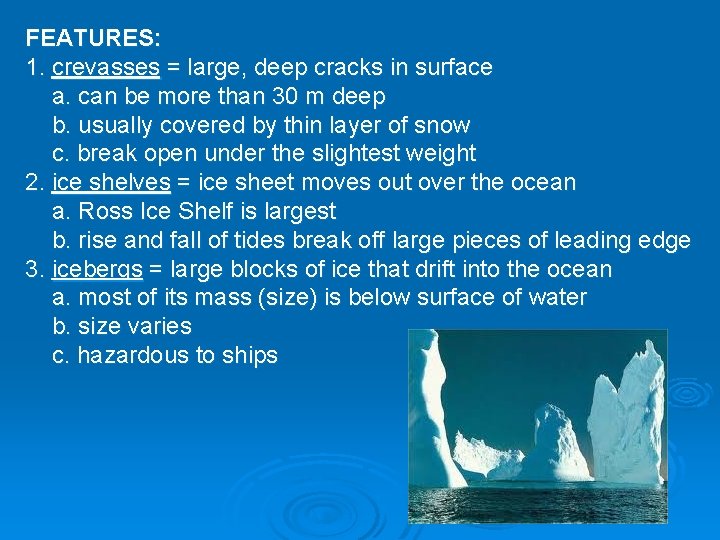
FEATURES: 1. crevasses = large, deep cracks in surface a. can be more than 30 m deep b. usually covered by thin layer of snow c. break open under the slightest weight 2. ice shelves = ice sheet moves out over the ocean a. Ross Ice Shelf is largest b. rise and fall of tides break off large pieces of leading edge 3. icebergs = large blocks of ice that drift into the ocean a. most of its mass (size) is below surface of water b. size varies c. hazardous to ships
EROSION BY: 1. plucking = meltwater freezes and erodes rock by loosening particles, then lifting and carrying them downslope 2. abrading = scouring of bedrock surface by rock fragments over which ice moves a. striations = parallel grooves and scratches formed from embedded rocks b. glacial grooves = very large striations c. glacial polish = silt and sand embedded in glacier base produces a smooth, shiny finish d. rock flour = abrasion grinds rocks and other coarse particles into silt size sediment e. scratches and grooves run parallel to direction of glacial movement which can show direction of ice movement
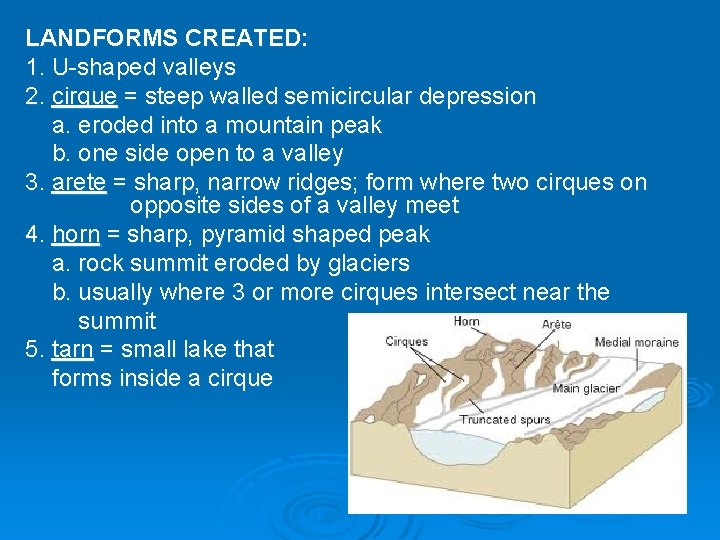
LANDFORMS CREATED: 1. U-shaped valleys 2. cirque = steep walled semicircular depression a. eroded into a mountain peak b. one side open to a valley 3. arete = sharp, narrow ridges; form where two cirques on opposite sides of a valley meet 4. horn = sharp, pyramid shaped peak a. rock summit eroded by glaciers b. usually where 3 or more cirques intersect near the summit 5. tarn = small lake that forms inside a cirque
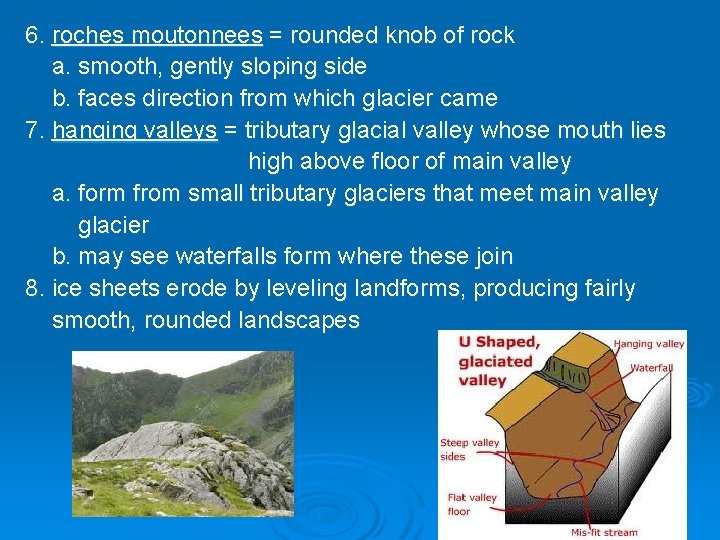
6. roches moutonnees = rounded knob of rock a. smooth, gently sloping side b. faces direction from which glacier came 7. hanging valleys = tributary glacial valley whose mouth lies high above floor of main valley a. form from small tributary glaciers that meet main valley glacier b. may see waterfalls form where these join 8. ice sheets erode by leveling landforms, producing fairly smooth, rounded landscapes
DEPOSITION: 1. erratics = large boulders a. transported to present location by a glacier b. composition usually differs from that of bedrock over which it now lies 2. glacial drift = all sediment deposited by a glacier or its meltwaters a. glacial till = mixed debri carried embedded in ice and on tops, sides, and front edges 1) sediments scraped off by base of glacier 2) left behind when glacial ice melts b. stratified drift = sediment sorted, deposited, and layered by glacial meltwater c. meltwater = water that results from melting of glacial snow and ice 1) usually milky in color 2) presence of fine rock particles
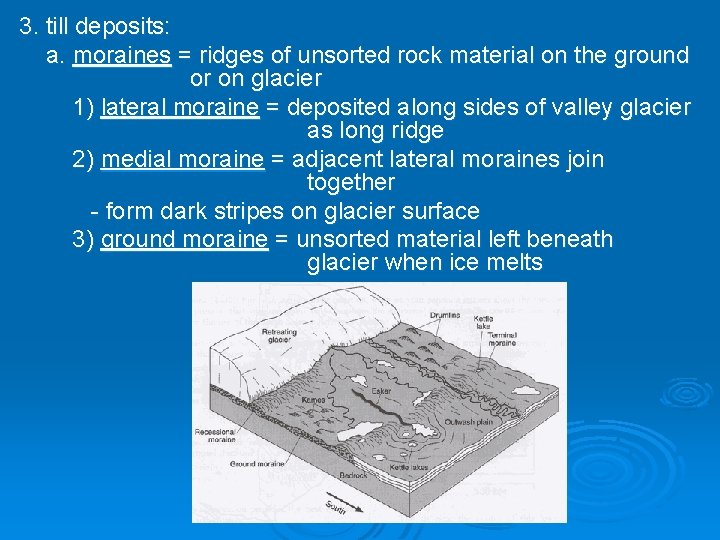
3. till deposits: a. moraines = ridges of unsorted rock material on the ground or on glacier 1) lateral moraine = deposited along sides of valley glacier as long ridge 2) medial moraine = adjacent lateral moraines join together - form dark stripes on glacier surface 3) ground moraine = unsorted material left beneath glacier when ice melts
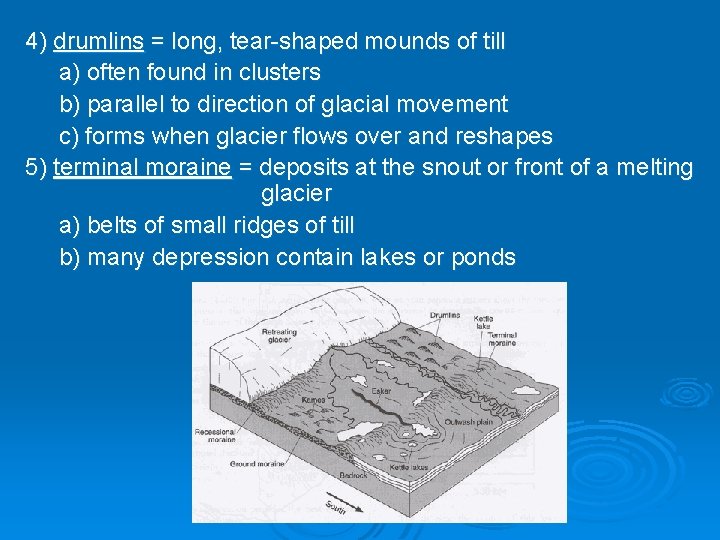
4) drumlins = long, tear-shaped mounds of till a) often found in clusters b) parallel to direction of glacial movement c) forms when glacier flows over and reshapes 5) terminal moraine = deposits at the snout or front of a melting glacier a) belts of small ridges of till b) many depression contain lakes or ponds
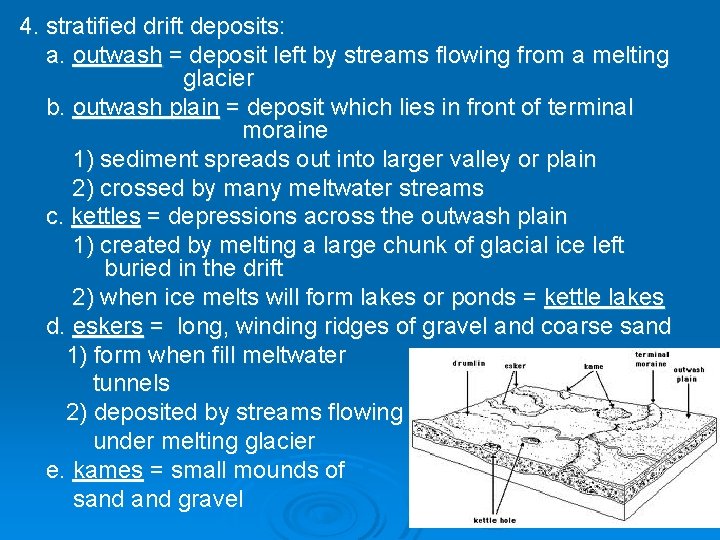
4. stratified drift deposits: a. outwash = deposit left by streams flowing from a melting glacier b. outwash plain = deposit which lies in front of terminal moraine 1) sediment spreads out into larger valley or plain 2) crossed by many meltwater streams c. kettles = depressions across the outwash plain 1) created by melting a large chunk of glacial ice left buried in the drift 2) when ice melts will form lakes or ponds = kettle lakes d. eskers = long, winding ridges of gravel and coarse sand 1) form when fill meltwater tunnels 2) deposited by streams flowing under melting glacier e. kames = small mounds of sand gravel
ice age = long period of climatic cooling during which continental ice sheets cover large areas of earth’s surface 1. time of extensive glacial activity 2. earliest one = 600 mya 3. most recent one began 2 - 3 million years ago, retreated about 18, 000 years ago 4. climate changes a. drop in average temperature of about 5 o. C b. have increase in snowfall 5. glacial period = time when ice sheets advance (during cold periods) a. during last period covered nearly 1/3 of land surface b. sea level was 140 m lower than today 6. interglacial periods = time of warmer temperature and ice sheets retreat
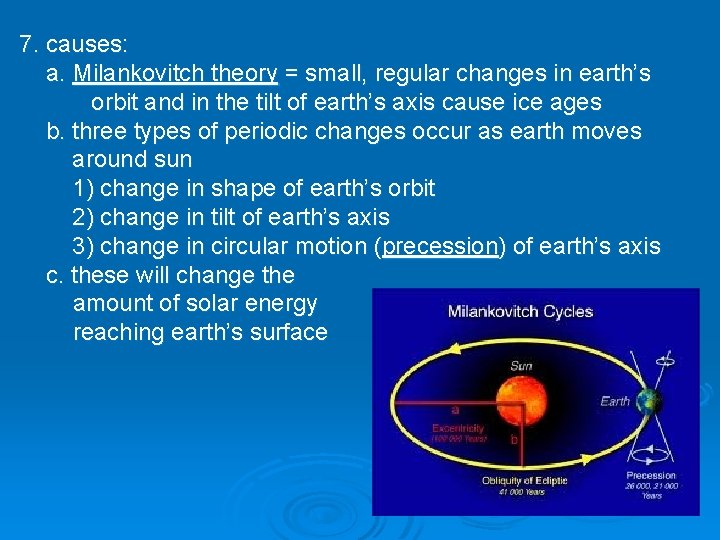
7. causes: a. Milankovitch theory = small, regular changes in earth’s orbit and in the tilt of earth’s axis cause ice ages b. three types of periodic changes occur as earth moves around sun 1) change in shape of earth’s orbit 2) change in tilt of earth’s axis 3) change in circular motion (precession) of earth’s axis c. these will change the amount of solar energy reaching earth’s surface