
Mass Movements Wind and Glaciers Objectives Identify factors
Mass Movements, Wind, and Glaciers Objectives • Identify factors that affect mass movements. • Relate how mass movements affect people. • Analyze the relationship between gravity and mass movements Vocabulary – mass movement – slump – creep – avalanche – mudflow – landslide
Mass Movements at Earth’s Surface Mass Movements • Mass movement is the downslope movement of loose sediments and weathered rock resulting from the force of gravity. • Climatic conditions determine which materials and how much of each will be made available for mass movement. • All mass movements occur on slopes and range from extremely slow motions to sudden slides, falls, and flows.
Mass Movements at Earth’s Surface Variables That Influence Mass Movements • Variables that influence the mass movements of Earth’s material include: – The material’s weight resulting from gravity, which works to pull the material down a slope – The material’s resistance to sliding or flowing – A trigger, such as an earthquake, that works to shake material loose from a slope • Mass movement occurs when the forces working to pull material down a slope are stronger than the material’s resistance to sliding, flowing, or falling.
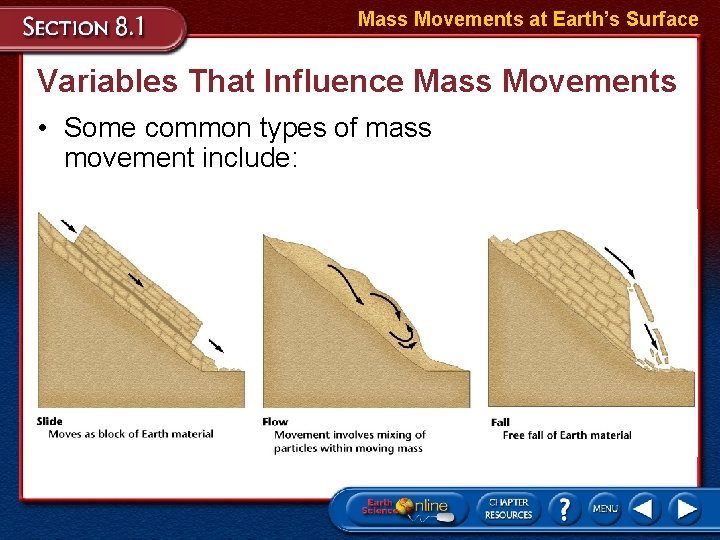
Mass Movements at Earth’s Surface Variables That Influence Mass Movements • Some common types of mass movement include:
Mass Movements at Earth’s Surface Variables That Influence Mass Movements Water – On a slope, too little water may prevent sediment grains from holding together at all, thereby increasing the material’s potential for movement. – The addition of water to sediments on a slope helps to hold the grains together and makes the material more stable. – Too much water can make a slope unstable. – Water is very important to the process of mass movement, but it is not involved as a transport agent.
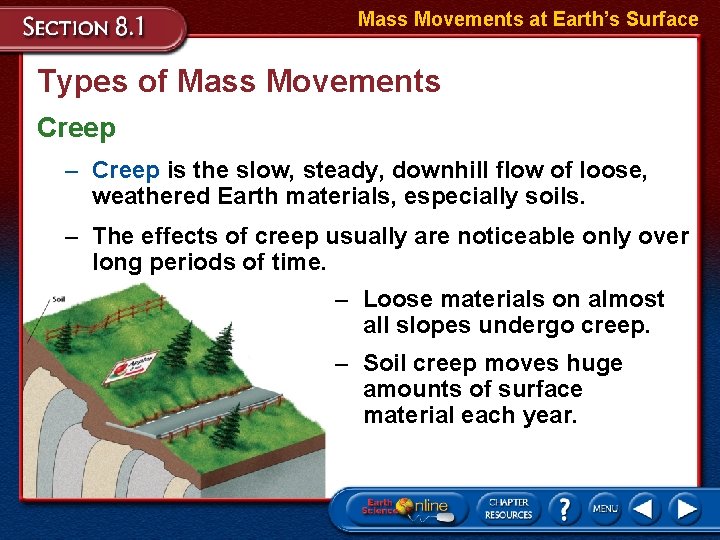
Mass Movements at Earth’s Surface Types of Mass Movements Creep – Creep is the slow, steady, downhill flow of loose, weathered Earth materials, especially soils. – The effects of creep usually are noticeable only over long periods of time. – Loose materials on almost all slopes undergo creep. – Soil creep moves huge amounts of surface material each year.
Mass Movements at Earth’s Surface Types of Mass Movements Flows – In some mass movements, Earth materials flow as if they were a thick liquid. – Earth flows are moderately slow movements of soils. – Mudflows are swiftly moving mixtures of mud and water. – Mudflows can be triggered by earthquakes or similar vibrations and are common in volcanic regions.
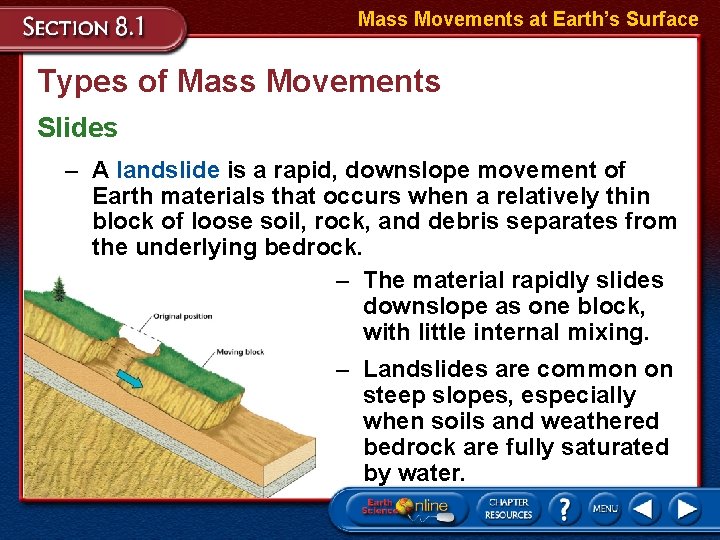
Mass Movements at Earth’s Surface Types of Mass Movements Slides – A landslide is a rapid, downslope movement of Earth materials that occurs when a relatively thin block of loose soil, rock, and debris separates from the underlying bedrock. – The material rapidly slides downslope as one block, with little internal mixing. – Landslides are common on steep slopes, especially when soils and weathered bedrock are fully saturated by water.
Mass Movements at Earth’s Surface Types of Mass Movements Slides – A rock slide is a type of landslide that occurs when a sheet of rock moves downhill on a sliding surface. – During a rock slide, relatively thin blocks of rock are broken into smaller blocks as they move downslope.

Mass Movements at Earth’s Surface Types of Mass Movements Slumps – A slump results when the mass of material in a landslide rotates and slides along a curved surface. – Slumps may occur in areas that have thick soils on moderate-to-steep slopes. – Slumps are common after rains and leave crescent-shaped scars on slopes.

Mass Movements at Earth’s Surface Types of Mass Movements Avalanches – Avalanches are landslides that occur in mountainous areas, usually on slopes of at least 35°, with thick accumulations of snow. – Avalanches usually occur when snow has melted, either due to radiation from the Sun or warmth from the ground, and then refrozen into an icy layer. – Snow that falls on top of this crust can eventually build up, become heavy, slip off, and slide down a slope as an avalanche. – A vibrating trigger, even from a single skier, can send such an unstable layer sliding down a mountainside.
Mass Movements at Earth’s Surface Types of Mass Movements Rock Falls – Rock falls commonly occur at high elevations, in steep road cuts, and on rocky shorelines. – Rocks loosened by physical weathering processes may fall directly downward or bounce and roll, ultimately producing a cone-shaped pile of coarse debris, called talus, at the base of the slope.
Mass Movements at Earth’s Surface Mass Movements Affect People • Human activities often contribute to the factors that cause mass movements. • Activities such as constructing heavy buildings, roads, and other structures can make slope materials unstable.
Mass Movements at Earth’s Surface Mass Movements Affect People Dangerous Mudflows – Human lives are in danger when people live on steep terrain or in the path of unstable slope materials. – In December of 1999, northern Venezuela experienced severe mudflows and landslides in which tens of thousands of people died and more than 114 000 people were left homeless.
Mass Movements at Earth’s Surface Reducing the Risks • Catastrophic mass movements are most common on slopes greater than 25° that experience annual rainfall of over 90 cm. • The best way to minimize the destruction caused by mass movements is to avoid building structures on such steep and unstable slopes.
Mass Movements at Earth’s Surface Reducing the Risks Preventative Actions – Some actions can help to avoid the potential hazards of landslides. – Most of the efforts at slope stabilization and prevention of mass movements, however, are generally successful only in the short run.
Wind Objectives • Describe conditions that contribute to the likelihood that an area will experience wind erosion. • Identify wind-formed landscape features. • Describe how dunes form and migrate. • Explain the effects of wind erosion on human activities. Vocabulary – deflation – dune – abrasion – loess – ventifact
Wind • Moving air can pick up and transport Earth materials in the process of erosion. • Unlike water, wind can transport sediments uphill as well as downhill. • As an erosional agent, wind can modify and change landscapes in arid and coastal areas.
Wind Erosion and Transport • Wind transport and erosion primarily occur in areas with little vegetative cover, such as deserts, semiarid areas, seashores, and some lakeshores. • Wind erosion is a problem in many parts of the United States.
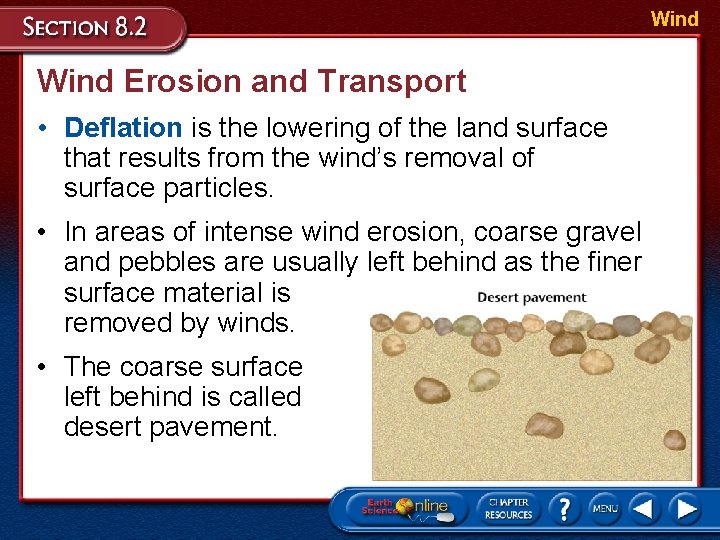
Wind Erosion and Transport • Deflation is the lowering of the land surface that results from the wind’s removal of surface particles. • In areas of intense wind erosion, coarse gravel and pebbles are usually left behind as the finer surface material is removed by winds. • The coarse surface left behind is called desert pavement.
Wind Erosion and Transport • Abrasion is a process of erosion that occurs when particles, such as sand, rub against the surface of rocks or other materials. • In wind abrasion, wind picks up materials such as sand particles and blows them against rocks and other objects. • Because sand is often made of quartz, a very hard mineral, wind abrasion can be a very effective agent of erosion.
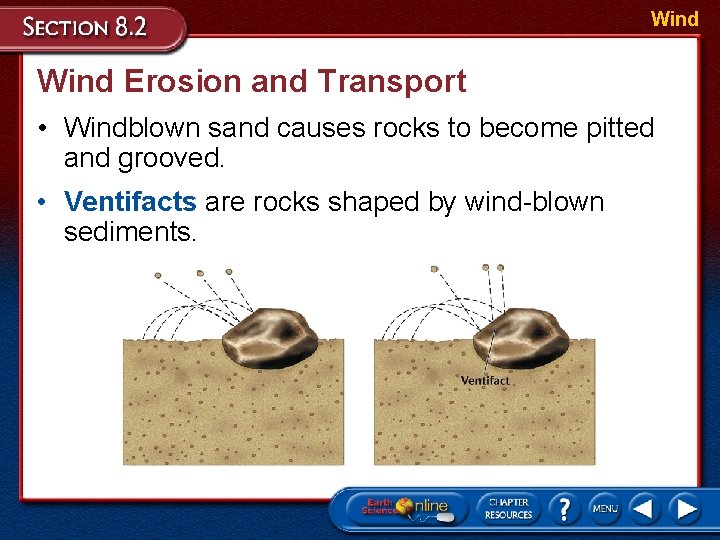
Wind Erosion and Transport • Windblown sand causes rocks to become pitted and grooved. • Ventifacts are rocks shaped by wind-blown sediments.
Wind Deposition • Wind deposition occurs in areas where there are changes in wind velocity. • As wind velocity decreases, some of the windblown sand other materials can no longer stay airborne, and they drop out of the airstream to form a deposit on the ground.
Wind Deposition Formation of Dunes – In wind-blown environments, sand particles tend to accumulate where an object blocks the particles’ forward movement. – A dune is a pile of wind-blown sand that develops over time. – Conditions, including the availability of sand, wind velocity, wind direction, and the amount of vegetation present under which a dune forms, determine its particular shape. – The velocity of the wind above the ground surface determines the height of a dune.

Wind Deposition Loess – Wind can carry fine, lightweight particles such as silt and clay in great quantities and for long distances. – Many parts of Earth’s surface are covered by thick layers of windblown silt known as loess. – Where precipitation is adequate, loess soils are some of the most fertile soils on Earth because they contain abundant minerals and nutrients.
Glaciers Objectives • Explain how glaciers form. • Compare and contrast the conditions that produce valley glaciers and those that produce continental glaciers. • Describe how glaciers modify the landscape. • Recognize glacial landscape features. Vocabulary – glacier – moraine – valley glacier – outwash plain – continental glacier – drumlin – cirque – esker
Glaciers • Glaciers formed much of the landscape that exists presently in the northern United States and elsewhere in the world. • Today, scientists measure the movements of glaciers and changes in their sizes to track climatic changes. • Air bubbles trapped deep in glacial ice can provide data about the composition of Earth’s atmosphere at the time when the ice layers were formed.
Glaciers Moving Masses of Ice • A glacier is a large, moving mass of ice. • Glaciers form near Earth’s poles and in mountainous areas at high elevations. • Cold temperatures year-round keep fallen snow from completely melting, and allow it to accumulate in an area called a snowfield. • The weight of the top layers exerts downward pressure that forces the accumulated snow below to recrystallize into ice. • Glaciers currently cover only about 10 percent of Earth’s surface.
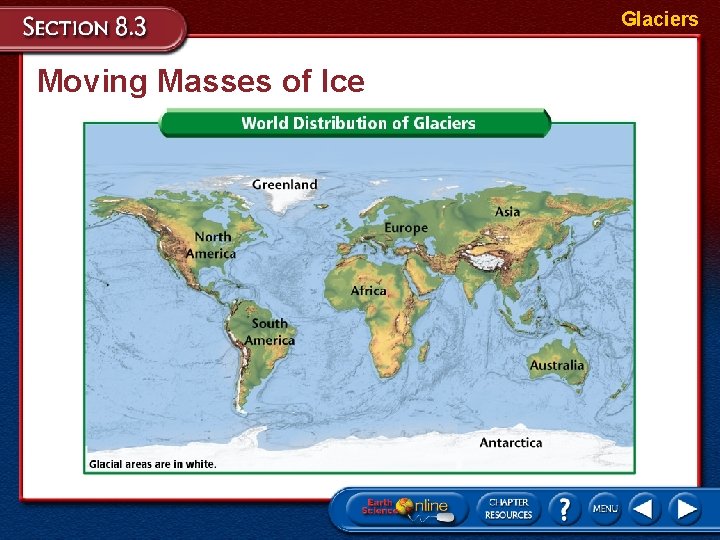
Glaciers Moving Masses of Ice
Glaciers Moving Masses of Ice Valley Glaciers – Glaciers can be classified as one of two types: valley glaciers or continental glaciers. – Valley glaciers are glaciers that form in valleys in high, mountainous areas. – Continental glaciers, also called ice sheets, are glaciers that cover broad, continent-sized areas. – A continental glacier is thickest at its center. – Continental glaciers are confined to Greenland, northern Canada, and Antarctica.
Glaciers Glacial Erosion • Glaciers are the most powerful erosional agent because of their great size, weight, and density. • When glaciers with embedded rocks move over bedrock valley walls, they grind out parallel scratches into the bedrock. • Small scratches are called striations, and the larger ones are called grooves. • Scratches and grooves provide evidence of a glacier’s history and establish its direction of movement.
Glaciers Glacial Erosion • Glacial erosion can create certain features. – Cirques are deep depressions scooped out by valley glaciers. – An arete is a sharp, steep ridge where two cirques on opposite sides of a valley meet. – A horn is a steep, pyramid-shaped peak formed by glaciers on three or more sides of a mountaintop. – A hanging valley is a tributary valley that enters a U-shaped valley from high up a mountain side.
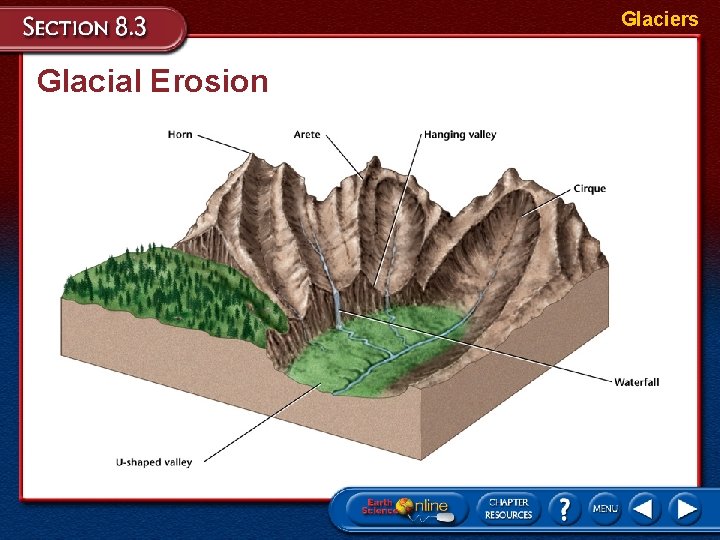
Glaciers Glacial Erosion
Glaciers Glacial Deposition • Glacial till is the mixed debris that glaciers carry embedded in their ice and on their tops, sides, and front edges. • Moraines are ridges consisting of till deposited by glaciers. – Outwash is gravel, sand, and fine silt formed from the grinding action of the glacier on underlying rock that is deposited by meltwater. – An outwash plain is the area at the leading edge of the glacier, where the meltwater streams flow and deposit outwash.
Glaciers Glacial Deposition Drumlins and Eskers – Drumlins are elongated landforms that are formed when glaciers move over older moraines. – Eskers are long, winding ridges of layered sediments that are deposited by streams flowing under a melting glacier.
- Slides: 38