
Mass Metrology April Susceptometer 2003 June 2007 Sartorius


- Slides: 39
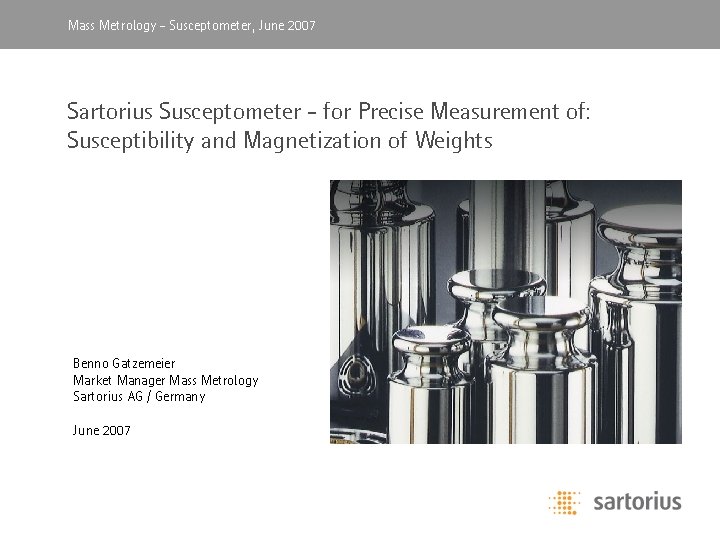
Mass Metrology, -April Susceptometer, 2003 June 2007 Sartorius Susceptometer - for Precise Measurement of: Susceptibility and Magnetization of Weights Benno Gatzemeier Market Manager Mass Metrology Sartorius AG / Germany June 2007
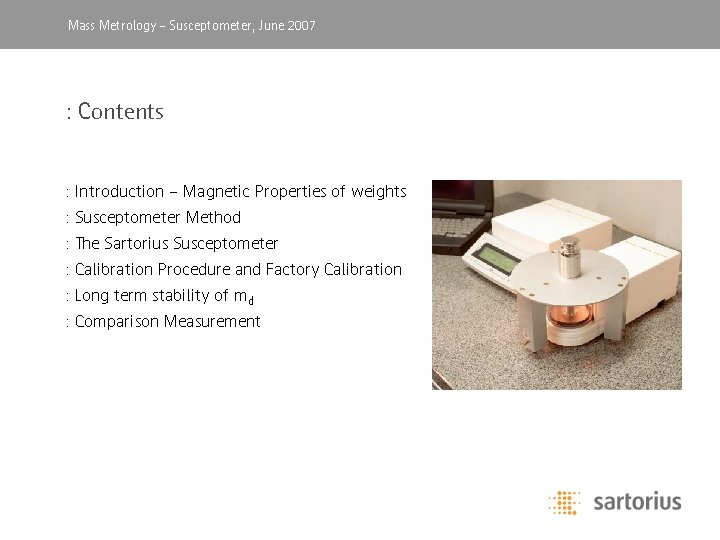
Mass Metrology, -April Susceptometer, 2003 June 2007 : Contents : Introduction – Magnetic Properties of weights : Susceptometer Method : The Sartorius Susceptometer : Calibration Procedure and Factory Calibration : Long term stability of md : Comparison Measurement
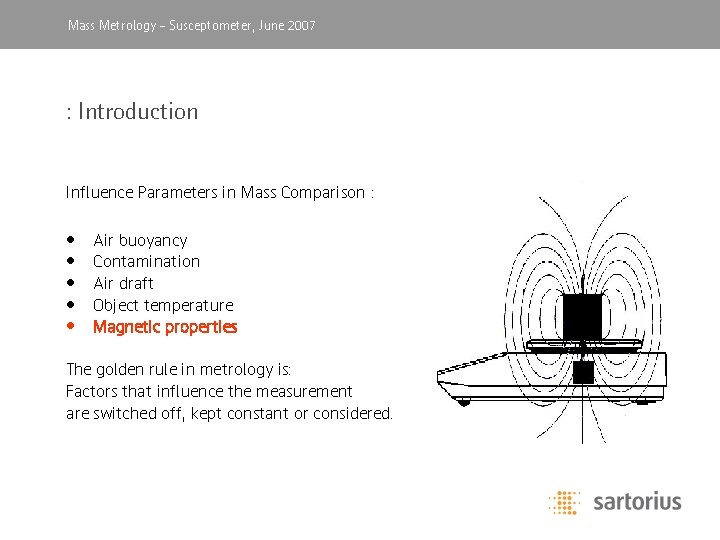
Mass Metrology, -April Susceptometer, 2003 June 2007 : Introduction Influence Parameters in Mass Comparison : • • • Air buoyancy Contamination Air draft Object temperature Magnetic properties The golden rule in metrology is: Factors that influence the measurement are switched off, kept constant or considered.
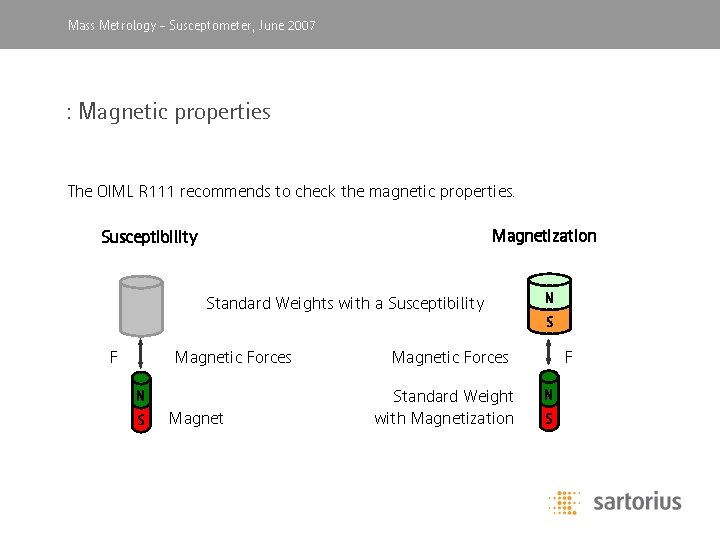
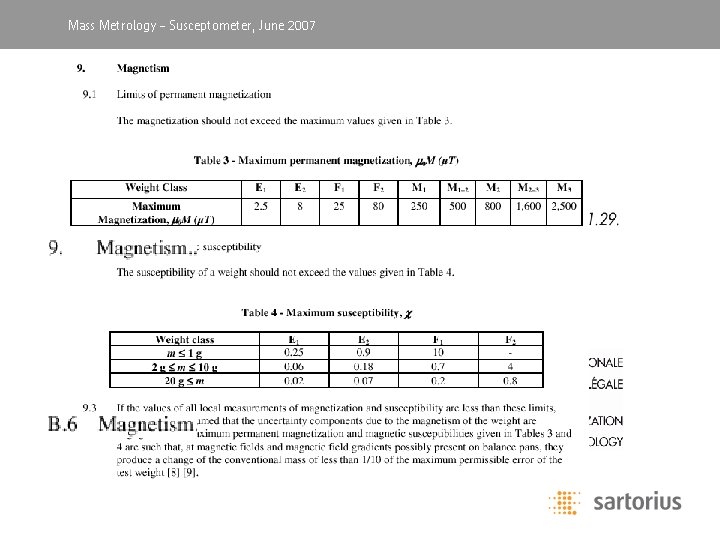
Mass Metrology, -April Susceptometer, 2003 June 2007 : Magnetic properties The OIML R 111 recommends to check the magnetic properties. Magnetization Susceptibility Standard Weights with a Susceptibility N S F Magnetic Forces N S Magnetic Forces Standard Weight with Magnetization F N S
Mass Metrology, -April Susceptometer, 2003 June 2007 : The new OIML R 111
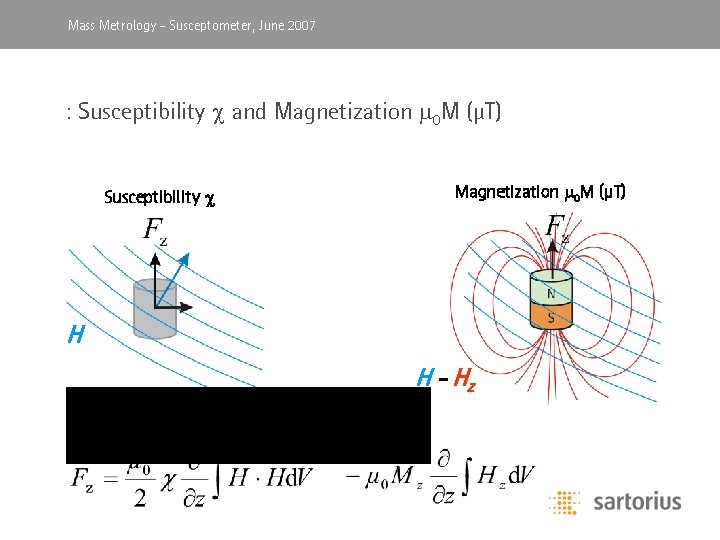
Mass Metrology, -April Susceptometer, 2003 June 2007 : Susceptibility and Magnetization 0 M (µT) Susceptibility Magnetization 0 M (µT) H H - Hz
Mass Metrology, -April Susceptometer, 2003 June 2007 : Recommended methods regarding the R 111
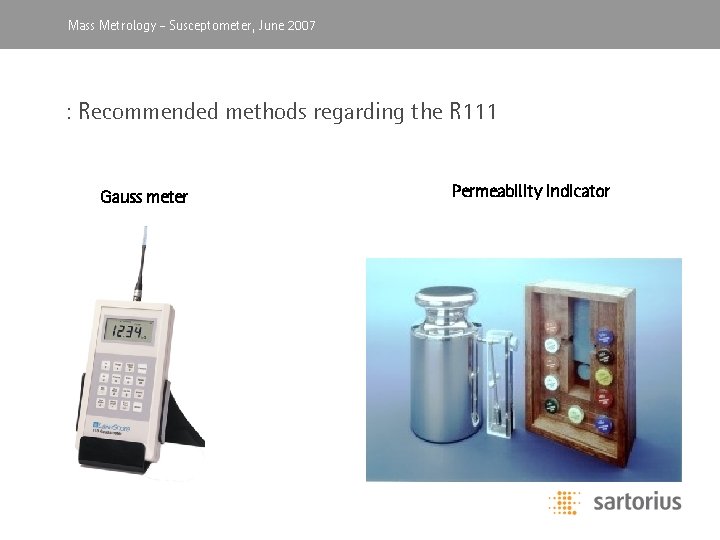
Mass Metrology, -April Susceptometer, 2003 June 2007 : Recommended methods regarding the R 111 Gauss meter Permeability Indicator
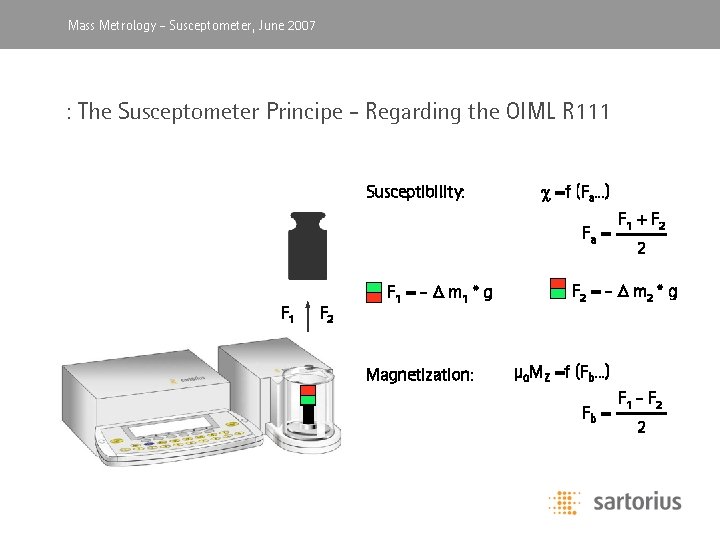
Mass Metrology, -April Susceptometer, 2003 June 2007 : The Susceptometer Principe - Regarding the OIML R 111 Susceptibility: =f (Fa. . . ) Fa = F 1 F 2 F 1 = - m 1 * g Magnetization: F 1 + F 2 2 F 2 = - m 2 * g µ 0 MZ =f (Fb. . . ) Fb = F 1 - F 2 2
Mass Metrology, -April Susceptometer, 2003 June 2007 : The Susceptometer Principe - Regarding the OIML R 111 The R 111 describes methods for the determination of the magnetic properties. One of them is the Susceptometer principle. A) Magnet B) Weighing Pan C) Bridge D) Gauge blocks E) Test Weight F) Pedestal F
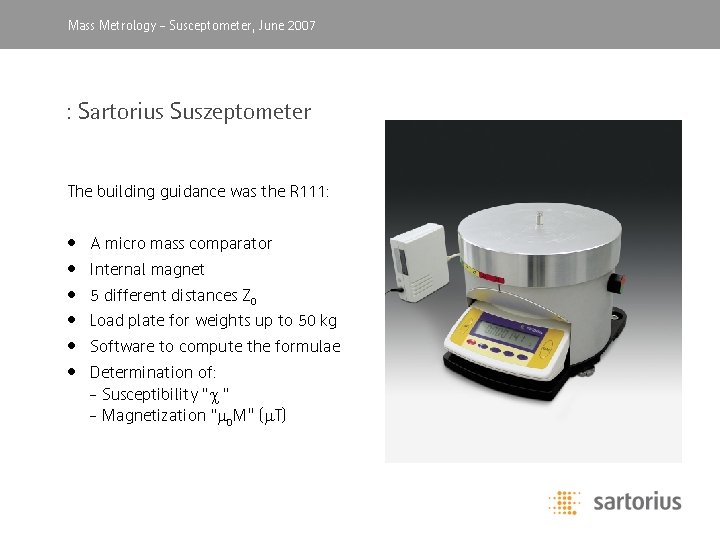
Mass Metrology, -April Susceptometer, 2003 June 2007 : Sartorius Suszeptometer The building guidance was the R 111: • • • A micro mass comparator Internal magnet 5 different distances Z 0 Load plate for weights up to 50 kg Software to compute the formulae Determination of: - Susceptibility “ “ - Magnetization “ 0 M” ( T)
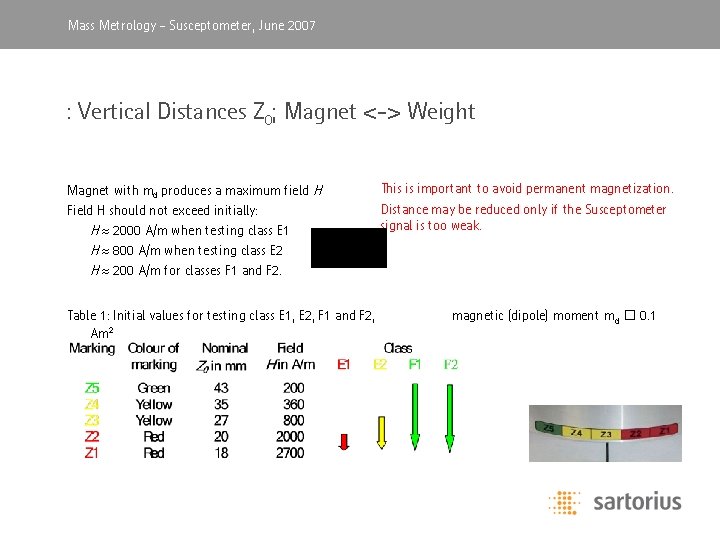
Mass Metrology, -April Susceptometer, 2003 June 2007 : Vertical Distances Z 0; Magnet <-> Weight Magnet with md produces a maximum field H Field H should not exceed initially: H 2000 A/m when testing class E 1 H 800 A/m when testing class E 2 H 200 A/m for classes F 1 and F 2. Table 1: Initial values for testing class E 1, E 2, F 1 and F 2, Am 2 This is important to avoid permanent magnetization. Distance may be reduced only if the Susceptometer signal is too weak. magnetic (dipole) moment md � 0. 1
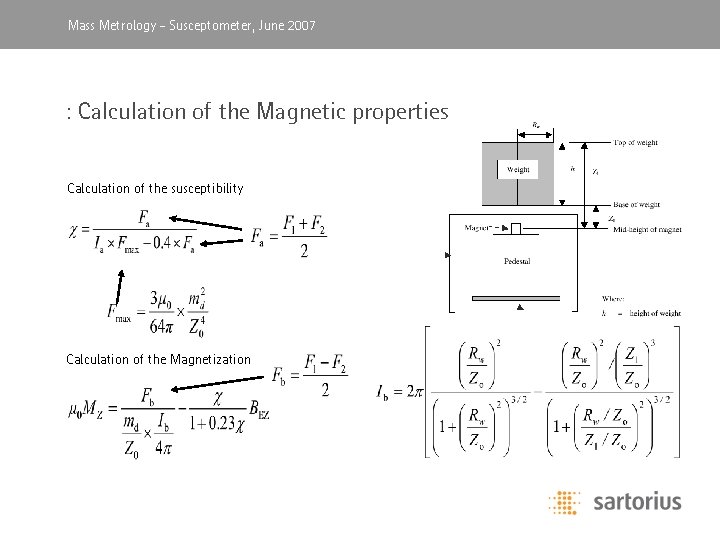
Mass Metrology, -April Susceptometer, 2003 June 2007 : Computation factors for Susceptibility and Magnetization: • • • Weighing Result of the Magnet Distance Z 0 : Magnet <-> Weight Geometry of the test weight magnetic (dipole) moment md [Am 2] gravitational acceleration [m/s 2] Local magnet field BEZ – 48 -60 [µT] To measure the Magnetization, we have to rotate the magnet! H H S S H
Mass Metrology, -April Susceptometer, 2003 June 2007 : Calculation of the Magnetic properties Calculation of the susceptibility Calculation of the Magnetization
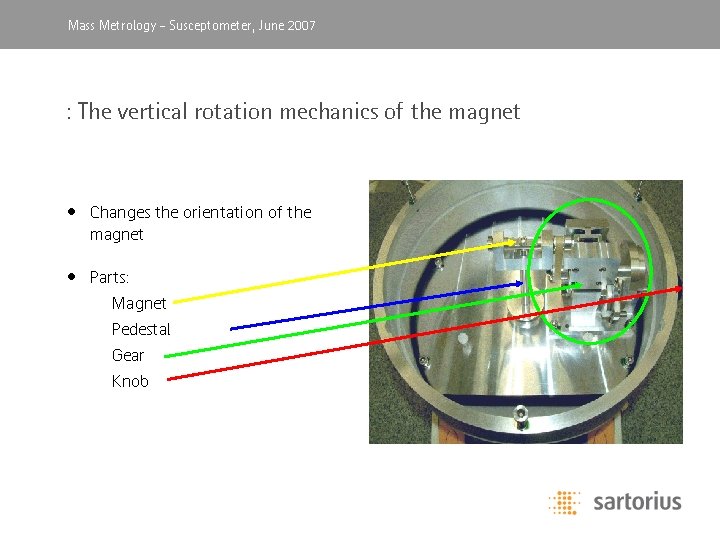
Mass Metrology, -April Susceptometer, 2003 June 2007 : The vertical rotation mechanics of the magnet • Changes the orientation of the magnet • Parts: Magnet Pedestal Gear Knob
Mass Metrology, -April Susceptometer, 2003 June 2007 : Application Software • • • Easy operating Step by step guide through the measurement procedure Initial distance is proposed Results via a serial connection Calculations, report and export Recalibrating the necessary constants Default parameters and user defined configurations Shape description, OIML knob weights predefined Export and import function for the sharp of the weights
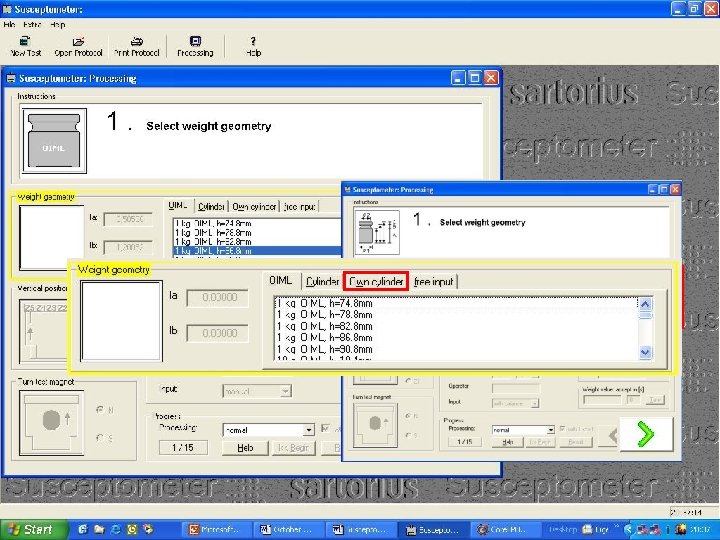
Mass Metrology, -April Susceptometer, 2003 June 2007 : 1. Select weighing geometry
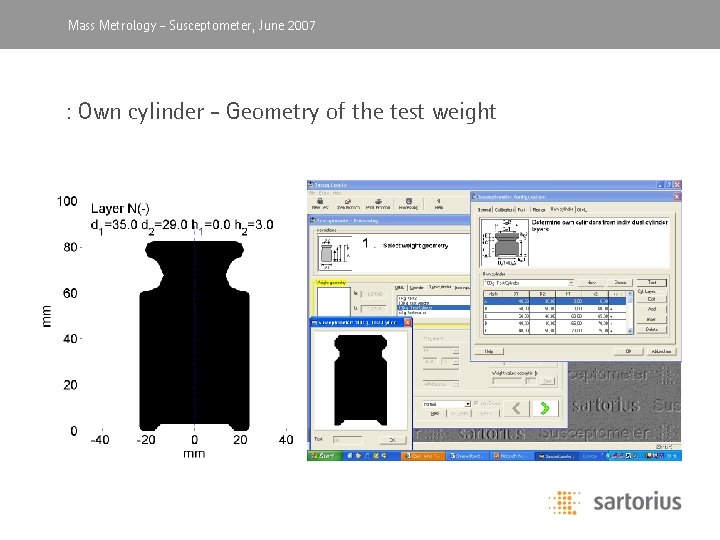
Mass Metrology, -April Susceptometer, 2003 June 2007 : Own cylinder - Geometry of the test weight
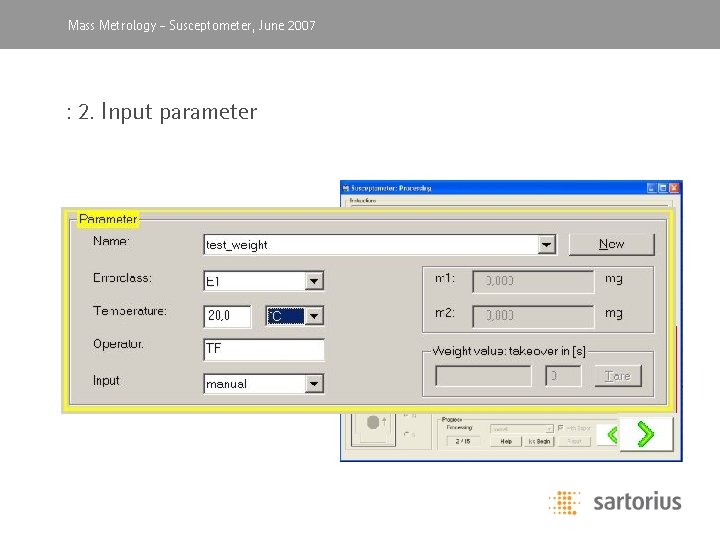
Mass Metrology, -April Susceptometer, 2003 June 2007 : 2. Input parameter
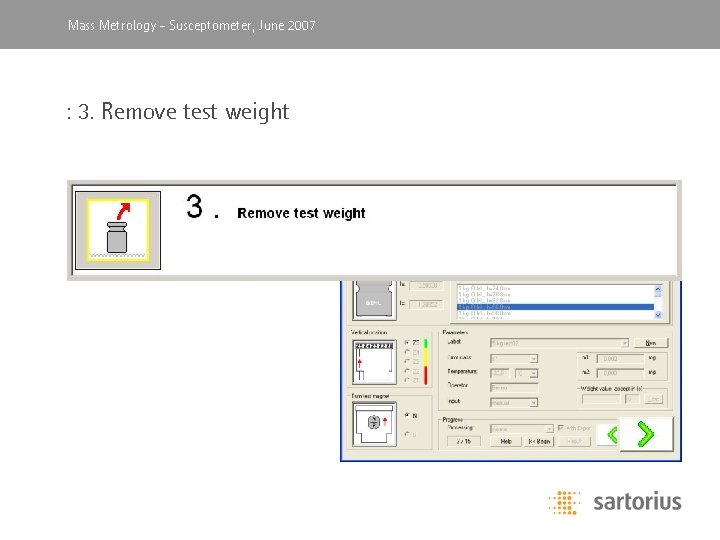
Mass Metrology, -April Susceptometer, 2003 June 2007 : 3. Remove test weight
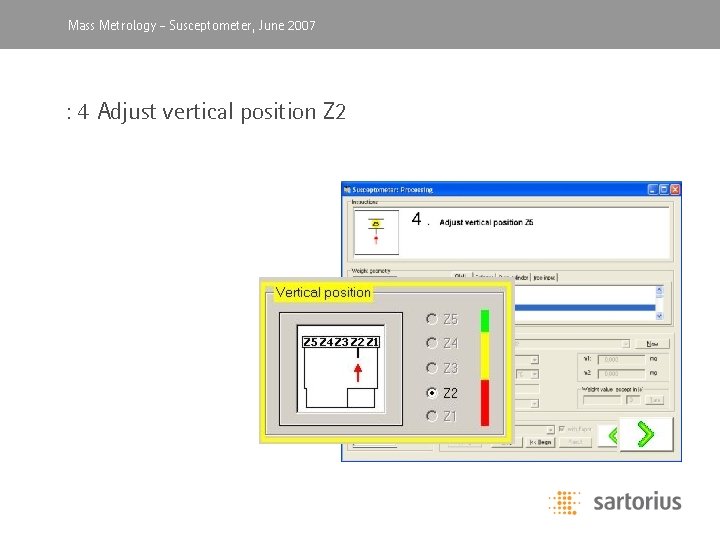
Mass Metrology, -April Susceptometer, 2003 June 2007 : 4 Adjust vertical position Z 2
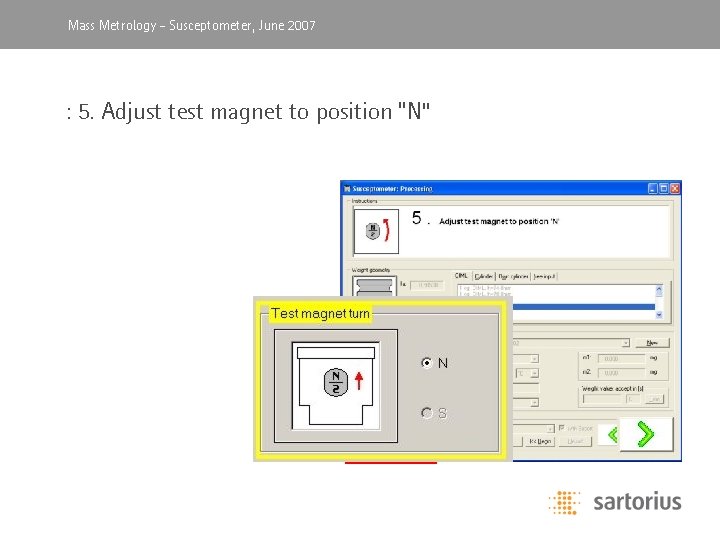
Mass Metrology, -April Susceptometer, 2003 June 2007 : 5. Adjust test magnet to position “N”
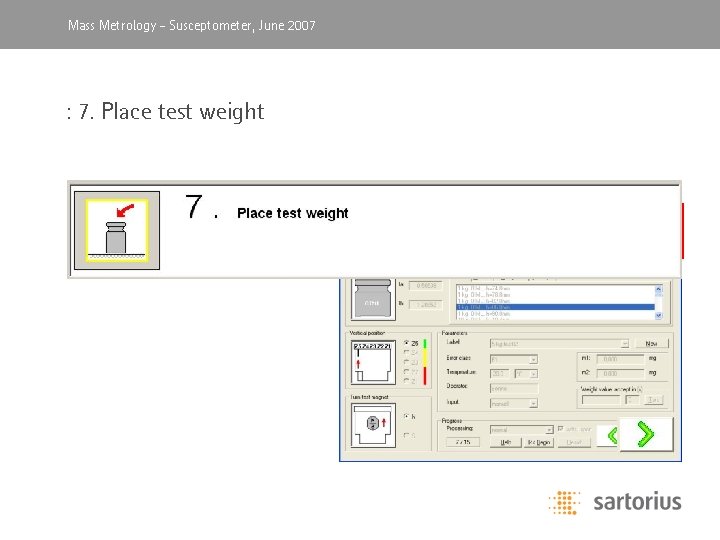
Mass Metrology, -April Susceptometer, 2003 June 2007 6. Place Tare balance : 7. test weight
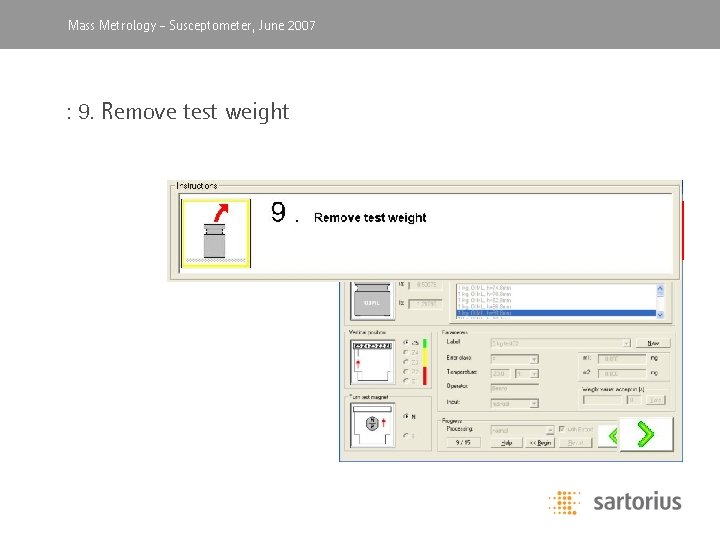
Mass Metrology, -April Susceptometer, 2003 June 2007 : 9. 8. Remove Determine testmeasured weight value m 1 for Z 4
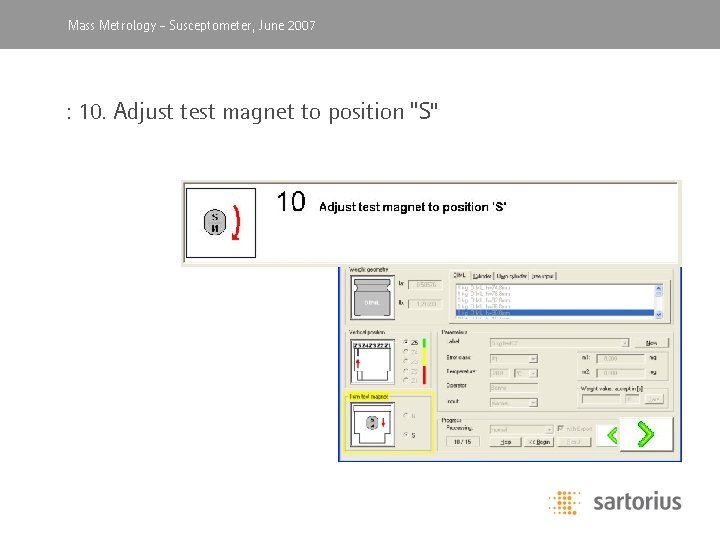
Mass Metrology, -April Susceptometer, 2003 June 2007 : 10. Adjust test magnet to position “S”
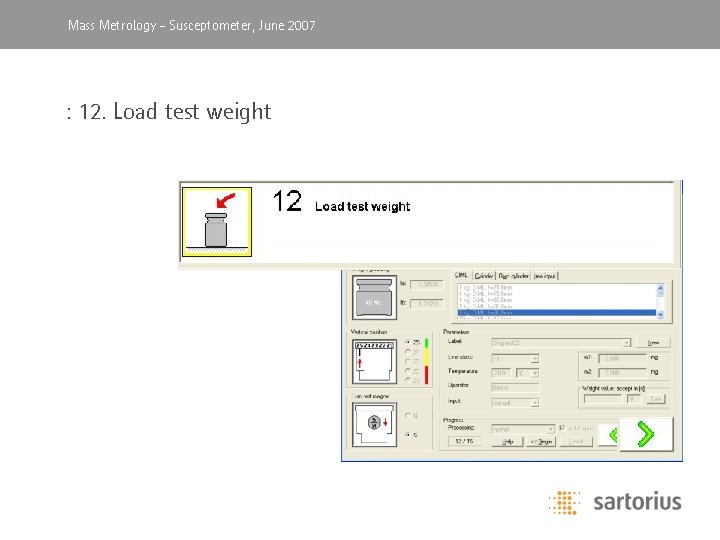
Mass Metrology, -April Susceptometer, 2003 June 2007 : 12. 11. Load Tare balance test weight
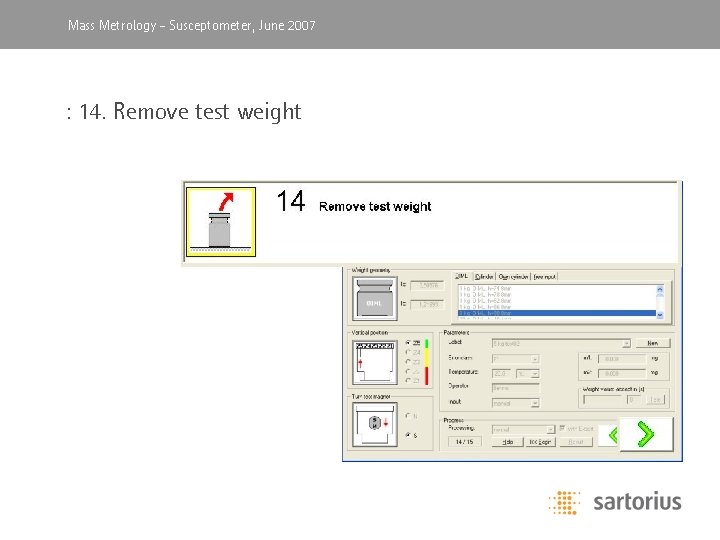
Mass Metrology, -April Susceptometer, 2003 June 2007 : 14. 13. Remove Determine testmeasured weight value m 2 for Z 5
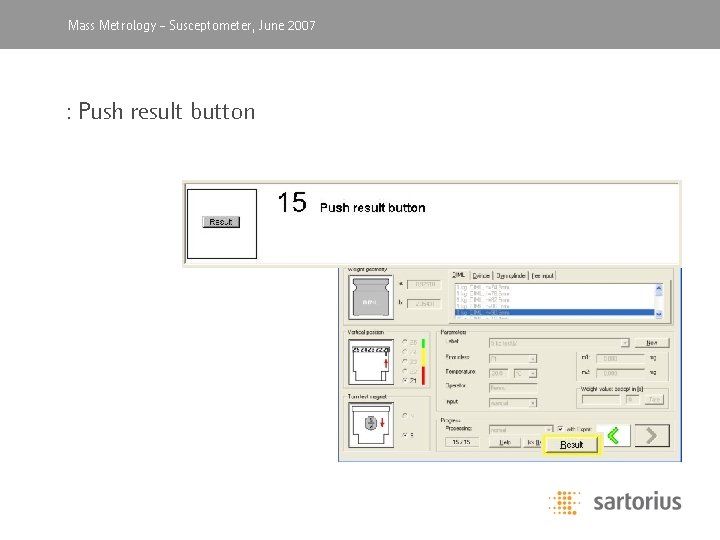
Mass Metrology, -April Susceptometer, 2003 June 2007 : Push result button
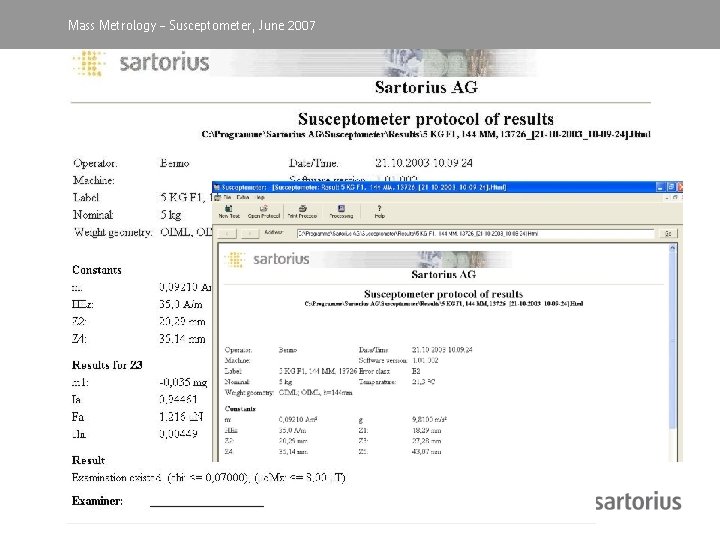
Mass Metrology, -April Susceptometer, 2003 June 2007
Mass Metrology, -April Susceptometer, 2003 June 2007 : Technical specifications Sartorius Susceptometer • • • Base area 338 x 286 mm Height 249 mm Maximum load 50 kg Dipole moment of the magnet m ~ 0. 1 Am 2 Geometry ratio of the magnet h/d = 0. 87 Height Z 0 adjustable in fixed steps Z 1=18 / Z 2=20 / Z 3=27 / Z 4=35 / Z 5=43 mm Field strength 2700 / 2000 / 800 / 360 / 200 A/m Readability of the Mass Comparator 10 µg or 1 µg Reverse gear for magnet external rotary knob with N-S marking
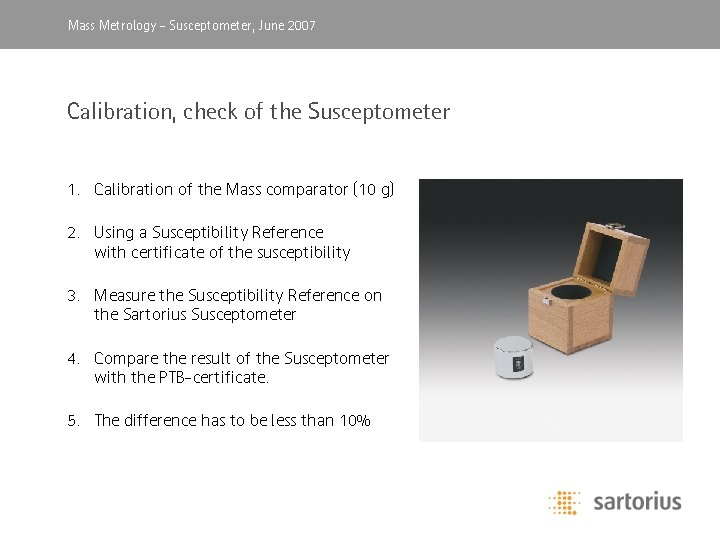
Mass Metrology, -April Susceptometer, 2003 June 2007 Calibration, check of the Susceptometer 1. Calibration of the Mass comparator (10 g) 2. Using a Susceptibility Reference with certificate of the susceptibility 3. Measure the Susceptibility Reference on the Sartorius Susceptometer 4. Compare the result of the Susceptometer with the PTB-certificate. 5. The difference has to be less than 10%
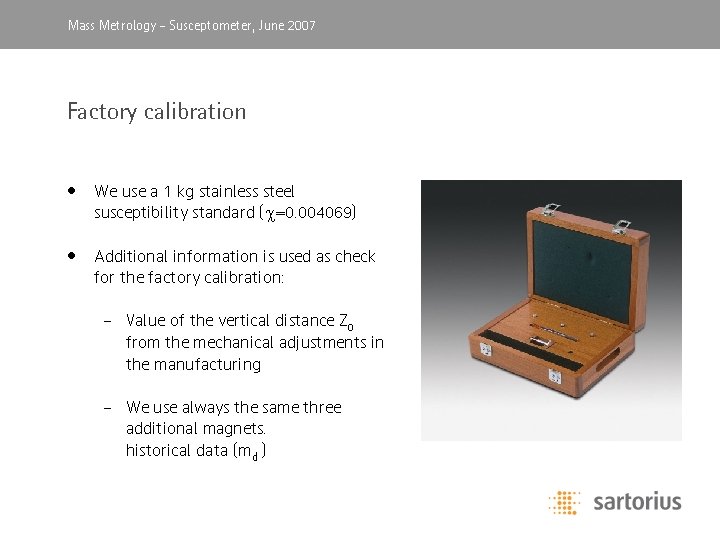
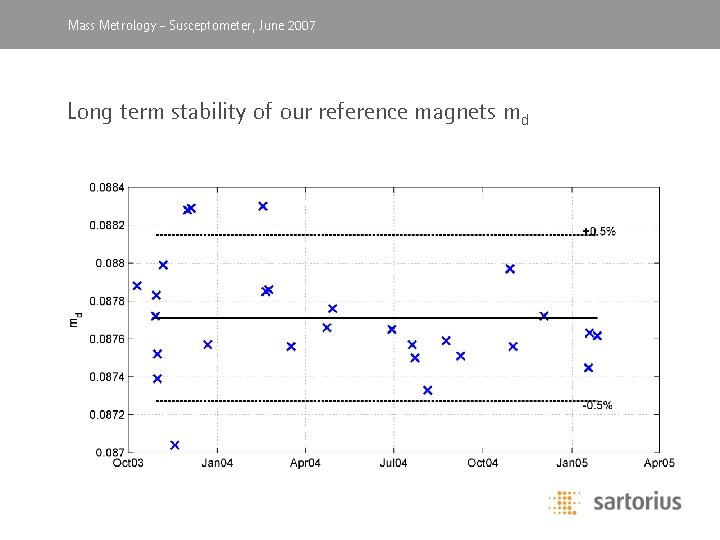
Mass Metrology, -April Susceptometer, 2003 June 2007 Factory calibration • We use a 1 kg stainless steel susceptibility standard ( =0. 004069) • Additional information is used as check for the factory calibration: – Value of the vertical distance Z 0 from the mechanical adjustments in the manufacturing – We use always the same three additional magnets. historical data (md )
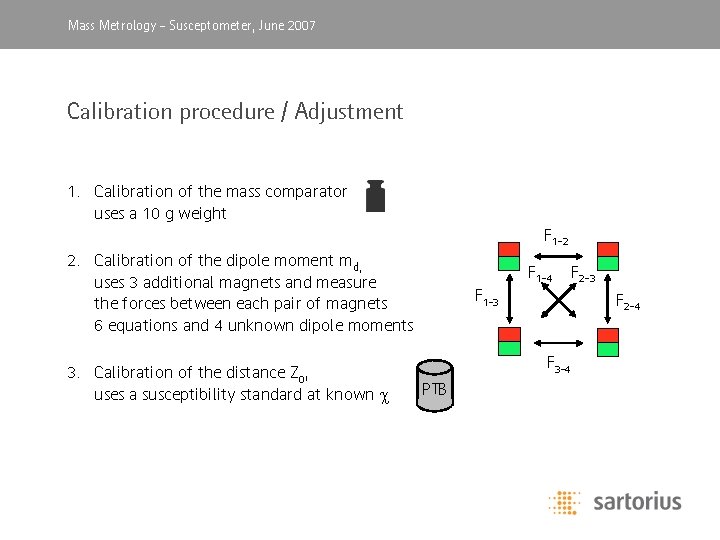
Mass Metrology, -April Susceptometer, 2003 June 2007 Calibration procedure / Adjustment 1. Calibration of the mass comparator uses a 10 g weight F 1 -2 2. Calibration of the dipole moment md, uses 3 additional magnets and measure the forces between each pair of magnets 6 equations and 4 unknown dipole moments 3. Calibration of the distance Z 0, uses a susceptibility standard at known F 1 -3 F 1 -4 F 2 -3 F 2 -4 F 3 -4 PTB
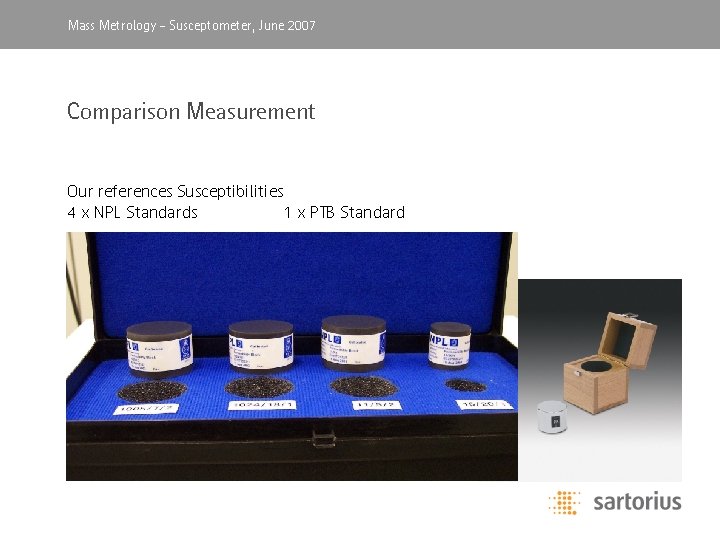
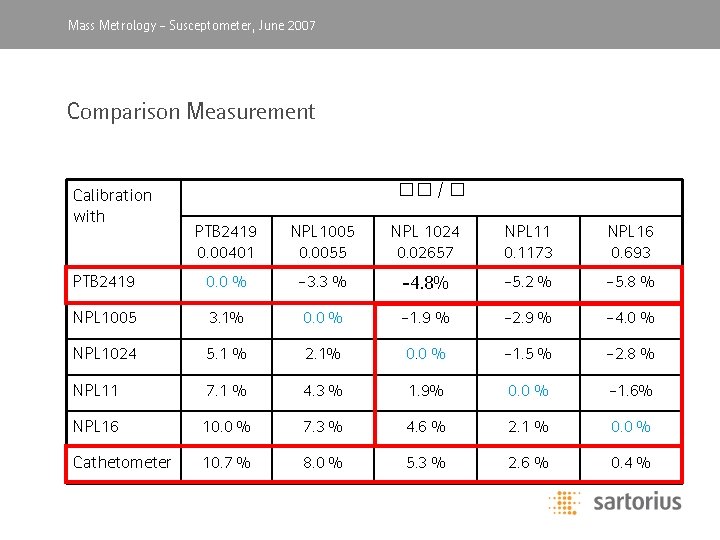
Mass Metrology, -April Susceptometer, 2003 June 2007 Comparison Measurement Our references Susceptibilities 4 x NPL Standards 1 x PTB Standard Question: Calibration with susceptibility standard : =0. 00401 Application range : 0< 1
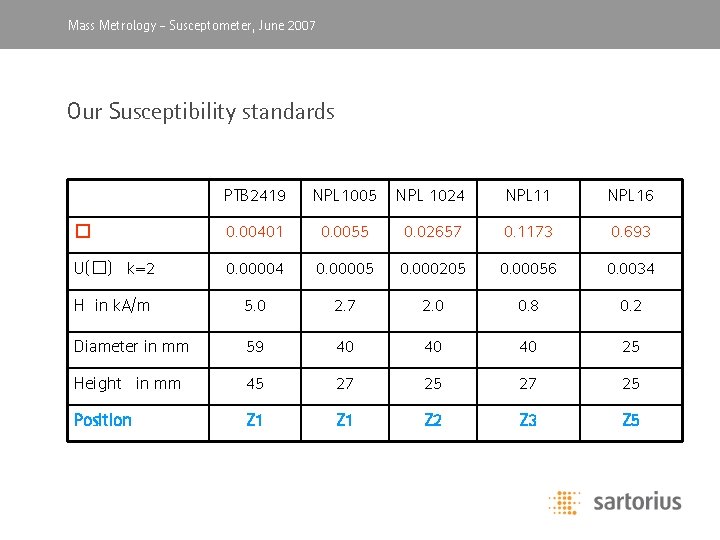
Mass Metrology, -April Susceptometer, 2003 June 2007 Our Susceptibility standards PTB 2419 NPL 1005 NPL 1024 NPL 11 NPL 16 � 0. 00401 0. 0055 0. 02657 0. 1173 0. 693 U(�) k=2 0. 00004 0. 00005 0. 000205 0. 00056 0. 0034 H in k. A/m 5. 0 2. 7 2. 0 0. 8 0. 2 Diameter in mm 59 40 40 40 25 Height in mm 45 27 25 Position Z 1 Z 2 Z 3 Z 5
Mass Metrology, -April Susceptometer, 2003 June 2007 Comparison Measurement Calibration with �� / � PTB 2419 0. 00401 NPL 1005 0. 0055 NPL 1024 0. 02657 NPL 11 0. 1173 NPL 16 0. 693 PTB 2419 0. 0 % -3. 3 % -4. 8% -5. 2 % -5. 8 % NPL 1005 3. 1% 0. 0 % -1. 9 % -2. 9 % -4. 0 % NPL 1024 5. 1 % 2. 1% 0. 0 % -1. 5 % -2. 8 % NPL 11 7. 1 % 4. 3 % 1. 9% 0. 0 % -1. 6% NPL 16 10. 0 % 7. 3 % 4. 6 % 2. 1 % 0. 0 % Cathetometer 10. 7 % 8. 0 % 5. 3 % 2. 6 % 0. 4 %
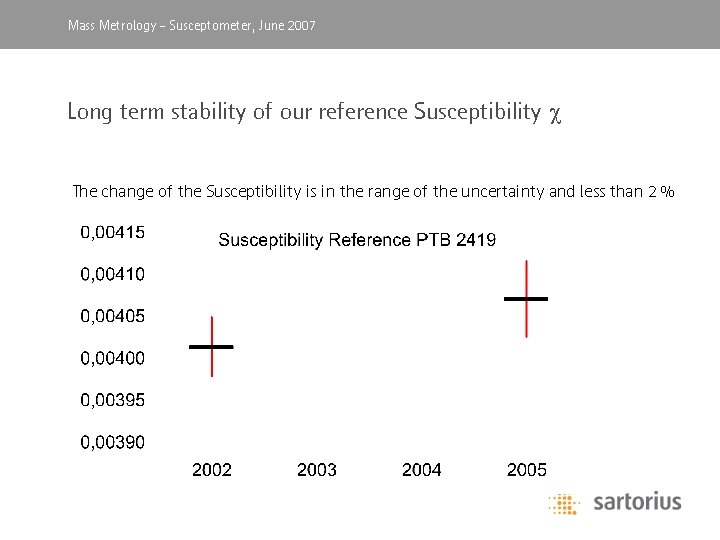
Mass Metrology, -April Susceptometer, 2003 June 2007 Long term stability of our reference Susceptibility The change of the Susceptibility is in the range of the uncertainty and less than 2 %
Mass Metrology, -April Susceptometer, 2003 June 2007 Long term stability of our reference magnets md
Mass Metrology, -April Susceptometer, 2003 June 2007 Thank you for your attention Benno Gatzemeier Mass Metrology Sartorius AG / Germany