
Mass Lab The metric system is a system
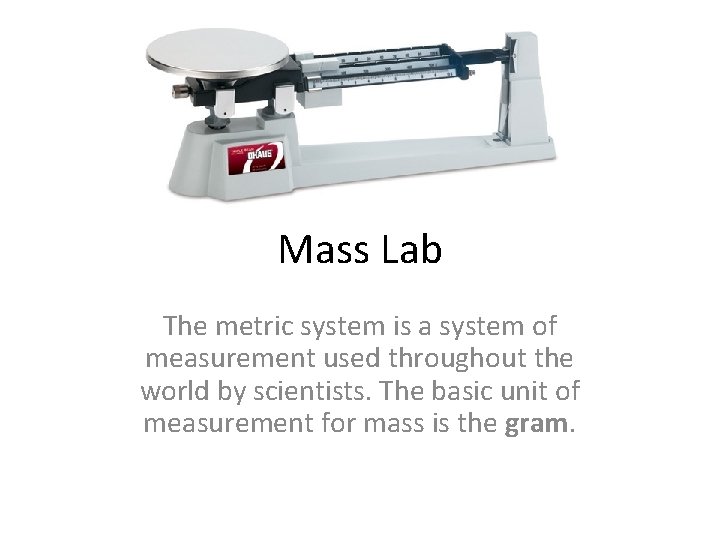
Mass Lab The metric system is a system of measurement used throughout the world by scientists. The basic unit of measurement for mass is the gram.
Purpose: To practice measuring objects in grams and convert those units to decigrams, milligrams, and kilograms. Background: 10 The metric system is based on the number ____. Because of this, it is easy to convert units of measurement into larger or smaller units, depending on what you are measuring. For example, if I measured the mass or an Kilo elephant, I would use _____ grams. But if I wanted to measure the mass of a butterfly, Milli I would use ______ grams.
Calculate • • 100 There are _____ cg in a gram. 10 There are _____ mg in a cg. 1000 Therefore, there are ______ mg in a gram. 10 One decigran is equal to ____ cg.
Procedures 1. Move all weights to zero and confirm that the arm is balanced at the zero mark 2. Place your first object on the pan 3. Move the 100 s weight over until the arm drops below zero, then move it back one grove and lock it in place. Record this number. 4. Repeat for the 10 s weight. Record this number. 5. Slide the 1 s weight over until the arm is balanced at zero. Record this number to 1 decimal place. 6. Add up the total mass of the object. 7. Repeat for the remaining 9 objects 8. Convert to decigrams, milligrams, and kilograms
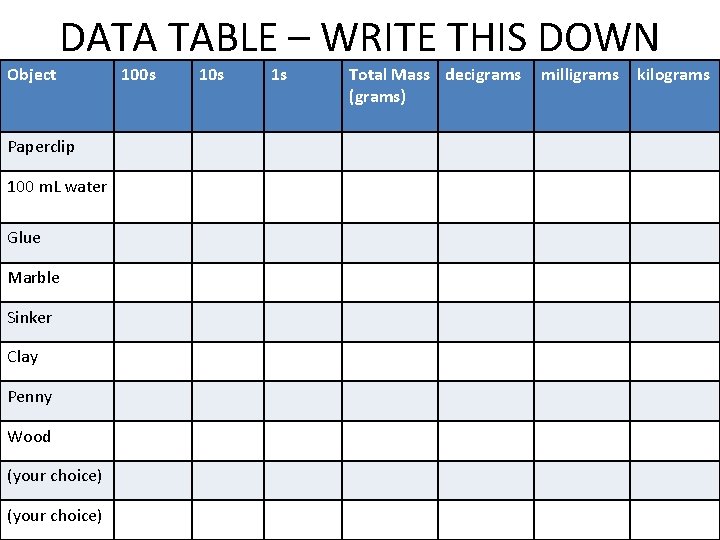
DATA TABLE – WRITE THIS DOWN Object Paperclip 100 m. L water Glue Marble Sinker Clay Penny Wood (your choice) 100 s 1 s Total Mass decigrams (grams) milligrams kilograms
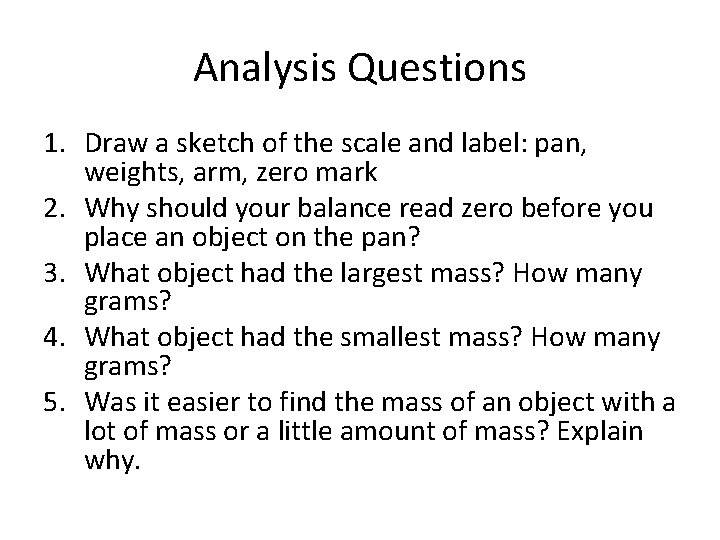
Analysis Questions 1. Draw a sketch of the scale and label: pan, weights, arm, zero mark 2. Why should your balance read zero before you place an object on the pan? 3. What object had the largest mass? How many grams? 4. What object had the smallest mass? How many grams? 5. Was it easier to find the mass of an object with a lot of mass or a little amount of mass? Explain why.
- Slides: 6