
Mass determination of Supersymmetric particles in ATLAS Dr

- Slides: 19
Mass determination of Supersymmetric particles in ATLAS Dr. scient. thesis by Borge Kile Gjelsten Fabiola Gianotti (CERN), opponent 1
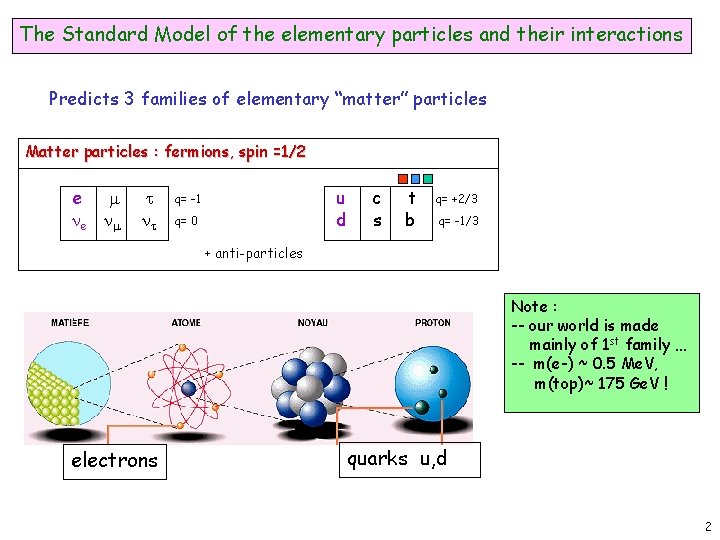
The Standard Model of the elementary particles and their interactions Predicts 3 families of elementary “matter” particles Matter particles : fermions, spin =1/2 e e u d q= -1 q= 0 c s t b q= +2/3 q= -1/3 + anti-particles Note : -- our world is made mainly of 1 st family … -- m(e-) ~ 0. 5 Me. V, m(top)~ 175 Ge. V ! electrons quarks u, d 2
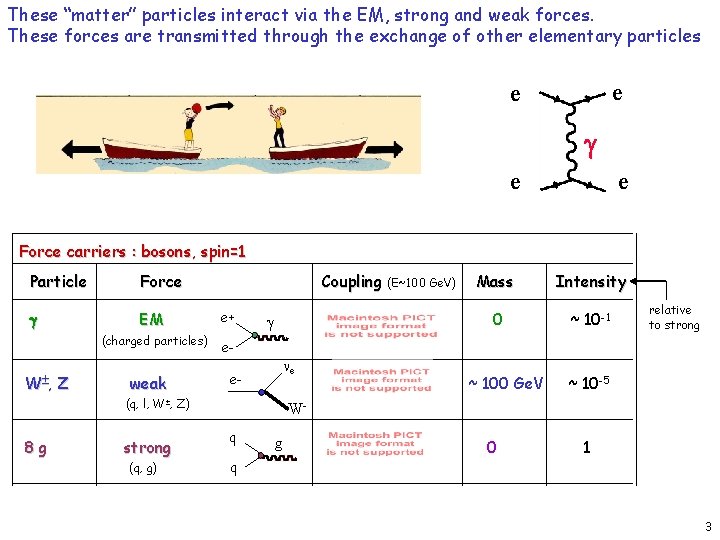
These “matter” particles interact via the EM, strong and weak forces. These forces are transmitted through the exchange of other elementary particles e e Force carriers : bosons, spin=1 Particle Force EM e+ (charged particles) e- W , Z weak Coupling (E~100 Ge. V) e- e (q, l, W , Z) 8 g strong (q, g) Mass Intensity 0 ~ 10 -1 ~ 100 Ge. V relative to strong ~ 10 -5 Wq q g 0 1 3
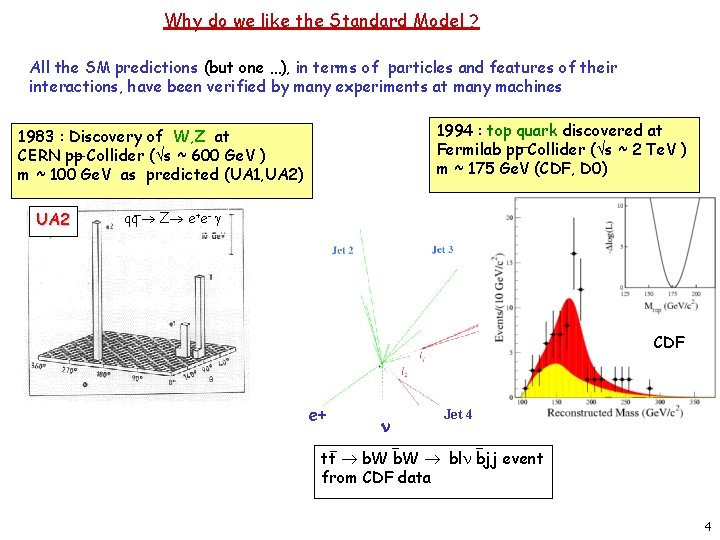
Why do we like the Standard Model ? All the SM predictions (but one …), in terms of particles and features of their interactions, have been verified by many experiments at many machines 1994 : top quark discovered at Fermilab pp Collider ( s ~ 2 Te. V ) m ~ 175 Ge. V (CDF, D 0) 1983 : Discovery of W, Z at CERN pp Collider ( s ~ 600 Ge. V ) m ~ 100 Ge. V as predicted (UA 1, UA 2) UA 2 qq Z e+e- CDF e+ Jet 4 tt b. W bl bjj event from CDF data 4
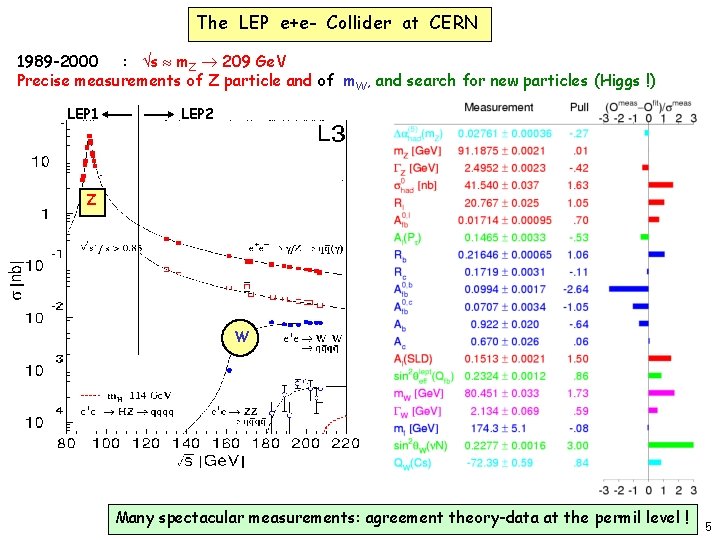
The LEP e+e- Collider at CERN 1989 -2000 : s m. Z 209 Ge. V Precise measurements of Z particle and of m. W, and search for new particles (Higgs !) LEP 1 LEP 2 Z W Many spectacular measurements: agreement theory-data at the permil level ! 5
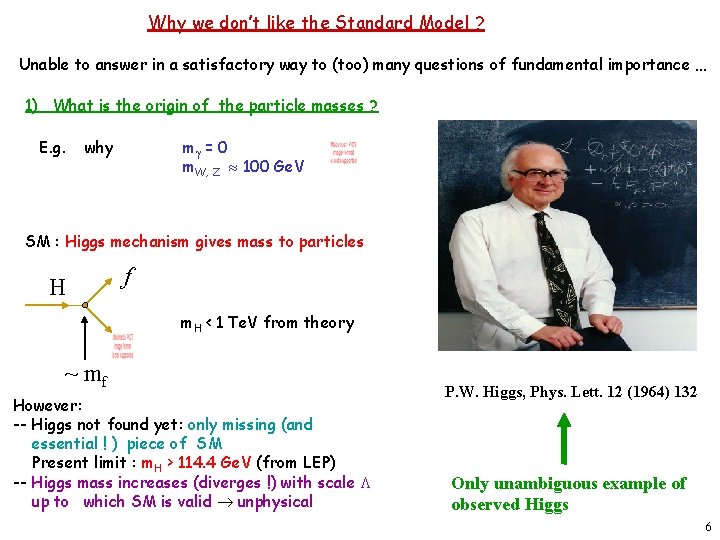
Why we don’t like the Standard Model ? Unable to answer in a satisfactory way to (too) many questions of fundamental importance … 1) What is the origin of the particle masses ? E. g. why m = 0 m. W, Z 100 Ge. V SM : Higgs mechanism gives mass to particles H f m. H < 1 Te. V from theory ~ mf However: -- Higgs not found yet: only missing (and essential ! ) piece of SM Present limit : m. H > 114. 4 Ge. V (from LEP) -- Higgs mass increases (diverges !) with scale up to which SM is valid unphysical P. W. Higgs, Phys. Lett. 12 (1964) 132 Only unambiguous example of observed Higgs 6
2) Many other open questions -- Why 3 lepton/quark families ? Why is the first family privileged ? -- Are there additional (heavy) leptons and bosons ? -- Are quarks and leptons really elementary ? -- What is the origin of matter / anti-matter asymmetry in the universe ? -- Why MEW/MPlanck ~ 10 -17 (“hierarchy” problem) ? -- What is the nature of the Universe Dark Matter ? Recent astrophysical measurements (e. g. WMAP satellite) indicate that The Universe is made of: -- 5% of known matter -- 25 % of “Dark Matter” (no SM particle can explain it) -- 70% of “Dark Energy” today we understand only 5% of the Universe composition 7
All this calls for A more fundamental theory of which SM is low-E approximation Best candidates : Supersymmetry (SUSY) Extra-dimensions Technicolour New Physics to solve SM problems, all predict New Physics at Te. V scale need a machine to explore the ~ Te. V energy range CERN Large Hadron Collider (LHC) Borge’s thesis is on Supersymmetry at LHC 8
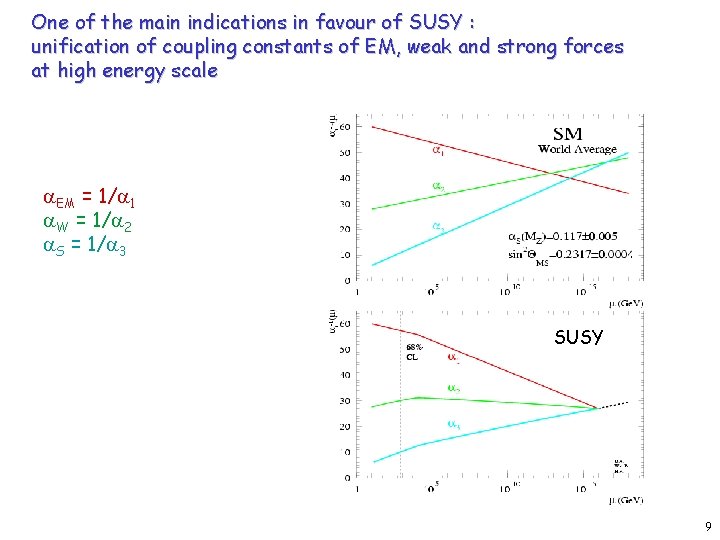
One of the main indications in favour of SUSY : unification of coupling constants of EM, weak and strong forces at high energy scale SM EM = 1/ 1 W = 1/ 2 S = 1/ 3 SUSY 9
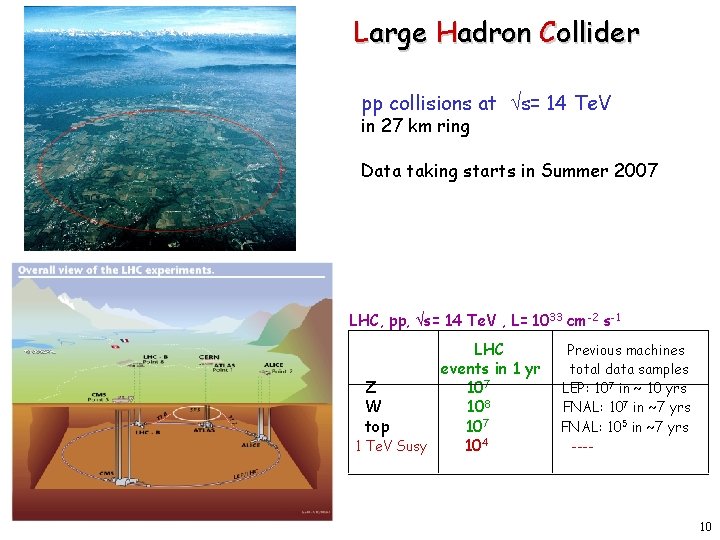
Large Hadron Collider pp collisions at s= 14 Te. V in 27 km ring Data taking starts in Summer 2007 LHC, pp, s= 14 Te. V , L= 1033 cm-2 s-1 LHC events in 1 yr Z 107 W 108 top 107 1 Te. V Susy 104 Previous machines total data samples LEP: 107 in ~ 10 yrs FNAL: 107 in ~7 yrs FNAL: 105 in ~7 yrs ---- 10
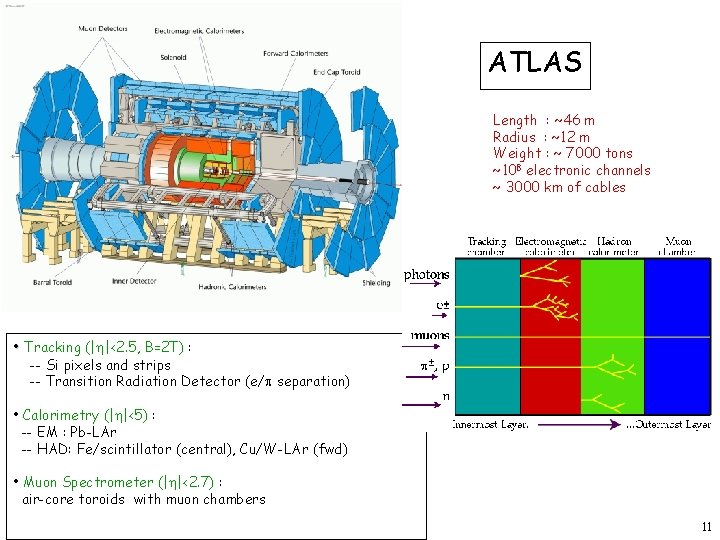
ATLAS Length : ~46 m Radius : ~12 m Weight : ~ 7000 tons ~108 electronic channels ~ 3000 km of cables • Tracking (| |<2. 5, B=2 T) : -- Si pixels and strips -- Transition Radiation Detector (e/ separation) • Calorimetry (| |<5) : -- EM : Pb-LAr -- HAD: Fe/scintillator (central), Cu/W-LAr (fwd) • Muon Spectrometer (| |<2. 7) : air-core toroids with muon chambers 11
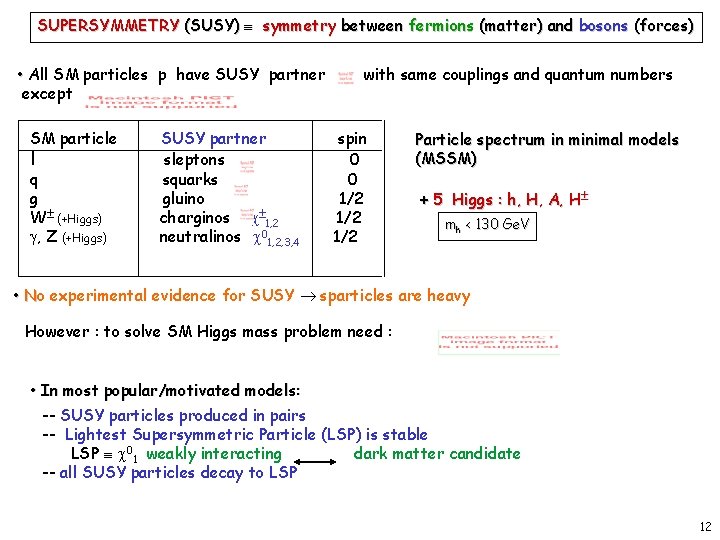
SUPERSYMMETRY (SUSY) symmetry between fermions (matter) and bosons (forces) • All SM particles p have SUSY partner except SM particle l q g W (+Higgs) , Z (+Higgs) SUSY partner sleptons squarks gluino charginos 1, 2 neutralinos 01, 2, 3, 4 with same couplings and quantum numbers spin 0 0 1/2 1/2 Particle spectrum in minimal models (MSSM) + 5 Higgs : h, H, A, H mh < 130 Ge. V • No experimental evidence for SUSY sparticles are heavy However : to solve SM Higgs mass problem need : • In most popular/motivated models: -- SUSY particles produced in pairs -- Lightest Supersymmetric Particle (LSP) is stable LSP 01 weakly interacting dark matter candidate -- all SUSY particles decay to LSP 12
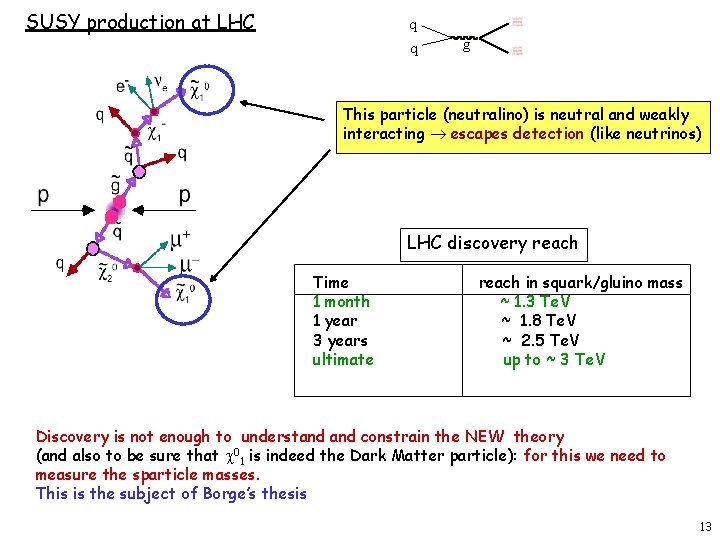
SUSY production at LHC q q g This particle (neutralino) is neutral and weakly interacting escapes detection (like neutrinos) LHC discovery reach Time 1 month 1 year 3 years ultimate reach in squark/gluino mass ~ 1. 3 Te. V ~ 1. 8 Te. V ~ 2. 5 Te. V up to ~ 3 Te. V Discovery is not enough to understand constrain the NEW theory (and also to be sure that 01 is indeed the Dark Matter particle): for this we need to measure the sparticle masses. This is the subject of Borge’s thesis 13
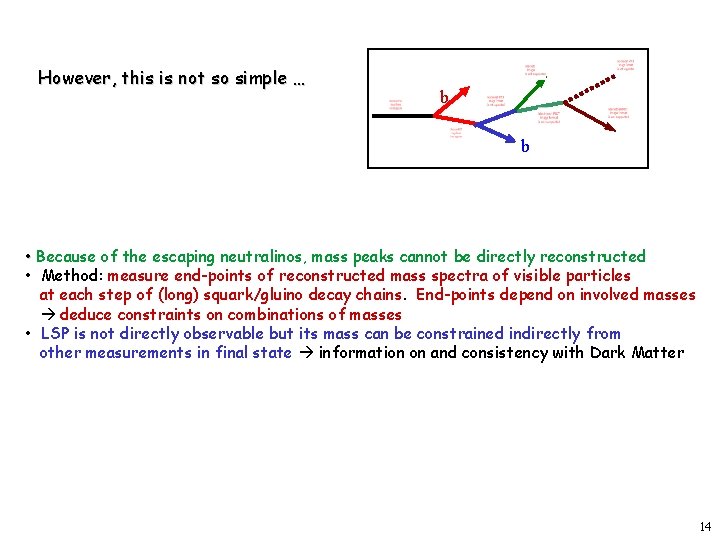
However, this is not so simple … b b • Because of the escaping neutralinos, mass peaks cannot be directly reconstructed • Method: measure end-points of reconstructed mass spectra of visible particles at each step of (long) squark/gluino decay chains. End-points depend on involved masses deduce constraints on combinations of masses • LSP is not directly observable but its mass can be constrained indirectly from other measurements in final state information on and consistency with Dark Matter 14
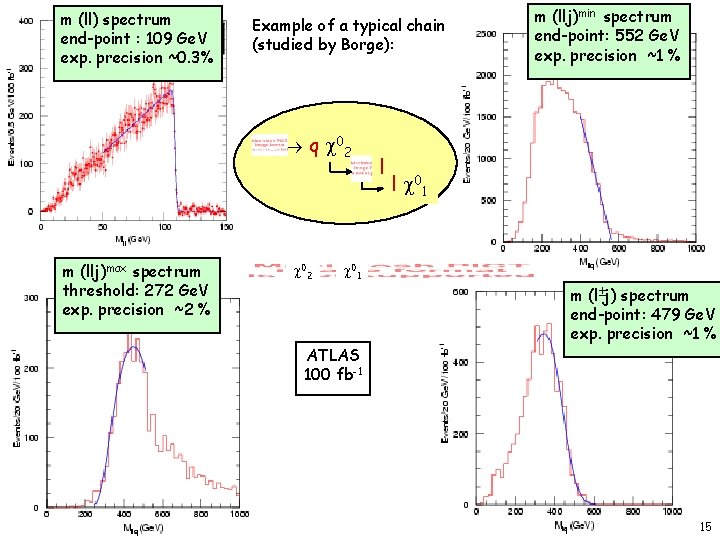
m (ll) spectrum end-point : 109 Ge. V exp. precision ~0. 3% Example of a typical chain (studied by Borge): q 02 m (llj)max spectrum threshold: 272 Ge. V exp. precision ~2 % 02 l m (llj)min spectrum end-point: 552 Ge. V exp. precision ~1 % l 01 ATLAS 100 fb-1 m (l j) spectrum end-point: 479 Ge. V exp. precision ~1 % 15
Borge’s thesis • Detailed studies on how to determine SUSY particle masses from end-point measurements • For the first time, the complexity of such measurements (coming e. g. from the a priori unknown SUSY phenomenology) has been addressed in detail • Pioneering work of scientific significance because this technique will be the standard method used at the LHC • For the reasons outlined before thesis subject is original and well motivated • The work level meets international standards, as demonstrated also by the two published papers based on this thesis • The thesis is written in a clear way, and indicates that Borge masters both experimental and theoretical/phenomenological issues 16
Back-up slides 17
25 ns Event rate in ATLAS : N = L x (pp) 109 interactions/s Mostly soft ( low p. T ) events Interesting hard (high-p. T ) events are rare very powerful detectors needed 18
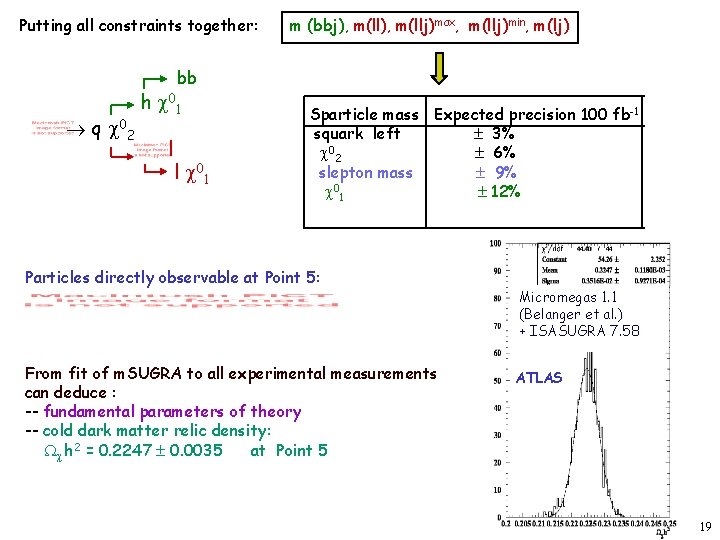
Putting all constraints together: m (bbj), m(llj)max, m(llj)min, m(lj) bb q 02 h 01 l l 01 Sparticle mass Expected precision 100 fb-1 squark left 3% 0 2 6% slepton mass 9% 0 1 12% Particles directly observable at Point 5: From fit of m. SUGRA to all experimental measurements can deduce : -- fundamental parameters of theory -- cold dark matter relic density: h 2 = 0. 2247 0. 0035 at Point 5 Micromegas 1. 1 (Belanger et al. ) + ISASUGRA 7. 58 ATLAS 19