
Mason Voluntary Stewardship Program Where critical areas agriculture
- Slides: 26
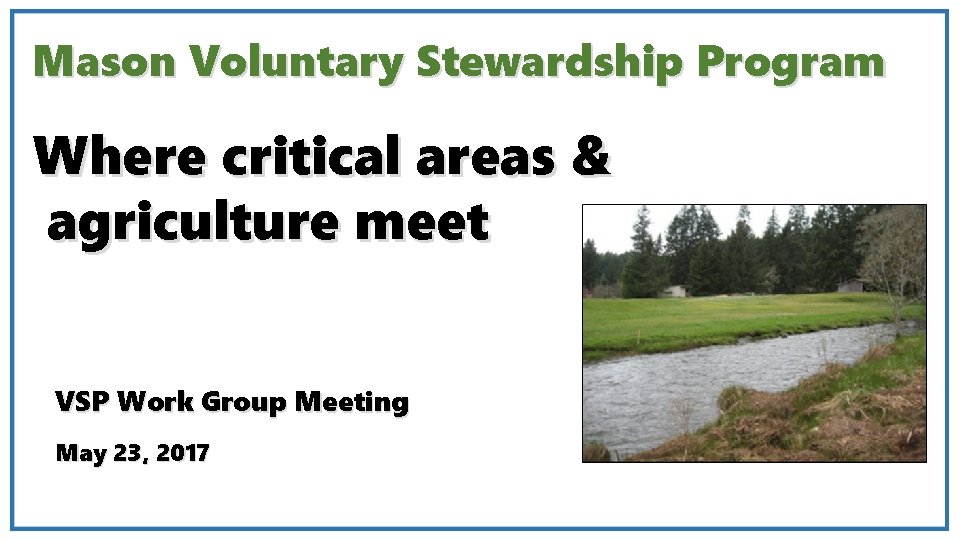
Mason Voluntary Stewardship Program Where critical areas & agriculture meet VSP Work Group Meeting May 23, 2017
Agenda 1. Frequently flooded areas 2. Geologically hazardous areas 3. Fish & wildlife habitat conservation areas (FWHCAs)
Working Conceptual Framework Mason County VSP Goals 1. Ensure the viability of agriculture and reduce the conversion of farmland to other uses 2. Protect baseline conditions for critical areas measured on a watershed scale as of July 2011 3. Enhance critical areas measured on a watershed scale through voluntary actions
Working Conceptual Framework Three goals implemented through four tracks: 1. Individual Stewardship Plans (ISP) 2. VSP Work Plan Outreach 3. Monitoring VSP Progress 4. Program Maintenance
Intersection of Frequently Flooded Areas and Agriculture
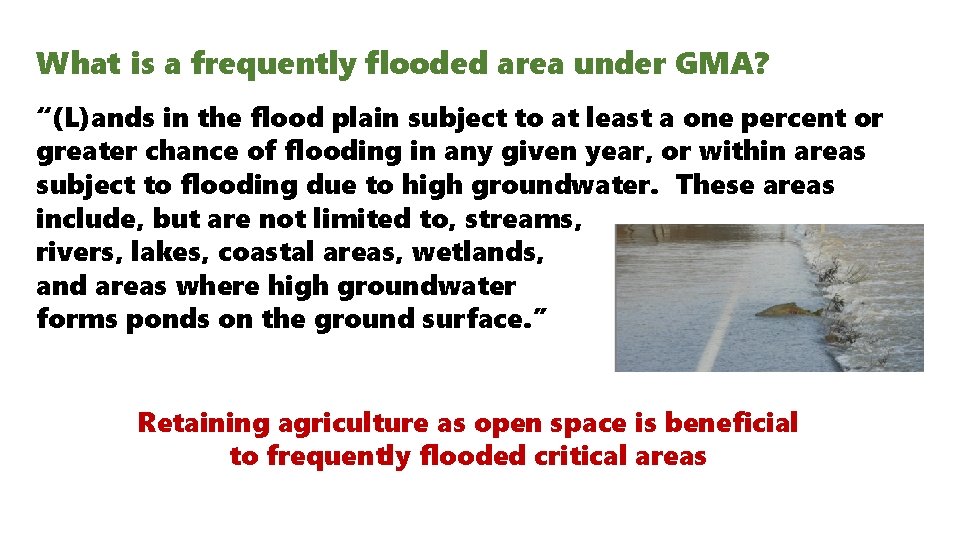
What is a frequently flooded area under GMA? “(L)ands in the flood plain subject to at least a one percent or greater chance of flooding in any given year, or within areas subject to flooding due to high groundwater. These areas include, but are not limited to, streams, rivers, lakes, coastal areas, wetlands, and areas where high groundwater forms ponds on the ground surface. ” Retaining agriculture as open space is beneficial to frequently flooded critical areas
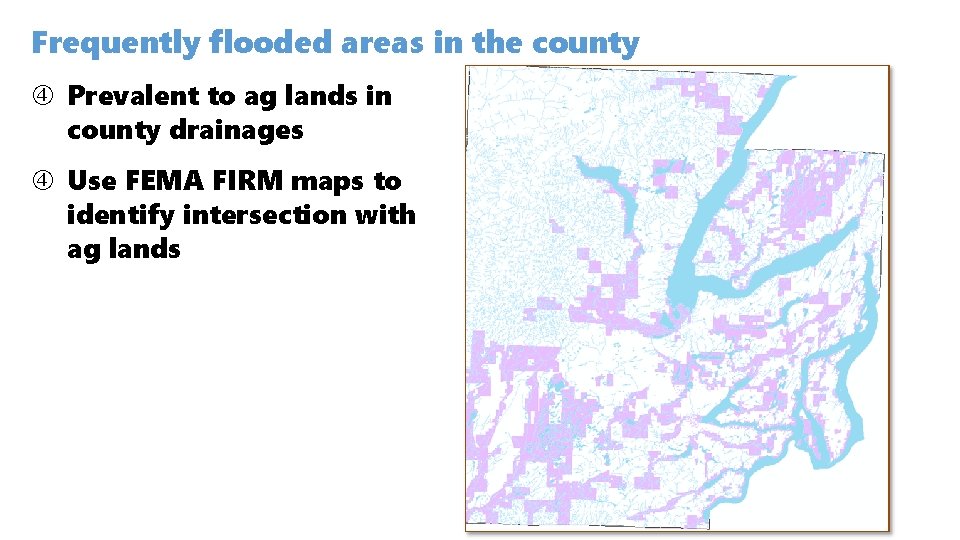
Frequently flooded areas in the county Prevalent to ag lands in county drainages Use FEMA FIRM maps to identify intersection with ag lands
Frequently flooded concerns for agriculture Damage to property/safety of people & livestock Expansion of flood area and duration, especially from other uses and public infrastructure Increased flood velocities; soil loss/bank erosion Deposition of flood-borne debris on ag lands Decreased property values Other?
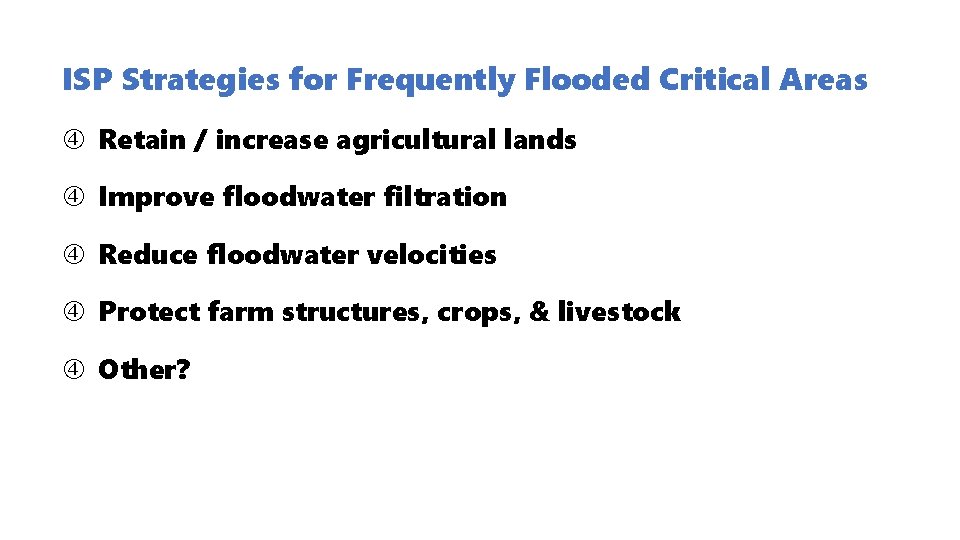
ISP Strategies for Frequently Flooded Critical Areas Retain / increase agricultural lands Improve floodwater filtration Reduce floodwater velocities Protect farm structures, crops, & livestock Other?
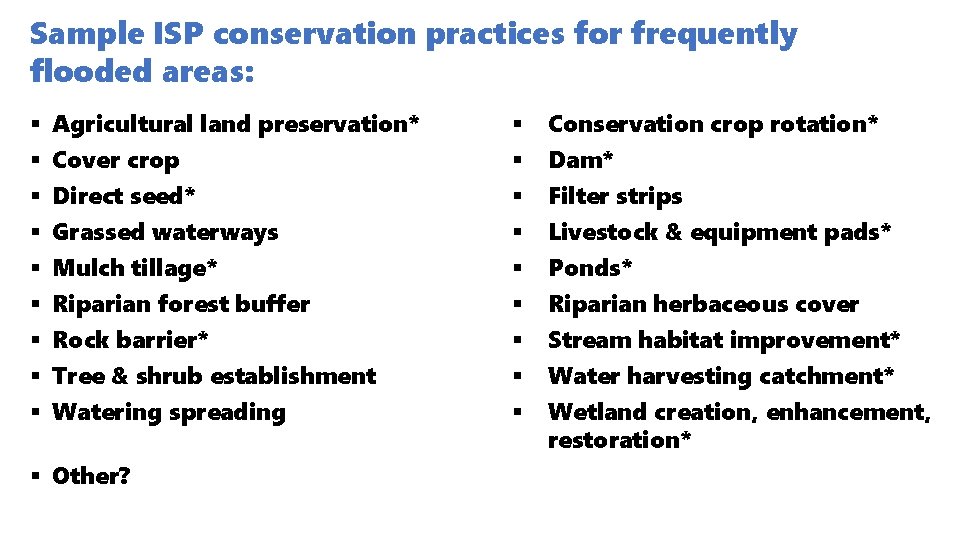
Sample ISP conservation practices for frequently flooded areas: § § § § § Agricultural land preservation* Cover crop Direct seed* Grassed waterways Mulch tillage* Riparian forest buffer Rock barrier* Tree & shrub establishment Watering spreading § Other? § § § § § Conservation crop rotation* Dam* Filter strips Livestock & equipment pads* Ponds* Riparian herbaceous cover Stream habitat improvement* Water harvesting catchment* Wetland creation, enhancement, restoration*
Intersection of Geologically Hazardous Areas and Agriculture
What is a geologically hazardous area under GMA? Geologically hazardous areas that because of their susceptibility to erosion, sliding, earthquake, or other geological events, are not suited to siting commercial, residential, or industrial development consistent with public health or safety concerns.
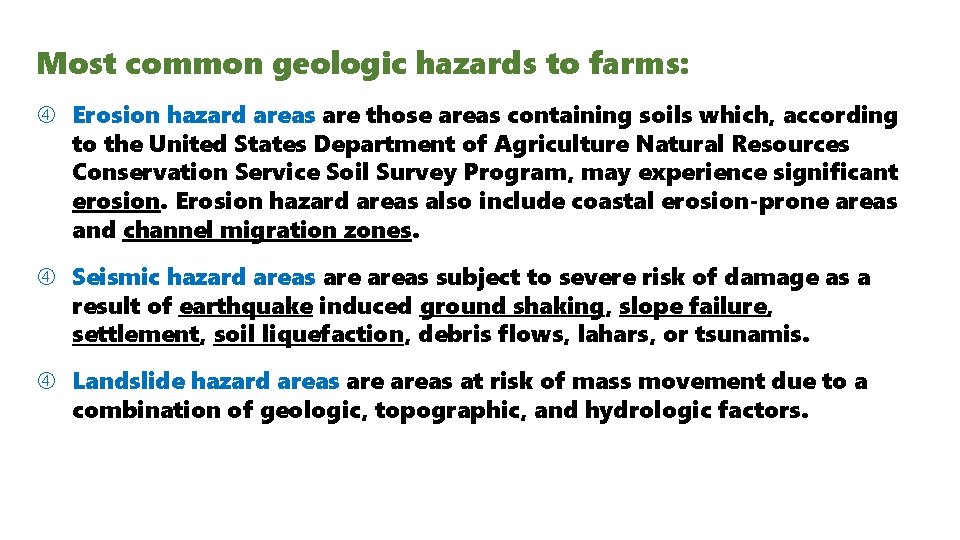
Most common geologic hazards to farms: Erosion hazard areas are those areas containing soils which, according to the United States Department of Agriculture Natural Resources Conservation Service Soil Survey Program, may experience significant erosion. Erosion hazard areas also include coastal erosion-prone areas and channel migration zones. Seismic hazard areas subject to severe risk of damage as a result of earthquake induced ground shaking, slope failure, settlement, soil liquefaction, debris flows, lahars, or tsunamis. Landslide hazard areas at risk of mass movement due to a combination of geologic, topographic, and hydrologic factors.
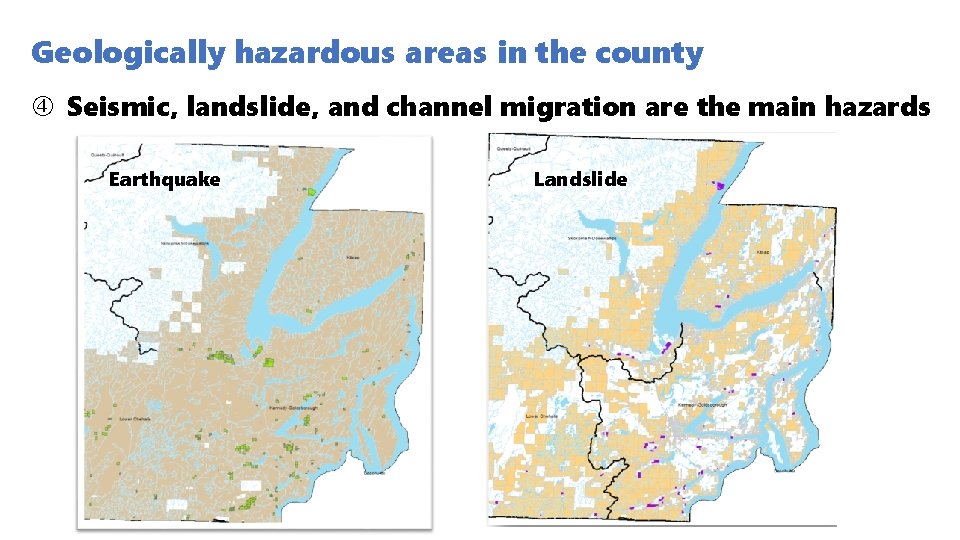
Geologically hazardous areas in the county Seismic, landslide, and channel migration are the main hazards Earthquake Landslide
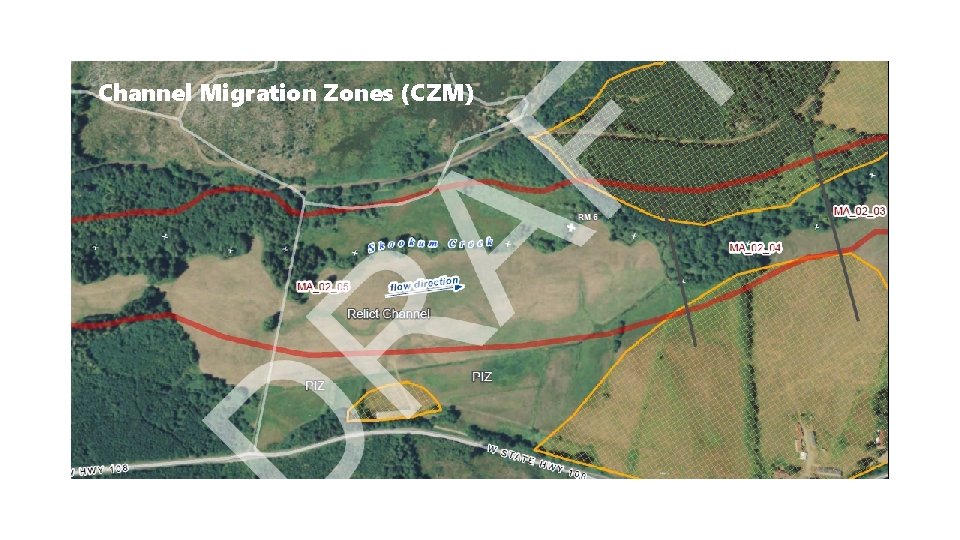
Channel Migration Zones (CZM)
Geologic hazard concerns for agriculture Damage to property / safety of people & livestock Soil loss from sheet or bank erosion Migration of streams through fields Landslide unto crops / structure Other?
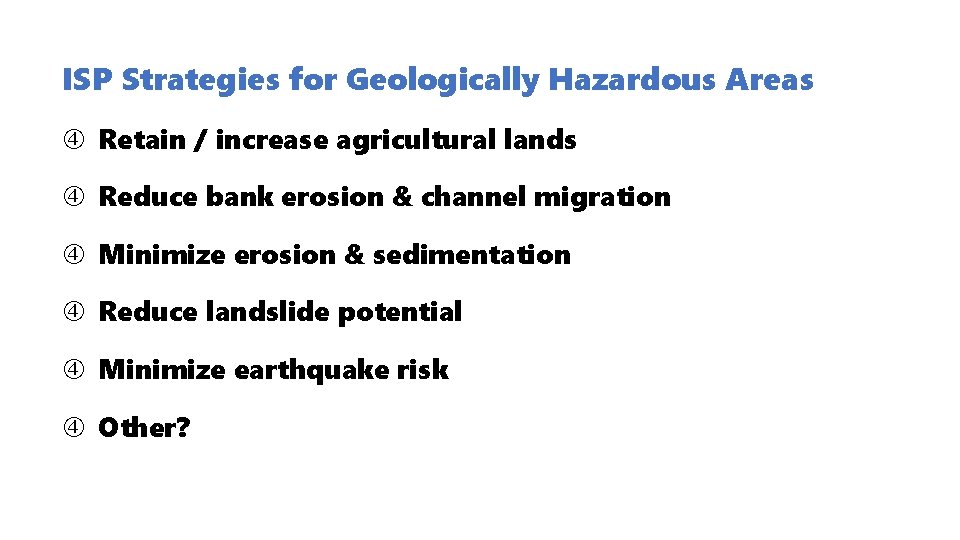
ISP Strategies for Geologically Hazardous Areas Retain / increase agricultural lands Reduce bank erosion & channel migration Minimize erosion & sedimentation Reduce landslide potential Minimize earthquake risk Other?
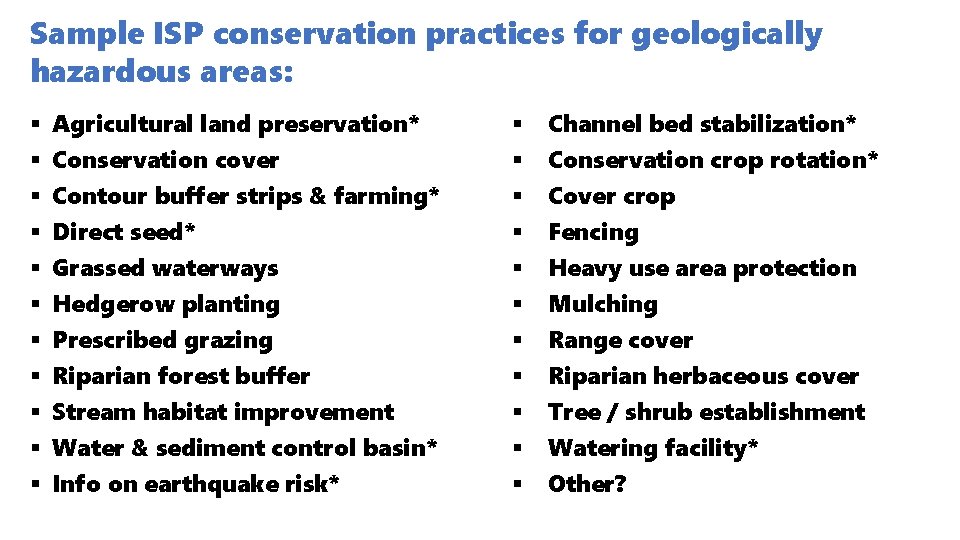
Sample ISP conservation practices for geologically hazardous areas: § § § Agricultural land preservation* Conservation cover Contour buffer strips & farming* Direct seed* Grassed waterways Hedgerow planting Prescribed grazing Riparian forest buffer Stream habitat improvement Water & sediment control basin* Info on earthquake risk* § § § Channel bed stabilization* Conservation crop rotation* Cover crop Fencing Heavy use area protection Mulching Range cover Riparian herbaceous cover Tree / shrub establishment Watering facility* Other?
Intersection of Fish & Wildlife Habitat Conservation Areas (FWHCA) and Agriculture
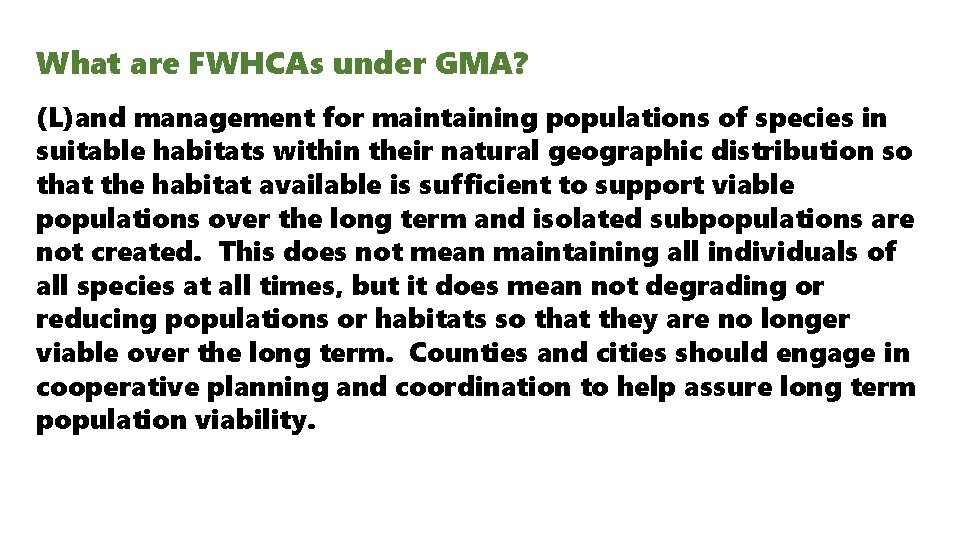
What are FWHCAs under GMA? (L)and management for maintaining populations of species in suitable habitats within their natural geographic distribution so that the habitat available is sufficient to support viable populations over the long term and isolated subpopulations are not created. This does not mean maintaining all individuals of all species at all times, but it does mean not degrading or reducing populations or habitats so that they are no longer viable over the long term. Counties and cities should engage in cooperative planning and coordination to help assure long term population viability.
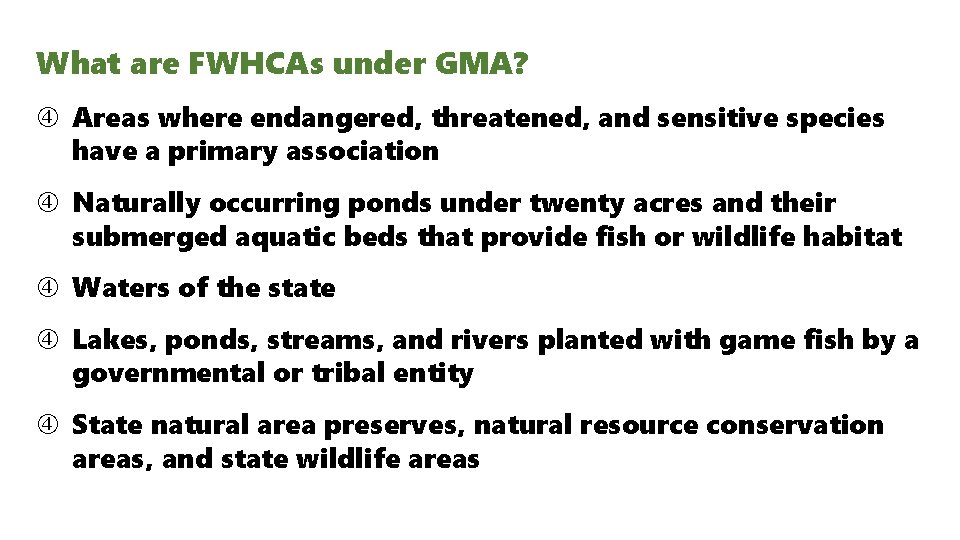
What are FWHCAs under GMA? Areas where endangered, threatened, and sensitive species have a primary association Naturally occurring ponds under twenty acres and their submerged aquatic beds that provide fish or wildlife habitat Waters of the state Lakes, ponds, streams, and rivers planted with game fish by a governmental or tribal entity State natural area preserves, natural resource conservation areas, and state wildlife areas
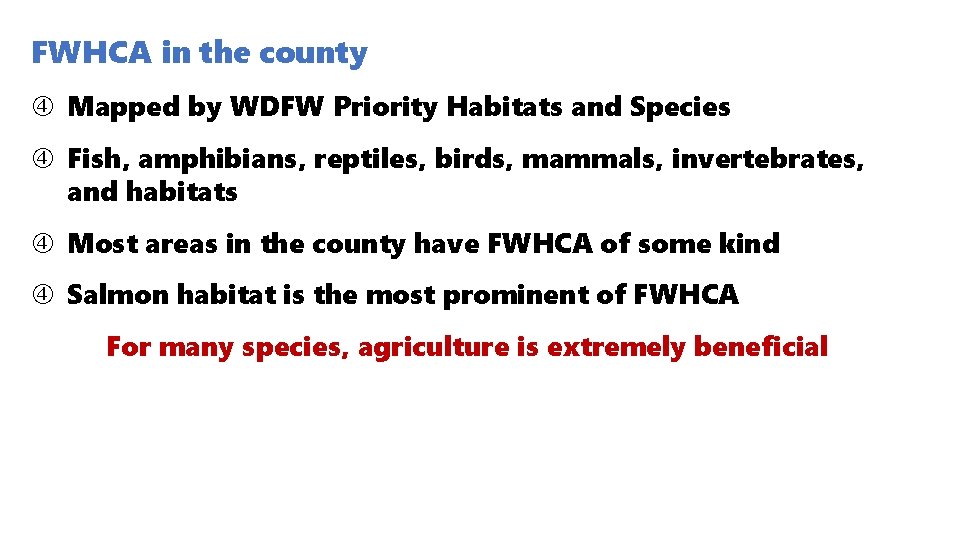
FWHCA in the county Mapped by WDFW Priority Habitats and Species Fish, amphibians, reptiles, birds, mammals, invertebrates, and habitats Most areas in the county have FWHCA of some kind Salmon habitat is the most prominent of FWHCA For many species, agriculture is extremely beneficial
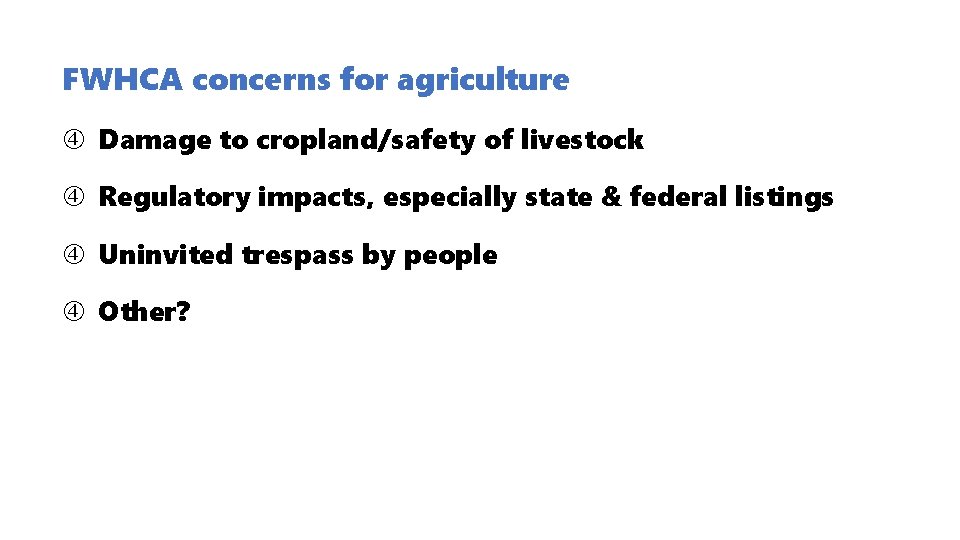
FWHCA concerns for agriculture Damage to cropland/safety of livestock Regulatory impacts, especially state & federal listings Uninvited trespass by people Other?
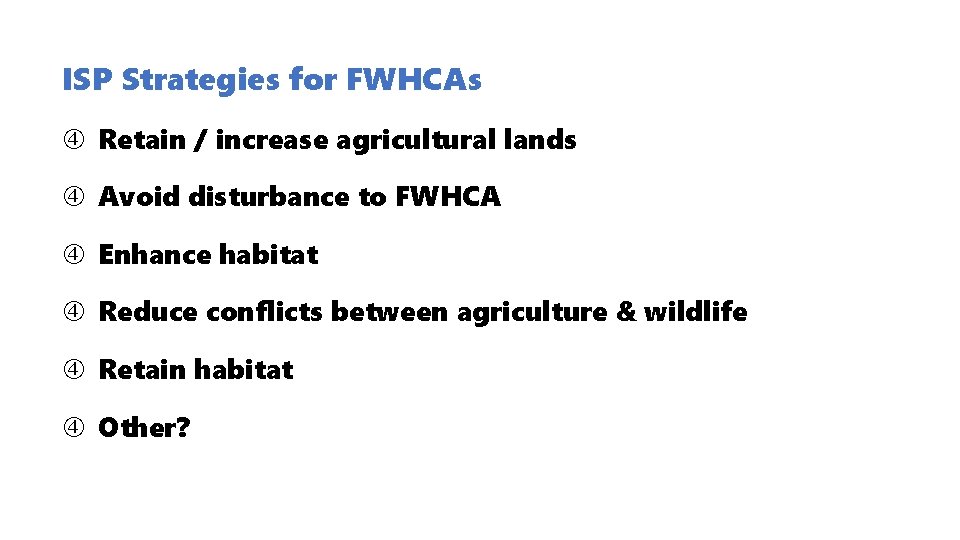
ISP Strategies for FWHCAs Retain / increase agricultural lands Avoid disturbance to FWHCA Enhance habitat Reduce conflicts between agriculture & wildlife Retain habitat Other?
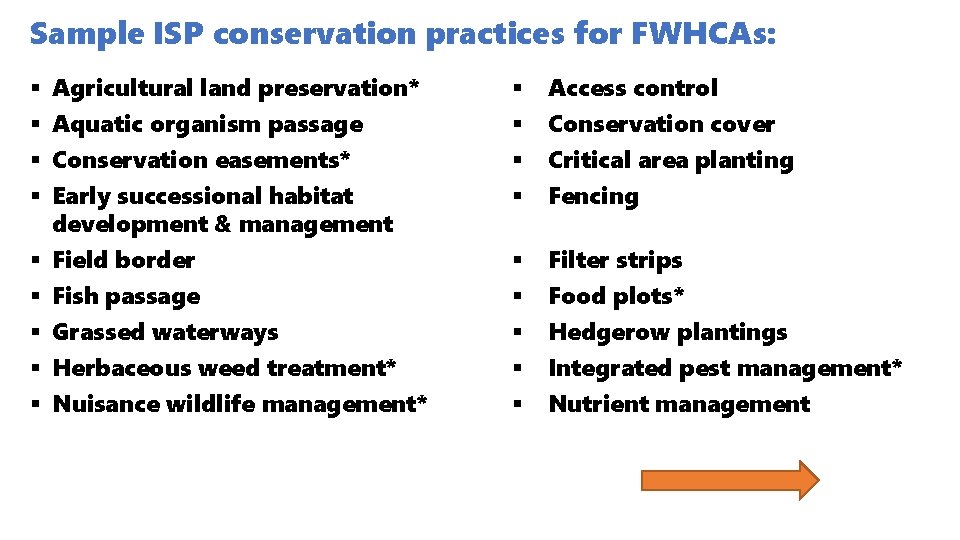
Sample ISP conservation practices for FWHCAs: § § Agricultural land preservation* Aquatic organism passage Conservation easements* Early successional habitat development & management § § Access control Conservation cover Critical area planting Fencing § § § Field border Fish passage Grassed waterways Herbaceous weed treatment* Nuisance wildlife management* § § § Filter strips Food plots* Hedgerow plantings Integrated pest management* Nutrient management
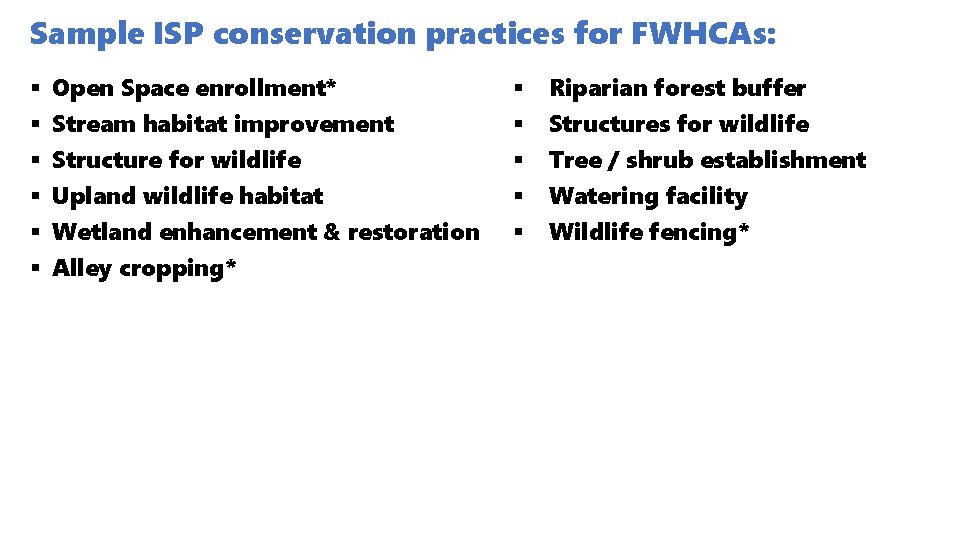
Sample ISP conservation practices for FWHCAs: § § § Open Space enrollment* Stream habitat improvement Structure for wildlife Upland wildlife habitat Wetland enhancement & restoration Alley cropping* § § § Riparian forest buffer Structures for wildlife Tree / shrub establishment Watering facility Wildlife fencing*