
MASH TL4 Testing and Evaluation of Free Standing


- Slides: 21
MASH TL-4 Testing and Evaluation of Free. Standing F-shape Portable Concrete Barrier 2019 -06 -LCB PS Developers Christopher Henson, Oregon DOT; Nina Ertel, P. E, Penn. DOT. ; Josh Palmer, Colorado DOT; Josh Keith, Colorado DOT Project Synopsis • Evaluate and test a 42” tall, F-shape profile, pin-and-loop connection, free-standing PCB in accordance with MASH. Project Goal A Free-Standing Portable Concrete Barrier that is MASH TL-4 compliant Project Background • A previous ODOT designed 42” PCB system met NCHRP Report 350 TL-4 criteria. • Under a Penn. DOT funded project, TTI is currently designing F-Shape precast barriers using a pin-and-loop connection keyed into asphalt to satisfy MASH TL-4 criteria.
MASH TL-4 Testing and Evaluation of Free. Standing F-shape Portable Concrete Barrier 2019 -06 -LCB Proposed Work Plan • Task 1: Literature Review and Engineering Analysis • Evaluate current PCB designs • Determine critical PCB designs • Determine which crash tests are critical for determining MASH compliance • Task 2: Construction and Demolition • Task 3: Full-Scale Crash Testing and Reporting • Perform critical full-scale crash tests (budgeting for two crash tests) • Provide a final report documenting crash test results • Provide a professional opinion for other PCB designs Deliverables A report providing details of the PCB system, documentation of the evaluation, crash test results, and the assessment of the performance of the PCB according to MASH specifications.
MASH TL-4 Testing and Evaluation of Free. Standing F-shape Portable Concrete Barrier 2019 -06 -LCB Urgency and Expected Benefit • • Several states use PCB in a permanent installation. The major advantage of PCB is that, when used on a paved shoulder, or paved median with no embedment, it can be easily removed to accommodate pavement overlays and then replaced without damage. Funding Total Estimated Cost = $245, 000 Research Period Work Schedule: (Estimated Project Duration = 10 months from initiation of the project) • Task 1 = 3 months • Task 2 = 3 months • Task 3 = 4 months
Shallowest Embedment or Footing for CIP Median Barrier at MASH TL-5 PS Developers 2019 -08 -LCB Jim Danila, MA Project Synopsis • Develop a design for a minimum embedment depth in ACP and/or the minimum footing dimensions required for a TL-5 concrete median barrier. Project Goal(s) Through testing or engineering analysis, identify minimum embedment depth in ACP and/or footing depth required to satisfy MASH TL-5 testing on a concrete median barrier, including the minimum barrier length required Project Background • MASH TL-5 single slope median barrier typically has a continuous shallow footing or deep end footings • These footings are sometime impractical due to buried utilities or bridge footings • TTI has recently performed work on high-containment barriers • • • MASH Test 4 -12 with 40 ft long SSB keyed into 1 -inch asphalt MASH Test 4 -12 with 70 ft long SSB keyed into 1 -inch asphalt Tx. DOT Project 0 -6948, structurally independent foundations for 54 -inch single slope barrier
Shallowest Embedment or Footing for CIP Median Barrier at MASH TL-5 2019 -08 -LCB Proposed Work Plan • Task 1: Simulation Analysis • Develop model of barrier keyed into asphalt and perform MASH Test 5 -12 impact simulations • Determine acceptable minimum barrier segment depth and length and final design for testing • Task 2: Construction of Test Installation • Task 3: Testing and Reporting • Perform MASH Test 5 -12 with tractor-van trailer • Prepare Final Report Deliverables • Final report • Engineering drawings
Shallowest Embedment or Footing for CIP Median Barrier at MASH TL-5 2019 -08 -LCB Urgency and Expected Benefit • With the release of NCHRP Report 892, TL-5 pier protection is likely to be a more commonly used design component • Reducing or eliminating some or all of the footing required for a TL-5 concrete barrier design will have an immediate cost reduction benefit. Funding • Task 1 – Simulation Analysis • Task 2 – Construction • Task 3 – Testing and Reporting $35, 000 $78, 000 $57, 000 TOTAL Research Period • 12 months $170, 000
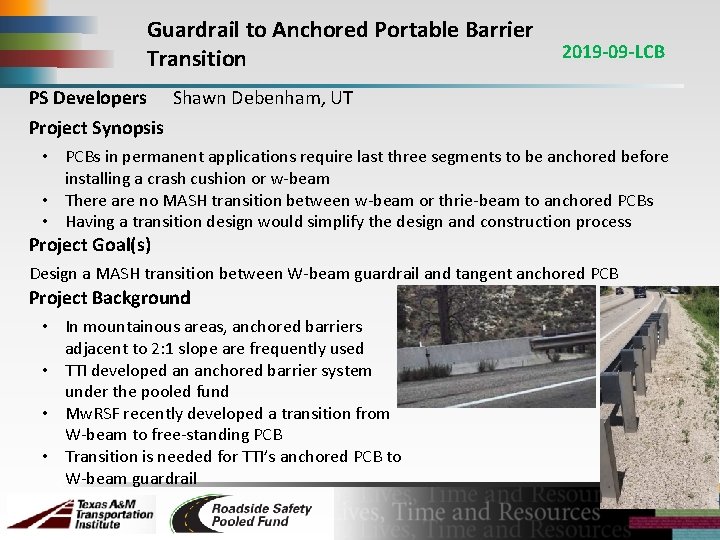
Guardrail to Anchored Portable Barrier Transition PS Developers 2019 -09 -LCB Shawn Debenham, UT Project Synopsis • PCBs in permanent applications require last three segments to be anchored before installing a crash cushion or w-beam • There are no MASH transition between w-beam or thrie-beam to anchored PCBs • Having a transition design would simplify the design and construction process Project Goal(s) Design a MASH transition between W-beam guardrail and tangent anchored PCB Project Background • In mountainous areas, anchored barriers adjacent to 2: 1 slope are frequently used • TTI developed an anchored barrier system under the pooled fund • Mw. RSF recently developed a transition from W-beam to free-standing PCB • Transition is needed for TTI’s anchored PCB to W-beam guardrail
Guardrail to Anchored Portable Barrier Transition 2019 -09 -LCB Proposed Work Plan • Task 1: Conceptual Design • Develop various concepts of the transition and present to Tech Rep. for selection of one concept for further development through simulation and testing • Task 2: Simulation Analysis • Develop models of the selected transition concept and perform MASH impact simulations to evaluate design • Make small modifications to the design to improve its performance if needed • Task 3: Construction • Task 4: Testing and Reporting • Perform MASH Test 3 -20 and Test 3 -22 at the downstream end of the transition • Prepare Final Report Deliverables • Final report • Engineering drawings
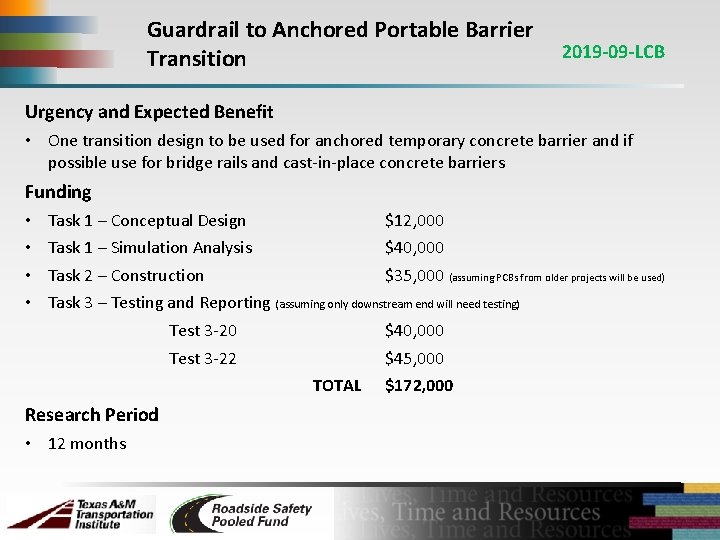
Guardrail to Anchored Portable Barrier Transition 2019 -09 -LCB Urgency and Expected Benefit • One transition design to be used for anchored temporary concrete barrier and if possible use for bridge rails and cast-in-place concrete barriers Funding • • Task 1 – Conceptual Design $12, 000 Task 1 – Simulation Analysis $40, 000 Task 2 – Construction $35, 000 (assuming PCBs from older projects will be used) Task 3 – Testing and Reporting (assuming only downstream end will need testing) Test 3 -20 $40, 000 Test 3 -22 $45, 000 TOTAL Research Period • 12 months $172, 000
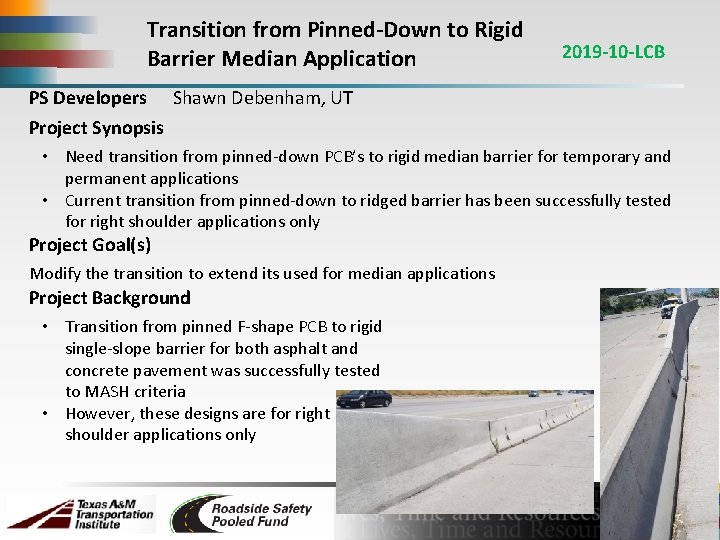
Transition from Pinned-Down to Rigid Barrier Median Application PS Developers 2019 -10 -LCB Shawn Debenham, UT Project Synopsis • Need transition from pinned-down PCB’s to rigid median barrier for temporary and permanent applications • Current transition from pinned-down to ridged barrier has been successfully tested for right shoulder applications only Project Goal(s) Modify the transition to extend its used for median applications Project Background • Transition from pinned F-shape PCB to rigid single-slope barrier for both asphalt and concrete pavement was successfully tested to MASH criteria • However, these designs are for right shoulder applications only
Guardrail to Anchored Portable Barrier Transition 2019 -10 -LCB Proposed Work Plan • Task 1: Transition Design • Previously developed roadside version of the transition design (from TTI projects 40516 -34 and 405160 -36) will be used as basis to develop a median transition design. This design effort will not include simulation • Additional testing is not needed as median version is not expected to deteriorate crash performance compared to the roadside version of the transition Deliverables • Final report • Engineering drawings
Guardrail to Anchored Portable Barrier Transition 2019 -10 -LCB Urgency and Expected Benefit • Development of a crashworthy transition from pinned-down anchored F-shape temporary concrete barrier to rigid single-slope barrier would provide states with a safe median barrier connection design Funding • Task 1 – Conceptual Design Research Period • 5 months $15, 000
Transition from W-Beam Guardrail to Concrete Barrier 2019 -11 -LCB PS Developers Hassan Raza, Mark Buckalew, Steve Walker, Carlos Torres Project Synopsis • Develop and evaluate a MASH TL-3 compliant W-Beam transition to various types of concrete barriers using engineering analysis, simulation, and/or crash testing. Project Goal(s) A MASH TL-3 compliant W-beam transition to various types of concrete barriers. Project Background • Many states use various types of concrete barriers as bridge railings. • Transitions from W-Beam guardrail to a concrete barrier have passed MASH criteria. • A W-Beam transition from a W-Beam guardrail to a concrete barrier has not been tested to MASH.
Transition from W-Beam Guardrail to Concrete Barrier 2019 -11 -LCB Proposed Work Plan • Task 1: Literature Review and Engineering Analysis • Evaluate W-Beam transition designs • Determine critical W-Beam transition designs • Determine which crash tests are critical for determining MASH compliance • Task 2: Construction and Demolition • Task 3: Full-Scale Crash Testing and Reporting • Perform critical full-scale crash tests (budgeting for two crash tests) • Provide a final report documenting crash test results • Provide a professional opinion for other W-Beam transition designs Deliverables A report providing details of the transition, documentation of the evaluation, crash test results, and the assessment of the performance of the transition according to MASH TL-3 criteria.
Transition from W-Beam Guardrail to Concrete Barrier 2019 -11 -LCB Urgency and Expected Benefit • • Several states connect W-Beam guardrail to various concrete barriers. MASH compliant transitions are urgently needed to meet MASH compliance dates. Funding Total Estimated Cost = $130, 000 Research Period Work Schedule: (Estimated Project Duration = 10 months from initiation of the project) • Task 1 = 3 months • Task 2 = 3 months • Task 3 = 4 months
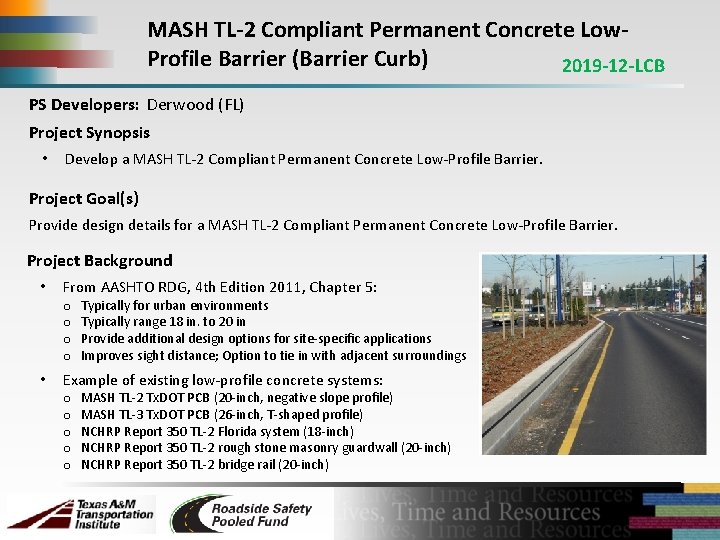
MASH TL-2 Compliant Permanent Concrete Low. Profile Barrier (Barrier Curb) 2019 -12 -LCB PS Developers: Derwood (FL) Project Synopsis • Develop a MASH TL-2 Compliant Permanent Concrete Low-Profile Barrier. Project Goal(s) Provide design details for a MASH TL-2 Compliant Permanent Concrete Low-Profile Barrier. Project Background • From AASHTO RDG, 4 th Edition 2011, Chapter 5: o o • Typically for urban environments Typically range 18 in. to 20 in Provide additional design options for site-specific applications Improves sight distance; Option to tie in with adjacent surroundings Example of existing low-profile concrete systems: o o o MASH TL-2 Tx. DOT PCB (20 -inch, negative slope profile) MASH TL-3 Tx. DOT PCB (26 -inch, T-shaped profile) NCHRP Report 350 TL-2 Florida system (18 -inch) NCHRP Report 350 TL-2 rough stone masonry guardwall (20 -inch) NCHRP Report 350 TL-2 bridge rail (20 -inch)
MASH TL-2 Compliant Permanent Concrete Low. Profile Barrier (Barrier Curb) 2019 -12 -LCB Proposed Work Plan Design and Crash Test a LON segment of MASH TL-2 Compliant Permanent Concrete Barrier (Barrier Curb). The project should look to optimize the system while allowing for potential future asphalt overlays, but not exceed 24 -inches of height to avoid sight distance issues. § Task 1. Design Detail Development and Finite Element Investigation. . Develop design details. Conduct finite element simulation as design aid and vehicle impact behavior prediction. § Task 2. System Construction & Full-Scale Crash Testing. Build test article. Conduct full-scale crash testing (TL-2). § Task 3. Implementation. Summarize implementation recommendations based on crash testing and engineering investigation. Deliverables § MASH TL-2 Compliant Permanent Concrete Low-Profile Barrier.
MASH TL-2 Compliant Permanent Concrete Low. Profile Barrier (Barrier Curb) 2019 -12 -LCB Urgency and Expected Benefit A MASH Compliant design for permanent design is currently not available. Benefits include: § Having a MASH option for urban areas where visibility of pedestrians, bicyclists, and businesses is paramount, in addition to providing sufficient stopping sight distance. § Provide a great crashworthy alternative for separated ped. /bicycle facilities (i. e. Barrier Curb). § Aesthetically mitigate items like; trees, street furniture, parklets, etc. in context sensitive areas (i. e. , urban areas with speeds between 35 and 45 MPH). Funding: $180, 000 Research Period : 1 year
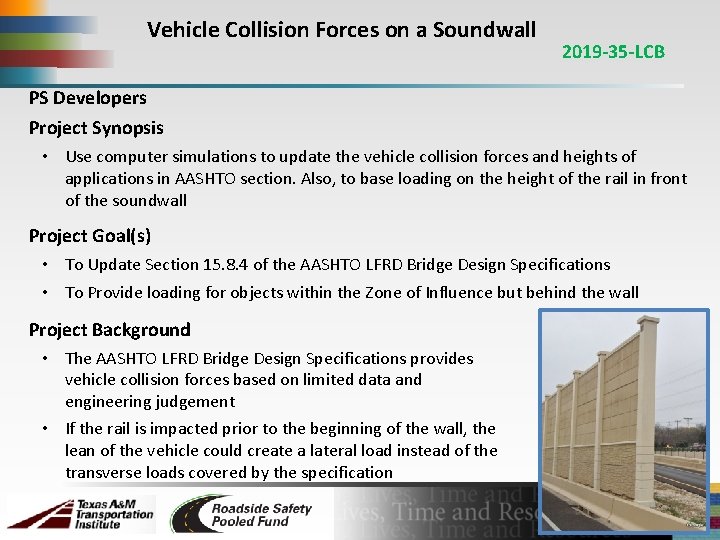
Vehicle Collision Forces on a Soundwall 2019 -35 -LCB PS Developers Project Synopsis • Use computer simulations to update the vehicle collision forces and heights of applications in AASHTO section. Also, to base loading on the height of the rail in front of the soundwall Project Goal(s) • To Update Section 15. 8. 4 of the AASHTO LFRD Bridge Design Specifications • To Provide loading for objects within the Zone of Influence but behind the wall Project Background • The AASHTO LFRD Bridge Design Specifications provides vehicle collision forces based on limited data and engineering judgement • If the rail is impacted prior to the beginning of the wall, the lean of the vehicle could create a lateral load instead of the transverse loads covered by the specification
Vehicle Collision Forces on a Soundwall 2019 -35 -LCB Proposed Work Plan • Simulate updated TL-5 and TL-4 vehicle models into tested systems with a relatively tall barrier to build a confidence level (validation) of simulation model for heavy vehicles into soundwalls • Conduct literature review to define the state of practice for common soundwall configurations and installations details • Define critical configurations for evaluation • Conduct impact simulations of the selected configuration to determine the impact force • Process the impact force profile into a design table format Deliverables • A report describing the process and the results of the project • A table describe loading profile for both vertical and longitudinal directions and the selected critical impact conditions • Equivalent static force of these profiles
Vehicle Collision Forces on a Soundwall 2019 -35 -LCB Urgency and Expected Benefit • Expansion of highways and high speed roadways into more residential areas leads to more soundwall applications • Soundwalls exposed to vehicle impact loads that they cannot withstand. • Safety and labiality risk by having the soundwalls next to the driving public and the residential population • Benefit to user agencies to identify design load to ensure the integrity of the soundwalls Funding $89, 559 estimated Research Period Expected to span over 12 months