
MAS Lesson 3 Military Aircraft Systems Airtosurface Ordnance





- Slides: 34
MAS Lesson 3 Military Aircraft Systems Air-to-surface Ordnance Slide 1
Objectives • LO 1 P 1 - Identify types of air-launched weapons used by military aircraft • LO 2 P 3 - Describe capability and limitations of air-toground missiles Slide 2
Objectives Explain: • The history of air-to-surface and surface-to-surface missiles • The main roles for air-to-surface missiles • Explain the type of damage required to disable target types • Details of the main missiles launched from aircraft in British service Slide 3
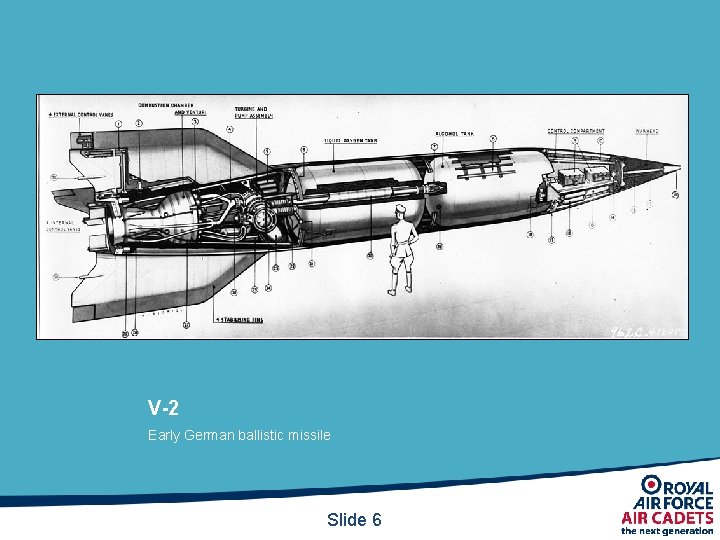
History • World War II - V 1 and V 2 developed as ‘stand-off’ weapons. Inertially guided, V 1 was a cruise missile and V 2 a ballistic missile Slide 4
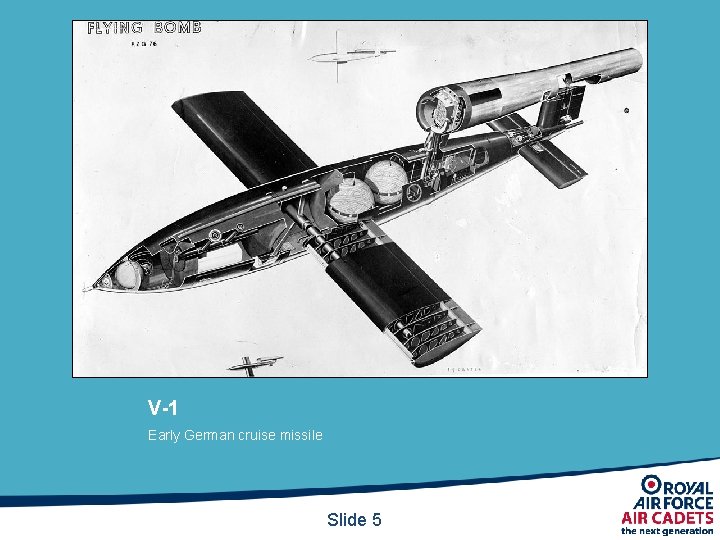
V-1 Early German cruise missile Slide 5
V-2 Early German ballistic missile Slide 6
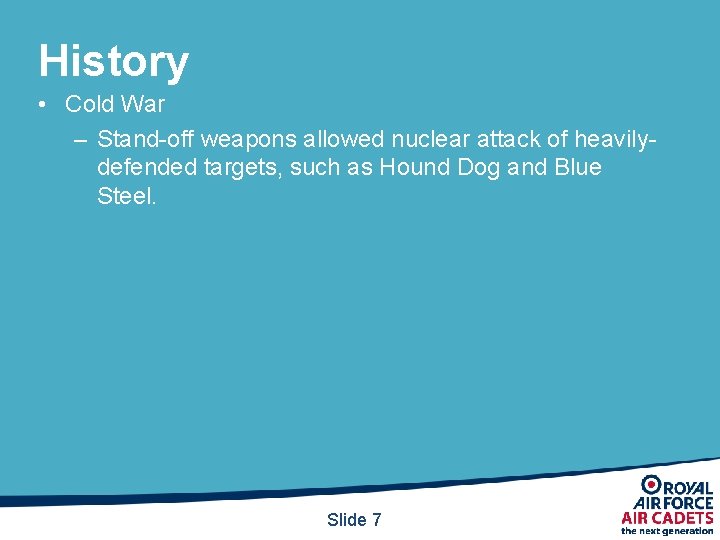
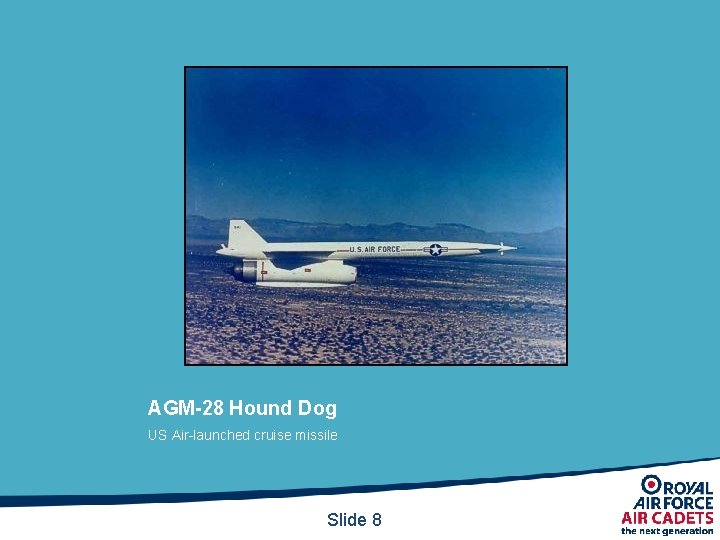
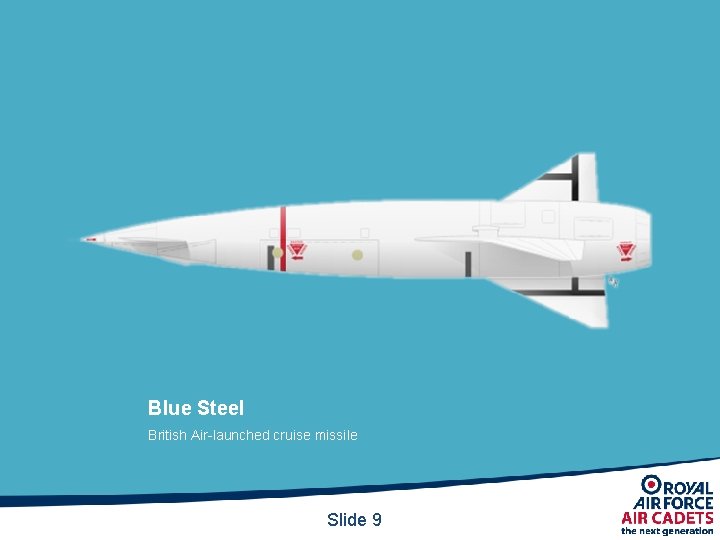
History • Cold War – Stand-off weapons allowed nuclear attack of heavilydefended targets, such as Hound Dog and Blue Steel. Slide 7
AGM-28 Hound Dog US Air-launched cruise missile Slide 8
Blue Steel British Air-launched cruise missile Slide 9
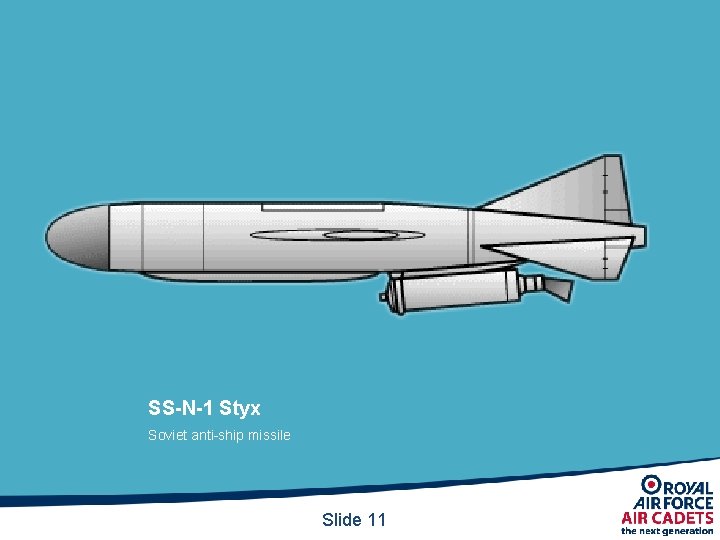
History • Cold War – Stand-off weapons allowed nuclear attack of heavilydefended targets, such as Hound Dog and Blue Steel. – Anti-ship weapons were developed by the USSR to counter NATO’s superiority at sea, such as the Styx. Soon, weapons were small enough for air launch, such as the Exocet. Slide 10
SS-N-1 Styx Soviet anti-ship missile Slide 11
History • Gulf War – Guided weapons now commonplace – 10% of all airsurface weapons launched were guided – In 2003 invasion, 90% of air-surface weapons launched were guided Slide 12
Roles • • • Strategic strike Suppression of enemy air defence (SEAD) Anti-tank Anti-shipping Close air support (CAS) Slide 13
Damage Levels • Strategic strike – Large targets – Long term effect – Large warhead required Slide 14
Damage Levels • Suppression of enemy air defence (SEAD) – Delicate targets – Short term effect – Speed and accuracy more important than destructive effect Slide 15
Damage Levels • Anti-tank – Categorised as M-Kill or K-Kill • Mobility-Kill – tank unable to move • Complete destruction – A relatively small amount of explosive is required to achieve M-Kill or K-Kill – Friendly troops or neutral personnel may be in the vicinity – Accuracy is favoured over warhead size Slide 16
Damage Levels • Anti-shipping – Ships can be damaged or sunk – Larger ships may require multiple hits to sink – Ships defences may need to be penetrated, by: • Speed • Stealth • Low-altitude • A combination of the above Slide 17
Damage Levels • Anti-shipping – Ships can be damaged or sunk – Larger ships may require multiple hits to sink – Ships defences may need to be penetrated – Defences include: • Surface-to-air missiles (SAM) – these may target either the missiles or the launch aircraft • Close-in weapons systems (CIWS) – point defence systems based on guns or short-range missiles • Decoys and electronic counter-measures (ECM) Slide 18
Weapons Slide 19
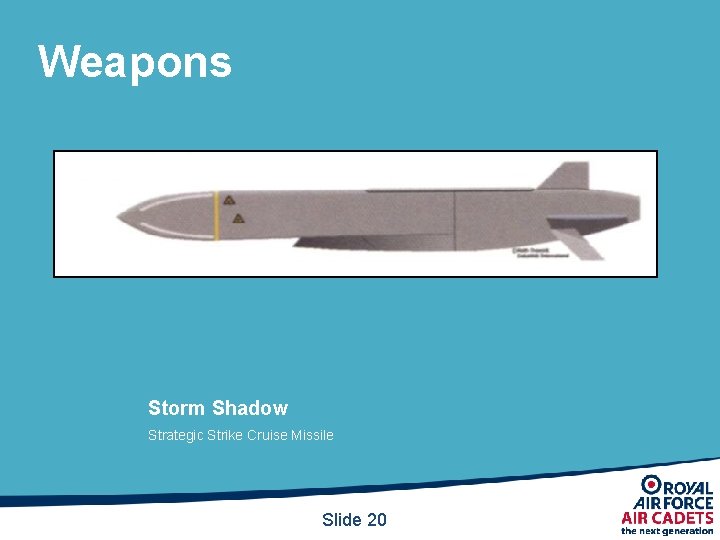
Weapons Storm Shadow Strategic Strike Cruise Missile Slide 20
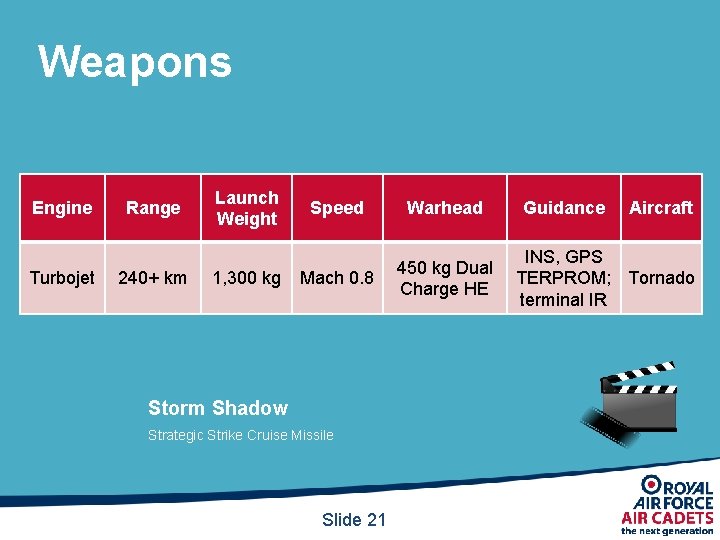
Weapons Engine Turbojet Range 240+ km Launch Weight 1, 300 kg Speed Warhead Mach 0. 8 450 kg Dual Charge HE Storm Shadow Strategic Strike Cruise Missile Slide 21 Guidance Aircraft INS, GPS TERPROM; Tornado terminal IR
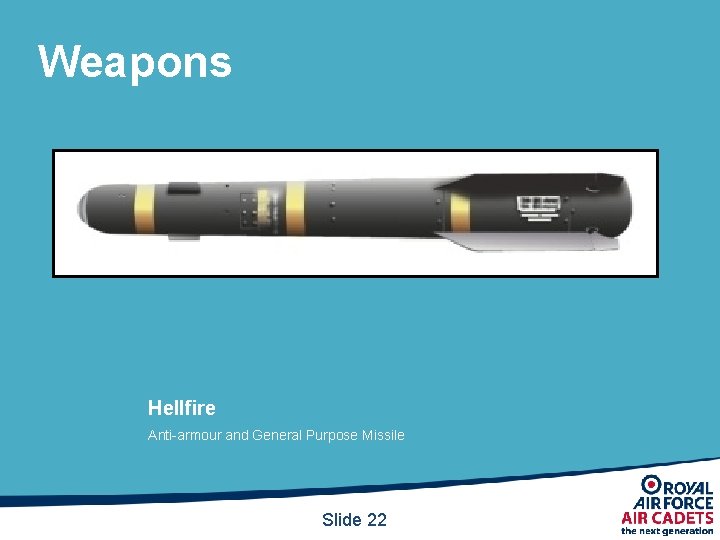
Weapons Hellfire Anti-armour and General Purpose Missile Slide 22
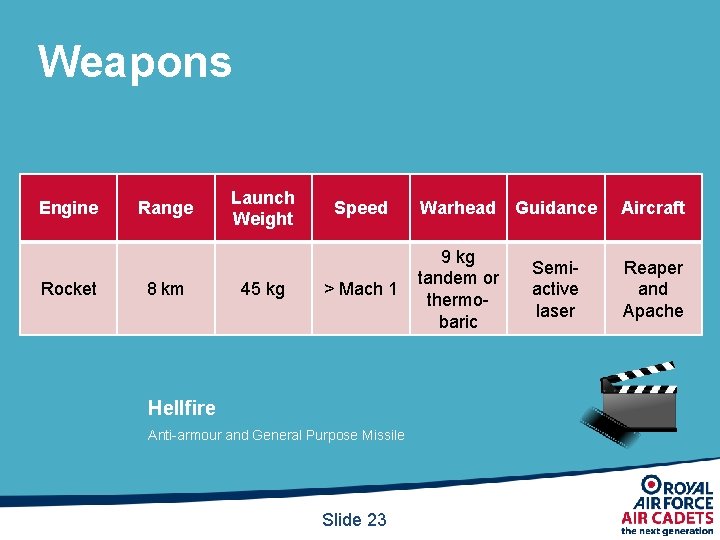
Weapons Engine Rocket Range 8 km Launch Weight 45 kg Speed Warhead Guidance Aircraft > Mach 1 9 kg tandem or thermobaric Semiactive laser Reaper and Apache Hellfire Anti-armour and General Purpose Missile Slide 23
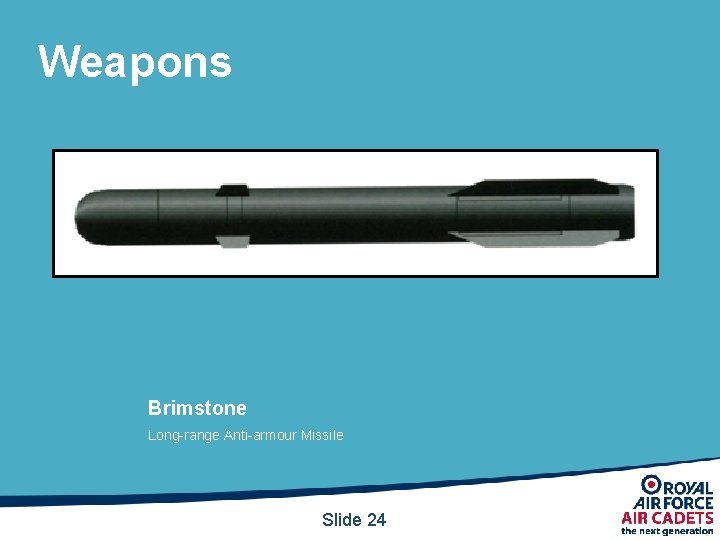
Weapons Brimstone Long-range Anti-armour Missile Slide 24
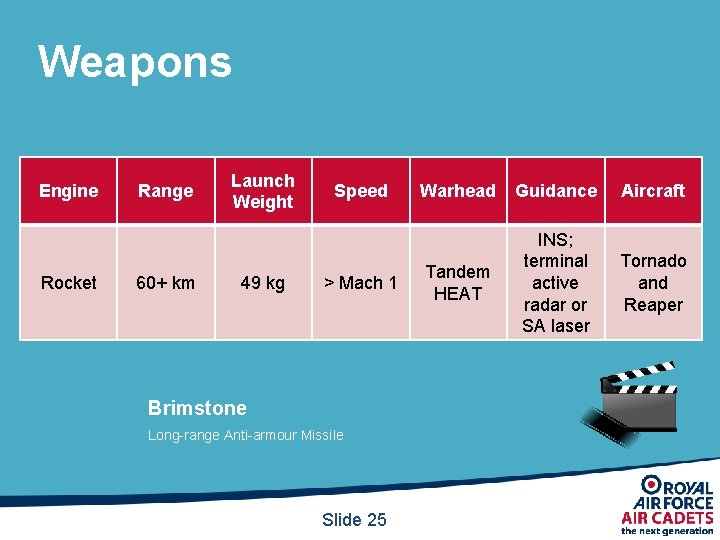
Weapons Engine Rocket Range 60+ km Launch Weight 49 kg Speed > Mach 1 Brimstone Long-range Anti-armour Missile Slide 25 Warhead Guidance Aircraft Tandem HEAT INS; terminal active radar or SA laser Tornado and Reaper
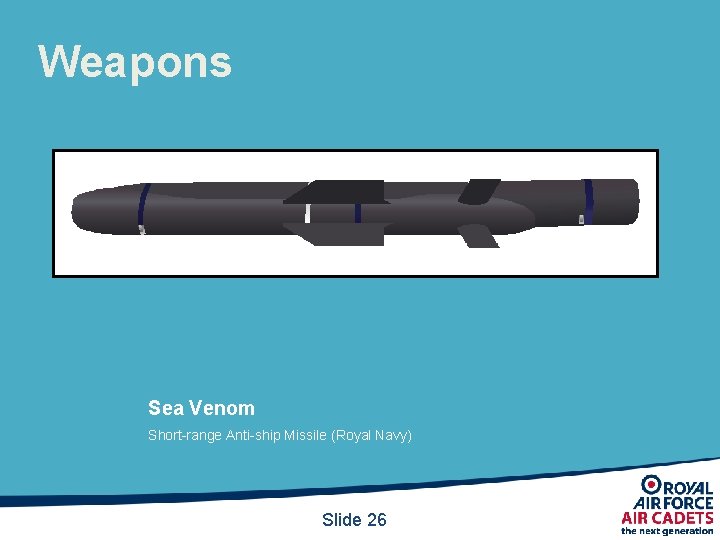
Weapons Sea Venom Short-range Anti-ship Missile (Royal Navy) Slide 26
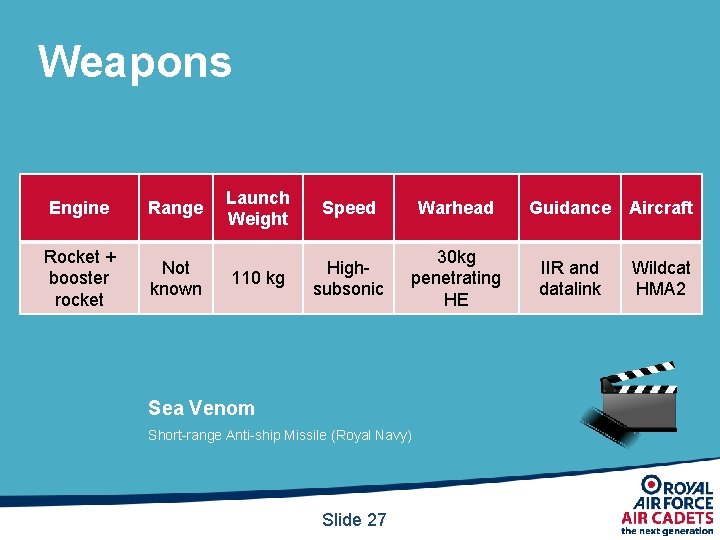
Weapons Engine Range Rocket + booster rocket Not known Launch Weight Speed Warhead Guidance Aircraft 110 kg Highsubsonic 30 kg penetrating HE IIR and datalink Wildcat HMA 2 Sea Venom Short-range Anti-ship Missile (Royal Navy) Slide 27
Weapons Missile Canister Martlet Short-range Anti-ship Missile (Royal Navy) Slide 28
Weapons Engine Range Launch Weight Speed Warhead Guidance Aircraft 2 -stage rocket 8 km 13 kg Mach 1. 5 3 kg dualeffect Laser SACLOS Wildcat HMA 2 Martlet Short-range Anti-ship Missile (Royal Navy) Slide 29
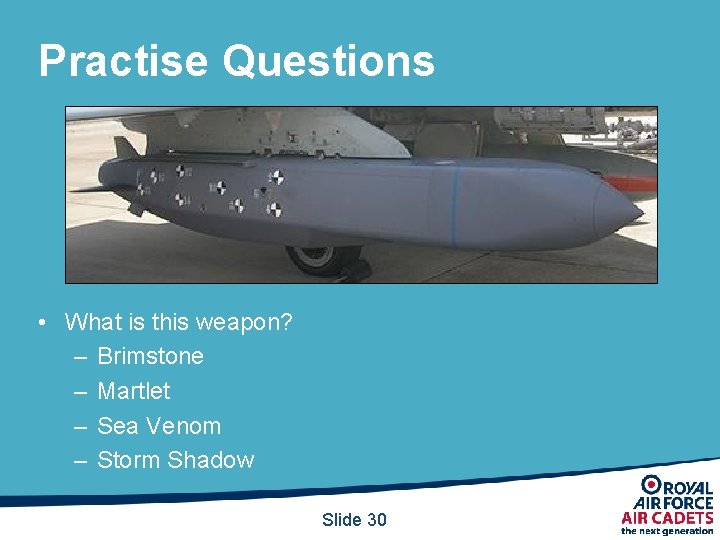
Practise Questions • What is this weapon? – Brimstone – Martlet – Sea Venom – Storm Shadow Slide 30
Practise Questions • How large is the warhead of a Sea Venom missile? – 3 kg – 300 kg – 3, 000 kg Slide 31
Practise Questions • What is the range of a Martlet missile? – 0. 8 km – 80 km – 800 km Slide 32
Practise Questions • Which weapon would not be suitable for attacking an armoured fighting vehicle? – Hellfire – Sea Venom – Brimstone – Martlet Slide 33
Objectives Explain: • The history of air-to-surface and surface-to-surface missiles • The main roles for air-to-surface missiles • Explain the type of damage required to disable target types • Details of the main missiles launched from aircraft in British service Slide 34