
MAS Lesson 1 Military Aircraft Systems Weapon Types



- Slides: 39
MAS Lesson 1 Military Aircraft Systems Weapon Types and Definitions Slide 1
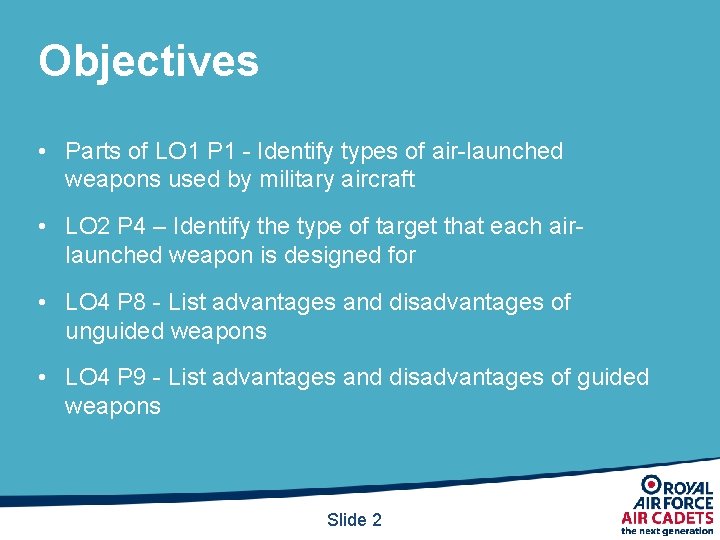
Objectives • Parts of LO 1 P 1 - Identify types of air-launched weapons used by military aircraft • LO 2 P 4 – Identify the type of target that each airlaunched weapon is designed for • LO 4 P 8 - List advantages and disadvantages of unguided weapons • LO 4 P 9 - List advantages and disadvantages of guided weapons Slide 2
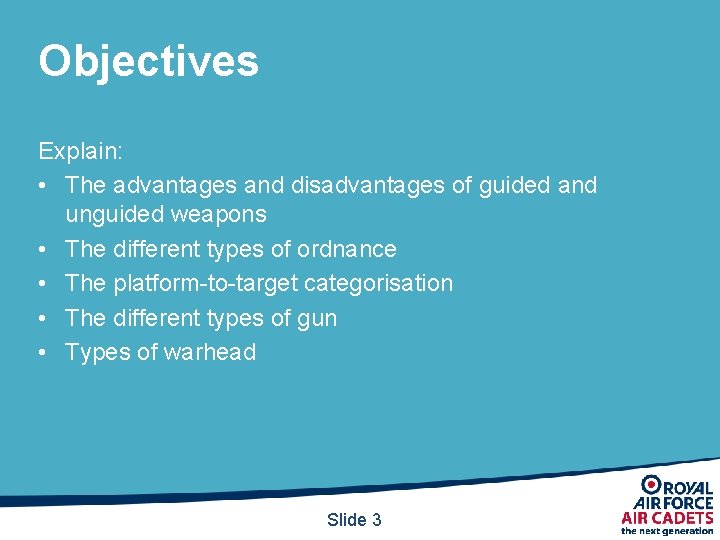
Objectives Explain: • The advantages and disadvantages of guided and unguided weapons • The different types of ordnance • The platform-to-target categorisation • The different types of gun • Types of warhead Slide 3
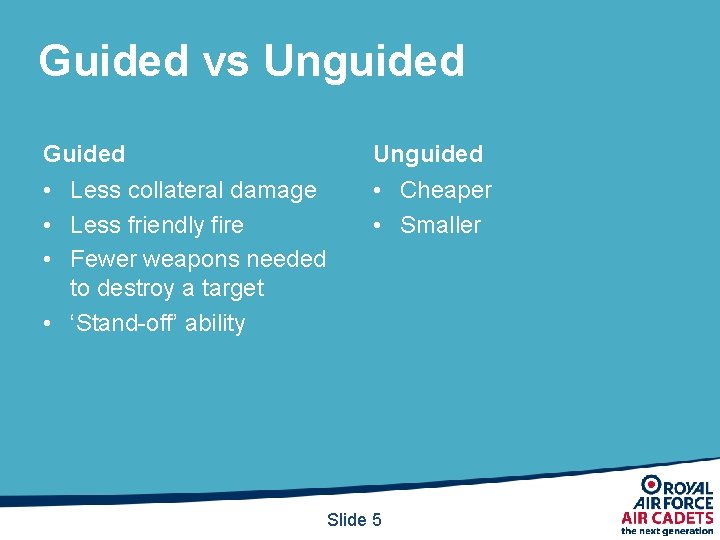
Guided vs Unguided • In a guided weapon, the path can be changed after launch • What do you think the advantages and disadvantages of fitting guidance systems to weapons are? Slide 4
Guided vs Unguided Guided • Less collateral damage • Less friendly fire • Fewer weapons needed to destroy a target • ‘Stand-off’ ability Unguided • Cheaper • Smaller Slide 5
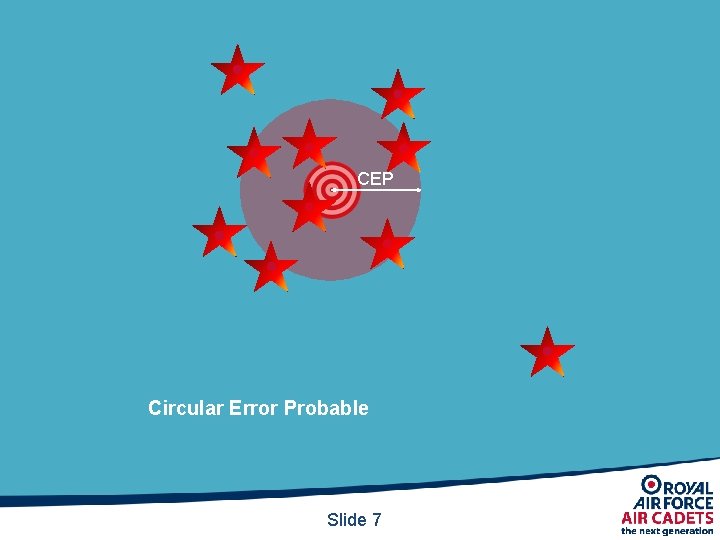
Accuracy - CEP • Circular area probable (CEP) is the distance at which the weapon will hit 50% of the time Slide 6
CEP Circular Error Probable Slide 7
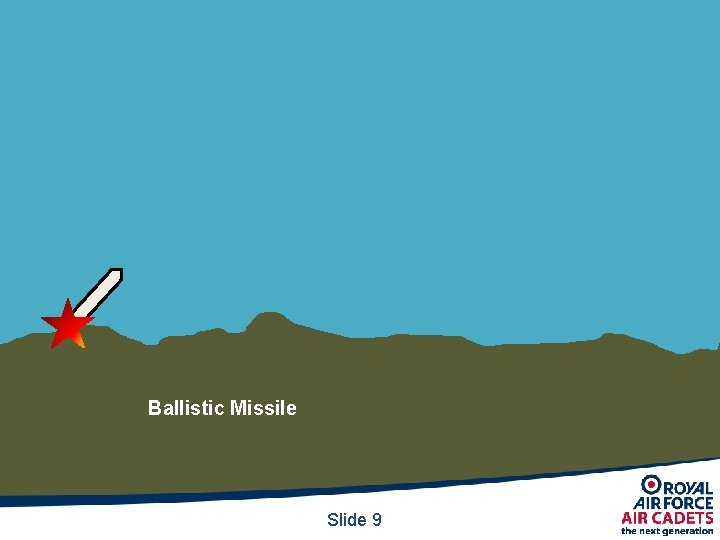
Terminology • Missile – powered, guided – Ballistic missile – arcs through the air Slide 8
Ballistic Missile Slide 9
Terminology • Missile – powered, guided – Ballistic missile – arcs through the air – Cruise missile – flies Slide 10
Cruise Missile Slide 11
Terminology • Missile – powered, guided – Ballistic missile – arcs through the air – Cruise missile – flies • Rocket – powered, unguided • Bomb – unpowered, guided or unguided • Torpedo – powered through water • Mine – lays in wait • Depth charge – underwater bomb used against submarines Slide 12
Platform to target Platform and target are categorised as: • Air • Surface • Sub-surface Slide 13
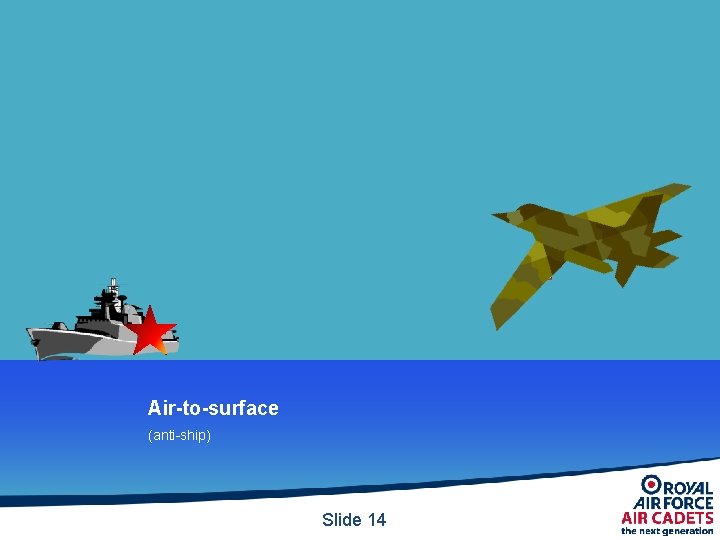
Air-to-surface (anti-ship) Slide 14
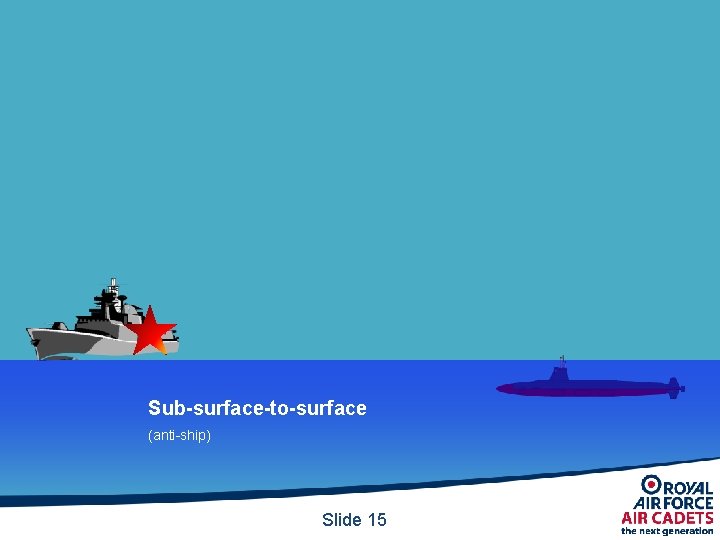
Sub-surface-to-surface (anti-ship) Slide 15
Gun Classification • A gun is a direct fire support weapon Slide 16
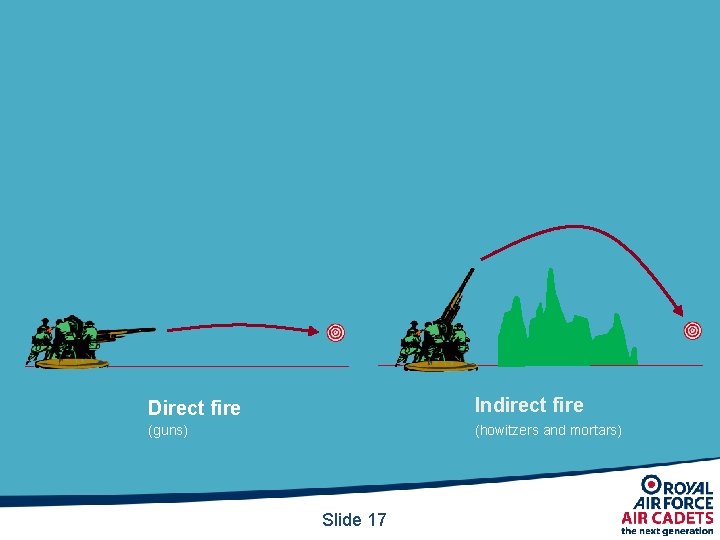
Direct fire Indirect fire (guns) (howitzers and mortars) Slide 17
Gun Classification • A gun is a direct fire support weapon • A shell is a projectile big enough to carry explosives • A bullet is a projectile which is not Slide 18
Gun Sub-classifications • A cannon is a gun that fires shells • An autocannon is an automatically loaded cannon • A machine-gun is an automatically loaded gun firing bullets Slide 19
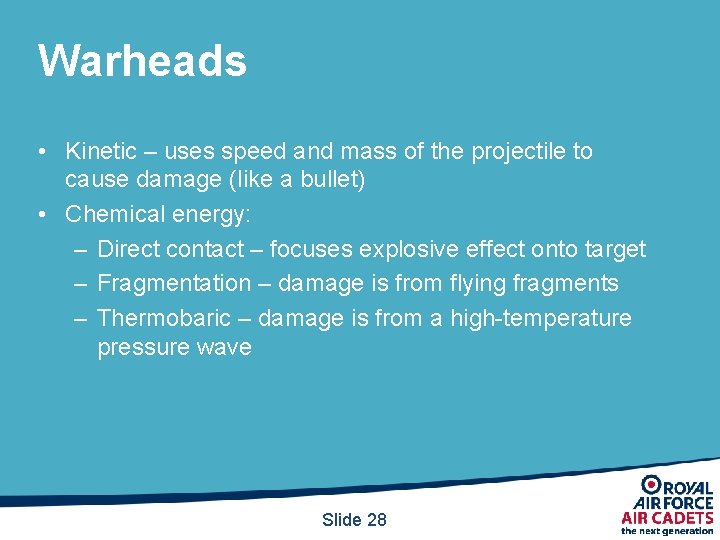
Warheads • Kinetic – uses speed and mass of the projectile to cause damage (like a bullet) Slide 20
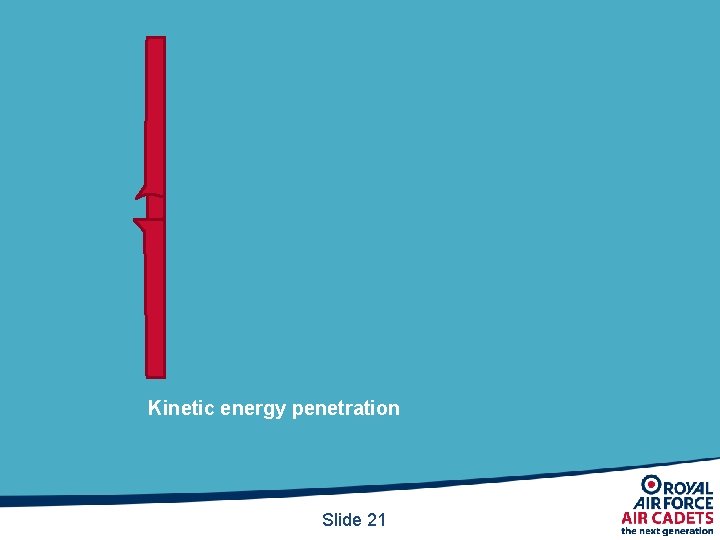
Kinetic energy penetration Slide 21
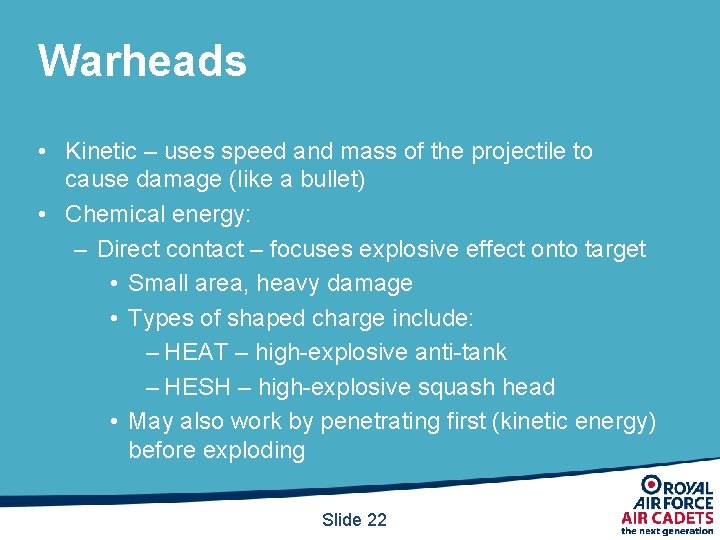
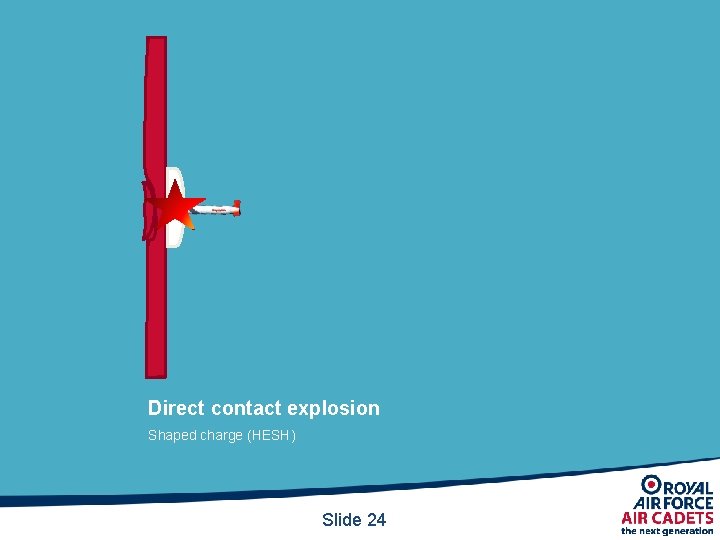
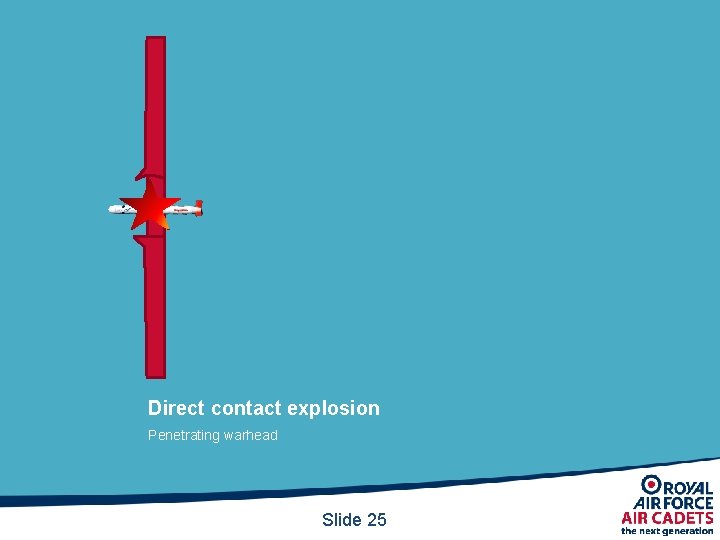
Warheads • Kinetic – uses speed and mass of the projectile to cause damage (like a bullet) • Chemical energy: – Direct contact – focuses explosive effect onto target • Small area, heavy damage • Types of shaped charge include: – HEAT – high-explosive anti-tank – HESH – high-explosive squash head • May also work by penetrating first (kinetic energy) before exploding Slide 22
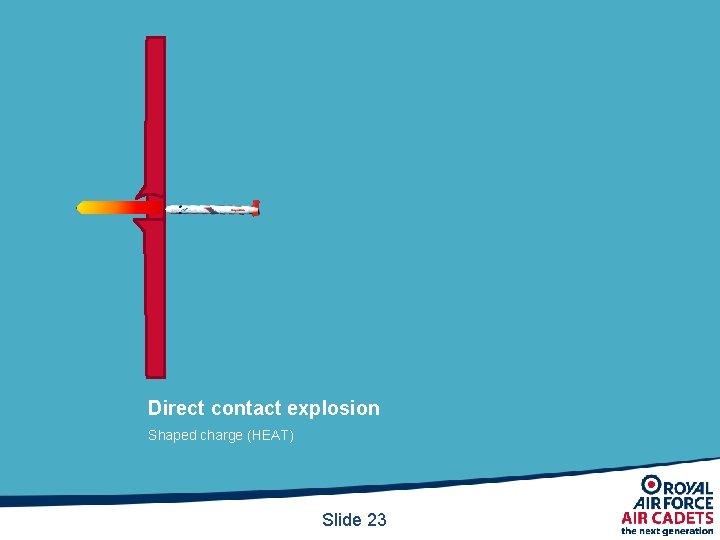
Direct contact explosion Shaped charge (HEAT) Slide 23
Direct contact explosion Shaped charge (HESH) Slide 24
Direct contact explosion Penetrating warhead Slide 25
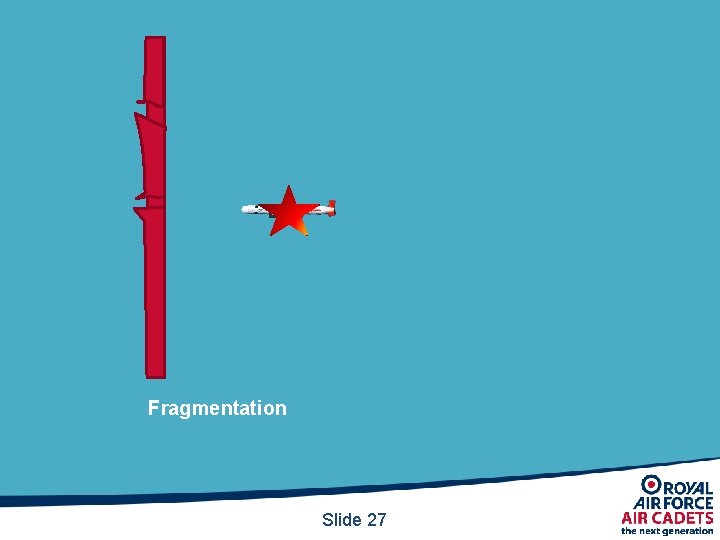
Warheads • Kinetic – uses speed and mass of the projectile to cause damage (like a bullet) • Chemical energy: – Direct contact – focuses explosive effect onto target Fragmentation – damage is from flying fragments – large area, less damage Slide 26
Fragmentation Slide 27
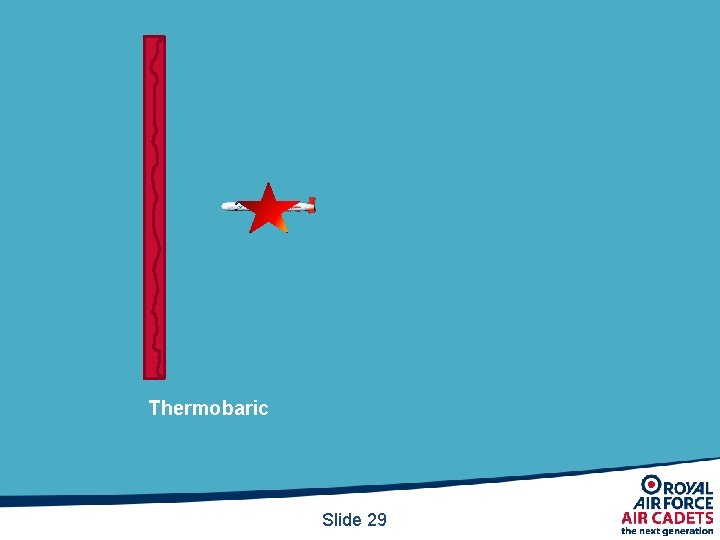
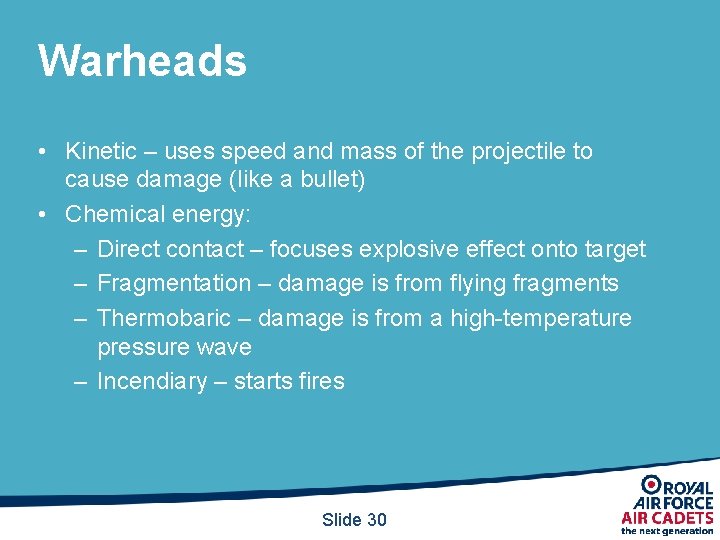
Warheads • Kinetic – uses speed and mass of the projectile to cause damage (like a bullet) • Chemical energy: – Direct contact – focuses explosive effect onto target – Fragmentation – damage is from flying fragments – Thermobaric – damage is from a high-temperature pressure wave Slide 28
Thermobaric Slide 29
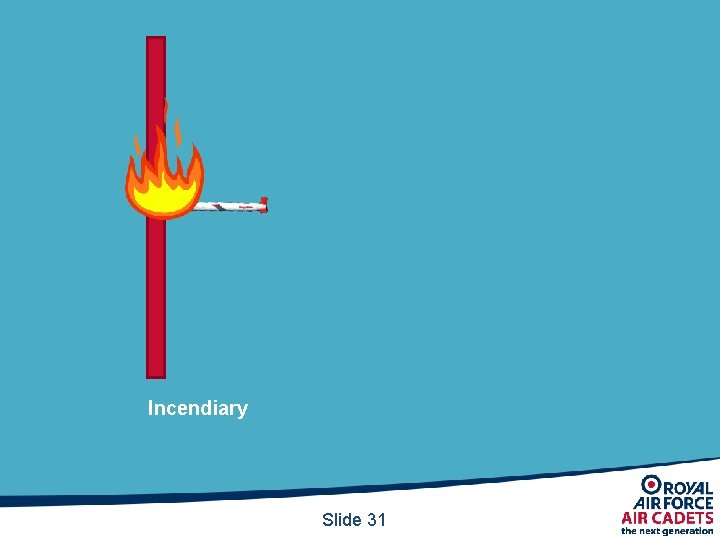
Warheads • Kinetic – uses speed and mass of the projectile to cause damage (like a bullet) • Chemical energy: – Direct contact – focuses explosive effect onto target – Fragmentation – damage is from flying fragments – Thermobaric – damage is from a high-temperature pressure wave – Incendiary – starts fires Slide 30
Incendiary Slide 31
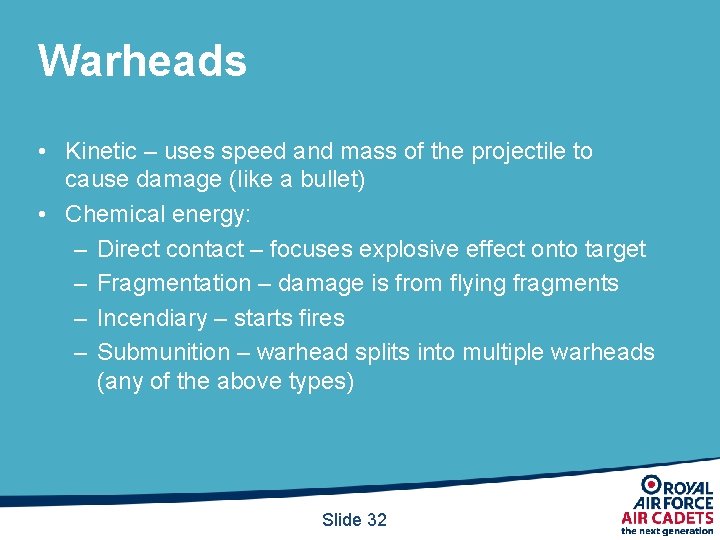
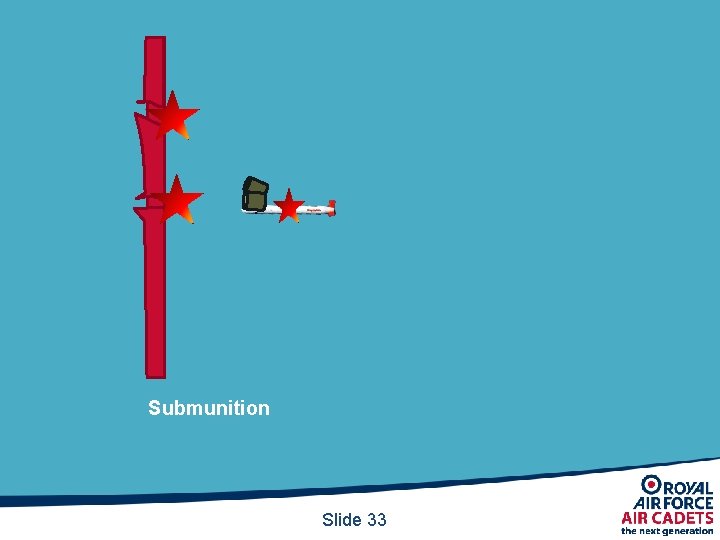
Warheads • Kinetic – uses speed and mass of the projectile to cause damage (like a bullet) • Chemical energy: – Direct contact – focuses explosive effect onto target – Fragmentation – damage is from flying fragments – Incendiary – starts fires – Submunition – warhead splits into multiple warheads (any of the above types) Slide 32
Submunition Slide 33
Practise Questions • Which of the following describes a weapon that is unguided and follows a ballistic arc? – Rocket – Ballistic missile – Cruise missile – Torpedo Slide 34
Practise Questions • Which of the following fires only solid projectiles? – Cannon – Auto-cannon – Machine gun – Mortar Slide 35
Practise Questions • Which of the following would not be found in the surface environment? – Armoured vehicles – Warships – Aircraft on the ground – Submerged submarines Slide 36
Practise Questions • Which of these warhead types would be un-suitable for attacking a heavily-protected target such as an armoured vehicle? – HEAT – Kinetic energy – Fragmentation – Shaped-charge submunition Slide 37
Practise Questions • Upon which attribute do un-guided weapons beat guided weapons? – Collateral damage – Cost – Friendly-fire – Range Slide 38
Objectives • Parts of LO 1 P 1 - Identify types of air-launched weapons used by military aircraft • LO 2 P 4 – Identify the type of target that each airlaunched weapon is designed for • LO 4 P 8 - List advantages and disadvantages of unguided weapons • LO 4 P 9 - List advantages and disadvantages of guided weapons Slide 39