
MARYLAND INFANTS TODDLERS PROGRAM CONSOLIDATED LOCAL IMPLEMENTATION GRANT
- Slides: 39
MARYLAND INFANTS & TODDLERS PROGRAM CONSOLIDATED LOCAL IMPLEMENTATION GRANT (CLIG) SFY 2019 Annual Grants Webinar Wednesday, March 13, 2018
APPLICATION SUBMISSION DUE DATE: MAY 11, 2018 All Required Documents Are Available for Download at: http: //marylandpublicschools. org/programs/Pages/Special. Education/rmmb/Grants/IT/index. aspx
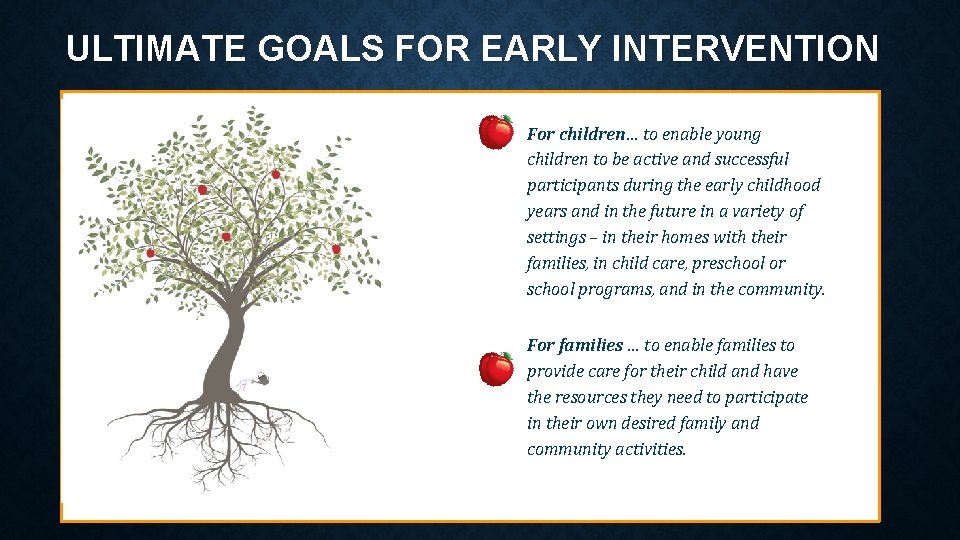
ULTIMATE GOALS FOR EARLY INTERVENTION For children… to enable young children to be active and successful participants during the early childhood years and in the future in a variety of settings – in their homes with their families, in child care, preschool or school programs, and in the community. For families … to enable families to provide care for their child and have the resources they need to participate in their own desired family and community activities.
CONSOLIDATED LOCAL IMPLEMENTATION GRANT (CLIG) The CLIG is designated as the primary grant mechanism through which local jurisdictions receive federal and State funds to implement local early intervention programs in compliance with federal and State regulations, policies, and procedures. As a result of participating in early intervention services, children show improved outcomes and programs achieve the ultimate goals for children and families.
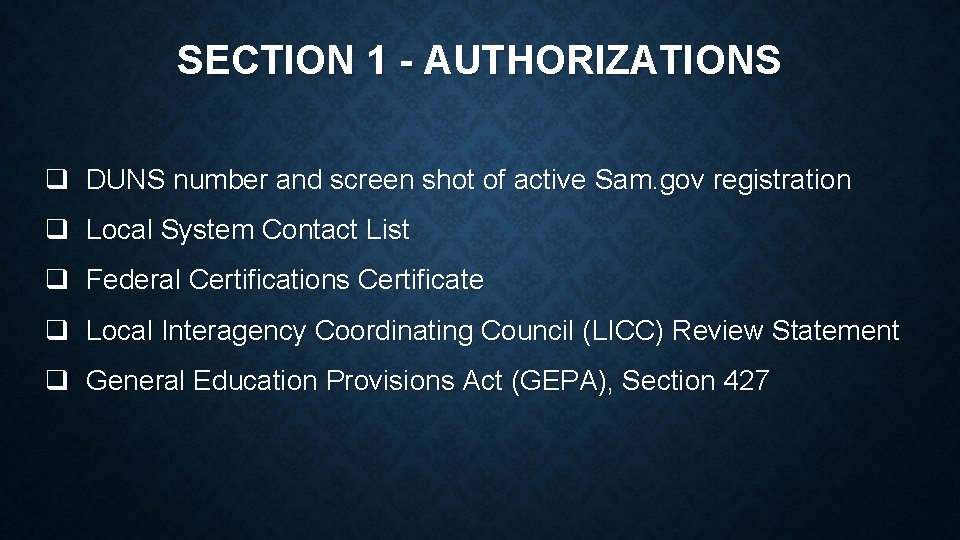
SECTION 1 - AUTHORIZATIONS q DUNS number and screen shot of active Sam. gov registration q Local System Contact List q Federal Certifications Certificate q Local Interagency Coordinating Council (LICC) Review Statement q General Education Provisions Act (GEPA), Section 427
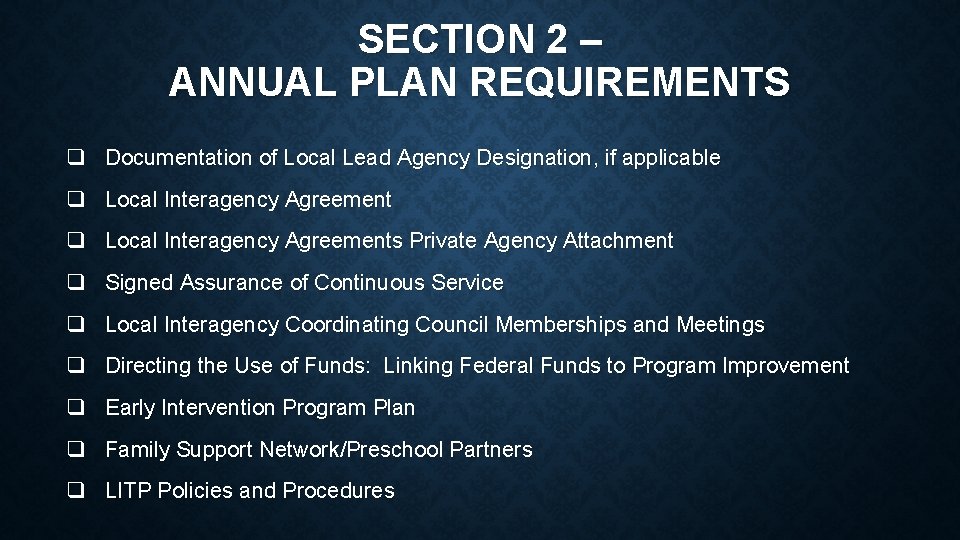
SECTION 2 – ANNUAL PLAN REQUIREMENTS q Documentation of Local Lead Agency Designation, if applicable q Local Interagency Agreements Private Agency Attachment q Signed Assurance of Continuous Service q Local Interagency Coordinating Council Memberships and Meetings q Directing the Use of Funds: Linking Federal Funds to Program Improvement q Early Intervention Program Plan q Family Support Network/Preschool Partners q LITP Policies and Procedures
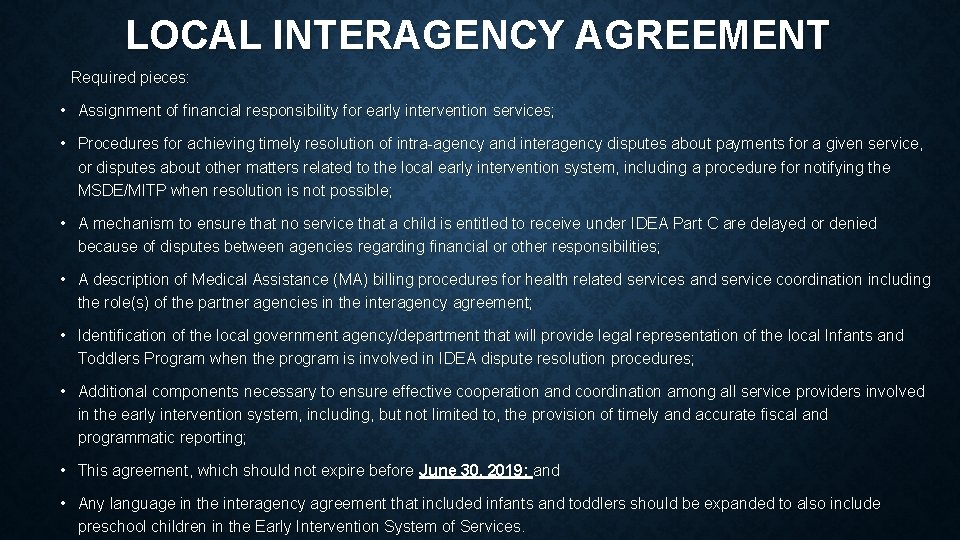
LOCAL INTERAGENCY AGREEMENT Required pieces: • Assignment of financial responsibility for early intervention services; • Procedures for achieving timely resolution of intra-agency and interagency disputes about payments for a given service, or disputes about other matters related to the local early intervention system, including a procedure for notifying the MSDE/MITP when resolution is not possible; • A mechanism to ensure that no service that a child is entitled to receive under IDEA Part C are delayed or denied because of disputes between agencies regarding financial or other responsibilities; • A description of Medical Assistance (MA) billing procedures for health related services and service coordination including the role(s) of the partner agencies in the interagency agreement; • Identification of the local government agency/department that will provide legal representation of the local Infants and Toddlers Program when the program is involved in IDEA dispute resolution procedures; • Additional components necessary to ensure effective cooperation and coordination among all service providers involved in the early intervention system, including, but not limited to, the provision of timely and accurate fiscal and programmatic reporting; • This agreement, which should not expire before June 30, 2019; and • Any language in the interagency agreement that included infants and toddlers should be expanded to also include preschool children in the Early Intervention System of Services.
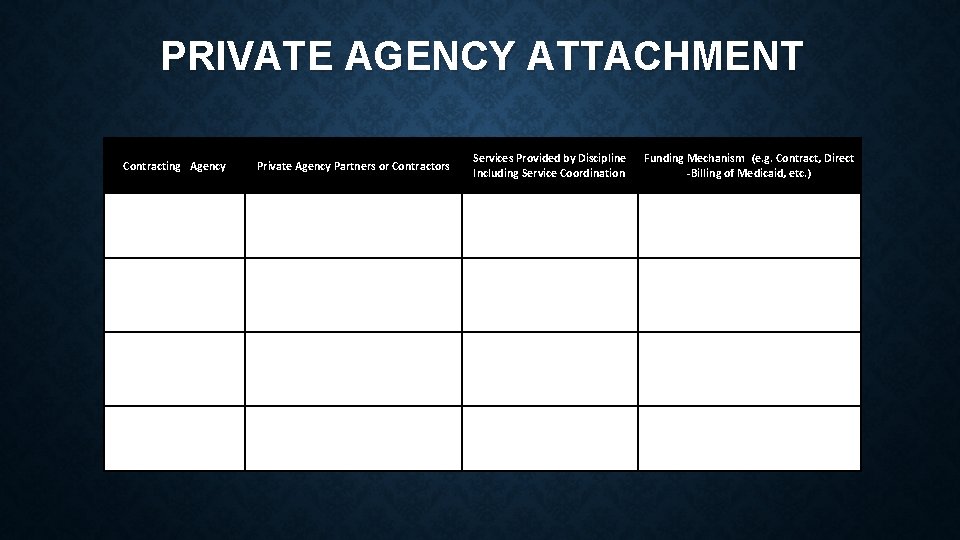
PRIVATE AGENCY ATTACHMENT Contracting Agency Private Agency Partners or Contractors Services Provided by Discipline Including Service Coordination Funding Mechanism (e. g. Contract, Direct -Billing of Medicaid, etc. )
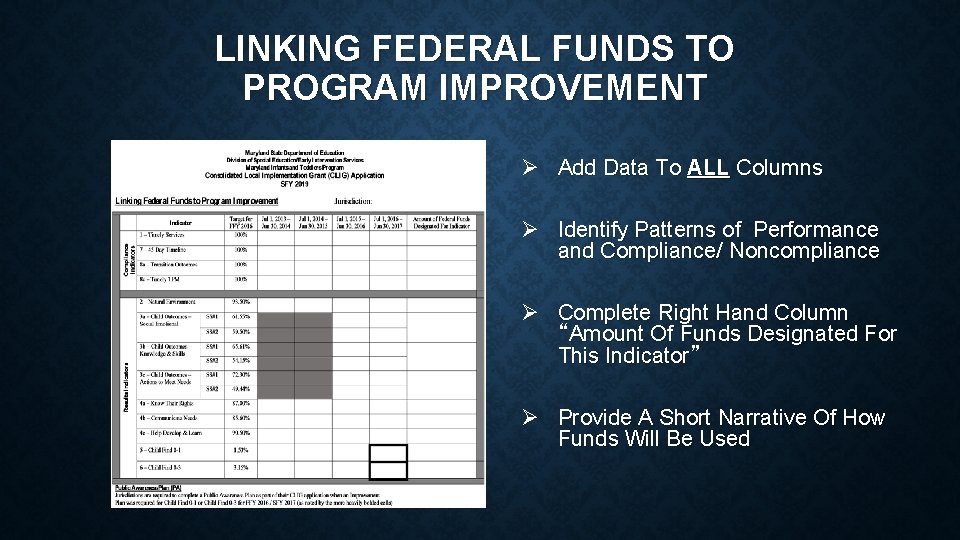
LINKING FEDERAL FUNDS TO PROGRAM IMPROVEMENT Ø Add Data To ALL Columns Ø Identify Patterns of Performance and Compliance/ Noncompliance Ø Complete Right Hand Column “Amount Of Funds Designated For This Indicator” Ø Provide A Short Narrative Of How Funds Will Be Used
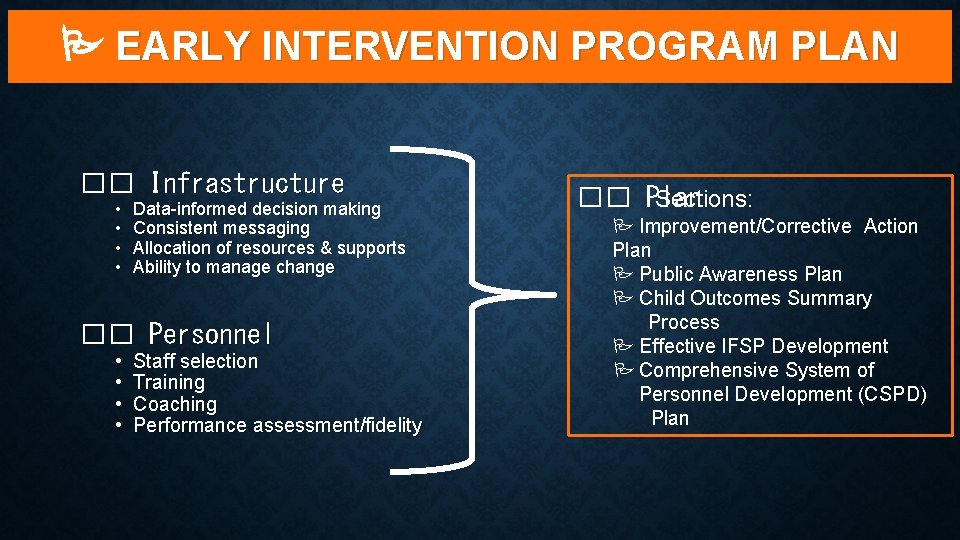
EARLY INTERVENTION PROGRAM PLAN �� Infrastructure • • Data-informed decision making Consistent messaging Allocation of resources & supports Ability to manage change �� Personnel • • Staff selection Training Coaching Performance assessment/fidelity �� Plan Sections: Improvement/Corrective Action Plan Public Awareness Plan Child Outcomes Summary Process Effective IFSP Development Comprehensive System of Personnel Development (CSPD) Plan
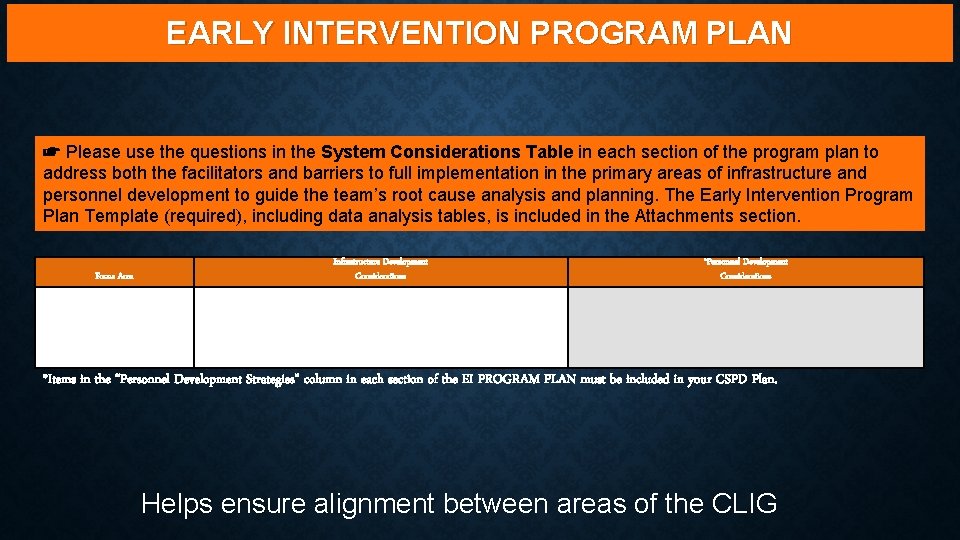
EARLY INTERVENTION PROGRAM PLAN ☛ Please use the questions in the System Considerations Table in each section of the program plan to address both the facilitators and barriers to full implementation in the primary areas of infrastructure and personnel development to guide the team’s root cause analysis and planning. The Early Intervention Program Plan Template (required), including data analysis tables, is included in the Attachments section. Focus Area Infrastructure Development Considerations *Personnel Development Considerations *Items in the “Personnel Development Strategies” column in each section of the EI PROGRAM PLAN must be included in your CSPD Plan. Helps ensure alignment between areas of the CLIG
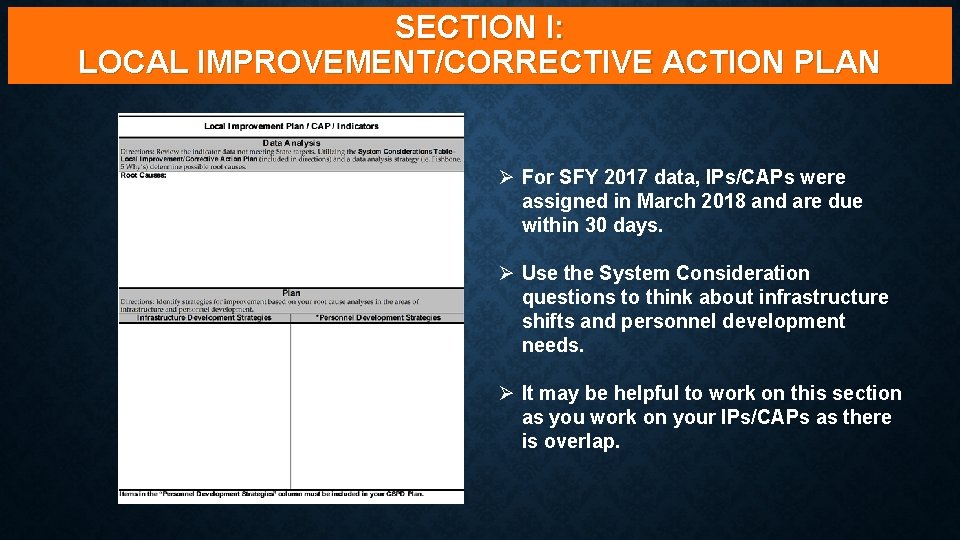
SECTION I: LOCAL IMPROVEMENT/CORRECTIVE ACTION PLAN Ø For SFY 2017 data, IPs/CAPs were assigned in March 2018 and are due within 30 days. Ø Use the System Consideration questions to think about infrastructure shifts and personnel development needs. Ø It may be helpful to work on this section as you work on your IPs/CAPs as there is overlap.
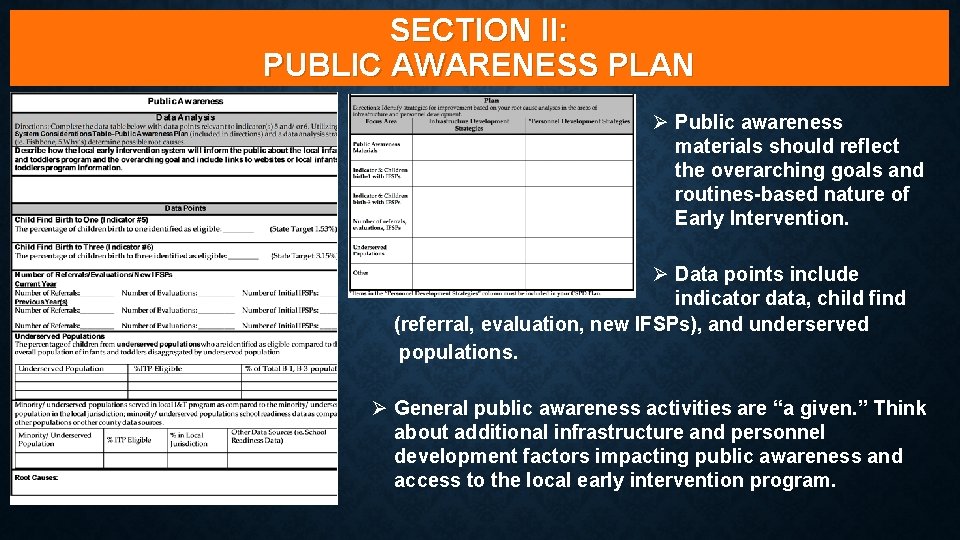
SECTION II: PUBLIC AWARENESS PLAN Ø Public awareness materials should reflect the overarching goals and routines-based nature of Early Intervention. Ø Data points include indicator data, child find (referral, evaluation, new IFSPs), and underserved populations. Ø General public awareness activities are “a given. ” Think about additional infrastructure and personnel development factors impacting public awareness and access to the local early intervention program.
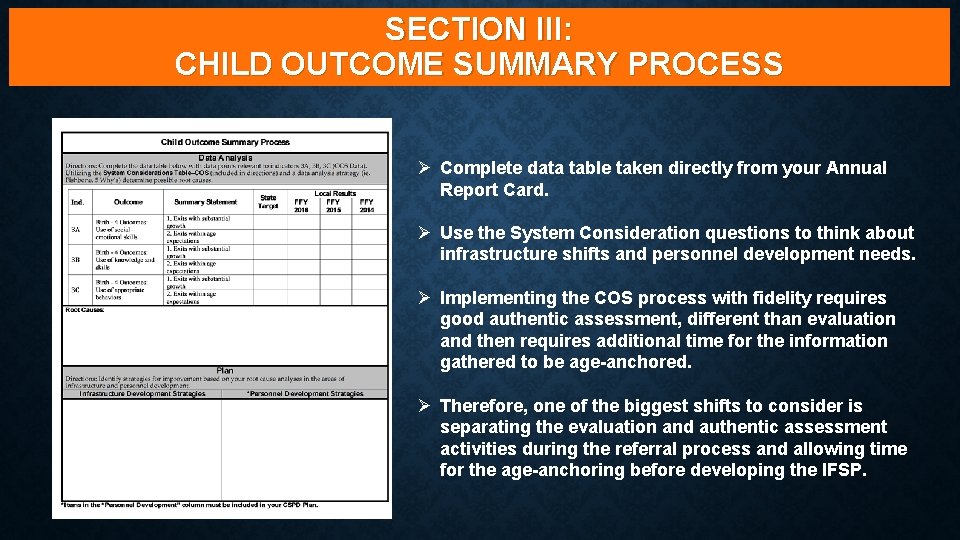
SECTION III: CHILD OUTCOME SUMMARY PROCESS Ø Complete data table taken directly from your Annual Report Card. Ø Use the System Consideration questions to think about infrastructure shifts and personnel development needs. Ø Implementing the COS process with fidelity requires good authentic assessment, different than evaluation and then requires additional time for the information gathered to be age-anchored. Ø Therefore, one of the biggest shifts to consider is separating the evaluation and authentic assessment activities during the referral process and allowing time for the age-anchoring before developing the IFSP.
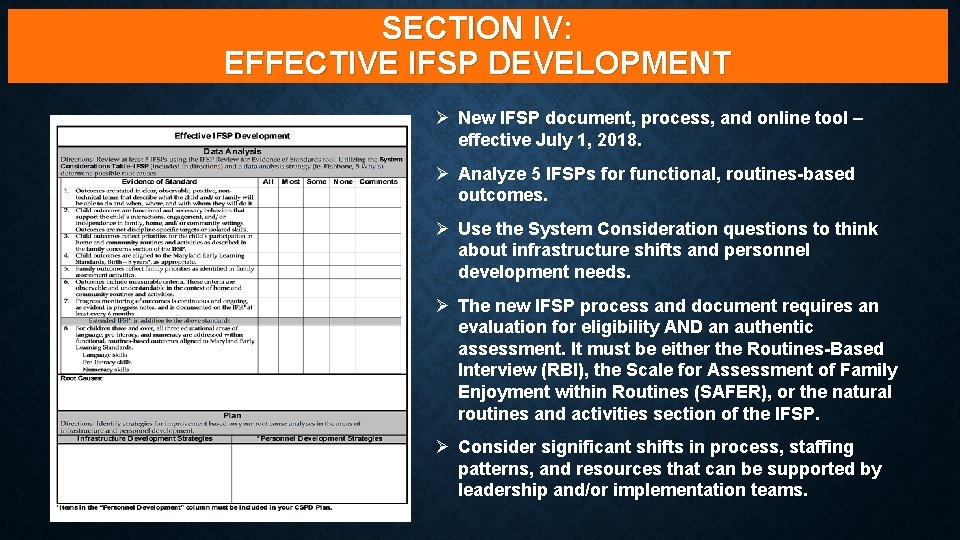
SECTION IV: EFFECTIVE IFSP DEVELOPMENT Ø New IFSP document, process, and online tool – effective July 1, 2018. Ø Analyze 5 IFSPs for functional, routines-based outcomes. Ø Use the System Consideration questions to think about infrastructure shifts and personnel development needs. Ø The new IFSP process and document requires an evaluation for eligibility AND an authentic assessment. It must be either the Routines-Based Interview (RBI), the Scale for Assessment of Family Enjoyment within Routines (SAFER), or the natural routines and activities section of the IFSP. Ø Consider significant shifts in process, staffing patterns, and resources that can be supported by leadership and/or implementation teams.
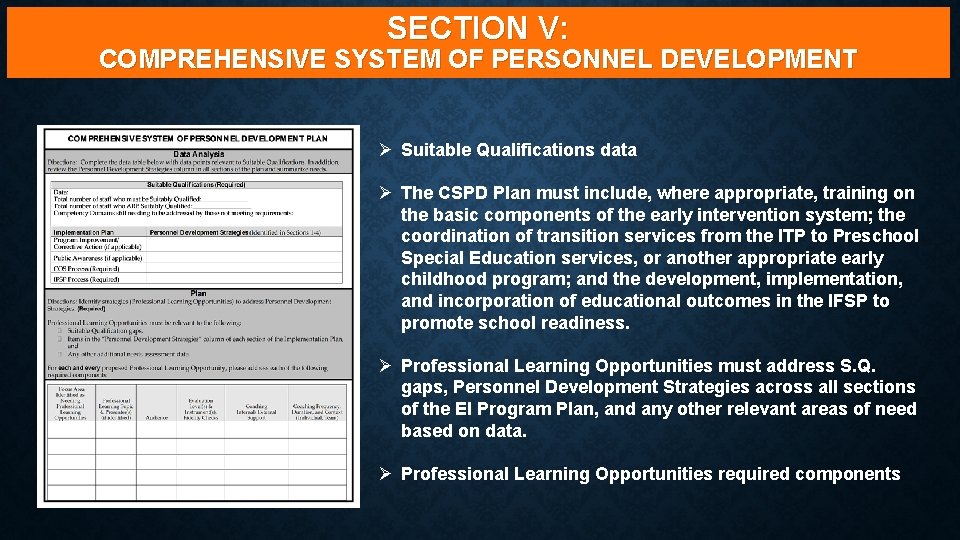
SECTION V: COMPREHENSIVE SYSTEM OF PERSONNEL DEVELOPMENT Ø Suitable Qualifications data Ø The CSPD Plan must include, where appropriate, training on the basic components of the early intervention system; the coordination of transition services from the ITP to Preschool Special Education services, or another appropriate early childhood program; and the development, implementation, and incorporation of educational outcomes in the IFSP to promote school readiness. Ø Professional Learning Opportunities must address S. Q. gaps, Personnel Development Strategies across all sections of the EI Program Plan, and any other relevant areas of need based on data. Ø Professional Learning Opportunities required components
SFY 2019 CLIG Family Support Network/Preschool Partners Grant Requirements Ø Describe how Family Support Network and Preschool Partners operates in your local program, including activities. Ø Provide specific strategies to improve response rate and representativeness of the Family Survey.
POLICES AND PROCEDURES Ø The MITP requires that a current version of your Policies and Procedures is on file. Ø If you have made changes since your original submission, please submit and updated version with your CLIG Submission.
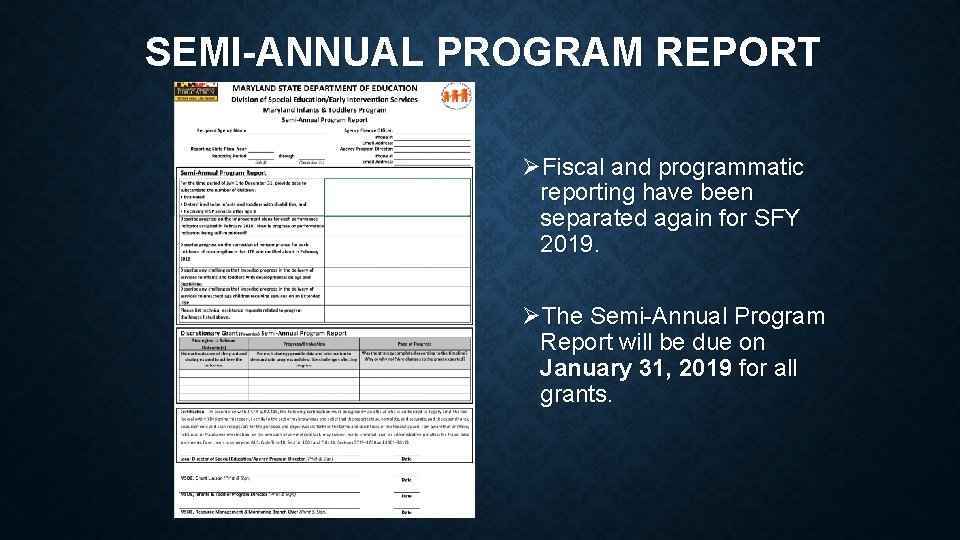
SEMI-ANNUAL PROGRAM REPORT ØFiscal and programmatic reporting have been separated again for SFY 2019. ØThe Semi-Annual Program Report will be due on January 31, 2019 for all grants.
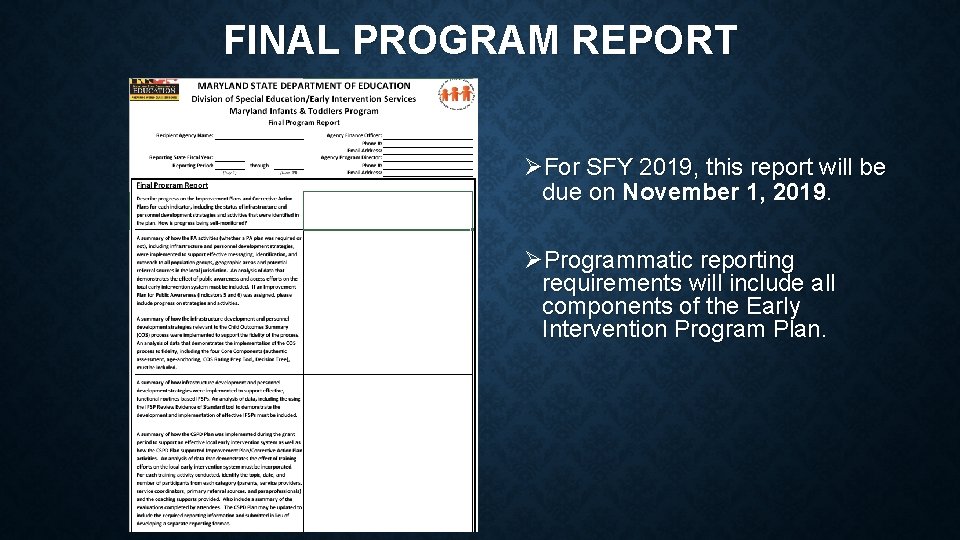
FINAL PROGRAM REPORT ØFor SFY 2019, this report will be due on November 1, 2019. ØProgrammatic reporting requirements will include all components of the Early Intervention Program Plan.
APPLICATION SUBMISSION DUE DATE: MAY 11, 2018 Use your MSDE Liaison for technical assistance in developing and implementing your plan. Consider sharing a draft of the plan prior to getting signatures to share ideas and feedback.
SPECIAL FUNDING SUPPORT • Available Funding for CLIG Grants Allocated to LITPs Based Upon Child Count and Referrals • Decreased Funding Limited to 2% • Supplementary Part B 611 Grant Line • Fiscal Reporting - Interim and Final Cumulative Variance Report Forms • Programmatic Reporting – Include in Semi-annual and Final Program Reports
SUPPLEMENTAL FUNDING ON THE NOGA
PART C SUBMISSIONS CALENDAR http: //marylandpublicschools. org/programs/Pages/Special. Education/rmmb/Grants/IT/index. aspx • Latest Submission Due Date Information • Correct Versions of Documents
MSDE SECURE WEB CLIENT MSDE Secure Web Client Access and Submission Procedures • Access • Uploading Procedures • Single Document Per File • File Naming Convention • Maintenance
THE BUDGET SUBMISSIONS WORKBOOK • ONLY Microsoft Excel - Windows Version - Compatible • The Entry of Information from Partner Agencies MUST Be Entered into a Single Copy of the Budget Submissions Workbook • Step-by-step Instructions in Section 4 of the CLIG Application
A WORD ABOUT BUDGETING • LLA, in Collaboration With Partner Agencies, : • Identifies Program Needs for Upcoming Year • Produces a Listing of Expenditures to Meet Identified Needs • Assigns Expenditures to the Appropriate Partner Agency • Assigns the Expenditures to a Funding Source – Local, CLIG, or Federal Medicaid
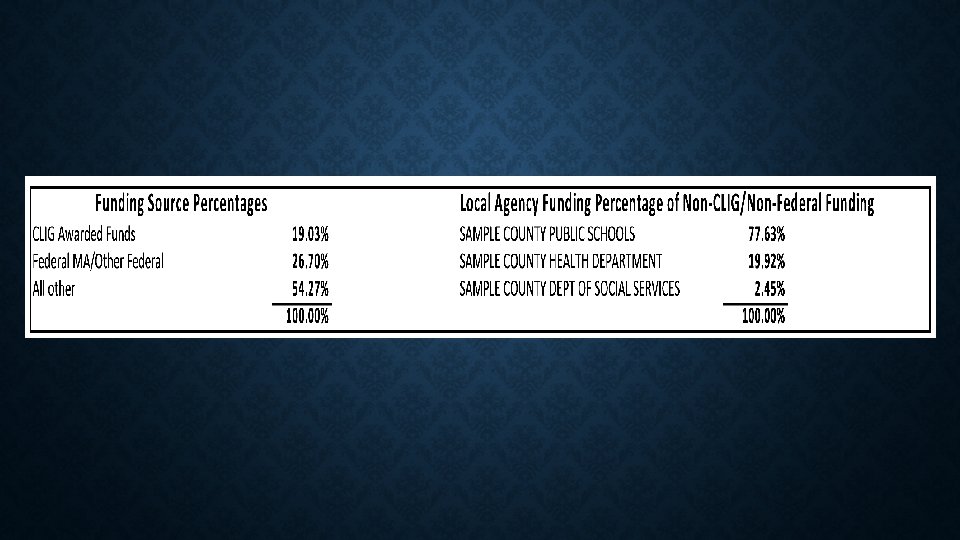
THE BUDGET SUBMISSIONS WORKBOOK Useful LITP Funding Information: The LITP Consolidated Budget Form 100 Includes Two Information Charts That Present The Percentage Of Fiscal Contribution By: • Local & Other State, CLIG, and Other Federal sources; and • Each of the partner agencies
WHAT’S NEW IN THE SFY 2019 BUDGET SUBMISSIONS WORKBOOK? • Federal MA Reimbursement Availability Worksheet – Form 100 • Description of Other Federal, Other State, and Other/Private Funds – Forms 100 A • Indirect Costs • Program/Category 206 Unlocked on the C-1 -25 Forms
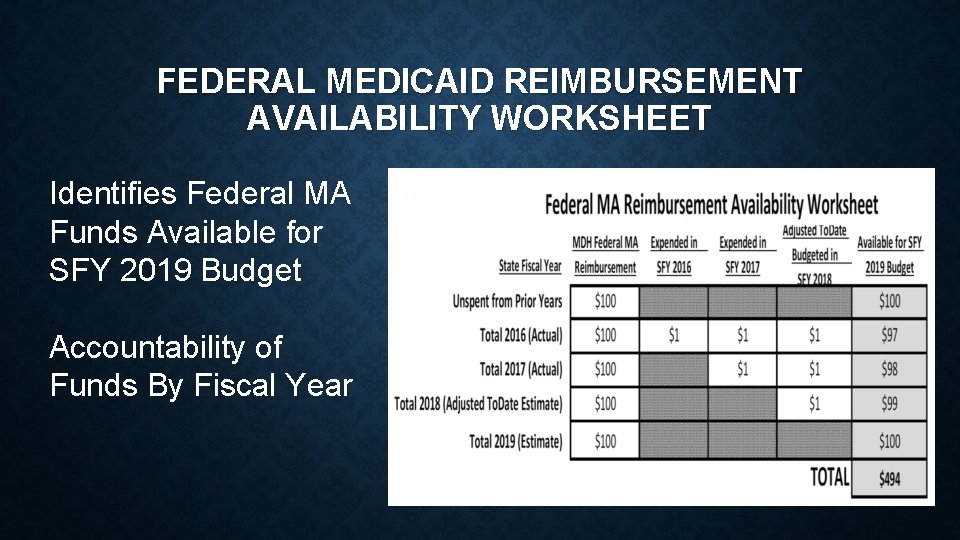
FEDERAL MEDICAID REIMBURSEMENT AVAILABILITY WORKSHEET Identifies Federal MA Funds Available for SFY 2019 Budget Accountability of Funds By Fiscal Year
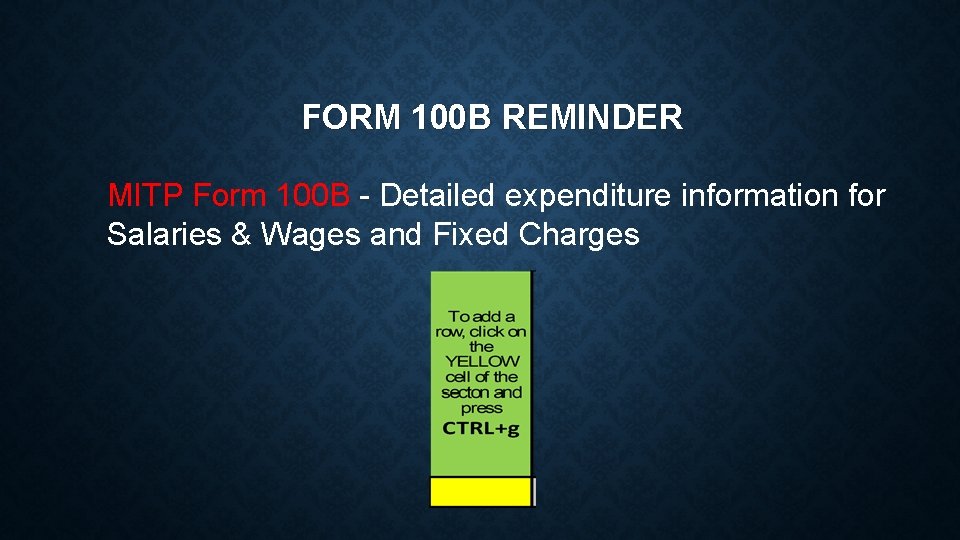
FORM 100 B REMINDER MITP Form 100 B - Detailed expenditure information for Salaries & Wages and Fixed Charges
CLIG STATE FUNDS & FEDERAL MEDICAID • Allocation Delivered via Grant and Intergovernmental Transfer Payment from the MDH • NOGA Shows Initial Grant Amount and Estimated IGT Funds • Reconciliation of Estimated IGT and Actual IGT Can Result in a Revision of the Grant Amount and/or Invoice for Expenditure of Funds Above Allocation • Accounting Setup Facilitates Management of the State Funds and Federal Medicaid
TIMELINE FOR CLIG STATE GENERAL FUNDS • June 30 - Obligate Entire State Infants & Toddlers Allocation • July 10 – Type 1 Report (Non-LSS Must Submit An Invoice) to COMPLETELY Expend The State Grant • August 31 - Based Upon The Reconciliation, The MSDE Issues NOGAs To Revise State Grant Approved Budgets And Invoices, as applicable • September 10 –Type 1 Report (Non-LSS Must Submit An Invoice) to COMPLETELY Expend The State Grant (if the Grant Amount was Revised) • September 30 – Final Financial Report To Account For The Final State Grant Approved Budget And Must Pay Invoice, if applicable • September 30 – Final Cumulative Variance Report Of The ENTIRE State Allocation
REPORTING • No Changes to Reporting Schedule • Special Interim and Final Reporting Forms For the State Systemic Improvement Plan Grants • Interim Progress/Cumulative Variance Report • Final Progress/Cumulative Variance Report
REVISION OF BUDGET AND PROGRAM PLANS (CFR § 200. 308) Approved Requests to Amend Grants are Required to: • Revise Budget • Revise Program Plans • Change a Key Person Specified in the Proposal • Extend the Grant Period (Federal Funds Only)
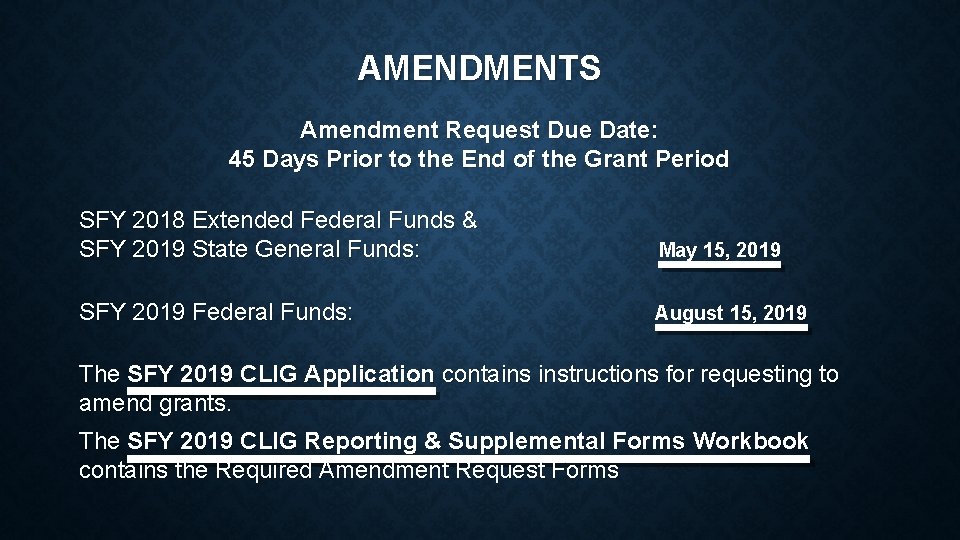
AMENDMENTS Amendment Request Due Date: 45 Days Prior to the End of the Grant Period SFY 2018 Extended Federal Funds & SFY 2019 State General Funds: May 15, 2019 SFY 2019 Federal Funds: August 15, 2019 The SFY 2019 CLIG Application contains instructions for requesting to amend grants. The SFY 2019 CLIG Reporting & Supplemental Forms Workbook contains the Required Amendment Request Forms
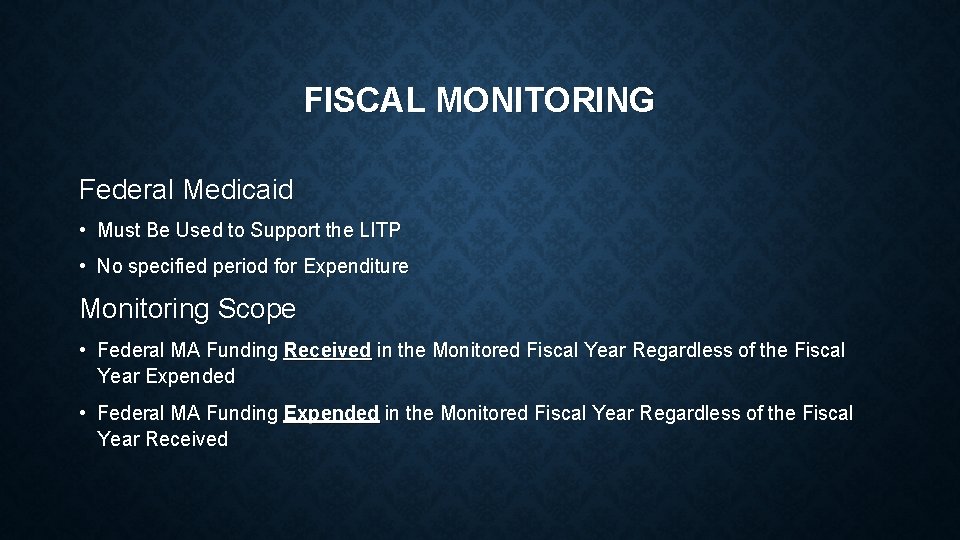
FISCAL MONITORING Federal Medicaid • Must Be Used to Support the LITP • No specified period for Expenditure Monitoring Scope • Federal MA Funding Received in the Monitored Fiscal Year Regardless of the Fiscal Year Expended • Federal MA Funding Expended in the Monitored Fiscal Year Regardless of the Fiscal Year Received
QUESTIONS? For assistance with any of the GLIG fiscal requirements, please contact: Glenn Grayman Lead Fiscal Grants Liaison 410 -767 -0243 Glenn. Grayman@Maryoland. gov