
Maryland Common Core State Curriculum Frameworks for Braille
Maryland Common Core State Curriculum Frameworks for Braille
BACKGROUND During the 2010 legislative session, MD House Bill 413 and Senate Bill 230 amended Education Article 8 -408 pertaining to the education of students with visual impairments. “By September 2012, the Maryland State Department of Education shall develop standards for the mastery and application of the braille code for English/Language arts and Mathematics as a student progresses from Prekindergarten through grade 12, inclusive. ”
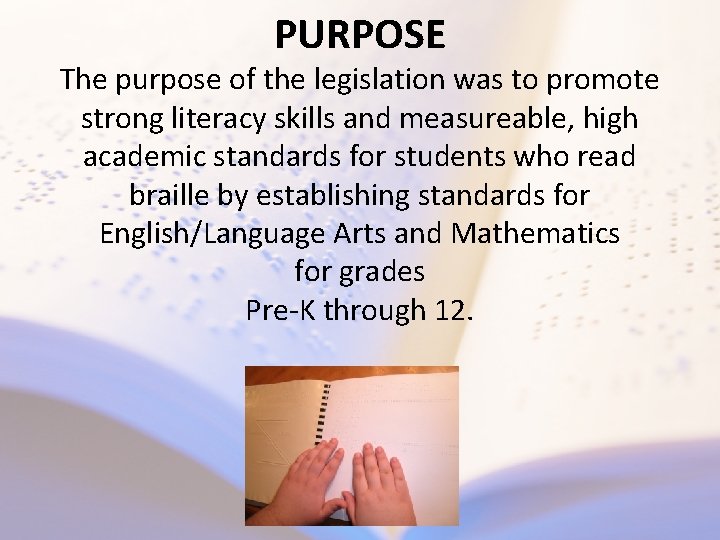
PURPOSE The purpose of the legislation was to promote strong literacy skills and measureable, high academic standards for students who read braille by establishing standards for English/Language Arts and Mathematics for grades Pre-K through 12.
Planning Process • Facilitator – Mid South Regional Resource Center • Identified Task Force Members and sent invitations • Developed a work plan • Identified meeting dates and locations for Year 1 of 2 • Gathered background information & materials • Began with MD State Curriculum
Meeting Process • Reviewed Charge with group: Develop standards for mastery of braille • Reviewed Work Plan with group • Background: Standards, Alignment • Building Glossary terms and definitions and common language • Consensus on document format What braille skills do students need to learn in order to access the standards?
Development Process for Year 1 • Reviewed other state’s work • Reviewed research, resources, curricula • Drafted standards • Meetings: whole group review and consensus worked best • Understanding of the content was critical! • Common Core adopted, MD Frameworks • Revised meeting schedule and work plan for Year 2!
Development Process for Year 2 • Increased meeting time and frequency • Drafted standards • Sent out for expert review • Internal Review • Revised
Expert Reviewers • Dr. Karen Blankenship, Professor, Vanderbilt University • Dr. Cay Holbrook, Professor, University of British Columbia • Susan Milloway, retired Teacher of the Visually Impaired, Pennsylvania • Dr. Ruby Ryles, Assistant Professor, Professional Development and Research Institute on Blindness, Louisiana Tech University • Dr. Derrick W. Smith, Assistant Professor, University of Alabama in Huntsville
Maryland is the only state to develop braille standards based on the Common Core
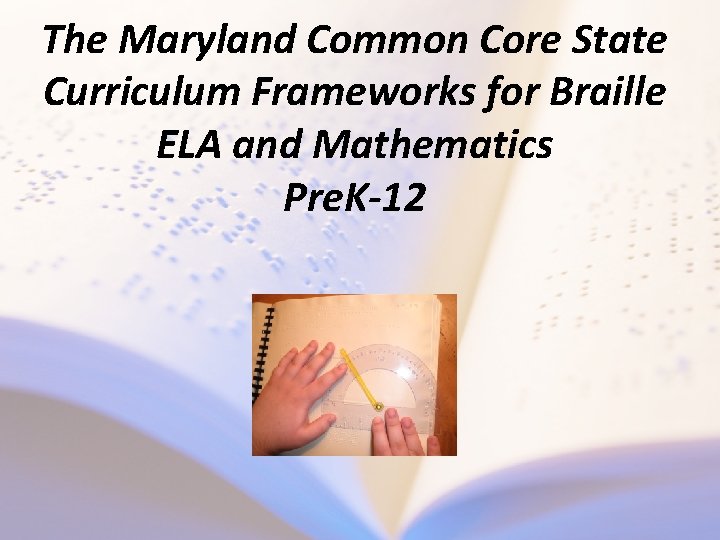
The Maryland Common Core State Curriculum Frameworks for Braille ELA and Mathematics Pre. K-12
Poll How many of you provide support, technical assistance, or professional development to programs for braille readers?
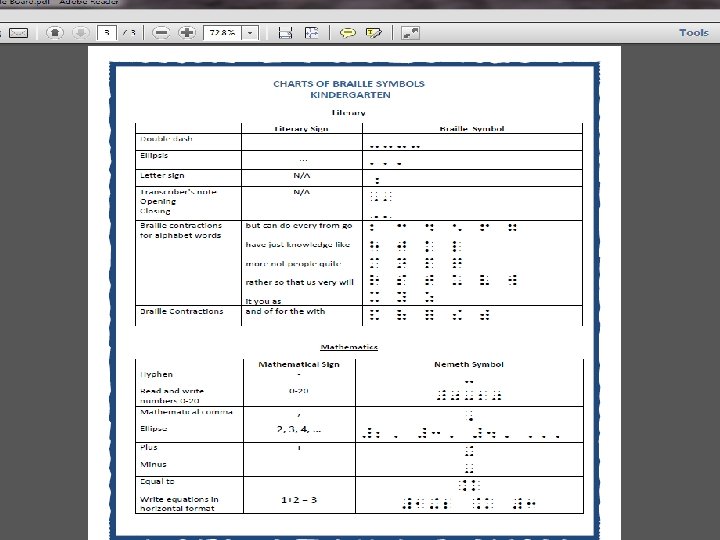
Task Force Guiding Principles Braille readers must have… • access to same grade-level standards and expectations, • early and frequent exposure to contracted braille, • early and frequent exposure to tactile graphics, • emphasis on proficient braille reading skills at an early age (hand movements, contractions, fluency), and • a thorough understanding of the Nemeth Braille Code for Mathematics and Science
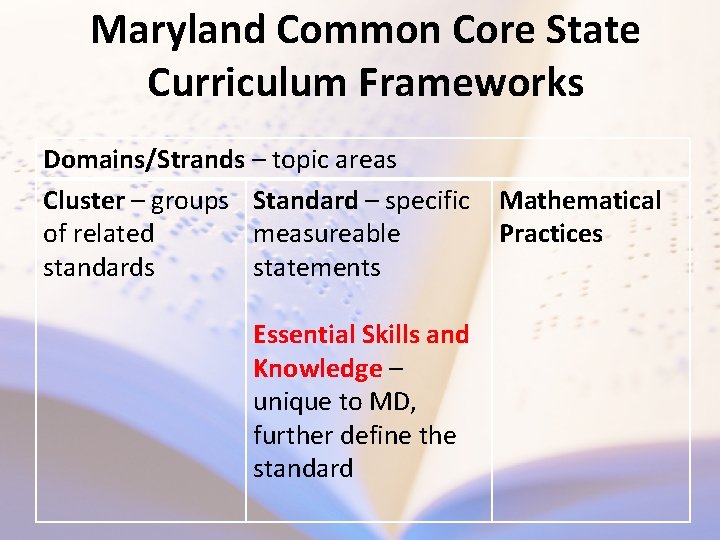
Maryland Common Core State Curriculum Frameworks Domains/Strands – topic areas Cluster – groups Standard – specific of related measureable standards statements Essential Skills and Knowledge – unique to MD, further define the standard Mathematical Practices
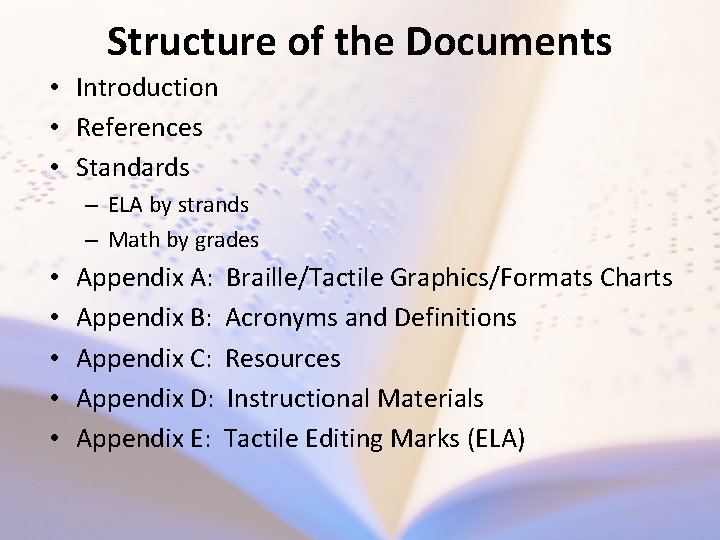
Structure of the Documents • Introduction • References • Standards – ELA by strands – Math by grades • • • Appendix A: Appendix B: Appendix C: Appendix D: Appendix E: Braille/Tactile Graphics/Formats Charts Acronyms and Definitions Resources Instructional Materials Tactile Editing Marks (ELA)
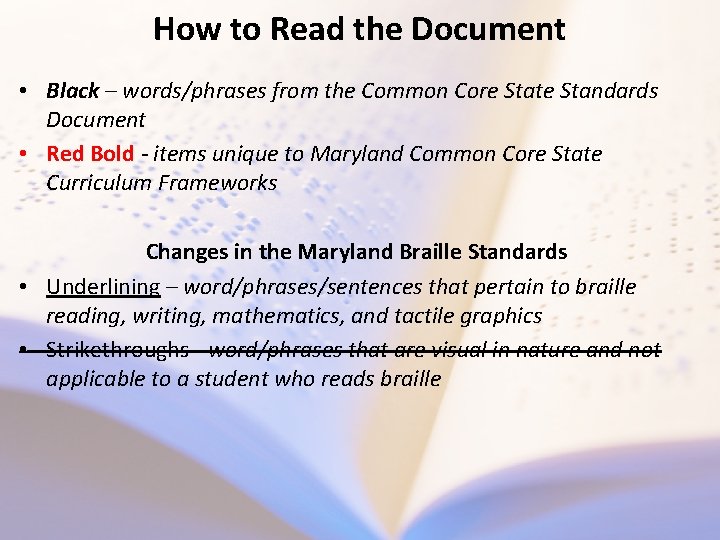
How to Read the Document • Black – words/phrases from the Common Core State Standards Document • Red Bold - items unique to Maryland Common Core State Curriculum Frameworks Changes in the Maryland Braille Standards • Underlining – word/phrases/sentences that pertain to braille reading, writing, mathematics, and tactile graphics • Strikethroughs - word/phrases that are visual in nature and not applicable to a student who reads braille
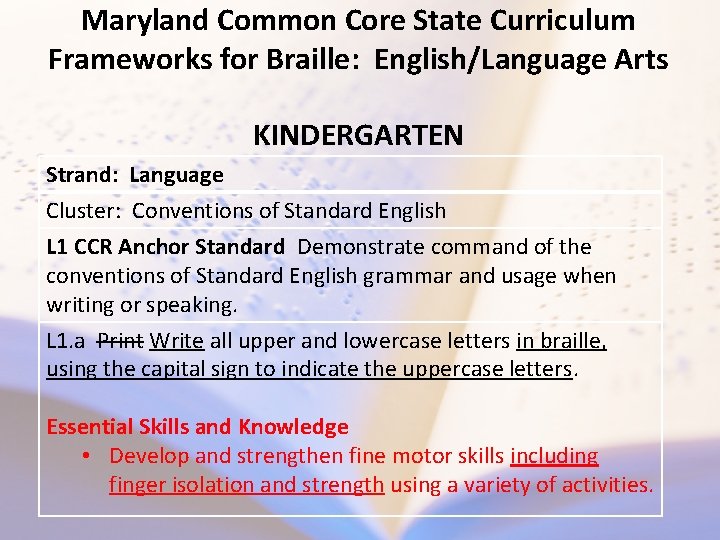
Maryland Common Core State Curriculum Frameworks for Braille: English/Language Arts KINDERGARTEN Strand: Language Cluster: Conventions of Standard English L 1 CCR Anchor Standard Demonstrate command of the conventions of Standard English grammar and usage when writing or speaking. L 1. a Print Write all upper and lowercase letters in braille, using the capital sign to indicate the uppercase letters. Essential Skills and Knowledge • Develop and strengthen fine motor skills including finger isolation and strength using a variety of activities.
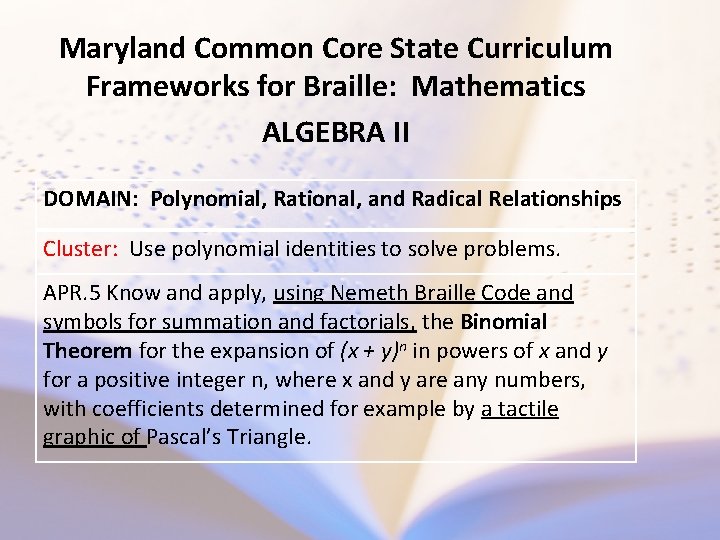
Maryland Common Core State Curriculum Frameworks for Braille: Mathematics ALGEBRA II DOMAIN: Polynomial, Rational, and Radical Relationships Cluster: Use polynomial identities to solve problems. APR. 5 Know and apply, using Nemeth Braille Code and symbols for summation and factorials, the Binomial Theorem for the expansion of (x + y)n in powers of x and y for a positive integer n, where x and y are any numbers, with coefficients determined for example by a tactile graphic of Pascal’s Triangle.
Dissemination Year 3 • Parent Workshops • Professional Development for teachers, braille transcribers, and paras – 2 hours, myself AND one Task Force member – Overview of the Common Core – Key highlights as it pertains to instructional needs of students with visual impairments
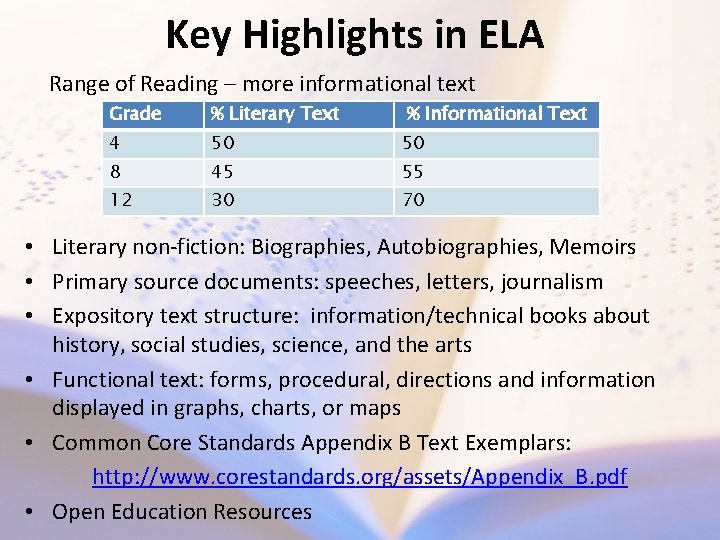
Key Highlights in ELA Range of Reading – more informational text Grade % Literary Text % Informational Text 4 50 50 8 45 55 12 30 70 • Literary non-fiction: Biographies, Autobiographies, Memoirs • Primary source documents: speeches, letters, journalism • Expository text structure: information/technical books about history, social studies, science, and the arts • Functional text: forms, procedural, directions and information displayed in graphs, charts, or maps • Common Core Standards Appendix B Text Exemplars: http: //www. corestandards. org/assets/Appendix_B. pdf • Open Education Resources
Complexity of Reading Word length, word frequency, sentence length, text cohesion, levels of meaning or purpose, structure, language conventionality and clarity, knowledge demands Reading Fluency Reading text with speed, accuracy, and proper expression. Braille readers need to be provided the same level of complex text and to be held to the same expectation for reading fluency!
Text Features • Print features – table of contents, index, glossary, appendix, pronunciation guide • Organizational aids – bold print, colored print, italics, bullets, titles, headings, subheadings, captions, labels, sidebars • Graphic aids – diagrams, graphs, figures, maps, charts/tables, timelines • Illustrations – photographs, drawings
Writing and Research • Citing evidence, analyzing content, apply grammar, spelling, and punctuation • Use higher level and content-specific vocabulary • Integrate knowledge from a variety of sources and report findings • Integration of technology
Key Highlights in Math • Pre. K through grade 5 – focus is computation of whole numbers, fractions, and decimals. Measurement and geometry tied to numbers and operations • Middle school – ratio, proportions, statistics, algebra, foundations of geometry • High School – functions, statistics, geometry, algebra • Procedural skill and fluency – quickly and accurately • Application to real world • Many of the standards are in lower grades!
Planning for the Future • Professional Development – Braille knowledge – Instructional strategies • Revise documents (Unified English Braille Code future changes) • Science?
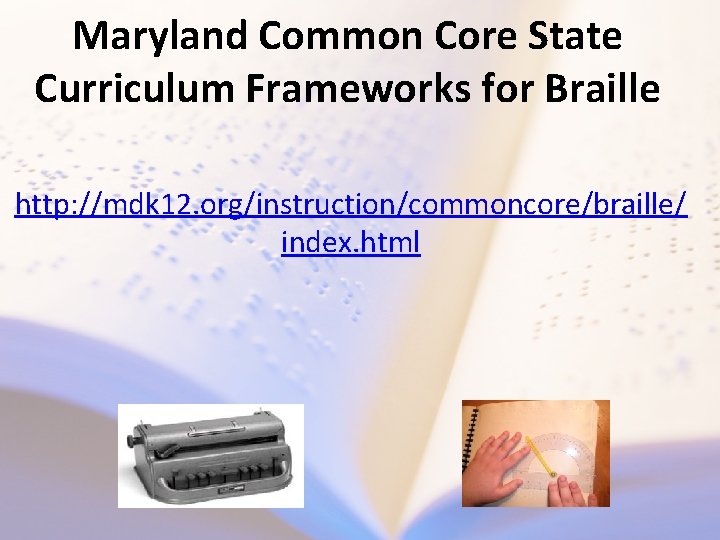
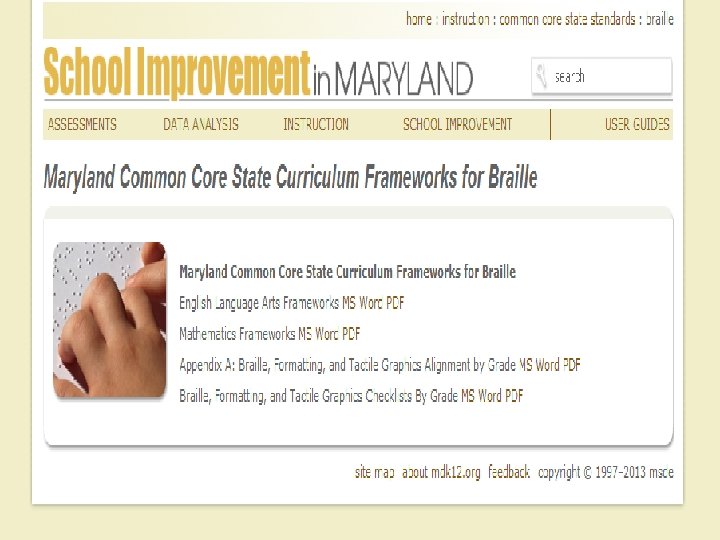
Maryland Common Core State Curriculum Frameworks for Braille http: //mdk 12. org/instruction/commoncore/braille/ index. html
- Slides: 27