
Marxist theory Who was Karl Marx Born in
Marxist theory
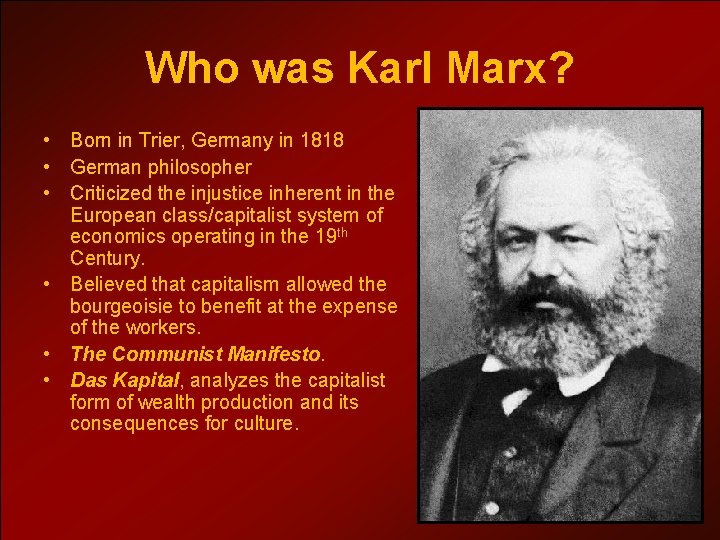
Who was Karl Marx? • Born in Trier, Germany in 1818 • German philosopher • Criticized the injustice inherent in the European class/capitalist system of economics operating in the 19 th Century. • Believed that capitalism allowed the bourgeoisie to benefit at the expense of the workers. • The Communist Manifesto. • Das Kapital, analyzes the capitalist form of wealth production and its consequences for culture.
Putting this theory in context • We have looked at several factors at work on us in terms of how we are marginalized or privileged in our society. • We discussed the Feminist lens- which examined how our gender impacts us. • We examined the Postcolonial lens- which examined how our identity as either a settler or an Indigenous person, impacts us.
Now…. • Now, we are examining how our socioeconomic level impacts us. • When viewing cultural productions through a Marxist lens, you will be looking at how the characters for whom you have empathy are doing in the economic system in which they find themselves. • In short, you will be looking at how capitalism is working for them.
What is Marxist theory? • A theory that focuses on the economic systems of human societies • Based on Karl Marx’s principles • Looks at the damaging effects of capitalism • Economic power is the motive behind all activities • Social and political power is determined by the economic power • All human events and productions are caused by material circumstances and the historical situation
Terminology • Material circumstances: economic conditions • Historical situation: the social /political/ ideological atmosphere generated by material circumstances • Bourgeoisies: people who control the world’s resources (upper class) • Proletariats: majority of the people who live in poor conditions and are involved in manual labour (lower class) • Ideology: A belief system and product of cultural conditioning • Capitalism: An economic system in which businesses and industries are controlled and run by private owners
Classes Differences in socioeconomic classes are much more significant than differences in religion, gender, etc. • Society is divided into the “haves” (bourgeoisies), and “havenots”(proletariats) • There are five classes in America based on their economic wealth/power: underclass, lower class, middle class, upper class and “aristocracy”
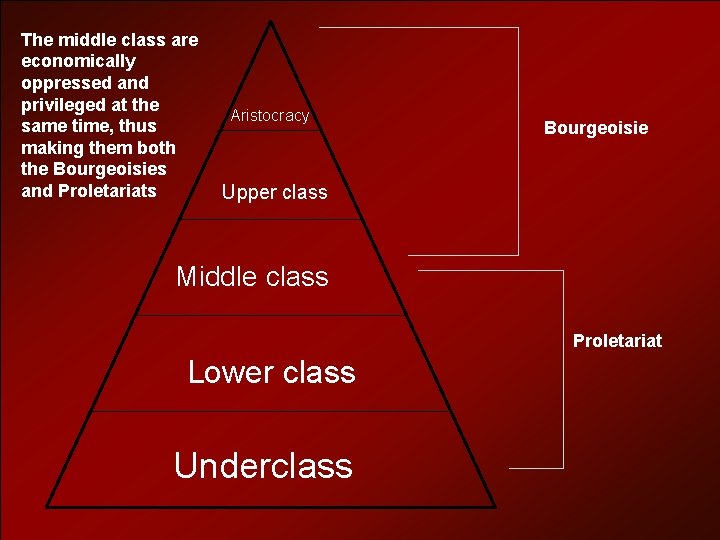
The middle class are economically oppressed and privileged at the same time, thus making them both the Bourgeoisies and Proletariats Aristocracy Bourgeoisie Upper class Middle class Proletariat Lower class Underclass
The Problem with the (North) American Dream: • Makes people believe that financial success is the product of hard work. • If someone is poor, it is because they are lazy. • The success of the American Dream rests on the misery of others. • Gives people a false hope that anything is possible. • If the dream fails, people blame themselves instead of the system that is keeping the rich and the poor where they are.
• Another problem Marxists see with capitalism is the commodification of people. • Any ideas re: what this might mean?
Questions • Does the work reinforce capitalist, imperialist or classist values? • How does the work criticize or invite readers to criticize oppressive socioeconomic forces and ideologies? • Does the work support the Marxist agenda but also support a capitalist, classist or imperialist agenda? • How does the work reflect the socioeconomic conditions of the time period in which it is set or the time period in which it was written? • How does the work show religion’s role in keeping the characters socioeconomically oppressed?

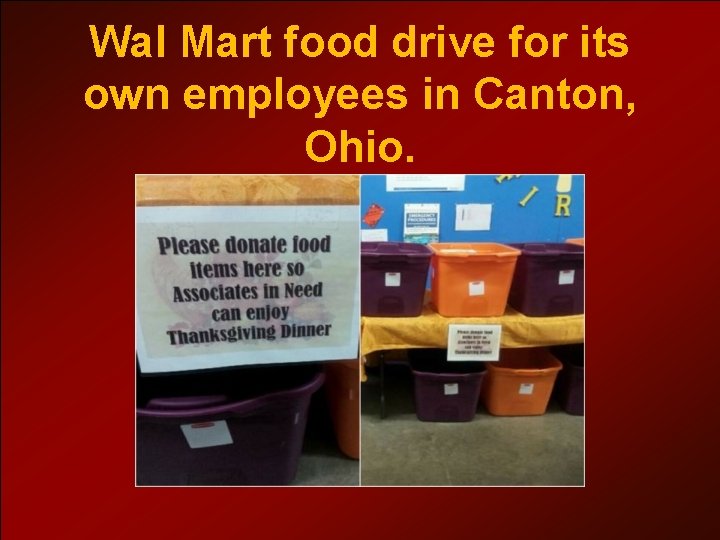
Wal Mart food drive for its own employees in Canton, Ohio.
“Summer Camp” Here is a lovely little camp Built among the Laurentian hills By a Children’s Welfare Society, Which is entirely supported by voluntary contributions. All summer long underprivileged children scamper about And it is astonishing how soon they look happy and well. Two weeks here in the sun and air Through the charity of our wealthy citizens Will be a wonderful help to the little tots When they return for a winter in the slums. -F. R. Scott
Sources • Tyson, Lois. Critical Theory Today: A User -Friendly Guide. New York: Routledge, 2006. Print. • http: //blog. pch. com/pchsearchandwin/files/ 2012/04/The-Publishers-Clearing-House. Prize-Patrol-Could-Visit-You-If-You-Dream -Big-And-Enter. jpg • Oxford Advanced Learner’s Dictionary
- Slides: 15