
Marxism Introduction Class Relations Capitalism and Commodification 2003
![Social Structure: Base and Superstructure Ü Base-- “The sum total of [the] relations of](https://slidetodoc.com/presentation_image_h2/7f3107760350df440a3e512f63cac5ad/image-23.jpg "Social Structure: Base and Superstructure Ü Base-- “The sum total of [the] relations of")
- Slides: 36
Marxism: Introduction Class Relations, Capitalism and Commodification 2003 Spring
Outline Ü Starting Questions Ü Focuses in this unit Ü Marx Ü “Snowed Up”
Starting Questions (1): Economic Determinism Ü Is money (or the economic relations we are in) the most important determinant in our life? Ü The apparently “non-materialist” aspects of life – the mental: our belief, ideas and ideals; the spiritual: our “soul” literature and all the cultural products. Love -- Can love transcend the conditioning of
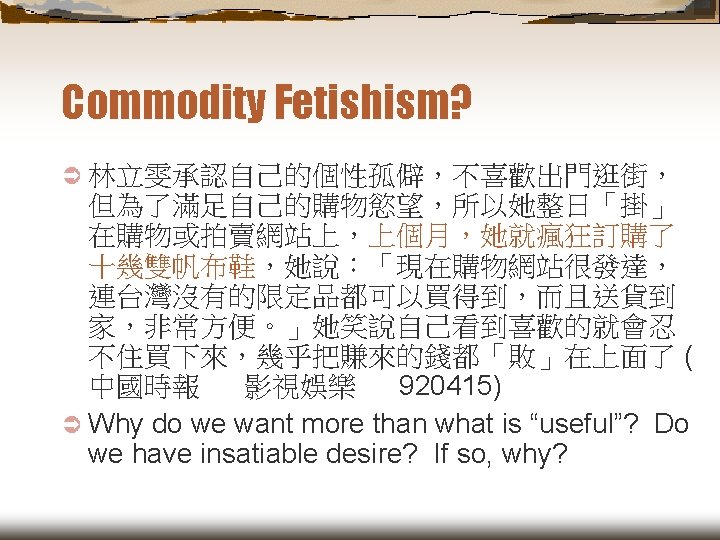
Starting Questions (2): Class Relations Ü Which class do you belong to? Are we all “middle class”? What types of “class relations” do you see in our society? Ü What is capitalism? How does it influence our life? Ü What type of “relations of production” are there at school and in between the teachers and students?
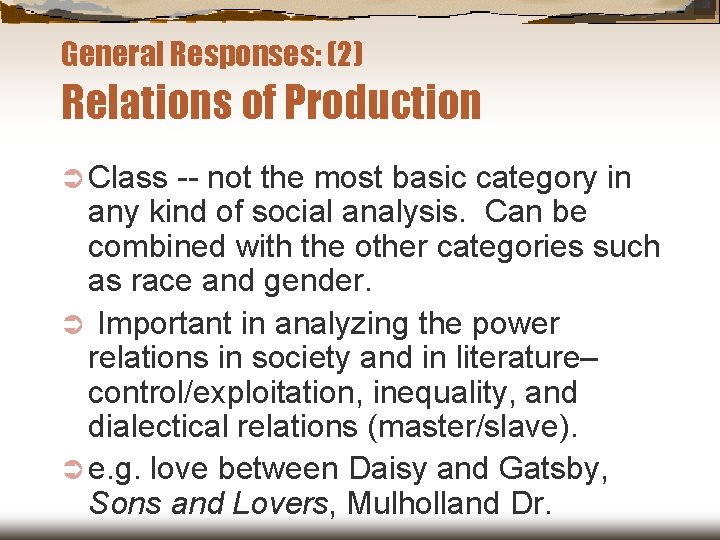
General Responses: (2) Relations of Production Ü Class -- not the most basic category in any kind of social analysis. Can be combined with the other categories such as race and gender. Ü Important in analyzing the power relations in society and in literature– control/exploitation, inequality, and dialectical relations (master/slave). Ü e. g. love between Daisy and Gatsby, Sons and Lovers, Mulholland Dr.
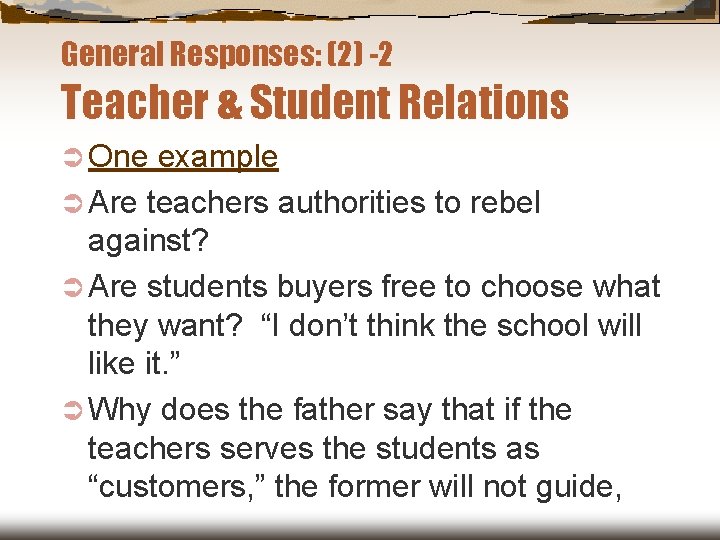
General Responses: (2) -2 Teacher & Student Relations Ü One example Ü Are teachers authorities to rebel against? Ü Are students buyers free to choose what they want? “I don’t think the school will like it. ” Ü Why does the father say that if the teachers serves the students as “customers, ” the former will not guide,
General Responses: (2) -3 Teacher & Student Relations Ü Teacher-student: commercial relation and others Ü Teachers (like experts and those with technical skills ) are “professionals” –they can produce more knowledge and thus more of their labor power and values. Ü They, like the students, are still in the system of domination and subordination. (Ref. Scase 80)
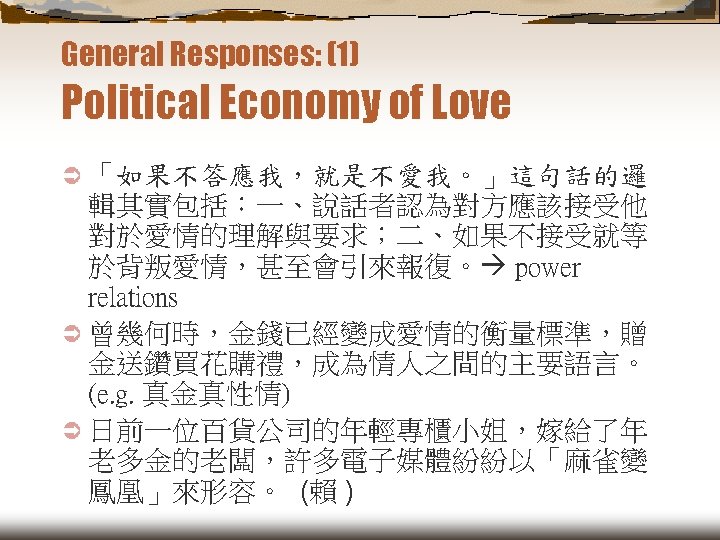
General Responses: (3) Our Consumption Habits Ü Why can’t we stop buying? Ü Possible reasons: Devaluation of the goods we buy or own; “positional goods” – When more people own the goods, the satisfaction it brings is reduced. (e. g. 40, 000 dollar face cream; shark fin; etc. ) Durkheim: human wants are in principle limitless; capitalism develops too fast, always changing our expectations. Stoppable only by 1) repressive social morality; 2) regulating capitalism. Loss of Religion and Sense of Stability. Marxist views: (later) capitalism creates false
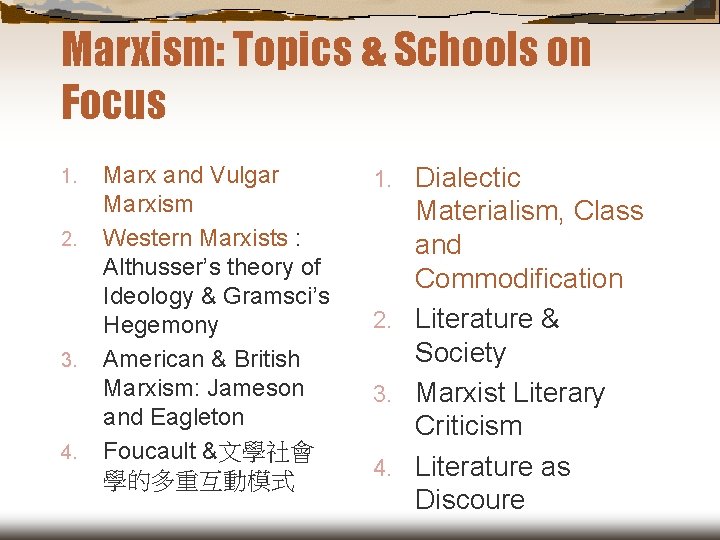
Marxism: Topics & Schools on Focus 1. 2. 3. 4. Marx and Vulgar Marxism Western Marxists : Althusser’s theory of Ideology & Gramsci’s Hegemony American & British Marxism: Jameson and Eagleton Foucault &文學社會 學的多重互動模式 Dialectic Materialism, Class and Commodification 2. Literature & Society 3. Marxist Literary Criticism 4. Literature as Discoure 1.
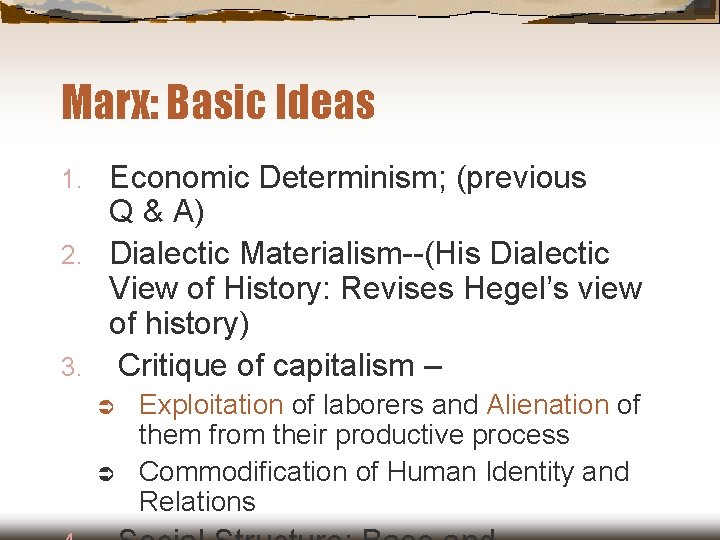
Marx: Basic Ideas Economic Determinism; (previous Q & A) 2. Dialectic Materialism--(His Dialectic View of History: Revises Hegel’s view of history) 3. Critique of capitalism – 1. Ü Ü Exploitation of laborers and Alienation of them from their productive process Commodification of Human Identity and Relations
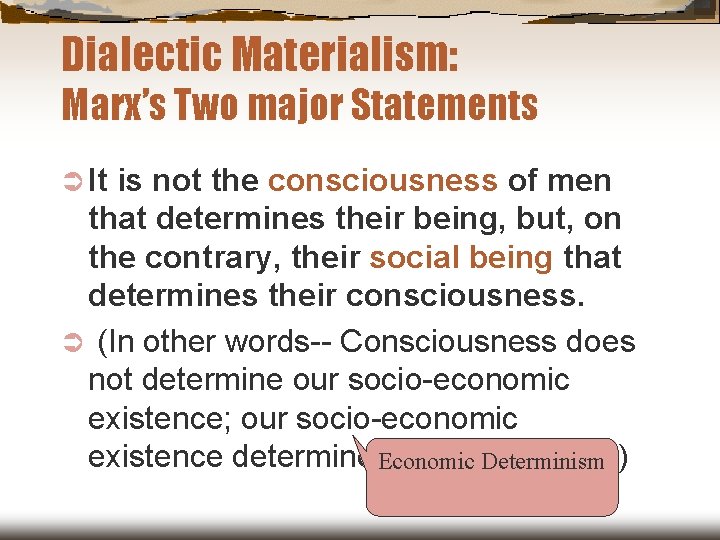
Dialectic Materialism: Marx’s Two major Statements Ü It is not the consciousness of men that determines their being, but, on the contrary, their social being that determines their consciousness. Ü (In other words-- Consciousness does not determine our socio-economic existence; our socio-economic existence determines. Economic consciousness. ) Determinism
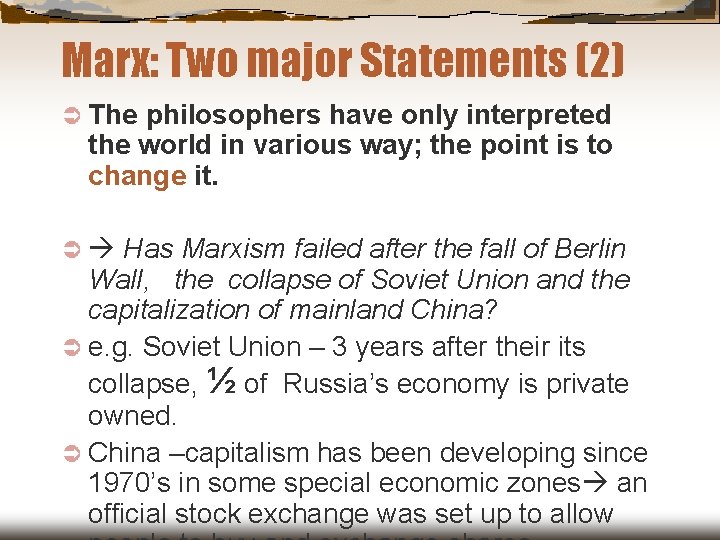
Marx: Two major Statements (2) Ü The philosophers have only interpreted the world in various way; the point is to change it. Has Marxism failed after the fall of Berlin Wall, the collapse of Soviet Union and the capitalization of mainland China? Ü e. g. Soviet Union – 3 years after their its collapse, ½ of Russia’s economy is private owned. Ü China –capitalism has been developing since 1970’s in some special economic zones an official stock exchange was set up to allow Ü
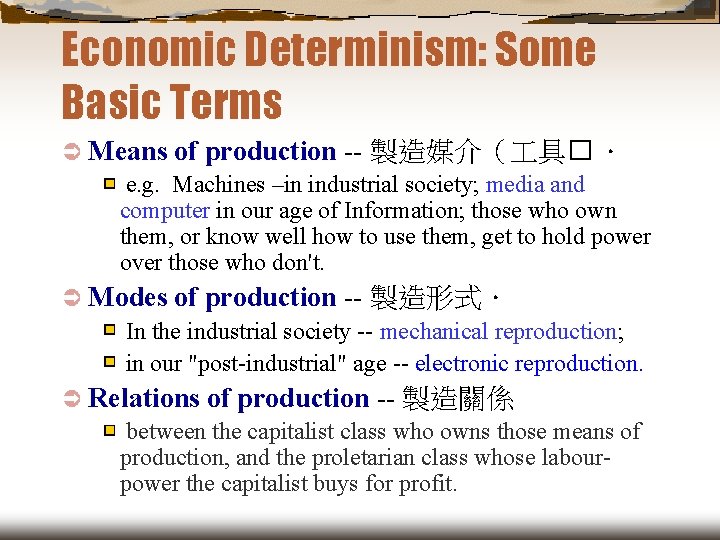
Economic Determinism: Some Basic Terms Ü Means of production -- 製造媒介( 具� . e. g. Machines –in industrial society; media and computer in our age of Information; those who own them, or know well how to use them, get to hold power over those who don't. Ü Modes of production -- 製造形式. In the industrial society -- mechanical reproduction; in our "post-industrial" age -- electronic reproduction. Ü Relations of production -- 製造關係 between the capitalist class who owns those means of production, and the proletarian class whose labourpower the capitalist buys for profit.
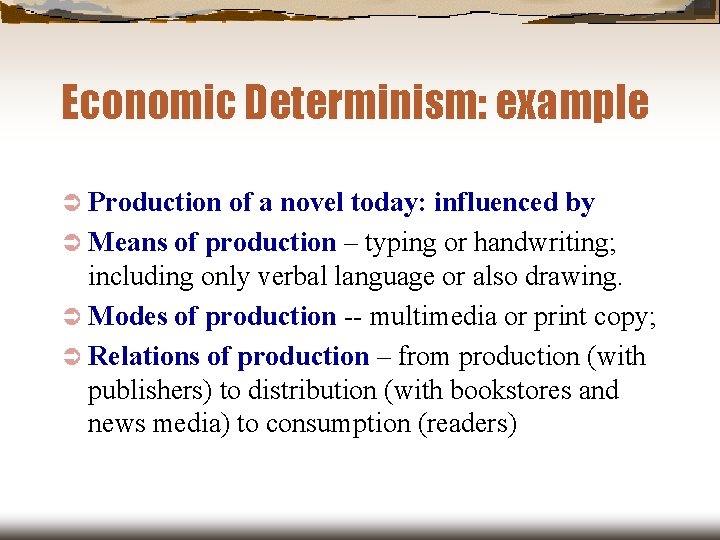
Economic Determinism: example Ü Production of a novel today: influenced by Ü Means of production – typing or handwriting; including only verbal language or also drawing. Ü Modes of production -- multimedia or print copy; Ü Relations of production – from production (with publishers) to distribution (with bookstores and news media) to consumption (readers)
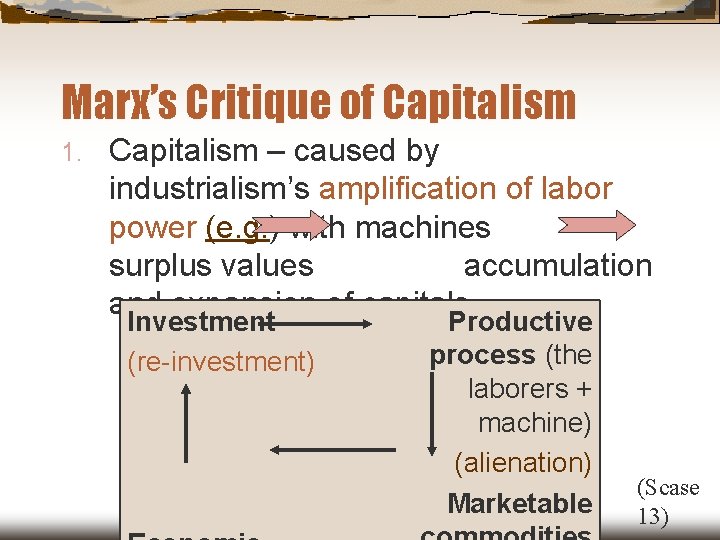
Marx’s Critique of Capitalism 1. Capitalism – caused by industrialism’s amplification of labor power (e. g. ) with machines surplus values accumulation and expansion of capitals Investment (re-investment) Productive process (the laborers + machine) (alienation) Marketable (Scase 13)
Marx’s Critique of Capitalism (2) 2. Consequences: exploitation and alienation of laborers, exchange values over use values; reification(物 化) and commodification of human relations Example: Modern Times ; Bicycle Thief
Marx’s Critique of Capitalism (2) 2. “immiseration thesis” -- exploitation and alienation of laborers, Note: Saunders argues that capitalism actually increases human wealth (of the poor and the rich alike) and improves human lives What do you think?
Marx’s Solution 3. Marx’s argument: State-owned properties Communism (example: clips of The Greatest Thinker: Marx) Ü Pension funds or share-holding is not enough; State-owned capital; possible problem, the State’s inefficiency; Ü Commune (regional economy, selfsufficiency)
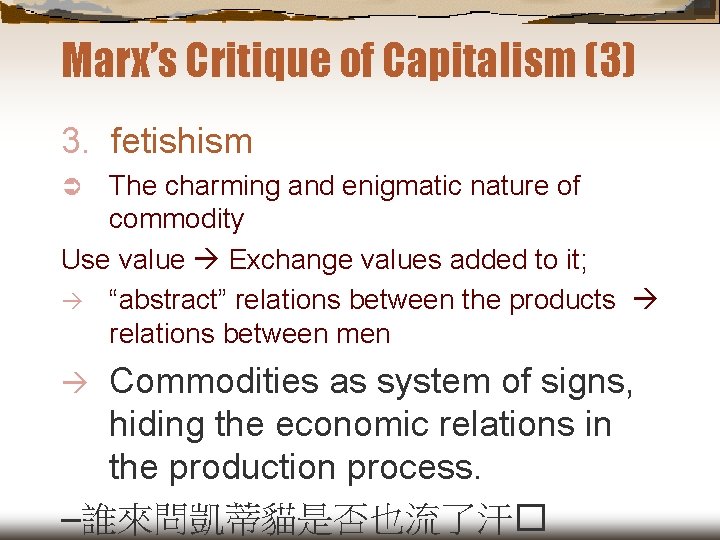
Marx’s Critique of Capitalism (3) 3. fetishism The charming and enigmatic nature of commodity Use value Exchange values added to it; “abstract” relations between the products relations between men Ü Commodities as system of signs, hiding the economic relations in the production process. –誰來問凱蒂貓是否也流了汗�
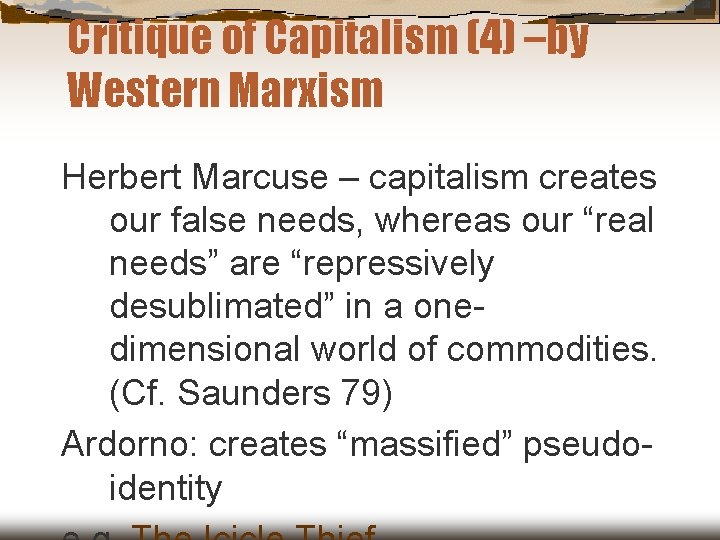
Critique of Capitalism (4) –by Western Marxism Herbert Marcuse – capitalism creates our false needs, whereas our “real needs” are “repressively desublimated” in a onedimensional world of commodities. (Cf. Saunders 79) Ardorno: creates “massified” pseudoidentity
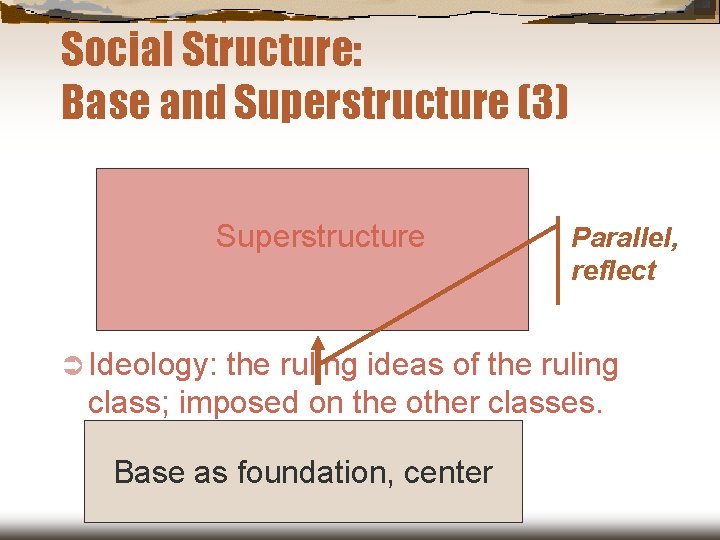
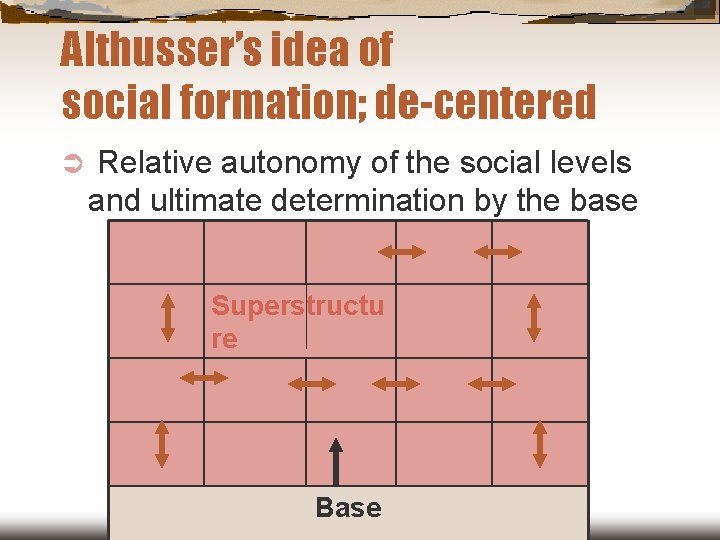
Social Structure: Base and Superstructure Ü Base-- “The sum total of [the] relations of production constitutes the economic structure of society, the real foundation” Ü Superstructure--a legal and political superstructure, cultural institutions and forms of social consciousness. Ü Relations between -The mode of production of material life conditions the social, political and intellectual life process in general.
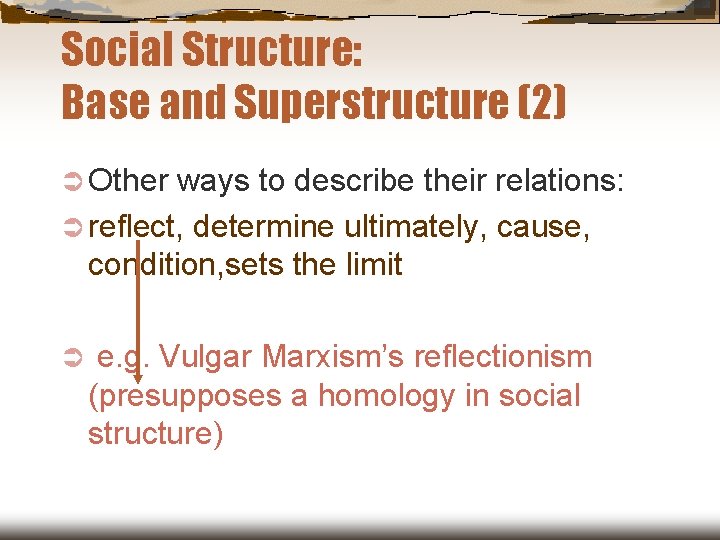
Social Structure: Base and Superstructure (2) Ü Other ways to describe their relations: Ü reflect, determine ultimately, cause, condition, sets the limit Ü e. g. Vulgar Marxism’s reflectionism (presupposes a homology in social structure)
Social Structure: Base and Superstructure (3) ÜSuperstructure Ü Ideology: Parallel, reflect the ruling ideas of the ruling class; imposed on the other classes. Base as foundation, center
Althusser’s idea of social formation; de-centered Ü Relative autonomy of the social levels and ultimate determination by the base Superstructu re Base
“Snowed Up” What are the binary opposites in the story? 2. How is Edie related to the men around her? 3. What gets "snowed up" in the story? 4. What do you think about the ending? Is Edie finally subject to both the control of her society and the belittling of her author? 1.
Binary Opposites class difference: Ü Lord Bilbrton--> has power, Ü Mr. Alderman Thrigg--> has money; Ü Aurelles--> Aurelles' playing chess -- "trying oh, so hard to play chess--which he does not understand--with papa; and all just because. " Ü father's position: in financial trouble, to be saved only by being appointed by the government. 2. difference in age and appearance: Lord Bilbrton "wizened", Mr. Alderman Thrigg "stout" and Aurelles "strong, tall, noblelooking" 1.
Edie in between these men Ü She prefers Aurelles over the other two suitors, though she is aware of the former's clumsiness in social games. reflected in her terms of address--> Aurelles or Phillip or Phil; Lord Bilberton or Charlie
Edie's change by the snow Ü Before the snow -- Edie's position against class difference and social customs: like a shuttlecock or tennis ball; 2. It is laughable. . . p. 20 Ü Edie's writer: rebelliousness and ambition as a 1. p. 20 the fur coat -- must wear it; interest in her own looks; 2. not going to be sold exactly. p. 20 3. be a poetess someday. 4. hate their "coming to the point. " --> will not marry them, will cry, quarreled; am cross. 5. "entanglement with a penniless soldier. "p. 21
The Other People’s reponses: 1) 1/4 Lord B: "poor shivering ancient body“ 2) 1/5 "I shall perish with an angel!" Mr. Thrigg is not good at using metaphors; Bilberton, silly with fright. Papa, cynical. * Mr. Thrigg as one trying to help; 3) 1/6 Mr. Thrigg in despair and struggle (p. 23) 1/14 p. 24
The Other People’s reponses : (2) 4) 1/14 All the servants left but the maid, papa an invalid, Bilberton helpless; Thrigg trapped in snow; the arrival of Phillip p. 25 5) 1/15 eat the cat; 6) 1/17 Papa and the Alderman may die. Philip is the only one active to get food. 7) 1/18 the last try by Phillip 8) 1/19 a feast; The Alderman eats a long time.
Edie's changing views of the snow and the others Ü 1)1/3 "Why it is beautiful! I wish I was snowballing Aurelles. " (21) 2) 1/4 nothing to do; hate the snow p. 21 1/5 6, laughs at her suiters. 3) 1/10 "we shall be starved. " Misses "Phillip. " --a very short entry. * turning point: 4) 1/14 "Nothing but snow. " "Such fun! The Alderman has been helping me in the kitchen. " Philip arrives; he is willing to rescue Thrigg only if he gives up his pursuit of Edie changes her tactics. p. 26
Edie's changing views of the snow and the others Ü 5) 1/15 must write to pass away the time; * Edie's weakness and incisive comment on the "weakness of the snow": 1/17 cries; comments on the snow. "the weak, feeble despised flakes of snow. " 1/18 waiting; * turning point: 1/19 he has all my heart 1/22 the roughs invasion; nice to have a soldier around. Hope for us at last--fog. 1/15 Is aware of her being a commodity between two men. Will be a good girl and make Phil a first rate wife.
“Snowed Up”: Its Contraditions Ü Although Jeffries writes a cautionary take about what happens when society is deprived of technological support, there also appears to be an unarticulated desire for such a catastrophe to occur, a desire for devastation and for reversion. Ü [He expresses] liberal anxiety but also a reactionary 'back to nature' impulse. (Meynard 139)
References Ü Sauders, Peter. Capitalism: A Social Audit. Buckingham: Open UP, 1995. Ü Scase, Richard. Class. Buckingham: Open UP, 1992. Ü 賴祥蔚. 〈情人的政治經濟學〉中國時報 92/02/14. Ü Maynard, Jessica. “A Marxist Reading of 'Snowed Up. ‘” Literary theories : a case study in critical performance. Eds. Julian Wolfreys and William Baker. London : Macmillan Press Ltd , 1996