
Marxism Background most influential political philosophy of working

Marxism

Background • • most influential political philosophy of working class modern political science, sociology and history effected by its ideas

Karl Marx • • German 1849 moved to London for many years buried in Highgate Cemetery in London "Philosophers want to explain the world, but the thing is to change it"
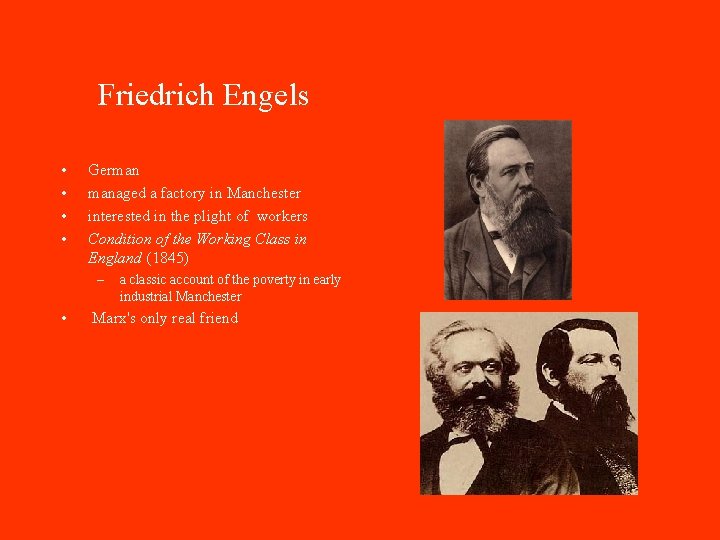
Friedrich Engels • • German managed a factory in Manchester interested in the plight of workers Condition of the Working Class in England (1845) – • a classic account of the poverty in early industrial Manchester Marx's only real friend
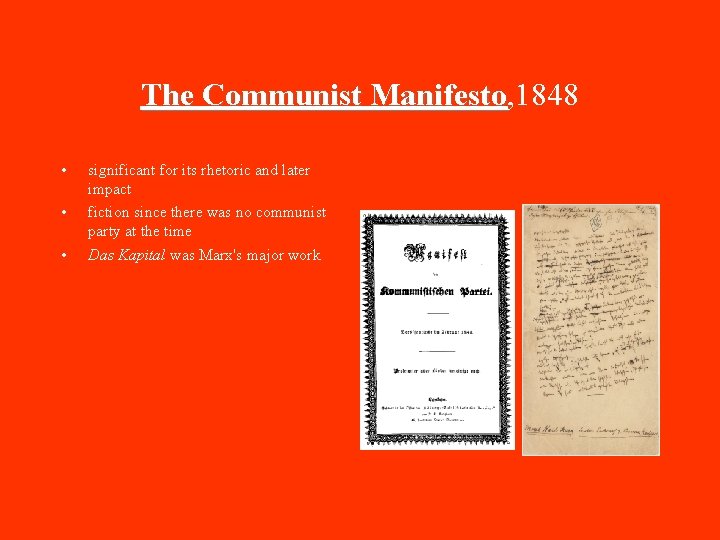
The Communist Manifesto, 1848 Manifesto • • • significant for its rhetoric and later impact fiction since there was no communist party at the time Das Kapital was Marx's major work

Marxist Theory • 1. 2. 3. Had three main sources: German philosophy English economics and French history
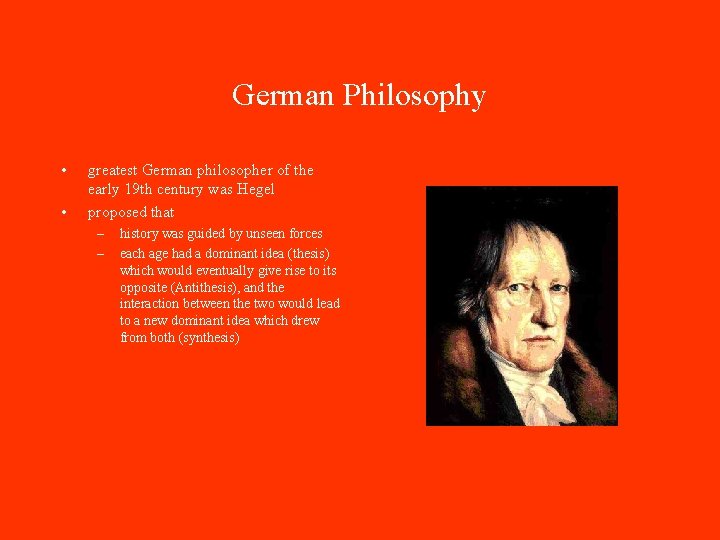
German Philosophy • • greatest German philosopher of the early 19 th century was Hegel proposed that – – history was guided by unseen forces each age had a dominant idea (thesis) which would eventually give rise to its opposite (Antithesis), and the interaction between the two would lead to a new dominant idea which drew from both (synthesis)
English Economics • • • Marx was impressed by Hegel's view of history but… Marx stressed the importance of material reality Which reality is most important? – – Economics…why? involved money and the value placed on labour

French History • • Marx influenced by idea that a revolution could bring about change in a few days history of France, after 1789, was a history of repeated revolution

What was new? • • None of this is new or inventive, except… Marx hypothesized that… – the creation and power of social classes were bound with the development of new modes of production
Marxist Historical Theory • Economics is at the heart of history • ideologies and actions are based on economic basis of society
What is the economic basis of society? 1. organization, ownership and control of the means of production • different means are important in different periods • agricultural society, who owns land is most important • industrial societies, it is the ownership of factories • For Marx, all significant history is that of class struggle
How did Marx explain his era? • the Labor Theory of Value – workers were exploited – workers produced surplus value which was collected by capitalists
Applying Marxism to History • Marx argued that feudalism (thesis) created the bourgeoisie (antithesis) • Bourgeoisie grew because agricultural society required markets to sell goods • Eventually bourgeoisie was as powerful as land-owning nobles • Bourgeoisie rose against them during French Revolution • Bourgeoisie established a capitalist society • Capitalism (synthesis) created industrial working class known as proletariat (antithesis) • Marx predicted that history required proletariat to realize its own position, rise up and overthrow capitalism • after a period of transition, workers would establish a stateless Communist society
Marxist View of the 1800 s • • capitalism contains seed of inevitable destruction because of overproduction Capitalism has the tendency to create just two classes who eventually have to fight each other -- Bourgeoisie vs Proletariat The Proletariat (workers) were deprived of ownership of the means of production and had no reason to maintain the oppressive system Deprived of any reason to preserve society, they will change it
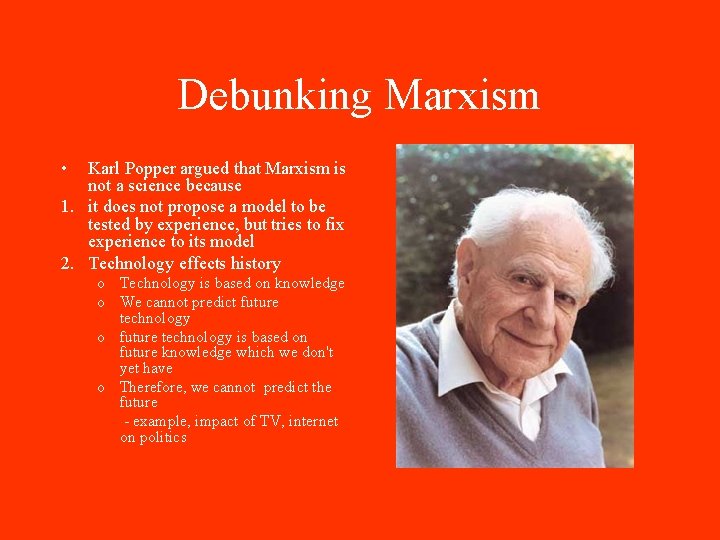
Debunking Marxism • Karl Popper argued that Marxism is not a science because 1. it does not propose a model to be tested by experience, but tries to fix experience to its model 2. Technology effects history o Technology is based on knowledge o We cannot predict future technology o future technology is based on future knowledge which we don't yet have o Therefore, we cannot predict the future - example, impact of TV, internet on politics
Emotional Appeal of Marxism • Marx assumes Proletariat are better than other classes b/c – more altruistic and deserving
Marxism Analogy to Christianity • 1. 2. 3. 4. 5. 6. 7. Marxism came to represent a sort of secular religion. How? Prophet (Marx) Holy Book (The Manifesto/Das Kapital) Chosen People (Proletariat) Clergy (Intellectual Leaders) Church (Communist Party) The Sinful (The Bourgeoisie) The Promised Land (Communist society)
- Slides: 18