
MARVELLOUS MAP OF MALTON CONTENTS 1950 s Black
MARVELLOUS MAP OF MALTON
CONTENTS 1950 s Black & White Guide Book Map of Malton Two Old Maps of Malton Explore the 1730 Map of Malton Explore a view of Malton in 1728 Eighteenth & nineteenth Century views of Malton from the river Then and Now – compare images of the Market Place over time Explore the Market Place in the 1830 s and the 1851 Census Explore the 1889 Map of Malton Explore Outside the Town Walls in Maltongate Explore early 1900 s photograph of Yorkersgate Explore early 1900 s photograph of Castlegate Billheads and changes in writing styles Explore paintings and photographs of St Michael’s Church Transport in Malton over time Glossary an explanation of the difficult words and Census returns Links and Credits NEXT
Explore the marvellous map of Malton has had a Market for over 800 years. The Market has changed over time and your task is to spot the changes. There are three maps to explore. A hand drawn old map from 1730 An old map from 1889 A modern map from 1950 Explore the maps by clicking on the red boxes. To get rid of the red boxes just click again! To return to the last page you looked at right click and choose “last viewed”. The first map is a modern map of Malton. Are you ready? START
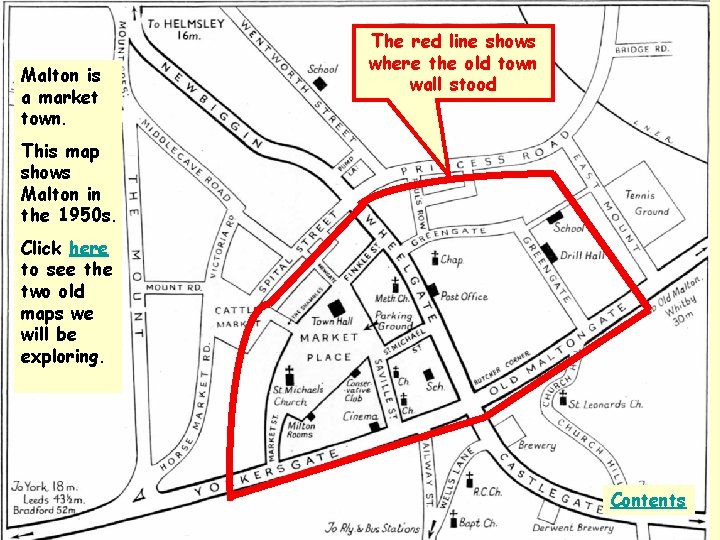
Malton is a market town. The red line shows where the old town wall stood This map shows Malton in the 1950 s. Click here to see the two old maps we will be exploring. Contents

Marvellous maps The map on the left is very old. It dates from 1730. The map below is over 100 years old. It dates from 1889. Look at the two maps – what has stayed the same? Click the hand drawn Old Map 1730 to explore what Malton looked like in 1730. Click Malton in 1889 to explore Malton in 1889. What do you think are the big differences?
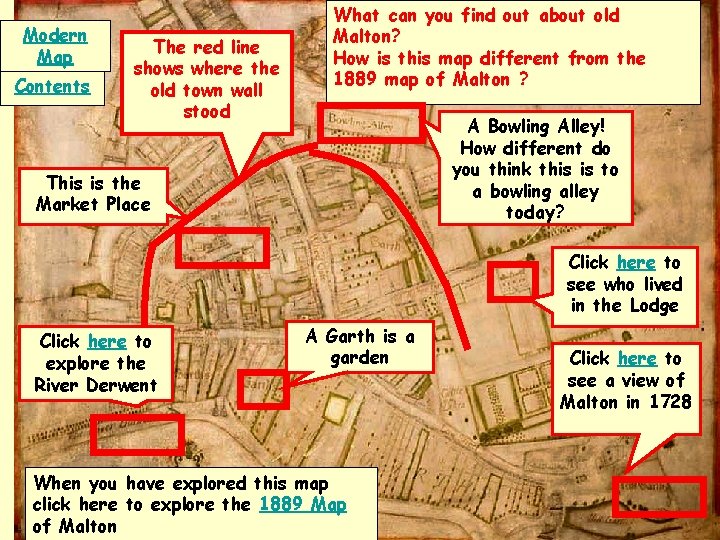
Modern Map Contents The red line shows where the old town wall stood What can you find out about old Malton? How is this map different from the 1889 map of Malton ? A Bowling Alley! How different do you think this is to a bowling alley today? This is the Market Place Click here to see who lived in the Lodge Click here to explore the River Derwent A Garth is a garden When you have explored this map click here to explore the 1889 Map of Malton Click here to see a view of Malton in 1728
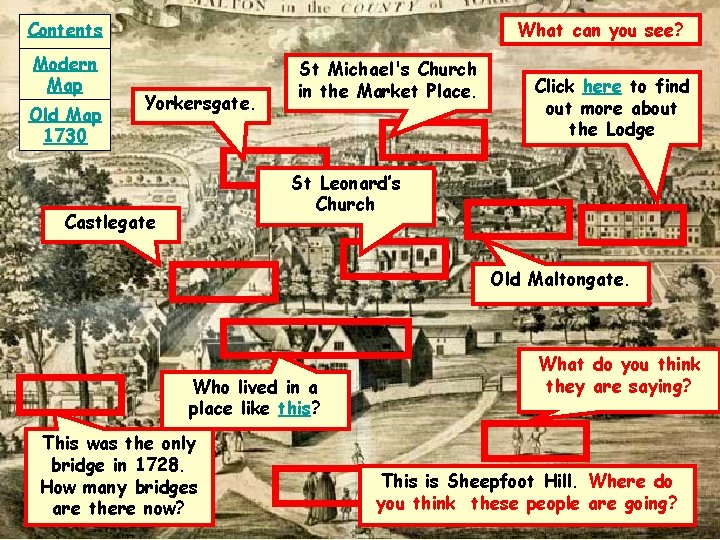
Contents Modern Map Old Map 1730 What can you see? Yorkersgate. St Michael's Church in the Market Place. Click here to find out more about the Lodge St Leonard’s Church Castlegate Old Maltongate. Who lived in a place like this? This was the only bridge in 1728. How many bridges are there now? What do you think they are saying? This is Sheepfoot Hill. Where do you think these people are going?
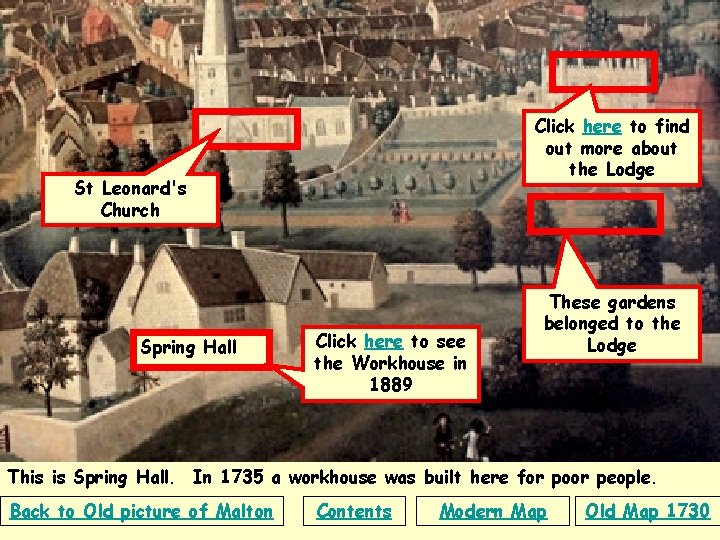
Click here to find out more about the Lodge St Leonard's Church Spring Hall Click here to see the Workhouse in 1889 These gardens belonged to the Lodge This is Spring Hall. In 1735 a workhouse was built here for poor people. Back to Old picture of Malton Contents Modern Map Old Map 1730
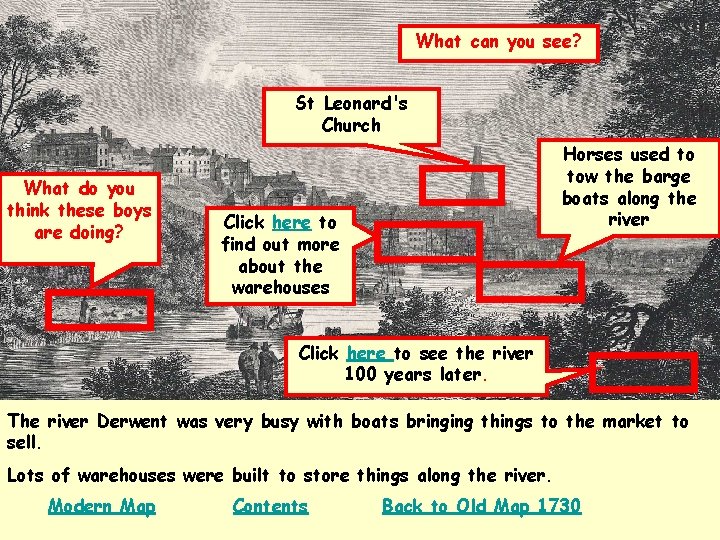
What can you see? St Leonard's Church What do you think these boys are doing? Horses used to tow the barge boats along the river Click here to find out more about the warehouses Click here to see the river 100 years later. The river Derwent was very busy with boats bringing things to the market to sell. Lots of warehouses were built to store things along the river. Modern Map Contents Back to Old Map 1730
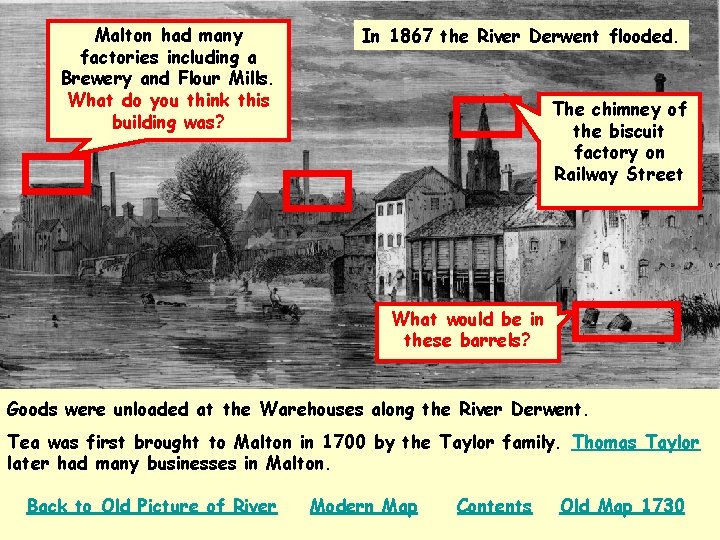
Malton had many factories including a Brewery and Flour Mills. What do you think this building was? In 1867 the River Derwent flooded. The chimney of the biscuit factory on Railway Street What would be in these barrels? Goods were unloaded at the Warehouses along the River Derwent. Tea was first brought to Malton in 1700 by the Taylor family. Thomas Taylor later had many businesses in Malton. Back to Old Picture of River Modern Map Contents Old Map 1730
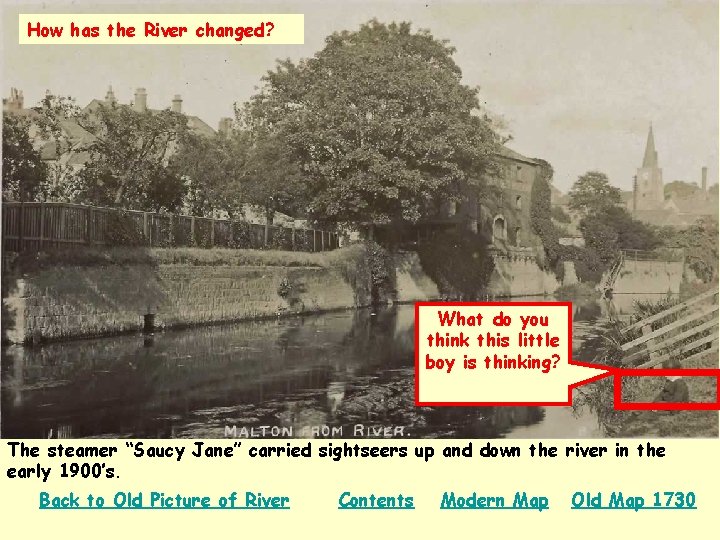
How has the River changed? What do you think this little boy is thinking? The steamer “Saucy Jane” carried sightseers up and down the river in the early 1900’s. Back to Old Picture of River Contents Modern Map Old Map 1730
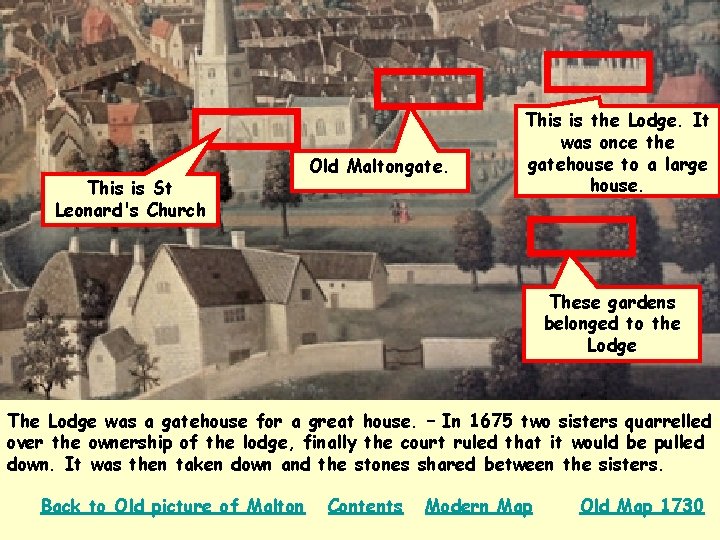
This is St Leonard's Church Old Maltongate. This is the Lodge. It was once the gatehouse to a large house. These gardens belonged to the Lodge The Lodge was a gatehouse for a great house. – In 1675 two sisters quarrelled over the ownership of the lodge, finally the court ruled that it would be pulled down. It was then taken down and the stones shared between the sisters. Back to Old picture of Malton Contents Modern Map Old Map 1730
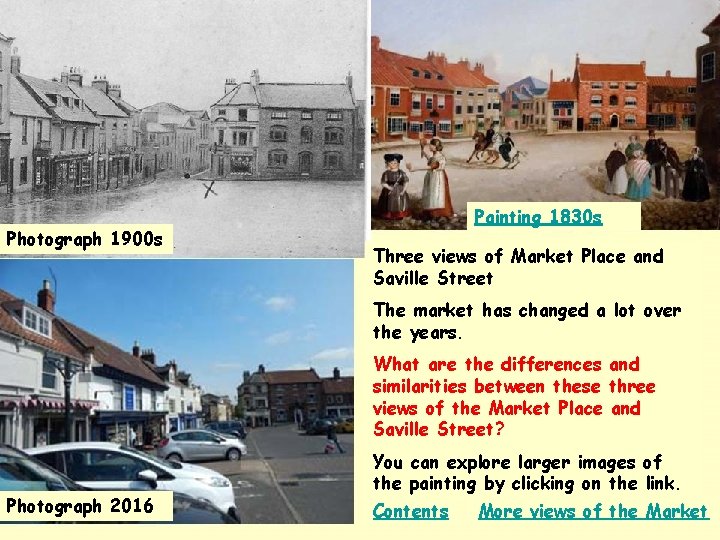
Photograph 1900 s Painting 1830 s Three views of Market Place and Saville Street The market has changed a lot over the years. What are the differences and similarities between these three views of the Market Place and Saville Street? Photograph 2016 You can explore larger images of the painting by clicking on the link. Contents More views of the Market
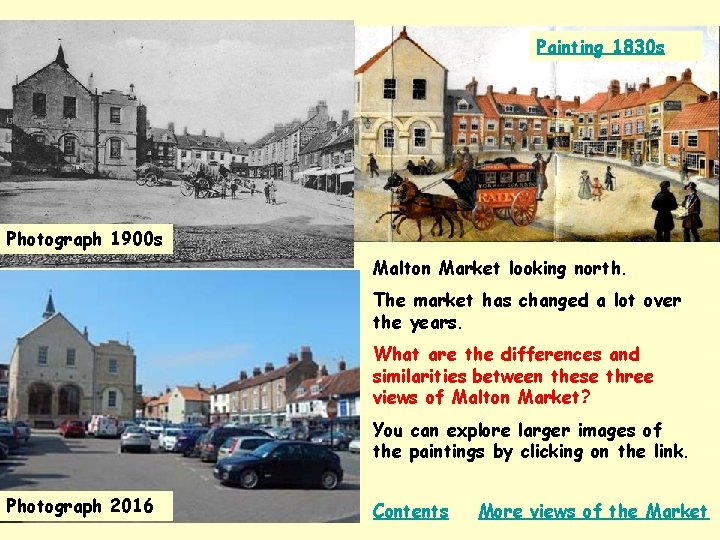
Painting 1830 s Photograph 1900 s Malton Market looking north. The market has changed a lot over the years. What are the differences and similarities between these three views of Malton Market? You can explore larger images of the paintings by clicking on the link. Photograph 2016 Contents More views of the Market
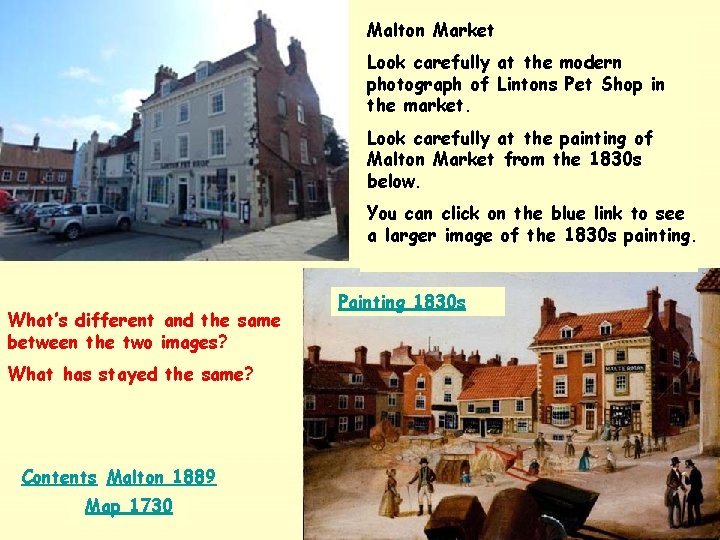
Malton Market Look carefully at the modern photograph of Lintons Pet Shop in the market. Look carefully at the painting of Malton Market from the 1830 s below. You can click on the blue link to see a larger image of the 1830 s painting. What’s different and the same between the two images? What has stayed the same? Contents Malton 1889 Map 1730 Painting 1830 s
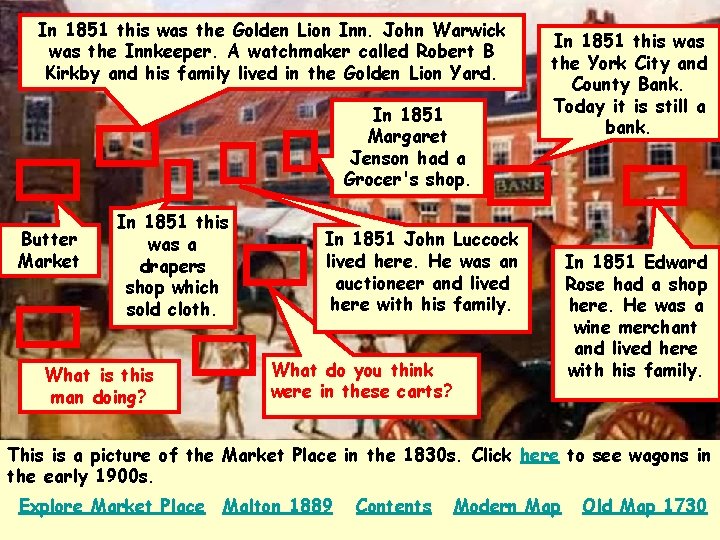
In 1851 this was the Golden Lion Inn. John Warwick was the Innkeeper. A watchmaker called Robert B Kirkby and his family lived in the Golden Lion Yard. In 1851 Margaret Jenson had a Grocer's shop. Butter Market In 1851 this was a drapers shop which sold cloth. What is this man doing? In 1851 this was the York City and County Bank. Today it is still a bank. In 1851 John Luccock lived here. He was an auctioneer and lived here with his family. What do you think were in these carts? In 1851 Edward Rose had a shop here. He was a wine merchant and lived here with his family. This is a picture of the Market Place in the 1830 s. Click here to see wagons in the early 1900 s. Explore Market Place Malton 1889 Contents Modern Map Old Map 1730
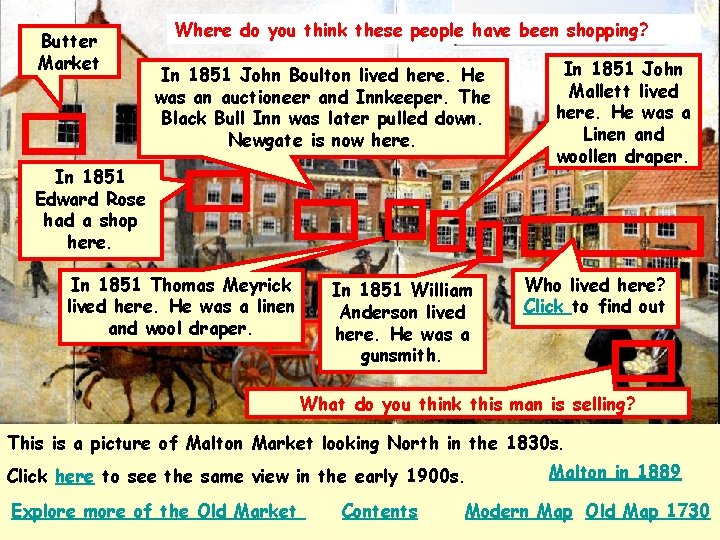
Butter Market Where do you think these people have been shopping? In 1851 John Boulton lived here. He was an auctioneer and Innkeeper. The Black Bull Inn was later pulled down. Newgate is now here. In 1851 Edward Rose had a shop here. In 1851 Thomas Meyrick lived here. He was a linen and wool draper. In 1851 William Anderson lived here. He was a gunsmith. In 1851 John Mallett lived here. He was a Linen and woollen draper. Who lived here? Click to find out What do you think this man is selling? This is a picture of Malton Market looking North in the 1830 s. Click here to see the same view in the early 1900 s. Explore more of the Old Market Contents Malton in 1889 Modern Map Old Map 1730
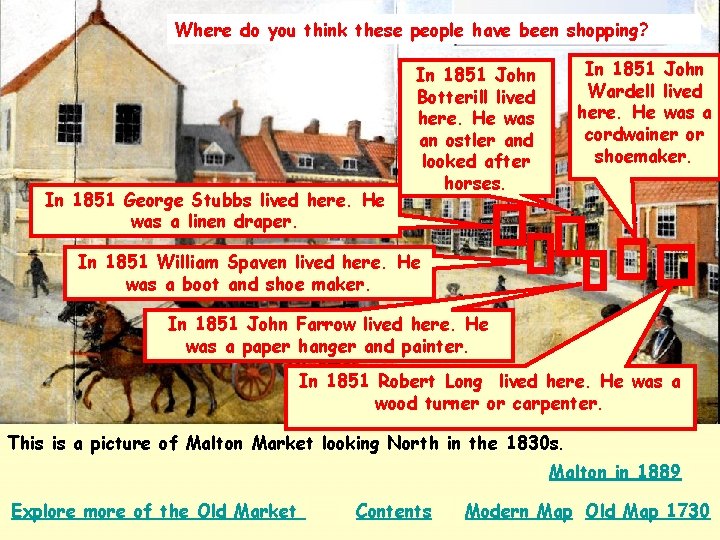
Where do you think these people have been shopping? In 1851 George Stubbs lived here. He was a linen draper. In 1851 John Wardell lived here. He was a cordwainer or shoemaker. In 1851 John Botterill lived here. He was an ostler and looked after horses. In 1851 William Spaven lived here. He was a boot and shoe maker. In 1851 John Farrow lived here. He was a paper hanger and painter. In 1851 Robert Long lived here. He was a wood turner or carpenter. This is a picture of Malton Market looking North in the 1830 s. Malton in 1889 Explore more of the Old Market Contents Modern Map Old Map 1730
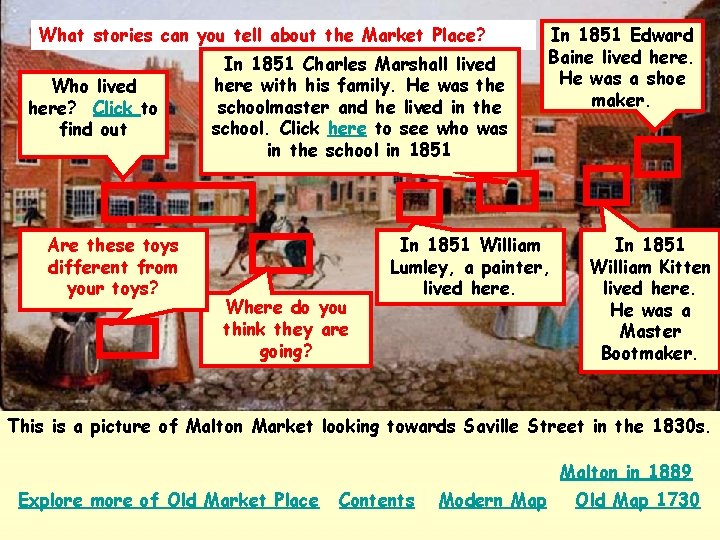
What stories can you tell about the Market Place? Who lived here? Click to find out Are these toys different from your toys? In 1851 Charles Marshall lived here with his family. He was the schoolmaster and he lived in the school. Click here to see who was in the school in 1851 Where do you think they are going? In 1851 Edward Baine lived here. He was a shoe maker. In 1851 William Lumley, a painter, lived here. In 1851 William Kitten lived here. He was a Master Bootmaker. This is a picture of Malton Market looking towards Saville Street in the 1830 s. Malton in 1889 Explore more of Old Market Place Contents Modern Map Old Map 1730
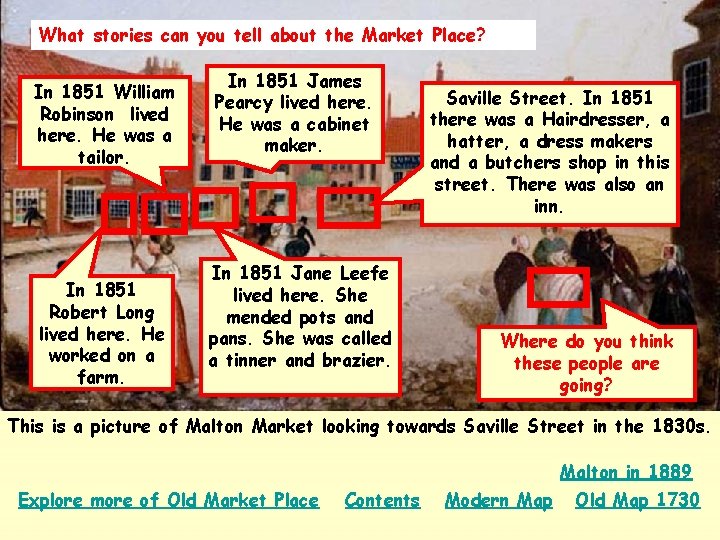
What stories can you tell about the Market Place? In 1851 William Robinson lived here. He was a tailor. In 1851 Robert Long lived here. He worked on a farm. In 1851 James Pearcy lived here. He was a cabinet maker. In 1851 Jane Leefe lived here. She mended pots and pans. She was called a tinner and brazier. Saville Street. In 1851 there was a Hairdresser, a hatter, a dress makers and a butchers shop in this street. There was also an inn. Where do you think these people are going? This is a picture of Malton Market looking towards Saville Street in the 1830 s. Malton in 1889 Explore more of Old Market Place Contents Modern Map Old Map 1730
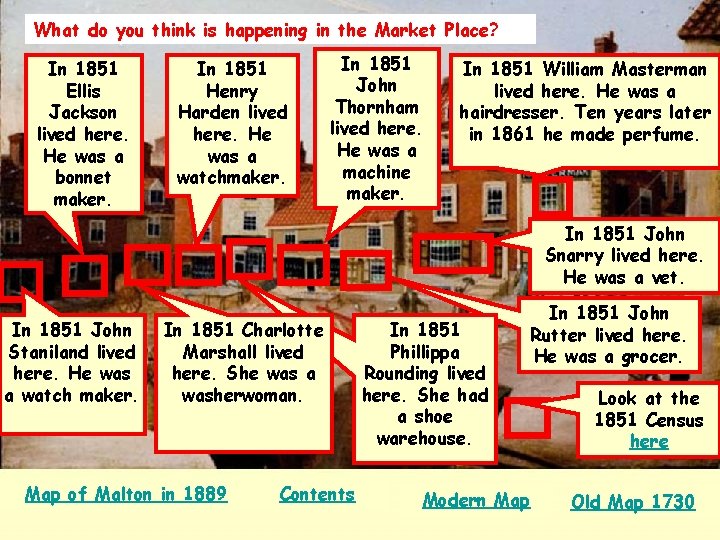
What do you think is happening in the Market Place? In 1851 Ellis Jackson lived here. He was a bonnet maker. In 1851 Henry Harden lived here. He was a watchmaker. In 1851 John Thornham lived here. He was a machine maker. In 1851 William Masterman lived here. He was a hairdresser. Ten years later in 1861 he made perfume. In 1851 John Snarry lived here. He was a vet. In 1851 John Staniland lived here. He was a watch maker. In 1851 Charlotte Marshall lived here. She was a washerwoman. Map of Malton in 1889 Contents In 1851 Phillippa Rounding lived here. She had a shoe warehouse. Modern Map In 1851 John Rutter lived here. He was a grocer. Look at the 1851 Census here Old Map 1730
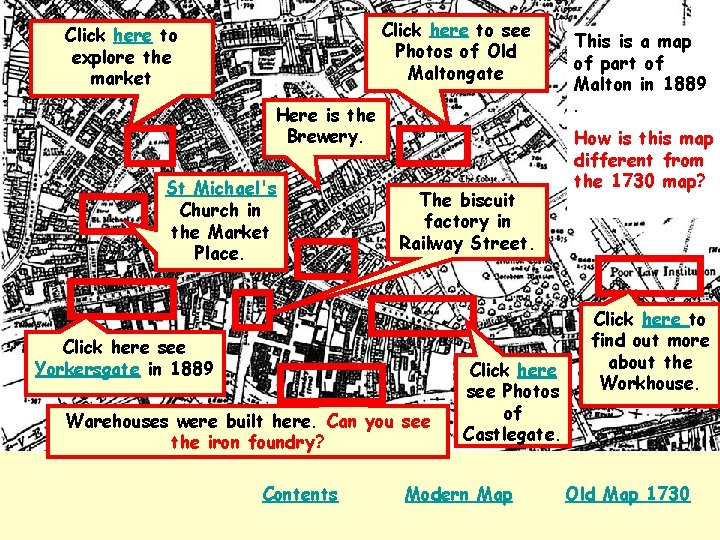
Click here to see Photos of Old Maltongate Click here to explore the market Here is the Brewery. St Michael's Church in the Market Place. The biscuit factory in Railway Street. Click here see Yorkersgate in 1889 Warehouses were built here. Can you see the iron foundry? Contents Click here see Photos of Castlegate. Modern Map This is a map of part of Malton in 1889. How is this map different from the 1730 map? Click here to find out more about the Workhouse. Old Map 1730
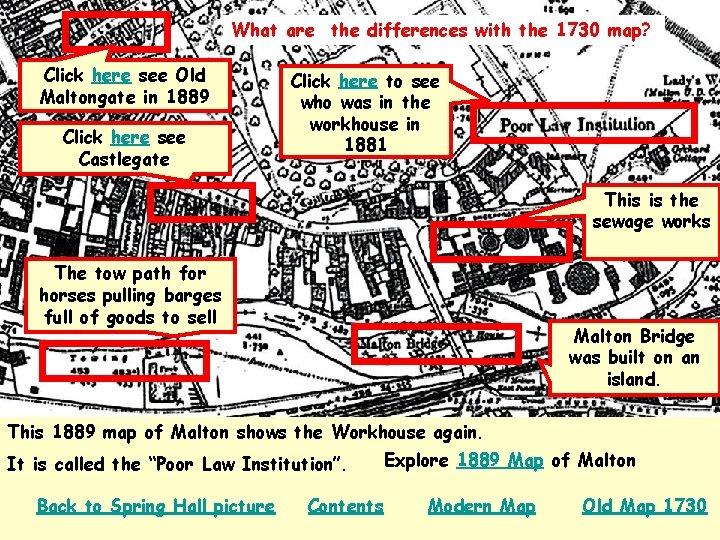
What are the differences with the 1730 map? Click here see Old Maltongate in 1889 Click here see Castlegate Click here to see who was in the workhouse in 1881 This is the sewage works The tow path for horses pulling barges full of goods to sell Malton Bridge was built on an island. This 1889 map of Malton shows the Workhouse again. It is called the “Poor Law Institution”. Back to Spring Hall picture Contents Explore 1889 Map of Malton Modern Map Old Map 1730
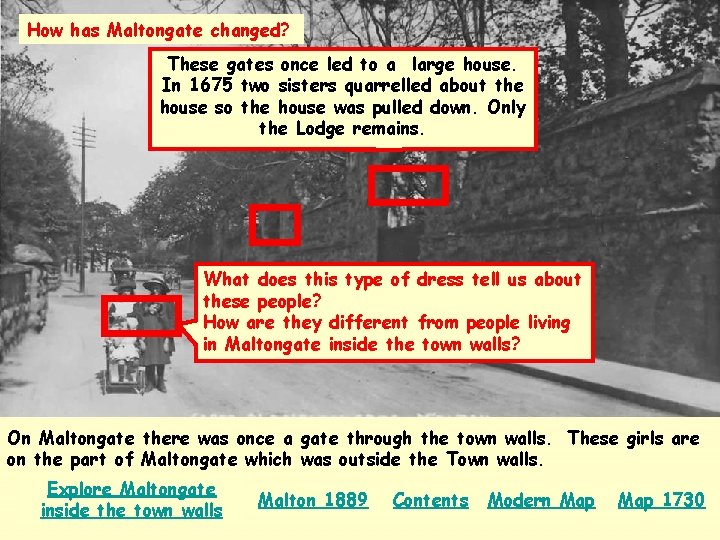
How has Maltongate changed? These gates once led to a large house. In 1675 two sisters quarrelled about the house so the house was pulled down. Only the Lodge remains. What does this type of dress tell us about these people? How are they different from people living in Maltongate inside the town walls? On Maltongate there was once a gate through the town walls. These girls are on the part of Maltongate which was outside the Town walls. Explore Maltongate inside the town walls Malton 1889 Contents Modern Map 1730

How has Old Maltongate changed? How long do you think they would have had to wait for the photograph to be taken? On Maltongate there was once a gate through the town walls. These people are on the part of Maltongate which was inside the town walls. Map of Malton in 1889 Contents Modern Map Old Map 1730
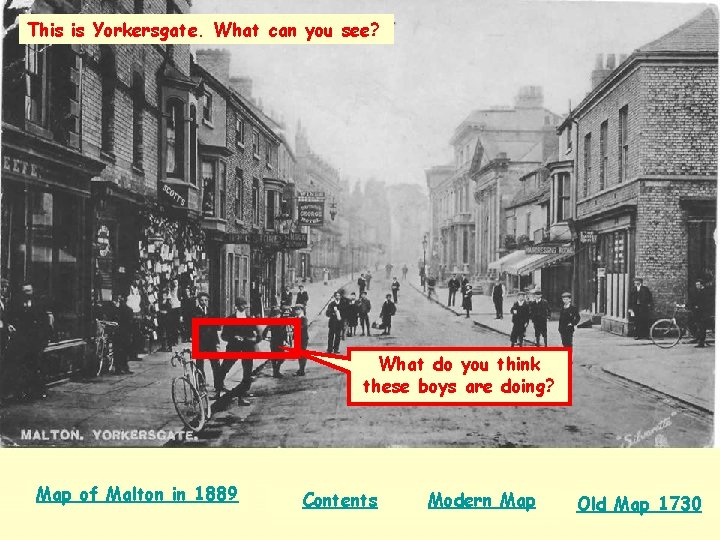
This is Yorkersgate. What can you see? What do you think these boys are doing? Map of Malton in 1889 Contents Modern Map Old Map 1730
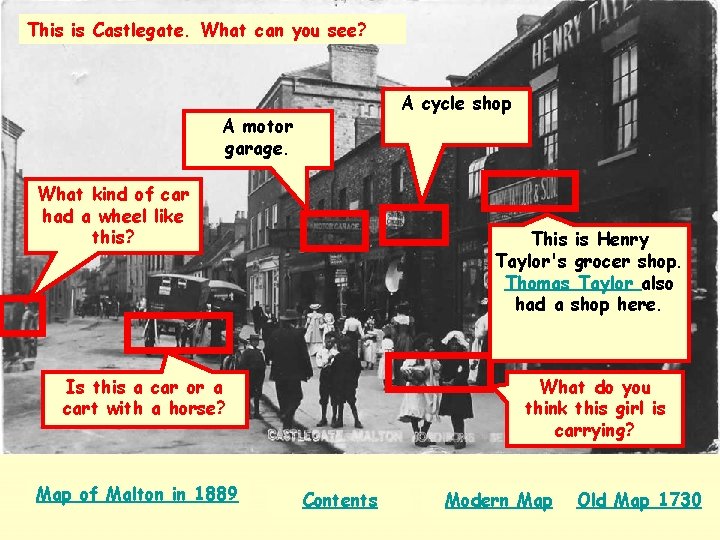
This is Castlegate. What can you see? A cycle shop A motor garage. What kind of car had a wheel like this? This is Henry Taylor's grocer shop. Thomas Taylor also had a shop here. Is this a car or a cart with a horse? Map of Malton in 1889 What do you think this girl is carrying? Contents Modern Map Old Map 1730
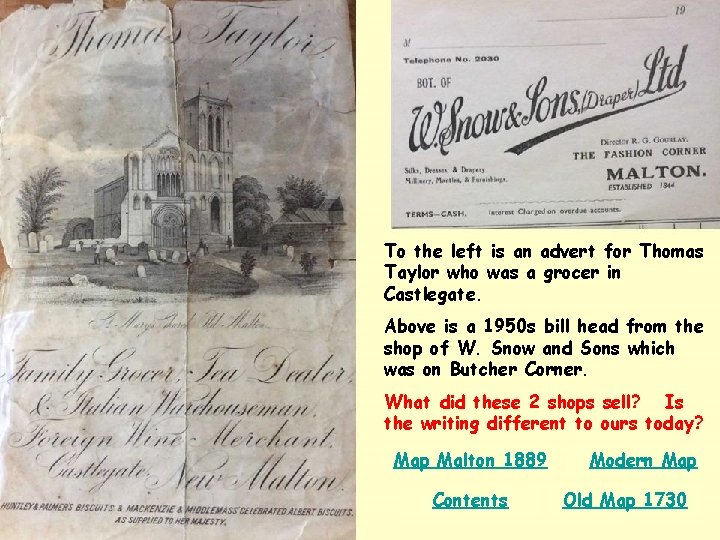
To the left is an advert for Thomas Taylor who was a grocer in Castlegate. Above is a 1950 s bill head from the shop of W. Snow and Sons which was on Butcher Corner. What did these 2 shops sell? Is the writing different to ours today? Map Malton 1889 Contents Modern Map Old Map 1730
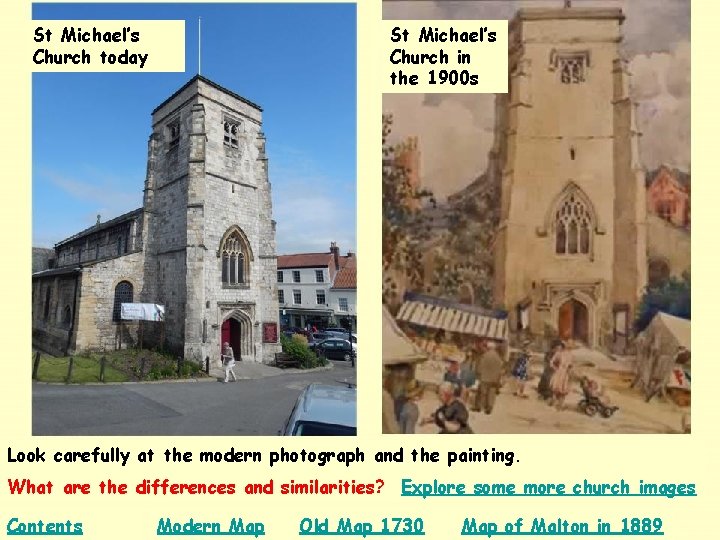
St Michael’s Church in the 1900 s St Michael’s Church today Look carefully at the modern photograph and the painting. What are the differences and similarities? Explore some more church images Contents Modern Map Old Map 1730 Map of Malton in 1889
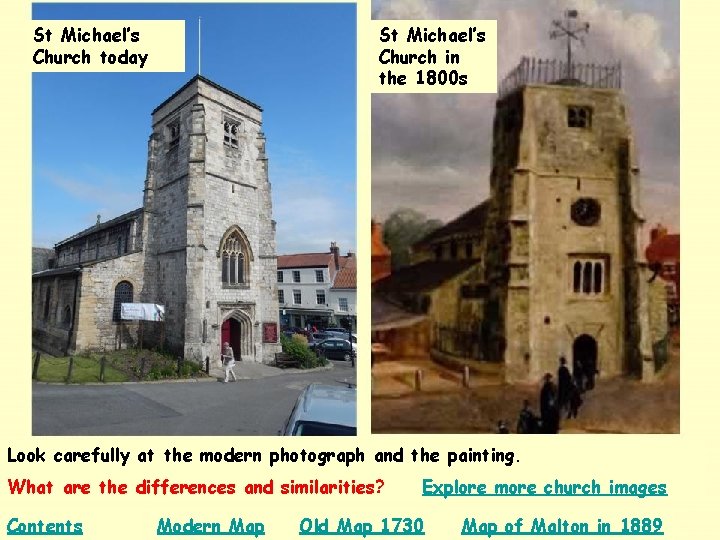
St Michael’s Church in the 1800 s St Michael’s Church today Look carefully at the modern photograph and the painting. What are the differences and similarities? Contents Modern Map Explore more church images Old Map 1730 Map of Malton in 1889
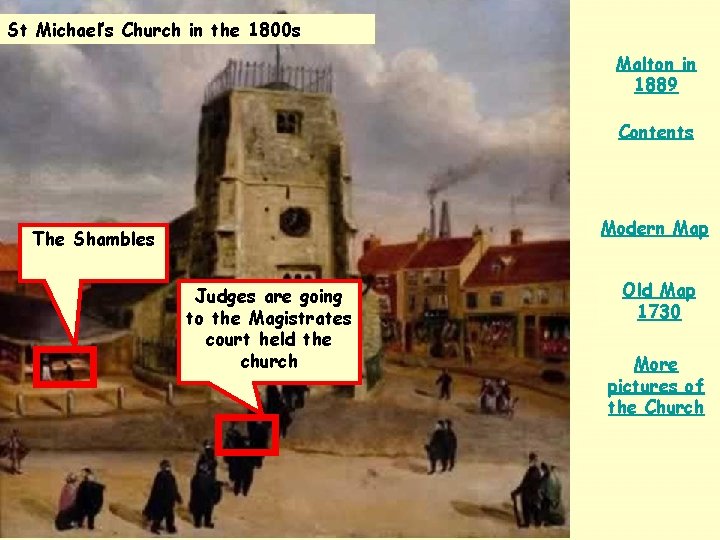
St Michael’s Church in the 1800 s Malton in 1889 Contents Modern Map The Shambles Judges are going to the Magistrates court held the church Old Map 1730 More pictures of the Church
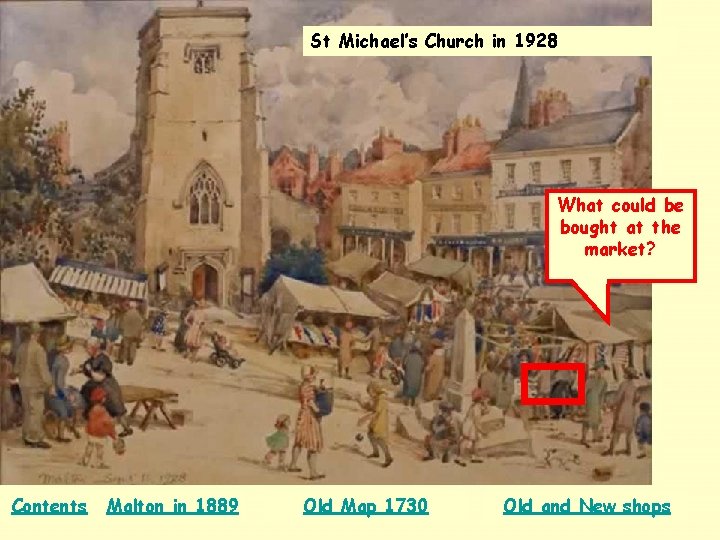
St Michael’s Church in 1928 What could be bought at the market? Contents Malton in 1889 Old Map 1730 Old and New shops
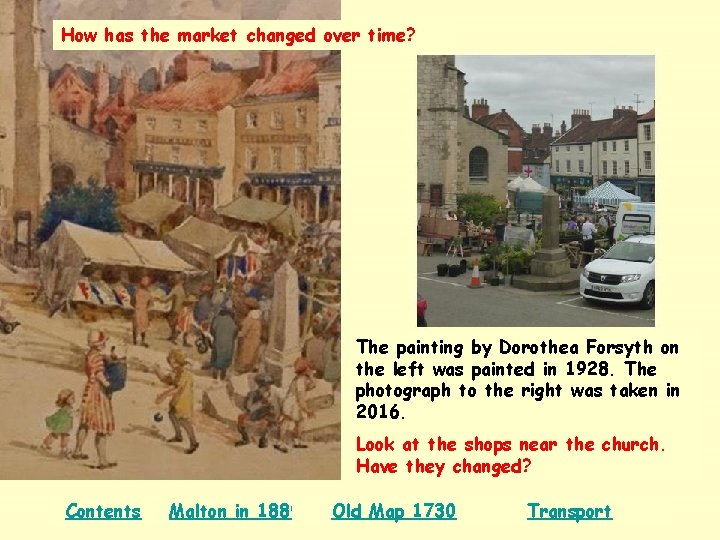
How has the market changed over time? The painting by Dorothea Forsyth on the left was painted in 1928. The photograph to the right was taken in 2016. Look at the shops near the church. Have they changed? Contents Malton in 1889 Old Map 1730 Transport
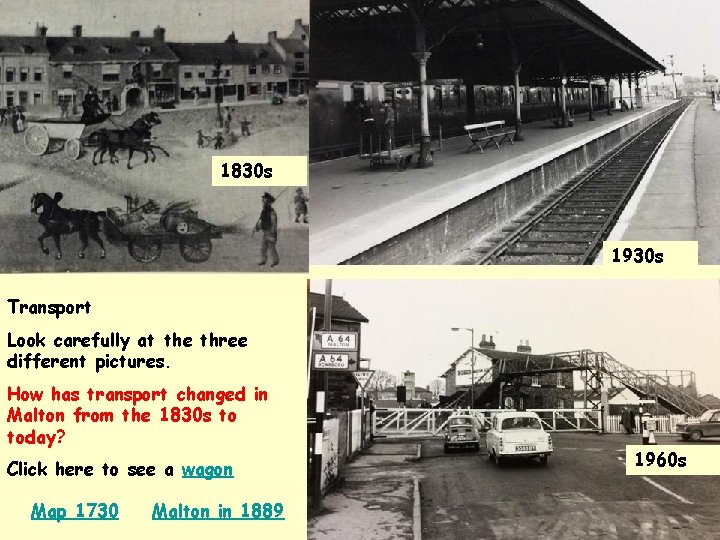
1830 s 1930 s Transport Look carefully at the three different pictures. How has transport changed in Malton from the 1830 s to today? Click here to see a wagon Map 1730 Malton in 1889 1960 s
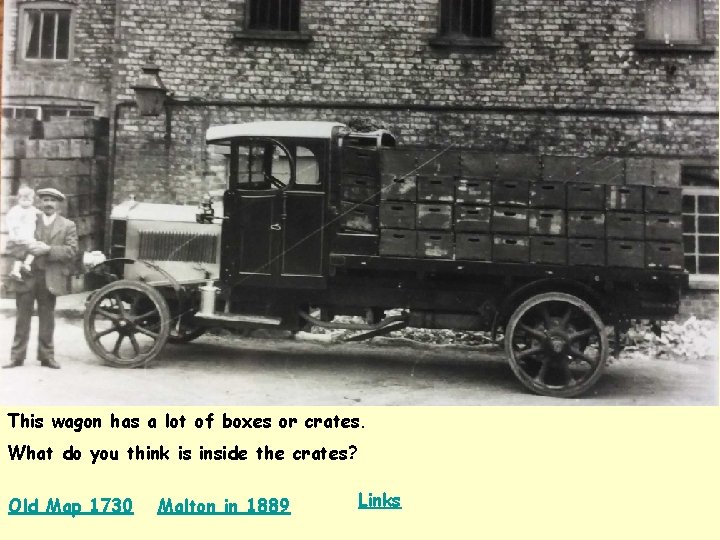
This wagon has a lot of boxes or crates. What do you think is inside the crates? Old Map 1730 Malton in 1889 Links
THE MARVELLOUS MAP OF MALTON We hope you have enjoyed exploring the Marvellous Map of Malton. We have looked at a lot of primary sources including maps, paintings and photographs. We have also explored the Census of Malton in 1851, the Census of Malton School in 1851 and the Workhouse in 1881. Visit Malton Museum for more information on the history of Malton in the new exhibition Malton Goes to Market. There is also a Resource box to accompany this digital resource. It can be obtained by contacting Malton museum www. maltonmuseum. co. uk LINKS If you would like to find out more about Malton there is a useful website here http: //www. maltonhistory. info/ which explores different themes over time such as transport. There is a currency converter on the National Archives website CREDITS
SOURCES USED Maps 1730 Map of Malton courtesy of Fitzwilliam Estate 1889 Map of Malton and 1950 Map of Malton We have also explored the Census of Malton in 1851, the Census of Malton School in 1851 and the Workhouse in 1881. We have a glossary of all the different trades in the Census. We have a explained some of the difficult words as well. We are very grateful to have been given permission to use photographs of Malton from http: //www. maltonhistory. info/ This resource was produced by volunteers from Malton Museum and a small team of Primary school teachers from the Ryedale Area together with Gillian Waters Consultancy.
- Slides: 37