
MARTIN LUTHER AND THE REFORMATION IN GERMANY Martin
- Slides: 13
MARTIN LUTHER AND THE REFORMATION IN GERMANY
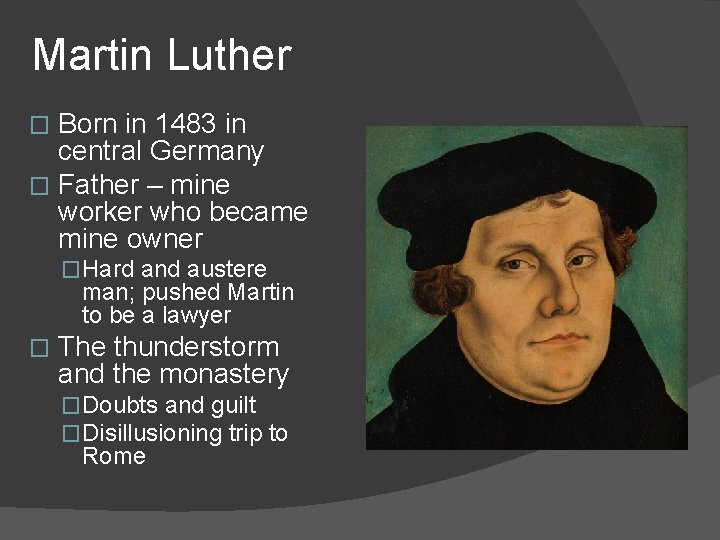
Martin Luther Born in 1483 in central Germany � Father – mine worker who became mine owner � �Hard and austere man; pushed Martin to be a lawyer � The thunderstorm and the monastery �Doubts and guilt �Disillusioning trip to Rome
“He was a tough, four-square man of peasant stock, with deep-set disturbing eyes and a character as open as daylight. His mind was active and vigorous, but he was no gymnast of the intellect, a man earnest and persevering rather than subtle and delicate in discrimination. His friends always respected him with an affectionate and sometimes rueful regard, knowing that he held nothing back from them, erected no screen, allowed them to touch his real inwardness. He never ceased to be a peasant, and was proud of his peasant blood. He could be rough in language, vulgar, crude, coarse. He had humor and loud laughter, but not wit. ” Owen Chadwick
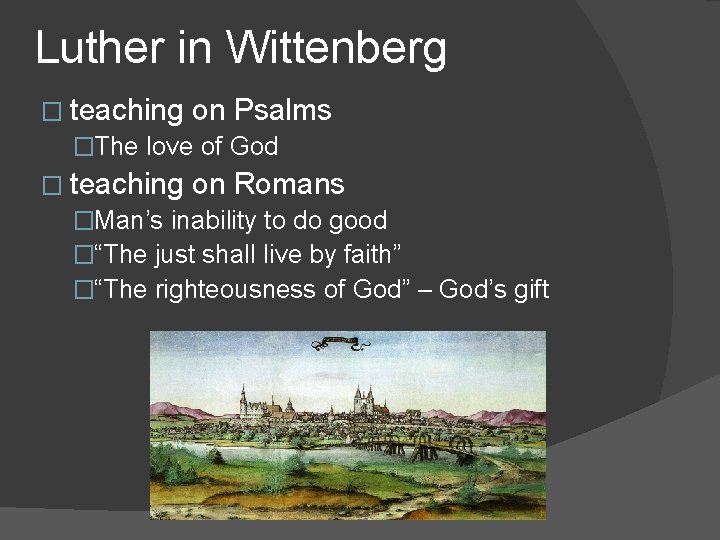
Luther in Wittenberg � teaching on Psalms �The love of God � teaching on Romans �Man’s inability to do good �“The just shall live by faith” �“The righteousness of God” – God’s gift
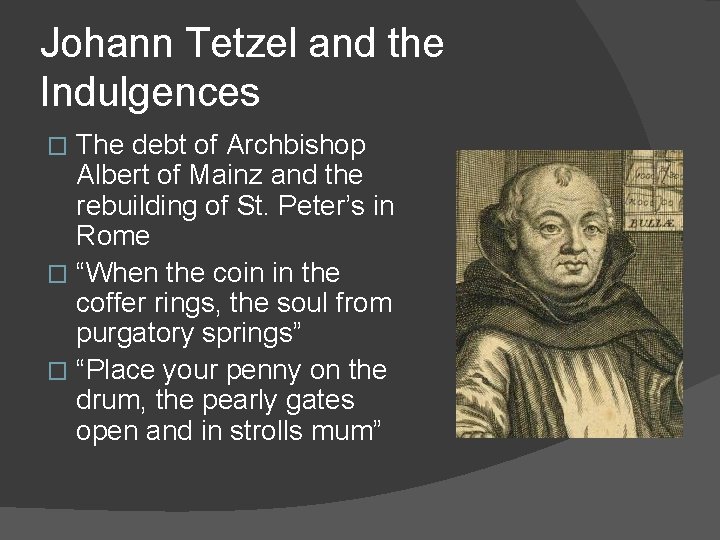
Johann Tetzel and the Indulgences The debt of Archbishop Albert of Mainz and the rebuilding of St. Peter’s in Rome � “When the coin in the coffer rings, the soul from purgatory springs” � “Place your penny on the drum, the pearly gates open and in strolls mum” �
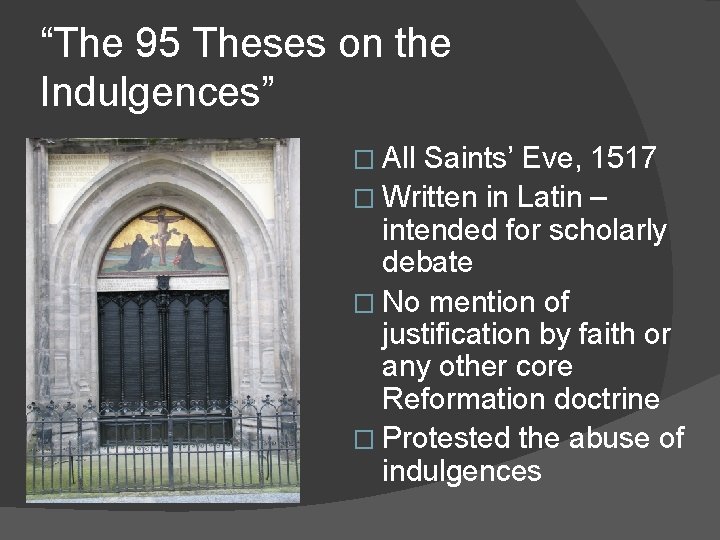
“The 95 Theses on the Indulgences” � All Saints’ Eve, 1517 � Written in Latin – intended for scholarly debate � No mention of justification by faith or any other core Reformation doctrine � Protested the abuse of indulgences
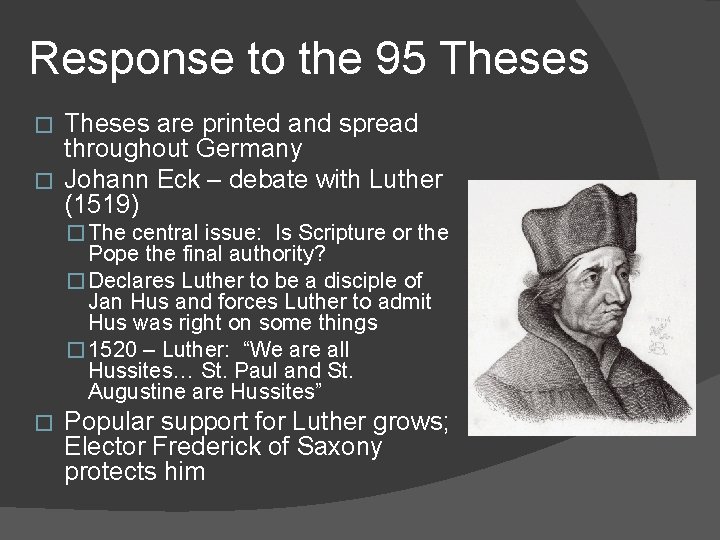
Response to the 95 Theses are printed and spread throughout Germany � Johann Eck – debate with Luther (1519) � � The central issue: Is Scripture or the Pope the final authority? � Declares Luther to be a disciple of Jan Hus and forces Luther to admit Hus was right on some things � 1520 – Luther: “We are all Hussites… St. Paul and St. Augustine are Hussites” � Popular support for Luther grows; Elector Frederick of Saxony protects him
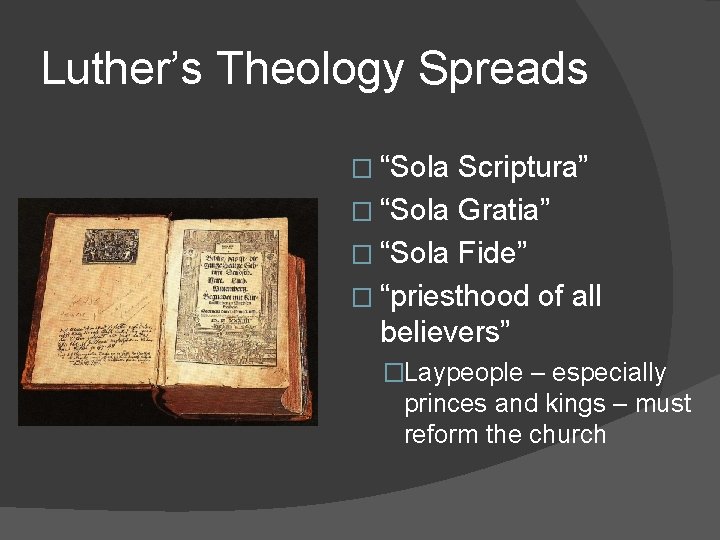
Luther’s Theology Spreads � “Sola Scriptura” � “Sola Gratia” � “Sola Fide” � “priesthood of all believers” �Laypeople – especially princes and kings – must reform the church
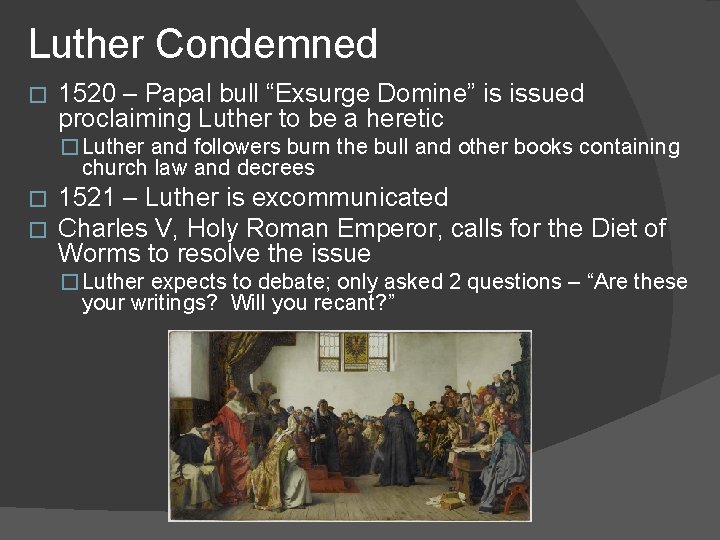
Luther Condemned � 1520 – Papal bull “Exsurge Domine” is issued proclaiming Luther to be a heretic � Luther and followers burn the bull and other books containing church law and decrees � � 1521 – Luther is excommunicated Charles V, Holy Roman Emperor, calls for the Diet of Worms to resolve the issue � Luther expects to debate; only asked 2 questions – “Are these your writings? Will you recant? ”
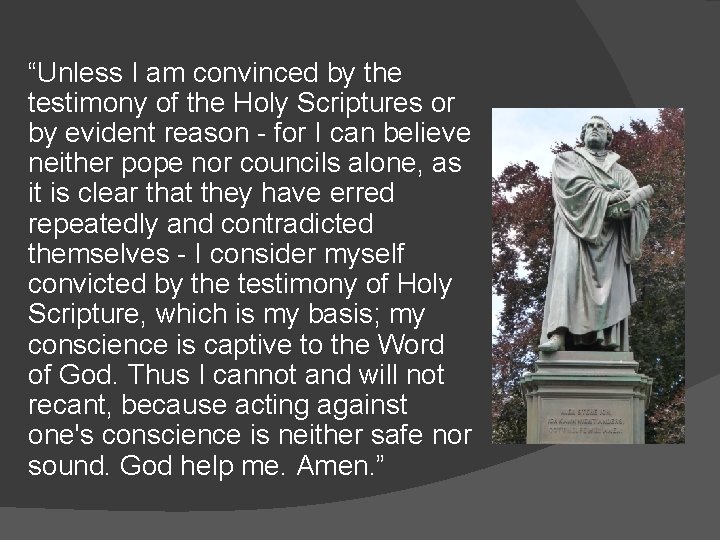
“Unless I am convinced by the testimony of the Holy Scriptures or by evident reason - for I can believe neither pope nor councils alone, as it is clear that they have erred repeatedly and contradicted themselves - I consider myself convicted by the testimony of Holy Scripture, which is my basis; my conscience is captive to the Word of God. Thus I cannot and will not recant, because acting against one's conscience is neither safe nor sound. God help me. Amen. ”
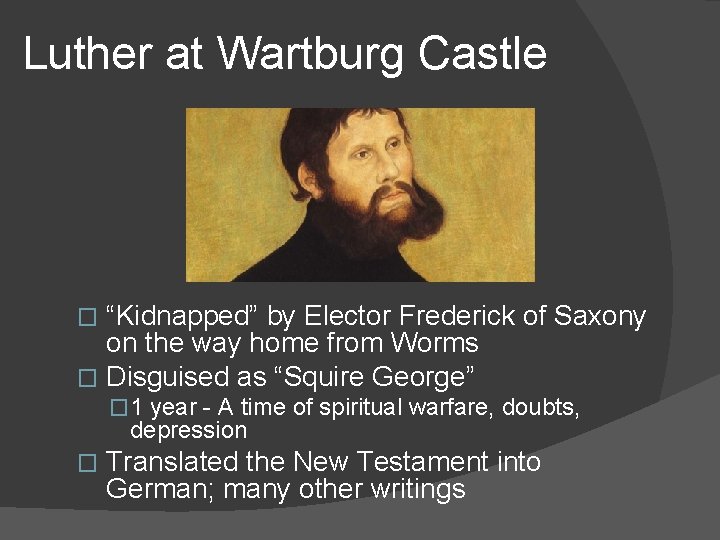
Luther at Wartburg Castle “Kidnapped” by Elector Frederick of Saxony on the way home from Worms � Disguised as “Squire George” � � 1 year - A time of spiritual warfare, doubts, depression � Translated the New Testament into German; many other writings
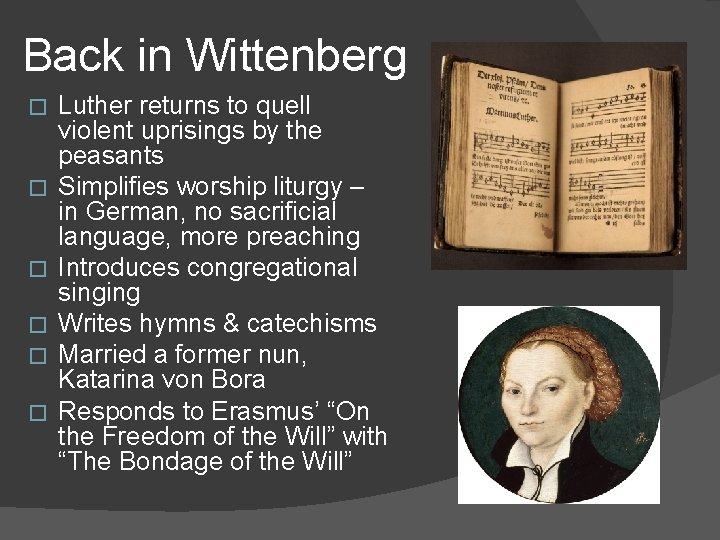
Back in Wittenberg � � � Luther returns to quell violent uprisings by the peasants Simplifies worship liturgy – in German, no sacrificial language, more preaching Introduces congregational singing Writes hymns & catechisms Married a former nun, Katarina von Bora Responds to Erasmus’ “On the Freedom of the Will” with “The Bondage of the Will”
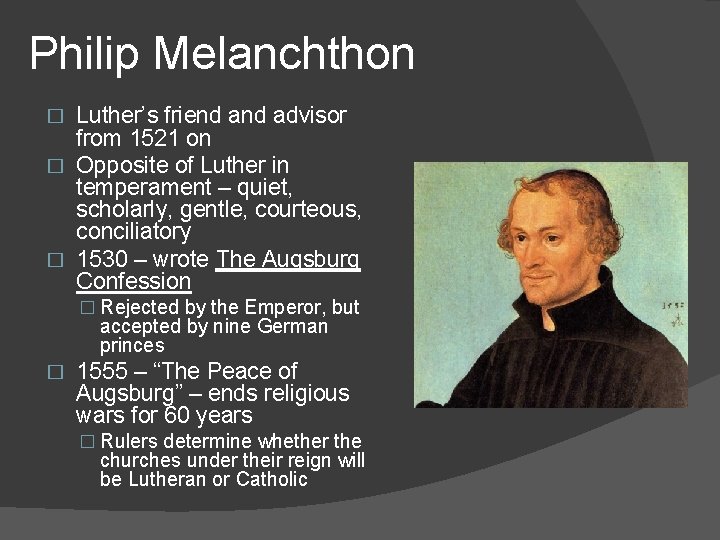
Philip Melanchthon Luther’s friend advisor from 1521 on � Opposite of Luther in temperament – quiet, scholarly, gentle, courteous, conciliatory � 1530 – wrote The Augsburg Confession � � Rejected by the Emperor, but accepted by nine German princes � 1555 – “The Peace of Augsburg” – ends religious wars for 60 years � Rulers determine whether the churches under their reign will be Lutheran or Catholic