
Martin Luther and the Protestant Reformation The invention
- Slides: 24
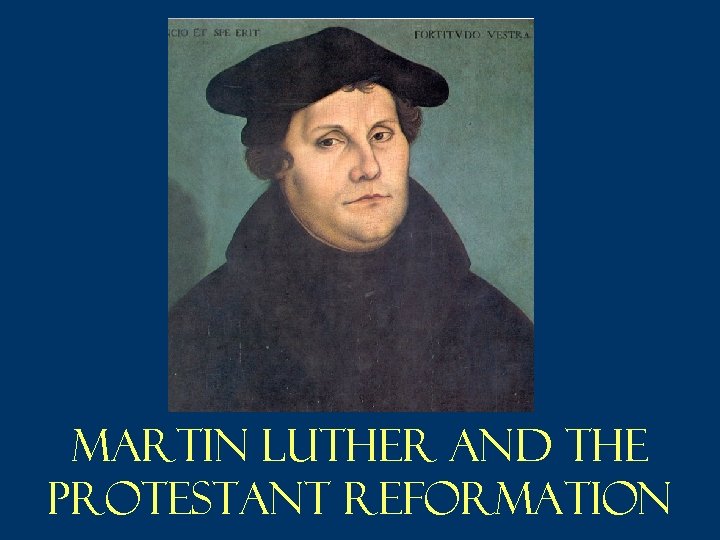
Martin Luther and the Protestant Reformation
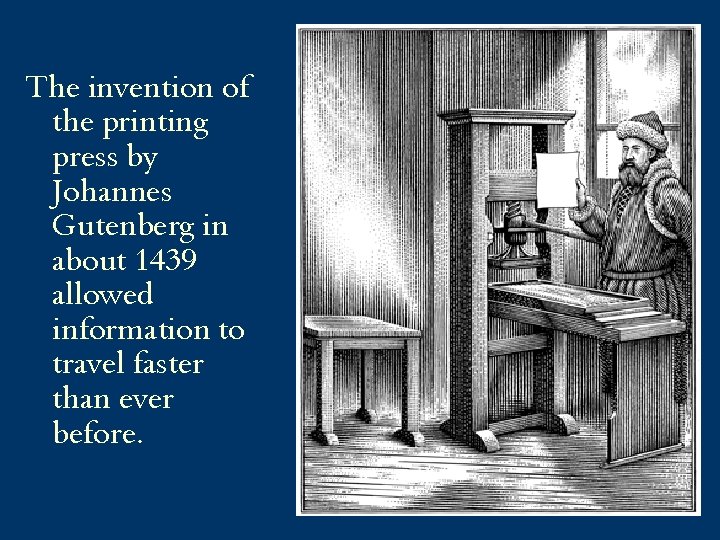
The invention of the printing press by Johannes Gutenberg in about 1439 allowed information to travel faster than ever before.
Four Theological Questions We might frame our discussion of the Protestant Reformation around four theological questions whose answers were revised by Martin Luther: 1) 2) 3) 4) How is a person to be saved? Where does religious authority reside? What is the church composed of? What is the highest form of Christian life?
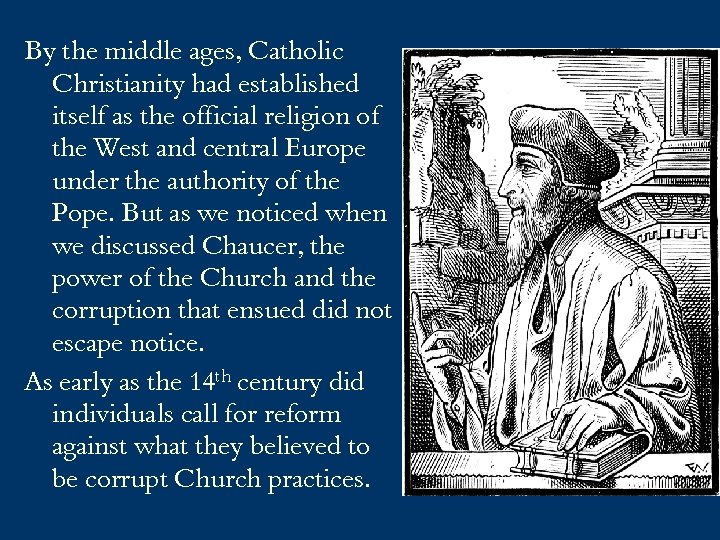
By the middle ages, Catholic Christianity had established itself as the official religion of the West and central Europe under the authority of the Pope. But as we noticed when we discussed Chaucer, the power of the Church and the corruption that ensued did not escape notice. As early as the 14 th century did individuals call for reform against what they believed to be corrupt Church practices.
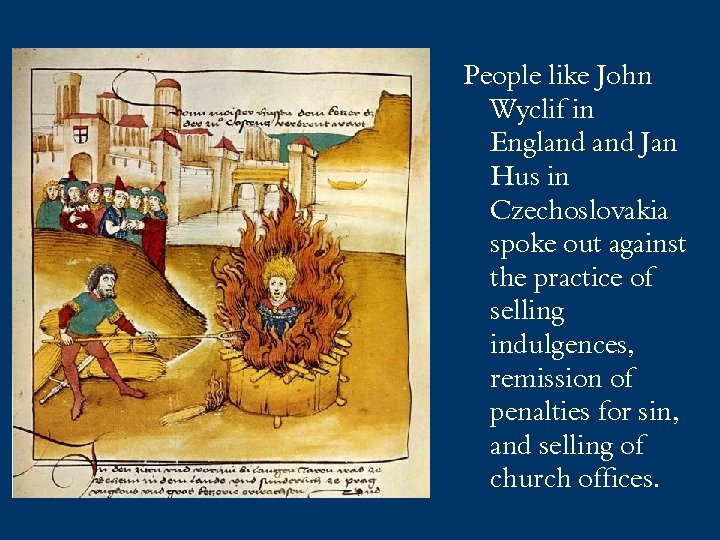
People like John Wyclif in England Jan Hus in Czechoslovakia spoke out against the practice of selling indulgences, remission of penalties for sin, and selling of church offices.
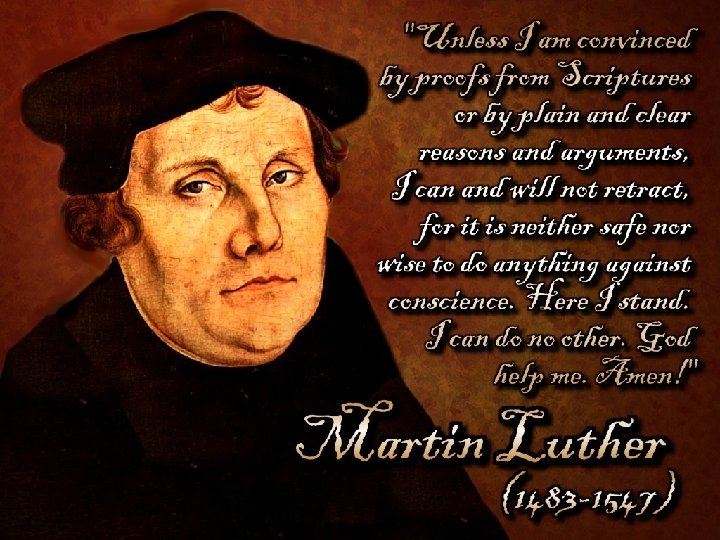
Martin Luther (1483 -1546) was born in Eisleben (Saxony, Germany) into a middle class family. He attended monastery school, obtained degrees from the University of Erfurt, and is trained as a lawyer. Luther has a conversion experience in 1505 when he is almost struck by lightning, and enters an Augustinian order against his father’s wishes. He becomes Professor of Biblical Theology at the University of Wittenberg in Saxony.
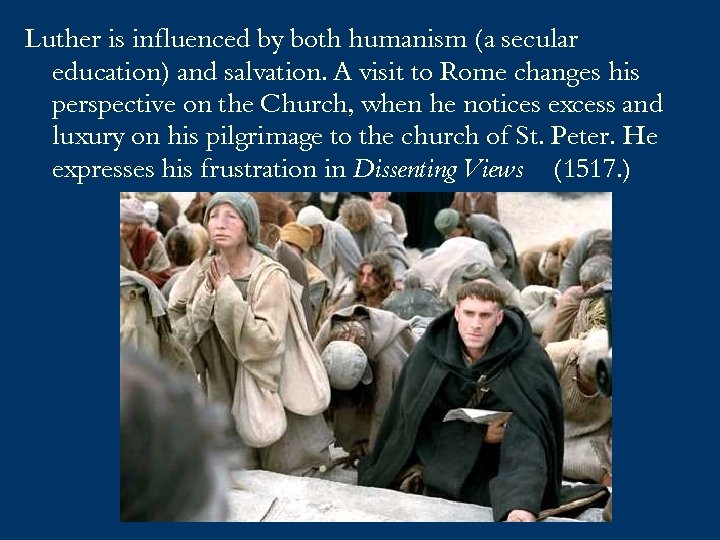
Luther is influenced by both humanism (a secular education) and salvation. A visit to Rome changes his perspective on the Church, when he notices excess and luxury on his pilgrimage to the church of St. Peter. He expresses his frustration in Dissenting Views (1517. )
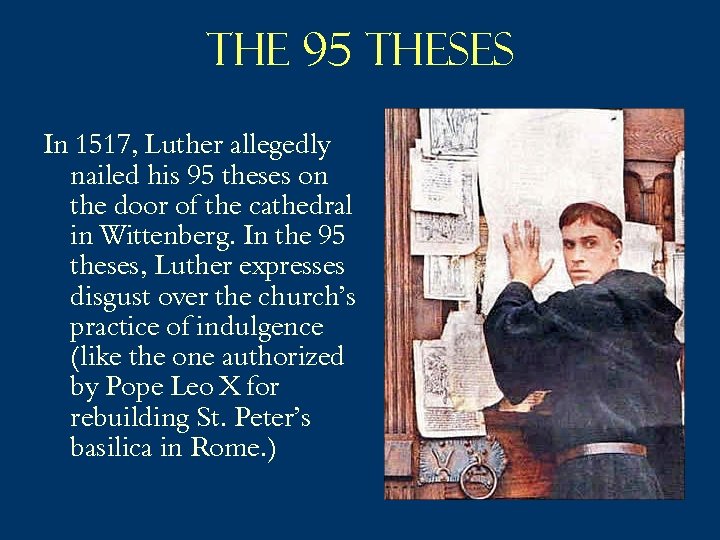
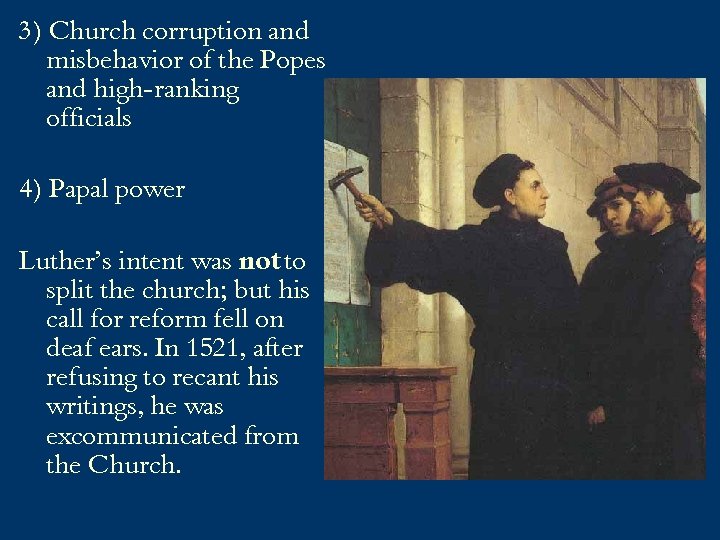
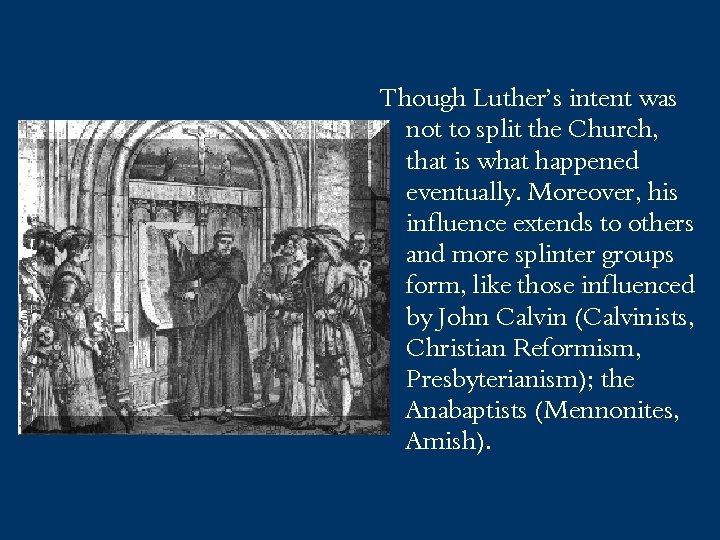
The 95 theses In 1517, Luther allegedly nailed his 95 theses on the door of the cathedral in Wittenberg. In the 95 theses, Luther expresses disgust over the church’s practice of indulgence (like the one authorized by Pope Leo X for rebuilding St. Peter’s basilica in Rome. )
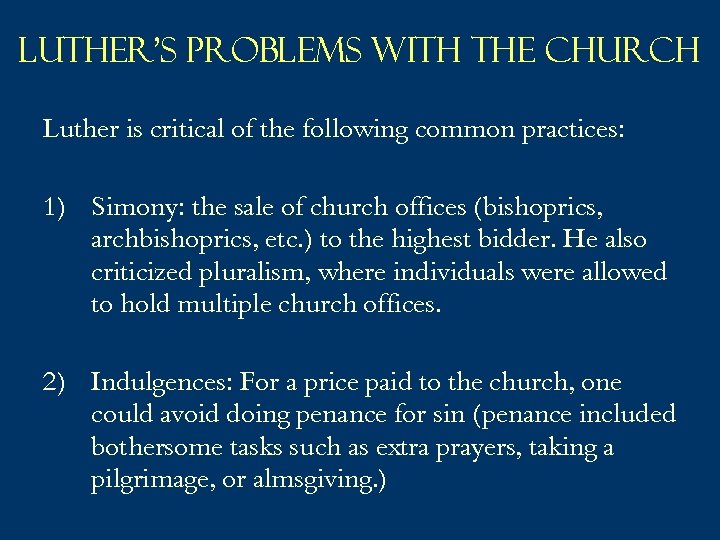
Luther’s Problems with the Church Luther is critical of the following common practices: 1) Simony: the sale of church offices (bishoprics, archbishoprics, etc. ) to the highest bidder. He also criticized pluralism, where individuals were allowed to hold multiple church offices. 2) Indulgences: For a price paid to the church, one could avoid doing penance for sin (penance included bothersome tasks such as extra prayers, taking a pilgrimage, or almsgiving. )
3) Church corruption and misbehavior of the Popes and high-ranking officials 4) Papal power Luther’s intent was not to split the church; but his call for reform fell on deaf ears. In 1521, after refusing to recant his writings, he was excommunicated from the Church.
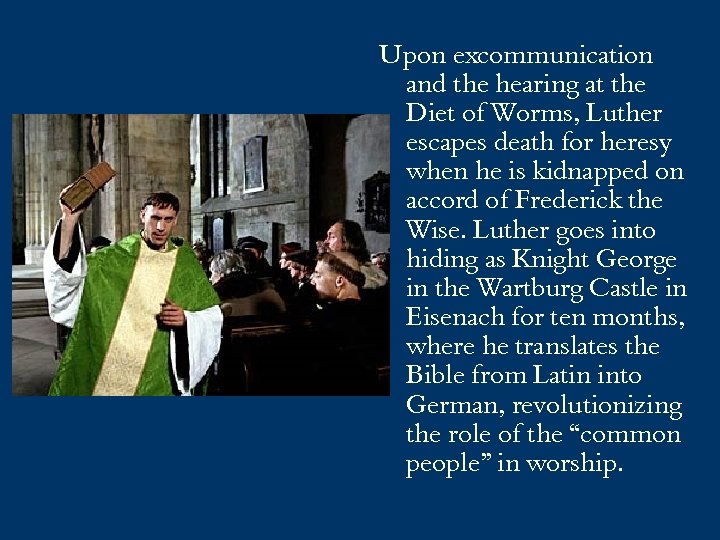
Upon excommunication and the hearing at the Diet of Worms, Luther escapes death for heresy when he is kidnapped on accord of Frederick the Wise. Luther goes into hiding as Knight George in the Wartburg Castle in Eisenach for ten months, where he translates the Bible from Latin into German, revolutionizing the role of the “common people” in worship.
What did Luther advocate? 1) The end of the sale of indulgences 2) The limiting of the Pope’s power 3) Emphasis on salvation through faith alone 4) Greater emphasis on individual direct communication with God 5) Reinterpretation of church sacraments 1) Argues that of the seven sacraments, the only genuine ones are the Lord’s Supper, baptism, and penance. Is critical of those involving celibacy and the Eucharist. He wants to extend communion to the laity and challenges the doctrine of transubstantiation.
The priesthood of all believers Luther believes that all Christians are priests before God. What’s revolutionary about this idea is that your salvation is dependent on you and you alone; it eliminates the middle man of Church authority. This paves the way for individual, personal relationships with one’s savior.
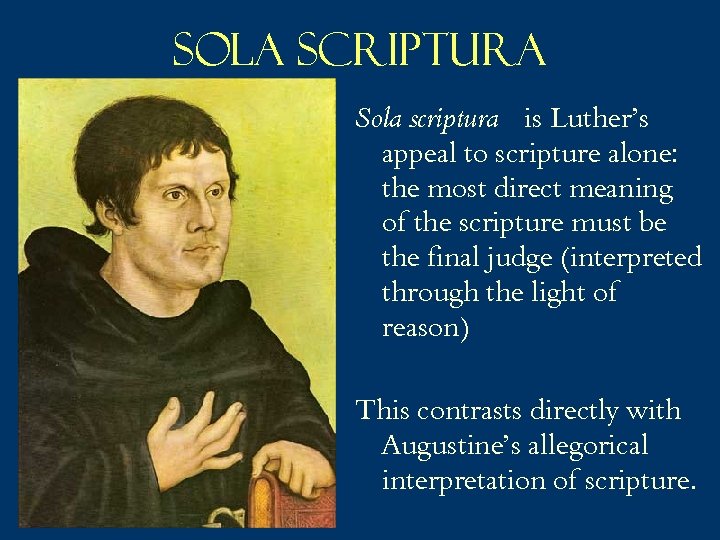
Sola Scriptura Sola scriptura is Luther’s appeal to scripture alone: the most direct meaning of the scripture must be the final judge (interpreted through the light of reason) This contrasts directly with Augustine’s allegorical interpretation of scripture.
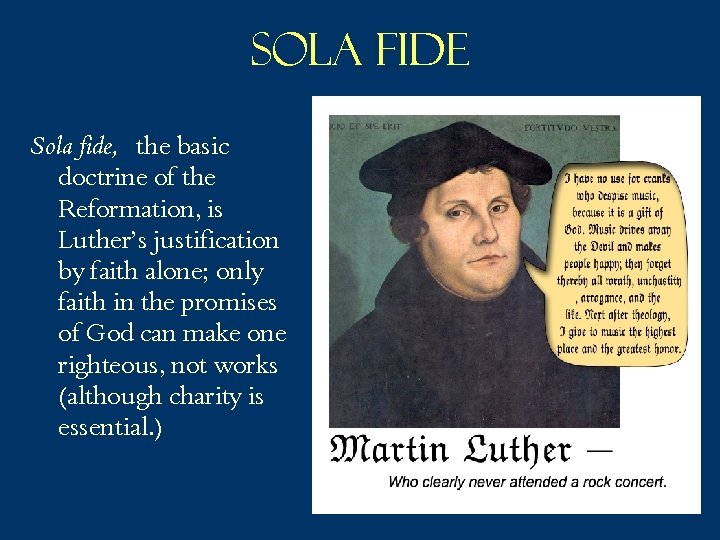
Sola Fide Sola fide, the basic doctrine of the Reformation, is Luther’s justification by faith alone; only faith in the promises of God can make one righteous, not works (although charity is essential. )
Address to the Christian nobility (1520) “The Romanists have very cleverly built three walls around themselves. Hitherto they have protected themselves by these walls in such a way that no one has been able to reform them. ” (Patterns , p. 392) 1) The claim that spiritual power (the power invested in the clergy by virtue of their office) is greater than temporal power 2) The claim that only the Pope can interpret scripture 3) The claim that the Pope alone can convene a council
“The pope is not a vicar of Christ in heaven, but only of Christ as he walked the earth. Christ in heaven, in the form of a ruler, needs no vicar, but sits on his throne and sees everything, does everything, knows everything, and has all power. But Christ needs a vicar in the form of a servant, the form in which he went about on earth, working, preaching, suffering, and dying. ” (Patterns , p. 397)
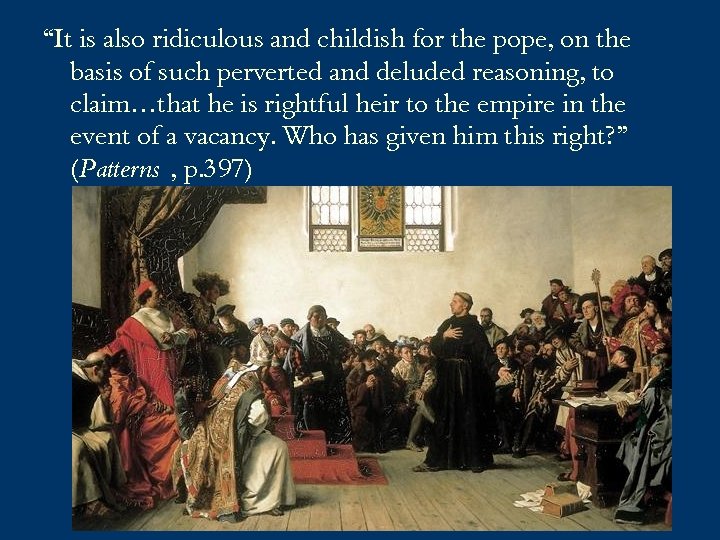
“It is also ridiculous and childish for the pope, on the basis of such perverted and deluded reasoning, to claim…that he is rightful heir to the empire in the event of a vacancy. Who has given him this right? ” (Patterns , p. 397)
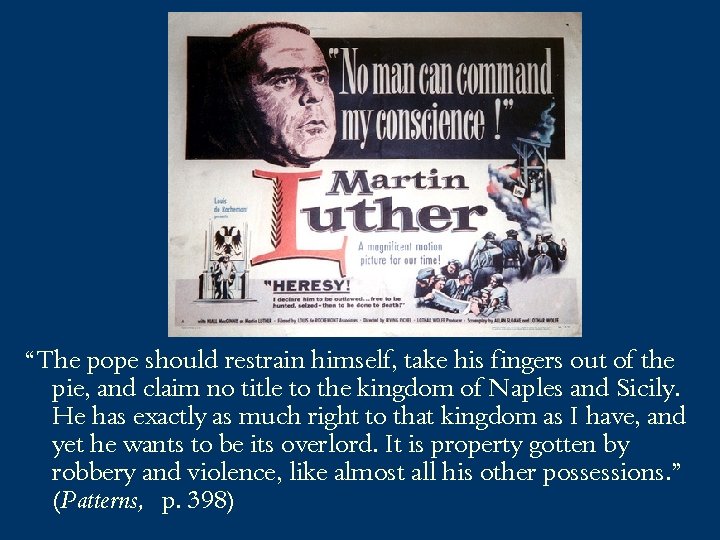
“The pope should restrain himself, take his fingers out of the pie, and claim no title to the kingdom of Naples and Sicily. He has exactly as much right to that kingdom as I have, and yet he wants to be its overlord. It is property gotten by robbery and violence, like almost all his other possessions. ” (Patterns, p. 398)
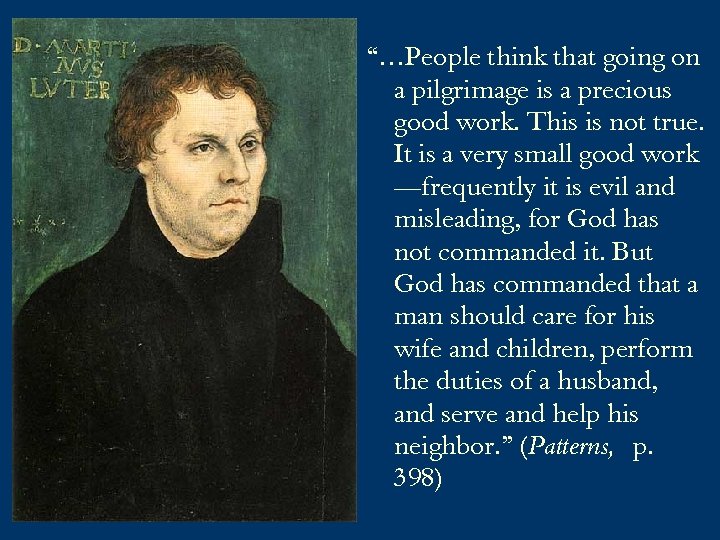
“…People think that going on a pilgrimage is a precious good work. This is not true. It is a very small good work —frequently it is evil and misleading, for God has not commanded it. But God has commanded that a man should care for his wife and children, perform the duties of a husband, and serve and help his neighbor. ” (Patterns, p. 398)
Luther’s contributions 1) Translating the Bible into German so all could have access 2) Abolished the hierarchy of the pope, cardinals, and bishops, and reduced the importance of the clergy 3) Kept only two of the seven sacraments: baptism and the Eucharist 4) Abolished monasteries and celibacy of the clergy 5) Challenged the notion of transubstantiation (“the marvelous and singular changing of the entire substance of the bread into the entire substance of the Body of Christ and of the entire substance of the wine into His blood. ”)
Though Luther’s intent was not to split the Church, that is what happened eventually. Moreover, his influence extends to others and more splinter groups form, like those influenced by John Calvin (Calvinists, Christian Reformism, Presbyterianism); the Anabaptists (Mennonites, Amish).
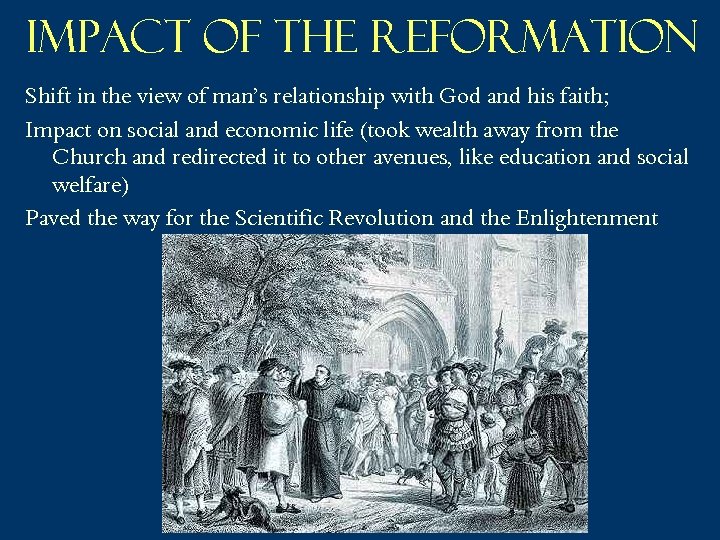
Impact of the Reformation Shift in the view of man’s relationship with God and his faith; Impact on social and economic life (took wealth away from the Church and redirected it to other avenues, like education and social welfare) Paved the way for the Scientific Revolution and the Enlightenment