
Martha Rogers Science of Unitary Human Beings Ferris
Martha Rogers: Science of Unitary Human Beings Ferris State University Kristen Lintjer Christine Maxim Sara Potes

Martha Rogers: An Introduction u. Martha Elizabeth Rogers was born on May 12, 1914 u. Nursing diploma in 1936, Knoxville General Hospital u. Bachelor of Science degree in Public Health Nursing in 1937, George Peabody College in Nashville u. Public health nurse in rural Michigan where she stayed for 2 years before returning to further study
Martha Rogers: An Introduction u. Master’s degree in 1945, Teacher’s College Columbia University, New York u. Public health nurse in Hartford, CT, advancing from staff nurse to acting Director of Education u. Established and eventually became the Executive Director of the first Visiting Nurse Service in Phoenix, AZ u. Doctorate degree in Science in 1954, John Hopkins University u. Head of the Division of Nursing at New York University in 1954 u. Officially retired as Professor and Head of the Division of Nursing in 1975 after 21 years of service u 1979 she became Professor Emeritus and continued to have an active role in the development of nursing and the SUHB until her death on March 13, 1994

History: Science of Unitary Human Beings u. Rogers directed her efforts “to evolve a conceptual system that would give identity to nursing as a knowledgeable endeavor. ” (Fawcett, 2005, p. 316) u Deliberately set out to develop a conceptual model when she realized that “there had to be a body of knowledge that was specific to and unique to nursing, or there was no need for higher education in nursing at all. ” (Fawcett, 2005, p. 316) u. Used a primarily deductive approach to develop the Science of Unitary Human Beings but also engaged in inductive thinking. (Fawcett, 2005)
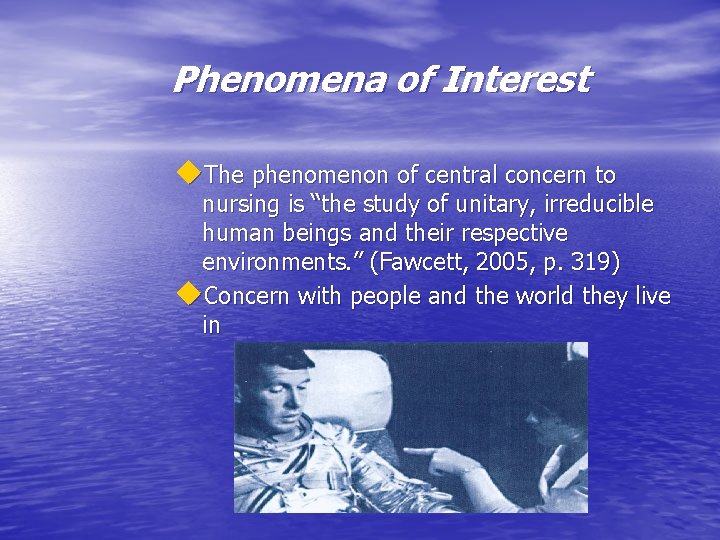
Phenomena of Interest u. The phenomenon of central concern to nursing is “the study of unitary, irreducible human beings and their respective environments. ” (Fawcett, 2005, p. 319) u. Concern with people and the world they live in

World View • Reflects the Simultaneous Action World View • Philosophical threads are “holism, process, • • [pan]dimensionality, evolution, energy fields, openness, noncausality, and pattern” (Fawcett, 2005, p. 318) Reflects a holistic view of human beings and environment Change is continuous, relative, and innovative Human beings are always progressing, reaching toward their potential (Fawcett, 2005) Parse names Rogers as “the creator of a new paradigm in the discipline of nursing, the simultaneity paradigm” (Hektor, 1989, p. 63)
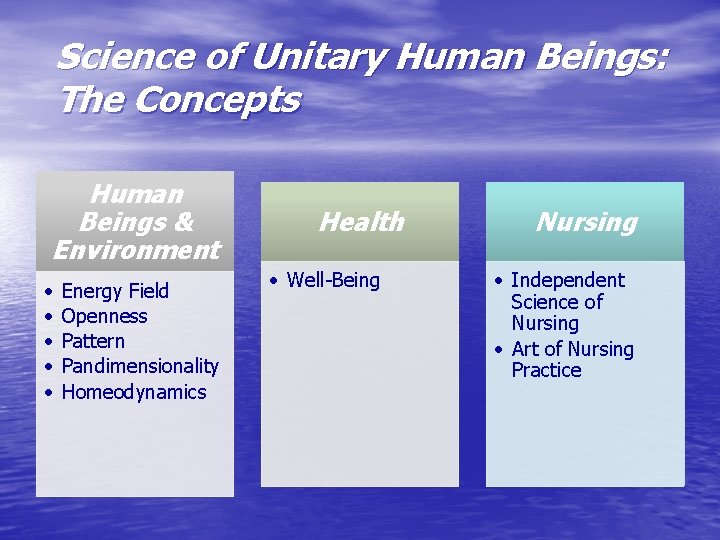
Science of Unitary Human Beings: The Concepts Human Beings & Environment • • • Energy Field Openness Pattern Pandimensionality Homeodynamics Health • Well-Being Nursing • Independent Science of Nursing • Art of Nursing Practice

Nonrelational Propositions Concept: Energy Field Human Being Energy Field Environment Energy Field

Concept: Energy Field (continued) u. A means of perceiving people and their respective environments as irreducible wholes u. Field…is a unifying concept and energy signifies the dynamic nature of the field. Energy fields are infinite and pandimensional; they are in continuous motion u. Human Energy Field: an irreducible, indivisible, pandimensional energy field identified by pattern and manifesting characteristics that are specific to the whole and which cannot be predicted from knowledge of the parts u. Environmental Energy Field: an irreducible, [indivisible] pandimensional energy field identified by pattern and integral with the human [energy] field (Fawcett, 2005)
Concept: Openness u. Energy fields are open, not a little bit or sometimes, but continuously u. Openness is nonvariant (Fawcett, 2005)

Nursing Assessment
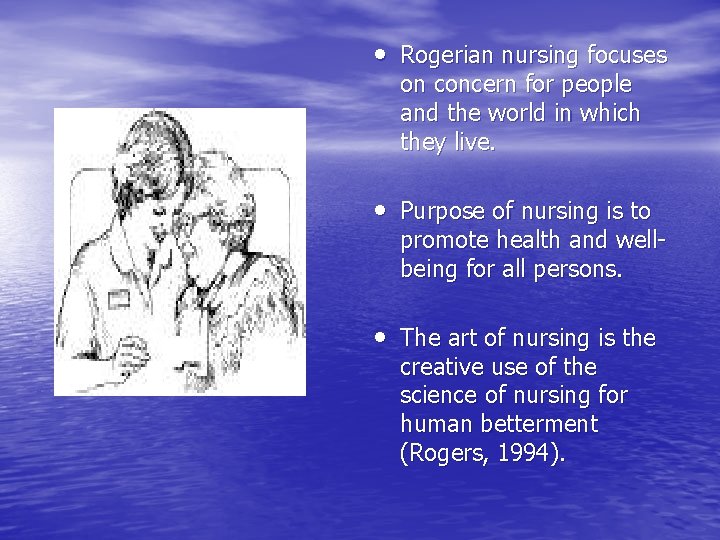
• Rogerian nursing focuses on concern for people and the world in which they live. • Purpose of nursing is to promote health and wellbeing for all persons. • The art of nursing is the creative use of the science of nursing for human betterment (Rogers, 1994).
Professional practice in nursing seeks to promote symphonic interaction between human and environmental fields
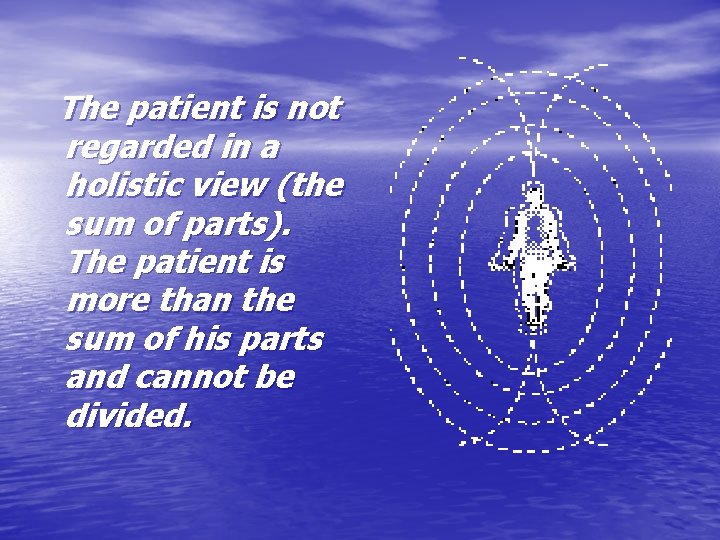
The patient is not regarded in a holistic view (the sum of parts). The patient is more than the sum of his parts and cannot be divided.
Changes in the life process in human beings are predicted to be inseparable from environmental changes and to reflect the mutual and simultaneous interaction between the two at any point in space and time. Changes are irreversible and nonrepeatable. They are rhythmical in nature and evidence growing complexity of pattern and organization. Change proceeds by the continuous repatterning of both human beings and environment by resonating waves.
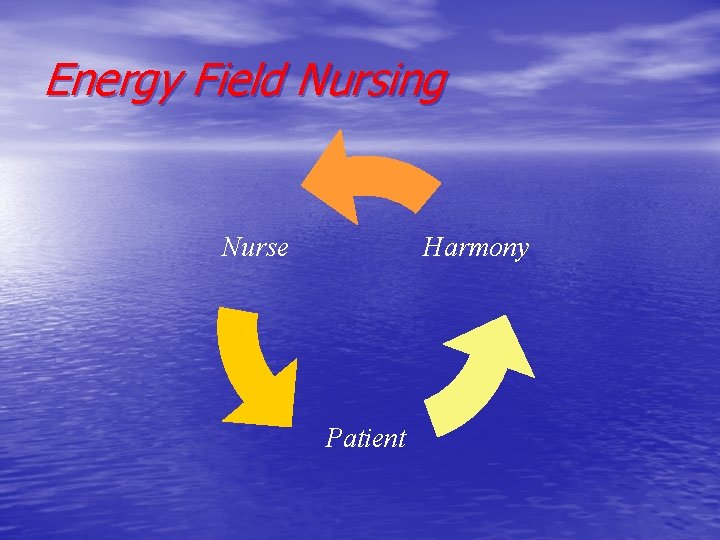
Energy Field Nursing Nurse Harmony Patient
Concept: Pattern u. The distinguishing characteristic of an energy field perceived as a single wave u. Pattern is an abstraction, its nature changes continuously, and it gives identity to the field…Each human field pattern is unique and is integral with its own unique environmental field pattern u. Energy field patterns are not directly observable u. Manifestations of field patterning are observable events in the real world. They are postulated to emerge out of the human-environmental field mutual process (Fawcett, 2005)
Concept: Pattern (continued) u. Manifestations of energy field pattern range from the physical body to such rhythmical phenomena as diversity in the experiences of time passing, the speed of motion, and sleepwake cycles u. Rogers has stated that she considers “physical bodies to be manifestations of field [pattern]” (Fawcett, 2005, p. 321) u. The evolution of life and non-life is a dynamic, irreducible, nonlinear process characterized by increasing complexification of energy field patterning. The nature of change is unpredictable and increasingly diverse (Fawcett, 2005)
Concept: Pandimensionality u. A nonlinear domain without spatial or temporal attributes u. Best expresses the idea of a unitary whole u. One does not move into or become pandimensional. Rather, this is a way of perceiving reality. u[All reality is pandimensional, and in such a pandimensional world, ] the relative nature of change becomes explicit (Fawcett, 2005)
Concept: Homeodynamics u. There are three dimensions to the concept of homeodynamics: 1. Resonancy 2. Helicy 3. Interality u. The definitions of the three dimensions are considered principles, explaining the nature and process of change. (Wright, 2007)
Principle: Resonancy u“The continuous change from lower to higher frequency wave patterns in human and environmental fields. ” u“Resonancy delineates the direction of evolutionary change in energy field pattern. ” (Fawcett, 2005, p. 322)
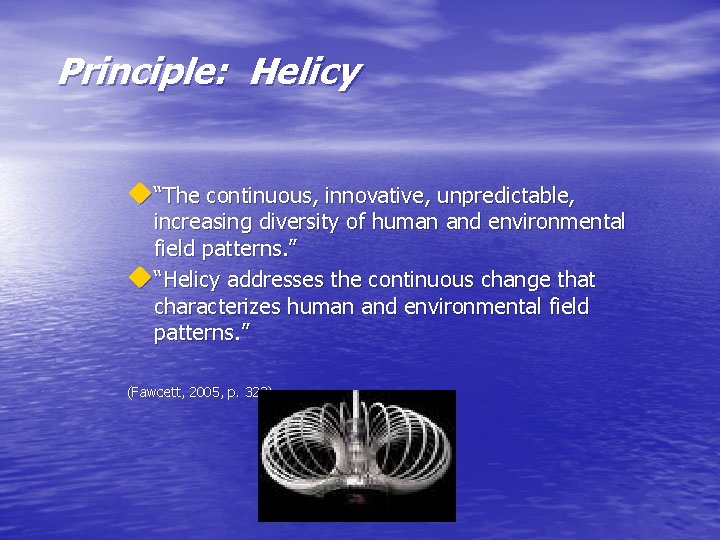
Principle: Helicy u“The continuous, innovative, unpredictable, increasing diversity of human and environmental field patterns. ” u“Helicy addresses the continuous change that characterizes human and environmental field patterns. ” (Fawcett, 2005, p. 322)

http: //www. youtube. com/watch? v=bc. Z 06 E ZKx. Ls
Principle: Interality u“The continuous mutual human field and environmental field process. ” u“Integrality emphasizes the nature of the relationship between the human and environmental fields. ” (Fawcett, 2005, p. 322)
Concept: Well-Being u. An expression of the life process u. Well-being is a value, it is not an absolute (Fawcett, 2005)
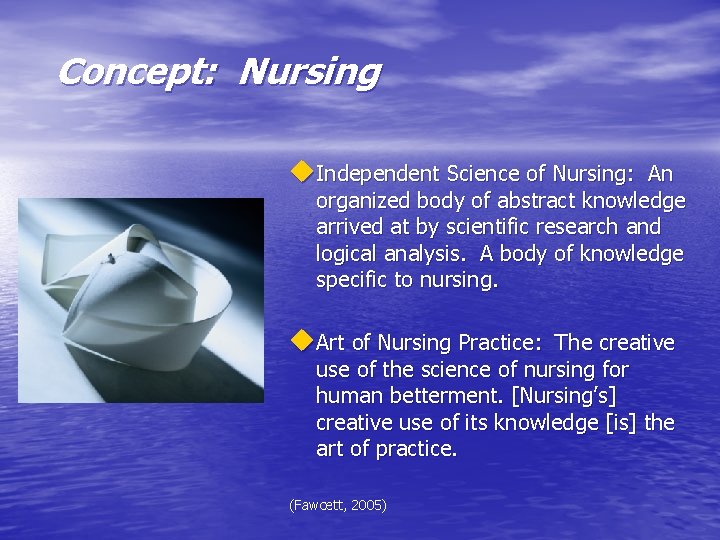
Concept: Nursing u. Independent Science of Nursing: An organized body of abstract knowledge arrived at by scientific research and logical analysis. A body of knowledge specific to nursing. u. Art of Nursing Practice: The creative use of the science of nursing for human betterment. [Nursing’s] creative use of its knowledge [is] the art of practice. (Fawcett, 2005)
![Relational Propositions A. For nurses, [the] focus consists of a long- established concern with](http://slidetodoc.com/presentation_image_h2/8b741c06098b97eba5876c31e0e3c4e2/image-27.jpg "Relational Propositions A. For nurses, [the] focus consists of a long- established concern with")
Relational Propositions A. For nurses, [the] focus consists of a long- established concern with people and the work they live in. It is the natural forerunner of an organized, abstract system encompassing people and their environments. B. [The nurse is] an environmental component for the individual receiving services. C. The primary focus of nursing is to promote health D. The purpose of nurses is to promote…wellbeing for all persons wherever they are. (Fawcett, 2005, p. 326)
Relational Propositions (continued) E. Nurses participate in the process of change, to help people move toward what is deemed better health F. The purpose of nurses is to promote health and well-being for all persons wherever they are G. The purpose of nursing is to promote human betterment wherever people are, on planet earth or in outer space (Fawcett, 2005, p. 326)
Generation of Theory: Grand Theories u. Theory of Accelerating Evolution (Rogers) u. Theory of Rhythmical Correlates of Change (Rogers) u. Theory of Paranormal Phenomena (Rogers) u. Theory of Health as Expanding Consciousness (Newman) u. Theory of Human Becoming (Parse) u. Life Perspective Rhythm Model (Fitzpatrick)
Generation of Theory: Middle-Range Theories u Power as Knowing Participation in Change (Barrett) u Theory of Human Field Motion (Ference) u Theory of Sentience Evolution (Parker) u Theory of Creativity, Actualization, and Empathy (Alligood) u Theory of Self-Transcendence (Reed) u Theory of Kaleidoscoping in Life’s Turbulence (Butcher) u Theory of Enfolding Health-as-Wholeness-and. Harmony (Barrett) u Theory of Healthiness (Leddy & Fawcett) u Theory of Perceived Dissonance (Bultemeier) u Theory of Aging (Alligood & Mc. Guire) u Theory of Enlightenment (Hills & Hanchett) u Theory of the Art of Professional Nursing (Alligood)
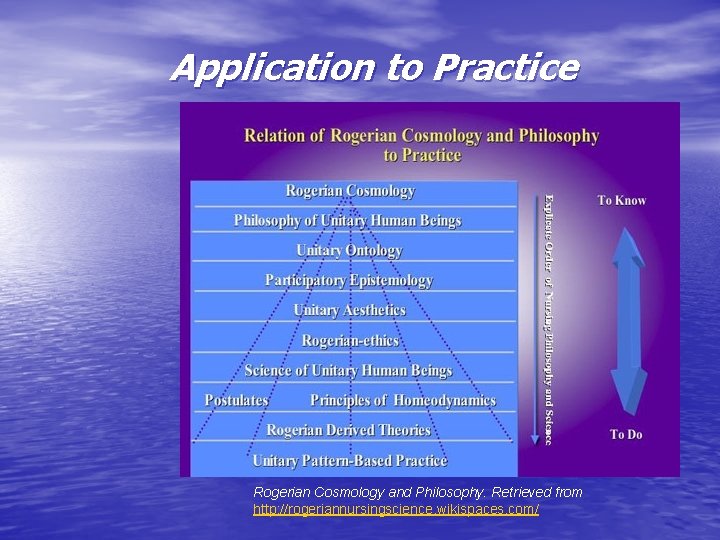
Application to Practice Rogerian Cosmology and Philosophy. Retrieved from http: //rogeriannursingscience. wikispaces. com/
Comprehensiveness • Fawcett describes theory as: – Sufficiently comprehensive in depth and content – Four metaparadigms are defined and described in detail – Depth in the description of the relationship between unitary human being and the environment
Depth of the Theory • • Model is based on science Nursing is an empirical science Continually translating theoretical knowledge into human service Always maintained the nursing practice needs to be theory based – – Flexible and creative Individualized Socially orientated Compassionate and skillful
Validity of the Theory • It provides direction for nursing practice • In depth guidelines written for: – Nursing research – Nursing education – Adminsitration of Nursing Services – Nursing practice • Compatible with ethical standards for nursing
How Applicable is the Theory? • Covers any health related issue from birth to • death Person – Families, social groups, communities • Can be used in a wide range of clinical areas – Outer space?

Uses in Clinical Practice
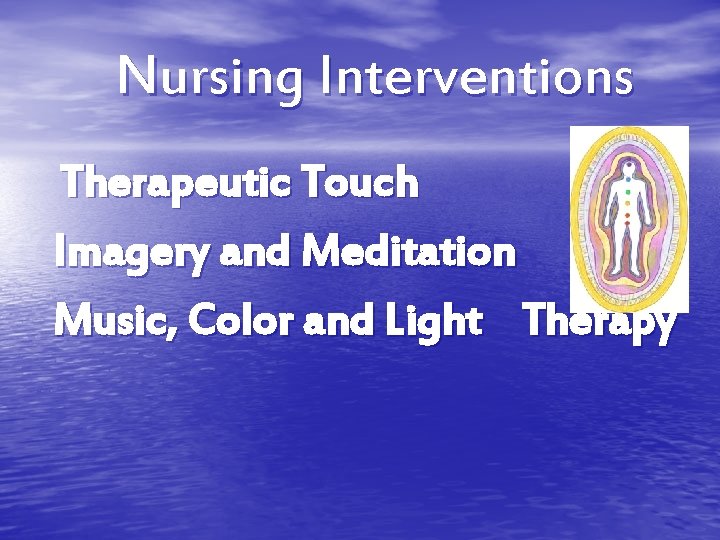
Nursing Interventions Therapeutic Touch Imagery and Meditation Music, Color and Light Therapy
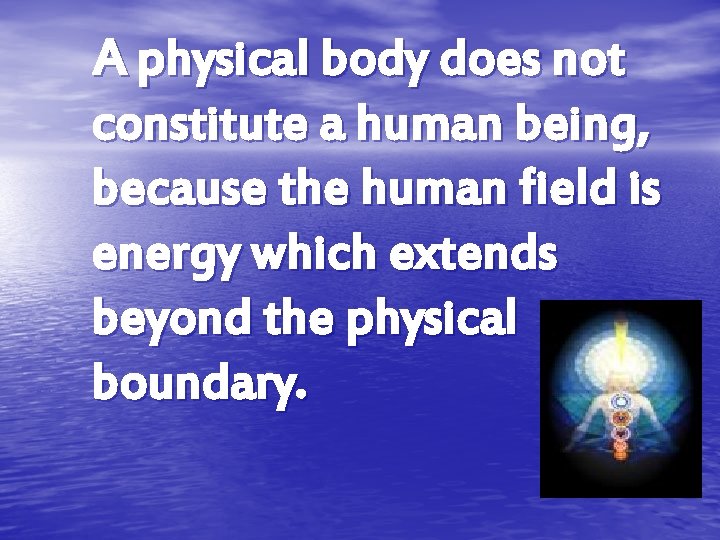
A physical body does not constitute a human being, because the human field is energy which extends beyond the physical boundary.
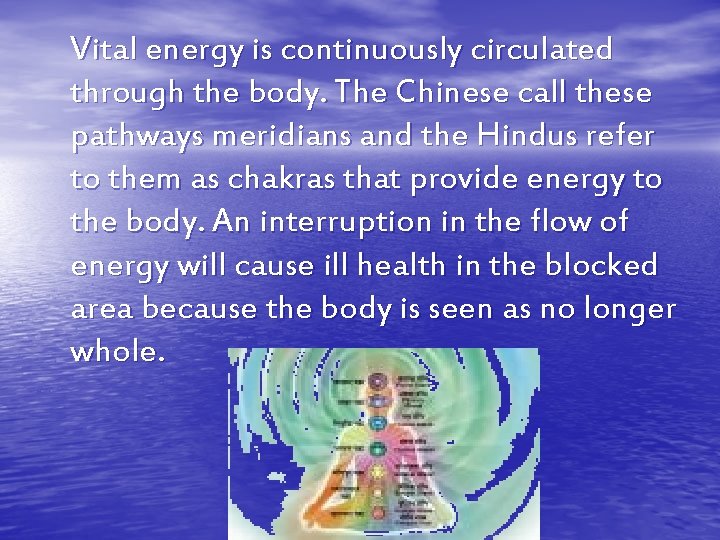
Vital energy is continuously circulated through the body. The Chinese call these pathways meridians and the Hindus refer to them as chakras that provide energy to the body. An interruption in the flow of energy will cause ill health in the blocked area because the body is seen as no longer whole.
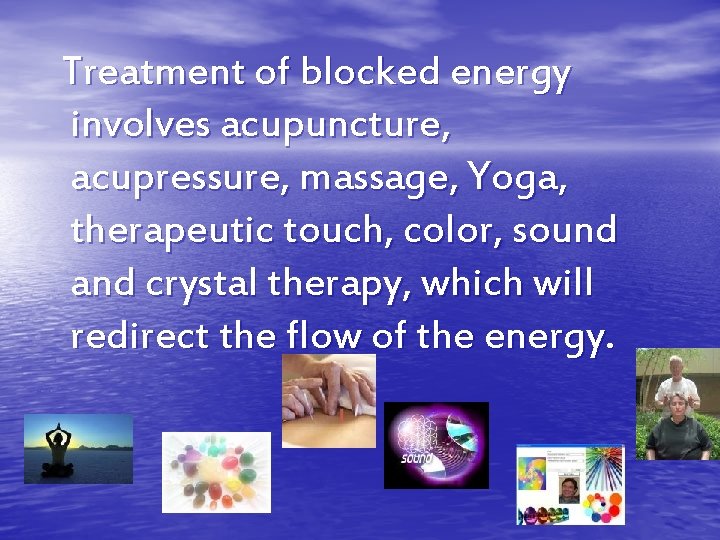
Treatment of blocked energy involves acupuncture, acupressure, massage, Yoga, therapeutic touch, color, sound and crystal therapy, which will redirect the flow of the energy.
Examples of interventions to help with the flow of energy
Color Therapy • Colored lights are applied to the body. • Red, yellow and orange are found to be • • stimulating or building colors. Green, turquoise and blue are repairing or balancing. Magenta is spiritual, emotional and physically balancing. Indigo, purple and violet are calming and depress the activity of internal organs. Scarlet is the most emotionally and physically stimulating.
Crystal Therapy • Crystals are used in the patients environment. • Quartz absorbs negative energy currents, eliminating them from the room as well as the body. This could be especially helpful in an ICU environment where there is a lot of electrical equipment. • Rock crystal maximizes physical and mental awareness and encourages free circulation of life force. • Crystals placed in a patients bedside water will prevent it from getting stale, but should be placed in a clear water jug and exposed to light.

Therapeutic Touch Therapeutic touch is healing technique used to relieve or eliminate emotional or physical pain. It is a non-invasive, holistic approach to healing that stimulates the recipients recuperative powers. It is a modern day laying-on-of-hands and is based on theory of an energy exchange between people.
We each have all the equipment needed for therapeutic touch right at our fingertips.
Therapeutic touch appears very simple, it starts with simply laying hands on or close to the body of an ill person for 10 to 15 minutes. It is actually much more complex and involves the exchange and moving of energy and must be done by a trained practitioner.
Purpose of Therapeutic Touch • Alleviate or cure pain • Relieve anxiety • Speed up the body’s natural healing properties • Decrease stress

Imagery
• Images live in the home of pandimensional space, time and motion. There is no here and there, in and out, up and down, no location, no directionality in the nonlinear domain. • Imagery is a knowing beyond words one can enhance one’s power to create change. • In imagery, we experience the principles of homeodynamics that Rogers named helicy, resonancy, and integrality. • Imagery is a modality that allows people to more fully participate in their health care by mobilizing healing abilities using the power of the imagination.
“Imagination is more important than knowledge. Knowledge is limited. Imagination encircles the world" (Einstein as noted by Viereck, 1929).
Guided Imagery Guided imagery is the use of the mind to arrive at a relaxed state and to create mental visualization in order to promote physical and mental health. Guided imagery can be done alone or it can be done through the direction of another person.
Treatment of Chronic Pain Using Guided Imagery • The use of guided imagery to assist persons experiencing • • • pain as they evolve with the pain experience is an effective evidence-based nursing intervention. Theory stresses the importance of a person being capable of knowingly participating in the process of change. Assisting the person with chronic pain to be aware of change as the pain evolves creates a sense of well-being. Chronic pain is not an isolated event but a manifestation of the whole. Therefore getting well involves resolving issues in all aspects of the person’s life.
• First is an awareness of the issues. Physical awareness of the pain is only a small part of human awareness. • For many people guided imagery causes a disappearance of time and space. • Guided imagery should not be used in place of analgesic medications but in adjunct with a pain regimen. • Guided imagery techniques are used to relax, transform sensory images of pain, and change thinking about pain.
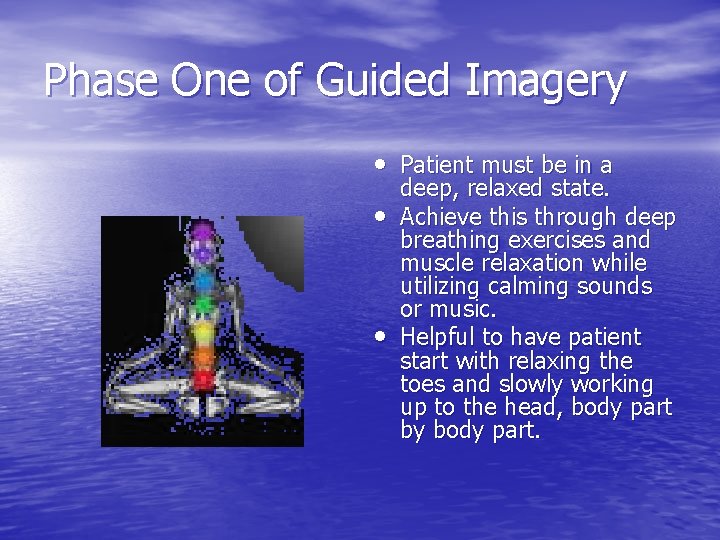
Phase One of Guided Imagery • Patient must be in a • • deep, relaxed state. Achieve this through deep breathing exercises and muscle relaxation while utilizing calming sounds or music. Helpful to have patient start with relaxing the toes and slowly working up to the head, body part by body part.
Phase Two of Guided Imagery • Phase two involves the actual visualization itself. • Several different types depending on if treating pain, anxiety, relaxation or healing. • Pain control imagery involves imagining the pain and transforming that image into no pain at all. • An example would be imagining your back pain as voltage and then cutting off the current, thereby cutting off the pain. • No side effects except for some sleepiness.

Nursing Education
"education is for the future, yesterday’s methods will not suffice for tomorrow’s needs" (Rogers, 1961).
Structure nursing education programs to teach nursing as both a science and as a learned profession.
Rogers’ model clearly articulates beliefs and values about human beings, health, nursing and the educational process.
Rogers’ model has been used to guide curriculum development in all levels of nursing education.
Rogers has said that nurses must commit to lifelong learning. The nature of the practice of nursing is the use of knowledge for human betterment.

Rogers advocated for separate licensure for nurses prepared at the associate degree and the baccalaureate prepared nurse. Rogers acknowledged that there is a difference between the technically oriented nurse and the professional nurse.
The Professional Nurse • The professional nurse needs to be well rounded. • Education needs to include the humanities, sciences and nursing.
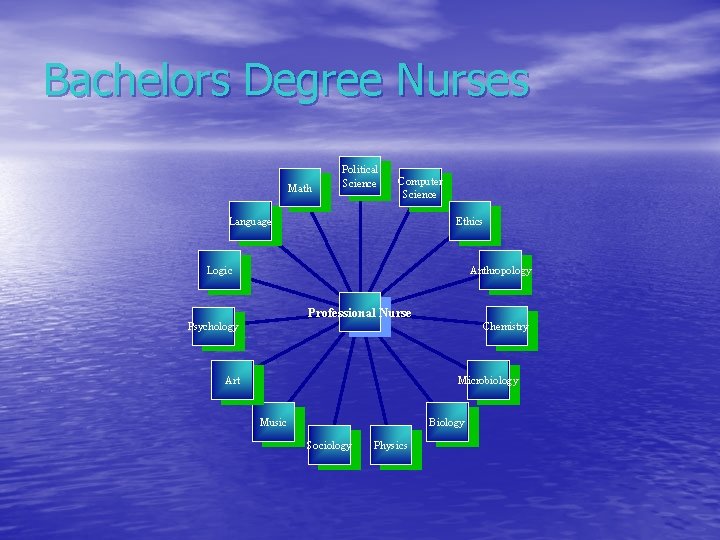
Bachelors Degree Nurses Math Political Science Computer Science Language Ethics Anthropology Logic Professional Nurse Chemistry Psychology Microbiology Art Biology Music Sociology Physics
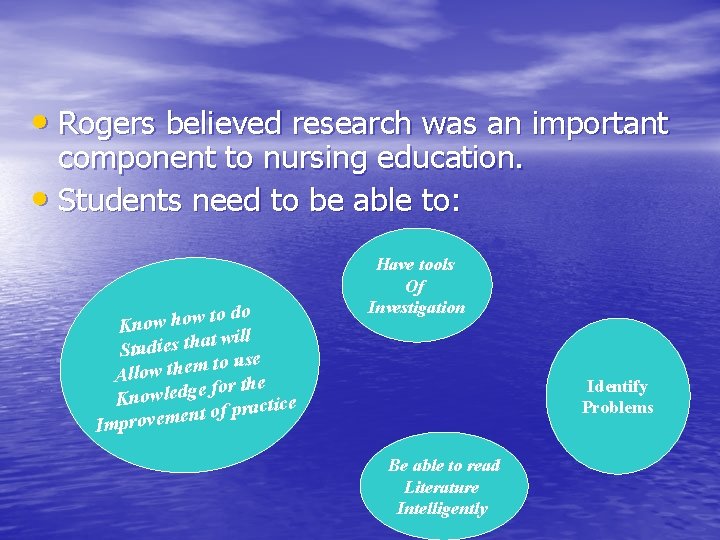
• Rogers believed research was an important component to nursing education. • Students need to be able to: to do w o h w o n K t will a h t s e i d u t S to use m e h t w o l Al for the e g d e l w o Kn actice r p f o t n e Improvem Have tools Of Investigation Identify Problems Be able to read Literature Intelligently
Masters prepared nurses need to know how to perform applied research.
Doctoral Programs Doctoral programs will focus on nursing as a learned field of endeavor and will produce the fundamental basic research and theoretical research.
Learning Clinical Skills • Acquisition of technical skills may be limited for the student in the hospital due to severity of patients and the use of technology. • Manipulative technical skills can be practiced and learned in practice labs, clinics, home health agencies, homeless shelters and senior centers.
Critical Case Study Using Rogerian Conceptual Model • Young woman admitted to psychiatric unit with severe depression secondary to ovarian malignancy. • Accompanied by husband one year old child. Husband appears supportive and attentive. He works as an accountant. • Diagnosis made two months ago. Had surgery and is currently undergoing chemotherapy.
Case Study (continued) • She has been sitting lonely with decreased ADL, repeated crying spells, decreased talking, muttering to self, decreased sleep, decreased appetite, neglecting child, complains of severe pain. • Three days ago attempted suicide by ingesting rat poison.
Assessment • Teary eyed young woman, ill kempt, clinging to husband, looking perplexed, not talking. When asked about condition, cries inconsolably.
Nursing Care with Rogers Model • Pattern appraisal • Mutual patterning • Evaluation
Pattern Appraisal • Visable rhythmical pattern is a manifestation of evolution to dissonance. • Has pattern manifestation of dissonance …depression with suidical ideation, ovarian malignancy, pain. • A pattern activity of healing is noted through reports of a positive operative course. • Patterning has to be directed towards reduction in perceived dissonance with her personal and environmental field.
Pattern Appraisal (continued) • Pain is a manifestation of perceived dissonance. • Decreased environmental energy transfer is • • visible by decreased talking and crying. Manifestation of fear…. her self knowledge links her illness to her personal belief of being punished for her past sins Appraisal can be grouped into exchanging patterns, communication patterns and relating patterns.
Pattern Appraisal (continued) • Time between nurse and patient is needed to foster healing. • During the process the nurse must rely on personal intuition and insight regarding the emerging pattern. • All this pattern forms the unitary pattern of the patient.
Mutual Patterning • The process is mutual between the nurse and patient. • The surgery performed, medication she is receiving are patterning modalities. • Patterning activities planned by the nurse are therapeutic touch, humor, meditation and imagery. • The patient needs to be assessed fully regarding her ability to understand agree with different patterning modalities.
Mutual Patterning (continued) • Therapeutic touch can be introduced. • Touch is introduced and incorporated into the management of pain, helps in energy transmission for healing and helps in developing trust in the nurse. • Teach her how to center the energy and channel her energy to the area of pain. • Use humor for increasing socialization and developing self confidence and developing worthiness.
Mutual Patterning (continued) • Human environmental patterning needs to involve the other individuals who share her environment including husband son. • Options are introduced relating to increase communication and hygiene patterns. • The entire family is involved in power as knowing participation in change.
Evaluation • The evaluation process centers on the • • • perceptions of dissonance that exist after the mutual pattern activities. The appraisal process is repeated. Manifestation of worry, pain, fear, sadness of mood has to be appraised with family members. A summary of the dissonance and/or harmony that is perceived is then shared with the patient and mutual patterning is modified or instituted as indicated based on the evaluation.
Society of Rogerian Scholars (SRS) • Founded in 1986 in the living room of Martha Rogers. • Met twice a month during Martha Rogers life to address ongoing inquiry into science of unitary human beings (SUHB). • Continues on today through collective body of research and writing about the SUHB. Gives assurance that the voice of Martha Rogers has not been silenced.
SRS Continues Martha Rogers Work • Society does not undertake specific projects. • Members use SUHB to guide their research or practice and to publish their work in peer reviewed journals. • In 1988 began publishing Nursing Science News. • In 1993 began publishing Visions: The Journal of Rogerian Nursing Science.
Focus of SRS • Education • Research • Practice in service to humankind

http: //www. youtube. com/watch? v=tmm. Xl MPh. Ry. Q
References • "Abstract Of Martha Rogers Video 0001. " 20 Sept. 2009. • • Web. 6 Mar. 2010. Fawcett, Jacqueline. 2 nd ed. 2005. Print. "Potessara@yahoo. com. " Message to the author. 4 Mar. 2010. E-mail. • Welcome to the Society of Rogerian Scholars - Homepage. • • 22 Feb. 2010. Web. 06 Mar. 2010. <http: //societyofrogerianscholars. org>. Wright, Barbara W. "The Evolution of Rogers' Science of Unitary Human Beings: 21 st Century Reflections. " Nursing Science Quarterly 20. 64 (2007). Print. You. Tube - Broadcast Yourself. 11 July 2009. Web. 06 Mar. 2010. <http: //youtube. com/watch? v=bcv 06 EZKx. LS>.
References • Therapeutic Touch: The Imprimatur of Nursing Dolores Krieger The American Journal of Nursing , Vol. 75, No. 5 (May, 1975), pp. 784 -787 (article consists of 4 pages) Published by: Lippincott Williams & Wilkins Stable URL: http: //www. jstor. org/stable/3423456 • Krieger, Dolores. Therapeutic Touch Inner Workbook. Santa Fe, NM: Bear & Company Publishing, 1996. • Pain Management Nursing Changes in the Meaning of Pain with the Use of Guided Imagery Wendy Lewandowski, RN, Ph. D, CS; Marion Good, RN, Ph. D, FAAN; Claire Burke Draucker, RN, Ph. D, CSPosted: 07/14/2005; Pain Manag Nurs. 2005; 6(2): 58 -67. © 2005 Energy Fields Nursing: An Exploration of New and Re-Discovered Boundaries for Practice. by Francis C Biley RN Ph. D Lecturer in Nursing, University of Wales College of Nursing and Catherine Jones RGN BN(Hons) Post-graduate Student, University of Wales College of Nursing • • e. CAM Advance Access published online on February 2, 2008 e. CAM, doi: 10. 1093/ecam/nen 006 The Effect of Therapeutic Touch on Pain and Fatigue of Cancer Patients Undergoing Chemotherapy Nahid Aghabati 1, Eesa Mohammadi 1 and Zahra Pour Esmaiel 2
- Slides: 88