
Marsys Law Art 1 16 Florida Constitution Rights





- Slides: 114
Marsy’s Law Art. 1, § 16, Florida Constitution Rights of Accused and Victims Dawn M. Buff Assistant State Attorney 12 th Judicial Circuit Manatee County dbuff@sao 12. org
Who is affected? LEOs Prosecutors Jails Judges Probation DJJ Prison Parole Boards Clemency Board Property & Evidence Clerk’s Office
How? Notification of Rights Notification of hearings (including parole/release/sentence reductions) Right to be heard in hearings Accountability for length of time to resolve trials/appeals Protecting confidentiality of victim in records Redacting of Information Awareness of where victim information is located Notifying other agencies of the assertion of Marsy’s law rights Interaction of victim’s rights with defendant’s rights Financial burden Time burden
HISTORY: Who is Marsy and why is she in our constitution?
History of Marsy’s Law Marsalee “Marsy” Nicholas, was a senior at UC Santa Barbara when she was stalked and murdered by an ex -boyfriend in California in 1983. Just a week after the murder, her mother and brother ran into her killer while he was out on bail. They felt that the killer stared them down during the encounter. They did not know he had been released on bail.
History of Marsy’s Law The suspect was later convicted and sentenced to life in prison. He died in prison while serving his sentence.
The Victims’ Rights Movement The Amendments in the Bill of Rights in the US Constitution were enacted to protect the accused, not victims. Speedy trial Confrontation of witnesses Right not to be compelled to be a witness against one’s self Right to counsel
The Victims’ Rights Movement The victim’s rights movement started in the 1970’s. It gained momentum in the 1980’s with the campaign by the mother of Sharon Tate (who was killed by Manson followers). Tate’s mother lobbied in California for victim impact statements. The victims' rights movement has led to things like victim impact statements and sex-offender registries.
History of Marsy’s Law Marsy’s brother, Henry Nicholas, is the co-founder of Broadcom Corp. which makes products for wireless and broadband communication. $$$$$ Henry Nicholas began a campaign to pass Marsy’s Law in California. Marsy's Law was first passed by California voters in 2008 as an amendment to the California Constitution and certain statutes.
History of Marsy’s Law In 2009, Henry Nicholas formed Marsy's Law for All, aimed at getting Marsy’s Law added to the constitution in all states and Ultimately passing an Amendment to the United States Constitution to protect the rights of victims nationwide.
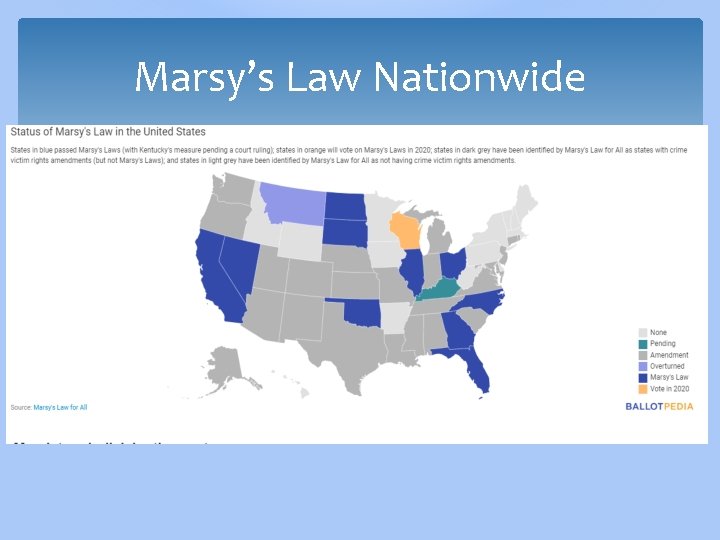
Marsy’s Law Nationwide
Marsy’s Law in Florida Art. 1 § 16, Florida Constitution Rights of Accused and Victims
Marsy’s Law in Florida What did it change?
What we had Previously we had many statutes concerning various aspects of victims rights and One small provision in the constitution. Marsy’s Law added most of the statutory protections to the State Constitution, many with additional protections. The previous statutory schemes were not removed.
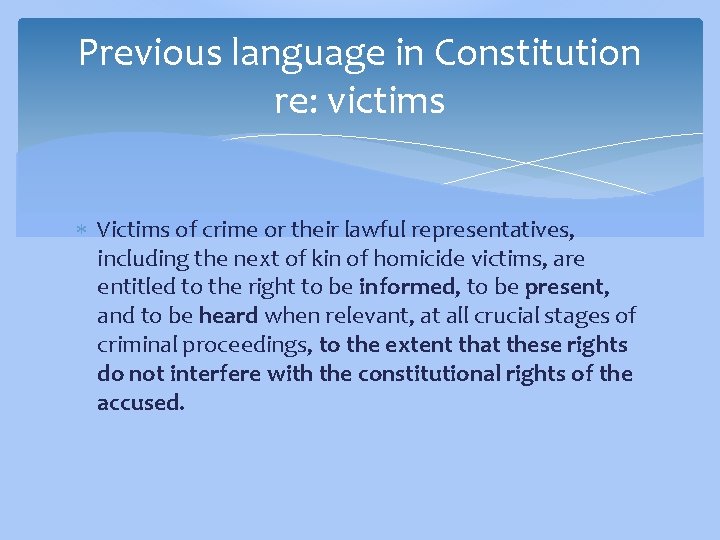
Previous language in Constitution re: victims Victims of crime or their lawful representatives, including the next of kin of homicide victims, are entitled to the right to be informed, to be present, and to be heard when relevant, at all crucial stages of criminal proceedings, to the extent that these rights do not interfere with the constitutional rights of the accused.
Current Language Art. 1, § 16, Florida Constitution Rights of Accused and Victims
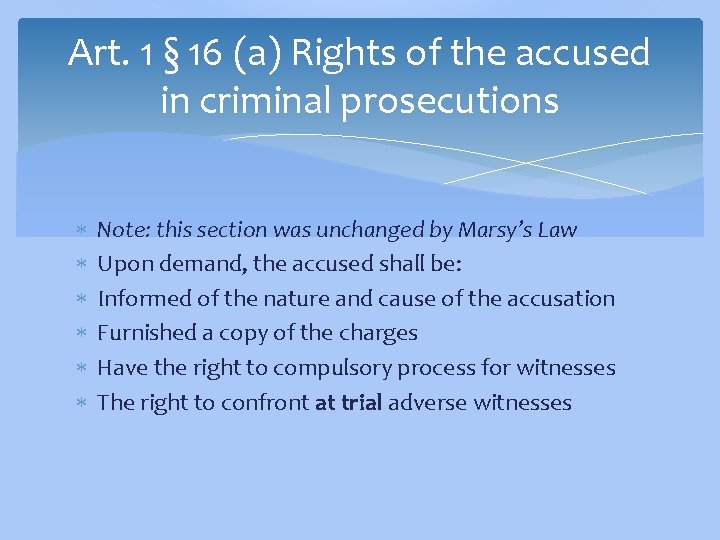
Art. 1 § 16 (a) Rights of the accused in criminal prosecutions Note: this section was unchanged by Marsy’s Law Upon demand, the accused shall be: Informed of the nature and cause of the accusation Furnished a copy of the charges Have the right to compulsory process for witnesses The right to confront at trial adverse witnesses
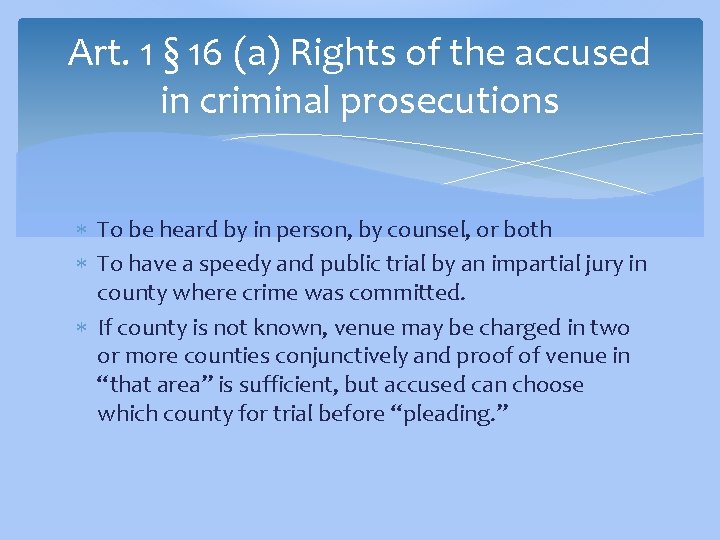
Art. 1 § 16 (a) Rights of the accused in criminal prosecutions To be heard by in person, by counsel, or both To have a speedy and public trial by an impartial jury in county where crime was committed. If county is not known, venue may be charged in two or more counties conjunctively and proof of venue in “that area” is sufficient, but accused can choose which county for trial before “pleading. ”
Art. 1 § 16 (a) Rights of the accused in criminal prosecutions Notice that many of these rights are the same as provided in the U. S. Constitution and its amendments. However, U. S Constitution does not address victims’ rights.
Supremacy Clause The U. S. Constitution and Federal Laws are the supreme law of the land. The States cannot make laws which conflict with the U. S. Constitution and its laws. For example, States cannot enact a law which requires a defendant to testify in his own defense. If the State Constitution conflicts with the U. S. Constitution, the U. S. Constitution is supreme,
Supremacy Clause On the State level, the State constitution is supreme over state statutes. The legislature cannot enact statutes which conflict with the State constitution. (Or if enacted and challenged, they will be found unconstitutional).
Supremacy Clause & Marsy’s Law By putting Marsy’s law in the State Constitution, the voters have put victims’ rights on par with defendants’ rights. Caveat: to the extent it does not conflict with the U. S. Constitution.
Art. 1 § 16(b): Victims’ Rights Philosophy as stated in Constitution To preserve and protect the right of crime victims to achieve justice, Ensure a meaningful role throughout the criminal and juvenile justice systems Ensure that crime victims’ rights and interests are respected and protected in a manner No less vigorous than protections afforded to the accused No longer says to the extent it conflicts with the defendant’s rights.
Art. 1 § 16: Victims of adults & juveniles treated similarly The rights apply to victims in adult court and in juvenile court. Constitutional provisions uses the terms defendant (adult) and delinquent (juvenile) as well as Sentencing (adult) and adjudication (juvenile)
Art. 1 § 16 (e): Definition of Victim means a person who suffers direct or threatened physical, psychological, or financial harm as a result of the commission of a crime Includes victim’s lawful representative Parent/guardian of minor Next of kin in homicide Unless there is a showing that such person’s interest is actually/potentially in conflict with the interests of the victim.
Art. 1 § 16 (b): Victims’ Rights Begins at the time of victimization
Art. 1 § 16(b)(1): Victims’ Rights The right to due process The right to be treated with fairness The right to be treated with respect for the victim’s dignity
Due Process A term which has been with us since the Magna Carta, but has eluded a definition for just as long.
Art. 1 § 16(b)(2): Victims’ Rights The right to be free from: Intimidation Harassment Abuse
Art. 1 § 16(b)(2): Victims’ Rights Keep in mind that one of the concerns of Marsy’s family was that the Defendant was out of jail and encountered them and stared them down in public. This section takes on great importance, as Marsy’s law allows victims the right to keep private any information which could be used to locate or harass them or their family.
Art. 1 § 16(b)(3): Victims’ Rights The right, within the judicial process, to be reasonably protected from the accused And any person acting on behalf of the accused. This does not create a special relationship between LEA and victim for purposes of lawsuit or any other obligation.
Art. 1 § 16(b)(3): Victims’ Rights What about when the Defendant’s attorney or investigator makes contact with the victim? Can this be precluded if perceived as harassment? Are there any federal constitutional provisions with which this would interfere?
Art. 1 § 16(b)(4): Bail The right to have the safety and welfare of the victim and the victim’s family considered: when setting bail including setting pre-trial release conditions which protect the safety and welfare of the victim/victim’s family
Bail: What the U. S. Constitution Says 8 th Amendment prohibits excessive bail
Bail: What the Florida Constitution says Fla. Const. art. I, § 14
Fla. Const. art. I, § 14 Re: Pre-trial release (bail) Unless charged with a capital offense or an offense punishable by life imprisonment AND the proof of guilt is evident or the presumption is great, every person charged with a crime. . . shall be entitled to pretrial release on reasonable conditions. If no conditions of release can reasonably protect the community from risk of physical harm to persons, assure the presence of the accused at trial, or assure the integrity of the judicial process, the accused may be detained. (requires a motion/hearing)
Rules of Criminal Procedure mirror the FL Constitution Fla. R. Cr. Procedure 3. 131 Pre-Trial Release (Bail)
Pre-Trial Release Fla. R. Cr. Procedure 3. 131 Unless charged with a capital offense or an offense punishable by life imprisonment and the proof of guilt is evident or the presumption is great, every person charged with a crime or violation of municipal or county ordinance shall be entitled to pretrial release on reasonable conditions.
Pre-Trial Release 3. 131 No Contact Provision As a condition of pretrial release, . . . the defendant shall refrain from any contact of any type with the victim, except through. . . Discovery. .
Pre-Trial Release 3. 131 No Contact Provision Upon motion by the defendant when bail is set, or upon later motion . . . the court may modify the condition precluding victim contact if good cause is shown and the interests of justice so require. The victim shall be permitted to be heard at any proceeding in which such modification is considered, and the state attorney shall notify the victim of the provisions of this subdivision and of the pendency of any such proceeding.
Pre-Trial Detention Fla. R. Cr. Procedure 3. 131 Same as in Florida Constitution If no conditions of release can reasonably protect the community from risk of physical harm to persons, assure the presence of the accused at trial, or assure the integrity of the judicial process, the accused may be detained.
Text of Marsy’s Law cont’d Art. 1 § 16 (b)(5) Note: This section does not say “upon request. ” The right to prevent disclosure of information or of records which could be used to locate or harass the victim/victim’s family or Which would disclose confidential or privileged information of the victim (does not include family in this part)
What is Identifying Information? Depending on the circumstances of the crime, that could mean anything from addresses of where crimes occurred to the identities of perpetrators, in domestic violence cases at least.
What can be used to locate the victim or victim’s family? Name? Address? Phone number? DOB? Photo? School?
Competing Constitutional Right Public Records in the Constitution
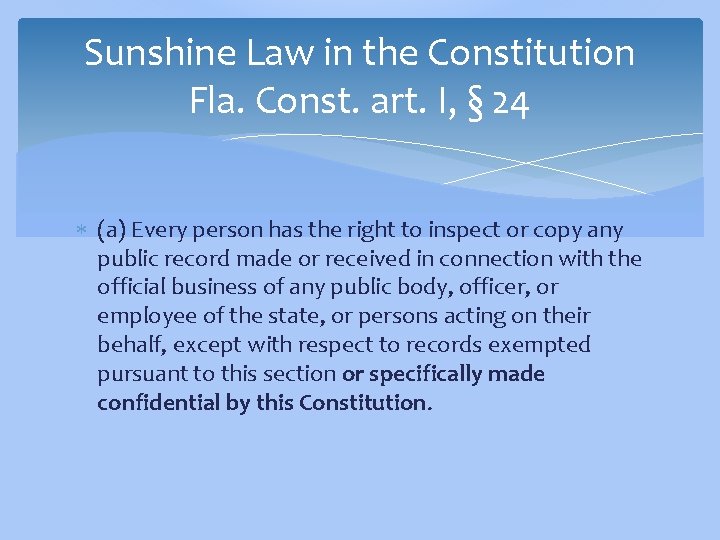
Sunshine Law in the Constitution Fla. Const. art. I, § 24 (a) Every person has the right to inspect or copy any public record made or received in connection with the official business of any public body, officer, or employee of the state, or persons acting on their behalf, except with respect to records exempted pursuant to this section or specifically made confidential by this Constitution.
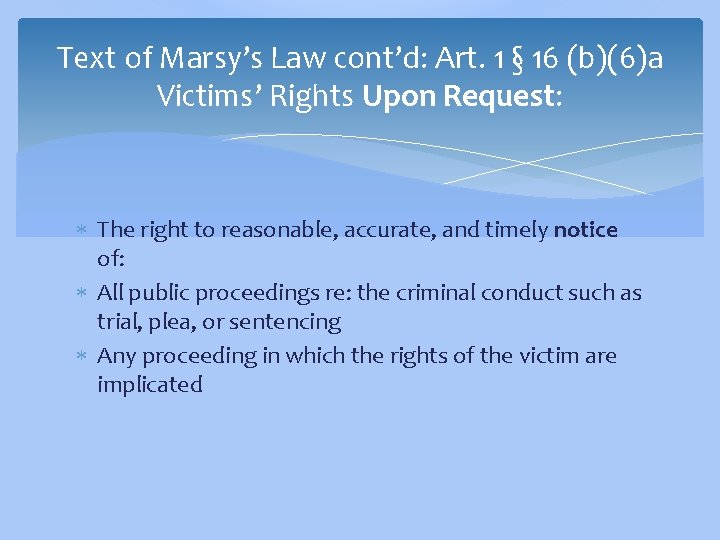
Text of Marsy’s Law cont’d: Art. 1 § 16 (b)(6)a Victims’ Rights Upon Request: The right to reasonable, accurate, and timely notice of: All public proceedings re: the criminal conduct such as trial, plea, or sentencing Any proceeding in which the rights of the victim are implicated
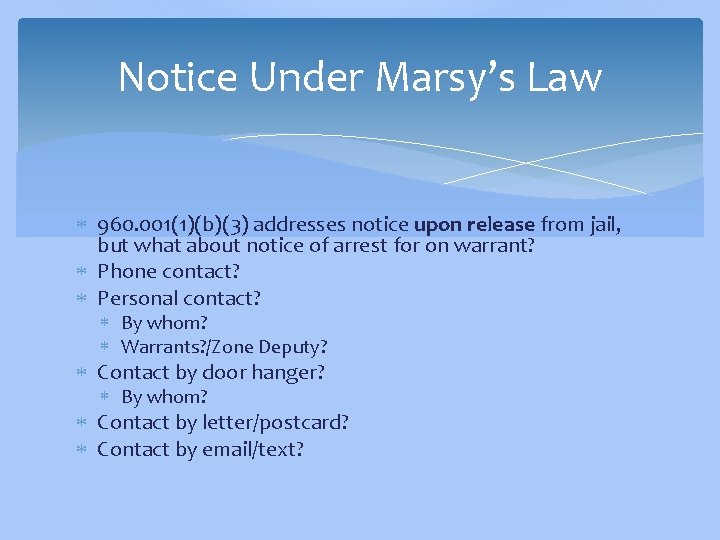
Notice Under Marsy’s Law 960. 001(1)(b)(3) addresses notice upon release from jail, but what about notice of arrest for on warrant? Phone contact? Personal contact? By whom? Warrants? /Zone Deputy? Contact by door hanger? By whom? Contact by letter/postcard? Contact by email/text?
Notice Under Marsy’s Law How do you document the efforts you have made? Where do you document? Whose duty is it to document?
960. 001 Victim’s Rights Brochure A victim of a crime shall be provided with a victim’s rights information card or brochure containing essential information concerning the rights of a victim and services available to a victim as required by state law.
Art. 1 § 16 (b)(6)a Victims’ Rights Upon Request: The right to be present at all public proceedings re: the criminal conduct such as trial, plea, or sentencing Even if the victim is a witness at the proceeding (notwithstanding any other rule to the contrary)
Rule of Sequestration 90. 616 (The rule to the contrary) (1) At the request of a party the court shall order, or upon its own motion the court may order, witnesses excluded from a proceeding so that they cannot hear the testimony of other witnesses except as provided. . . (d) In a criminal case, the victim of the crime, the victim’s next of kin, the parent or guardian of a minor child victim, or a lawful representative of such person, unless, upon motion, the court determines such person’s presence to be prejudicial.
Art. 1 § 16(b)(6)a Victims’ Rights Upon Request: The right to reasonable, accurate, and timely notice of: Release or escape
Art. 1 § 16(b)(6)b Victims’ Rights Upon Request The right to be heard in any public proceeding involving: 1) Pretrial release 2) Any other release from any form of legal constraint 3) Plea 4) Sentencing 5) Parole 6) Any other proceeding in which victim’s rights are implicated
921. 143 Victims’ Statutory Rights at Sentencing (1) Victim may (a) Appear before the sentencing court for the purpose of making a statement under oath for the record; and (b) Submit a written statement under oath to the office of the state attorney, which statement shall be filed with the sentencing court.
921. 143 Victims’ Statutory Rights at Sentencing (content of Victim Impact Statement) (2) The state attorney shall advise all victims/guardians/next of kin. . . that statements, whether oral or written, shall relate to the facts of the case and the extent of any harm (social, psychological, physical, financial, loss of earnings directly or indirectly resulting from the crime). . . and any matter relevant to an appropriate disposition and sentence.
921. 143: Statutory Rights at Sentencing Officer Cheryl Seiden Act (3) (b) The court may not accept a plea agreement that prohibits a law enforcement officer, correctional officer, or correctional probation officer from appearing or speaking at a parole hearing or clemency hearing. (c) In any case in which the victim is a law enforcement . . . a plea agreement may not prohibit the officer. . . from appearing or providing a statement at the sentencing hearing.
Art. 1 § 16(b)(6)c Victims’ Rights Upon Request The right to confer with the ASA concerning: 1) Plea agreements 2) PTI (Pre-trial intervention) 3) Release 4) Restitution 5) Sentencing 6) Or other disposition of the case
Art. 1 § 16(b)(6)d Victims’ Rights Upon Request The right to provide victim impact info concerning victim/family for the PSI (Pre-sentencing investigation report) The right to have victim impact information considered in sentencing recommendation to the court.
Art. 1 § 16(b)(6)e Victims’ Rights Upon Request Right to receive copy of PSI (pre-sentence investigation) and Any other report or record relevant to the exercise of a victim’s right Except those which are made confidential or exempt by other law.
945. 10. Confidential information (1) Except as otherwise provided by law or in this section, the following records and information held by the Department of Corrections are confidential and exempt from public record: (a) 1. Mental health, medical, or substance abuse records of an inmate or an offender; and 2. Protected health information of an inmate or an offender. (b) Pre-plea, pretrial intervention, and presentence investigative records
Fla. R. Cr. Pro. 3. 713 PSI Disclosure (c) On motion of the defendant or the prosecutor or on its own motion, the sentencing court may order the defendant to submit to a mental or physical examination that would be relevant to the sentencing decision. Copies of the examination or any other examination to be considered for the purpose of sentencing shall be disclosed to counsel for the parties subject to the limitation of rule 3. 713(b).
958. 07 Presentence report Provides that victim/next of kin can review PSI with confidential information redacted. The court may withhold from disclosure to the defendant and his or her attorney sources of information which have been obtained through a promise of confidentiality.
Art. 1 § 16(b)(6)f Victims’ Rights Upon Request The right 1) to be informed of and participate in all postconviction processes What is post-conviction process? Ineffective Assistance of Counsel Motion to Correct Illegal Sentence Motion for New Trial
Art. 1 § 16(b)(6)f Victims’ Rights Upon Request 2) to provide information to those considering/making release determinations; 3) to be notified of any release decision; 4) any decisions re: parole/early release in postconviction process extends to any person harmed by offender.
Who is any person harmed by the offender? Does that include uncharged conduct? Similar fact witnesses? People who declined to participate in prosecution?
Art. 1 § 16(b)(7): Victims’ Rights Upon Request re: 1 st Appearances The right of the victim to notice of, and to be present at, first appearances The right to be heard at first appearances regarding pre-trial release and The right to confer with the ASA concerning PTI/sentencing/disposition at first appearances are satisfied by (continued on next slide)
Art. 1 § 16(b)(7): Victims’ Rights re: 1 st Appearances (cont’d) A reasonable attempt by The appropriate agency to notify the victim and convey the victim’s view to the court
Art. 1 § 16(b)(7): Victims’ Rights re: 1 st Appearances (cont’d) Who is the appropriate agency? When are your first appearances? Who can attend? How? Is the victim contact info available to the State before first appearances to do so? How else can you convey that to the court? How large are your first appearance dockets? How many victim cases are there at first appearances?
Art. 1 § 16(b)(7): Victims’ Rights re: 1 st Appearances (cont’d) Law enforcement may notate PCA with any particular concerns of victim. Separate form to notify SAO about victim concerns? Do your judges take pleas/PTI contracts at first appearances?
How does the victim request these rights? Form? Verbally? From whom do they request? Does a request to law enforcement for protection under Marsy’s Law bind the SAO, Clerk’s Office, Probation, DOC? Do they have to request from each agency? Do they have to request each right they wish to enforce? How does one agency convey that to another agency?
Art. 1 § 16(b)(8): Victims’ Rights Return of Property The right to prompt return of property when no longer needed as evidence in the case. Note that this does not say “upon request. ” What procedures do you have in place for return of property when cased has been disposed of?
Art. 1 § 16(b)(8): Victims’ Rights Return of Property When is property no longer needed in a case? When declined? When nolle prossed? Conviction? Conclusion of sentence? After post-conviction proceedings? End of Statute of Limitations? Post-conviction proceedings must be filed within 2 years of mandate on appeal.
960. 001 Return of Property (h) Return of property to victim. --Law enforcement agencies and the state attorney shall promptly return a victim’s property held for evidentiary purposes unless there is a compelling law enforcement reason for retaining it. The court may enter appropriate orders to implement this subsection, including allowing photographs of the victim’s property to be used as evidence at the trial if no substantial evidentiary issue related thereto is in dispute.
Art. 1 §(b)(9): Victims’ Rights Restitution The right to full and timely restitution For all losses suffered (both directly and indirectly) as a result of the criminal conduct. Note: this does not require a request from the victim.
775. 089. Restitution (1)(a) In addition to any punishment, the court shall order the defendant to make restitution to the victim for: 1. Damage or loss caused directly or indirectly by the defendant's offense; and 2. Damage or loss related to the defendant's criminal episode, . . The court shall make the payment of restitution a condition of probation. .
775. 089. Restitution 2. A plea agreement may contain provisions that order restitution relating to criminal offenses committed by the defendant to which the defendant did not specifically enter a plea.
775. 089. Restitution (2)(a) When an offense has resulted in bodily injury to a victim, it shall require that the defendant: 1. Pay the cost of necessary medical and psychological care 2. Pay the cost of necessary physical and occupational therapy and rehabilitation. 3. Reimburse the victim for income lost 4. Reimburse funeral and related services
775. 089. Restitution (b) When an offense has not resulted in bodily injury to a victim, the defendant may be required to reimburse the victim for lost income. (3)(a) The court may require that the defendant make restitution as a condition of probation; within 5 years after the end of the term of imprisonment imposed if the court does not order probation; Or 5 years after the date of sentencing in any other case. If defendant not on probation, enforce by contempt proceedings.
960. 001: Restitution Law enforcement agencies and the state attorney shall inform the victim of the victim’s right to request and receive restitution and of the victim’s rights of enforcement in the event an offender does not comply with a restitution order.
Text of Marsy’s Law: Art. 1 § 16 (b)(10): Victims’ Speedy Trial 1) The right to proceedings free from unreasonable delay and 2) To prompt and final conclusion of the case and 2) Any related post judgement proceedings
Text of Marsy’s Law: Art. 1 § 16(b)(10): Victims’ Speedy Trial ASA may file speedy trial demand Trial court shall hold calendar call within 15 days Trial shall be set within 5 to 60 days after calendar call Unless court enters order with specific findings of fact re: why trial must commence after more than 60 days.
Text of Marsy’s Law Art. 1 § 16(b)(10)b: Victims’ Rights All state-level appeals and collateral attacks (attacks on something other than the legal issue at trial) must be complete within 2 years from date of appeal (non-capital) 5 years for capital cases Unless a court enters an order as to why delayed
Text of Marsy’s Law Art. 1 § 16(b)(10)b: Victims’ Rights Each year the chief judge of any DCA shall report to the Speaker of the House and the President of the Senate re: all cases where the court entered an order about inability to comply
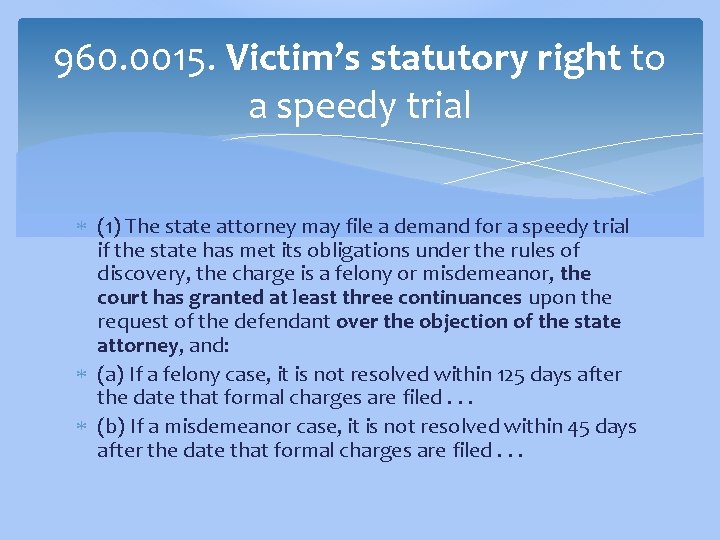
960. 0015. Victim’s statutory right to a speedy trial (1) The state attorney may file a demand for a speedy trial if the state has met its obligations under the rules of discovery, the charge is a felony or misdemeanor, the court has granted at least three continuances upon the request of the defendant over the objection of the state attorney, and: (a) If a felony case, it is not resolved within 125 days after the date that formal charges are filed. . . (b) If a misdemeanor case, it is not resolved within 45 days after the date that formal charges are filed. . .
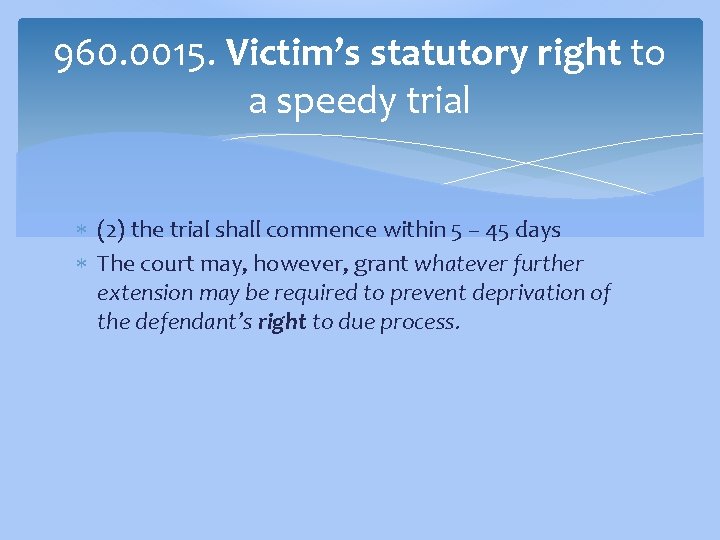
960. 0015. Victim’s statutory right to a speedy trial (2) the trial shall commence within 5 – 45 days The court may, however, grant whatever further extension may be required to prevent deprivation of the defendant’s right to due process.
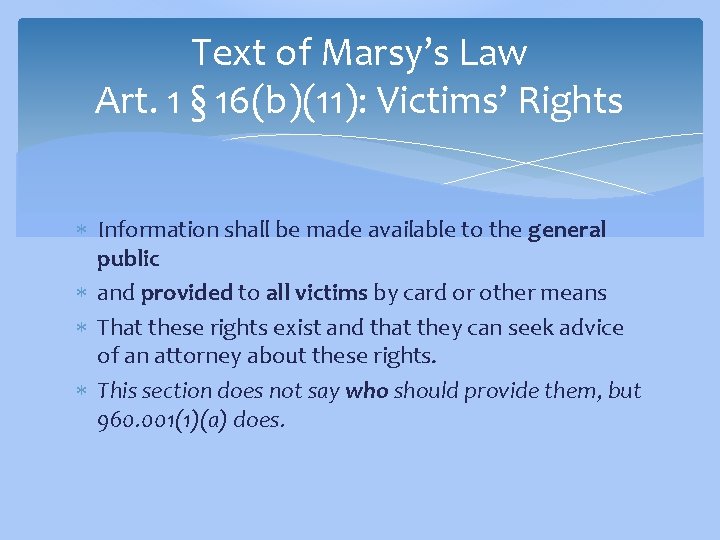
Text of Marsy’s Law Art. 1 § 16(b)(11): Victims’ Rights Information shall be made available to the general public and provided to all victims by card or other means That these rights exist and that they can seek advice of an attorney about these rights. This section does not say who should provide them, but 960. 001(1)(a) does.
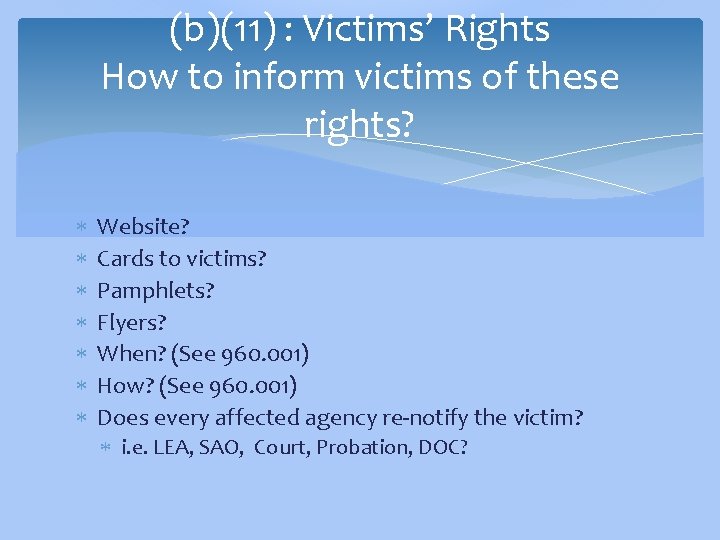
(b)(11) : Victims’ Rights How to inform victims of these rights? Website? Cards to victims? Pamphlets? Flyers? When? (See 960. 001) How? (See 960. 001) Does every affected agency re-notify the victim? i. e. LEA, SAO, Court, Probation, DOC?
Statute addressing notification of victim’s rights 960. 0021 (1) Victims must be properly advised in the courts of this state. (2) The courts may fulfill their obligation to advise crime victims by: (a) Making the following announcement at any arraignment, sentencing, or case-management proceeding: “If you are the victim of a crime with a case pending before this court, you are advised that you have the right:
Statute addressing notification of victim’s rights 960. 0021 1. To be informed. 2. To be present. 3. To be heard, when relevant, at all crucial stages of criminal proceedings to the extent that these rights do not interfere with the constitutional rights of the accused. (Remember this language taken out of Constitution) 4. To receive advance notification, when possible, of judicial proceedings and notification of scheduling changes 5. To seek crimes compensation and restitution.
Statute addressing notification of victim’s rights 960. 0021 6. To consult with the state attorney’s office in certain felony cases regarding the disposition of the case. (Constitutional provision says ALL cases) 7. To make an oral or written victim impact statement at the time of sentencing of a defendant. For further information regarding additional rights afforded to victims of crime, you may contact the state attorney’s office or obtain a listing of your rights from the Clerk of Court. ” Or the court can post rights on the courtroom doors.
Text of Marsy’s Law cont’d: Art. 1 § 16 (c) Who can assert these rights? Victim Retained attorney of victim Lawful representative of victim Or SAO upon request of victim The court or other authority shall act promptly on such request The court or other authority shall afford a remedy by due course of law for any violation of said rights.
Text of Marsy’s Law cont’d: Art. 1 § 16(c) The reason for any disposition of a victim’s right [by the court] shall be clearly stated on the record. What is a remedy by due course of law? Contempt? Reopen the case if something was complied with such as restitution?
Guidelines for fair treatment of victims and witnesses in the criminal justice and juvenile justice systems 960. 001
960. 001 This statute was last changed in 2014 before Marsy’s law was enacted. However, the statute refers to Art. 1, sect. 16(b) of the Florida Constitution which is Marsy’s law:
960. 001 Implementation of Marsy’s Law Every law enforcement agency. . . shall develop and implement guidelines for the use of their respective agencies, which guidelines are consistent with the purposes of this act and s. 16(b), Art. I of the State Constitution and are designed to implement s. 16(b), Art. I of the State Constitution and to achieve the following objectives:
960. 001(1)(a) Information concerning services available to victims State Attorneys and Public Defenders required to gather information regarding the following services in their jurisdiction and provide such information to LEAs in their jurisdiction. Law enforcement personnel shall ensure, through distribution of a victim’s rights information card or brochure at the crime scene, during the criminal investigation, and in any other appropriate manner, that victims are given, as a matter of course at the earliest possible time, information about:
Information concerning services available to victims: 960. 001(1)(a) 1) Crime victim compensation 2) Crisis intervention services, supportive or bereavement counseling, social service support referrals, and community-based victim treatment programs
960. 001(1)(a) Information concerning services available to victims 3) The role of the victim in the criminal or juvenile justice process, including what the victim may expect from the system as well as what the system expects from the victim 4) The stages in the criminal justice process which are of significance to the victim and the manner in which information about such stages can be obtained
960. 001(1)(a) Information concerning services available to victims 5) The right of a victim/parent/guardian/next of kin, who is not incarcerated, to be informed, to be present, and to be heard when relevant, at all crucial stages of a criminal or juvenile proceeding, to the extent that this right does not interfere with constitutional rights of the accused, as provided by s. 16(b), Art. I of the State Constitution; Note that 960. 001(1)(a) predates Marsy’s Law (which has put the victims’ rights on par with the defendants).
960. 001(1)(a) Information concerning services available to victims 6) In the case of incarcerated victims, the right to be informed and to submit written statements at all crucial stages 7) The right of a victim to a prompt and timely disposition of the case in order to minimize the period during which the victim must endure the responsibilities and stress involved to the extent that this right does not interfere with the constitutional rights of the accused. Remember this statute predates the Constitutional change of Marsy’s Law.
Information for purposes of notifying victim or appropriate next of kin of victim or other designated contact of victim 960. 001(1)(b) In the case of a homicide/attempted homicide, sexual battery/attempted sexual battery (Ch. 794), stalking or domestic violence, LEO or other agency personnel must request victim/next of kin fill out a victim notification card. Unless victim waived notification, the card must be filed at the sheriff’s office in the jurisdiction where offense occurred and shall include: The name, address, and phone number of the victim or the contact person and any relevant identification or case numbers assigned to the case.
Victim Notification 960. 001(1)(b)(3) The jail/detention facility shall make a reasonable attempt to notify the victim/next of kin within 4 hours following the release of the defendant on bail or from detention or commitment. If can’t reach by phone, do so in writing. Victim card follows the defendant upon being sentenced.
960. 001 Advance Notification A victim/witness shall be given information about steps that are available to protect them from intimidation. Victims of domestic violence shall also be given information about the address confidentiality program provided under s. 741. 403 Victims/witnesses shall be notified of any changes in scheduling for anything requiring their attendance.
960. 001 Victim/Next of kin shall be provided prompt advance notification of: Arrest of defendant Pre-trial release Court proceedings
Impact of Marsy’s Law Financial: Redaction of report Redaction of video/audio Redaction of photos? Who does the redaction? Is the defendant entitled to un-redacted version? What information can you make available to public to solve a crime? How long does it last?
Marsy’s Law Victim v. Defendant The right to discovery is by rule of procedure (statute). It is not a constitutional right. The defendant’s right to confront an accuser is constitutional (U. S. 6 th amendment)/ (FL Art. 1, section 16) The right to confront an accuser attaches at trial, not before.
Practical Implication of Marsy’s Law What is the relationship of the parties? Does the defendant already know how to locate the victim? Are there other statutory requirements which protect the victim’s interests without invoking Marsy’s law? Can the victim waive Marsy’s law after invoking?
Impact of Marsy’s Law in other States After the amendment was passed in South Dakota via a 2016 ballot initiative, county courts started complaining about a several million dollar increase in administrative costs. One official in South Dakota complained about a woman whose husband was killed in a car accident the previous year who couldn’t obtain police reports from DHSMV because they are afraid to release the information. They're “not sure if there was a crime, and if there was, who the victim is. "
Impact of Marsy’s Law Different agencies in the same county have different ideas of what is required. There are likely both legislative changes and lawsuits in the future.
Impact of Marsy’s Law At least one department is redacting every victim’s name from every report, regardless if requested. Other agencies aren’t redacting anything unless the victim requests it. Are the un-redacted versions being sent to the State? How does the SAO prosecute a case if they can’t ID their victim?
Confidentiality: Automatic or Upon Request? One major question is whether crime victims are automatically granted confidentiality or they have to ask for it first. The section addressing disclosure of identifying information is not prefaced by “upon request. ”
Impact of Marsy’s Law Redactions to online information? Redactions to locations of calls for service? If victim subsequently requests confidentiality, go back and remove from website?
Impact of Marsy’s Law Victims have a right to be present in court. Prosecutors may try to call victims to testify first, so they can remain in the courtroom for the entire trial. Think about LEO victims being present in court for whole trial. Batt LEO Resisting Arrest w/ violence Resisting Arrest w/o violence