
Mars Sample Return Discussions As presented on February
Mars Sample Return Discussions As presented on February 23, 2010 *Mars Sample Return is conceptual in nature and is subject to NASA approval. This approval would not be granted until NASA completes the National Environmental Policy Act (NEPA) process. 1
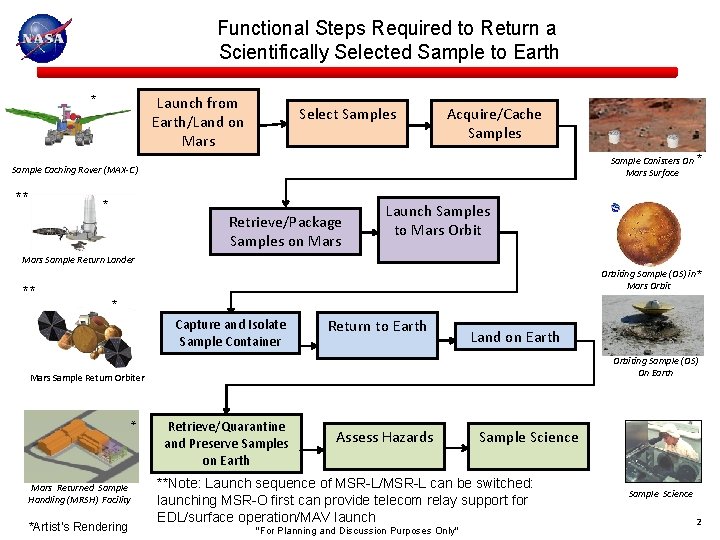
Functional Steps Required to Return a Scientifically Selected Sample to Earth Launch from Earth/Land on Mars * Select Samples Acquire/Cache Samples Sample Canisters On Mars Surface Sample Caching Rover (MAX-C) ** * Retrieve/Package Samples on Mars * Launch Samples to Mars Orbit Mars Sample Return Lander ** Orbiting Sample (OS) in * Mars Orbit * Capture and Isolate Sample Container Return to Earth Land on Earth Orbiting Sample (OS) On Earth Mars Sample Return Orbiter * Mars Returned Sample Handling (MRSH) Facility *Artist’s Rendering Retrieve/Quarantine and Preserve Samples on Earth Assess Hazards Sample Science **Note: Launch sequence of MSR-L/MSR-L can be switched: launching MSR-O first can provide telecom relay support for EDL/surface operation/MAV launch "For Planning and Discussion Purposes Only" Sample Science 2
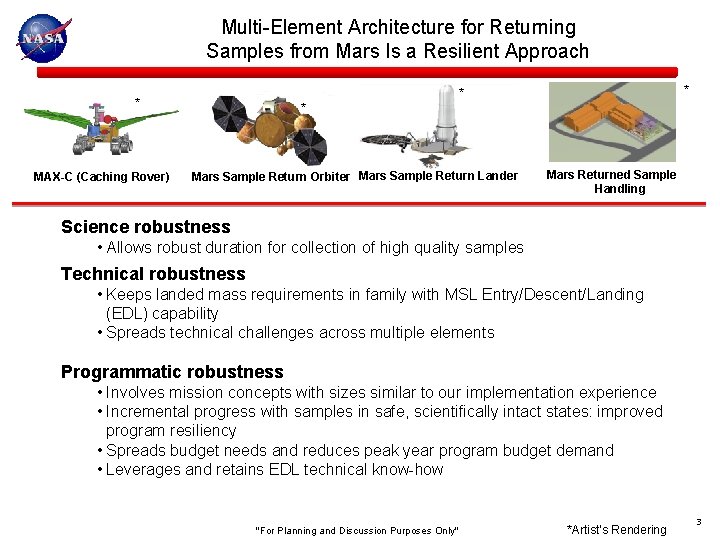
Multi-Element Architecture for Returning Samples from Mars Is a Resilient Approach MAX-C (Caching Rover) * * * Mars Sample Return Orbiter Mars Sample Return Lander Mars Returned Sample Handling Science robustness • Allows robust duration for collection of high quality samples Technical robustness • Keeps landed mass requirements in family with MSL Entry/Descent/Landing (EDL) capability • Spreads technical challenges across multiple elements Programmatic robustness • Involves mission concepts with sizes similar to our implementation experience • Incremental progress with samples in safe, scientifically intact states: improved program resiliency • Spreads budget needs and reduces peak year program budget demand • Leverages and retains EDL technical know-how "For Planning and Discussion Purposes Only" *Artist’s Rendering 3
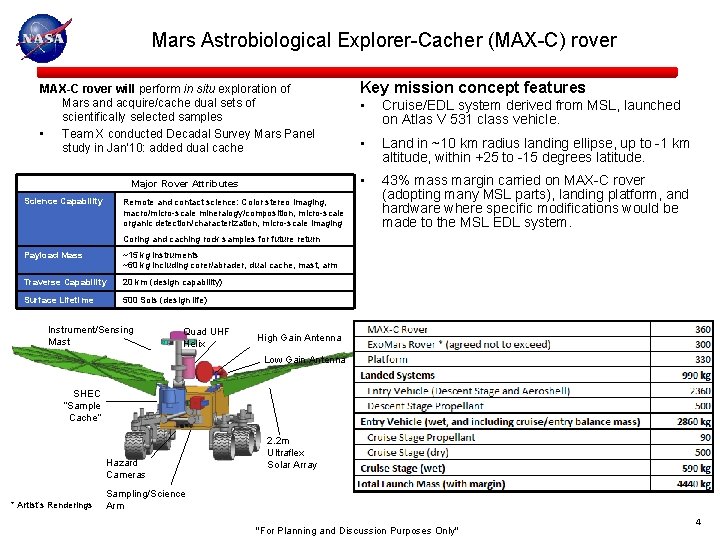
Mars Astrobiological Explorer-Cacher (MAX-C) rover MAX-C rover will perform in situ exploration of Mars and acquire/cache dual sets of scientifically selected samples • Team X conducted Decadal Survey Mars Panel study in Jan’ 10: added dual cache Major Rover Attributes Science Capability Remote and contact science: Color stereo imaging, macro/micro-scale mineralogy/composition, micro-scale organic detection/characterization, micro-scale imaging Key mission concept features • Cruise/EDL system derived from MSL, launched on Atlas V 531 class vehicle. • Land in ~10 km radius landing ellipse, up to -1 km altitude, within +25 to -15 degrees latitude. • 43% mass margin carried on MAX-C rover (adopting many MSL parts), landing platform, and hardware where specific modifications would be made to the MSL EDL system. Coring and caching rock samples for future return Payload Mass ~15 kg instruments ~60 kg including corer/abrader, dual cache, mast, arm Traverse Capability 20 km (design capability) Surface Lifetime 500 Sols (design life) Instrument/Sensing Mast Quad UHF Helix High Gain Antenna Low Gain Antenna * SHEC “Sample Cache” Hazard Cameras * Artist’s Renderings 2. 2 m Ultraflex Solar Array Sampling/Science Arm "For Planning and Discussion Purposes Only" 4
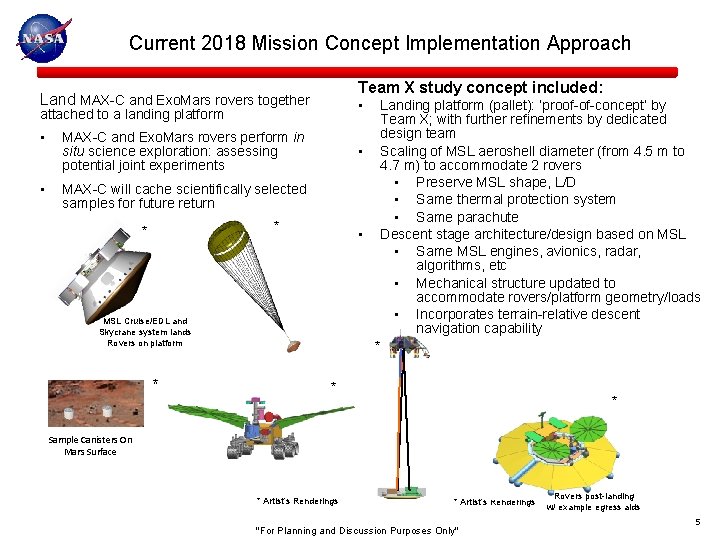
Current 2018 Mission Concept Implementation Approach Team X study concept included: Land MAX-C and Exo. Mars rovers together • attached to a landing platform • MAX-C and Exo. Mars rovers perform in situ science exploration: assessing potential joint experiments • MAX-C will cache scientifically selected samples for future return • * * • MSL Cruise/EDL and Skycrane system lands Rovers on platform * Sample Canisters On Mars Surface Landing platform (pallet): ‘proof-of-concept’ by Team X; with further refinements by dedicated design team Scaling of MSL aeroshell diameter (from 4. 5 m to 4. 7 m) to accommodate 2 rovers • Preserve MSL shape, L/D • Same thermal protection system • Same parachute Descent stage architecture/design based on MSL • Same MSL engines, avionics, radar, algorithms, etc • Mechanical structure updated to accommodate rovers/platform geometry/loads • Incorporates terrain-relative descent navigation capability * * * MAX-C Rover * Artist’s Renderings "For Planning and Discussion Purposes Only" Rovers post-landing w/ example egress aids 5
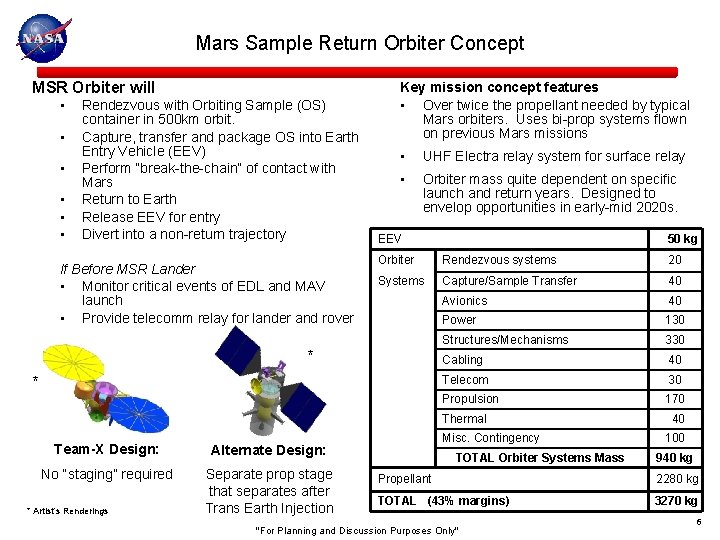
Mars Sample Return Orbiter Concept MSR Orbiter will • • • Rendezvous with Orbiting Sample (OS) container in 500 km orbit. Capture, transfer and package OS into Earth Entry Vehicle (EEV) Perform “break-the-chain” of contact with Mars Return to Earth Release EEV for entry Divert into a non-return trajectory If Before MSR Lander • Monitor critical events of EDL and MAV launch • Provide telecomm relay for lander and rover Key mission concept features • Over twice the propellant needed by typical Mars orbiters. Uses bi-prop systems flown on previous Mars missions • UHF Electra relay system for surface relay • Orbiter mass quite dependent on specific launch and return years. Designed to envelop opportunities in early-mid 2020 s. EEV Orbiter Rendezvous systems 20 Systems Capture/Sample Transfer 40 Avionics 40 Power 130 Structures/Mechanisms 330 Cabling 40 Telecom 30 Propulsion 170 Thermal 40 Misc. Contingency 100 * * Team-X Design: Alternate Design: No “staging” required Separate prop stage that separates after Trans Earth Injection * Artist’s Renderings 50 kg TOTAL Orbiter Systems Mass 940 kg Propellant 2280 kg TOTAL (43% margins) 3270 kg "For Planning and Discussion Purposes Only" 6
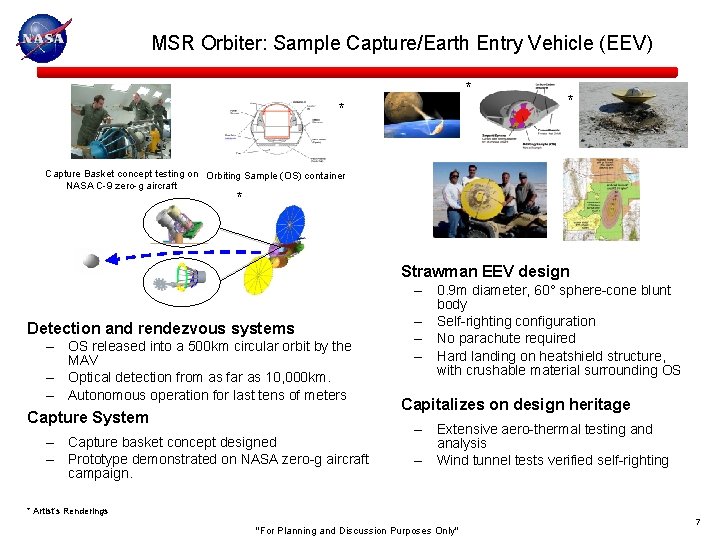
MSR Orbiter: Sample Capture/Earth Entry Vehicle (EEV) * * * Capture Basket concept testing on Orbiting Sample (OS) container NASA C-9 zero-g aircraft * Strawman EEV design Detection and rendezvous systems – OS released into a 500 km circular orbit by the MAV – Optical detection from as far as 10, 000 km. – Autonomous operation for last tens of meters Capture System – Capture basket concept designed – Prototype demonstrated on NASA zero-g aircraft campaign. – 0. 9 m diameter, 60° sphere-cone blunt body – Self-righting configuration – No parachute required – Hard landing on heatshield structure, with crushable material surrounding OS Capitalizes on design heritage – Extensive aero-thermal testing and analysis – Wind tunnel tests verified self-righting * Artist’s Renderings "For Planning and Discussion Purposes Only" 7
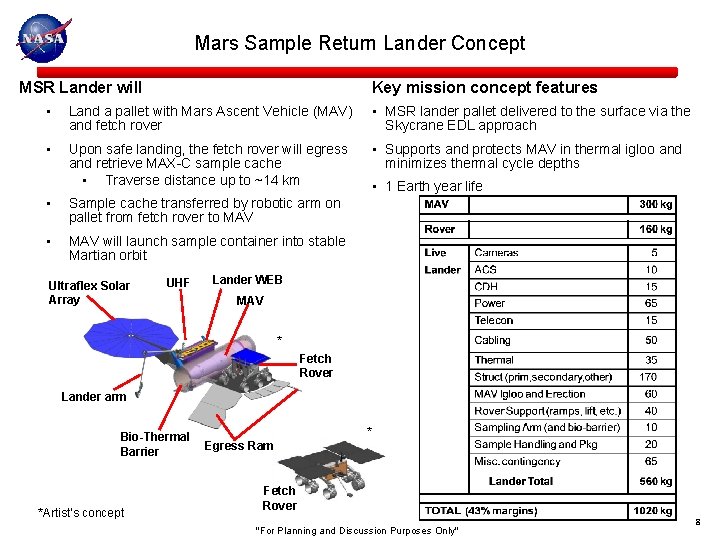
Mars Sample Return Lander Concept MSR Lander will Key mission concept features • Land a pallet with Mars Ascent Vehicle (MAV) and fetch rover • MSR lander pallet delivered to the surface via the Skycrane EDL approach • Upon safe landing, the fetch rover will egress and retrieve MAX-C sample cache • Traverse distance up to ~14 km • Supports and protects MAV in thermal igloo and minimizes thermal cycle depths • Sample cache transferred by robotic arm on pallet from fetch rover to MAV • MAV will launch sample container into stable Martian orbit Ultraflex Solar Array UHF • 1 Earth year life Lander WEB MAV * Fetch Rover Lander arm Bio-Thermal Barrier *Artist’s concept * Egress Ramps Fetch Rover "For Planning and Discussion Purposes Only" 8
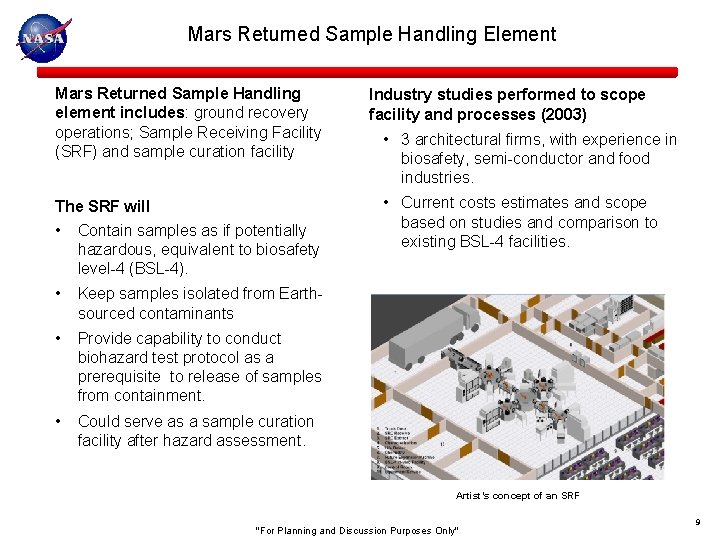
Mars Returned Sample Handling Element Mars Returned Sample Handling element includes: ground recovery operations; Sample Receiving Facility (SRF) and sample curation facility The SRF will • Contain samples as if potentially hazardous, equivalent to biosafety level-4 (BSL-4). • Keep samples isolated from Earthsourced contaminants • Provide capability to conduct biohazard test protocol as a prerequisite to release of samples from containment. • Could serve as a sample curation facility after hazard assessment. Industry studies performed to scope facility and processes (2003) • 3 architectural firms, with experience in biosafety, semi-conductor and food industries. • Current costs estimates and scope based on studies and comparison to existing BSL-4 facilities. Artist’s concept of an SRF "For Planning and Discussion Purposes Only" 9
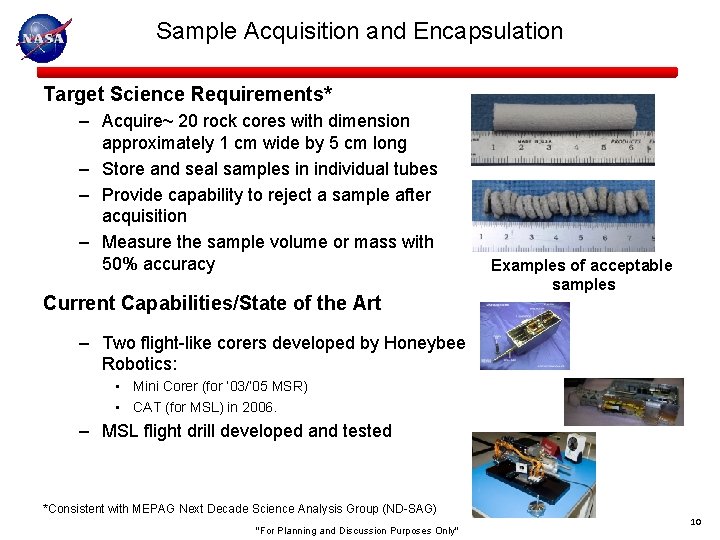
Sample Acquisition and Encapsulation Target Science Requirements* – Acquire~ 20 rock cores with dimension approximately 1 cm wide by 5 cm long – Store and seal samples in individual tubes – Provide capability to reject a sample after acquisition – Measure the sample volume or mass with 50% accuracy Current Capabilities/State of the Art Examples of acceptable samples – Two flight-like corers developed by Honeybee Robotics: • Mini Corer (for ’ 03/‘ 05 MSR) • CAT (for MSL) in 2006. – MSL flight drill developed and tested *Consistent with MEPAG Next Decade Science Analysis Group (ND-SAG) "For Planning and Discussion Purposes Only" 10
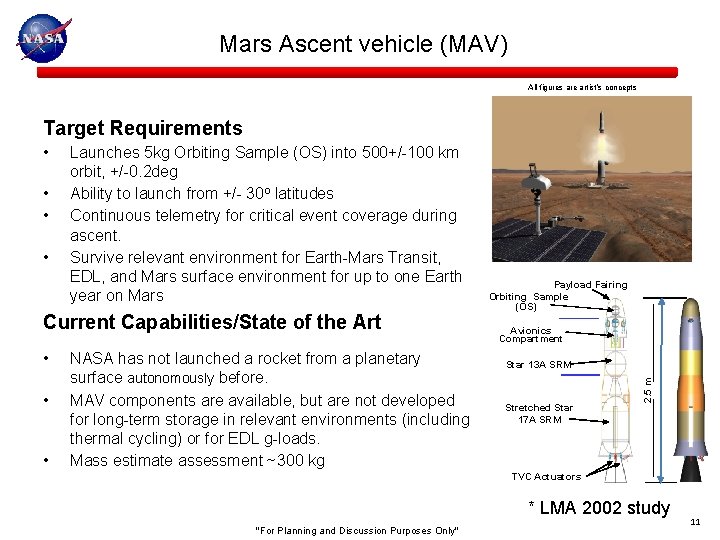
Mars Ascent vehicle (MAV) All figures are artist’s concepts Target Requirements • • • Launches 5 kg Orbiting Sample (OS) into 500+/-100 km orbit, +/-0. 2 deg Ability to launch from +/- 30 o latitudes Continuous telemetry for critical event coverage during ascent. Survive relevant environment for Earth-Mars Transit, EDL, and Mars surface environment for up to one Earth year on Mars Current Capabilities/State of the Art • • • NASA has not launched a rocket from a planetary surface autonomously before. MAV components are available, but are not developed for long-term storage in relevant environments (including thermal cycling) or for EDL g-loads. Mass estimate assessment ~300 kg Payload Fairing Orbiting Sample (OS) Avionics Compartment Star 13 A SRM Stretched Star 17 A SRM 2. 5 m • TVC Actuators * LMA 2002 study "For Planning and Discussion Purposes Only" 11
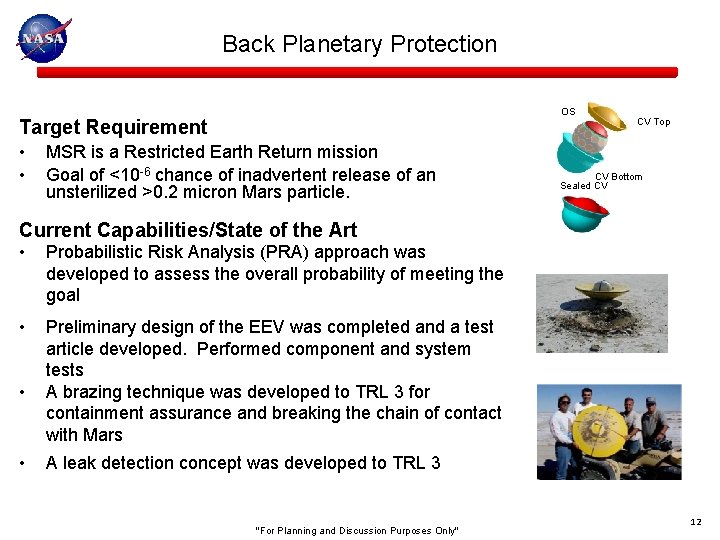
Back Planetary Protection OS Target Requirement • • MSR is a Restricted Earth Return mission Goal of <10 -6 chance of inadvertent release of an unsterilized >0. 2 micron Mars particle. CV Top CV Bottom Sealed CV Current Capabilities/State of the Art • Probabilistic Risk Analysis (PRA) approach was developed to assess the overall probability of meeting the goal • Preliminary design of the EEV was completed and a test article developed. Performed component and system tests A brazing technique was developed to TRL 3 for containment assurance and breaking the chain of contact with Mars • • A leak detection concept was developed to TRL 3 "For Planning and Discussion Purposes Only" 12
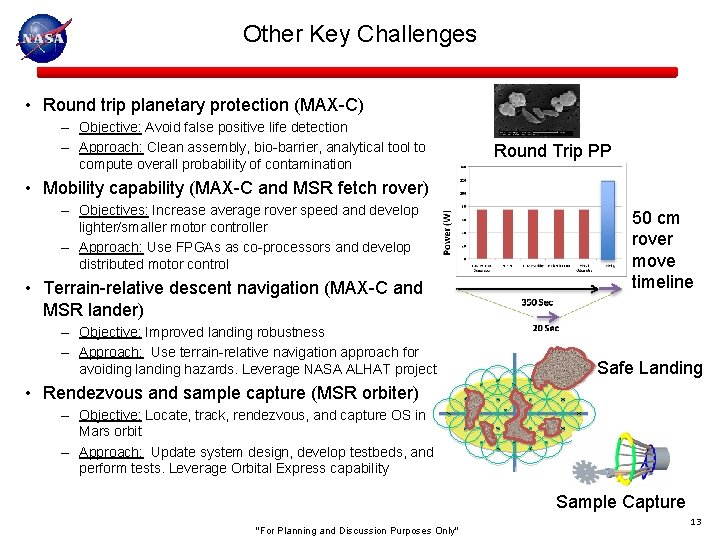
Other Key Challenges • Round trip planetary protection (MAX-C) – Objective: Avoid false positive life detection – Approach: Clean assembly, bio-barrier, analytical tool to compute overall probability of contamination Round Trip PP • Mobility capability (MAX-C and MSR fetch rover) – Objectives: Increase average rover speed and develop lighter/smaller motor controller – Approach: Use FPGAs as co-processors and develop distributed motor control • Terrain-relative descent navigation (MAX-C and MSR lander) – Objective: Improved landing robustness – Approach: Use terrain-relative navigation approach for avoiding landing hazards. Leverage NASA ALHAT project 50 cm rover move timeline Safe Landing • Rendezvous and sample capture (MSR orbiter) – Objective: Locate, track, rendezvous, and capture OS in Mars orbit – Approach: Update system design, develop testbeds, and perform tests. Leverage Orbital Express capability Sample Capture "For Planning and Discussion Purposes Only" 13
Summary • Strong scientific impetus for sample return – Next major step in understanding Mars and the Solar System • Engineering readiness for sample return – Past investments have developed key capabilities critical to sample return – Key remaining technical challenges/development are identified • Resilient multi-flight-element approach – Science robustness • Allows proper sample selection/acquisition – Technical robustness • • Spreads technical challenges across multiple elements Keeps landed mass requirements in family with MSL EDL capability – Programmatic robustness • • Involves concepts similar to our existing implementation experience Scientifically intact samples on/around Mars that provides program resiliency Spreads budget needs over ~1. 5 decade Approach amenable to international partnership • Multi-element MSR should not be viewed as an “isolated (flagship) mission” but as a cohesive campaign that builds on the past decade of Mars exploration "For Planning and Discussion Purposes Only" 14
- Slides: 14