
Mars PreNoachian and Noachian The Early Years THE
- Slides: 30
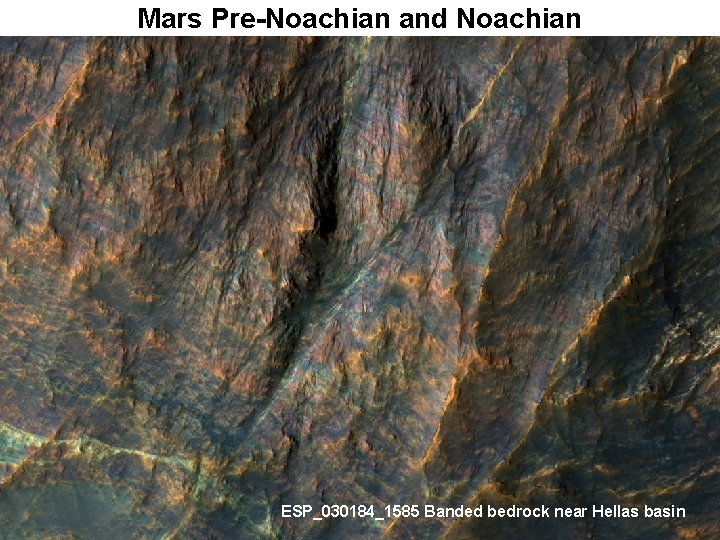
Mars Pre-Noachian and Noachian The Early Years THE NOACHIAN ESP_030184_1585 Banded bedrock near Hellas basin 1
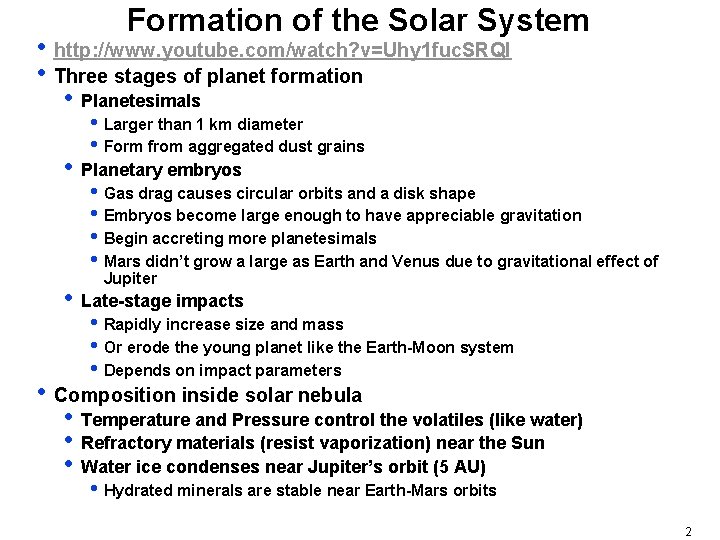
Formation of the Solar System • http: //www. youtube. com/watch? v=Uhy 1 fuc. SRQI • Three stages of planet formation • Planetesimals • Planetary embryos • • Larger than 1 km diameter • Form from aggregated dust grains • Gas drag causes circular orbits and a disk shape • Embryos become large enough to have appreciable gravitation • Begin accreting more planetesimals • Mars didn’t grow a large as Earth and Venus due to gravitational effect of Jupiter Late-stage impacts • Rapidly increase size and mass • Or erode the young planet like the Earth-Moon system • Depends on impact parameters • Composition inside solar nebula • • • Temperature and Pressure control the volatiles (like water) Refractory materials (resist vaporization) near the Sun Water ice condenses near Jupiter’s orbit (5 AU) • Hydrated minerals are stable near Earth-Mars orbits 2
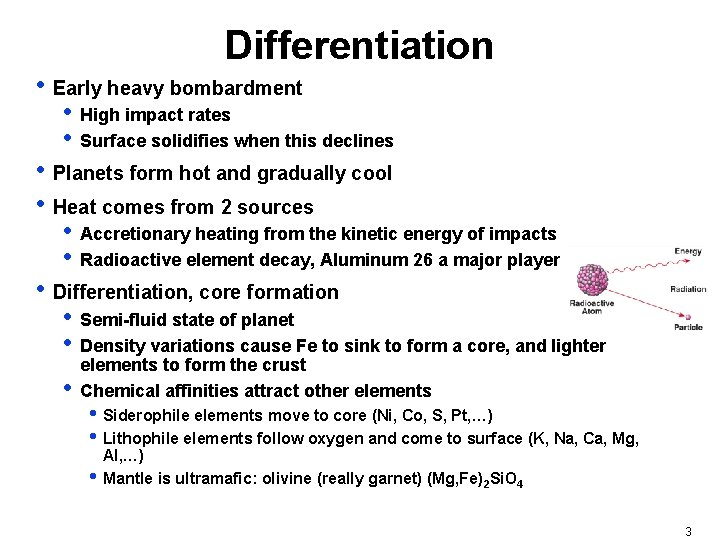
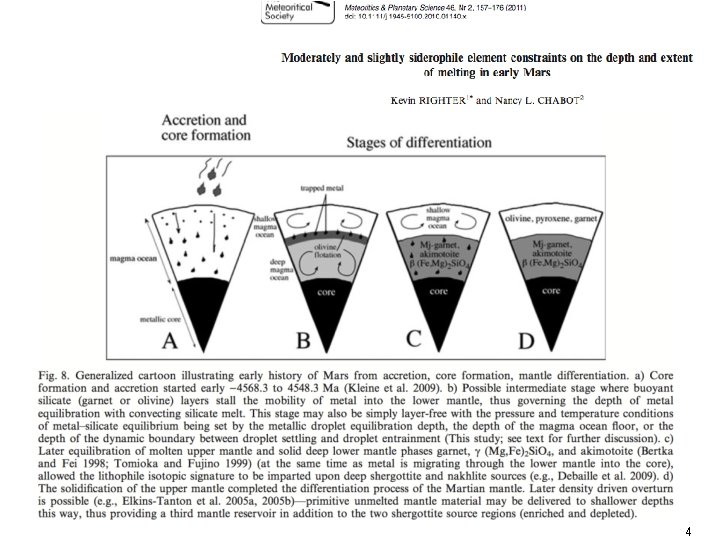
Differentiation • Early heavy bombardment • • High impact rates Surface solidifies when this declines • • Accretionary heating from the kinetic energy of impacts Radioactive element decay, Aluminum 26 a major player • • Semi-fluid state of planet Density variations cause Fe to sink to form a core, and lighter elements to form the crust Chemical affinities attract other elements • Planets form hot and gradually cool • Heat comes from 2 sources • Differentiation, core formation • • Siderophile elements move to core (Ni, Co, S, Pt, …) • Lithophile elements follow oxygen and come to surface (K, Na, Ca, Mg, • Al, …) Mantle is ultramafic: olivine (really garnet) (Mg, Fe)2 Si. O 4 3
4
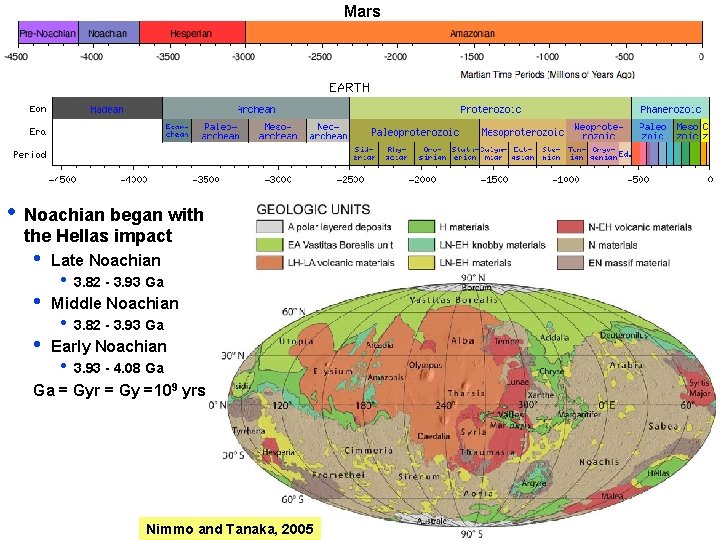
Mars • Noachian began with the Hellas impact • Late Noachian • Middle Noachian • Early Noachian • 3. 82 - 3. 93 Ga • 3. 93 - 4. 08 Ga Ga = Gyr = Gy =109 yrs Nimmo and Tanaka, 2005 5
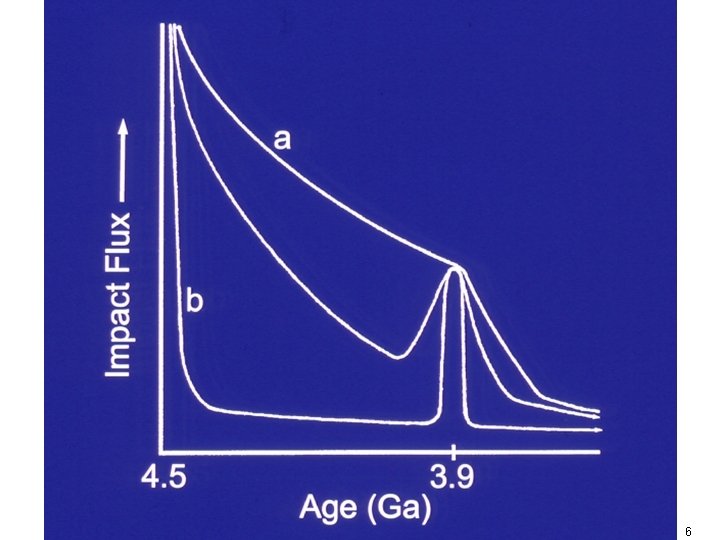
6
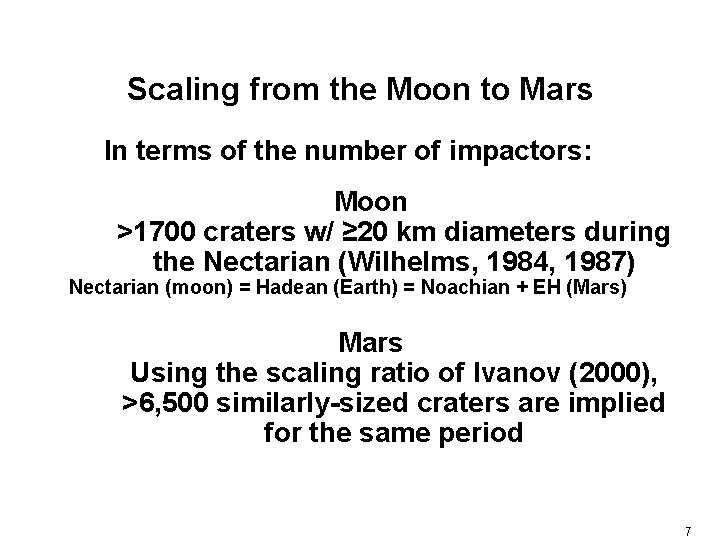
Scaling from the Moon to Mars In terms of the number of impactors: Moon >1700 craters w/ ≥ 20 km diameters during the Nectarian (Wilhelms, 1984, 1987) Nectarian (moon) = Hadean (Earth) = Noachian + EH (Mars) Mars Using the scaling ratio of Ivanov (2000), >6, 500 similarly-sized craters are implied for the same period 7
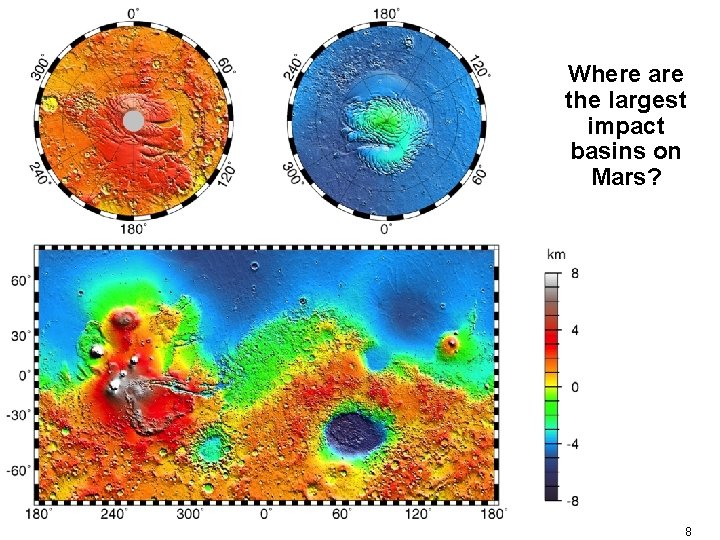
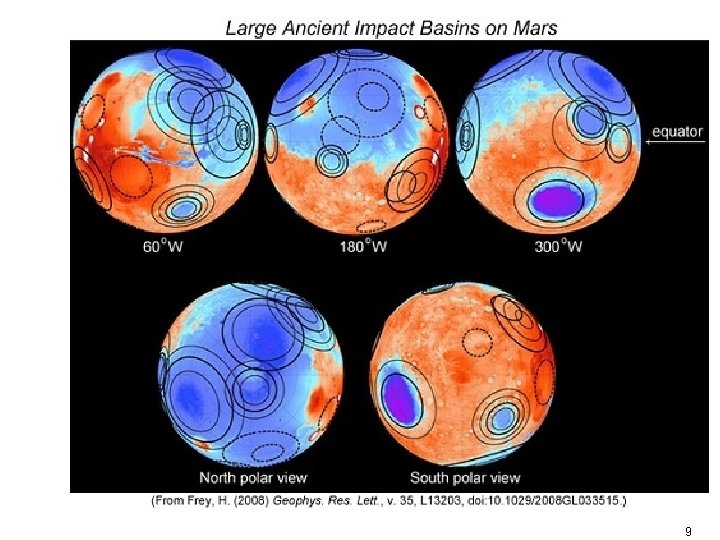
Where are the largest impact basins on Mars? 8
9
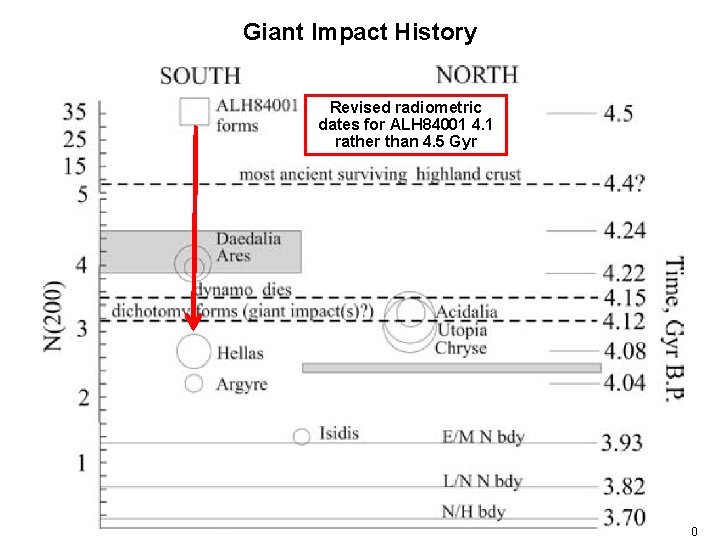
Giant Impact History Revised radiometric dates for ALH 84001 4. 1 rather than 4. 5 Gyr 10
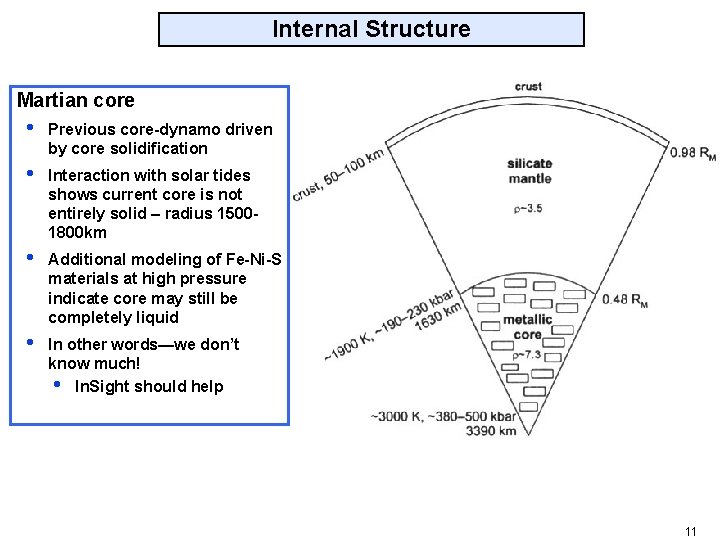
Internal Structure Martian core • Previous core-dynamo driven by core solidification • Interaction with solar tides shows current core is not entirely solid – radius 15001800 km • Additional modeling of Fe-Ni-S materials at high pressure indicate core may still be completely liquid • In other words—we don’t know much! • In. Sight should help 11
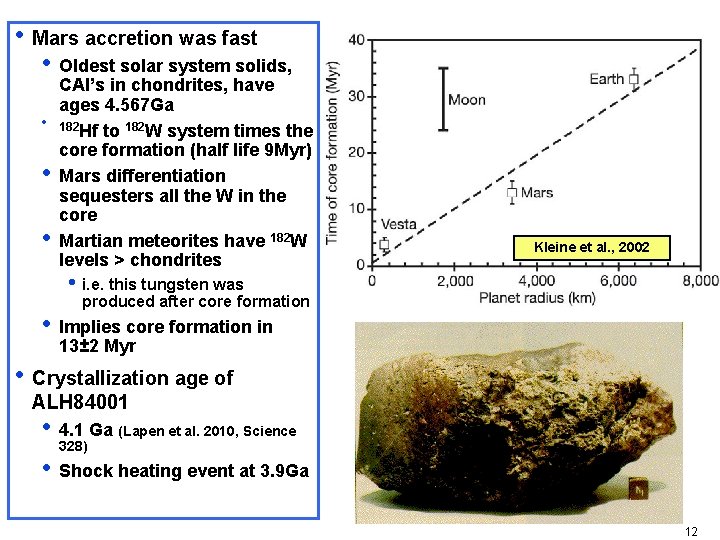
• Mars accretion was fast • Oldest solar system solids, CAI’s in chondrites, have ages 4. 567 Ga • 182 Hf to 182 W system times the core formation (half life 9 Myr) • Mars differentiation sequesters all the W in the core • Martian meteorites have 182 W levels > chondrites Kleine et al. , 2002 • i. e. this tungsten was • produced after core formation Implies core formation in 13± 2 Myr • Crystallization age of ALH 84001 • • 4. 1 Ga (Lapen et al. 2010, Science 328) Shock heating event at 3. 9 Ga 12
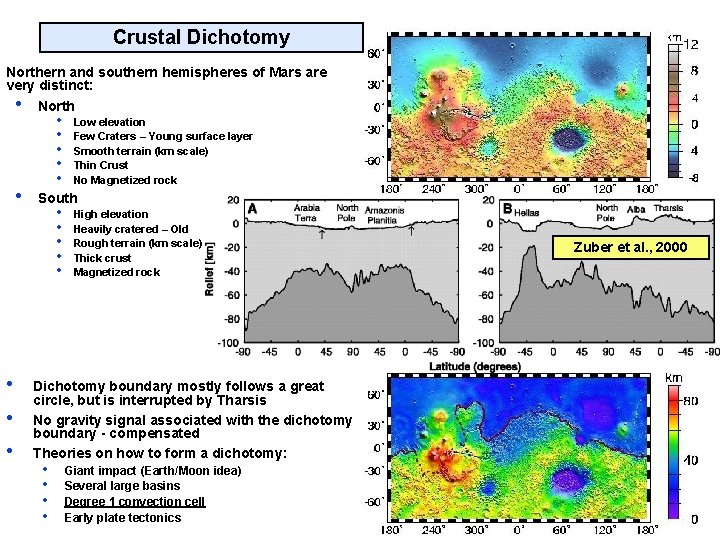
Crustal Dichotomy Northern and southern hemispheres of Mars are very distinct: • North • • • Low elevation Few Craters – Young surface layer Smooth terrain (km scale) Thin Crust No Magnetized rock South • • • High elevation Heavily cratered – Old Rough terrain (km scale) Thick crust Magnetized rock Zuber et al. , 2000 Dichotomy boundary mostly follows a great circle, but is interrupted by Tharsis No gravity signal associated with the dichotomy boundary - compensated Theories on how to form a dichotomy: • • Giant impact (Earth/Moon idea) Several large basins Degree 1 convection cell Early plate tectonics 13
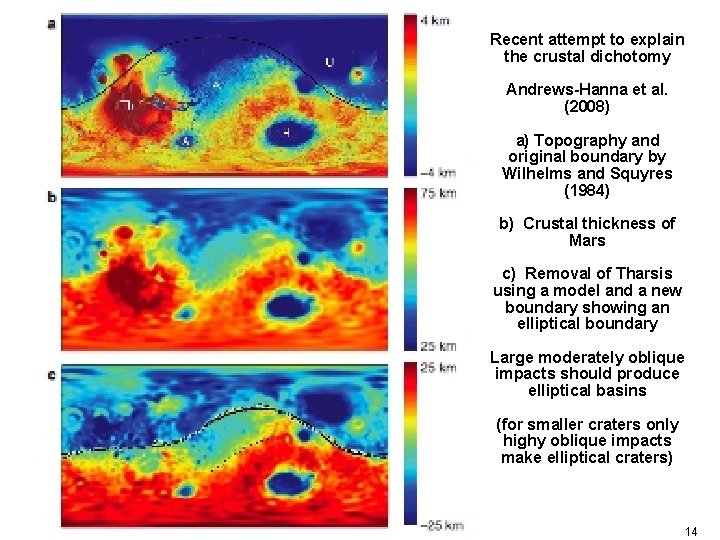
Recent attempt to explain the crustal dichotomy Andrews-Hanna et al. (2008) a) Topography and original boundary by Wilhelms and Squyres (1984) b) Crustal thickness of Mars c) Removal of Tharsis using a model and a new boundary showing an elliptical boundary Large moderately oblique impacts should produce elliptical basins (for smaller craters only highy oblique impacts make elliptical craters) 14
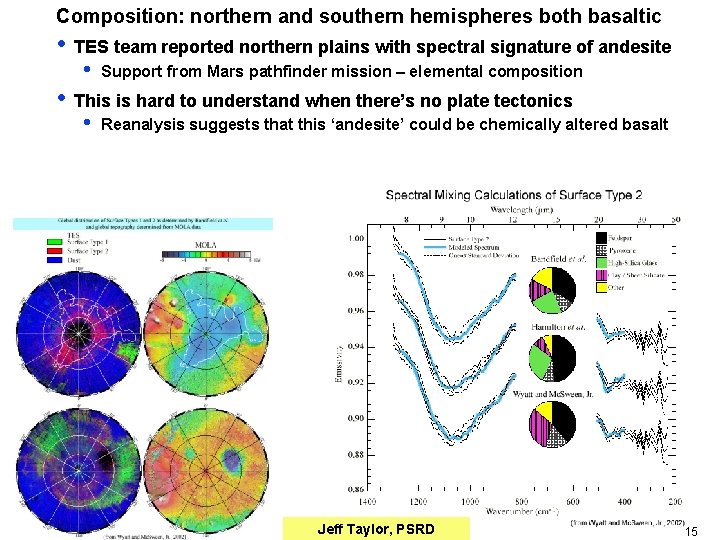
Composition: northern and southern hemispheres both basaltic • • TES team reported northern plains with spectral signature of andesite • Support from Mars pathfinder mission – elemental composition This is hard to understand when there’s no plate tectonics • Reanalysis suggests that this ‘andesite’ could be chemically altered basalt Jeff Taylor, PSRD 15
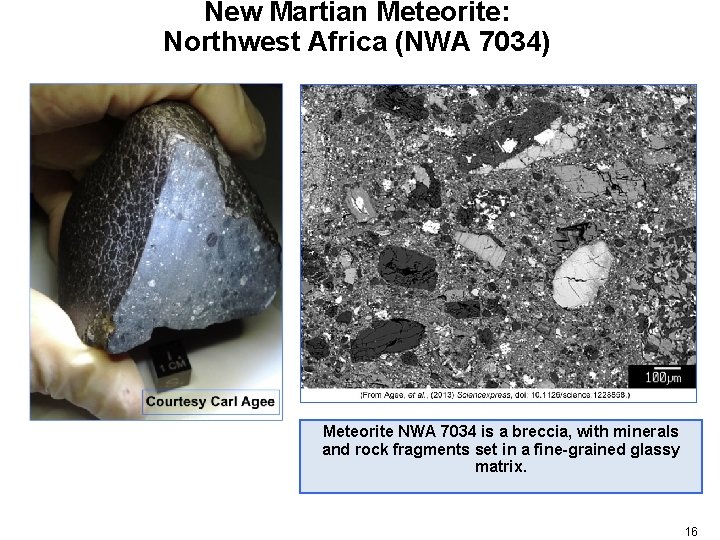
New Martian Meteorite: Northwest Africa (NWA 7034) Meteorite NWA 7034 is a breccia, with minerals and rock fragments set in a fine-grained glassy matrix. 16
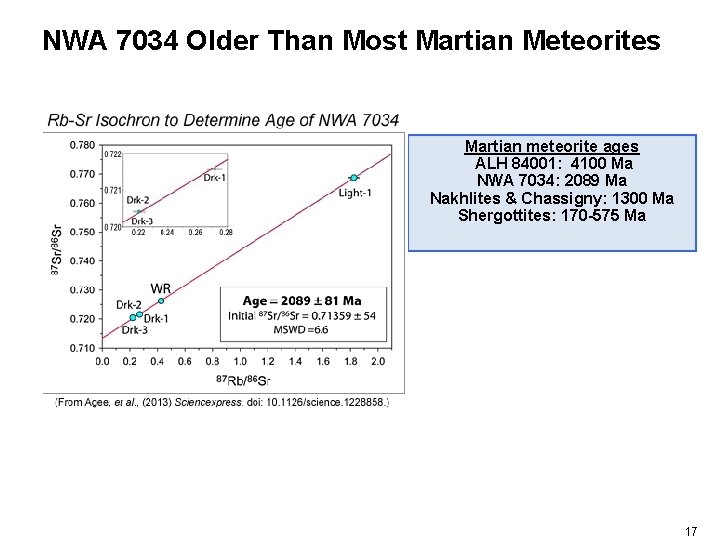
NWA 7034 Older Than Most Martian Meteorites Martian meteorite ages ALH 84001: 4100 Ma NWA 7034: 2089 Ma Nakhlites & Chassigny: 1300 Ma Shergottites: 170 -575 Ma 17
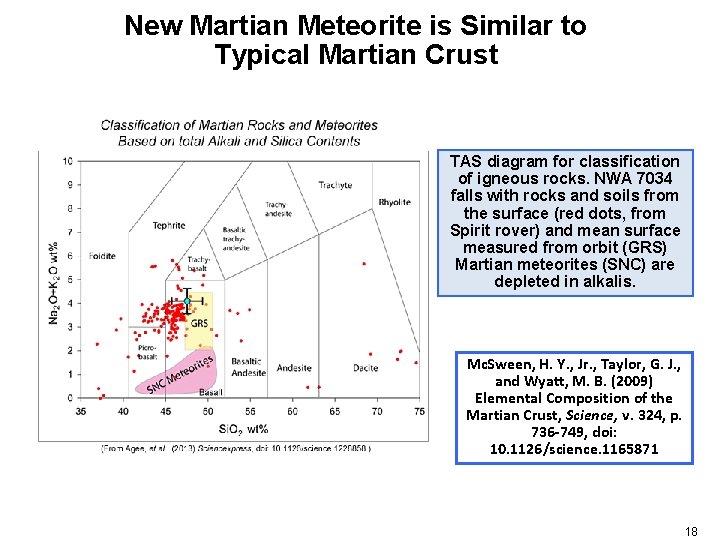
New Martian Meteorite is Similar to Typical Martian Crust TAS diagram for classification of igneous rocks. NWA 7034 falls with rocks and soils from the surface (red dots, from Spirit rover) and mean surface measured from orbit (GRS) Martian meteorites (SNC) are depleted in alkalis. Mc. Sween, H. Y. , Jr. , Taylor, G. J. , and Wyatt, M. B. (2009) Elemental Composition of the Martian Crust, Science, v. 324, p. 736 -749, doi: 10. 1126/science. 1165871 18
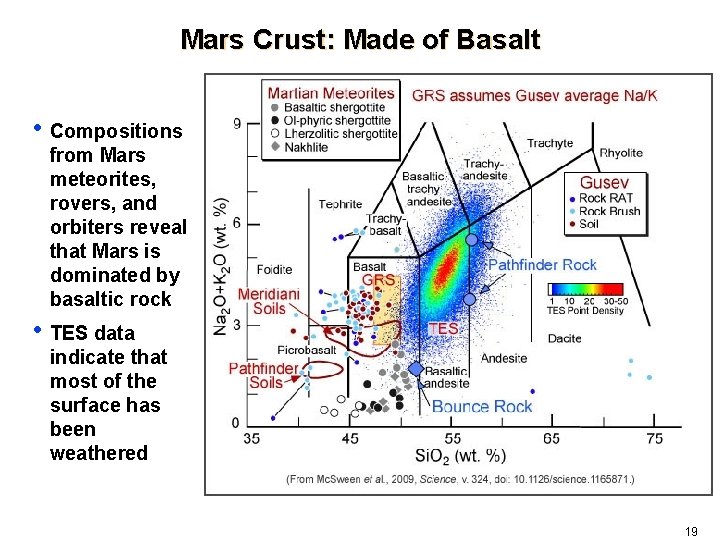
Mars Crust: Made of Basalt • Compositions from Mars meteorites, rovers, and orbiters reveal that Mars is dominated by basaltic rock • TES data indicate that most of the surface has been weathered 19
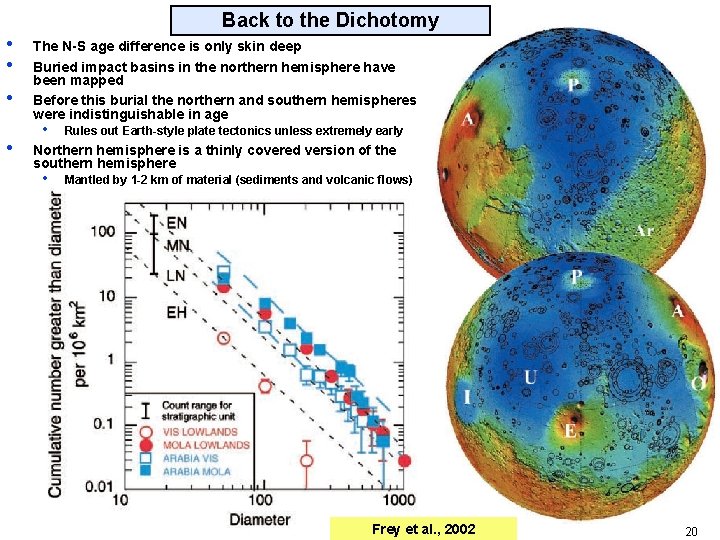
Back to the Dichotomy • • The N-S age difference is only skin deep Buried impact basins in the northern hemisphere have been mapped Before this burial the northern and southern hemispheres were indistinguishable in age • Rules out Earth-style plate tectonics unless extremely early Northern hemisphere is a thinly covered version of the southern hemisphere • Mantled by 1 -2 km of material (sediments and volcanic flows) Frey et al. , 2002 20
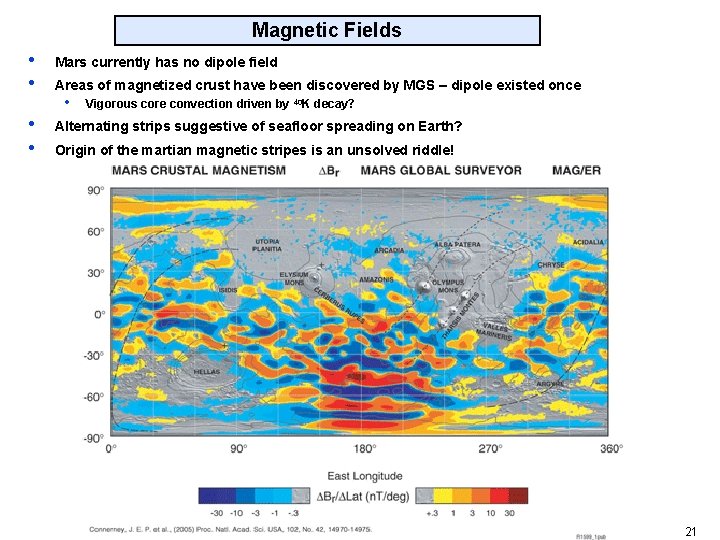
Magnetic Fields • • Mars currently has no dipole field Areas of magnetized crust have been discovered by MGS – dipole existed once • Vigorous core convection driven by 40 K decay? Alternating strips suggestive of seafloor spreading on Earth? Origin of the martian magnetic stripes is an unsolved riddle! 21
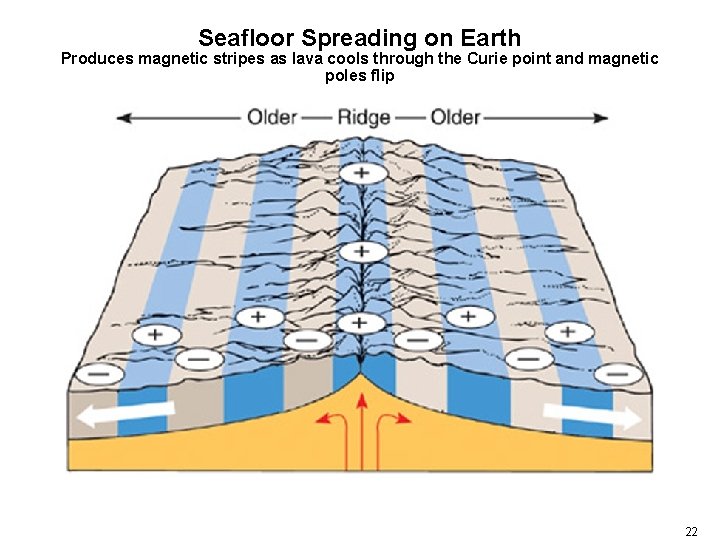
Seafloor Spreading on Earth Produces magnetic stripes as lava cools through the Curie point and magnetic poles flip 22
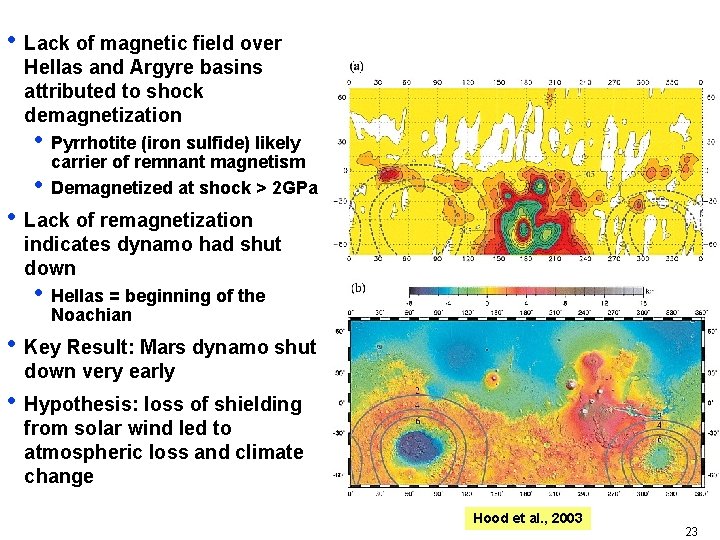
• Lack of magnetic field over Hellas and Argyre basins attributed to shock demagnetization • • Pyrrhotite (iron sulfide) likely carrier of remnant magnetism Demagnetized at shock > 2 GPa • Lack of remagnetization indicates dynamo had shut down • Hellas = beginning of the Noachian • Key Result: Mars dynamo shut down very early • Hypothesis: loss of shielding from solar wind led to atmospheric loss and climate change Hood et al. , 2003 23
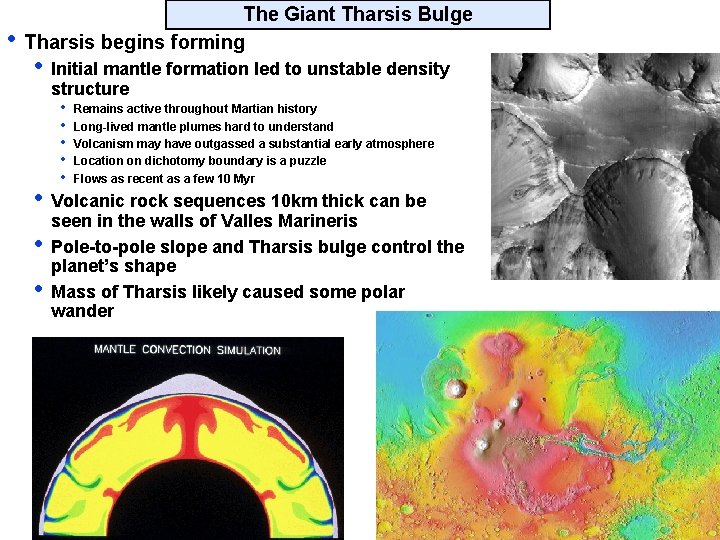
• The Giant Tharsis Bulge Tharsis begins forming • • Initial mantle formation led to unstable density structure • Remains active throughout Martian history • Long-lived mantle plumes hard to understand • Volcanism may have outgassed a substantial early atmosphere • Location on dichotomy boundary is a puzzle • Flows as recent as a few 10 Myr Volcanic rock sequences 10 km thick can be seen in the walls of Valles Marineris Pole-to-pole slope and Tharsis bulge control the planet’s shape Mass of Tharsis likely caused some polar wander 24
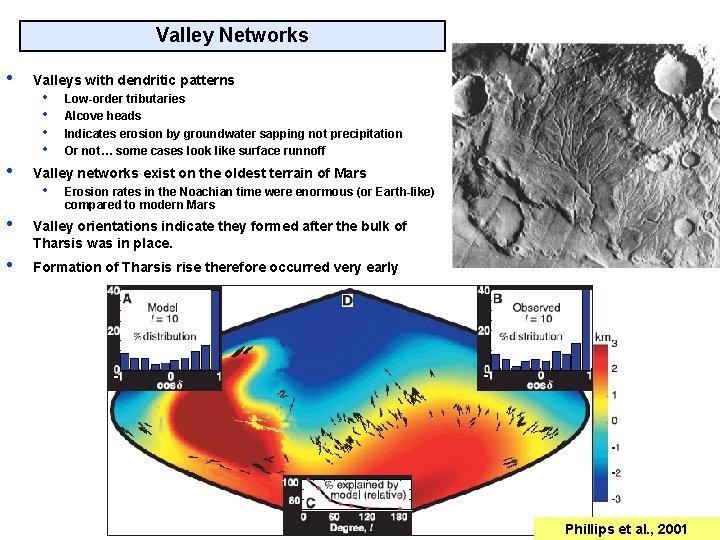
Valley Networks • • Valleys with dendritic patterns • • Low-order tributaries Alcove heads Indicates erosion by groundwater sapping not precipitation Or not… some cases look like surface runnoff Valley networks exist on the oldest terrain of Mars • Erosion rates in the Noachian time were enormous (or Earth-like) compared to modern Mars • Valley orientations indicate they formed after the bulk of Tharsis was in place. • Formation of Tharsis rise therefore occurred very early Phillips et al. , 200125
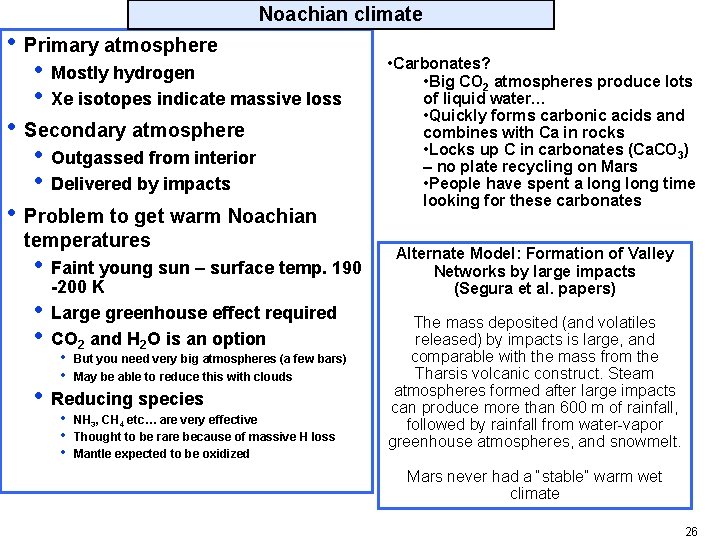
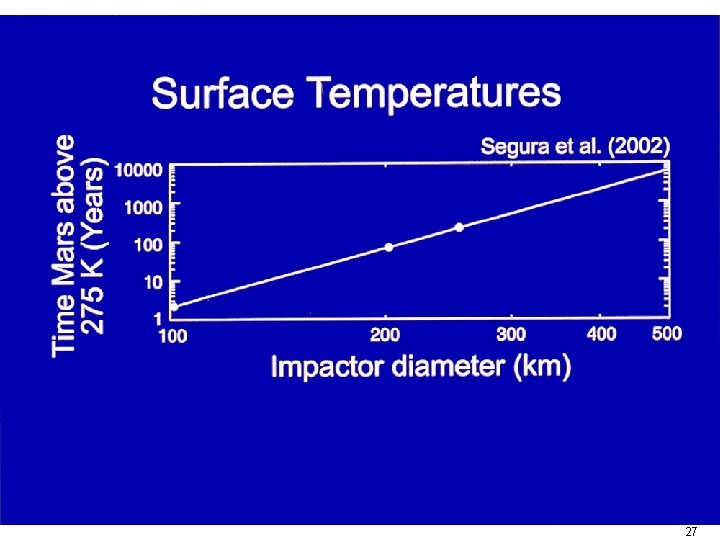
• Primary atmosphere Noachian climate • • Mostly hydrogen Xe isotopes indicate massive loss • • Outgassed from interior Delivered by impacts • Secondary atmosphere • Problem to get warm Noachian temperatures • • Faint young sun – surface temp. 190 -200 K Large greenhouse effect required CO 2 and H 2 O is an option • But you need very big atmospheres (a few bars) • May be able to reduce this with clouds Reducing species • NH 3, CH 4 etc… are very effective • Thought to be rare because of massive H loss • Mantle expected to be oxidized • Carbonates? • Big CO 2 atmospheres produce lots of liquid water… • Quickly forms carbonic acids and combines with Ca in rocks • Locks up C in carbonates (Ca. CO 3) – no plate recycling on Mars • People have spent a long time looking for these carbonates Alternate Model: Formation of Valley Networks by large impacts (Segura et al. papers) The mass deposited (and volatiles released) by impacts is large, and comparable with the mass from the Tharsis volcanic construct. Steam atmospheres formed after large impacts can produce more than 600 m of rainfall, followed by rainfall from water-vapor greenhouse atmospheres, and snowmelt. Mars never had a “stable” warm wet climate 26
27
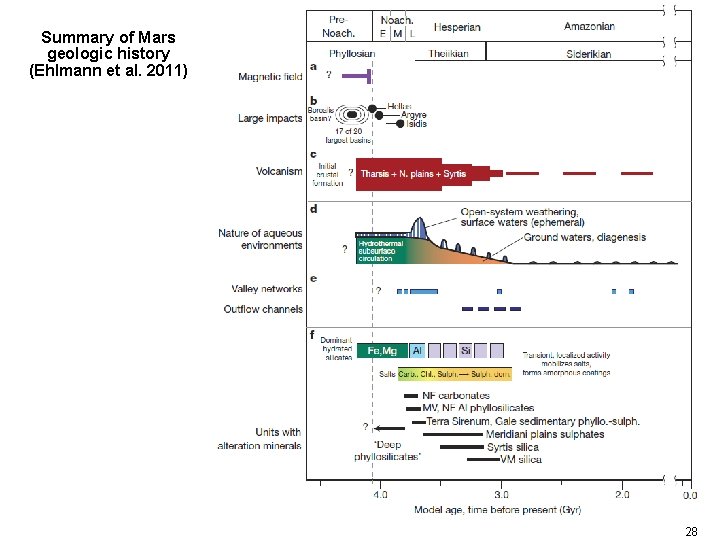
Summary of Mars geologic history (Ehlmann et al. 2011) 28
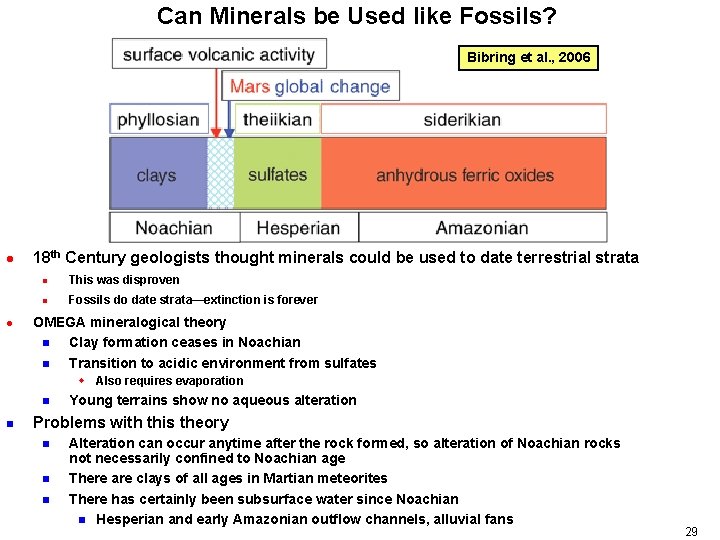
Can Minerals be Used like Fossils? Bibring et al. , 2006 l l 18 th Century geologists thought minerals could be used to date terrestrial strata l This was disproven l Fossils do date strata—extinction is forever OMEGA mineralogical theory n Clay formation ceases in Noachian n Transition to acidic environment from sulfates w Also requires evaporation n n Young terrains show no aqueous alteration Problems with this theory n n n Alteration can occur anytime after the rock formed, so alteration of Noachian rocks not necessarily confined to Noachian age There are clays of all ages in Martian meteorites There has certainly been subsurface water since Noachian n Hesperian and early Amazonian outflow channels, alluvial fans 29
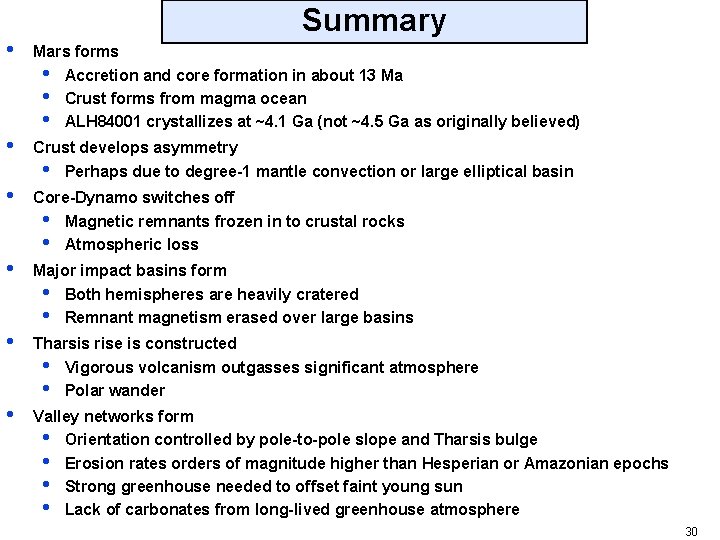
• • • Summary Mars forms • Accretion and core formation in about 13 Ma • Crust forms from magma ocean • ALH 84001 crystallizes at ~4. 1 Ga (not ~4. 5 Ga as originally believed) Crust develops asymmetry • Perhaps due to degree-1 mantle convection or large elliptical basin Core-Dynamo switches off • Magnetic remnants frozen in to crustal rocks • Atmospheric loss Major impact basins form • Both hemispheres are heavily cratered • Remnant magnetism erased over large basins Tharsis rise is constructed • Vigorous volcanism outgasses significant atmosphere • Polar wander Valley networks form • Orientation controlled by pole-to-pole slope and Tharsis bulge • Erosion rates orders of magnitude higher than Hesperian or Amazonian epochs • Strong greenhouse needed to offset faint young sun • Lack of carbonates from long-lived greenhouse atmosphere 30