
Mars Odyssey PSG Mission Status Gaylon W Mc
- Slides: 17
Mars Odyssey PSG Mission Status Gaylon W. Mc. Smith Robert A. Mase June 9, 2003
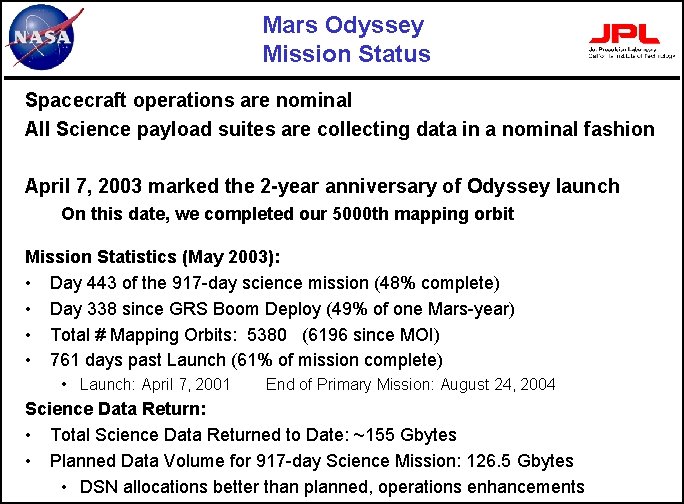
Mars Odyssey Mission Status Spacecraft operations are nominal All Science payload suites are collecting data in a nominal fashion April 7, 2003 marked the 2 -year anniversary of Odyssey launch On this date, we completed our 5000 th mapping orbit Mission Statistics (May 2003): • Day 443 of the 917 -day science mission (48% complete) • Day 338 since GRS Boom Deploy (49% of one Mars-year) • Total # Mapping Orbits: 5380 (6196 since MOI) • 761 days past Launch (61% of mission complete) • Launch: April 7, 2001 End of Primary Mission: August 24, 2004 Science Data Return: • Total Science Data Returned to Date: ~155 Gbytes • Planned Data Volume for 917 -day Science Mission: 126. 5 Gbytes • DSN allocations better than planned, operations enhancements
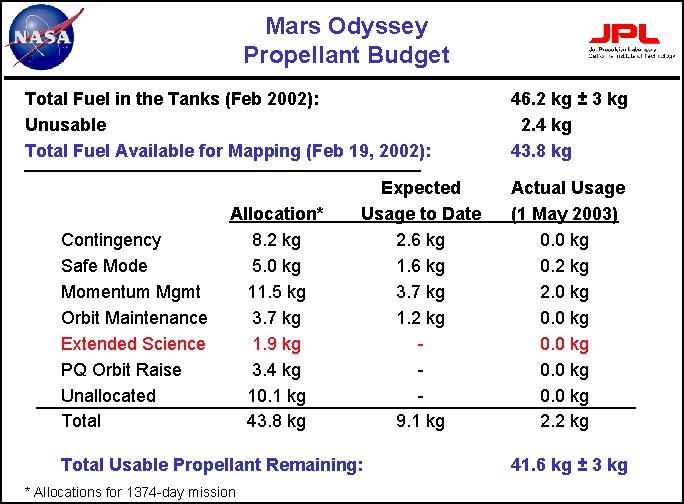
Mars Odyssey Propellant Budget Total Fuel in the Tanks (Feb 2002): Unusable Total Fuel Available for Mapping (Feb 19, 2002): Contingency Safe Mode Momentum Mgmt Orbit Maintenance Extended Science PQ Orbit Raise Unallocated Total Allocation* 8. 2 kg 5. 0 kg 11. 5 kg 3. 7 kg 1. 9 kg 3. 4 kg 10. 1 kg 43. 8 kg Expected Usage to Date 2. 6 kg 1. 6 kg 3. 7 kg 1. 2 kg 9. 1 kg Total Usable Propellant Remaining: * Allocations for 1374 -day mission 46. 2 kg ± 3 kg 2. 4 kg 43. 8 kg Actual Usage (1 May 2003) 0. 0 kg 0. 2 kg 2. 0 kg 0. 0 kg 2. 2 kg 41. 6 kg ± 3 kg
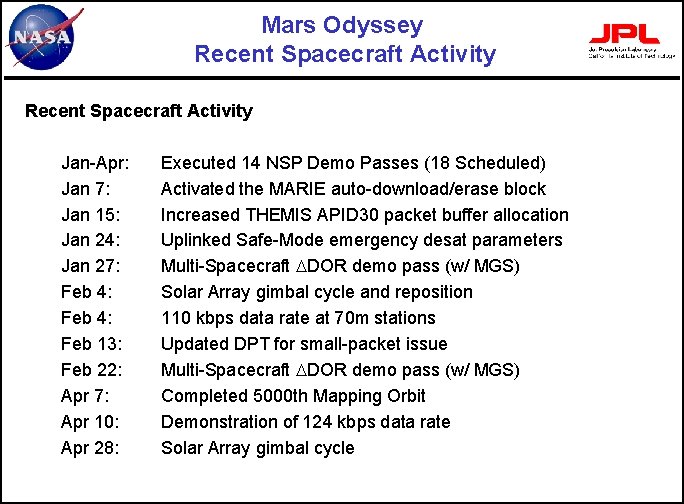
Mars Odyssey Recent Spacecraft Activity Jan-Apr: Jan 7: Jan 15: Jan 24: Jan 27: Feb 4: Feb 13: Feb 22: Apr 7: Apr 10: Apr 28: Executed 14 NSP Demo Passes (18 Scheduled) Activated the MARIE auto-download/erase block Increased THEMIS APID 30 packet buffer allocation Uplinked Safe-Mode emergency desat parameters Multi-Spacecraft DDOR demo pass (w/ MGS) Solar Array gimbal cycle and reposition 110 kbps data rate at 70 m stations Updated DPT for small-packet issue Multi-Spacecraft DDOR demo pass (w/ MGS) Completed 5000 th Mapping Orbit Demonstration of 124 kbps data rate Solar Array gimbal cycle
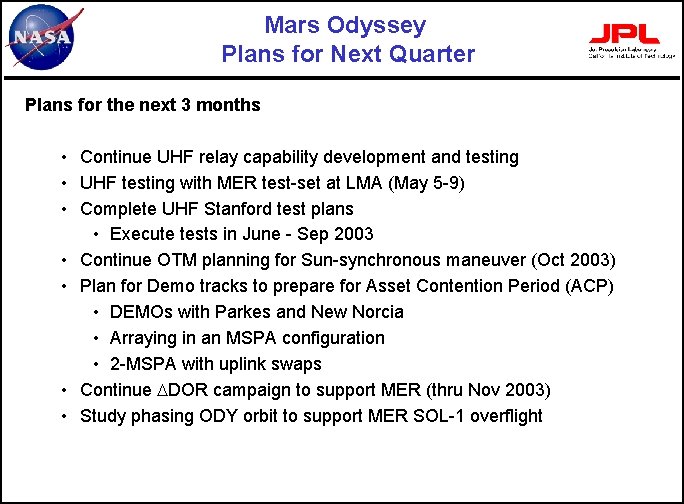
Mars Odyssey Plans for Next Quarter Plans for the next 3 months • Continue UHF relay capability development and testing • UHF testing with MER test-set at LMA (May 5 -9) • Complete UHF Stanford test plans • Execute tests in June - Sep 2003 • Continue OTM planning for Sun-synchronous maneuver (Oct 2003) • Plan for Demo tracks to prepare for Asset Contention Period (ACP) • DEMOs with Parkes and New Norcia • Arraying in an MSPA configuration • 2 -MSPA with uplink swaps • Continue DDOR campaign to support MER (thru Nov 2003) • Study phasing ODY orbit to support MER SOL-1 overflight
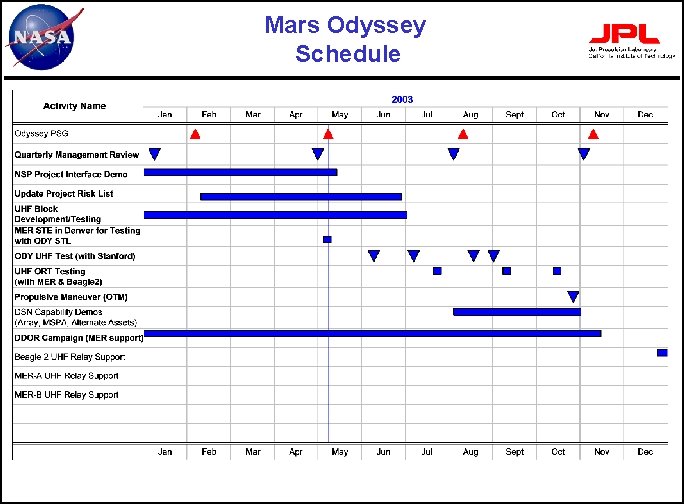
Mars Odyssey Schedule
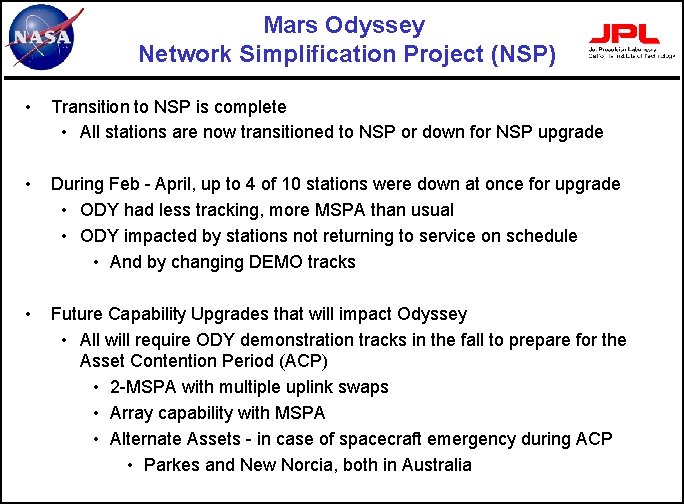
Mars Odyssey Network Simplification Project (NSP) • Transition to NSP is complete • All stations are now transitioned to NSP or down for NSP upgrade • During Feb - April, up to 4 of 10 stations were down at once for upgrade • ODY had less tracking, more MSPA than usual • ODY impacted by stations not returning to service on schedule • And by changing DEMO tracks • Future Capability Upgrades that will impact Odyssey • All will require ODY demonstration tracks in the fall to prepare for the Asset Contention Period (ACP) • 2 -MSPA with multiple uplink swaps • Array capability with MSPA • Alternate Assets - in case of spacecraft emergency during ACP • Parkes and New Norcia, both in Australia
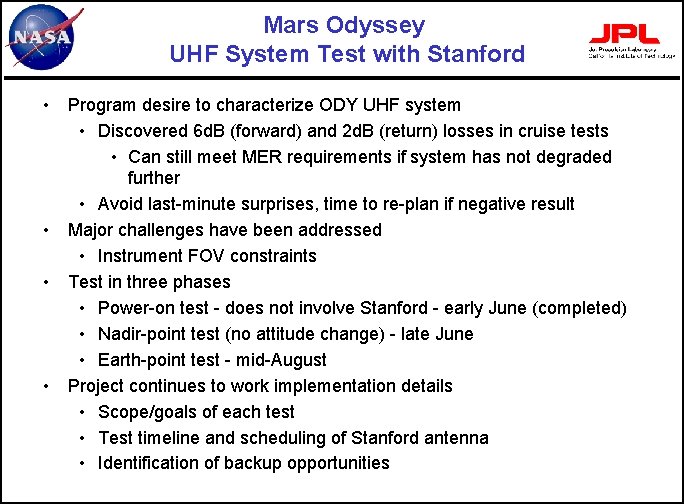
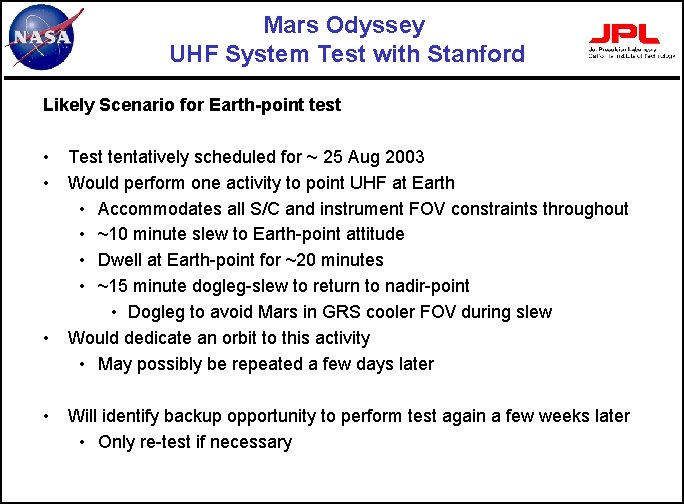
Mars Odyssey UHF System Test with Stanford • • Program desire to characterize ODY UHF system • Discovered 6 d. B (forward) and 2 d. B (return) losses in cruise tests • Can still meet MER requirements if system has not degraded further • Avoid last-minute surprises, time to re-plan if negative result Major challenges have been addressed • Instrument FOV constraints Test in three phases • Power-on test - does not involve Stanford - early June (completed) • Nadir-point test (no attitude change) - late June • Earth-point test - mid-August Project continues to work implementation details • Scope/goals of each test • Test timeline and scheduling of Stanford antenna • Identification of backup opportunities
Mars Odyssey UHF System Test with Stanford Likely Scenario for Earth-point test • • Test tentatively scheduled for ~ 25 Aug 2003 Would perform one activity to point UHF at Earth • Accommodates all S/C and instrument FOV constraints throughout • ~10 minute slew to Earth-point attitude • Dwell at Earth-point for ~20 minutes • ~15 minute dogleg-slew to return to nadir-point • Dogleg to avoid Mars in GRS cooler FOV during slew Would dedicate an orbit to this activity • May possibly be repeated a few days later Will identify backup opportunity to perform test again a few weeks later • Only re-test if necessary
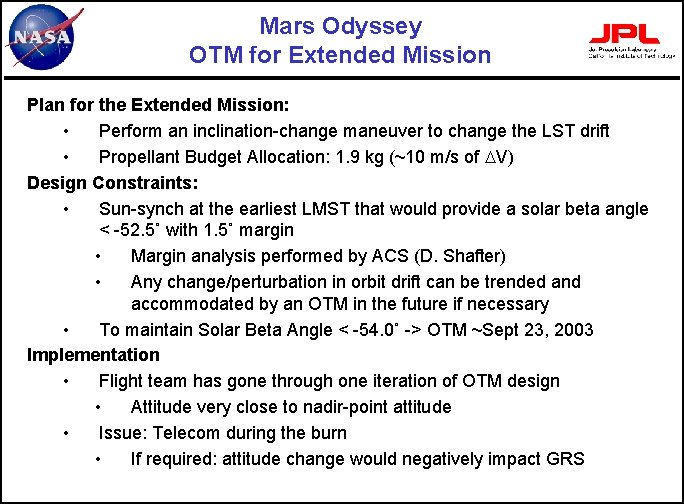
Mars Odyssey OTM for Extended Mission Plan for the Extended Mission: • Perform an inclination-change maneuver to change the LST drift • Propellant Budget Allocation: 1. 9 kg (~10 m/s of DV) Design Constraints: • Sun-synch at the earliest LMST that would provide a solar beta angle < -52. 5˚ with 1. 5˚ margin • Margin analysis performed by ACS (D. Shafter) • Any change/perturbation in orbit drift can be trended and accommodated by an OTM in the future if necessary • To maintain Solar Beta Angle < -54. 0˚ -> OTM ~Sept 23, 2003 Implementation • Flight team has gone through one iteration of OTM design • Attitude very close to nadir-point attitude • Issue: Telecom during the burn • If required: attitude change would negatively impact GRS
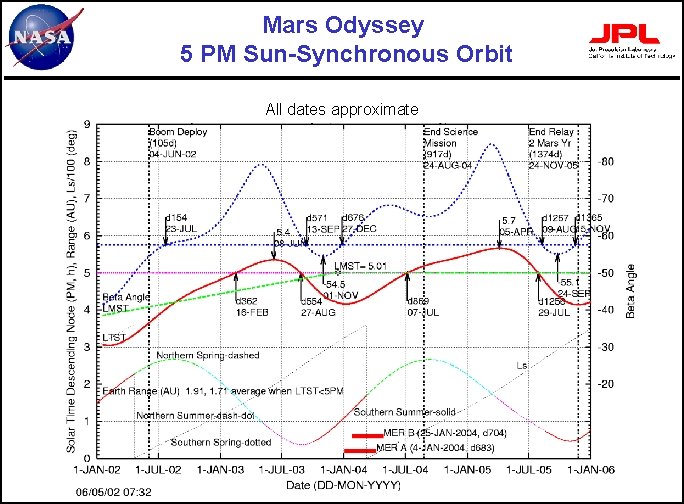
Mars Odyssey 5 PM Sun-Synchronous Orbit All dates approximate
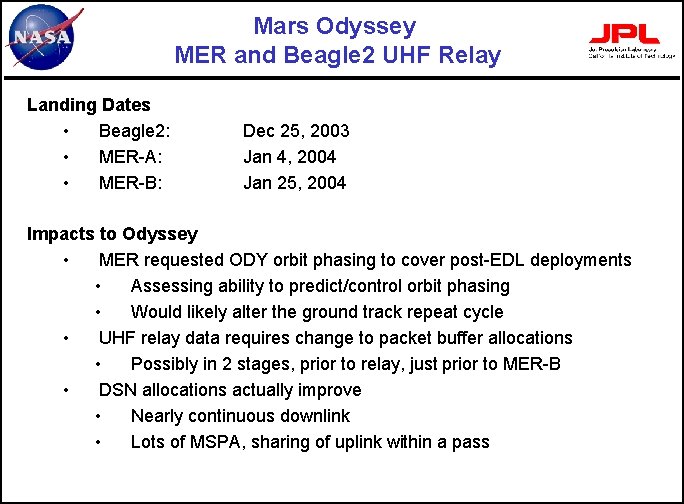
Mars Odyssey MER and Beagle 2 UHF Relay Landing Dates • Beagle 2: • MER-A: • MER-B: Dec 25, 2003 Jan 4, 2004 Jan 25, 2004 Impacts to Odyssey • MER requested ODY orbit phasing to cover post-EDL deployments • Assessing ability to predict/control orbit phasing • Would likely alter the ground track repeat cycle • UHF relay data requires change to packet buffer allocations • Possibly in 2 stages, prior to relay, just prior to MER-B • DSN allocations actually improve • Nearly continuous downlink • Lots of MSPA, sharing of uplink within a pass
Backup Slides UHF Relay Packet Buffer Allocations
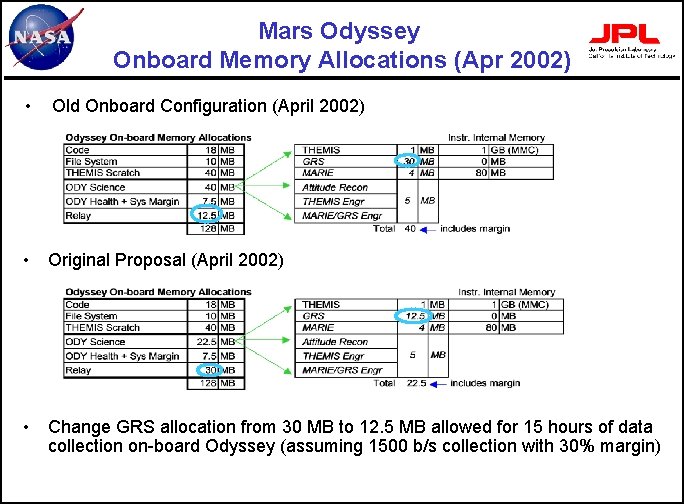
Mars Odyssey Onboard Memory Allocations (Apr 2002) • Old Onboard Configuration (April 2002) • Original Proposal (April 2002) • Change GRS allocation from 30 MB to 12. 5 MB allowed for 15 hours of data collection on-board Odyssey (assuming 1500 b/s collection with 30% margin)
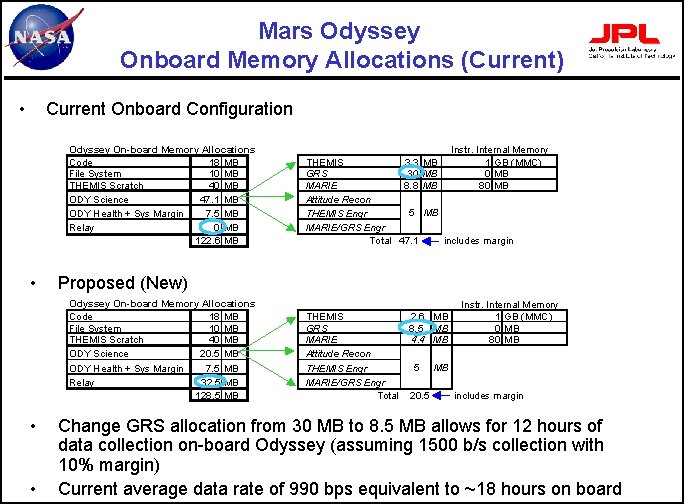
Mars Odyssey Onboard Memory Allocations (Current) • Current Onboard Configuration Odyssey On-board Memory Allocations Code 18 MB File System 10 MB THEMIS Scratch 40 MB ODY Science 47. 1 MB ODY Health + Sys Margin 7. 5 MB Relay 0 MB 122. 6 MB THEMIS 3. 3 GRS 30 MARIE 8. 8 Attitude Recon 5 THEMIS Engr MARIE/GRS Engr Total 47. 1 • Current On Board Configuration • • MB includes margin Proposed (New) Odyssey On-board Memory Allocations Code 18 MB File System 10 MB THEMIS Scratch 40 MB ODY Science 20. 5 MB ODY Health + Sys Margin 7. 5 MB Relay 32. 5 MB 128. 5 MB • Instr. Internal Memory 1 GB (MMC) 0 MB 80 MB MB THEMIS 2. 6 GRS 8. 5 MARIE 4. 4 Attitude Recon 5 THEMIS Engr MARIE/GRS Engr Total 20. 5 MB MB MB Instr. Internal Memory 1 GB (MMC) 0 MB 80 MB MB includes margin Change GRS allocation from 30 MB to 8. 5 MB allows for 12 hours of data collection on-board Odyssey (assuming 1500 b/s collection with 10% margin) Current average data rate of 990 bps equivalent to ~18 hours on board
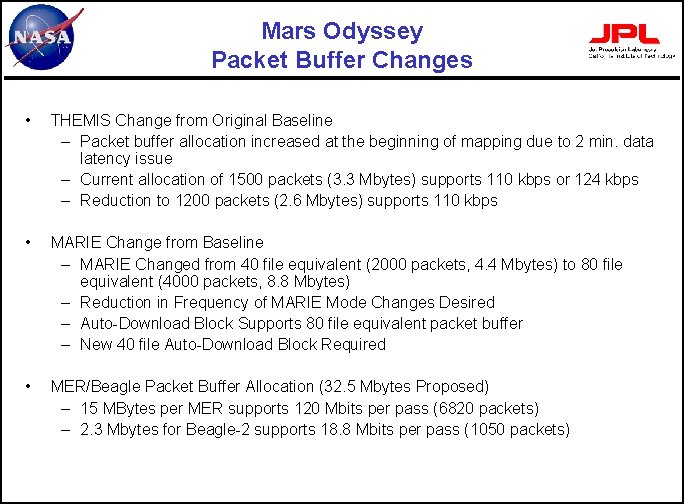
Mars Odyssey Packet Buffer Changes • THEMIS Change from Original Baseline – Packet buffer allocation increased at the beginning of mapping due to 2 min. data latency issue – Current allocation of 1500 packets (3. 3 Mbytes) supports 110 kbps or 124 kbps – Reduction to 1200 packets (2. 6 Mbytes) supports 110 kbps • MARIE Change from Baseline – MARIE Changed from 40 file equivalent (2000 packets, 4. 4 Mbytes) to 80 file equivalent (4000 packets, 8. 8 Mbytes) – Reduction in Frequency of MARIE Mode Changes Desired – Auto-Download Block Supports 80 file equivalent packet buffer – New 40 file Auto-Download Block Required • MER/Beagle Packet Buffer Allocation (32. 5 Mbytes Proposed) – 15 MBytes per MER supports 120 Mbits per pass (6820 packets) – 2. 3 Mbytes for Beagle-2 supports 18. 8 Mbits per pass (1050 packets)
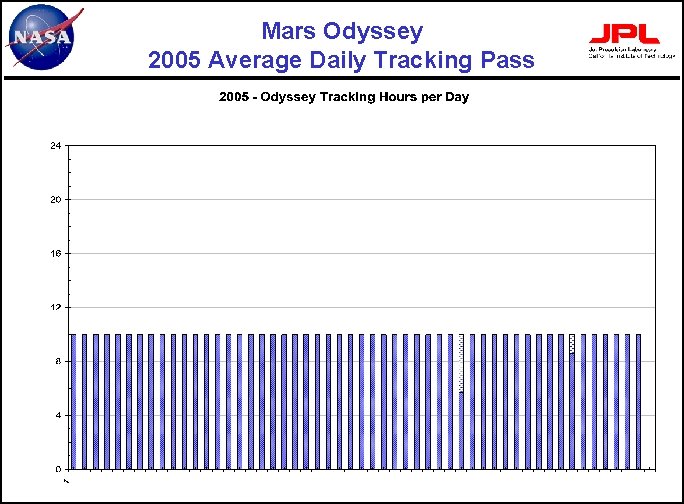
Mars Odyssey 2005 Average Daily Tracking Pass