
Mars Exploration By Brylen Eliza and Jamie MARS

Mars Exploration By: Brylen, Eliza, and Jamie
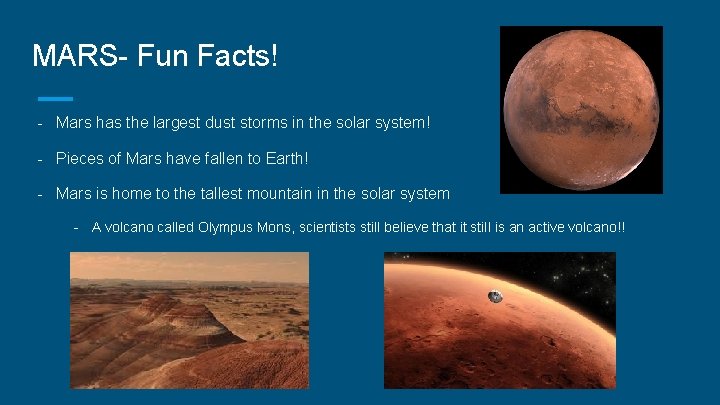
MARS- Fun Facts! - Mars has the largest dust storms in the solar system! - Pieces of Mars have fallen to Earth! - Mars is home to the tallest mountain in the solar system - A volcano called Olympus Mons, scientists still believe that it still is an active volcano!!
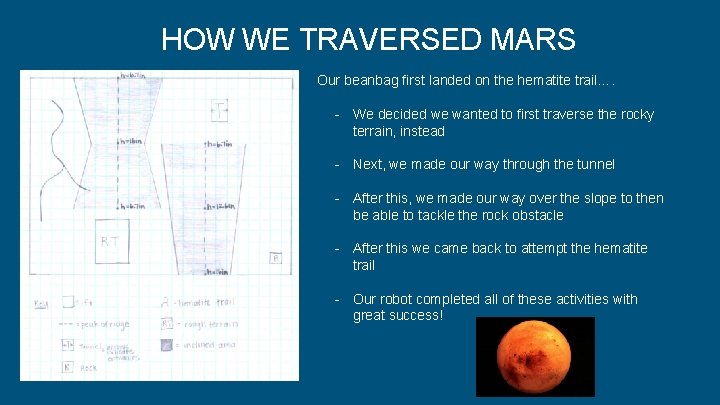
HOW WE TRAVERSED MARS Our beanbag first landed on the hematite trail…. - We decided we wanted to first traverse the rocky terrain, instead - Next, we made our way through the tunnel - After this, we made our way over the slope to then be able to tackle the rock obstacle - After this we came back to attempt the hematite trail - Our robot completed all of these activities with great success!
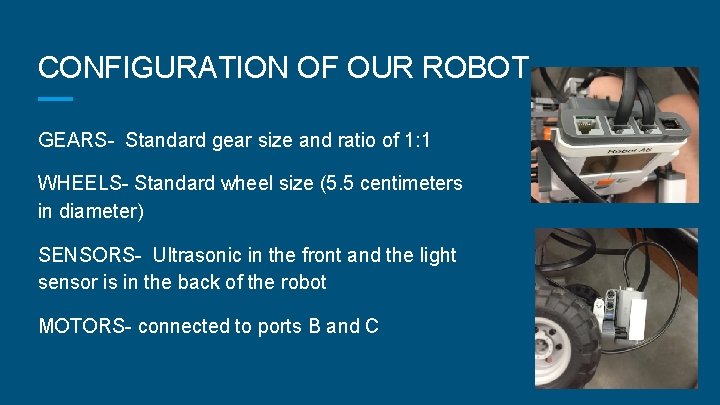
CONFIGURATION OF OUR ROBOT GEARS- Standard gear size and ratio of 1: 1 WHEELS- Standard wheel size (5. 5 centimeters in diameter) SENSORS- Ultrasonic in the front and the light sensor is in the back of the robot MOTORS- connected to ports B and C
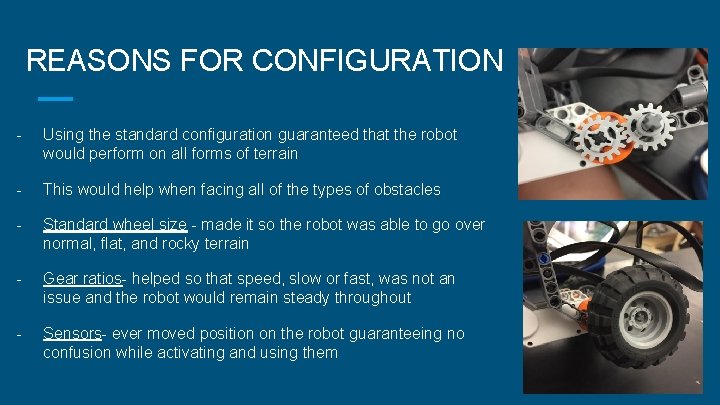
REASONS FOR CONFIGURATION - Using the standard configuration guaranteed that the robot would perform on all forms of terrain - This would help when facing all of the types of obstacles - Standard wheel size - made it so the robot was able to go over normal, flat, and rocky terrain - Gear ratios- helped so that speed, slow or fast, was not an issue and the robot would remain steady throughout - Sensors- ever moved position on the robot guaranteeing no confusion while activating and using them
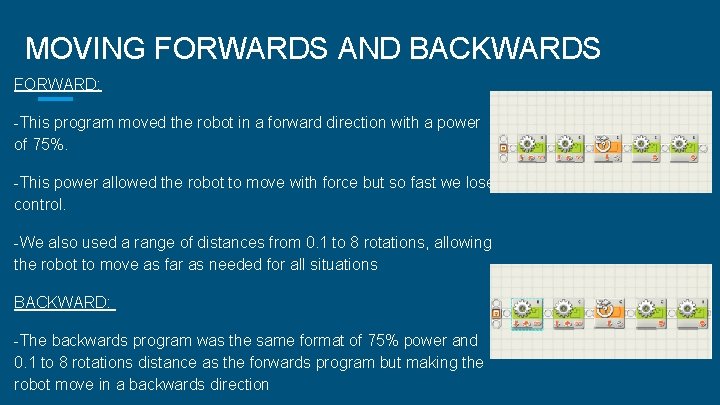
MOVING FORWARDS AND BACKWARDS FORWARD: -This program moved the robot in a forward direction with a power of 75%. -This power allowed the robot to move with force but so fast we lose control. -We also used a range of distances from 0. 1 to 8 rotations, allowing the robot to move as far as needed for all situations BACKWARD: -The backwards program was the same format of 75% power and 0. 1 to 8 rotations distance as the forwards program but making the robot move in a backwards direction
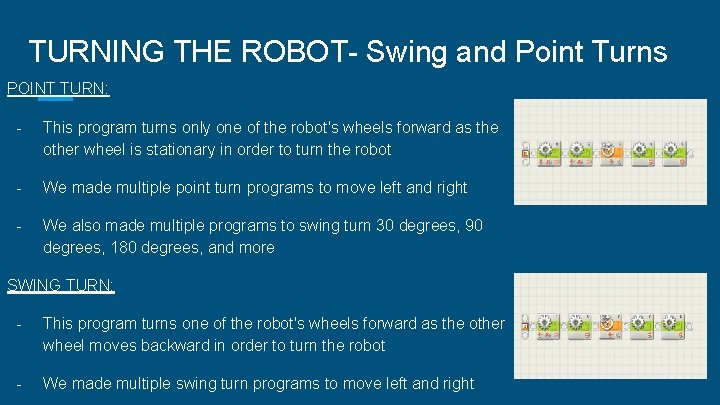
TURNING THE ROBOT- Swing and Point Turns POINT TURN: - This program turns only one of the robot's wheels forward as the other wheel is stationary in order to turn the robot - We made multiple point turn programs to move left and right - We also made multiple programs to swing turn 30 degrees, 90 degrees, 180 degrees, and more SWING TURN: - This program turns one of the robot's wheels forward as the other wheel moves backward in order to turn the robot - We made multiple swing turn programs to move left and right

SLOPES: Incline and Decline - - INCLINED SLOPE - How we approached this: chose to set the power at 50% - Reason for our approach: robot would have enough power to move over the incline, but not too much so that it would flip over DECLINED SLOPE - How we approached this: chose to set the power at 30%
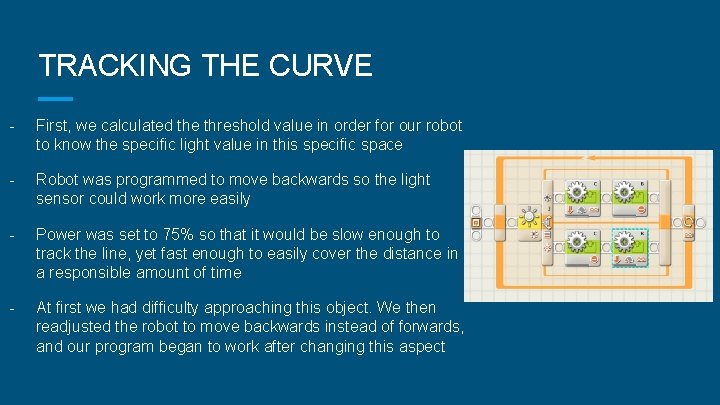
TRACKING THE CURVE - First, we calculated the threshold value in order for our robot to know the specific light value in this specific space - Robot was programmed to move backwards so the light sensor could work more easily - Power was set to 75% so that it would be slow enough to track the line, yet fast enough to easily cover the distance in a responsible amount of time - At first we had difficulty approaching this object. We then readjusted the robot to move backwards instead of forwards, and our program began to work after changing this aspect
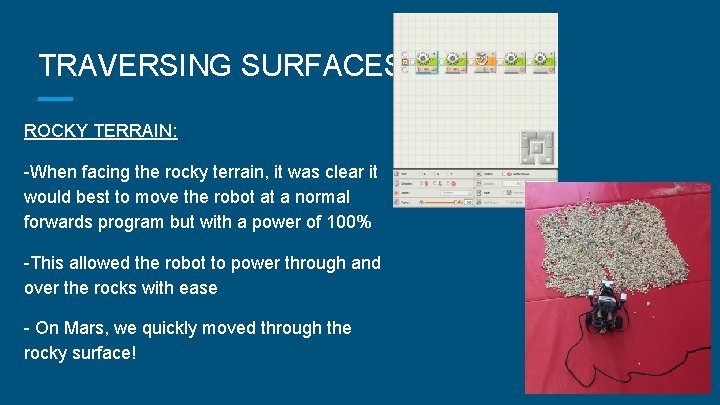
TRAVERSING SURFACES ROCKY TERRAIN: -When facing the rocky terrain, it was clear it would best to move the robot at a normal forwards program but with a power of 100% -This allowed the robot to power through and over the rocks with ease - On Mars, we quickly moved through the rocky surface!
BIBLIOGRAPHY SOURCES http: //channel. nationalgeographic. com/mars/ http: //space-facts. com/mars/ https: //www. nasa. gov/audience/forstudents/k-4/stories/nasa-knows/what-is-mars -k 4. html https: //www. forbes. com/forbes/welcome/? to. URL=https: //www. forbes. com/sites/lo renthompson/2017/02/06/four-reasons-president-trump-will-send-u-s-astronautsto-mars/&ref. URL=https: //www. google. com/&referrer=https: //www. google. com/ http: //www. salon. com/topic/mars/
- Slides: 11