
MarkSweep A tracing garbage collection technique Hagen Bhm
Mark-Sweep A tracing garbage collection technique Hagen Böhm November 21 st, 2001 hagen@net. uni-sb. de Copyright, 1996 © Dale Carnegie & Associates, Inc.
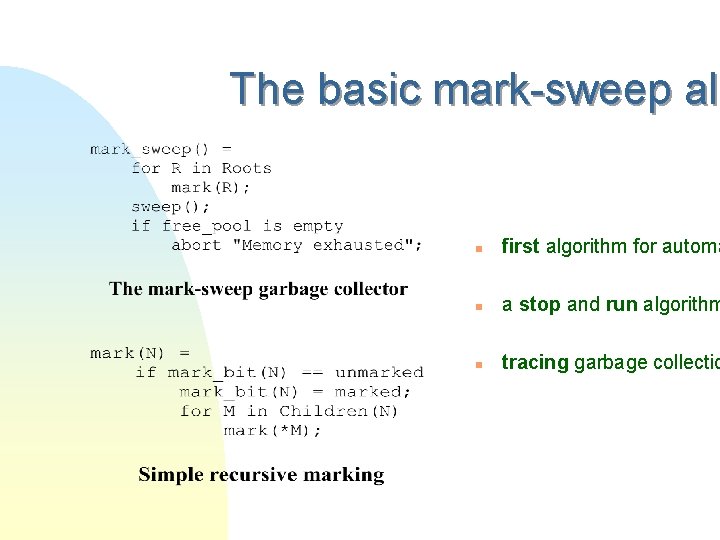
The basic mark-sweep alg n first algorithm for automa n a stop and run algorithm n tracing garbage collectio
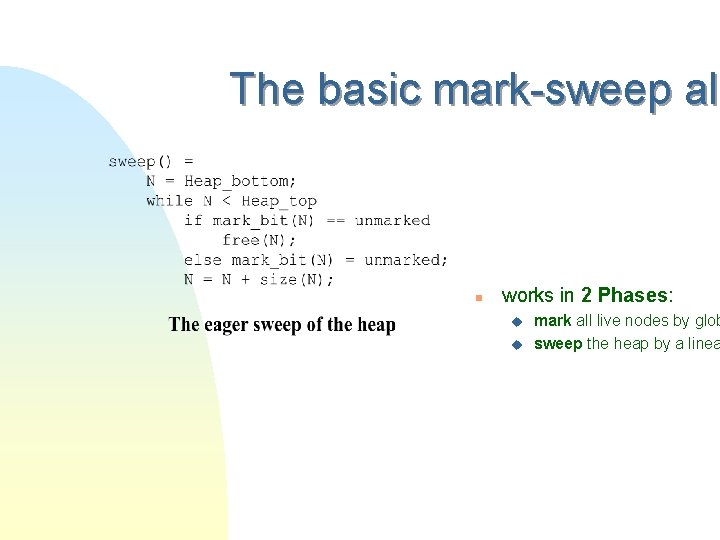
The basic mark-sweep alg n works in 2 Phases: u u mark all live nodes by glob sweep the heap by a linea
The basic mark-sweep algorithm n benefits u u u handles cycles naturally no overhead on pointer manipulations low space cost: using a simple mark-bit (architecture depend!!!)
The basic mark-sweep algorithm n drawbacks u u computation halted while gc high costs! F F F u u every active cell is visited by marking all cells are examined by sweep recursive marking (time and space!) tending to fragment memory => programs may “thrash” heap residency too large => gc will become high frequently
Outlook onto improvements n iterative solution to marking using a marking stack u u n n n minimising the depth of the stack handling overflows pointer reversal bitmap marking lazy sweeping
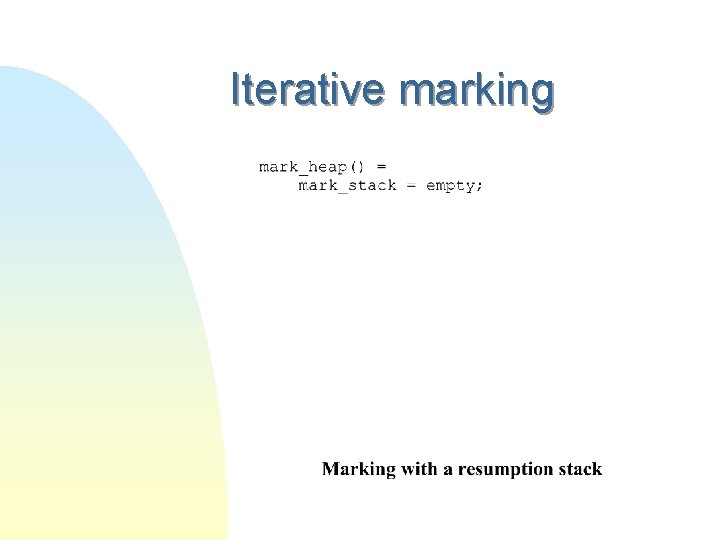
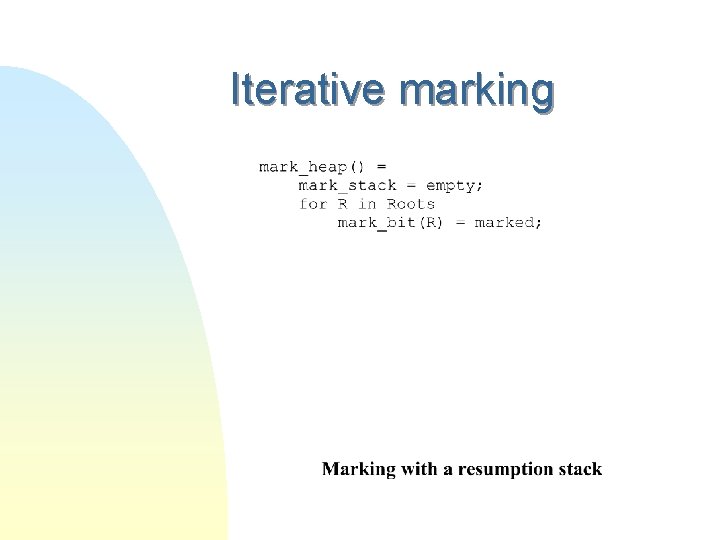
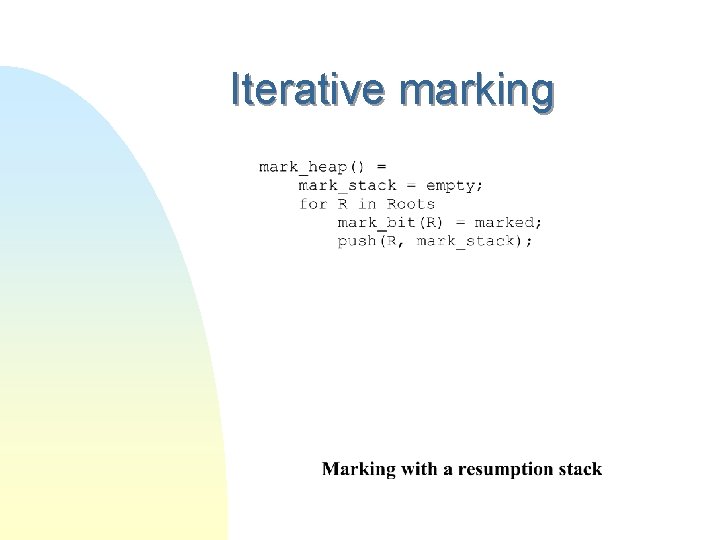
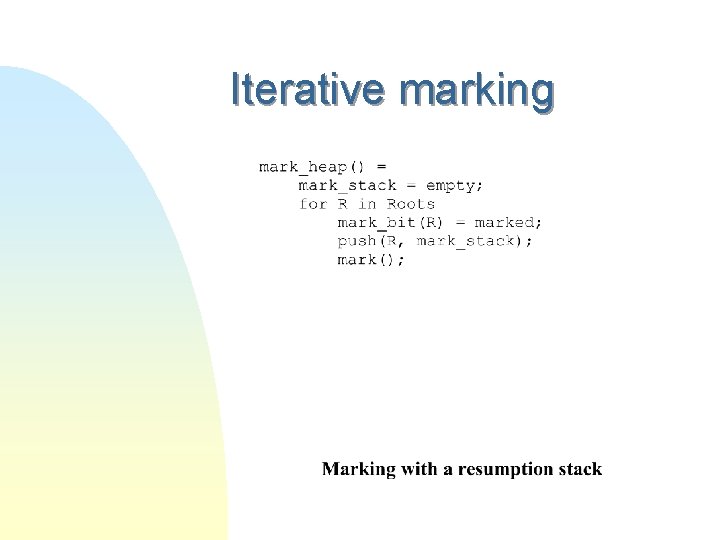
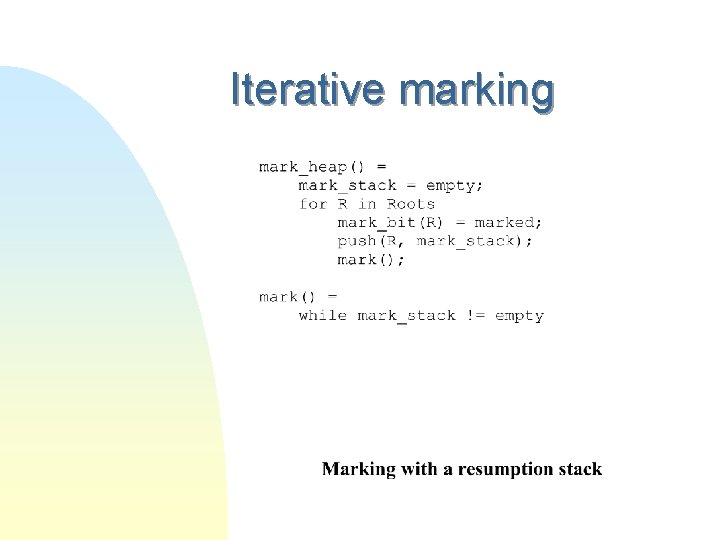
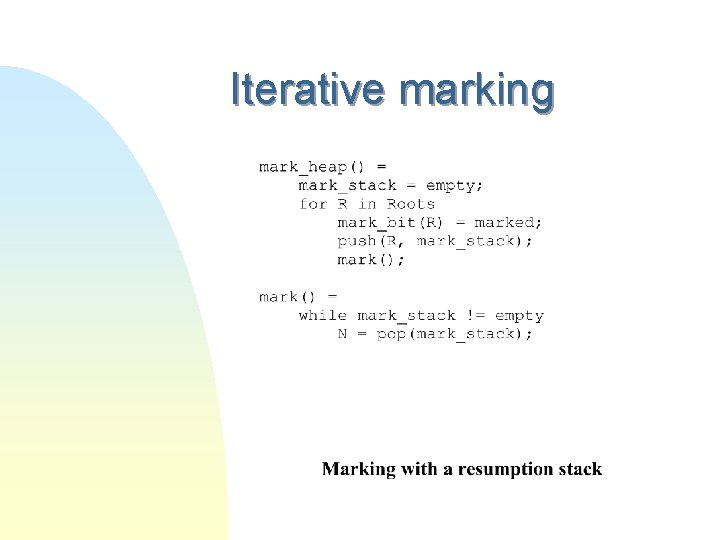
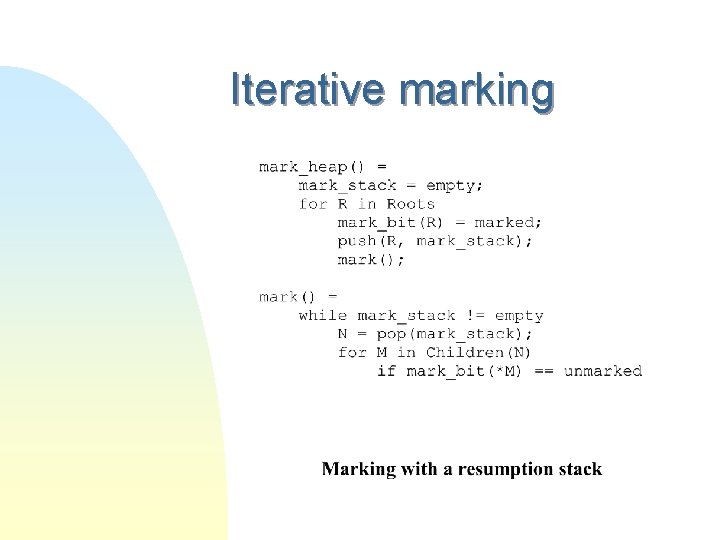
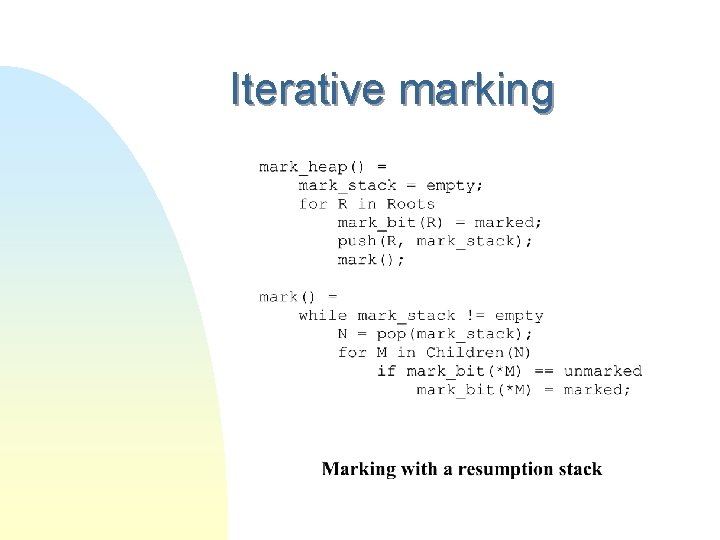
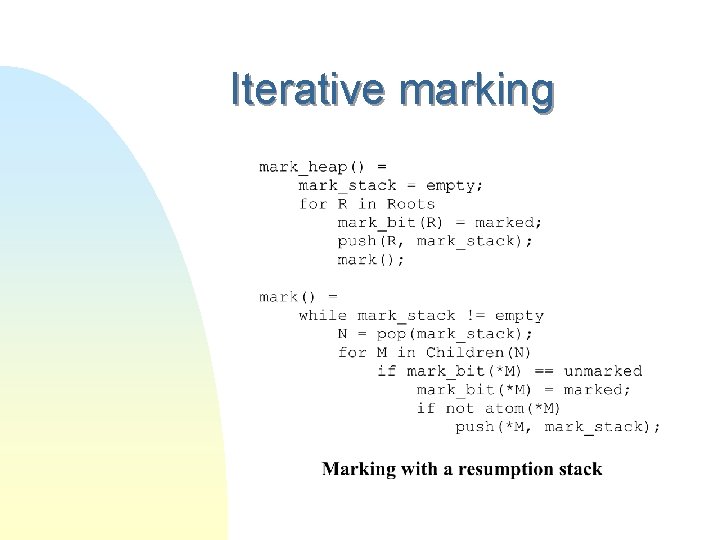
Iterative marking n Recursive procedure calls are time- and spacewasting u u n reserving/discarding working space procedure call overheads improve the performance by. . . u u replacing recursive calls by iterative loops using an auxiliary stack for pointers to nodes known to be live.
Iterative marking
Iterative marking
Iterative marking
Iterative marking
Iterative marking
Iterative marking
Iterative marking
Iterative marking
Iterative marking
Minimising stack depth n n pushing constituent pointers of large objects in small groups onto the stack using pointer reversal (more later)
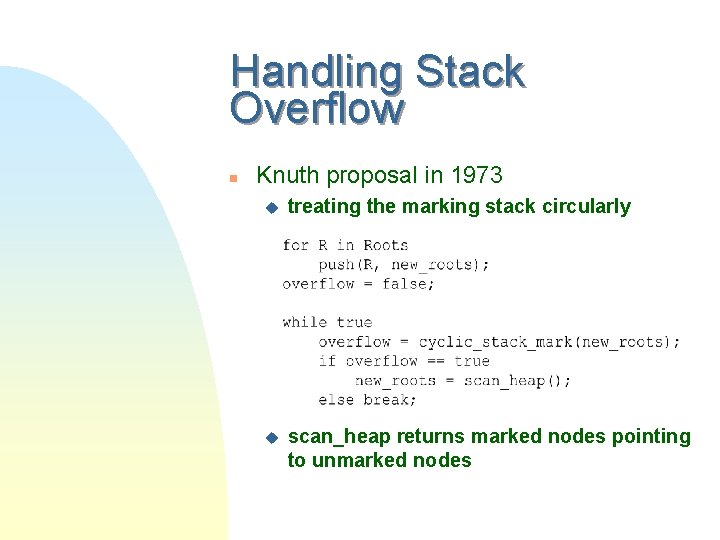
Handling Stack Overflow n Knuth proposal in 1973 u treating the marking stack circularly u scan_heap returns marked nodes pointing to unmarked nodes
Handling Stack Overflow n Kurokawa proposal in 1981 u remove items from stack that have fewer than 2 unmarked children F F u no child is unmarked: clear slot one child is unmarked: replace slot entry by a descendent with 2 or more unmarked children marking the passed ones approach is not robust!!!
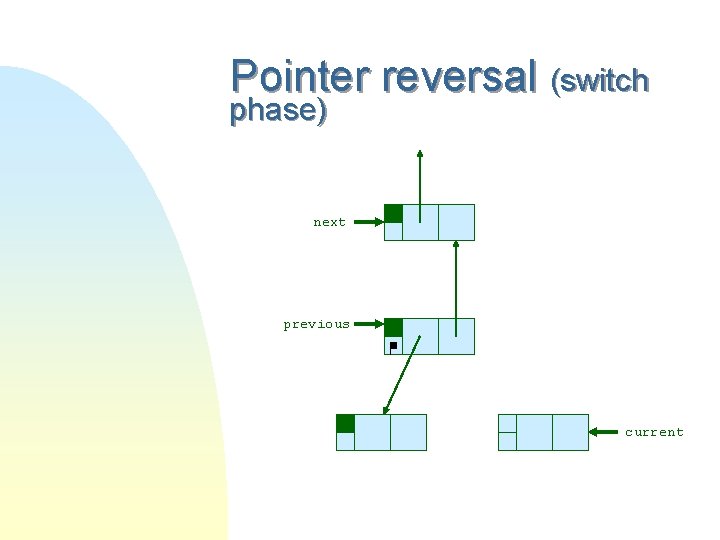
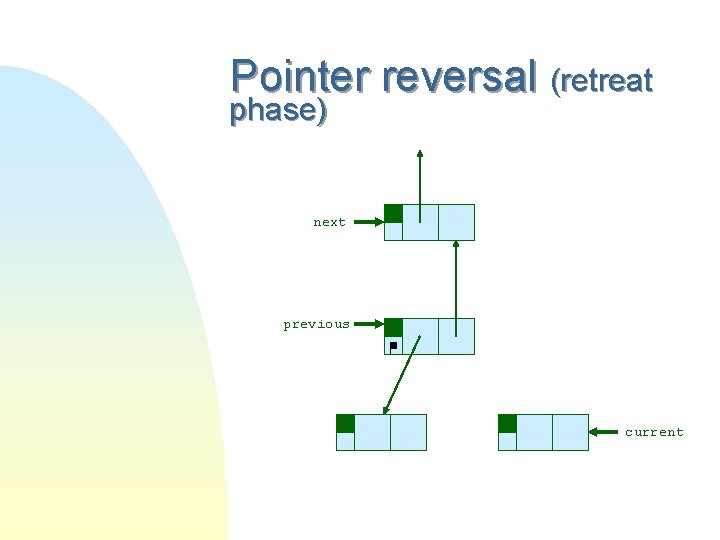
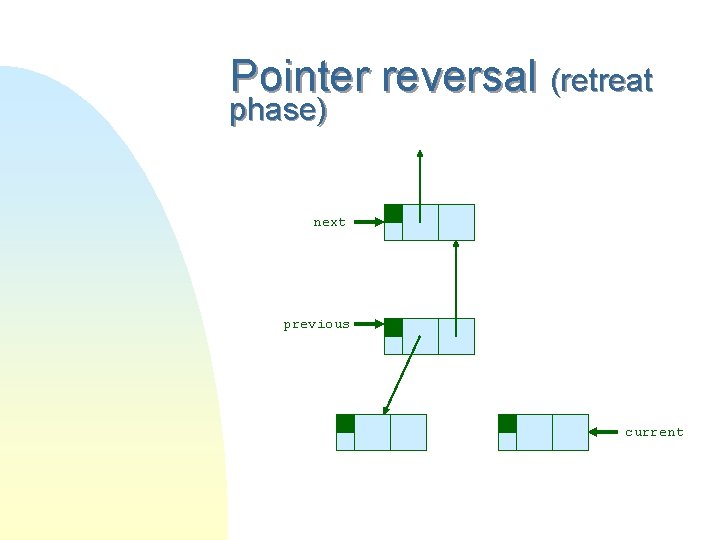
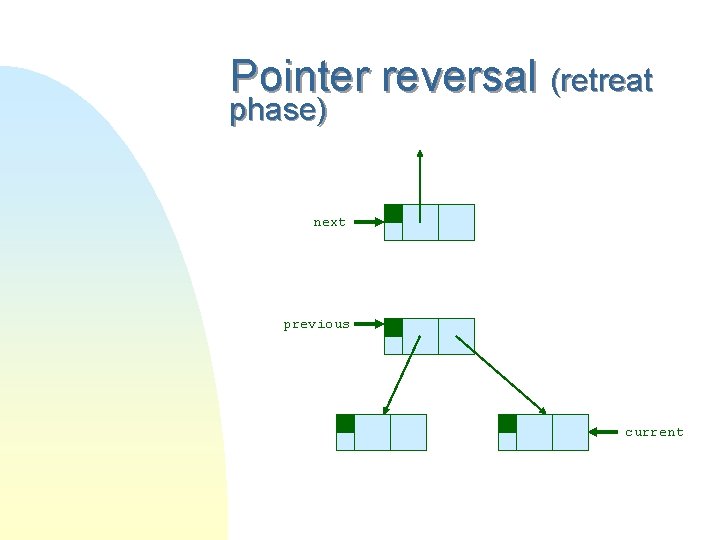
Pointer reversal n n efficient marking must record the trace it passed temporarily reversing of pointers traversed by mark (child-pointers become ancestor-pointers) restore pointer fields when tracing back developed independently by Schorr and Waite (1967) and by Deutsch (1973)
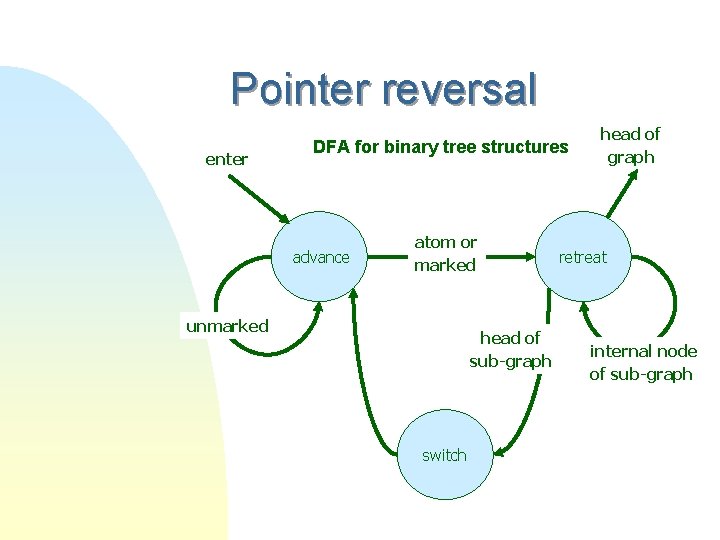
Pointer reversal enter DFA for binary tree structures advance atom or marked unmarked head of sub-graph switch head of graph retreat internal node of sub-graph
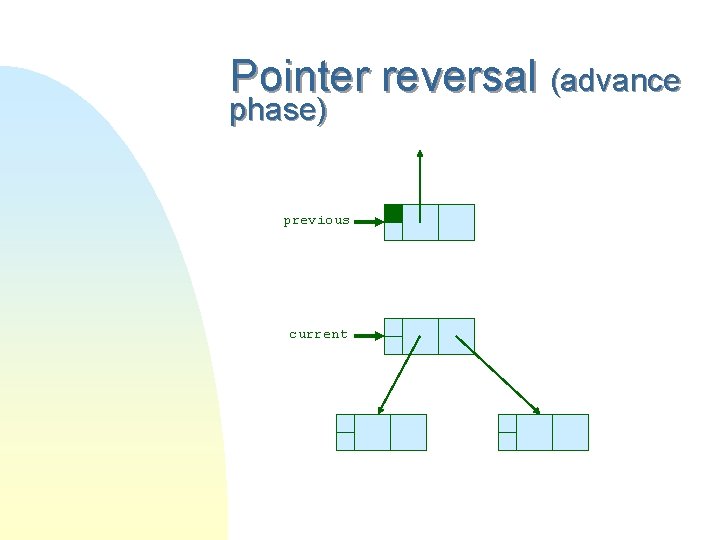
Pointer reversal (advance phase) previous current
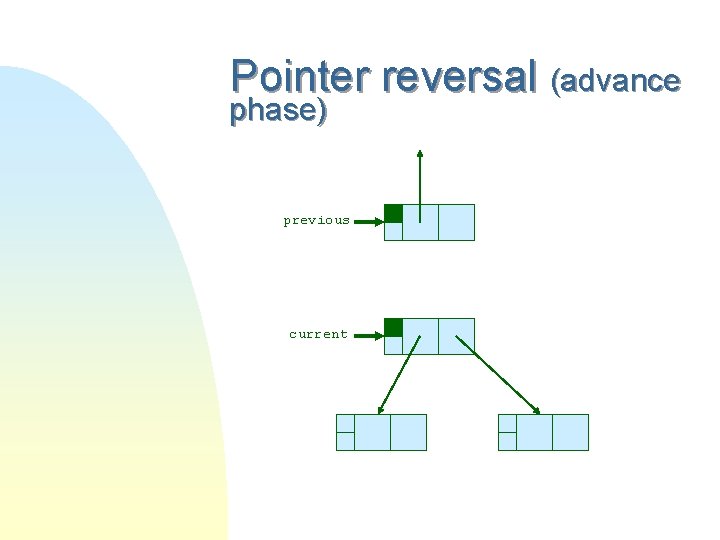
Pointer reversal (advance phase) previous current
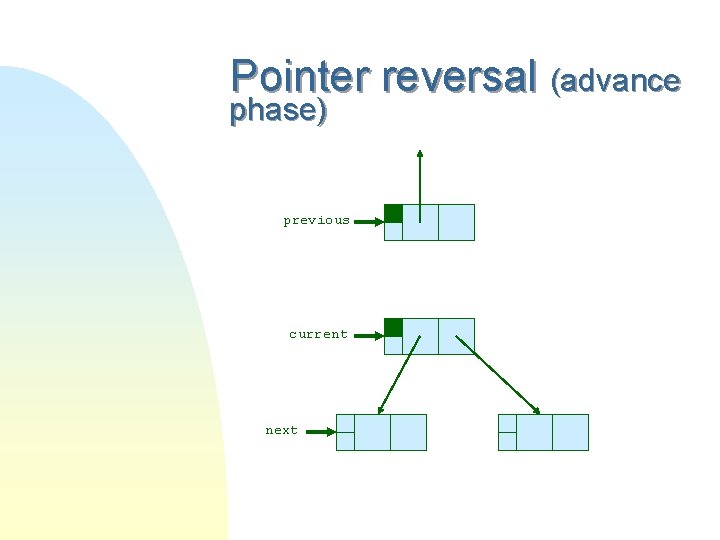
Pointer reversal (advance phase) previous current next
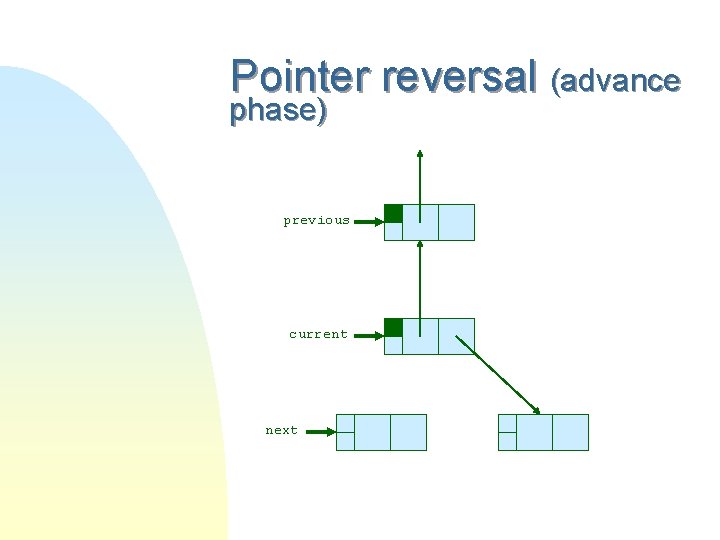
Pointer reversal (advance phase) previous current next
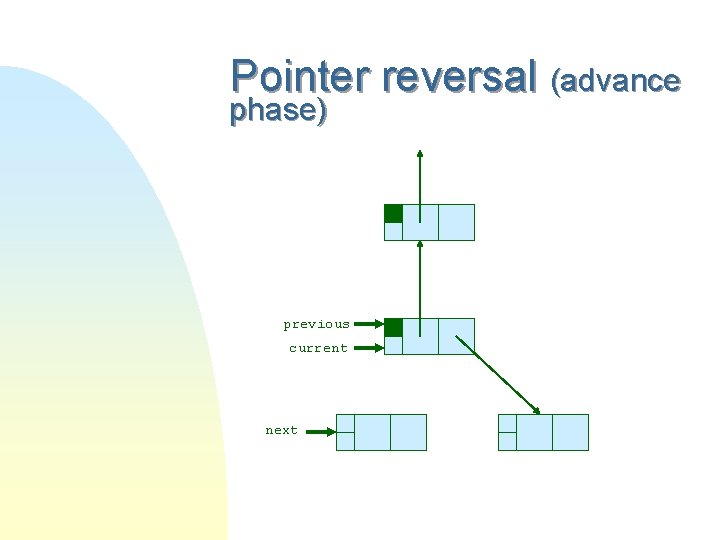
Pointer reversal (advance phase) previous current next
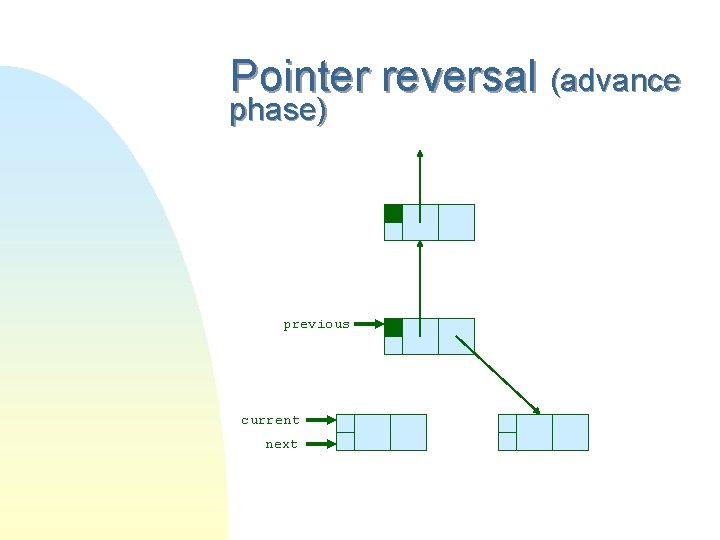
Pointer reversal (advance phase) previous current next
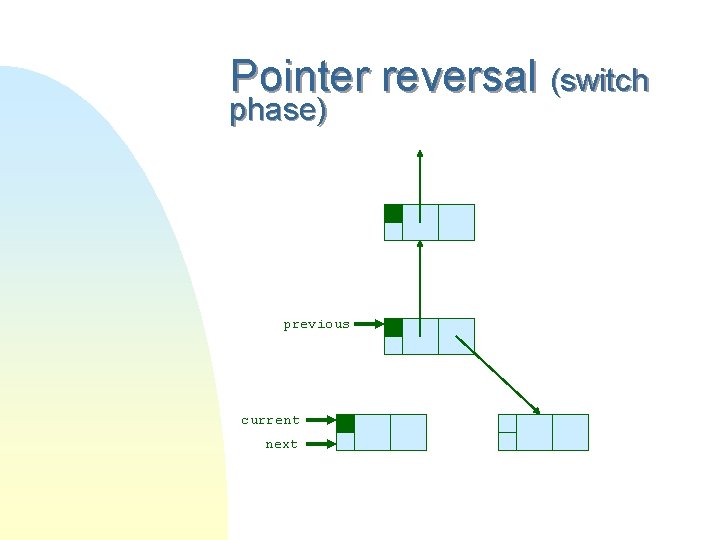
Pointer reversal (switch phase) previous current next
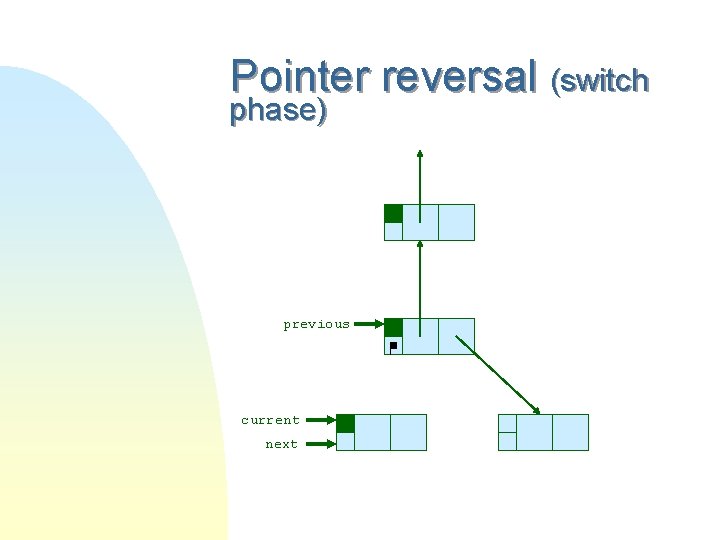
Pointer reversal (switch phase) previous current next
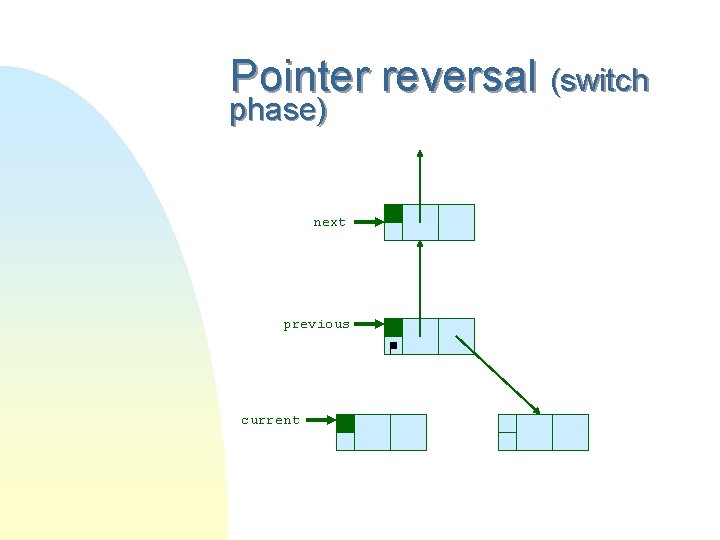
Pointer reversal (switch phase) next previous current
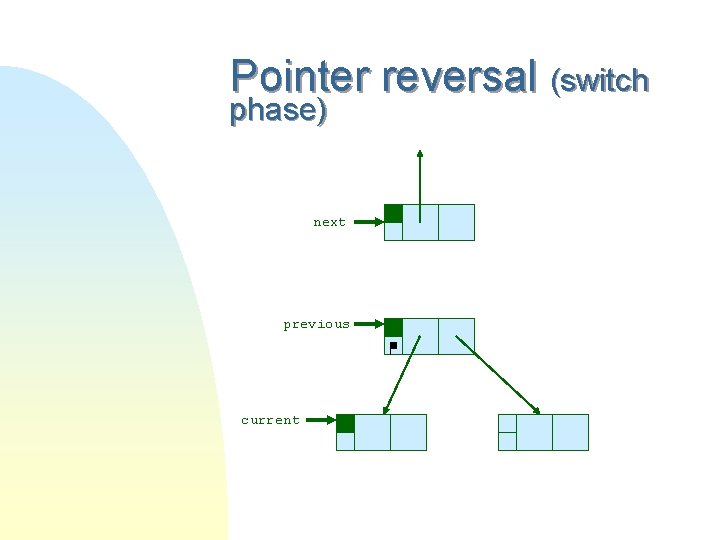
Pointer reversal (switch phase) next previous current
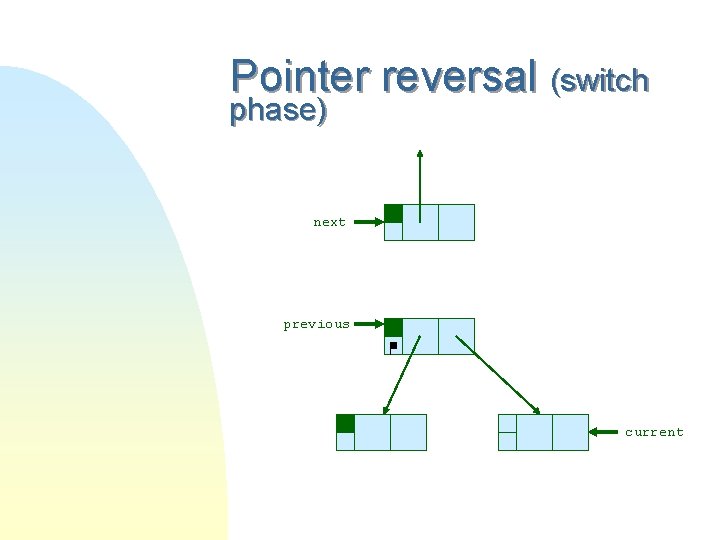
Pointer reversal (switch phase) next previous current
Pointer reversal (switch phase) next previous current
Pointer reversal (retreat phase) next previous current
Pointer reversal (retreat phase) next previous current
Pointer reversal (retreat phase) next previous current
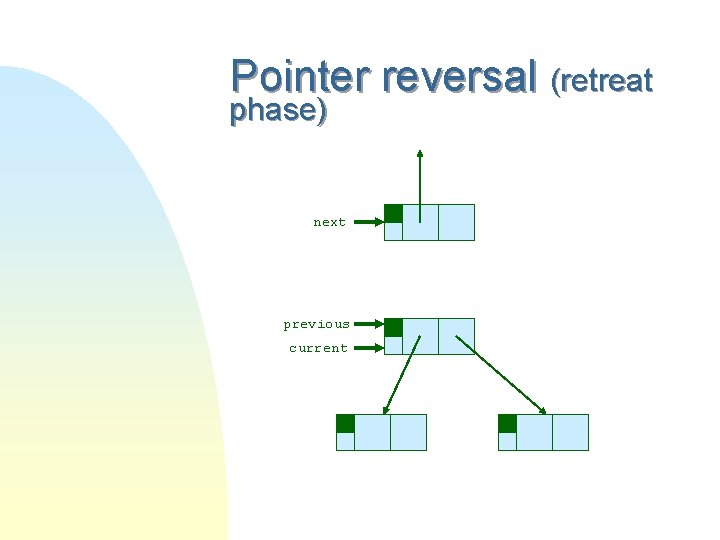
Pointer reversal (retreat phase) next previous current
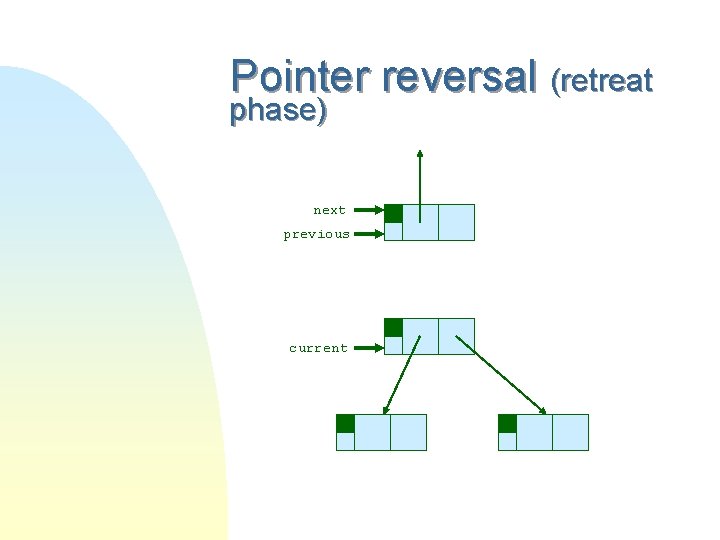
Pointer reversal (retreat phase) next previous current
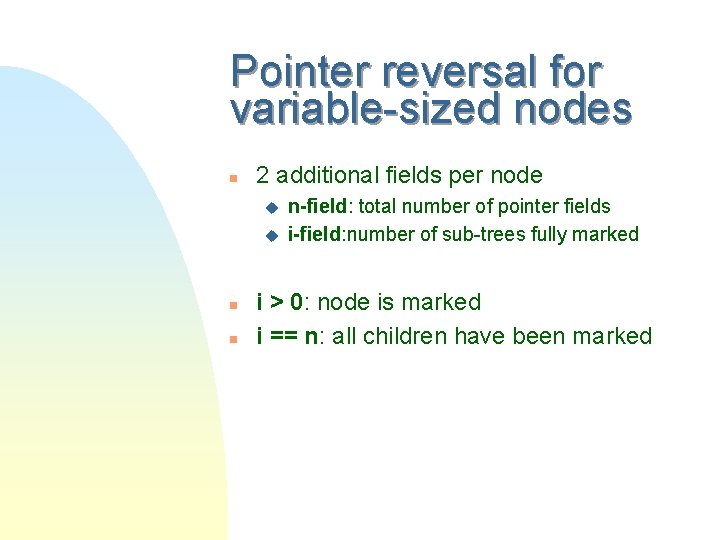
Pointer reversal for variable-sized nodes n 2 additional fields per node u u n n n-field: total number of pointer fields i-field: number of sub-trees fully marked i > 0: node is marked i == n: all children have been marked
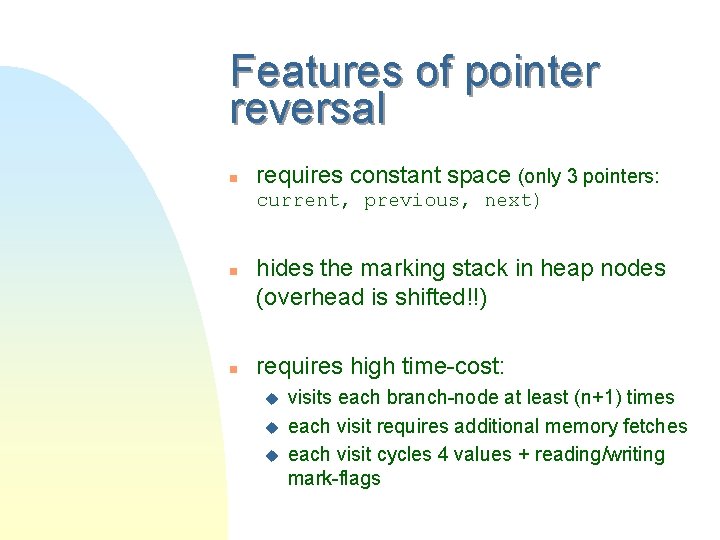
Features of pointer reversal n requires constant space (only 3 pointers: current, previous, next) n n hides the marking stack in heap nodes (overhead is shifted!!) requires high time-cost: u u u visits each branch-node at least (n+1) times each visit requires additional memory fetches each visit cycles 4 values + reading/writing mark-flags
Pointer reversal conclusion Don’t use pointer reversal!!!! except for having problems with stack overflow. . .
Bitmap marking n n Problem: where to find space for markbits in objects? Solution: store them in a separate bitmap table
Features of bitmap marking n n n one bit start-address of object in heap size of bitmap inversely proportional to size of smallest object the bit corresponding to an object is accessed by shifting object’s address
Bitmap marking (example) n n 32 -bit architecture smallest object = 2 words bitmap takes about 1. 5 % of heap. if p is start address of object, then mark-bit is accessed by: mark_bit(p) = return bitmap[p>>3];
Bitmap marking pro/contra n benefits u u u requires small space bitmap mostly can held in RAM heap mustn’t be contiguous mark-bits can be saved due to large objects big atomic objects never be touched in sweep no object need to be accessed n drawbacks u access bitmap more expensive than writing to object
Lazy sweeping n Problem: sweep phase expensive!!! n But: u u pre-fetching pages or cache lines will be profitable much less likely to effect virtual memory behaviour
Lazy sweeping n Problem: sweep interrupts user program!!! n Improvement: execute sweep in parallel with mutator
![Hughes’s lazy sweeping [1982] n n do a fixed amount of sweeping at each](http://slidetodoc.com/presentation_image/577159360fc571f7bb4f446345f44556/image-48.jpg "Hughes’s lazy sweeping [1982] n n do a fixed amount of sweeping at each")
Hughes’s lazy sweeping [1982] n n do a fixed amount of sweeping at each allocation sweep-phase cost transferred to allocation n no free-list manipulations n bitmaps reduce performance!!!
![Boehm-Demers-Weiser sweeper [first in 1988] n 2 -level allocation: u u n n low-level:](http://slidetodoc.com/presentation_image/577159360fc571f7bb4f446345f44556/image-49.jpg "Boehm-Demers-Weiser sweeper [first in 1988] n 2 -level allocation: u u n n low-level:")
Boehm-Demers-Weiser sweeper [first in 1988] n 2 -level allocation: u u n n low-level: acquire blocks from OS for single sized objects high-level: assign objects to the blocks free-list for each object size, threaded through blocks queues for reclaimable blocks
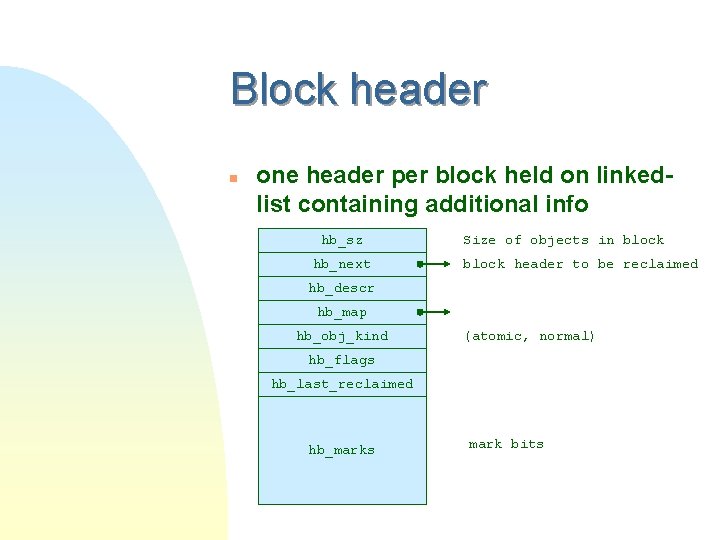
Block header n one header per block held on linkedlist containing additional info hb_sz hb_next Size of objects in block header to be reclaimed hb_descr hb_map hb_obj_kind (atomic, normal) hb_flags hb_last_reclaimed hb_marks mark bits
![Zorn’s lazy sweeper [1989] n for each object size => cache vector of n](http://slidetodoc.com/presentation_image/577159360fc571f7bb4f446345f44556/image-51.jpg "Zorn’s lazy sweeper [1989] n for each object size => cache vector of n")
Zorn’s lazy sweeper [1989] n for each object size => cache vector of n objects n Vector empty? Sweep to refill it! n sweeping = allocating (10 -12 cycles)
MS? RC? CC? n n n Tracing gc = much lower overhead on mutator than RC considering caching/virtual memory environment, answer gets more difficult (MS or CC? ? ? ) depends on application!
Space and locality mark-sweep. . . u u require less address space has better cache and vm behavior bitmap improvement (only reading live, non-atomic objects in mark-phase) adding object to free-list may cause page fault/cache miss
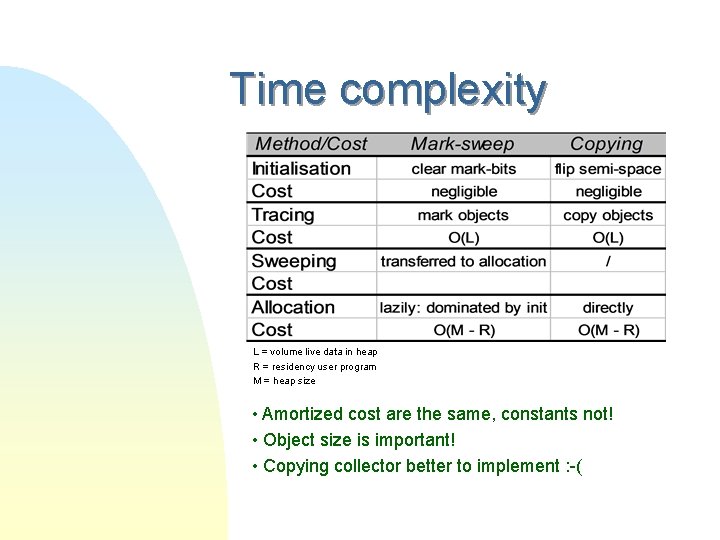
Time complexity L = volume live data in heap R = residency user program M = heap size • Amortized cost are the same, constants not! • Object size is important! • Copying collector better to implement : -(
- Slides: 54