
Marks consisting of both word and figurative elements
Marks consisting of both, word and figurative elements and how the figurative elements affect the distinctiveness Sven Stürmann Chairperson of the 2 nd Board of Appeal The Hague, 26 March 2018 1
CP 3. Distinctiveness – Figurative marks containing descriptive/non-distinctive words Common Practice Document June 2015: Unanimous endorsement at the Administrative Board Meeting.
Scope of the common practice Scope • The objective of this project was to find a common practice in relation to when a figurative mark, containing purely descriptive/non distinctive words, passes the absolute grounds examination because the figurative element renders sufficient distinctive character.

Distinctive Trade Marks 4
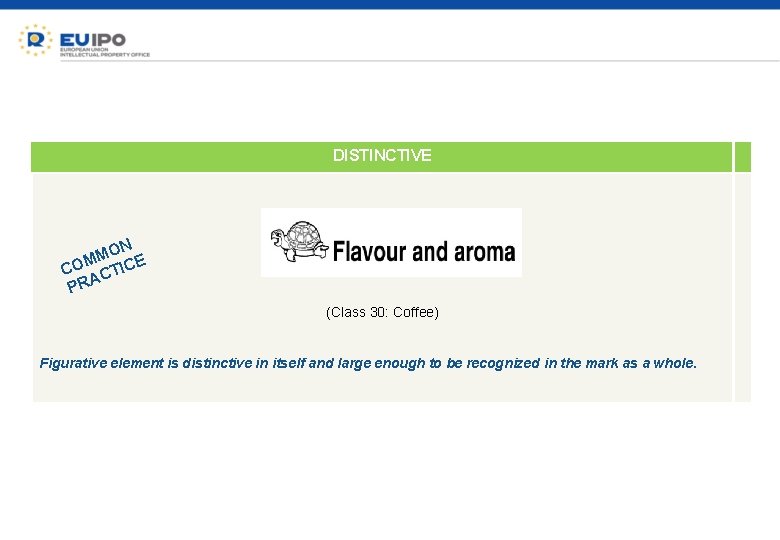
DISTINCTIVE N MO E M CO CTIC A PR (Class 30: Coffee) Figurative element is distinctive in itself and large enough to be recognized in the mark as a whole.
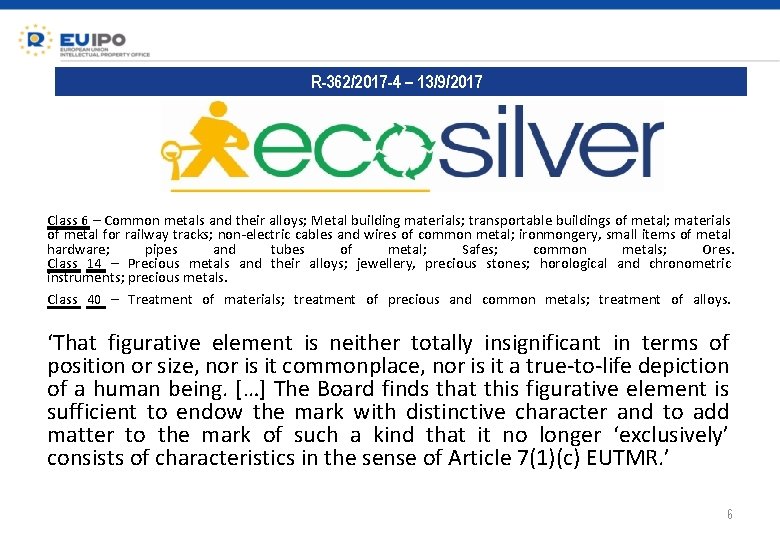
R-362/2017 -4 – 13/9/2017 Class 6 – Common metals and their alloys; Metal building materials; transportable buildings of metal; materials of metal for railway tracks; non-electric cables and wires of common metal; ironmongery, small items of metal hardware; pipes and tubes of metal; Safes; common metals; Ores. Class 14 – Precious metals and their alloys; jewellery, precious stones; horological and chronometric instruments; precious metals. Class 40 – Treatment of materials; treatment of precious and common metals; treatment of alloys. ‘That figurative element is neither totally insignificant in terms of position or size, nor is it commonplace, nor is it a true-to-life depiction of a human being. […] The Board finds that this figurative element is sufficient to endow the mark with distinctive character and to add matter to the mark of such a kind that it no longer ‘exclusively’ consists of characteristics in the sense of Article 7(1)(c) EUTMR. ’ 6
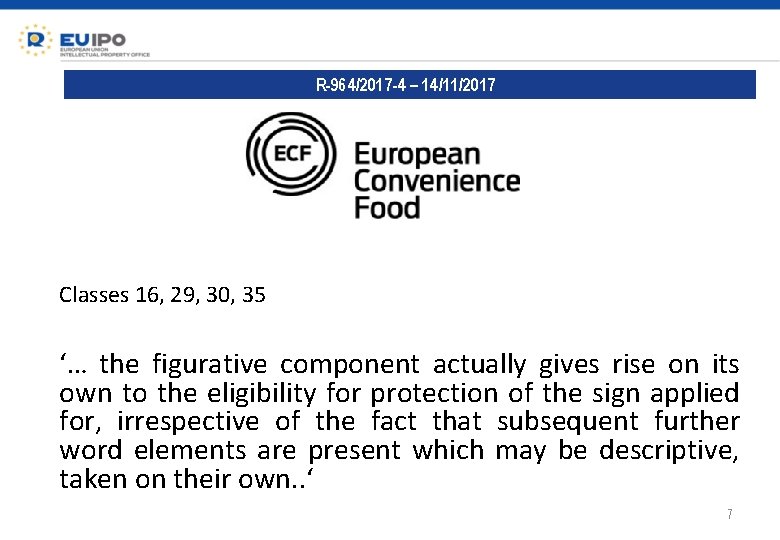
R-964/2017 -4 – 14/11/2017 Classes 16, 29, 30, 35 ‘… the figurative component actually gives rise on its own to the eligibility for protection of the sign applied for, irrespective of the fact that subsequent further word elements are present which may be descriptive, taken on their own. . ‘ 7
Non-distinctive Trade Marks 8
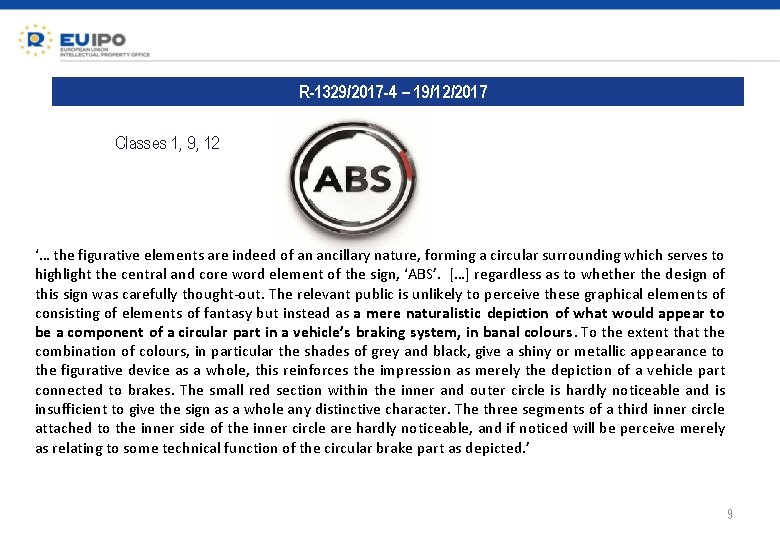
R-1329/2017 -4 – 19/12/2017 Classes 1, 9, 12 ‘… the figurative elements are indeed of an ancillary nature, forming a circular surrounding which serves to highlight the central and core word element of the sign, ‘ABS’. […] regardless as to whether the design of this sign was carefully thought-out. The relevant public is unlikely to perceive these graphical elements of consisting of elements of fantasy but instead as a mere naturalistic depiction of what would appear to be a component of a circular part in a vehicle’s braking system, in banal colours. To the extent that the combination of colours, in particular the shades of grey and black, give a shiny or metallic appearance to the figurative device as a whole, this reinforces the impression as merely the depiction of a vehicle part connected to brakes. The small red section within the inner and outer circle is hardly noticeable and is insufficient to give the sign as a whole any distinctive character. The three segments of a third inner circle attached to the inner side of the inner circle are hardly noticeable, and if noticed will be perceive merely as relating to some technical function of the circular brake part as depicted. ’ 9
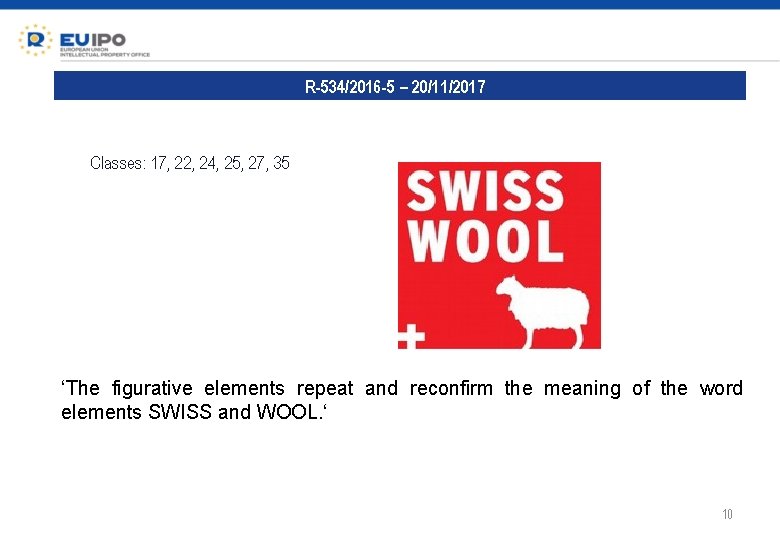
R-534/2016 -5 – 20/11/2017 Classes: 17, 22, 24, 25, 27, 35 ‘The figurative elements repeat and reconfirm the meaning of the word elements SWISS and WOOL. ‘ 10
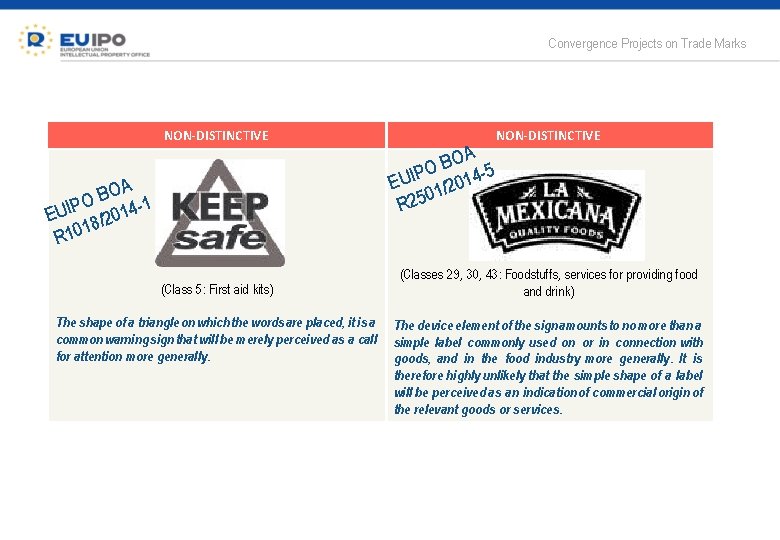
Convergence Projects on Trade Marks NON-DISTINCTIVE OA B O 1 EUIP 8/20141 R 10 (Class 5: First aid kits) The shape of a triangle on which the words are placed, it is a common warning sign that will be merely perceived as a call for attention more generally. NON-DISTINCTIVE OA B O 5 EUIP 1/20140 R 25 (Classes 29, 30, 43: Foodstuffs, services for providing food and drink) The device element of the sign amounts to no more than a simple label commonly used on or in connection with goods, and in the food industry more generally. It is therefore highly unlikely that the simple shape of a label will be perceived as an indication of commercial origin of the relevant goods or services.
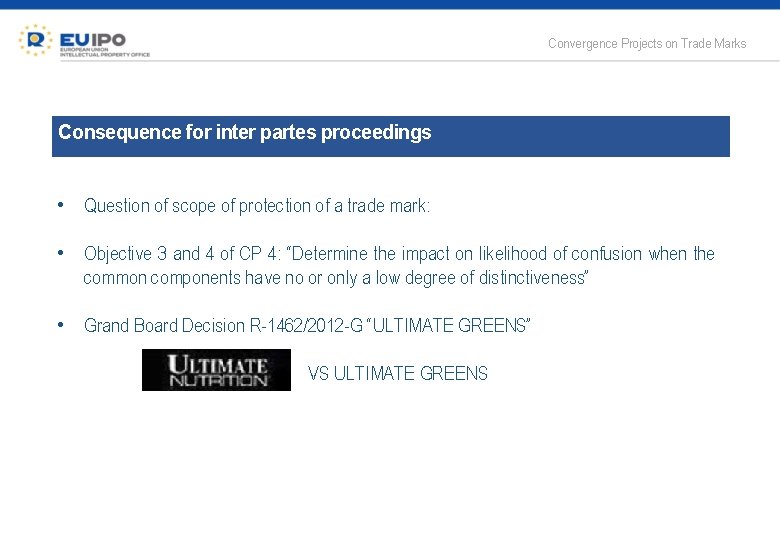
Convergence Projects on Trade Marks Consequence for inter partes proceedings • Question of scope of protection of a trade mark: • Objective 3 and 4 of CP 4: “Determine the impact on likelihood of confusion when the common components have no or only a low degree of distinctiveness” • Grand Board Decision R-1462/2012 -G “ULTIMATE GREENS” VS ULTIMATE GREENS
Convergence Projects on Trade Marks Consequence for inter partes proceedings But: • F 1 Judgment of 24/05/2012, C-196/11, F 1 -LIVE: in proceedings opposing the registration of an EUTM, the validity of earlier trade marks may not be called into question. • Consequently, the elements corresponding to the earlier mark cannot be considered as devoid of distinctive character in the trade mark comparison, but must be deemed to be endowed with some (low/minimal) degree of distinctiveness.
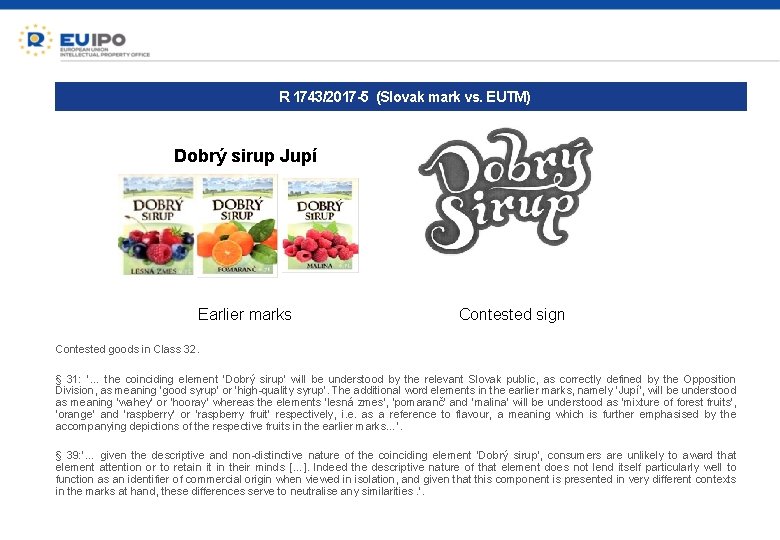
R 1743/2017 -5 (Slovak mark vs. EUTM) Dobrý sirup Jupí Earlier marks Contested sign Contested goods in Class 32. § 31: ‘… the coinciding element ‘Dobrý sirup’ will be understood by the relevant Slovak public, as correctly defined by the Opposition Division, as meaning ‘good syrup’ or ‘high-quality syrup’. The additional word elements in the earlier marks, namely ‘Jupí’, will be understood as meaning ‘wahey’ or ‘hooray’ whereas the elements ‘lesná zmes’, ‘pomaranč’ and ‘malina’ will be understood as ‘mixture of forest fruits’, ‘orange’ and ‘raspberry’ or ‘raspberry fruit’ respectively, i. e. as a reference to flavour, a meaning which is further emphasised by the accompanying depictions of the respective fruits in the earlier marks…’. § 39: ’… given the descriptive and non-distinctive nature of the coinciding element ‘Dobrý sirup’, consumers are unlikely to award that element attention or to retain it in their minds […]. Indeed the descriptive nature of that element does not lend itself particularly well to function as an identifier of commercial origin when viewed in isolation, and given that this component is presented in very different contexts in the marks at hand, these differences serve to neutralise any similarities. ’.
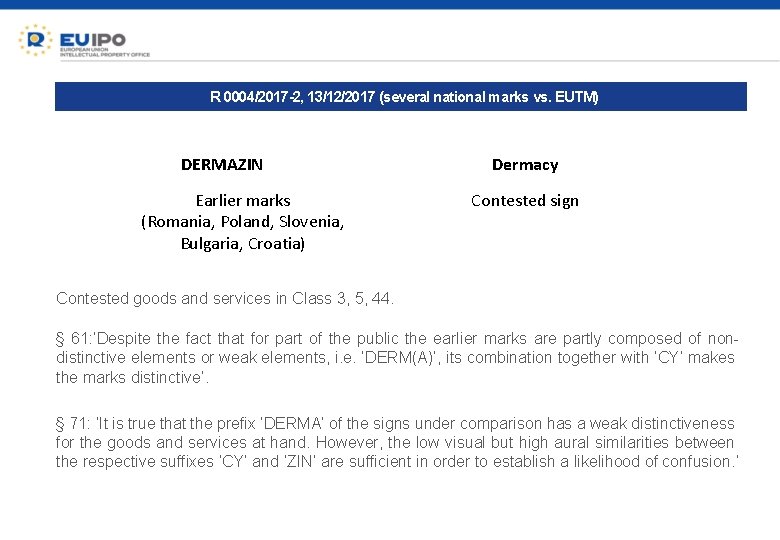
R 0004/2017 -2, 13/12/2017 (several national marks vs. EUTM) DERMAZIN Earlier marks (Romania, Poland, Slovenia, Bulgaria, Croatia) Dermacy Contested sign Contested goods and services in Class 3, 5, 44. § 61: ’Despite the fact that for part of the public the earlier marks are partly composed of nondistinctive elements or weak elements, i. e. ‘DERM(A)’, its combination together with ‘CY’ makes the marks distinctive’. § 71: ‘It is true that the prefix ‘DERMA’ of the signs under comparison has a weak distinctiveness for the goods and services at hand. However, the low visual but high aural similarities between the respective suffixes ‘CY’ and ‘ZIN’ are sufficient in order to establish a likelihood of confusion. ’
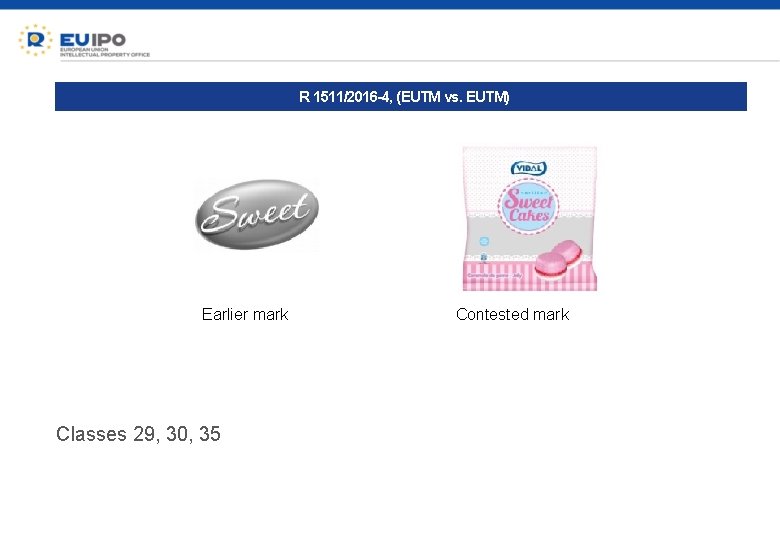
R 1511/2016 -4, (EUTM vs. EUTM) Earlier mark Classes 29, 30, 35 Contested mark
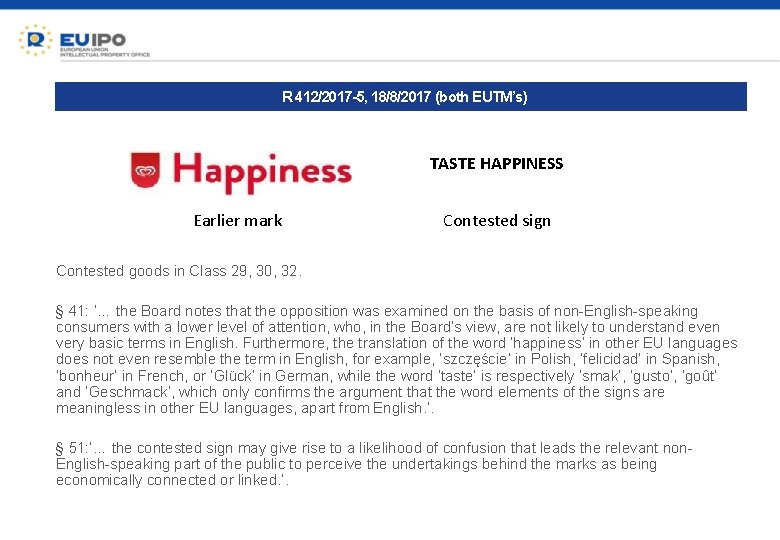
R 412/2017 -5, 18/8/2017 (both EUTM’s) TASTE HAPPINESS Earlier mark Contested sign Contested goods in Class 29, 30, 32. § 41: ‘… the Board notes that the opposition was examined on the basis of non-English-speaking consumers with a lower level of attention, who, in the Board’s view, are not likely to understand even very basic terms in English. Furthermore, the translation of the word ‘happiness’ in other EU languages does not even resemble the term in English, for example, ‘szczęście’ in Polish, ‘felicidad’ in Spanish, ‘bonheur’ in French, or ‘Glück’ in German, while the word ‘taste’ is respectively ‘smak’, ‘gusto’, ‘goût’ and ‘Geschmack‘, which only confirms the argument that the word elements of the signs are meaningless in other EU languages, apart from English. ’. § 51: ’… the contested sign may give rise to a likelihood of confusion that leads the relevant non. English-speaking part of the public to perceive the undertakings behind the marks as being economically connected or linked. ’.
- Slides: 18