
Markov Decision Processes Value Iteration Pieter Abbeel UC
Markov Decision Processes Value Iteration Pieter Abbeel UC Berkeley EECS
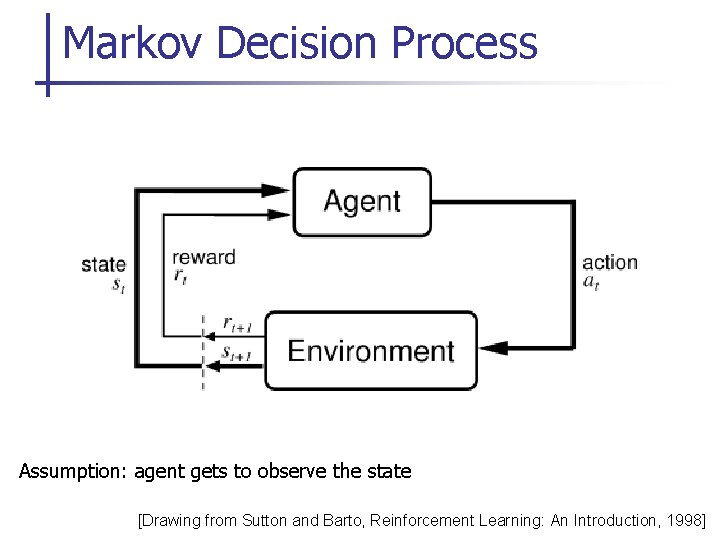
Markov Decision Process Assumption: agent gets to observe the state [Drawing from Sutton and Barto, Reinforcement Learning: An Introduction, 1998]
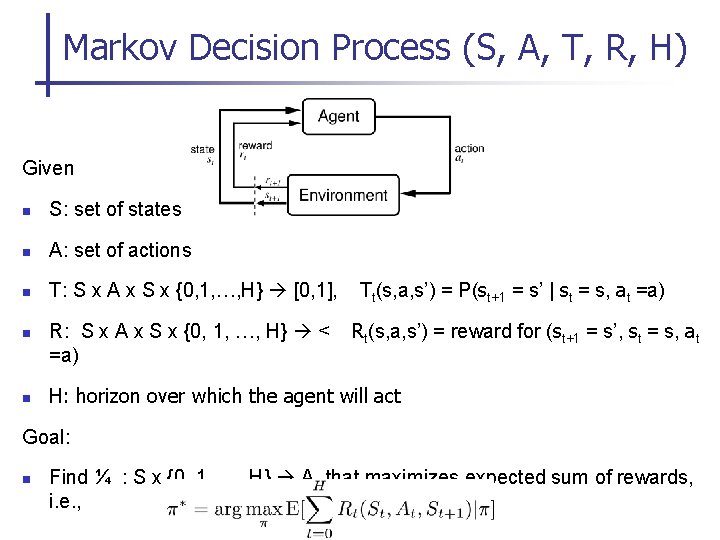
Markov Decision Process (S, A, T, R, H) Given n S: set of states n A: set of actions n T: S x A x S x {0, 1, …, H} [0, 1], n n R: S x A x S x {0, 1, …, H} < =a) Tt(s, a, s’) = P(st+1 = s’ | st = s, at =a) Rt(s, a, s’) = reward for (st+1 = s’, st = s, at H: horizon over which the agent will act Goal: n Find ¼ : S x {0, 1, …, H} A that maximizes expected sum of rewards, i. e. ,
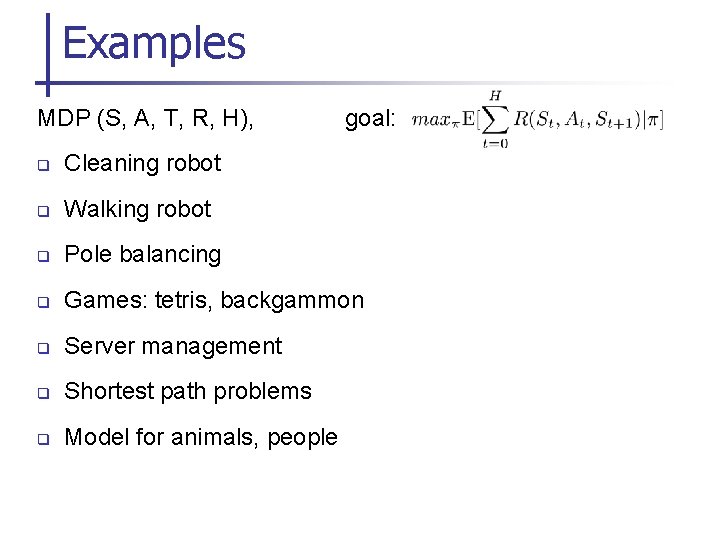
Examples MDP (S, A, T, R, H), goal: q Cleaning robot q Walking robot q Pole balancing q Games: tetris, backgammon q Server management q Shortest path problems q Model for animals, people
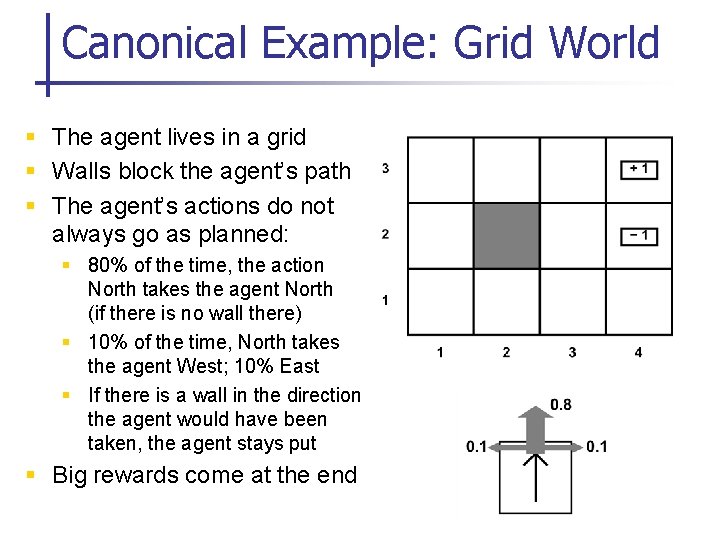
Canonical Example: Grid World § The agent lives in a grid § Walls block the agent’s path § The agent’s actions do not always go as planned: § 80% of the time, the action North takes the agent North (if there is no wall there) § 10% of the time, North takes the agent West; 10% East § If there is a wall in the direction the agent would have been taken, the agent stays put § Big rewards come at the end
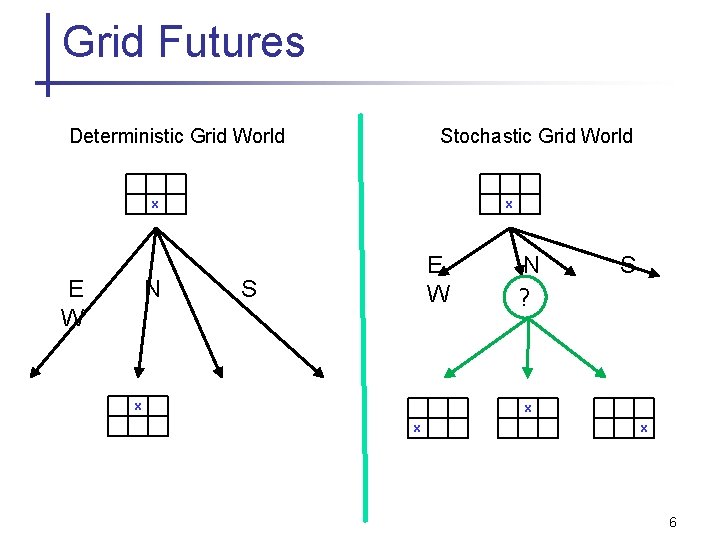
Grid Futures Deterministic Grid World Stochastic Grid World X E W N X E W S X N ? S X X X 6
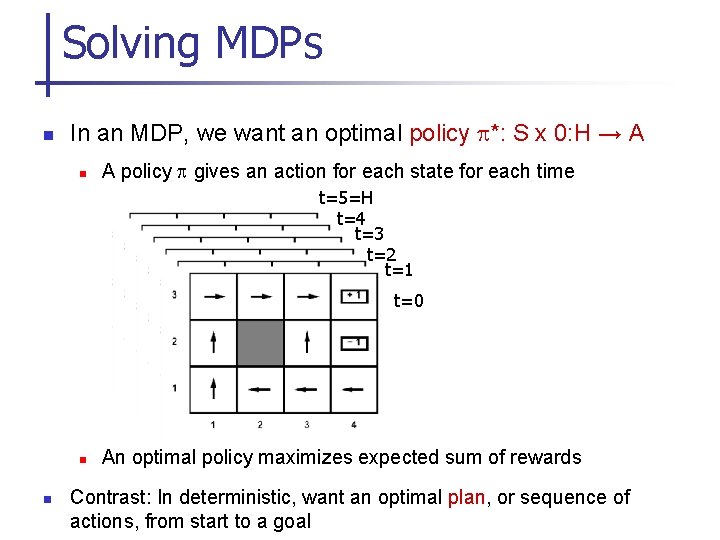
Solving MDPs n In an MDP, we want an optimal policy *: S x 0: H → A n A policy gives an action for each state for each time t=5=H t=4 t=3 t=2 t=1 t=0 n n An optimal policy maximizes expected sum of rewards Contrast: In deterministic, want an optimal plan, or sequence of actions, from start to a goal
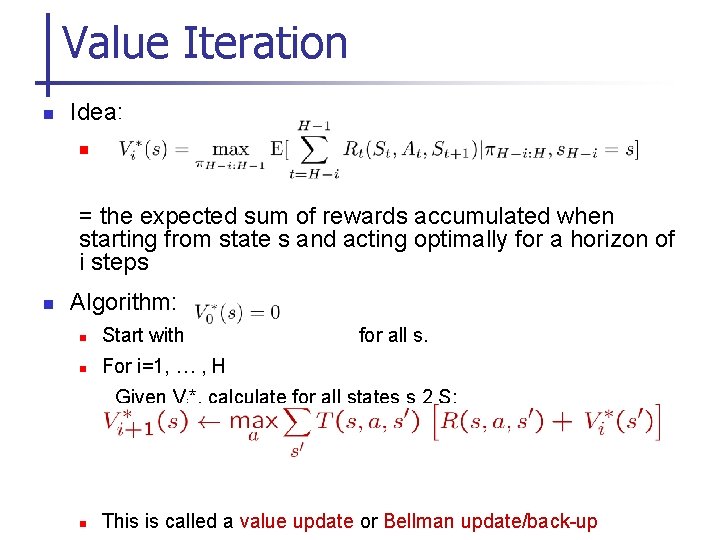
Value Iteration n Idea: n = the expected sum of rewards accumulated when starting from state s and acting optimally for a horizon of i steps n Algorithm: n Start with n For i=1, … , H for all s. Given Vi*, calculate for all states s 2 S: n This is called a value update or Bellman update/back-up
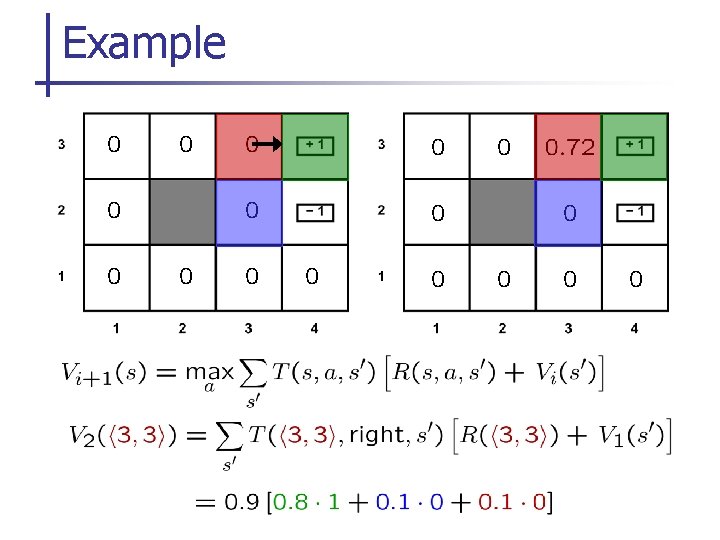
Example
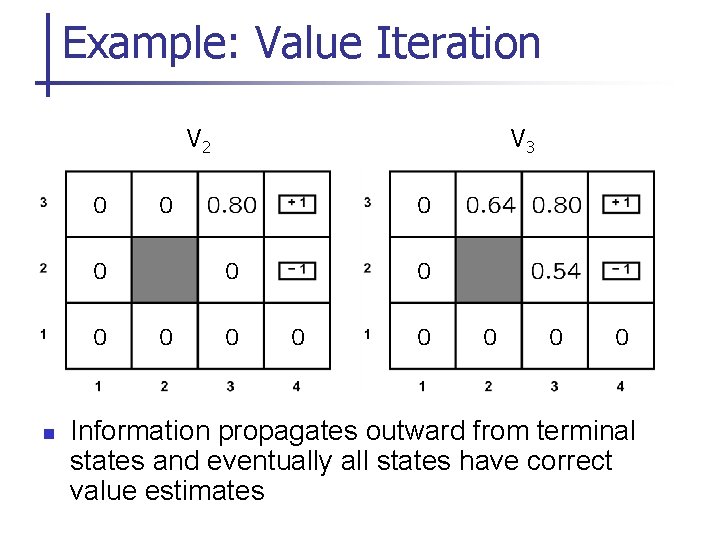
Example: Value Iteration V 2 n V 3 Information propagates outward from terminal states and eventually all states have correct value estimates
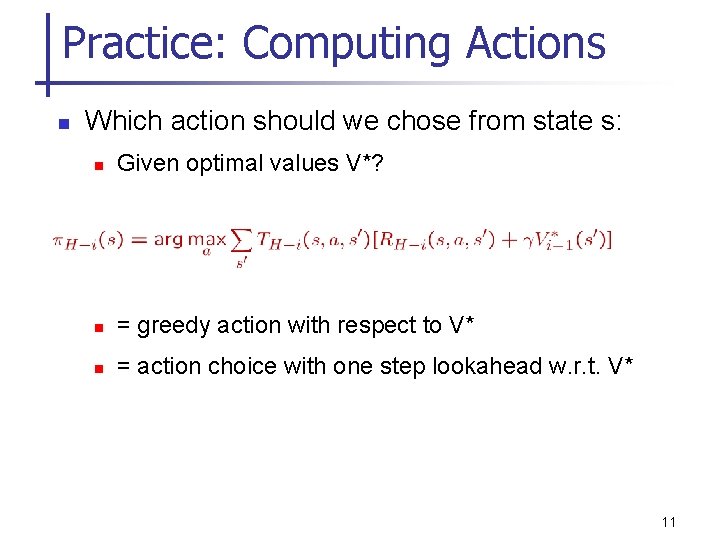
Practice: Computing Actions n Which action should we chose from state s: n Given optimal values V*? n = greedy action with respect to V* n = action choice with one step lookahead w. r. t. V* 11
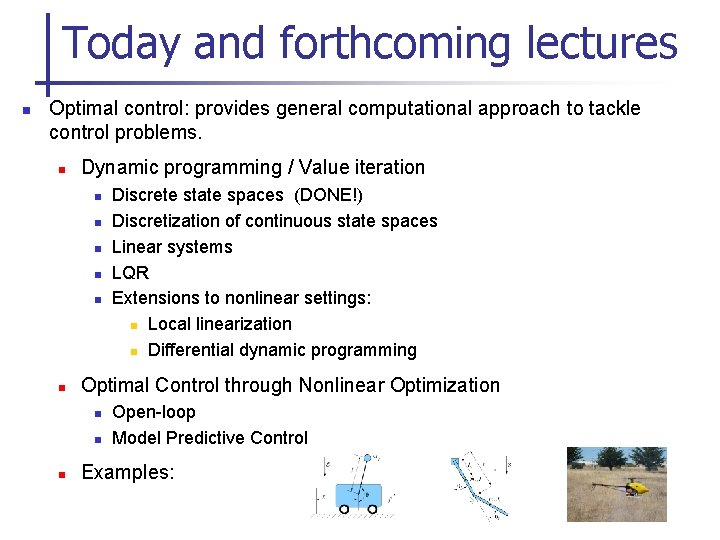
Today and forthcoming lectures n Optimal control: provides general computational approach to tackle control problems. n Dynamic programming / Value iteration n n n Optimal Control through Nonlinear Optimization n Discrete state spaces (DONE!) Discretization of continuous state spaces Linear systems LQR Extensions to nonlinear settings: n Local linearization n Differential dynamic programming Open-loop Model Predictive Control Examples:
- Slides: 12