
Marking System Architecture Studies An overview of the
- Slides: 9
Marking System Architecture Studies • An overview of the prototypical process and challenges Mike Furst Mgr, System Design & Integration 09 -15 -00 Internal Use Only
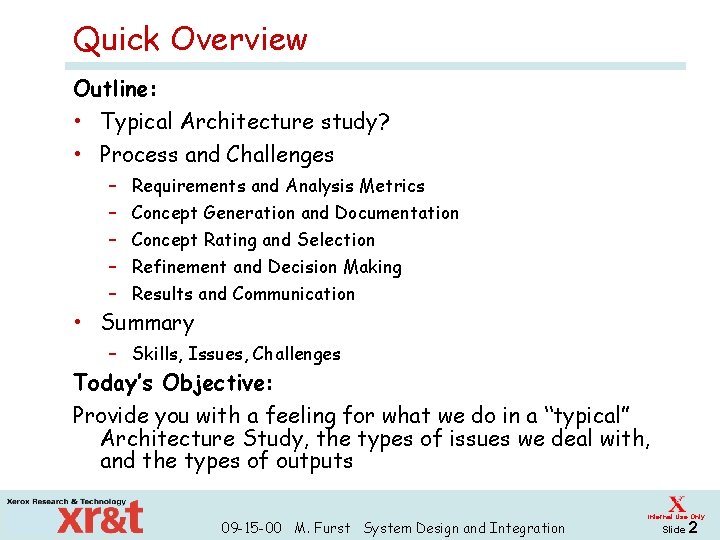
Quick Overview Outline: • Typical Architecture study? • Process and Challenges – – – Requirements and Analysis Metrics Concept Generation and Documentation Concept Rating and Selection Refinement and Decision Making Results and Communication • Summary – Skills, Issues, Challenges Today’s Objective: Provide you with a feeling for what we do in a “typical” Architecture Study, the types of issues we deal with, and the types of outputs 09 -15 -00 M. Furst System Design and Integration Internal Use Only Slide 2
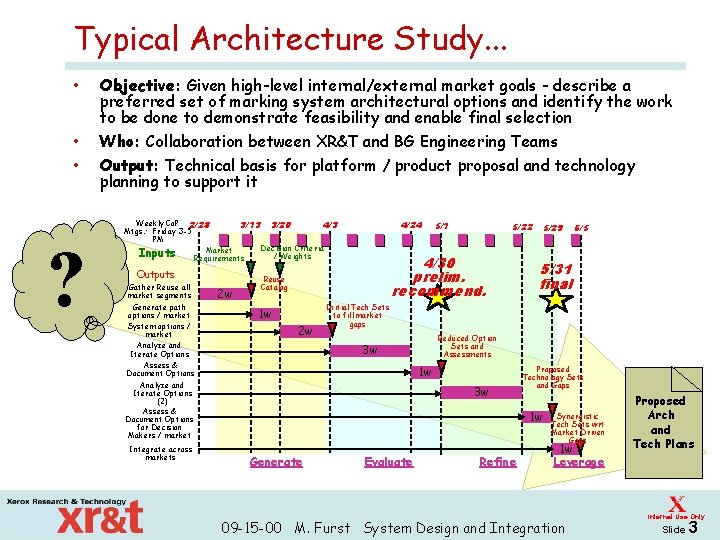
Typical Architecture Study. . . • Objective: Given high-level internal/external market goals - describe a preferred set of marking system architectural options and identify the work to be done to demonstrate feasibility and enable final selection • • Who: Collaboration between XR&T and BG Engineering Teams Output: Technical basis for platform / product proposal and technology planning to support it ? Weekly Co. P 2/28 3/13 3/20 4/3 Mtgs. : Friday 3 -5 PM Decision Criteria Market Inputs Requirements / Weights Outputs Gather Reuse all market segments Generate path options / market System options / market Analyze and Iterate Options Assess & Document Options Analyze and Iterate Options (2) Assess & Document Options for Decision Makers / market Integrate across markets 2 w 4/24 2 w 5/22 4/30 prelim. recommend. Reuse Catalog 1 w 5/1 5/29 5/31 final Initial Tech Sets to fill market gaps Reduced Option Sets and Assessments 3 w 1 w 3 w Proposed Technology Sets and Gaps 1 w Generate 6/5 Evaluate Refine Synergistic Tech Sets wrt Market Driven Gaps 1 w Leverage 09 -15 -00 M. Furst System Design and Integration Proposed Arch and Tech Plans Internal Use Only Slide 3
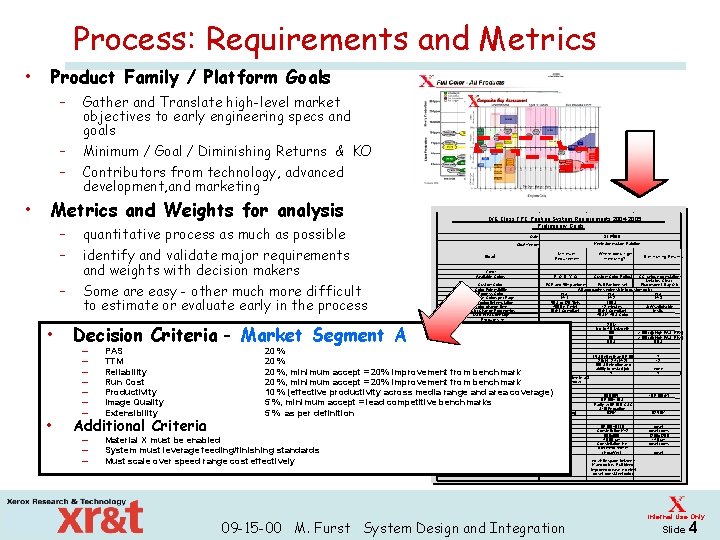
Process: Requirements and Metrics • Product Family / Platform Goals – – – • Gather and Translate high-level market objectives to early engineering specs and goals Minimum / Goal / Diminishing Returns & KO Contributors from technology, advanced development, and marketing Metrics and Weights for analysis – – – • • quantitative process as much as possible identify and validate major requirements and weights with decision makers Some are easy - other much more difficult to estimate or evaluate early in the process Decision Criteria - Market Segment A – – – – PAS TTM Reliability Run Cost Productivity Image Quality Extensibility Additional Criteria – – – D/E Class FPC Printing System Requirements 2004 -2005 Preliminary Goals 3/14/00 Date: Kevin Jones/Jack Ratcliffe Goal Keeper: Minimum Requirement Goal Color Available Colors Custom Color Extensibility Process Color Printable Colors per Page 4850 color/tint emulation Color change time Color Change Ergonomics Max. Area Coverage Productivity Average Monthly Print Volume (A 4 simplex pages) Duty Cycle Simplex speed (A 4 PPM) Duplex speed (A 4 PPM) Availability Diminishing Returns R, G, B, Y, O Custom Color Rollout CC, unique formulations Metalics, Clear, ECP and 50+ pantones Full Pantone set Fluorescent, Day-Glo All approaches extensible to custom color n/a n/a K+1 K+2 K+3 50% of 128 Tints 100% 4890 (<7 min) <2 minutes S/W switchable ID/HI Compliant in situ 40%K, 40% Color 1. 5 M 150 75 97% Reliability 20 % Shutdown Rate per 10 equiv. A 4 DP 180 Reliability UMR <4 20 % Job Integrity DP 180 20 %, minimum accept = 20% improvement from benchmark OGMR ? Guaranteed Uptime in a 3 Availability day print window 20 %, minimum accept = 20% improvement from benchmark TCO 10 % (effective productivity across media range. Supplies and coverage) $0. 0006 Costarea - ($/page/black) Service Parts Cost ($/page) 5 %, minimum accept = lead competitive benchmarks Service Labor Cost ($/page) Print Engine UMC ($) $80 K (swag) 5 % as per definition 6 Material X must be enabled System must leverage feeding/finishing standards Must scale over speed range cost effectively Where does it get interesting? Image Quality Monochrome Color Resolution HLC color registration (microns) image to page registration (mm) DP 180 92 c 600 x 600 <=85 um < 1 mm front-to-back registration (mm) DP 180 General IQ 09 -15 -00 M. Furst System Design and Integration 2. 0 M Up to 4. 0 M/Month 180 90 98% 15% Better than DP 180 2. 0(K), 2. 4 (K+2) 100% Detection and ability to restart job ? >180 (@ high PAS, Risk) 99% ? <2 none ? $0. 0005 DP 180+10% Parity w/DP 180, CSC Skill Reduction $35 K <DP 180(K) DP 180+9110 Constellation K+2 600 x 600 40 -80 um Constellation like 0. 65 mm/0. 55 mm (Hour/Ver) offset forms 1200 x 1200 <40 um offset forms $25. 6 K offset no white space between K and colors, Full bleed, improved crease, no vinyl offset, consistent color Internal Use Only Slide 4
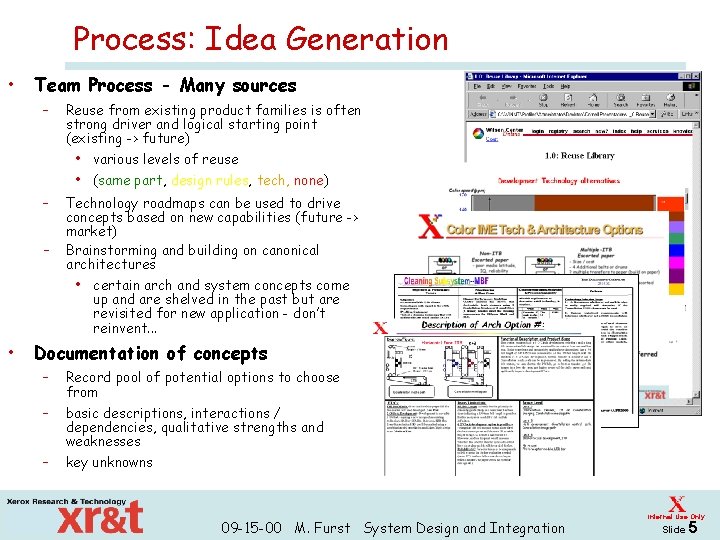
Process: Idea Generation • Team Process - Many sources – Reuse from existing product families is often strong driver and logical starting point (existing -> future) • various levels of reuse • (same part, design rules, tech, none) none – Technology roadmaps can be used to drive concepts based on new capabilities (future -> market) Brainstorming and building on canonical architectures – • certain arch and system concepts come up and are shelved in the past but are revisited for new application - don’t reinvent. . . • Documentation of concepts – – – Record pool of potential options to choose from basic descriptions, interactions / dependencies, qualitative strengths and weaknesses key unknowns 09 -15 -00 M. Furst System Design and Integration Internal Use Only Slide 5
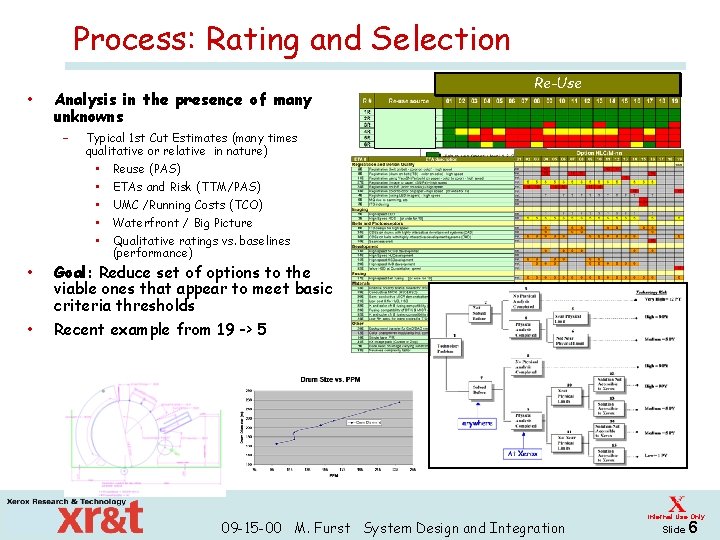
Process: Rating and Selection • Analysis in the presence of many unknowns – Re-Use Typical 1 st Cut Estimates (many times qualitative or relative in nature) • • • Reuse (PAS) ETAs and Risk (TTM/PAS) UMC /Running Costs (TCO) Waterfront / Big Picture Qualitative ratings vs. baselines (performance) • Goal: Reduce set of options to the viable ones that appear to meet basic criteria thresholds • Recent example from 19 -> 5 09 -15 -00 M. Furst System Design and Integration Internal Use Only Slide 6
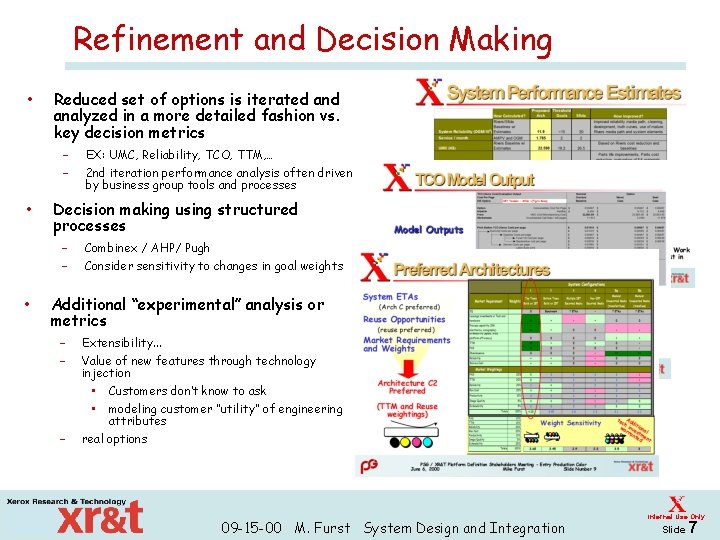
Refinement and Decision Making • Reduced set of options is iterated analyzed in a more detailed fashion vs. key decision metrics – – • Decision making using structured processes – – • EX: UMC, Reliability, TCO, TTM, … 2 nd iteration performance analysis often driven by business group tools and processes Combinex / AHP/ Pugh Consider sensitivity to changes in goal weights Additional “experimental” analysis or metrics – – – Extensibility. . . Value of new features through technology injection • Customers don’t know to ask • modeling customer “utility” of engineering attributes real options 09 -15 -00 M. Furst System Design and Integration Internal Use Only Slide 7
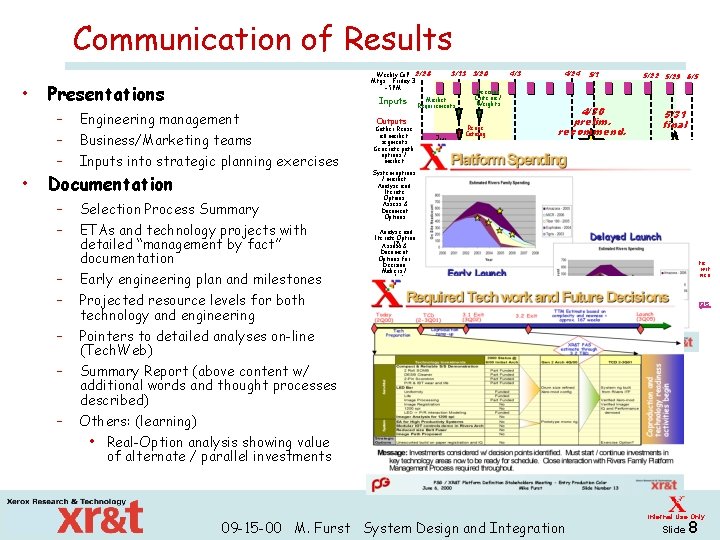
Communication of Results • • Weekly Co. P 2/28 Mtgs. : Friday 3 -5 PM Presentations – – – Inputs Engineering management Business/Marketing teams Inputs into strategic planning exercises Documentation – – – – Selection Process Summary ETAs and technology projects with detailed “management by fact” documentation Early engineering plan and milestones Projected resource levels for both technology and engineering Pointers to detailed analyses on-line (Tech. Web) Summary Report (above content w/ additional words and thought processes described) Others: (learning) • Real-Option analysis showing value of alternate / parallel investments 3/13 3/20 Gather Reuse all market segments Generate path options / market System options / market Analyze and Iterate Options Assess & Document Options 2 w 4/24 Decision Criteria / Weights Market Requirements Outputs 4/3 2 w 5/31 final Initial Tech Sets to fill market gaps Reduced Option Sets and Assessments 3 w 1 w Analyze and Iterate Options (2) & Assess Document Options for Decision Makers / market Integrate across markets 5/22 5/29 6/5 4/30 prelim. recommend. Reuse Catalog 1 w 5/1 3 w Proposed Technology Sets and Gaps 1 w Synergistic Tech Sets wrt Market Driven Gaps 1 w Generate Evaluate 09 -15 -00 M. Furst System Design and Integration Refine Leverage Internal Use Only Slide 8
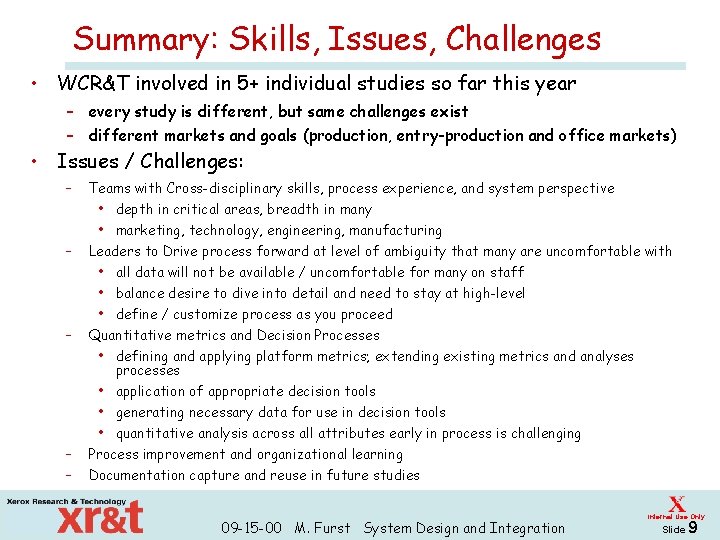
Summary: Skills, Issues, Challenges • WCR&T involved in 5+ individual studies so far this year – every study is different, but same challenges exist – different markets and goals (production, entry-production and office markets) • Issues / Challenges: – – – Teams with Cross-disciplinary skills, process experience, and system perspective • depth in critical areas, breadth in many • marketing, technology, engineering, manufacturing Leaders to Drive process forward at level of ambiguity that many are uncomfortable with • all data will not be available / uncomfortable for many on staff • balance desire to dive into detail and need to stay at high-level • define / customize process as you proceed Quantitative metrics and Decision Processes • defining and applying platform metrics; extending existing metrics and analyses processes • application of appropriate decision tools • generating necessary data for use in decision tools • quantitative analysis across all attributes early in process is challenging Process improvement and organizational learning Documentation capture and reuse in future studies 09 -15 -00 M. Furst System Design and Integration Internal Use Only Slide 9