
Marking and Feedback guidance for BTEC Mark to

Marking and Feedback guidance for BTEC • • Mark to the Eastbury School Editing Code Annotate in margin where assessment criteria has been achieved. Identify any positives (www) Provide guidance on what specifically needs to be added (having already annotated in the text where this should go). Link all improvements to an assessment criteria e. g. To achieve P 7 you must; For M 4 you need to; Use keywords and terms so that pupils know what they need to do e. g. explain, how, why, etc. Set other targets e. g. written structure, SP + GR, use of references, etc. Give students the opportunity to respond (in green pen if written OR using a different colour/highlighted font if on computer)
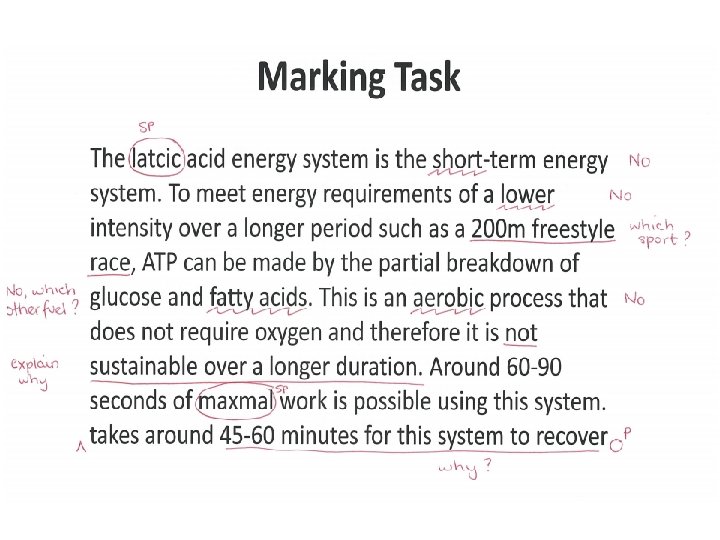

BTEC Level 3 Extended Diploma in Sport (Development, Coaching and Fitness) Students Name: John Smith Subject: Unit 1. Principles of Anatomy and Physiology in Sport Assignment Title: The Energy Systems (Assignment 7) Year: 12 Teacher Name: Mr Davies Issue Date: 22/03/11 Deadlines – Draft Copy: 30/03/11 Final Copy: 06/04/11 Assessment Criteria / Grades Awarded Pass Describe three different energy systems and their use in sport and exercise activities (P 7) Merit Explain the three different energy systems and their use in sport and exercise activities (M 4) Distinction Analyse three different energy systems and their use in sport and exercise activities (D 2) Referral Comments Draft: Not all of the information you have written about the lactic acid system is correct – check and make corrections to achieve P 7. You have correctly identified a sporting example but be more specific. To achieve M 4 you need to explain why a 200 m swimmer would need to use this system For M 4 you also need to explain how lactic acid is produced and why it affects performance. For M 4, explain why it takes 45 -60 minutes to recover and to achieve D 2, say how this could then affect sporting performance. Signed: R. Davies Date: 30/03/11
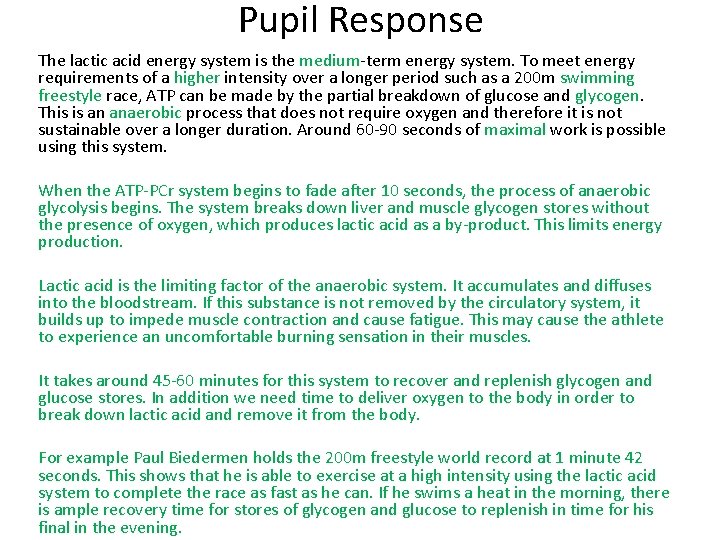
Pupil Response The lactic acid energy system is the medium-term energy system. To meet energy requirements of a higher intensity over a longer period such as a 200 m swimming freestyle race, ATP can be made by the partial breakdown of glucose and glycogen. This is an anaerobic process that does not require oxygen and therefore it is not sustainable over a longer duration. Around 60 -90 seconds of maximal work is possible using this system. When the ATP-PCr system begins to fade after 10 seconds, the process of anaerobic glycolysis begins. The system breaks down liver and muscle glycogen stores without the presence of oxygen, which produces lactic acid as a by-product. This limits energy production. Lactic acid is the limiting factor of the anaerobic system. It accumulates and diffuses into the bloodstream. If this substance is not removed by the circulatory system, it builds up to impede muscle contraction and cause fatigue. This may cause the athlete to experience an uncomfortable burning sensation in their muscles. It takes around 45 -60 minutes for this system to recover and replenish glycogen and glucose stores. In addition we need time to deliver oxygen to the body in order to break down lactic acid and remove it from the body. For example Paul Biedermen holds the 200 m freestyle world record at 1 minute 42 seconds. This shows that he is able to exercise at a high intensity using the lactic acid system to complete the race as fast as he can. If he swims a heat in the morning, there is ample recovery time for stores of glycogen and glucose to replenish in time for his final in the evening.
- Slides: 4