
Markets for Risk Management A Reinsurance Primer Based

Markets for Risk Management A Reinsurance Primer Based upon “Reinsurance and Financial Strategies” (Fall 2004), by J. David Cummins* Not to be reproduced without permission. *This lecture note represents an abridged and (lightly) edited version of a Fall 2004 lecture note by J. David Cummins entitled “Reinsurance and Financial Strategies” (Copyright 2004 by J. David Cummins), which was used with his permission. A Reinsurance Primer Page 1
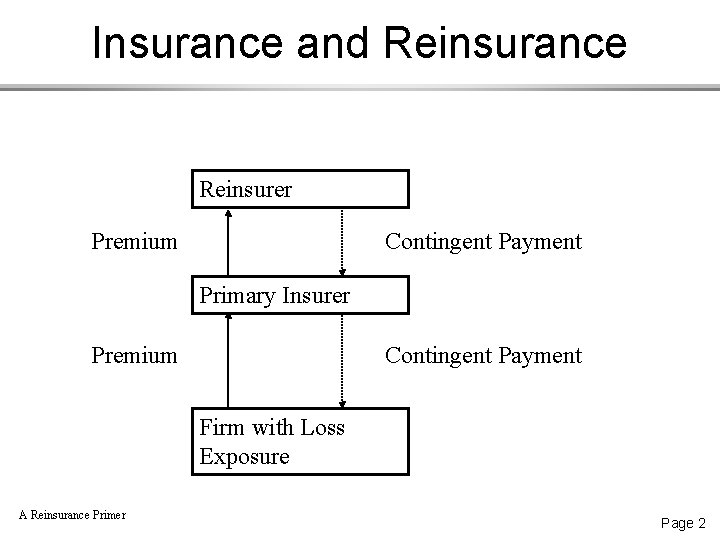
Insurance and Reinsurance Reinsurer Premium Contingent Payment Primary Insurer Premium Contingent Payment Firm with Loss Exposure A Reinsurance Primer Page 2
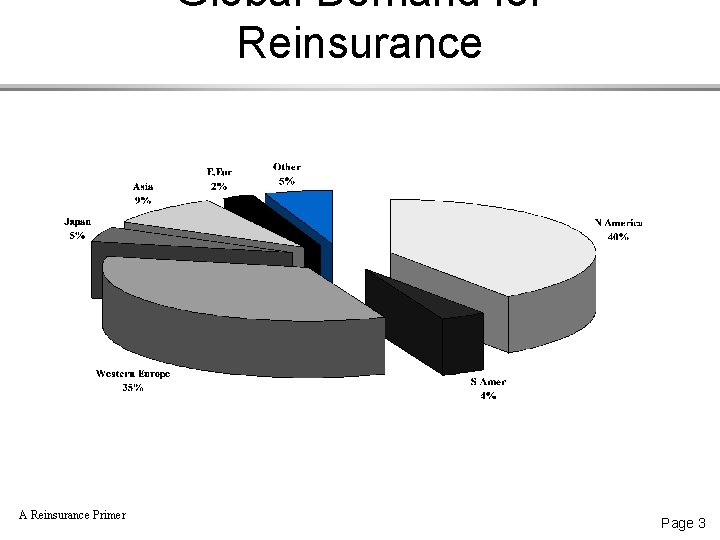
Global Demand for Reinsurance A Reinsurance Primer Page 3
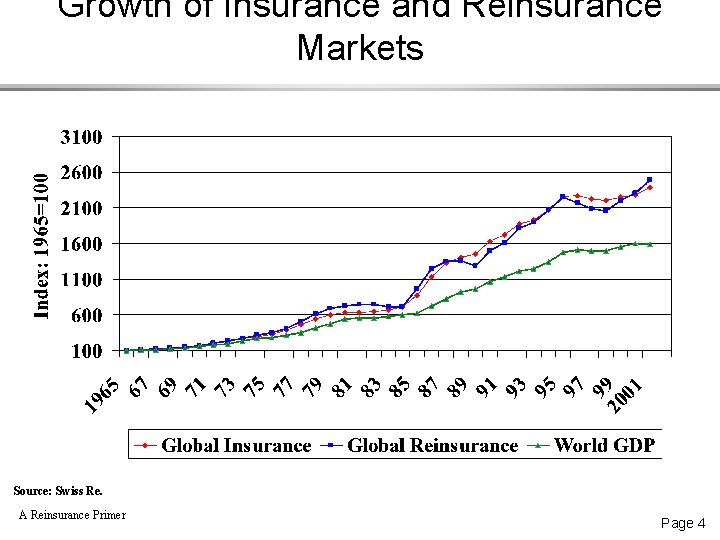
Growth of Insurance and Reinsurance Markets Source: Swiss Re. A Reinsurance Primer Page 4
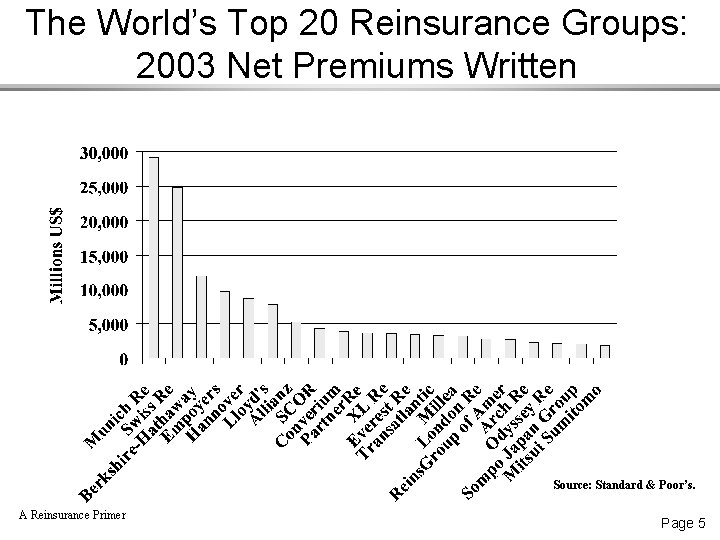
The World’s Top 20 Reinsurance Groups: 2003 Net Premiums Written Source: Standard & Poor’s. A Reinsurance Primer Page 5
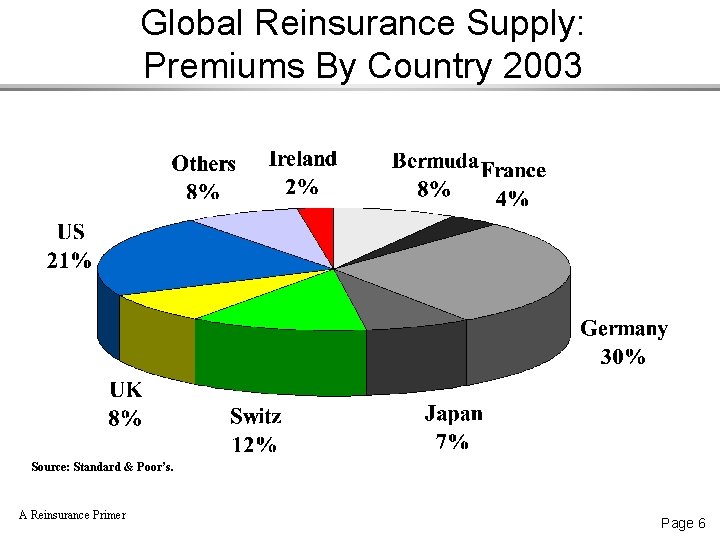
Global Reinsurance Supply: Premiums By Country 2003 Source: Standard & Poor’s. A Reinsurance Primer Page 6
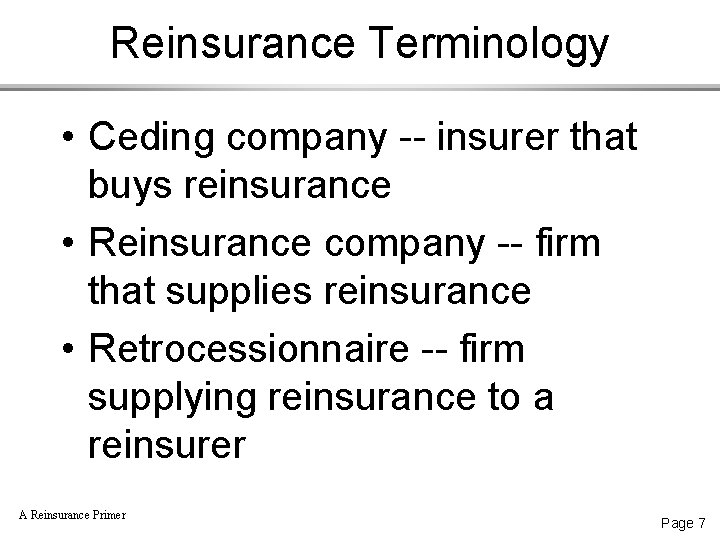
Reinsurance Terminology • Ceding company -- insurer that buys reinsurance • Reinsurance company -- firm that supplies reinsurance • Retrocessionnaire -- firm supplying reinsurance to a reinsurer A Reinsurance Primer Page 7
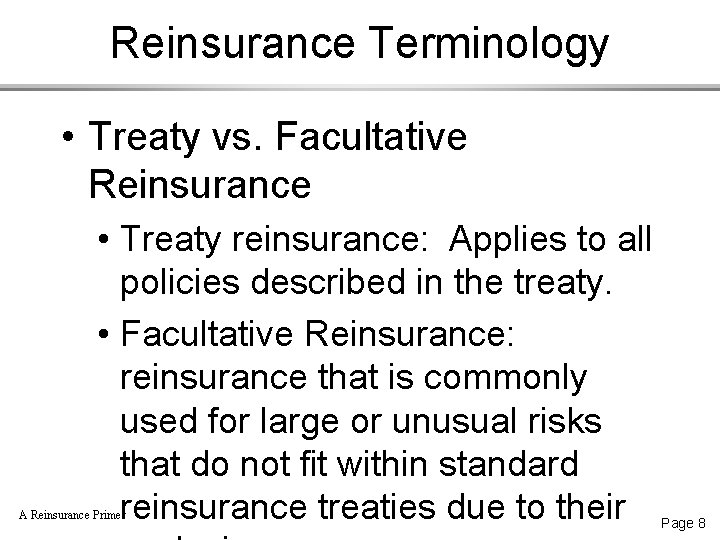
Reinsurance Terminology • Treaty vs. Facultative Reinsurance • Treaty reinsurance: Applies to all policies described in the treaty. • Facultative Reinsurance: reinsurance that is commonly used for large or unusual risks that do not fit within standard reinsurance treaties due to their A Reinsurance Primer Page 8
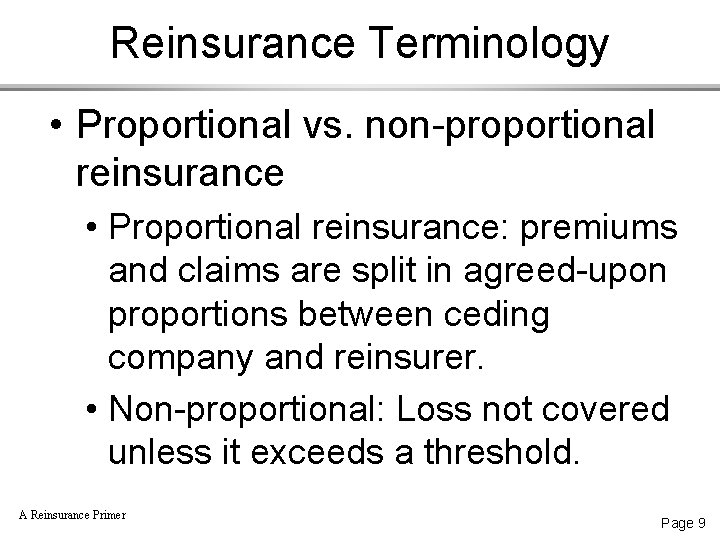
Reinsurance Terminology • Proportional vs. non-proportional reinsurance • Proportional reinsurance: premiums and claims are split in agreed-upon proportions between ceding company and reinsurer. • Non-proportional: Loss not covered unless it exceeds a threshold. A Reinsurance Primer Page 9
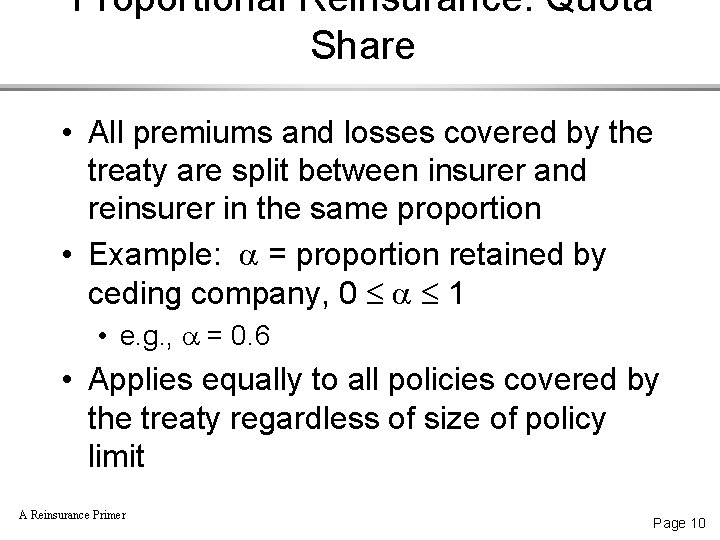
Proportional Reinsurance: Quota Share • All premiums and losses covered by the treaty are split between insurer and reinsurer in the same proportion • Example: = proportion retained by ceding company, 0 1 • e. g. , = 0. 6 • Applies equally to all policies covered by the treaty regardless of size of policy limit A Reinsurance Primer Page 10
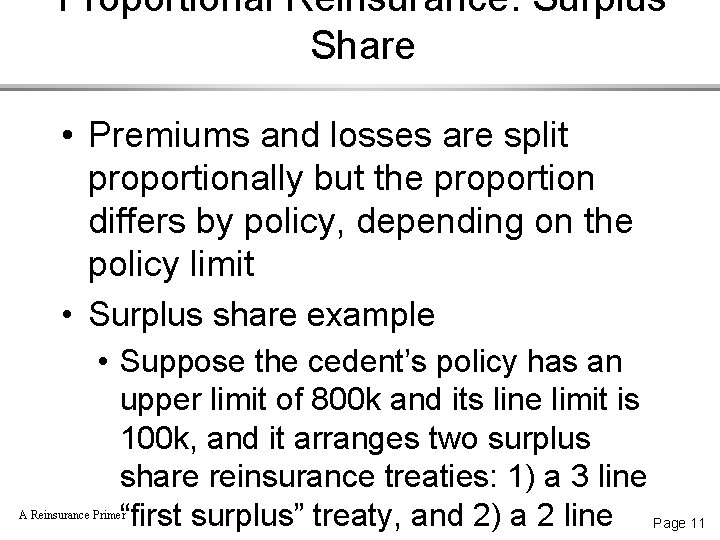
Proportional Reinsurance: Surplus Share • Premiums and losses are split proportionally but the proportion differs by policy, depending on the policy limit • Surplus share example • Suppose the cedent’s policy has an upper limit of 800 k and its line limit is 100 k, and it arranges two surplus share reinsurance treaties: 1) a 3 line “first surplus” treaty, and 2) a 2 line Page 11 A Reinsurance Primer
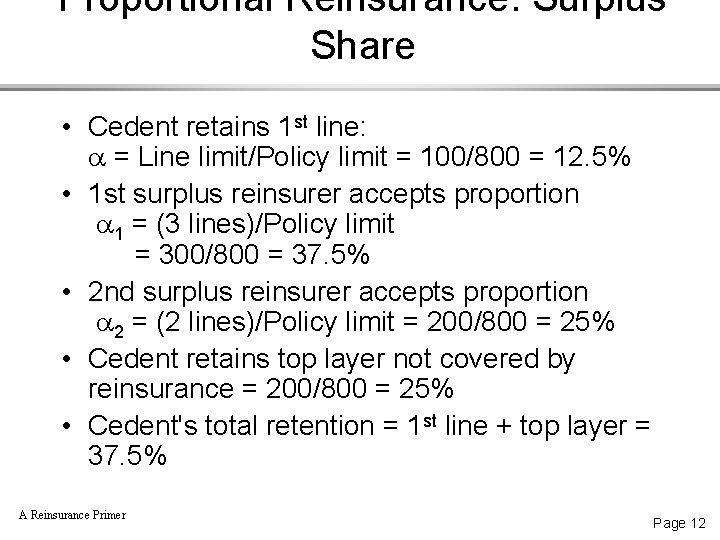
Proportional Reinsurance: Surplus Share • Cedent retains 1 st line: = Line limit/Policy limit = 100/800 = 12. 5% • 1 st surplus reinsurer accepts proportion 1 = (3 lines)/Policy limit = 300/800 = 37. 5% • 2 nd surplus reinsurer accepts proportion 2 = (2 lines)/Policy limit = 200/800 = 25% • Cedent retains top layer not covered by reinsurance = 200/800 = 25% • Cedent's total retention = 1 st line + top layer = 37. 5% A Reinsurance Primer Page 12
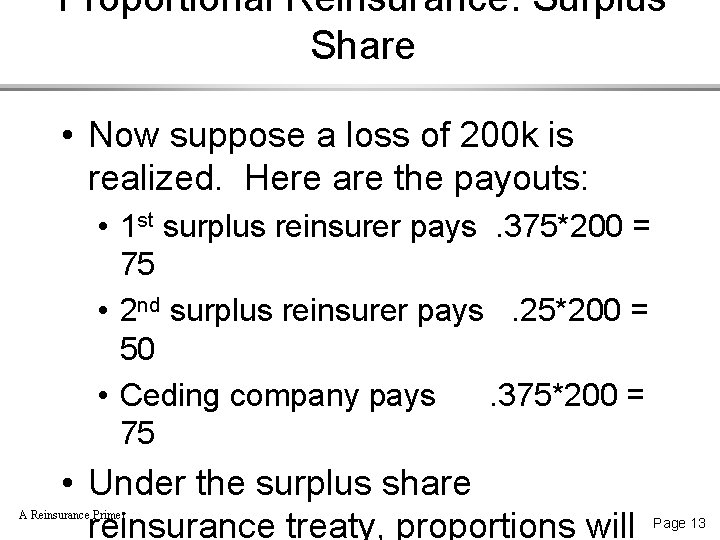
Proportional Reinsurance: Surplus Share • Now suppose a loss of 200 k is realized. Here are the payouts: • 1 st surplus reinsurer pays. 375*200 = 75 • 2 nd surplus reinsurer pays. 25*200 = 50 • Ceding company pays. 375*200 = 75 • Under the surplus share reinsurance treaty, proportions will A Reinsurance Primer Page 13
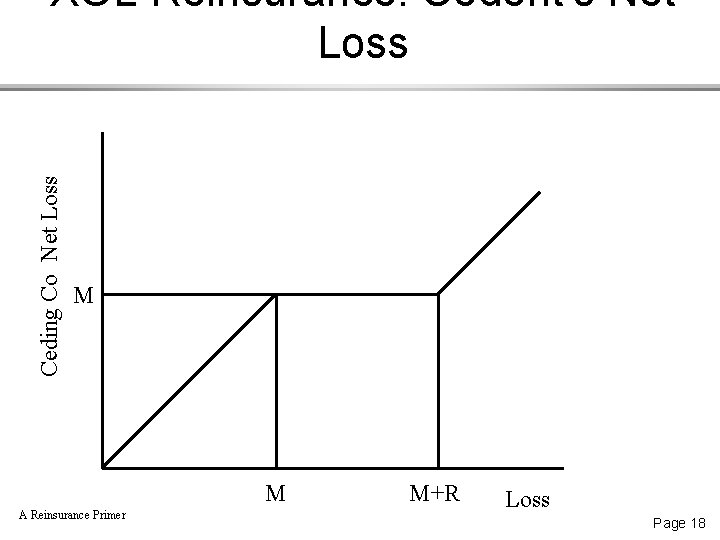
Non-Proportional Reinsurance: Excess of Loss (“XOL”) • XOL contracts have an “attachment point” and a “policy limit”, similar to strike prices in options contracts. • Reinsurer does not pay if loss is less than the attachment point. • For losses in excess of the attachment, reinsurer pays: L – attachment, with a maximum payment equal to the limit. A Reinsurance Primer Page 14
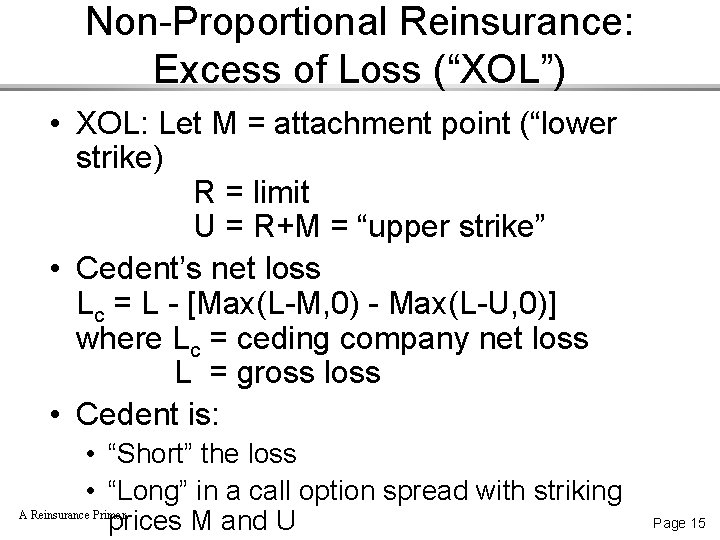
Non-Proportional Reinsurance: Excess of Loss (“XOL”) • XOL: Let M = attachment point (“lower strike) R = limit U = R+M = “upper strike” • Cedent’s net loss Lc = L - [Max(L-M, 0) - Max(L-U, 0)] where Lc = ceding company net loss L = gross loss • Cedent is: • “Short” the loss • “Long” in a call option spread with striking A Reinsurance Primer prices M and U Page 15
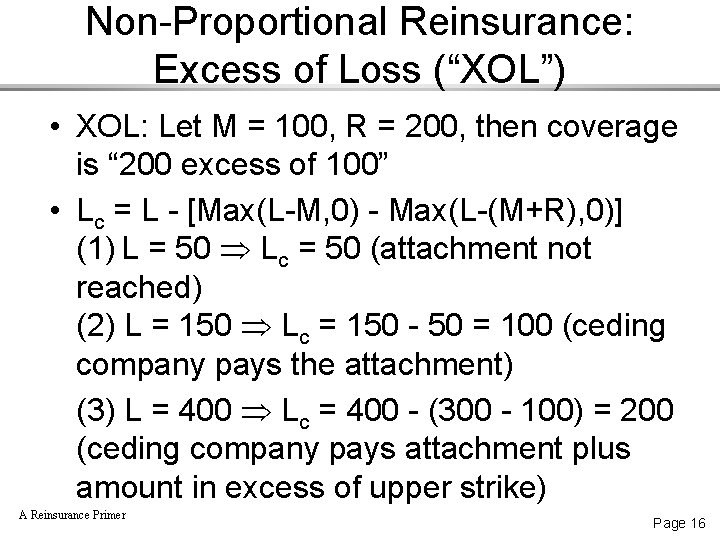
Non-Proportional Reinsurance: Excess of Loss (“XOL”) • XOL: Let M = 100, R = 200, then coverage is “ 200 excess of 100” • Lc = L - [Max(L-M, 0) - Max(L-(M+R), 0)] (1) L = 50 Lc = 50 (attachment not reached) (2) L = 150 Lc = 150 - 50 = 100 (ceding company pays the attachment) (3) L = 400 Lc = 400 - (300 - 100) = 200 (ceding company pays attachment plus amount in excess of upper strike) A Reinsurance Primer Page 16
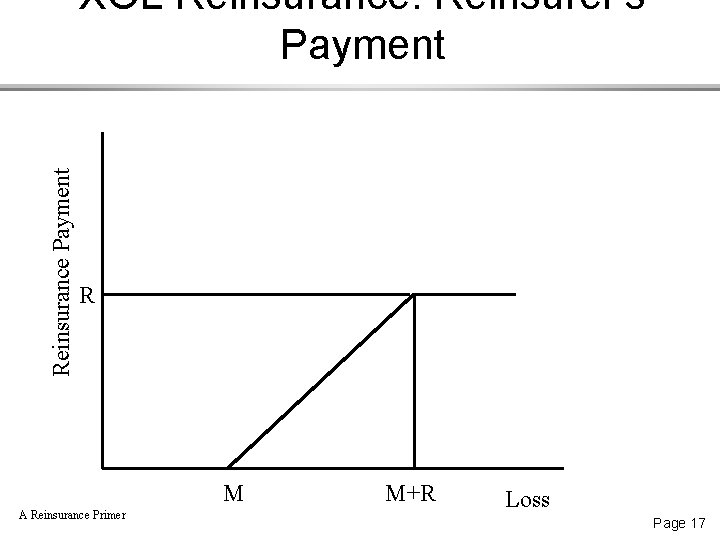
Reinsurance Payment XOL Reinsurance: Reinsurer’s Payment R M A Reinsurance Primer M+R Loss Page 17
Ceding Co Net Loss XOL Reinsurance: Cedent’s Net Loss M M A Reinsurance Primer M+R Loss Page 18
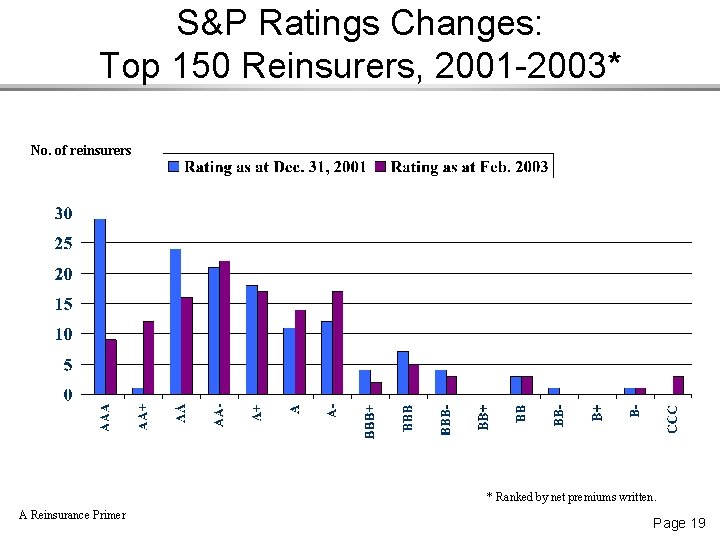
S&P Ratings Changes: Top 150 Reinsurers, 2001 -2003* No. of reinsurers * Ranked by net premiums written. A Reinsurance Primer Page 19
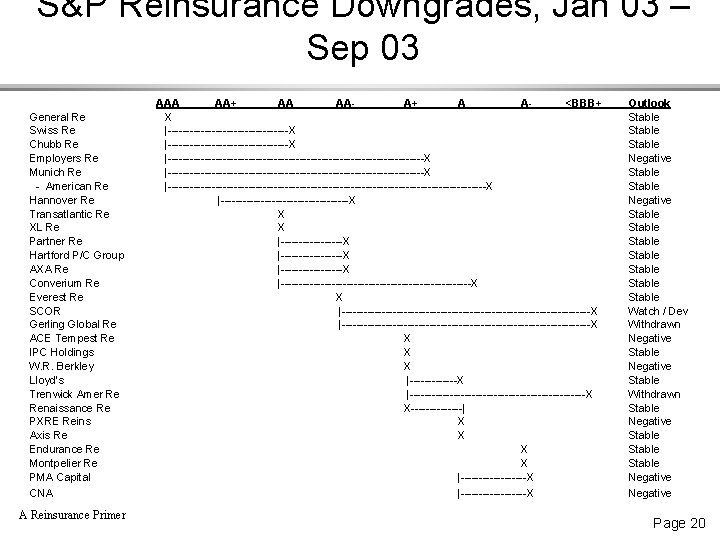
S&P Reinsurance Downgrades, Jan 03 – Sep 03 General Re Swiss Re Chubb Re Employers Re Munich Re - American Re Hannover Re Transatlantic Re XL Re Partner Re Hartford P/C Group AXA Re Converium Re Everest Re SCOR Gerling Global Re ACE Tempest Re IPC Holdings W. R. Berkley Lloyd’s Trenwick Amer Re Renaissance Re PXRE Reins Axis Re Endurance Re Montpelier Re PMA Capital CNA A Reinsurance Primer AAA AA+ AA AAA+ A A<BBB+ X |---------------------------------X |----------------------------------------------------------------------X |--------------------------------------------X |------------------X X X |-----------------X |-----------------------------------X X |--------------------------------------------------------------------X X |-------X |------------------------X X-------| X X |------------------X Outlook Stable Negative Stable Stable Watch / Dev Withdrawn Negative Stable Withdrawn Stable Negative Stable Negative Page 20
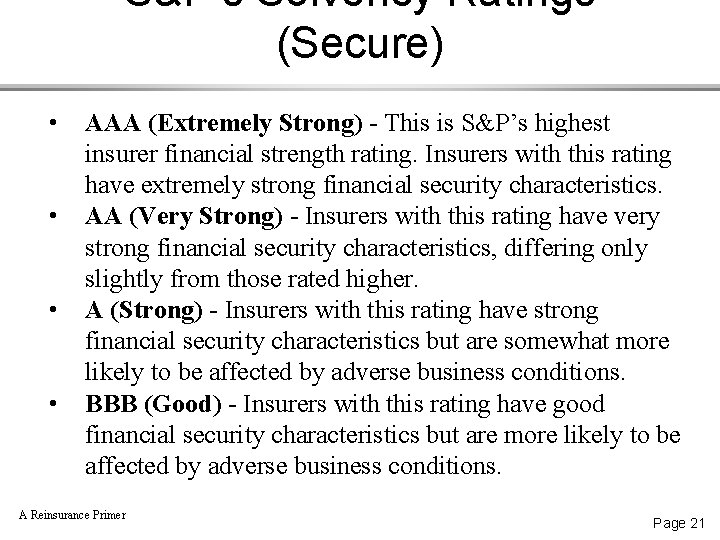
S&P’s Solvency Ratings (Secure) • • AAA (Extremely Strong) - This is S&P’s highest insurer financial strength rating. Insurers with this rating have extremely strong financial security characteristics. AA (Very Strong) - Insurers with this rating have very strong financial security characteristics, differing only slightly from those rated higher. A (Strong) - Insurers with this rating have strong financial security characteristics but are somewhat more likely to be affected by adverse business conditions. BBB (Good) - Insurers with this rating have good financial security characteristics but are more likely to be affected by adverse business conditions. A Reinsurance Primer Page 21
S&P’s Solvency Ratings (Vulnerable) • • BB (Marginal) - Insurers with this rating have marginal financial security characteristics, and adverse business conditions could lead to insufficient ability to meet financial commitments. B (Weak) - Insurers with this rating have weak financial security characteristics, and adverse business conditions will likely impair their ability to meet financial commitments. CCC (Very Weak) - Insurers with this rating have very weak financial security characteristics and are dependent on favorable conditions to meet financial commitments. CC (Extremely Weak) - Insurers with this rating have extremely weak financial security characteristics and are not likely to meet some of their financial commitments. A Reinsurance Primer Page 22
- Slides: 22