
MarketOriented Cloud Computing Vision Hype and Reality for
![Introduction: trend � Web Search Trends: [C]. Google and Salesforce. com in Cloud computing](https://slidetodoc.com/presentation_image_h2/7df8ced3c825ea90db046c484de5f0c4/image-4.jpg "Introduction: trend � Web Search Trends: [C]. Google and Salesforce. com in Cloud computing")
- Slides: 38
Market-Oriented Cloud Computing: Vision, Hype, and Reality for Delivering IT Services as Computing Utilities Rajkumar Buyya(1, 2), Chee Shin Yeo(1), and Srikumar Venugopa(l) 1. Grid Computing and Distributed Systems (GRIDS) Laboratory Department of computer Science and Software Engineering The University of Melbourne, Australia 2. Manjrasoft Pty Ltd, Melbourne, Australia HPCC '08. 10 th IEEE 1
Outline � Introduction � Market-Oriented Cloud Architecture � Commercial offering of market-oriented Clouds requirement and Qos issue � Emerging cloud platform � Amazon EC 2 intro&pricing � Google App Engine intro&pricing � Microsoft Anzure platform intro&pricing � Possible pricing strategy(by Ming Lung) � Conclusions&comments 2
Introduction: definition � Definition of cloud: � A Cloud is a type of parallel and distributed system; � Consisting of a collection of interconnected and virtualized computers � That are dynamically provisioned and presented as one or more unified computing resources � , based on service-level agreements established through negotiation between the service provider and consumers. ” 3
Introduction: trend � Web Search Trends: [C]. Google and Salesforce. com in Cloud computing deal, Siliconrepublic. com - Apr 14 2008 4
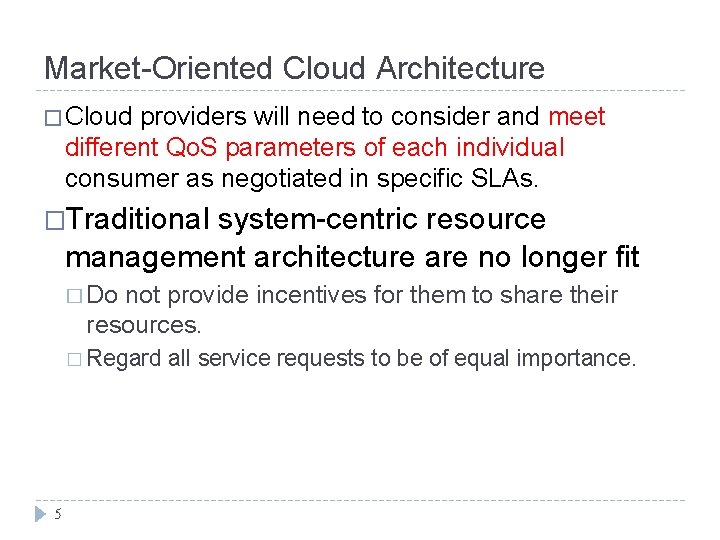
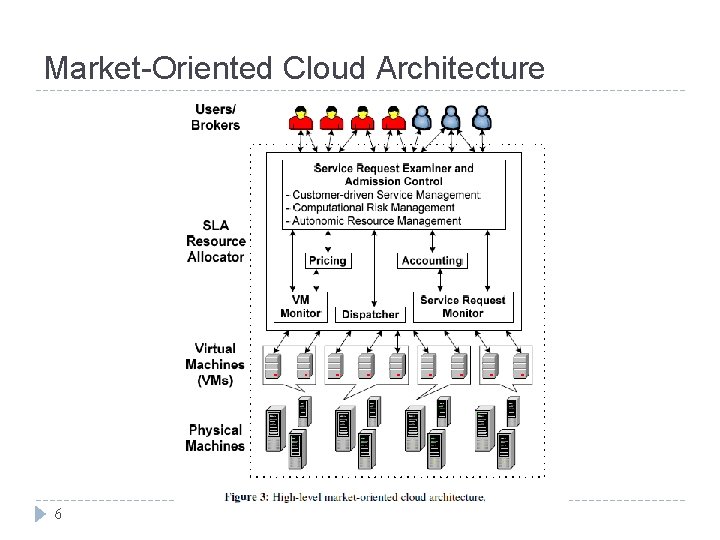
Market-Oriented Cloud Architecture � Cloud providers will need to consider and meet different Qo. S parameters of each individual consumer as negotiated in specific SLAs. �Traditional system-centric resource management architecture are no longer fit � Do not provide incentives for them to share their resources. � Regard 5 all service requests to be of equal importance.
Market-Oriented Cloud Architecture 6
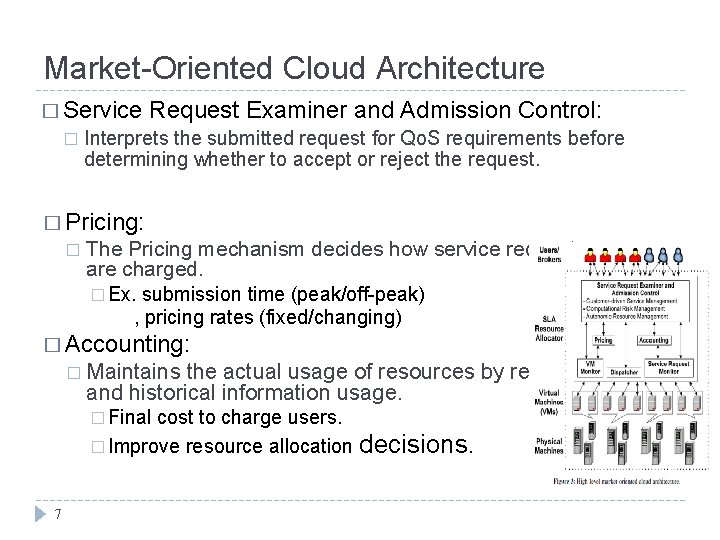
Market-Oriented Cloud Architecture � Service � Request Examiner and Admission Control: Interprets the submitted request for Qo. S requirements before determining whether to accept or reject the request. � Pricing: � The Pricing mechanism decides how service requests are charged. � Ex. submission time (peak/off-peak) , pricing rates (fixed/changing) � Accounting: � Maintains the actual usage of resources by requests and historical information usage. � Final cost to charge users. � Improve resource allocation decisions. 7
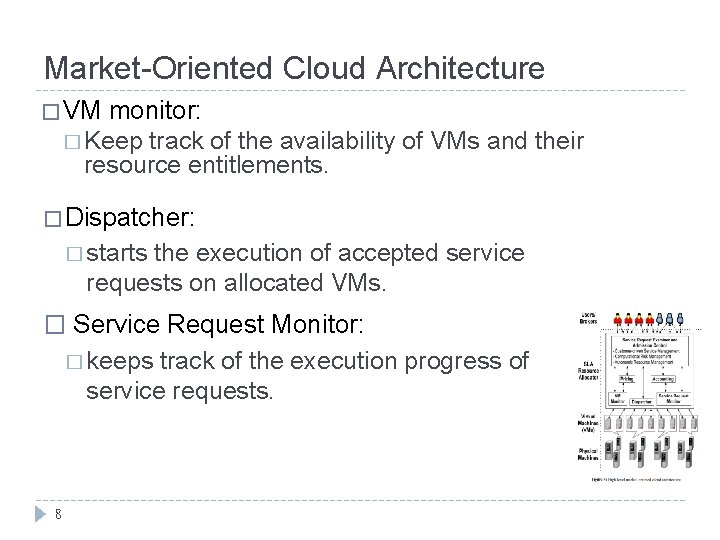
Market-Oriented Cloud Architecture � VM monitor: � Keep track of the availability of VMs and their resource entitlements. � Dispatcher: � starts the execution of accepted service requests on allocated VMs. � Service Request Monitor: � keeps track of the execution progress of service requests. 8
Qos parameter issue � In cloud there are critical Qo. S parameters to consider in a service request � time, cost, reliability and trust/security. � In particular, Qo. S requirements cannot be static and need to be dynamically updated over time. � Due to continuing changes in business operations and operating environments. �But , there are no or limited support for dynamic negotiation of SLAs. � Recently, we have developed negotiation mechanisms based on alternate offers protocol for establishing SLAs [8]. 9 [8]S. Venugopal, X. Chu, and R. Buyya. using the Alternate Offers Protocol (IWQo. S 2008), A Negotiation Mechanism for Advance Resource Reservation
Commercial offering of market-oriented Clouds requirement � Customizable � Support customer-driven service management based on customer profiles and requested service requirements. � Market-based resource management � Contain computational risk management to sustain SLA-oriented resource allocation. �Incorporate models: � Effectively autonomic resource management self-manage changes in service requirements to satisfy both new service demands and existing service obligations. 10
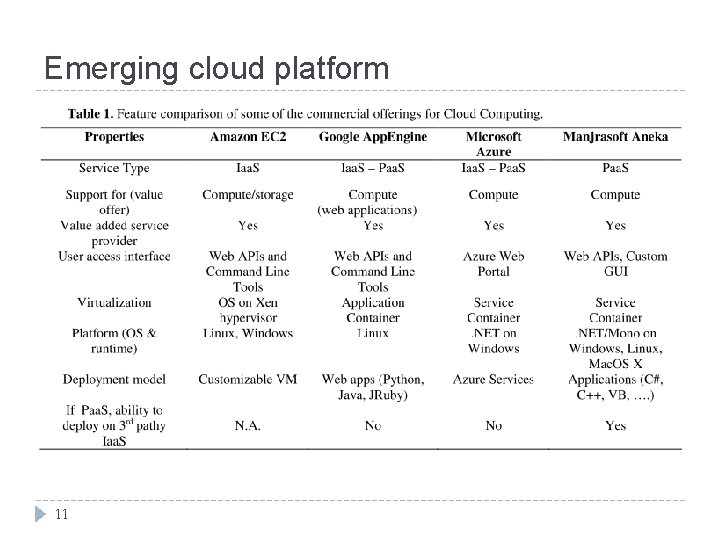
Emerging cloud platform 11
Amazon EC 2 12
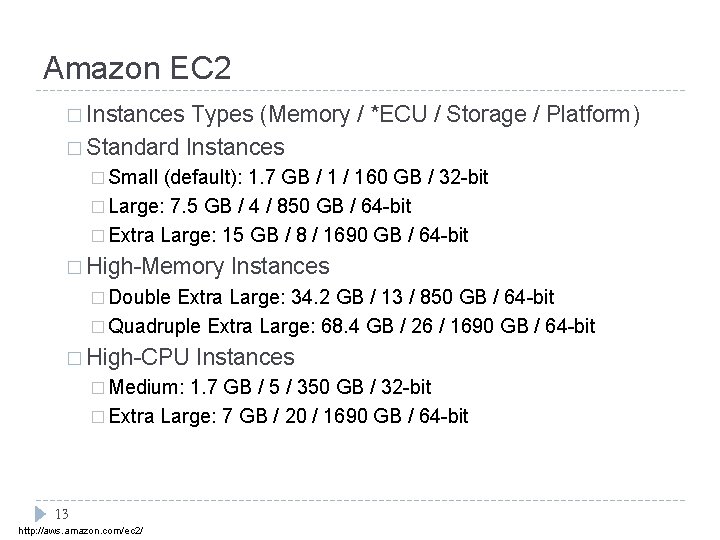
Amazon EC 2 � Instances Types (Memory / *ECU / Storage / Platform) � Standard Instances � Small (default): 1. 7 GB / 160 GB / 32 -bit � Large: 7. 5 GB / 4 / 850 GB / 64 -bit � Extra Large: 15 GB / 8 / 1690 GB / 64 -bit � High-Memory Instances � Double Extra Large: 34. 2 GB / 13 / 850 GB / 64 -bit � Quadruple Extra Large: 68. 4 GB / 26 / 1690 GB / 64 -bit � High-CPU � Medium: Instances 1. 7 GB / 5 / 350 GB / 32 -bit � Extra Large: 7 GB / 20 / 1690 GB / 64 -bit 13 http: //aws. amazon. com/ec 2/
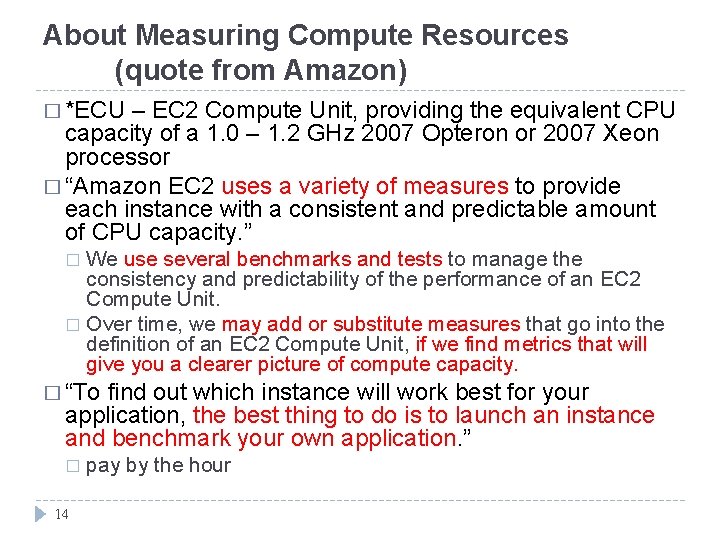
About Measuring Compute Resources (quote from Amazon) � *ECU – EC 2 Compute Unit, providing the equivalent CPU capacity of a 1. 0 – 1. 2 GHz 2007 Opteron or 2007 Xeon processor � “Amazon EC 2 uses a variety of measures to provide each instance with a consistent and predictable amount of CPU capacity. ” We use several benchmarks and tests to manage the consistency and predictability of the performance of an EC 2 Compute Unit. � Over time, we may add or substitute measures that go into the definition of an EC 2 Compute Unit, if we find metrics that will give you a clearer picture of compute capacity. � � “To find out which instance will work best for your application, the best thing to do is to launch an instance and benchmark your own application. ” � 14 pay by the hour
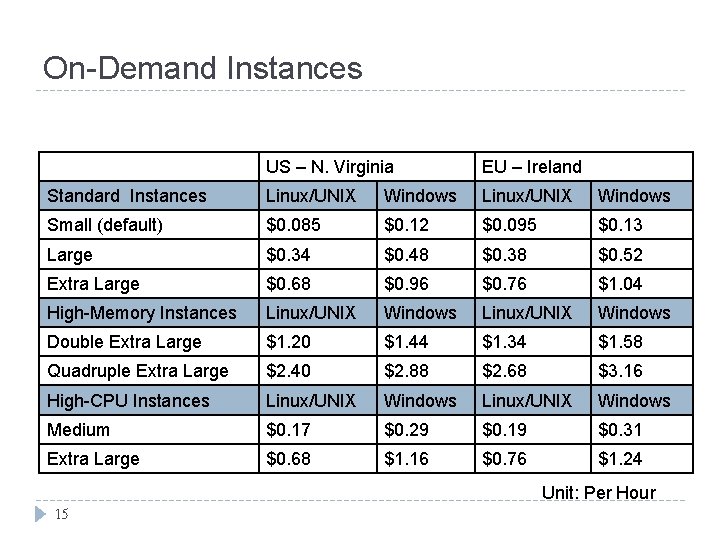
On-Demand Instances US – N. Virginia EU – Ireland Standard Instances Linux/UNIX Windows Small (default) $0. 085 $0. 12 $0. 095 $0. 13 Large $0. 34 $0. 48 $0. 38 $0. 52 Extra Large $0. 68 $0. 96 $0. 76 $1. 04 High-Memory Instances Linux/UNIX Windows Double Extra Large $1. 20 $1. 44 $1. 34 $1. 58 Quadruple Extra Large $2. 40 $2. 88 $2. 68 $3. 16 High-CPU Instances Linux/UNIX Windows Medium $0. 17 $0. 29 $0. 19 $0. 31 Extra Large $0. 68 $1. 16 $0. 76 $1. 24 Unit: Per Hour 15
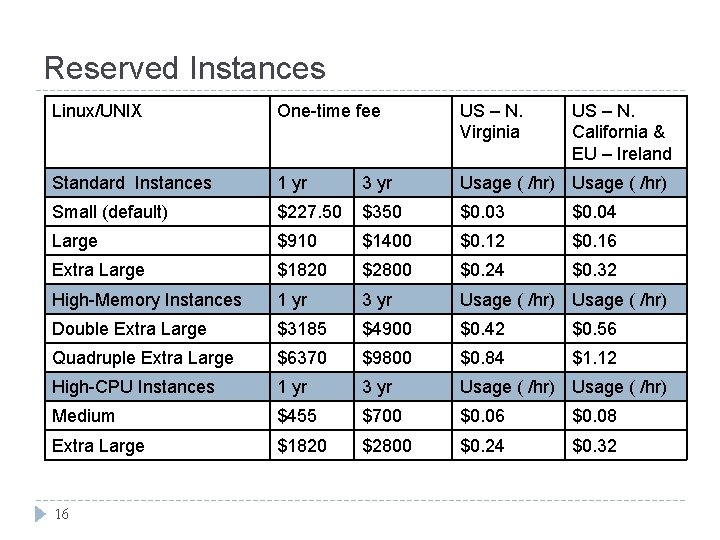
Reserved Instances Linux/UNIX One-time fee US – N. Virginia Standard Instances 1 yr 3 yr Usage ( /hr) Small (default) $227. 50 $350 $0. 03 $0. 04 Large $910 $1400 $0. 12 $0. 16 Extra Large $1820 $2800 $0. 24 $0. 32 High-Memory Instances 1 yr 3 yr Usage ( /hr) Double Extra Large $3185 $4900 $0. 42 $0. 56 Quadruple Extra Large $6370 $9800 $0. 84 $1. 12 High-CPU Instances 1 yr 3 yr Usage ( /hr) Medium $455 $700 $0. 06 $0. 08 Extra Large $1820 $2800 $0. 24 $0. 32 16 US – N. California & EU – Ireland
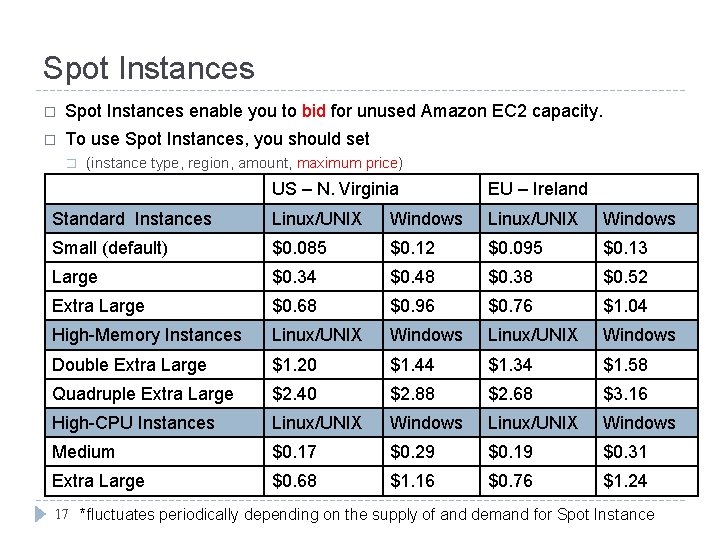
Spot Instances � Spot Instances enable you to bid for unused Amazon EC 2 capacity. � To use Spot Instances, you should set � (instance type, region, amount, maximum price) US – N. Virginia EU – Ireland Standard Instances Linux/UNIX Windows Small (default) $0. 085 $0. 12 $0. 095 $0. 13 Large $0. 34 $0. 48 $0. 38 $0. 52 Extra Large $0. 68 $0. 96 $0. 76 $1. 04 High-Memory Instances Linux/UNIX Windows Double Extra Large $1. 20 $1. 44 $1. 34 $1. 58 Quadruple Extra Large $2. 40 $2. 88 $2. 68 $3. 16 High-CPU Instances Linux/UNIX Windows Medium $0. 17 $0. 29 $0. 19 $0. 31 Extra Large $0. 68 $1. 16 $0. 76 $1. 24 17 *fluctuates periodically depending on the supply of and demand for Spot Instance
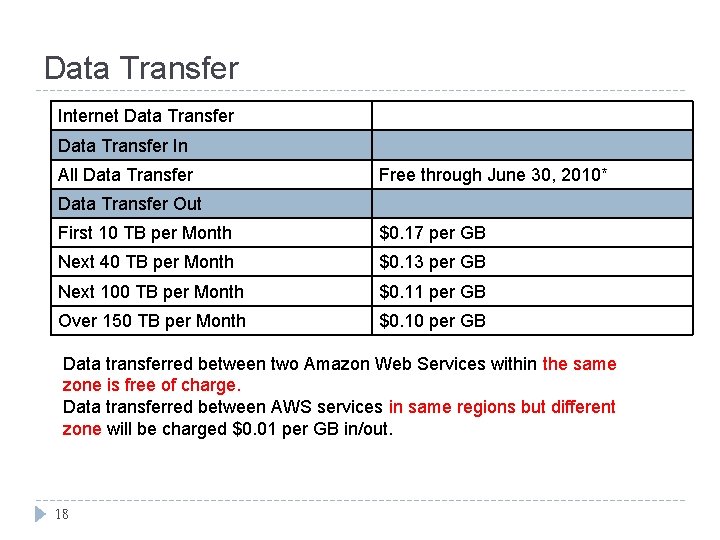
Data Transfer Internet Data Transfer In All Data Transfer Free through June 30, 2010* Data Transfer Out First 10 TB per Month $0. 17 per GB Next 40 TB per Month $0. 13 per GB Next 100 TB per Month $0. 11 per GB Over 150 TB per Month $0. 10 per GB Data transferred between two Amazon Web Services within the same zone is free of charge. Data transferred between AWS services in same regions but different zone will be charged $0. 01 per GB in/out. 18
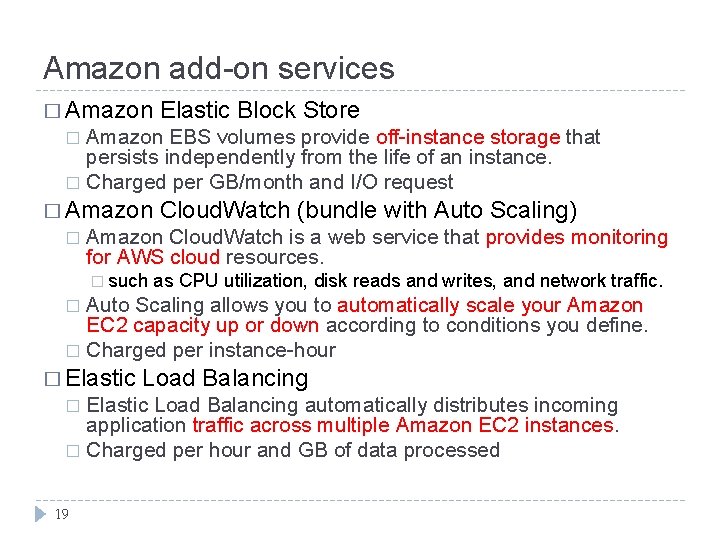
Amazon add-on services � Amazon Elastic Block Store Amazon EBS volumes provide off-instance storage that persists independently from the life of an instance. � Charged per GB/month and I/O request � � Amazon � Cloud. Watch (bundle with Auto Scaling) Amazon Cloud. Watch is a web service that provides monitoring for AWS cloud resources. � such as CPU utilization, disk reads and writes, and network traffic. Auto Scaling allows you to automatically scale your Amazon EC 2 capacity up or down according to conditions you define. � Charged per instance-hour � � Elastic Load Balancing automatically distributes incoming application traffic across multiple Amazon EC 2 instances. � Charged per hour and GB of data processed � 19
Google App Engine 20
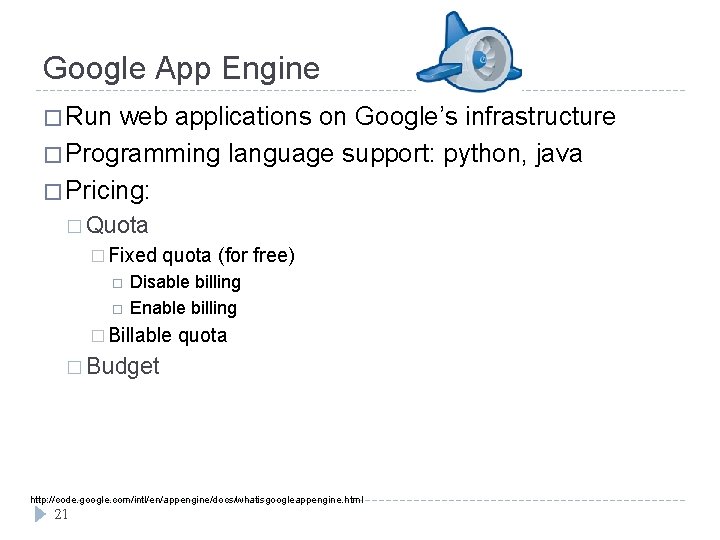
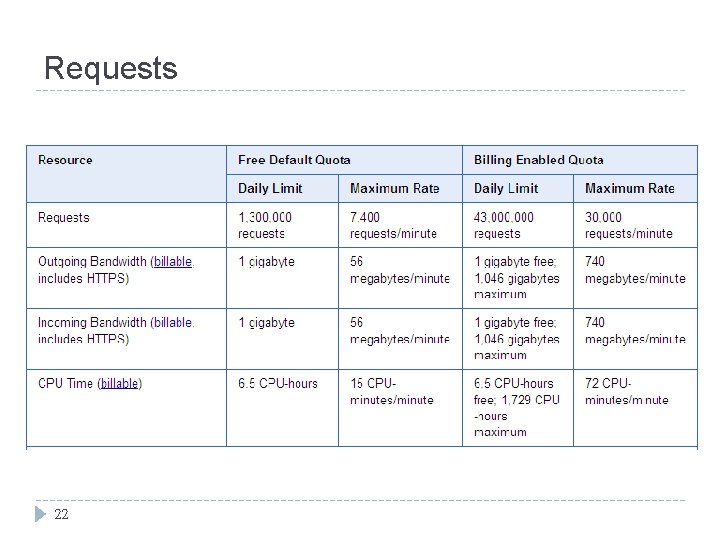
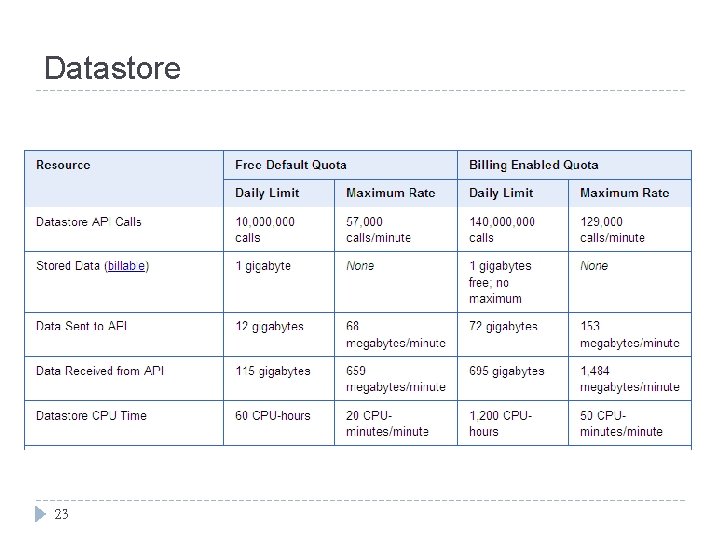
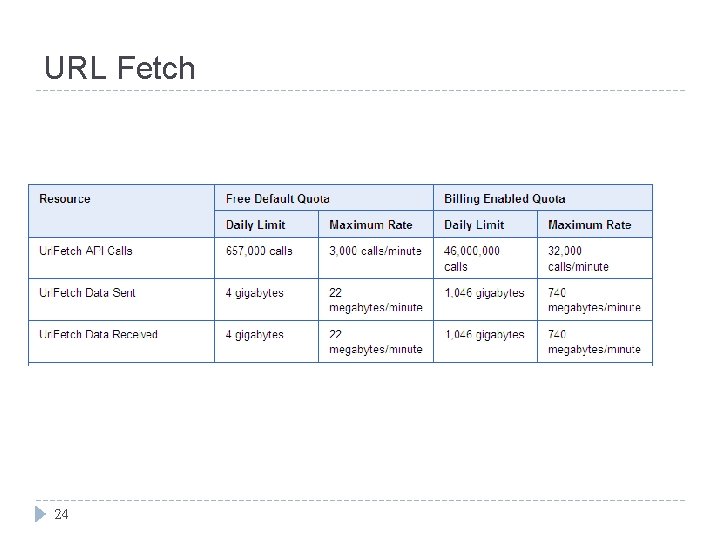
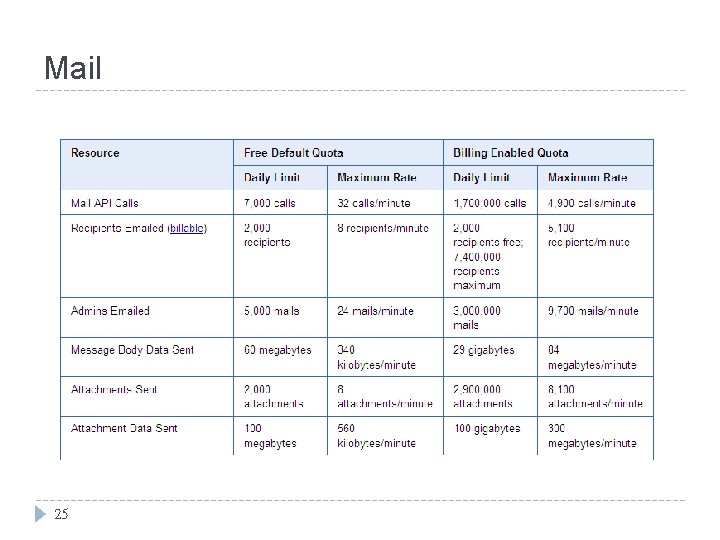
Google App Engine � Run web applications on Google’s infrastructure � Programming language support: python, java � Pricing: � Quota � Fixed quota (for free) Disable billing Enable billing � Billable quota � Budget http: //code. google. com/intl/en/appengine/docs/whatisgoogleappengine. html 21
Requests 22
Datastore 23
URL Fetch 24
Mail 25
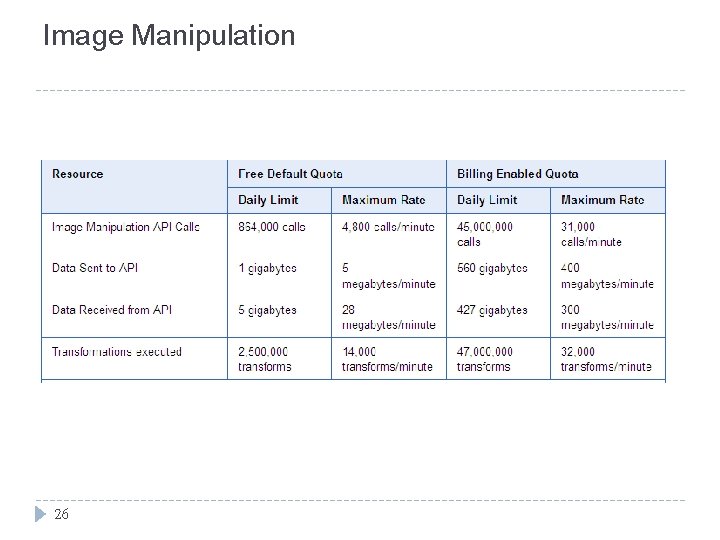
Image Manipulation 26
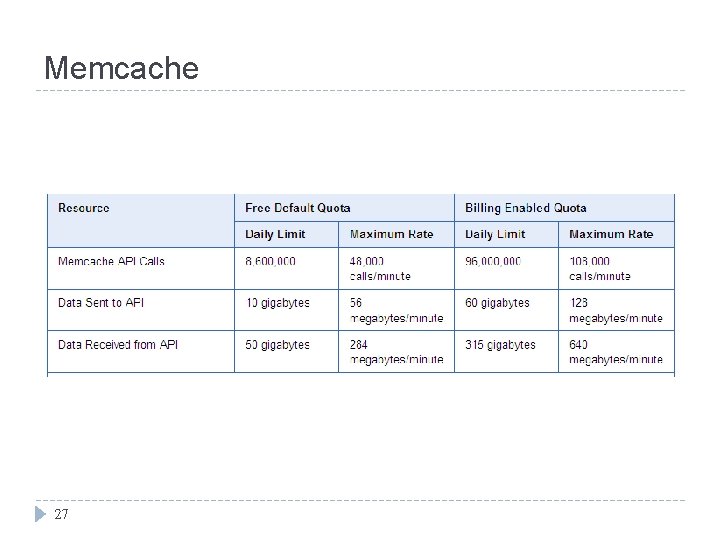
Memcache 27
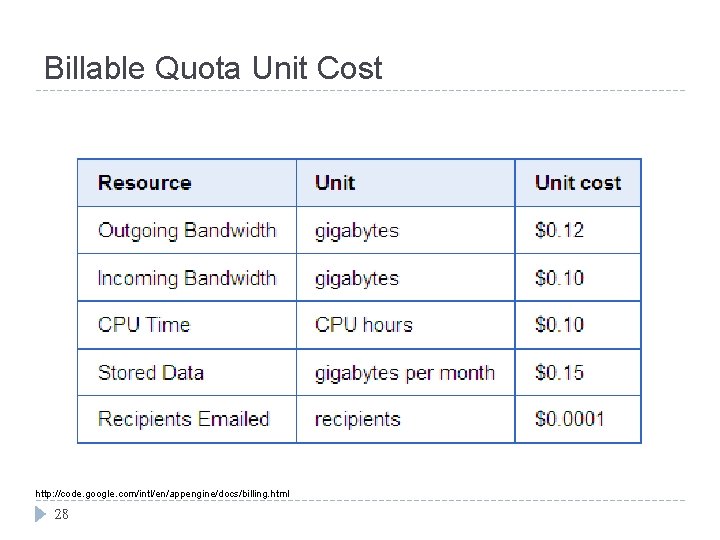
Billable Quota Unit Cost http: //code. google. com/intl/en/appengine/docs/billing. html 28
Microsoft Windows Azure 29
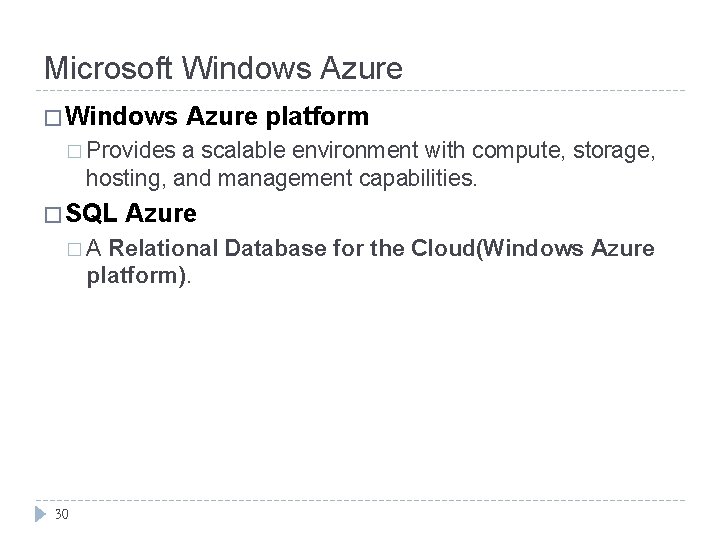
Microsoft Windows Azure � Windows Azure platform � Provides a scalable environment with compute, storage, hosting, and management capabilities. � SQL �A Azure Relational Database for the Cloud(Windows Azure platform). 30
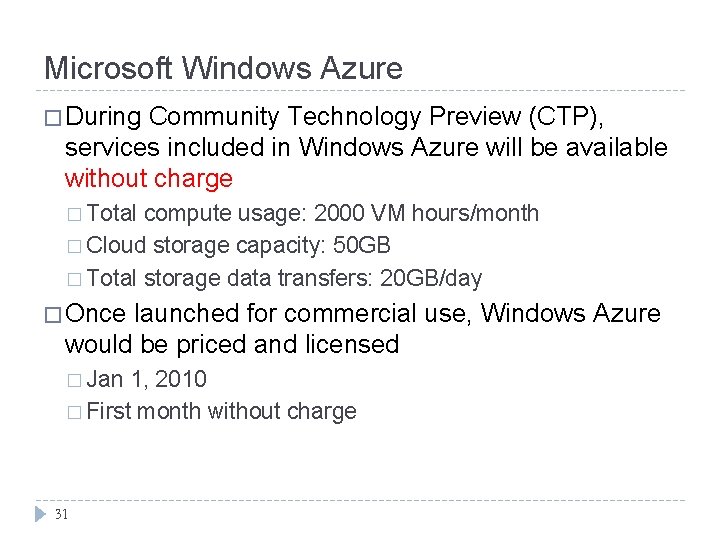
Microsoft Windows Azure � During Community Technology Preview (CTP), services included in Windows Azure will be available without charge � Total compute usage: 2000 VM hours/month � Cloud storage capacity: 50 GB � Total storage data transfers: 20 GB/day � Once launched for commercial use, Windows Azure would be priced and licensed � Jan 1, 2010 � First month without charge 31
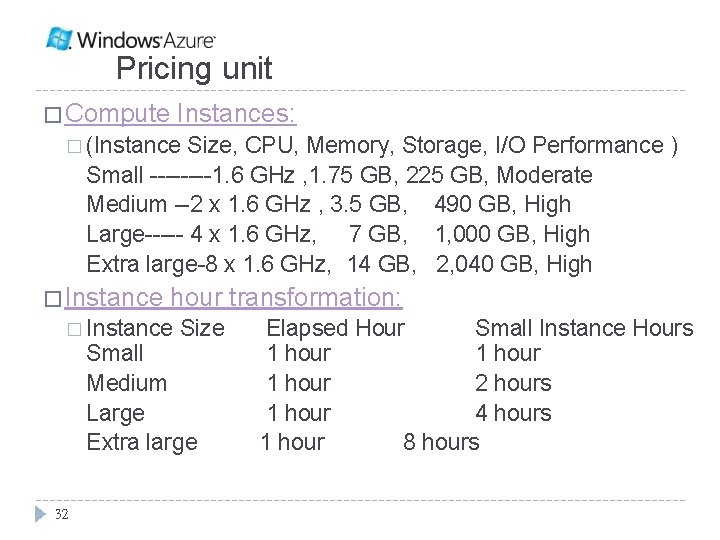
Pricing unit � Compute Instances: � (Instance Size, CPU, Memory, Storage, I/O Performance ) Small ----1. 6 GHz , 1. 75 GB, 225 GB, Moderate Medium --2 x 1. 6 GHz , 3. 5 GB, 490 GB, High Large----- 4 x 1. 6 GHz, 7 GB, 1, 000 GB, High Extra large-8 x 1. 6 GHz, 14 GB, 2, 040 GB, High � Instance hour transformation: � Instance Size Small Medium Large Extra large 32 Elapsed Hour Small Instance Hours 1 hour 2 hours 1 hour 4 hours 1 hour 8 hours
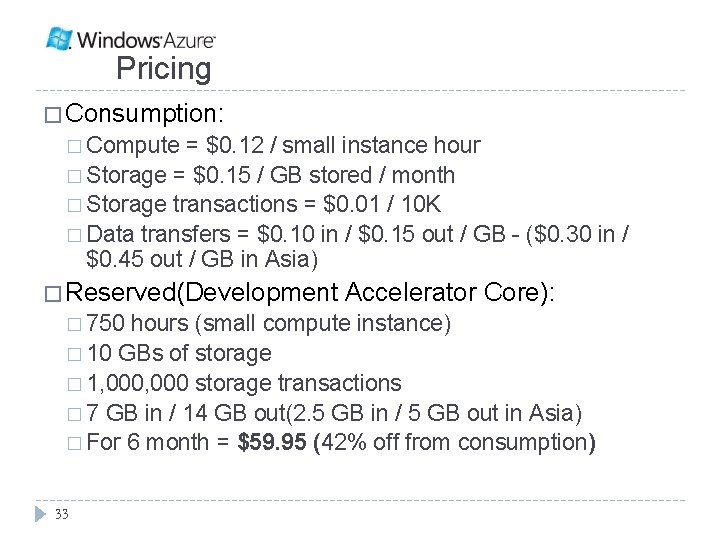
Pricing � Consumption: � Compute = $0. 12 / small instance hour � Storage = $0. 15 / GB stored / month � Storage transactions = $0. 01 / 10 K � Data transfers = $0. 10 in / $0. 15 out / GB - ($0. 30 in / $0. 45 out / GB in Asia) � Reserved(Development � 750 Accelerator Core): hours (small compute instance) � 10 GBs of storage � 1, 000 storage transactions � 7 GB in / 14 GB out(2. 5 GB in / 5 GB out in Asia) � For 6 month = $59. 95 (42% off from consumption) 33
Pricing � Web Edition: Up to 1 GB relational database = $9. 99 / month � Business Edition: Up to 10 GB relational database = $99. 99 / month � Data transfers = $0. 10 in / $0. 15 out / GB - ($0. 30 in / $0. 45 out / GB in Asia) 34
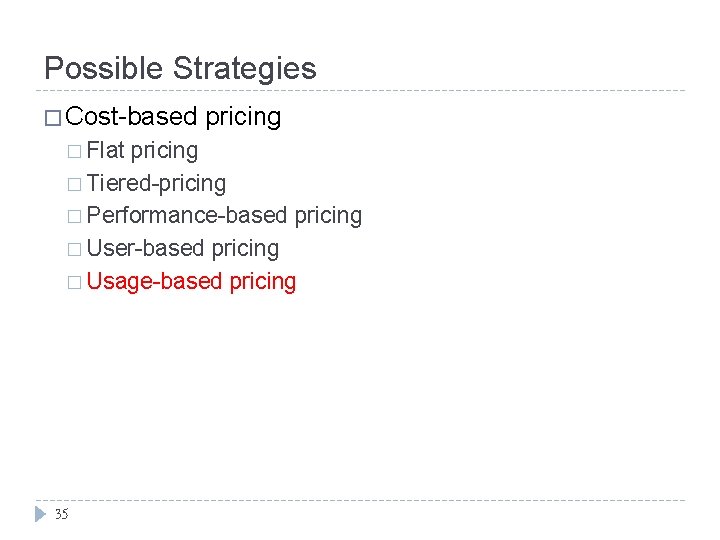
Possible Strategies � Cost-based � Flat pricing � Tiered-pricing � Performance-based pricing � User-based pricing � Usage-based pricing 35
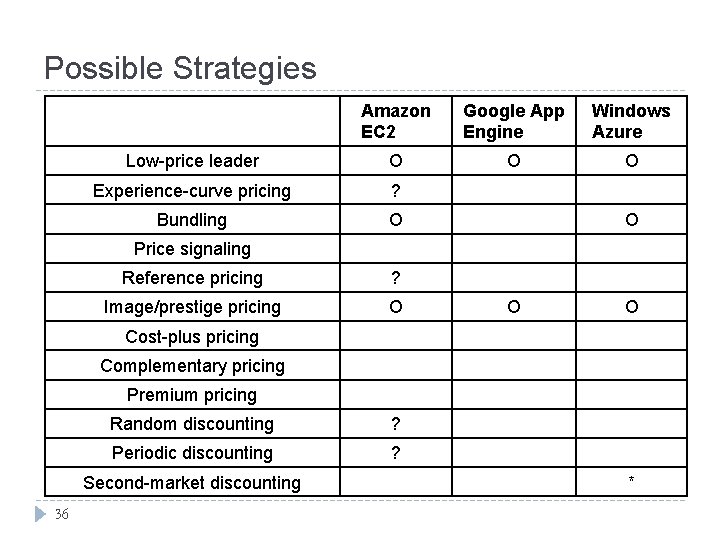
Possible Strategies Amazon EC 2 Google App Engine Windows Azure Low-price leader O O O Experience-curve pricing ? Bundling O O Price signaling Reference pricing ? Image/prestige pricing O O O Cost-plus pricing Complementary pricing Premium pricing Random discounting ? Periodic discounting ? Second-market discounting 36 *
Possible Strategies � Other effects � Similar 37 prices (competing situation? )
Conclusion&Comments � In this paper, we have proposed architecture for market-oriented allocation of resources within Clouds. � We have discussed some representative platforms for Cloud computing covering the state-of-the-art. � Comments: � This paper has a simple but clear architecture that we can use. (need add something detail) � Some of the information of the cloud platform are out of date, but the comparison is good. 38