
Marketled explanation for successful industrial development Marketled development
- Slides: 5
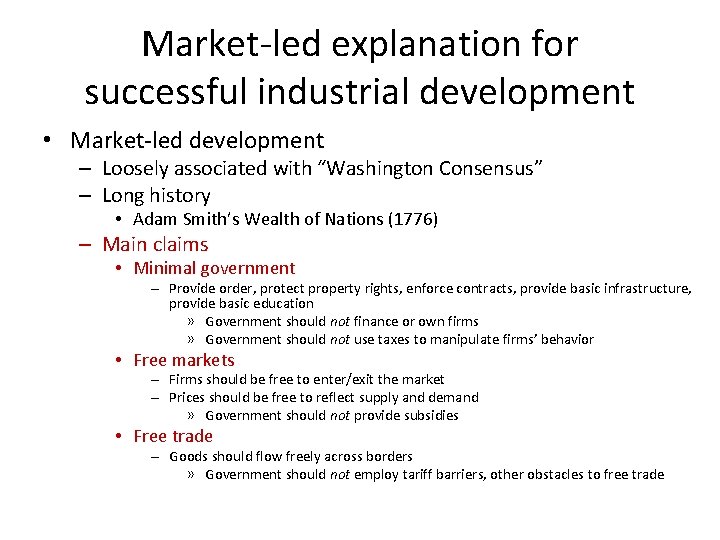
Market-led explanation for successful industrial development • Market-led development – Loosely associated with “Washington Consensus” – Long history • Adam Smith’s Wealth of Nations (1776) – Main claims • Minimal government – Provide order, protect property rights, enforce contracts, provide basic infrastructure, provide basic education » Government should not finance or own firms » Government should not use taxes to manipulate firms’ behavior • Free markets – Firms should be free to enter/exit the market – Prices should be free to reflect supply and demand » Government should not provide subsidies • Free trade – Goods should flow freely across borders » Government should not employ tariff barriers, other obstacles to free trade
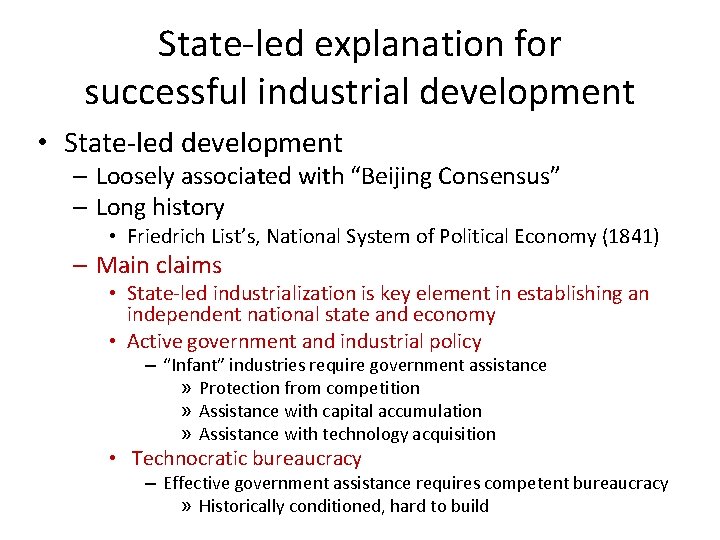
State-led explanation for successful industrial development • State-led development – Loosely associated with “Beijing Consensus” – Long history • Friedrich List’s, National System of Political Economy (1841) – Main claims • State-led industrialization is key element in establishing an independent national state and economy • Active government and industrial policy – “Infant” industries require government assistance » Protection from competition » Assistance with capital accumulation » Assistance with technology acquisition • Technocratic bureaucracy – Effective government assistance requires competent bureaucracy » Historically conditioned, hard to build
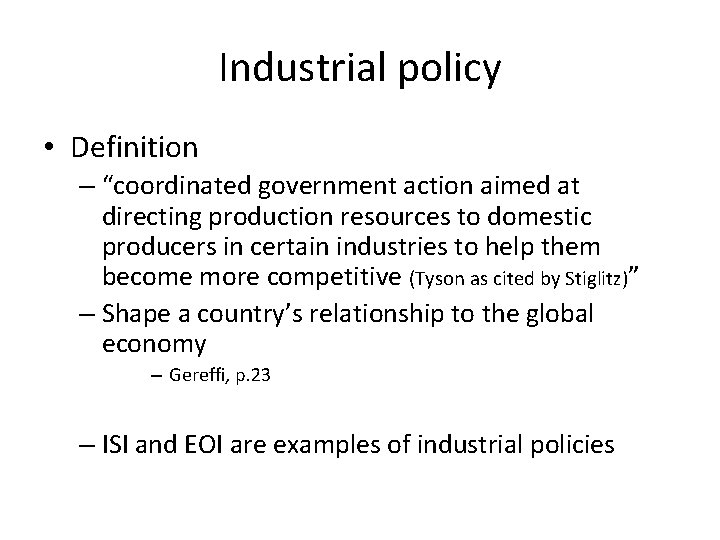
Industrial policy • Definition – “coordinated government action aimed at directing production resources to domestic producers in certain industries to help them become more competitive (Tyson as cited by Stiglitz)” – Shape a country’s relationship to the global economy – Gereffi, p. 23 – ISI and EOI are examples of industrial policies
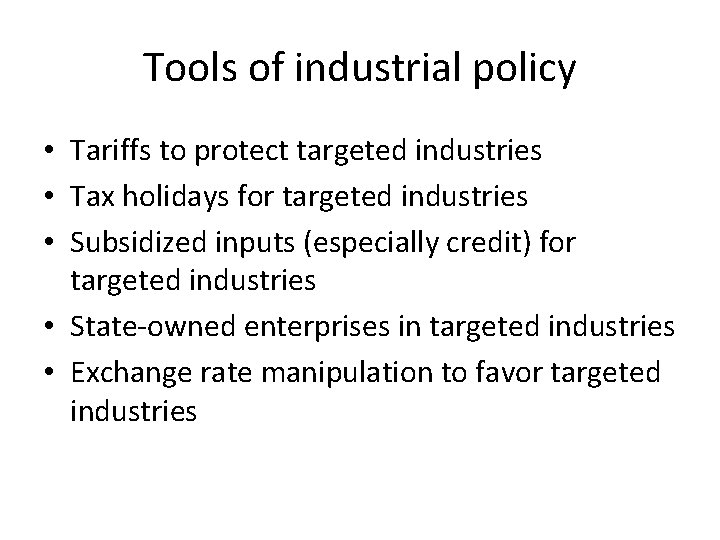
Tools of industrial policy • Tariffs to protect targeted industries • Tax holidays for targeted industries • Subsidized inputs (especially credit) for targeted industries • State-owned enterprises in targeted industries • Exchange rate manipulation to favor targeted industries
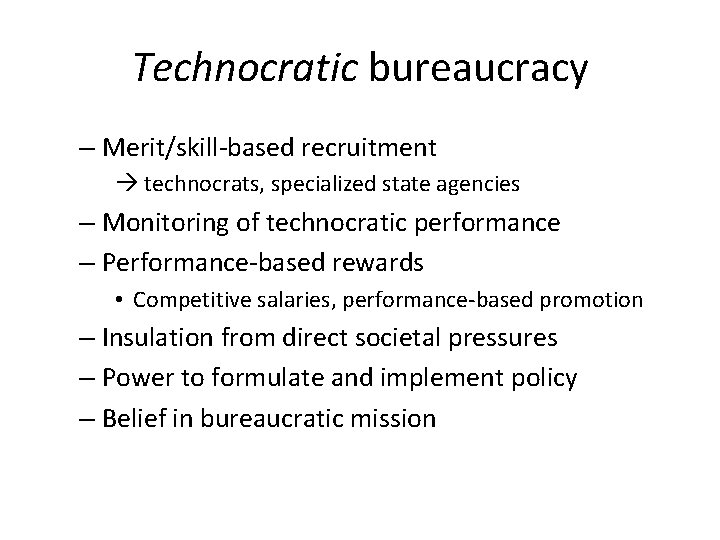
Technocratic bureaucracy – Merit/skill-based recruitment technocrats, specialized state agencies – Monitoring of technocratic performance – Performance-based rewards • Competitive salaries, performance-based promotion – Insulation from direct societal pressures – Power to formulate and implement policy – Belief in bureaucratic mission