
Marketing Unit 4 Basics of Marketing To market
Marketing Unit 4
Basics of Marketing • To market a product successfully, a company has to understand what people want to buy and why they want to buy it. • Market-a group of customers who share common wants and needs. • Marketing-the process of creating, promoting, and presenting a product or service to meet the wants and needs of consumers.
The Functions of Marketing • 7 functions – Distribution-process of getting goods and services to customers (purchasing, stock handling, inventory control, and physical distribution). – Financing —getting the money that is necessary for setting up and running a business
The Functions of Marketing – Marketing Information Managementgathering and analyzing information about consumers, trends, and competitors’ products. – Pricing —deciding how much to charge for a product or service so the business can make a profit. – Product/Service Management— obtaining, developing, maintaining, and improving a product or product mix in response to market opportunities
The Functions of Marketing – Promotion —any effort to inform, persuade, or remind potential customers about a business’s products or services. – Selling —providing customers with the goods and services they choose to buy. • Companies use relationship marketing to build and maintain relationships with customers.
The Marketing Mix • Marketing mix—to determine the price of a product – There is a 5 th P in recent years (People)
The Marketing Mix • Product —Is there a demand for the product or service? Includes Brand Name, Packaging, Accessories of product/service need to appeal to people • Often businesses create a logo to give a visual identity to a company or brand. A logo is a symbol that companies often use in advertising, stationery and other business materials that allow people to easily recognize the brand its meaning – http : //www. wordgames. com/logo-quiz. html
The Marketing Mix • Place —how and where customers will buy product/service. – Channel of distribution—pathway to direct products to consumers • Direct distribution- goods/services sold from producer to customer • Indirect distribution- involves one or more intermediaries
The Marketing Mix • Price — to determine the price of a product – How much are customers willing to pay? – Is the price competitive with other products? – Can the company make a profit? – Break-even point is the point at which total revenues/sales equal total costs and expenses of developing and offering a product or service

The Marketing Mix • Promotion —involves making customers aware of the product. – Most important promotion is advertising
Marketing Research • Market Research—gathering and analysis of information on the size, location and makeup of a market. • Marketing Concept- determines the wants and needs of customers and providing them more efficiently and effectively than competitors.
Information About Consumers • Before a product is put on the market, marketers gather information about the people who make up the market. They analyze and label their markets by demographics. • Demographics are facts about the population. • Usually is done through surveys, sales figures, databases and census
Information About Consumers • After studying a market, firms can aim their product/service at a group of potential customers. • Target Marketing—focus on the people most likely to buy their goods/services. • Market segmentation—division of a market for a product into groups of customers who have the same needs and traits.
The Seven Steps of Product Development • Step 1: Generate Ideas – Workers get together and think of product/service ideas. This is called brainstorming. – Development department, market search staff and outside market researchers may be involved.
The Seven Steps of Product Development • Step 2: Screen Ideas – Team must evaluate each idea. How do these ideas fit the company’s mission and strategy ? – Does the new product compete with one the company’s existing products? – Responses from consumers are crucial.
The Seven Steps of Product Development • Step 3: Develop a Business Plan – Once the creative ideas pass the screening process, one or two if the ideas are developed into a business plan. – The written proposal provides a look at the market. – This includes estimated sales, costs, profit potential, market trends and competing products
The Seven Steps of Product Development • Step 4: Develop the Product – If the company’s decision makers are in favor of the product, a prototype will be made. – A prototype is a model of the actual product. It is used to see what the new product will look like – It also tests how it can be made. – A company might experience delays in finalizing the product as it is tested.
The Seven Steps of Product Development • Step 5: Test-Market the Product – Once the product is fully developed, it should be test-marketed. – To test-market a product means to offer it in a limited market for a limited time. – The goal is to collect customers’ responses to see if the product is likely to be a success. – Testing may give a competitor time to produce a similar product.
The Seven Steps of Product Development • Step 6: Introduce the Product – When the product has passed the market test, it is ready for the marketplace. – A publicity campaign introduces the product. – The costs of launching a new product are often high. – The company has a short period of time in the market before competitors start to develop similar products.
The Seven Steps of Product Development • Step 7: Evaluate Customer Acceptance – One the product is introduced, marketers track customers and their responses to it. Their reports answer key questions that can be used in the company’s research and development plans. – Who are the best customers? – What new products are they buying? – How often do customers buy the new product?
Review • Go to Kahoot • https: //play. kahoot. it/#/k/89338303 d 0 a 2 -476 a-af 32 -10 b 1635 a 4728
Advertising
Why do businesses advertise? • Advertising—the public promotion of something such as a product, service, business, or event, to attract or increase interest in it. • Advertisers use humor, creativity, style, and originality to create an image for their products and services.
Types of Media • A medium is a channel or system of communication. • TV is a medium. • Media —are members of the mass media • Mass media are channels of communication, such as TV, radio and newspapers • Advertisements are delivered to consumers through mass media
Types of Media • At your desk, you and your partner must try and come up with all the types of media. I will give you a hint, there are 9 different types.
Types of Media: • • Newspapers Magazines TV Direct-Mail (letter’s, flyers, postcards, etc. ) • Radio • • Billboards Transit Jingles Online (Banners, pop-ups, etc. )
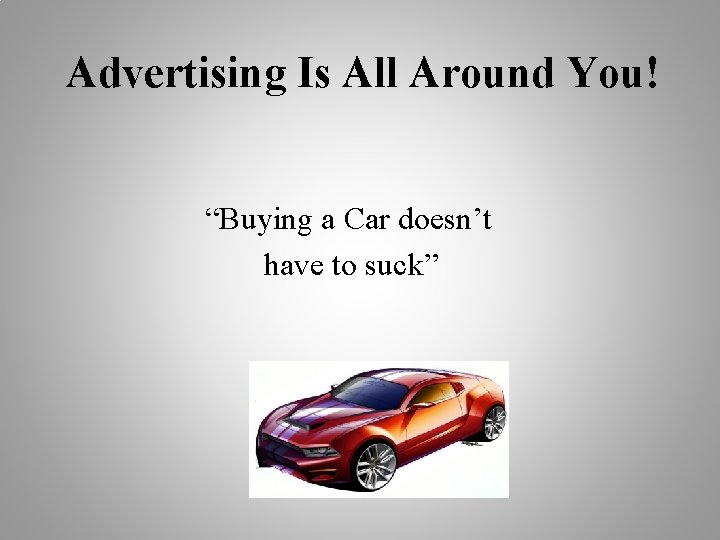
Advertising Is All Around You! “Buying a Car doesn’t have to suck”
What is persuasion? A means of convincing people: • to buy a certain product • to believe something or act in a certain way • to agree with a point of view

Video • http: //www. dailymotion. com/video/x 2 v mw 1 c
Common persuasive techniques often used in advertising • • • Slogan Repetition Bandwagon Testimonial Appeals to Emotion Expert Opinion Purpose?
Slogan: “Easy, Breezy, Beautiful… _______” A catchy phrase or statement often used to sell a service or a product
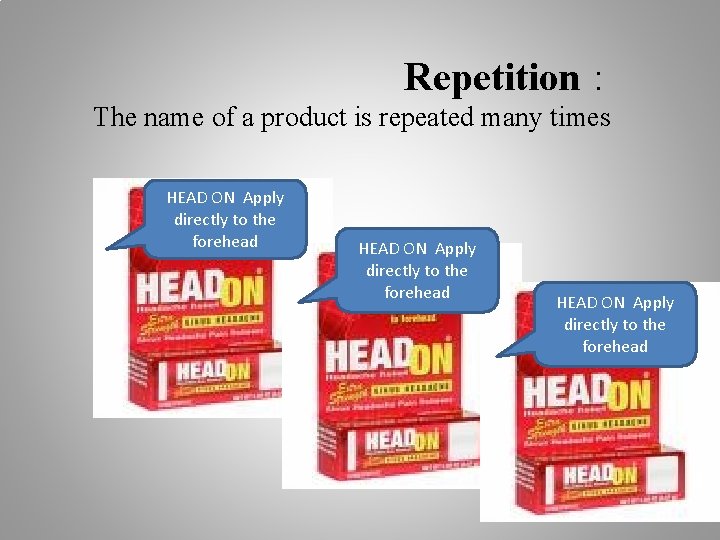
Repetition : The name of a product is repeated many times HEAD ON Apply directly to the forehead
Bandwagon A statement suggesting that everyone is using a specific product, so you should too

Testimonial A well-known person supports a product or service
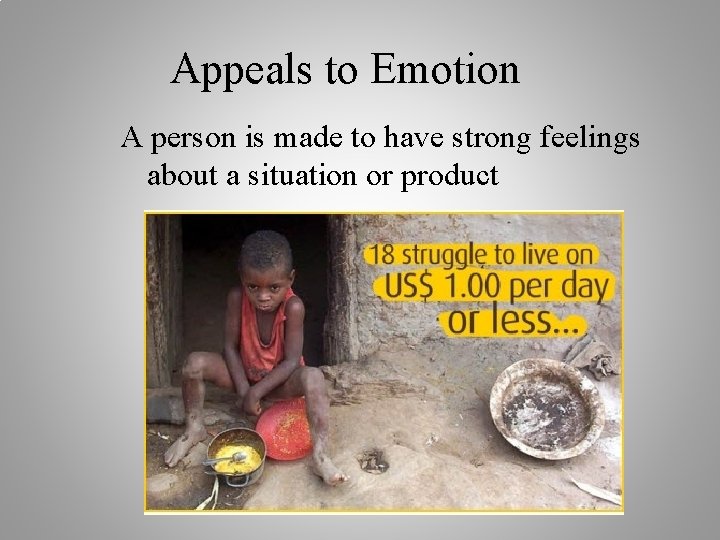
Appeals to Emotion A person is made to have strong feelings about a situation or product
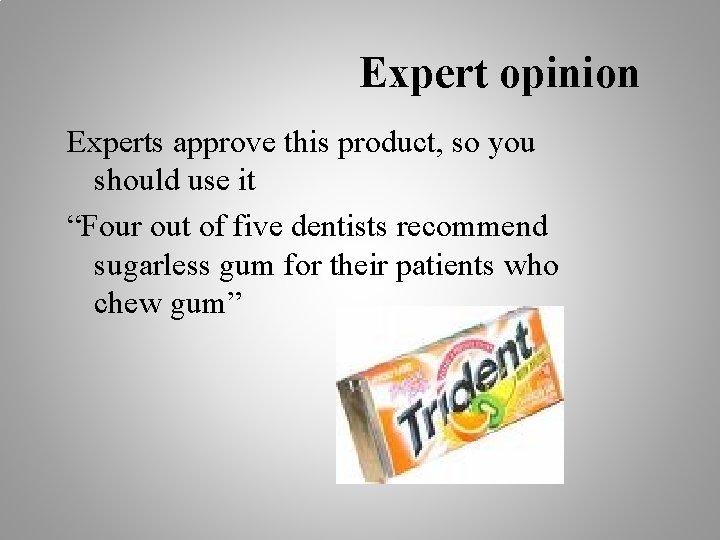
Expert opinion Experts approve this product, so you should use it “Four out of five dentists recommend sugarless gum for their patients who chew gum”
Quick review • • • Slogan Repetition Bandwagon Testimonial Emotional Appeal Expert Opinion
Audience Awareness Advertisers know how to • target their audiences (Called Target Market) • use appropriate persuasive technique

Who’s the audience?

Audience?
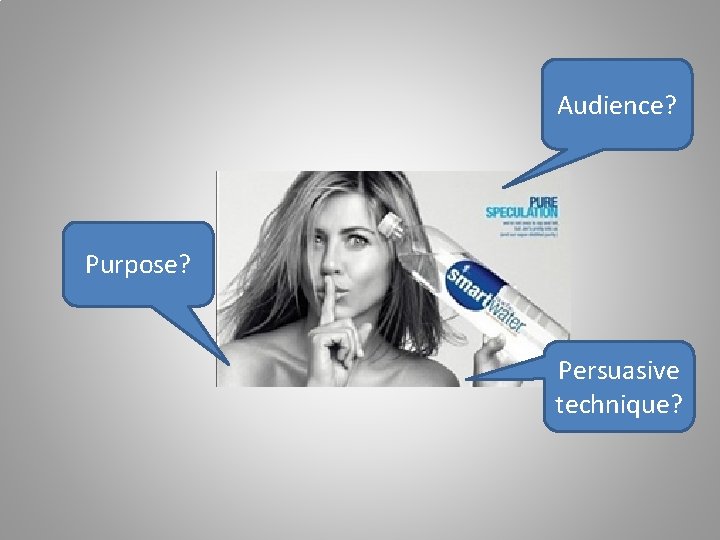
Audience? Purpose? Persuasive technique?
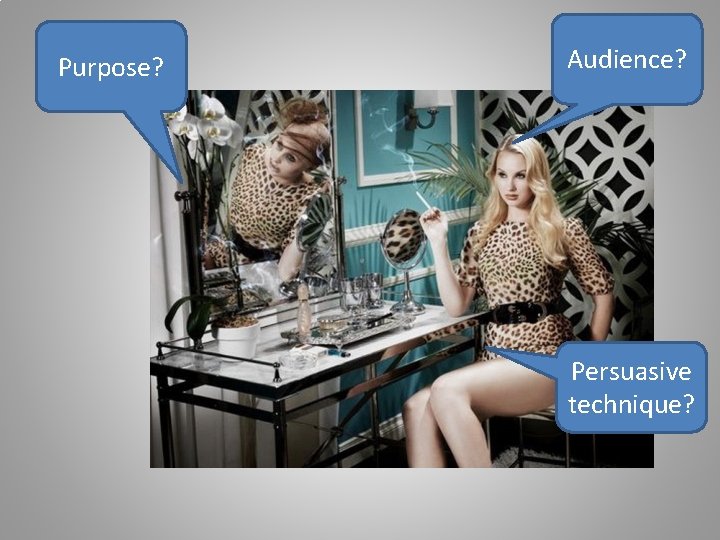
Purpose? Audience? Persuasive technique?

Audience?
Audience? Purpose?
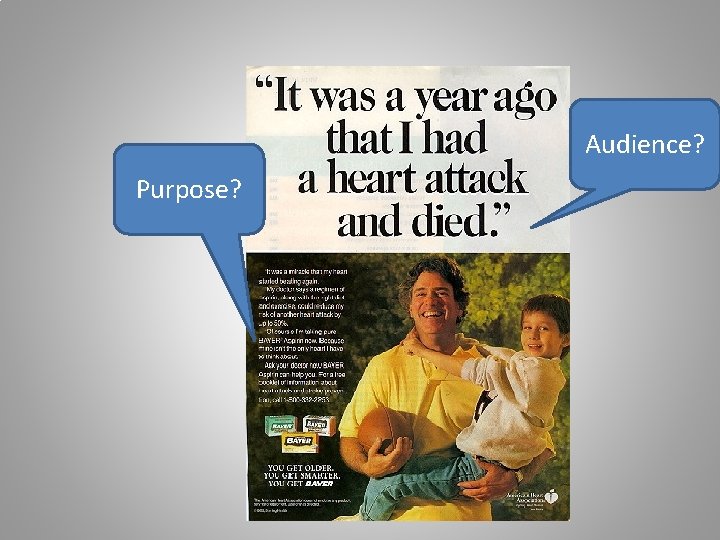
Audience? Purpose?
Relevant facts • Advertisers spend about $200 billion a year on TV advertising • The average cost for Super Bowl ads is $2. 6 million per 30 second spot • The average American watches about 24, 000 TV commercials a year http: //television-commercial. net/
Making Connections • What is your favorite jingle? • What slogan for a product do you find yourself saying? • What TV commercial has influenced you to make a purchase? • Since Michael Jordan shops at Kroger, does that mean we should too?
- Slides: 47