
Marketing of HighTechnology Products and Innovations Understanding HighTech
- Slides: 36
Marketing of High-Technology Products and Innovations Understanding High-Tech Customers
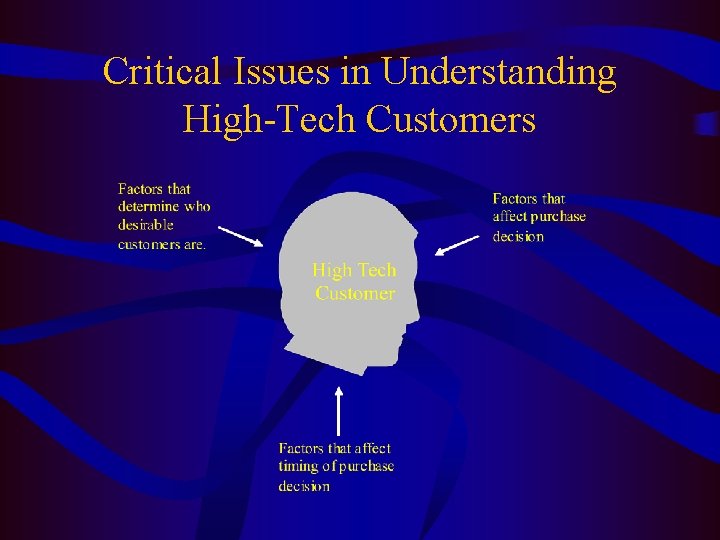
Critical Issues in Understanding High-Tech Customers
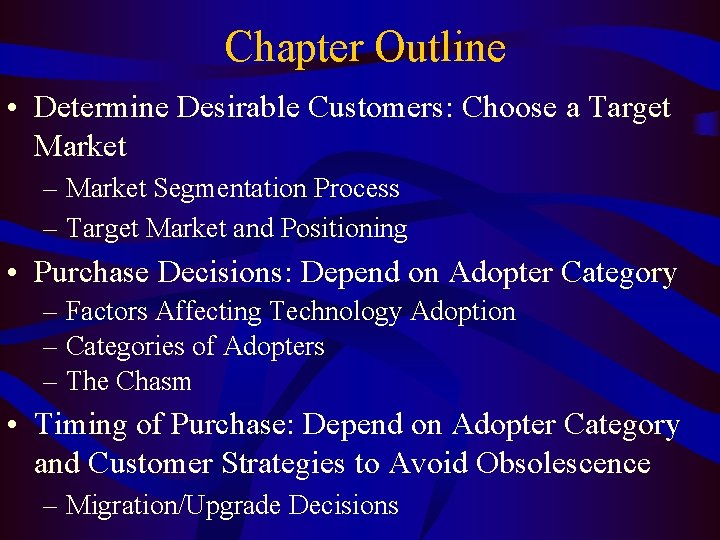
Chapter Outline • Determine Desirable Customers: Choose a Target Market – Market Segmentation Process – Target Market and Positioning • Purchase Decisions: Depend on Adopter Category – Factors Affecting Technology Adoption – Categories of Adopters – The Chasm • Timing of Purchase: Depend on Adopter Category and Customer Strategies to Avoid Obsolescence – Migration/Upgrade Decisions
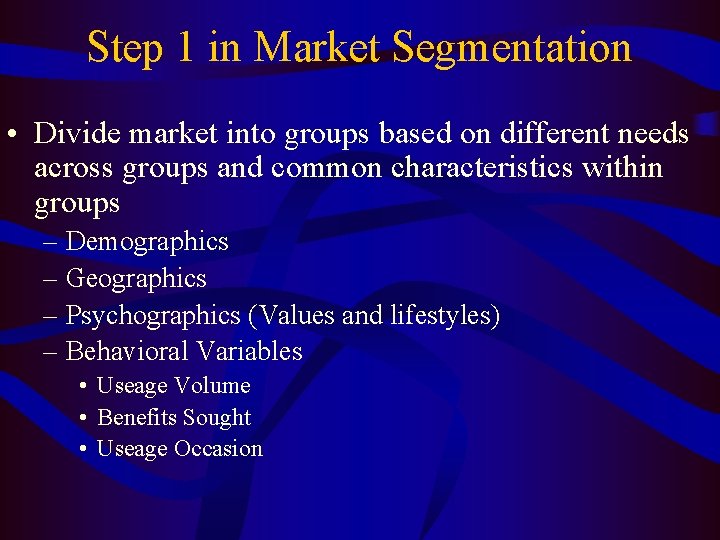
Step 1 in Market Segmentation • Divide market into groups based on different needs across groups and common characteristics within groups – Demographics – Geographics – Psychographics (Values and lifestyles) – Behavioral Variables • Useage Volume • Benefits Sought • Useage Occasion
Step 2 in Market Segmentation • Profile (describe) customers in each segment by specifying a typical customer in the segment.
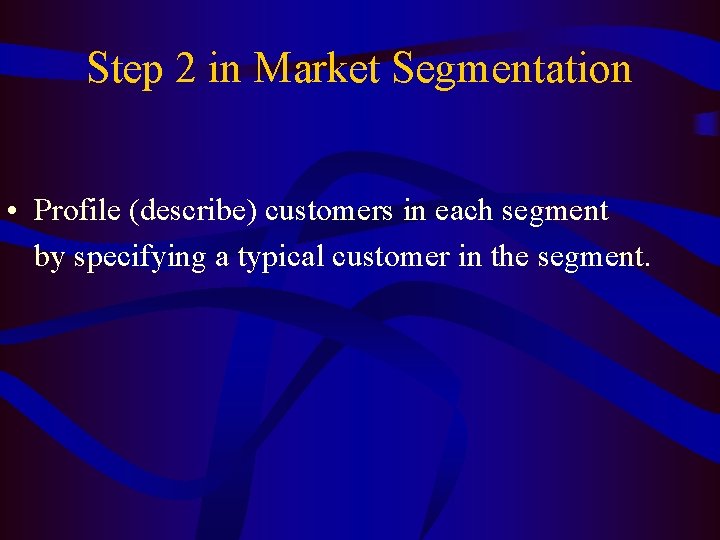
Examples of Tech Customer Segments: “Technographics”
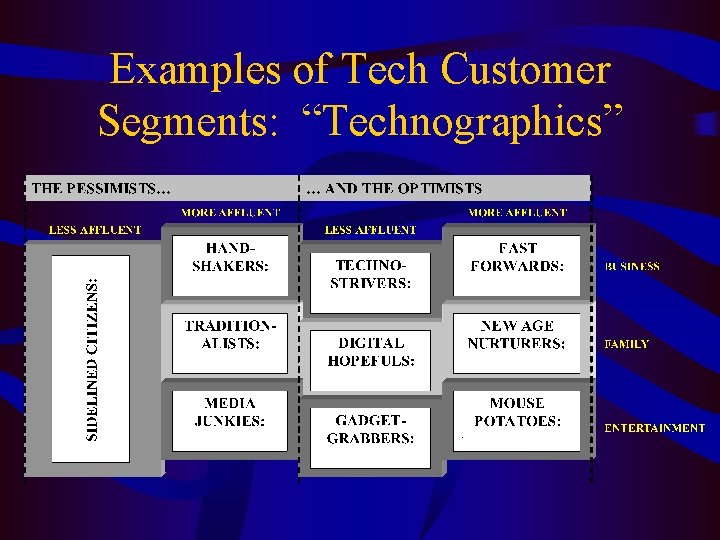
Examples of Tech Customer Segments: “Technographics” SIDELINED CITIZENS: Not interested in technology
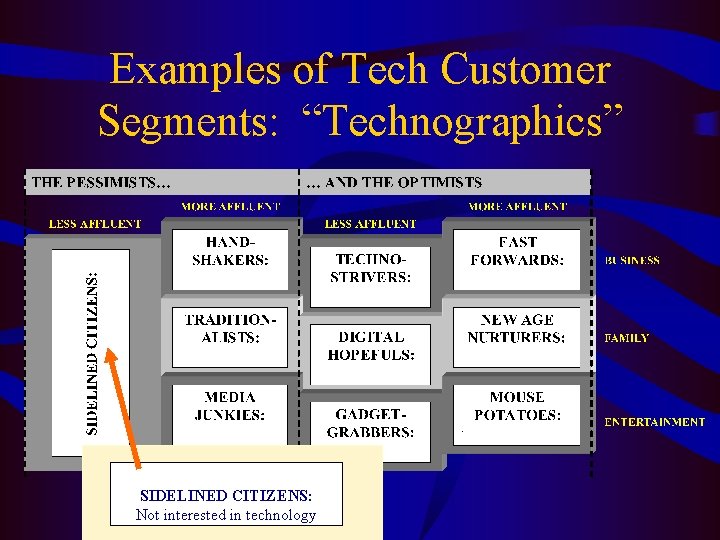
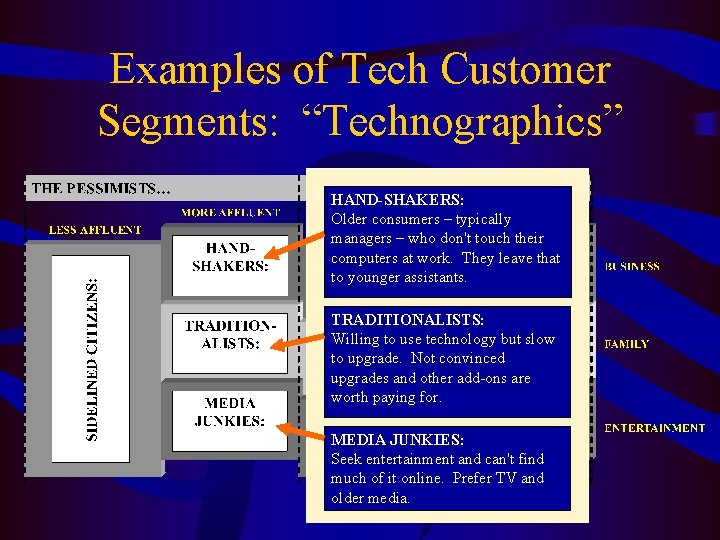
Examples of Tech Customer Segments: “Technographics” HAND-SHAKERS: Older consumers – typically managers – who don't touch their computers at work. They leave that to younger assistants. TRADITIONALISTS: Willing to use technology but slow to upgrade. Not convinced upgrades and other add-ons are worth paying for. MEDIA JUNKIES: Seek entertainment and can't find much of it online. Prefer TV and older media.
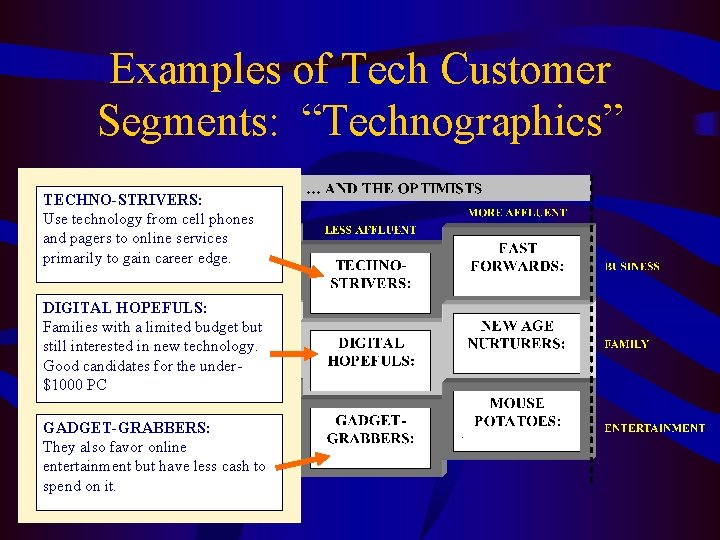
Examples of Tech Customer Segments: “Technographics” TECHNO-STRIVERS: Use technology from cell phones and pagers to online services primarily to gain career edge. DIGITAL HOPEFULS: Families with a limited budget but still interested in new technology. Good candidates for the under$1000 PC GADGET-GRABBERS: They also favor online entertainment but have less cash to spend on it.
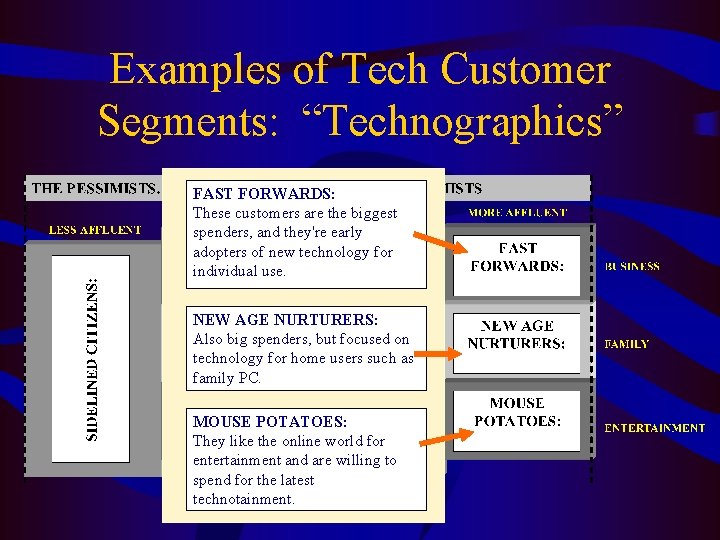
Examples of Tech Customer Segments: “Technographics” FAST FORWARDS: These customers are the biggest spenders, and they're early adopters of new technology for individual use. NEW AGE NURTURERS: Also big spenders, but focused on technology for home users such as family PC. MOUSE POTATOES: They like the online world for entertainment and are willing to spend for the latest technotainment.
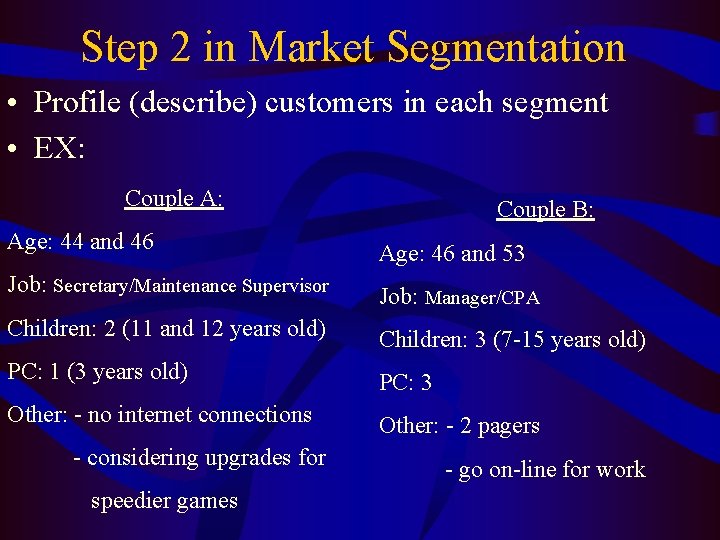
Step 2 in Market Segmentation • Profile (describe) customers in each segment • EX: Couple A: Couple B: Age: 44 and 46 Age: 46 and 53 Job: Secretary/Maintenance Supervisor Job: Manager/CPA Children: 2 (11 and 12 years old) Children: 3 (7 -15 years old) PC: 1 (3 years old) PC: 3 Other: - no internet connections Other: - 2 pagers - considering upgrades for speedier games - go on-line for work
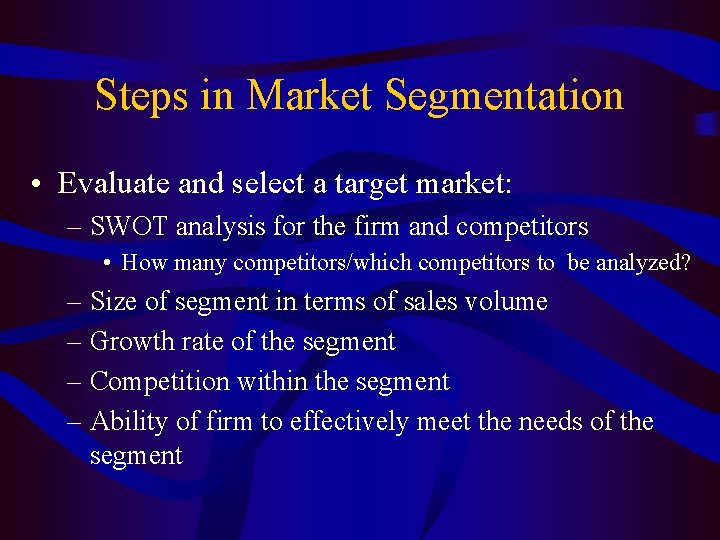
Steps in Market Segmentation • Evaluate and select a target market: – SWOT analysis for the firm and competitors • How many competitors/which competitors to be analyzed? – Size of segment in terms of sales volume – Growth rate of the segment – Competition within the segment – Ability of firm to effectively meet the needs of the segment
Beachhead • Must identify the best “beachhead” – A single target market from which to pursue the mainstream market (starting from the adjacent segments) • Focus on early market or mainstream? – Cannot afford to pursue many segments at once
Step 4 of Segmentation Process • Position the product within the segment – Positioning: the act of designing the company’s offering and image to occupy a distinctive place in the mind of the target market. • Consider customer perceptions (perceived benefit (value)/cost) • Position relative to perceived competition (a distinctive place) • Position on important, compelling attributes/benefits – Would the cost of creating such a product be much higher? – Would customers buy this product by paying a lot? – What is the solution in the trade-off of high quality vs. cost? • Strengthening/Grab unoccupied position/De-position and re-position/Exclusive Club
Factors Affecting Purchase Decision • Customer FUD: uncertain about the benefits and cost • Relative Advantage – Perceived benefit vs. cost • Compatibility – The extent to which adopting and using the innovation is based on existing ways of doing things • Complexity – The easier, the better/ interface (ex: on-line button, stat sw) • Ability to communicate product benefits (HDTV, CPU) • Observability – How easily the benefits be observed by current customers/other customers
Factors Affecting Purchase Decision • An example of Web TV: importance of communicating all unique benefits of a new product – Web TV: a web surfing device (a small box) for TVs – In 1996, internet was exploding/TV is everywhere – Traditional marketing: heavy advertising & dealer training – Problem: target customers didn’t understand the device – Solution: in 1997, an education initiative was launched; customers were explained the benefits of Internet and Web. TV – Result: Sales increase 7 times
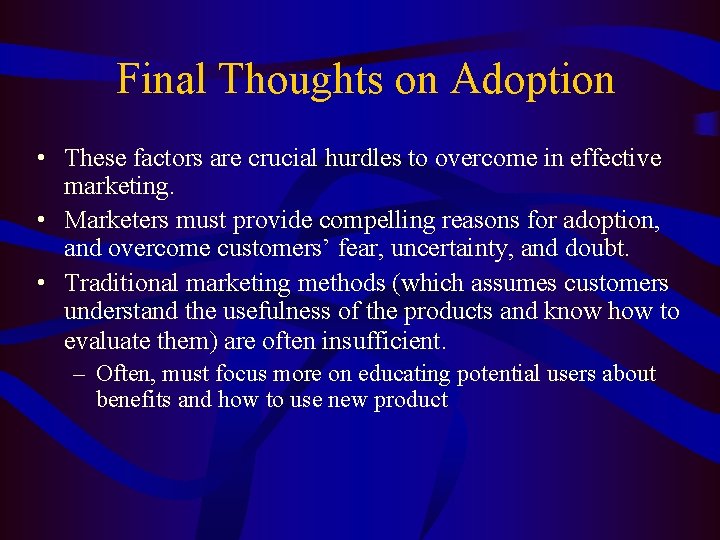
Final Thoughts on Adoption • These factors are crucial hurdles to overcome in effective marketing. • Marketers must provide compelling reasons for adoption, and overcome customers’ fear, uncertainty, and doubt. • Traditional marketing methods (which assumes customers understand the usefulness of the products and know how to evaluate them) are often insufficient. – Often, must focus more on educating potential users about benefits and how to use new product
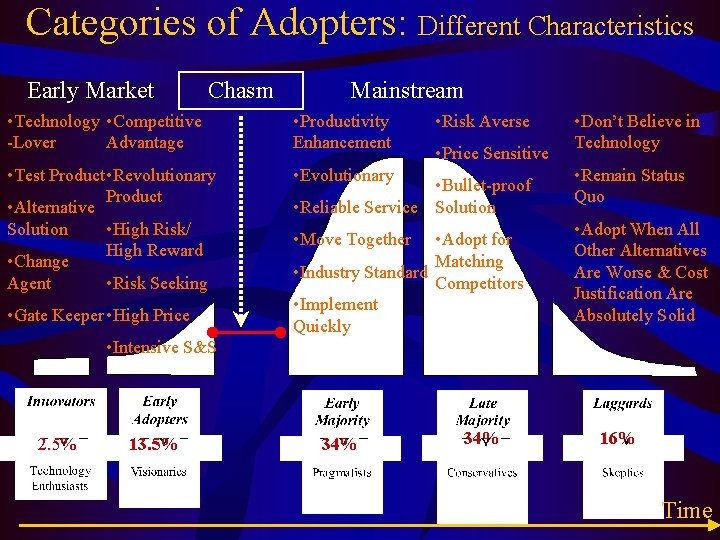
Categories of Adopters: Different Characteristics Early Market Chasm Mainstream • Technology • Competitive -Lover Advantage • Productivity Enhancement • Test Product • Revolutionary Product • Alternative Solution • High Risk/ High Reward • Change Agent • Risk Seeking • Evolutionary • Gate Keeper • High Price • Risk Averse • Price Sensitive • Bullet-proof • Reliable Service Solution • Adopt for Matching • Industry Standard Competitors • Implement Quickly • Move Together • Don’t Believe in Technology • Remain Status Quo • Adopt When All Other Alternatives Are Worse & Cost Justification Are Absolutely Solid • Intensive S&S 2. 5% 13. 5% 34% 16% Time
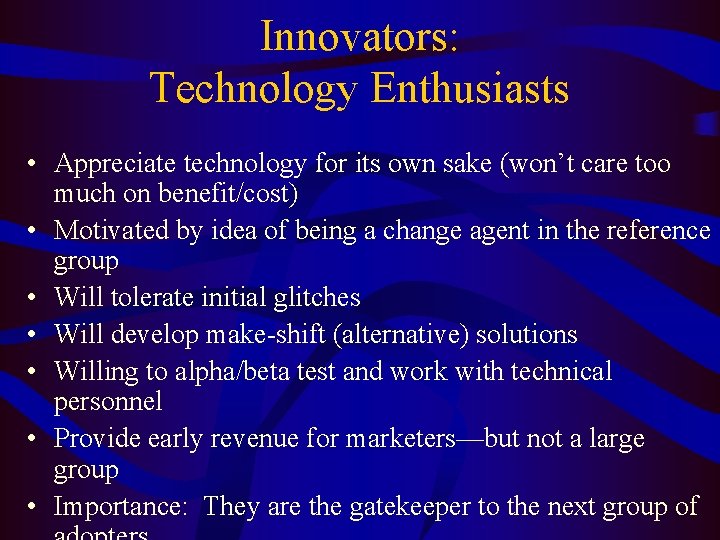
Innovators: Technology Enthusiasts • Appreciate technology for its own sake (won’t care too much on benefit/cost) • Motivated by idea of being a change agent in the reference group • Will tolerate initial glitches • Will develop make-shift (alternative) solutions • Willing to alpha/beta test and work with technical personnel • Provide early revenue for marketers—but not a large group • Importance: They are the gatekeeper to the next group of
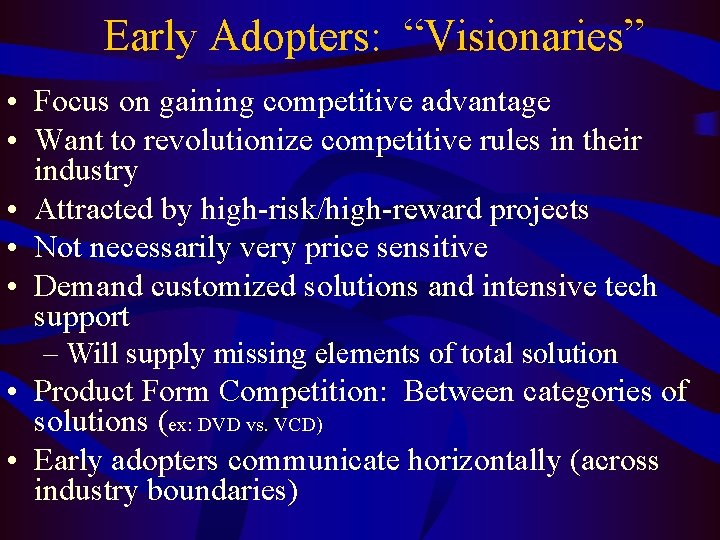
Early Adopters: “Visionaries” • Focus on gaining competitive advantage • Want to revolutionize competitive rules in their industry • Attracted by high-risk/high-reward projects • Not necessarily very price sensitive • Demand customized solutions and intensive tech support – Will supply missing elements of total solution • Product Form Competition: Between categories of solutions (ex: DVD vs. VCD) • Early adopters communicate horizontally (across industry boundaries)
Early Majority: “Pragmatists” • Comfortable with only evolutionary changes in business practices, in order to gain productivity enhancements • Averse to disruptions in their operations • Want proven applications, reliable service • Buy only with a reference from trusted colleague in same industry
Pragmatists (Cont. ) • This groups is the bulwark of the mainstream market: – They want to move together (herd mentality) – They want to pick the same technology solution (avoid risk) – Once they make a decision, they want to implement it quickly. • Requires industry standards
Late Majority: “Conservatives” • Risk averse, technology shy • Very price sensitive • Require completely pre-assembled, bullet-proof solutions • Motivated only by need to keep up with competitors in their industry • Rely on single, trusted advisor
Laggards: “Skeptics” • Want to maintain status quo (current condition) • Technology is a hindrance to operations • Buy only if all other alternatives worse and cost justification is absolutely solid
Target Innovators or the Early Majority? • Target the majority when: – Word of mouth effects are low – Consumer products industries (vs. b-to-b) – Low ratio of innovators to majority users (a lot more in majority category) – Profit margins decline slowly with time (still profitable in majority category) – Long time period for market acceptance (longer to cross chasm)
What is the “Chasm? ” • Gap between early market and mainstream market— – Visionaries vs. Pragmatists • Visionary market is saturated, but mainstream not yet ready to buy. • Marketing that was successful with visionaries simply is not effective with pragmatists – Intensive services vs. reliable products – Advanced technology vs. complete product package – Customized features vs. simplifying usage
Goal: Minimize time in the Chasm • Look to the new strategies necessary to reach the mainstream market • Pick a single target market with specific application • R&D must: – build interfaces to legacy systems – work with partners – ride the line between service and engineering
Crossing the Chasm Summary • The whole product is the critical success factor • Until a high-tech firm has established itself in the mainstream market, it has not proven itself. • To manage the mainstream market effectively, firm must work with partners in a disciplined fashion (that prioritizes partners so as to provide a “whole” product, including hardware, software, connection, and training, . . )
Factors Affecting Rate of Adoption: Customer Strategies to Avoid Obsolescence • Basic Issue: Tension between adopting newest generations of technology and obsoleting investments in prior generations. • Marketing implication: Firms must manage a migration path for customers to the new generation.
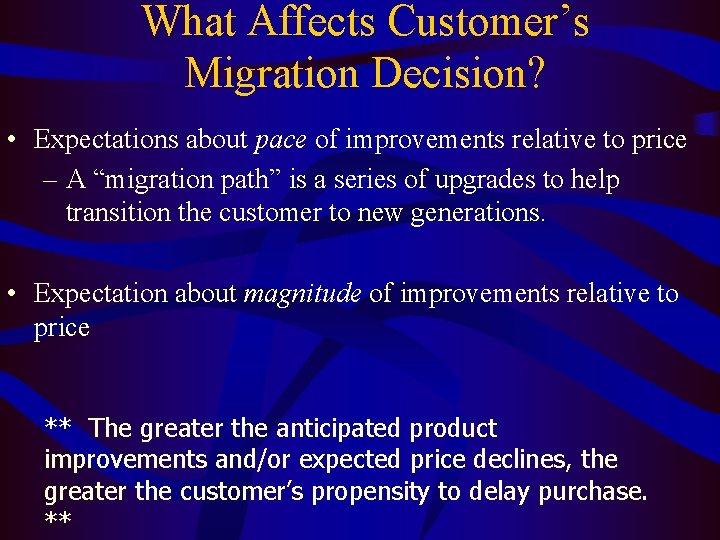
What Affects Customer’s Migration Decision? • Expectations about pace of improvements relative to price – A “migration path” is a series of upgrades to help transition the customer to new generations. • Expectation about magnitude of improvements relative to price ** The greater the anticipated product improvements and/or expected price declines, the greater the customer’s propensity to delay purchase. **
Implication: • High-tech firms must provide upgrades that allow firms to take advantage of new technology without scrapping investments in the prior generation.
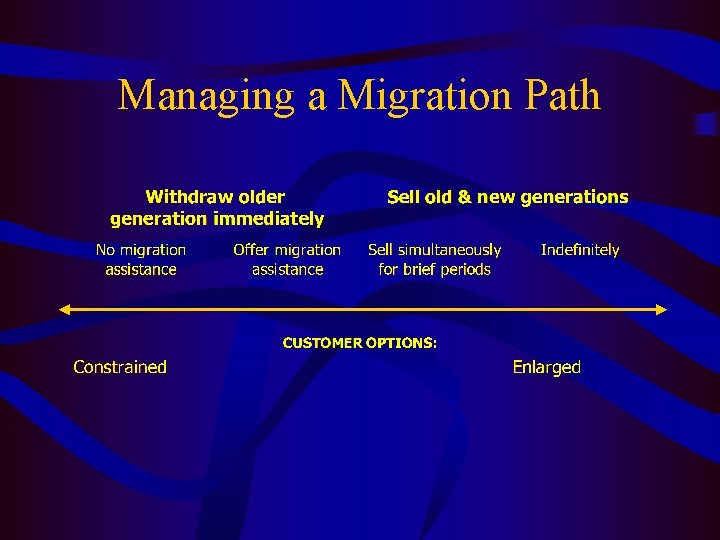
Managing a Migration Path
Managing A Migration Path • When customers expect a rapid pace in technology advancement: – They will be willing to wait for price declines – Migration assistance (i. e. , trade-ins, etc. ) mitigates against customer stalling and leapfrogging.
Managing A Migration Path • When customers expect significant magnitude of improvement – They realize smooth upgrading is unlikely – Waiting for price declines may result in purchasing an obsolete product – Therefore, migration path is less crucial, as it is meaningless, to a certain extent
Managing A Migration Path • When customers have uncertainty about expectations: – Migration path makes sense – Sell old and new simultaneously
Cross-Selling • The strategy of pushing new products to current customers based on their past purchases. Crossselling is designed to widen the customer's reliance on the company and decrease the likelihood of the customer switching to a competitor. • Cross-selling (selling additional products to existing customers) deepens the relationship and improves customer retention, both of which are important for market ownership. Cross-selling prevents competitors from taking customers, and is much cheaper than advertising and searching for new customers.