
Marketing of HighTechnology Products and Innovations Jakki J
- Slides: 25
Marketing of High-Technology Products and Innovations Jakki J. Mohr Chapter 1: Introduction to High-Technology
Technology is ubiquitous n Examples of traditional “high-tech” industries: n n n Computers and information technology Biotechnology Telecommunications Internet Examples of some industries where technological innovation is creating radical changes: n n n Waste management Agriculture Automotive Oil and Gas Consumer Products © Jakki Mohr, 2001
The “New Economy” n n n Substitution of knowledge and information for physical assets Massive investments in information technology Enhanced productivity Falling prices for technology Faster growth and lower inflation at the same time © Jakki Mohr, 2001
Drawbacks to Technology Impact on Economy n n n Volatile Relies on constant stream of innovation Dot-com crashes Stock market effects Global effects © Jakki Mohr, 2001
Definitions of “High-Tech” n n Government perspective “Common underlying characteristics” perspective © Jakki Mohr, 2001
Definitions of Technology: n n n the practical application of knowledge especially in a particular area (e. g. , engineering) a manner of accomplishing a task especially using technical processes, methods, or knowledge (e. g. , new technologies for information storage) scientific technology involving the production or use of advanced or sophisticated devices (as in computers or electronics) © Jakki Mohr, 2001
Definitions of Technology: Government Perspective n Classify industries based on objective, measurable indicators: n n the number of technical employees $ spent on R&D # of patents filed in industry Used by the Bureau of Labor Statistics, Organization for Economic Cooperation and Development, and the National Science Foundation © Jakki Mohr, 2001
Level 1 Industries: Technology-Intensive © Jakki Mohr, 2001
Level 1 Industries (Cont) Technology-Intensive © Jakki Mohr, 2001
Level II Industries: Technology Moderate © Jakki Mohr, 2001
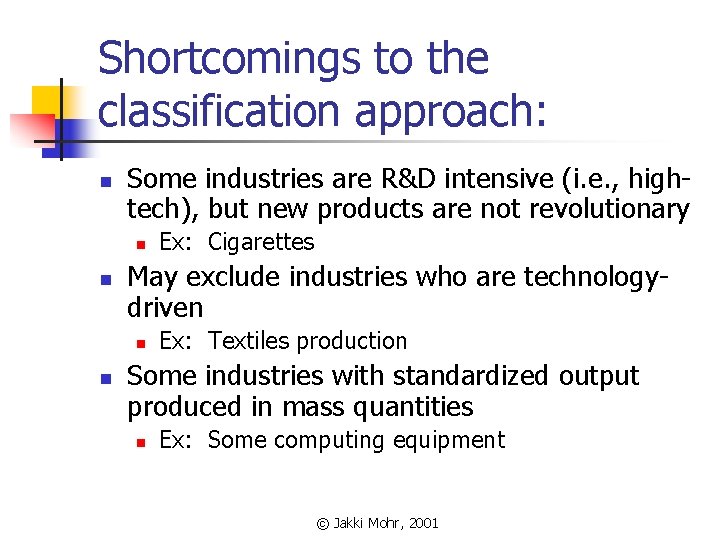
Shortcomings to the classification approach: n Some industries are R&D intensive (i. e. , hightech), but new products are not revolutionary n n May exclude industries who are technologydriven n n Ex: Cigarettes Ex: Textiles production Some industries with standardized output produced in mass quantities n Ex: Some computing equipment © Jakki Mohr, 2001
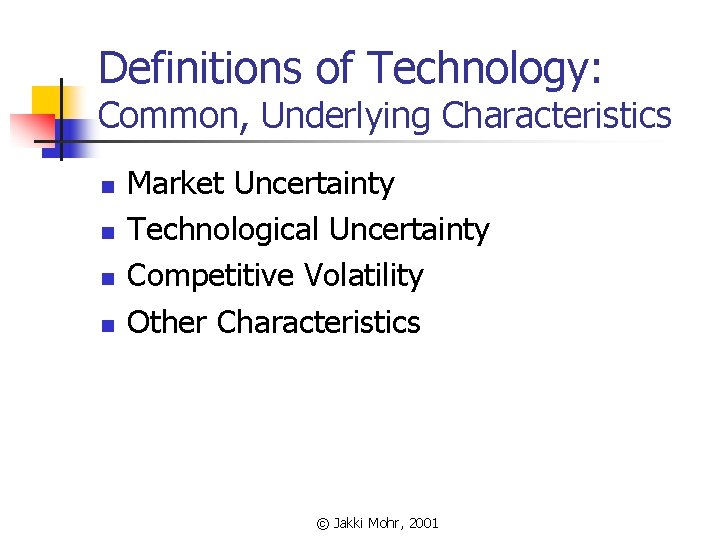
Definitions of Technology: Common, Underlying Characteristics n n Market Uncertainty Technological Uncertainty Competitive Volatility Other Characteristics © Jakki Mohr, 2001
Market Uncertainty: ambiguity about the type and extent of customer needs that can be satisfied by a particular technology n n n Consumer fear, uncertainty and doubt (FUD) Customer needs change rapidly and unpredictably Customer anxiety over the lack of standards and dominant design Uncertainty over the pace of adoption Uncertainty over/inability to forecast market size © Jakki Mohr, 2001
Technology Uncertainty: not knowing whether the technology or the company can deliver on its promise n n n Uncertainty over whether the new innovation will function as promised Uncertainty over timetable for new product development Ambiguity over whether the supplier will be able to fix customer problems with the technology Concerns over unanticipated/unintended consequences Concerns over obsolescence © Jakki Mohr, 2001
Competitive Volatility: changes in competitors, offerings, strategies n n n Uncertainty over who will be future competitors Uncertainty over “the rules of the game” (i. e. , competitive strategies and tactics) Uncertainty over “product form” competition n n competition between product classes vs. between different brands of the same product Implication: Creative destruction © Jakki Mohr, 2001
Characterizing the High-Tech Environment © Jakki Mohr, 2001
Other Characteristics Common to High-Tech Markets: n “Unit-one” costs: when the cost of producing the first unit is very high relative to the costs of reproduction n n Ex: development vs. reproduction of software Demand-side increasing returns: When the value of the product increases as more people adopt it n n n Also called network externalities and bandwagon effects Ex: portals on the Internet Implications: may give away products for free © Jakki Mohr, 2001
Other Characteristics Common to High-Tech Markets: (Cont. ) n Tradeability problems arise because it is difficult to value the know-how which forms the basis of the underlying technology n n Ex: How much to charge for licensing the rights to a wasteeating microbe? Knowledge spillover: Another type of externality that arises from the fact that technological developments in one domain spur new developments and innovations in other areas. n Ex: Human Genome Project © Jakki Mohr, 2001
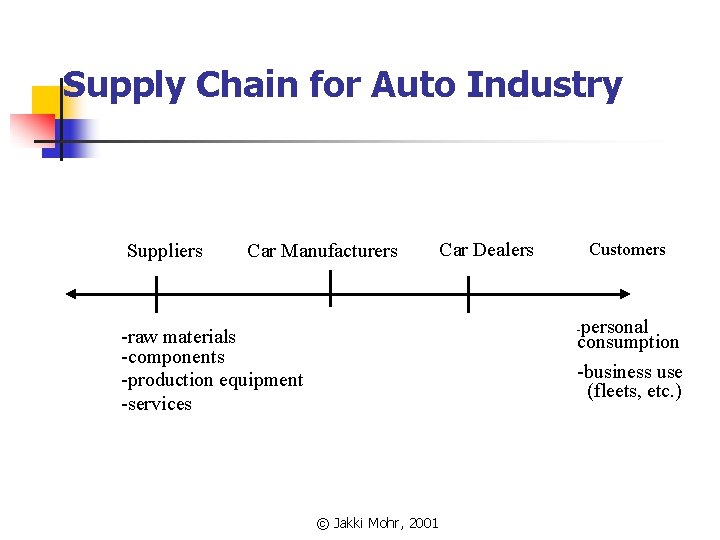
Supply Chain for Auto Industry Suppliers Car Manufacturers Car Dealers Customers personal consumption - -raw materials -components -production equipment -services -business use (fleets, etc. ) © Jakki Mohr, 2001
A Supply Chain Perspective on Technology n n Often, technological innovations occur at upstream (i. e. , supplier) levels in the supply chain Such innovations may radically affect the manufacturing process or the inner workings of a product, but End-user behavior may not be significantly affected Examples: cars, food, computing, hair styling, Internet © Jakki Mohr, 2001
Continuum of Innovations © Jakki Mohr, 2001
Supplier vs. Customer Perceptions of Nature of Innovation © Jakki Mohr, 2001
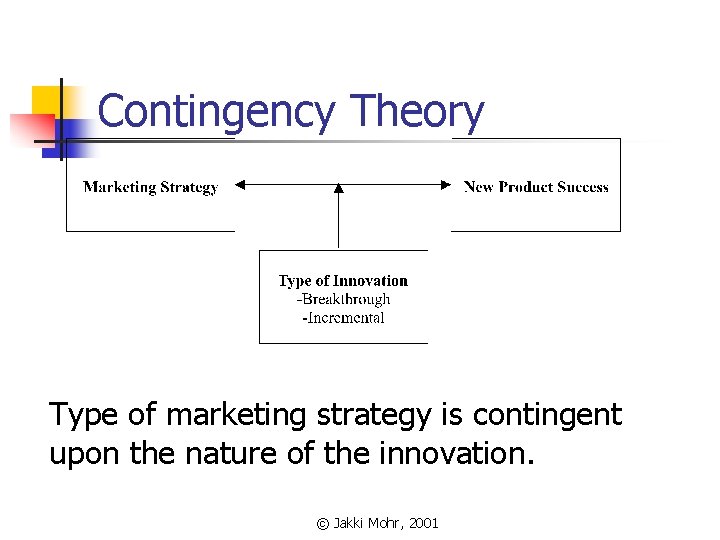
Contingency Theory Type of marketing strategy is contingent upon the nature of the innovation. © Jakki Mohr, 2001
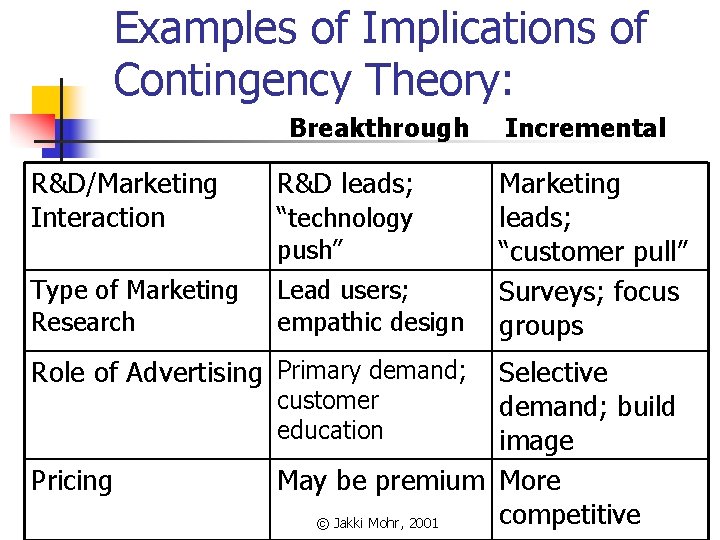
Examples of Implications of Contingency Theory: Breakthrough R&D/Marketing Interaction R&D leads; “technology Type of Marketing Research Lead users; empathic design push” Role of Advertising Primary demand; Pricing Incremental Marketing leads; “customer pull” Surveys; focus groups Selective customer demand; build education image May be premium More competitive © Jakki Mohr, 2001
Framework for High-Tech Marketing Decisions © Jakki Mohr, 2001