
Marketing Mix UNIT 4 5 PRICE Pricing Is
- Slides: 22
Marketing Mix UNIT 4. 5 PRICE
Pricing �Is a crucial part of any marketing strategy �Research has shown that many products fail due to poor pricing decisions �Managers need to set a price that is competitive and also profitable �Setting too high a price deters customers, leading to less demand even financial problems for the firm �Setting too low a price could lead to an undesirable image �Price can affect the image of a business or its products
Pricing Decisions �Price makers or setters Ability to set its own prices (within reason) Example: Monopolist – has high degree of market power and has the ability to set its own prices �Price takers Firms that take the price given by others in the market
Pricing Strategy #1 COST-BASED PRICING The central idea is that firms will assess their costs of producing or supplying each unit, and then add an amount on top of the calculated cost.
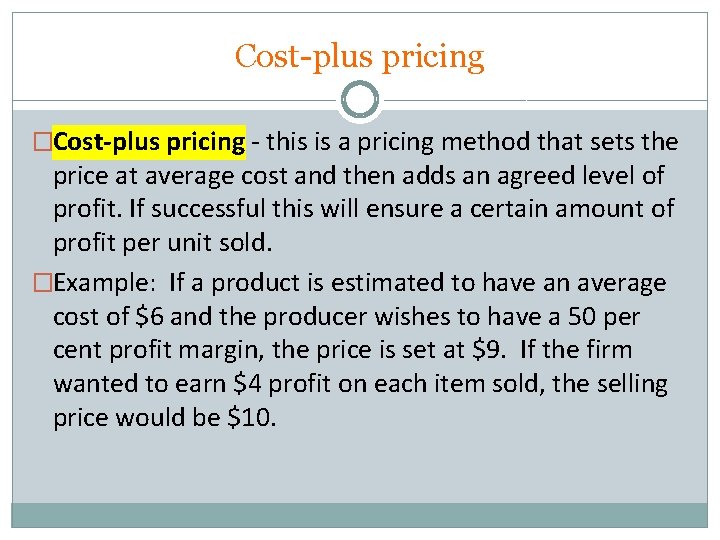
Cost-plus pricing �Cost-plus pricing - this is a pricing method that sets the price at average cost and then adds an agreed level of profit. If successful this will ensure a certain amount of profit per unit sold. �Example: If a product is estimated to have an average cost of $6 and the producer wishes to have a 50 per cent profit margin, the price is set at $9. If the firm wanted to earn $4 profit on each item sold, the selling price would be $10.
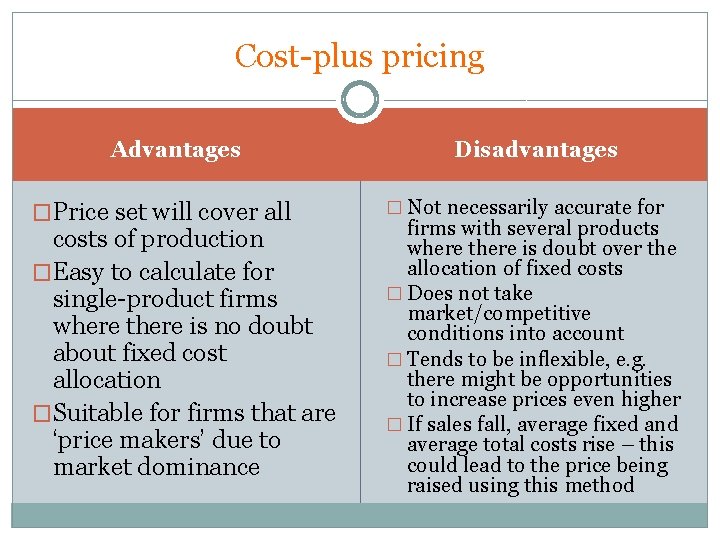
Cost-plus pricing Advantages �Price set will cover all costs of production �Easy to calculate for single-product firms where there is no doubt about fixed cost allocation �Suitable for firms that are ‘price makers’ due to market dominance Disadvantages � Not necessarily accurate for firms with several products where there is doubt over the allocation of fixed costs � Does not take market/competitive conditions into account � Tends to be inflexible, e. g. there might be opportunities to increase prices even higher � If sales fall, average fixed and average total costs rise – this could lead to the price being raised using this method
Pricing Strategy #2 MARKET-LED PRICING Are based on the level of demand for a firm’s products (or the level of demand in the industry in which the firm operates)
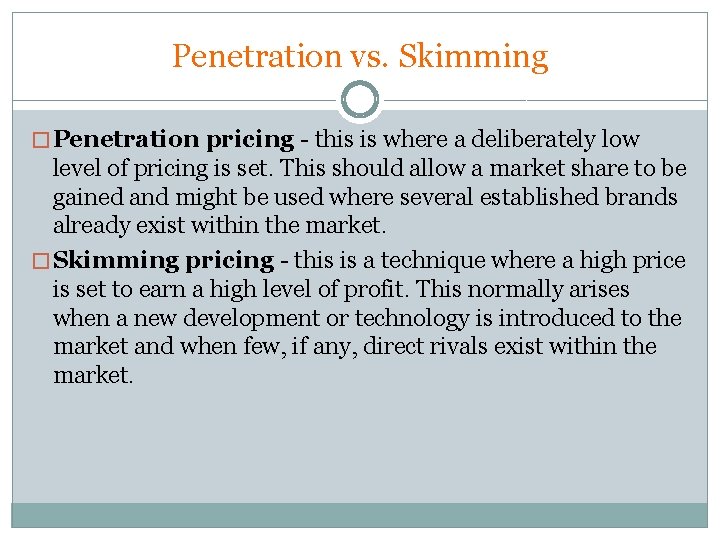
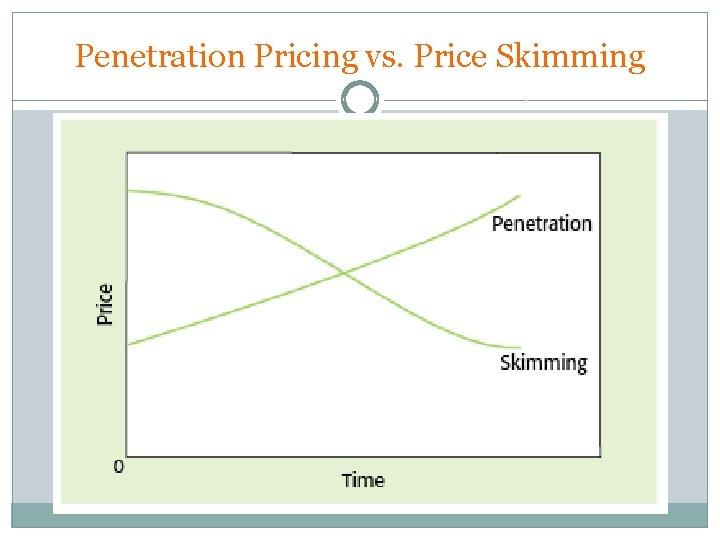
Penetration vs. Skimming � Penetration pricing - this is where a deliberately low level of pricing is set. This should allow a market share to be gained and might be used where several established brands already exist within the market. � Skimming pricing - this is a technique where a high price is set to earn a high level of profit. This normally arises when a new development or technology is introduced to the market and when few, if any, direct rivals exist within the market.
Penetration Pricing vs. Price Skimming
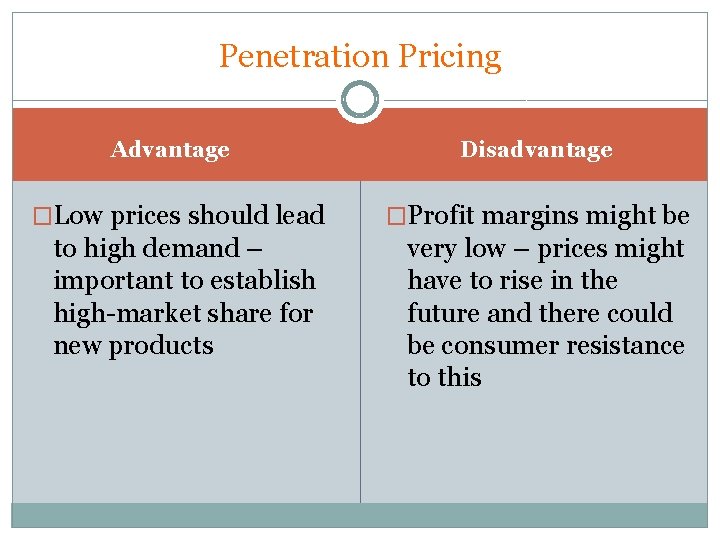
Penetration Pricing Advantage �Low prices should lead to high demand – important to establish high-market share for new products Disadvantage �Profit margins might be very low – prices might have to rise in the future and there could be consumer resistance to this
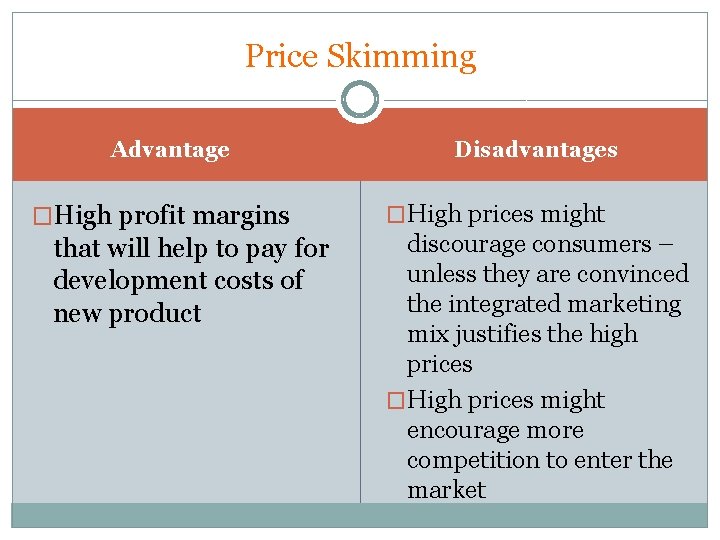
Price Skimming Advantage �High profit margins that will help to pay for development costs of new product Disadvantages �High prices might discourage consumers – unless they are convinced the integrated marketing mix justifies the high prices �High prices might encourage more competition to enter the market
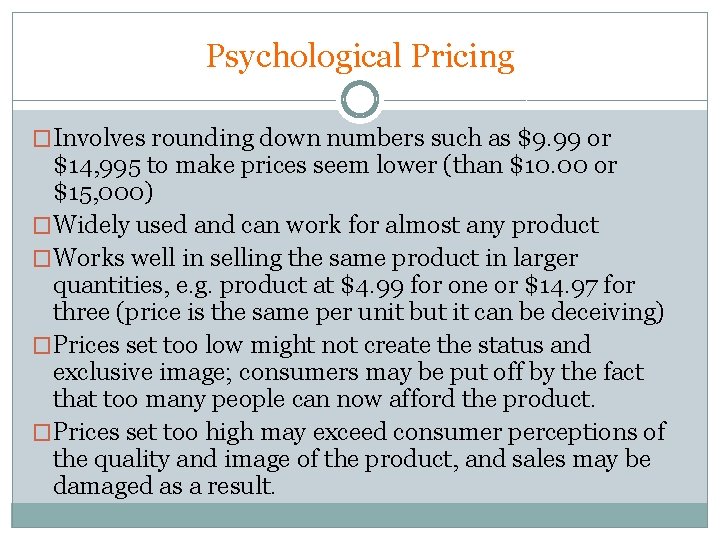
Psychological Pricing �Involves rounding down numbers such as $9. 99 or $14, 995 to make prices seem lower (than $10. 00 or $15, 000) �Widely used and can work for almost any product �Works well in selling the same product in larger quantities, e. g. product at $4. 99 for one or $14. 97 for three (price is the same per unit but it can be deceiving) �Prices set too low might not create the status and exclusive image; consumers may be put off by the fact that too many people can now afford the product. �Prices set too high may exceed consumer perceptions of the quality and image of the product, and sales may be damaged as a result.
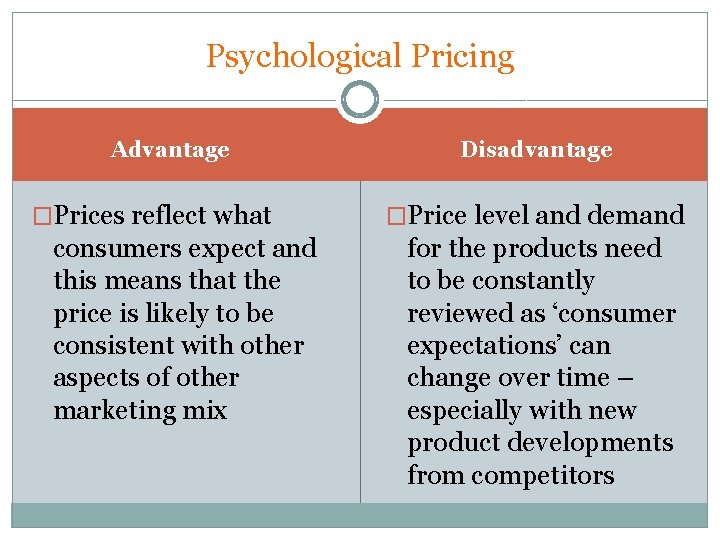
Psychological Pricing Advantage �Prices reflect what consumers expect and this means that the price is likely to be consistent with other aspects of other marketing mix Disadvantage �Price level and demand for the products need to be constantly reviewed as ‘consumer expectations’ can change over time – especially with new product developments from competitors
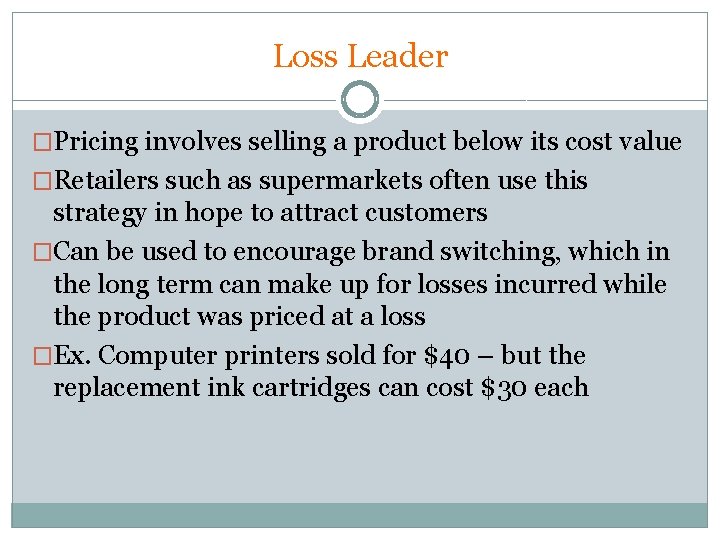
Loss Leader �Pricing involves selling a product below its cost value �Retailers such as supermarkets often use this strategy in hope to attract customers �Can be used to encourage brand switching, which in the long term can make up for losses incurred while the product was priced at a loss �Ex. Computer printers sold for $40 – but the replacement ink cartridges can cost $30 each
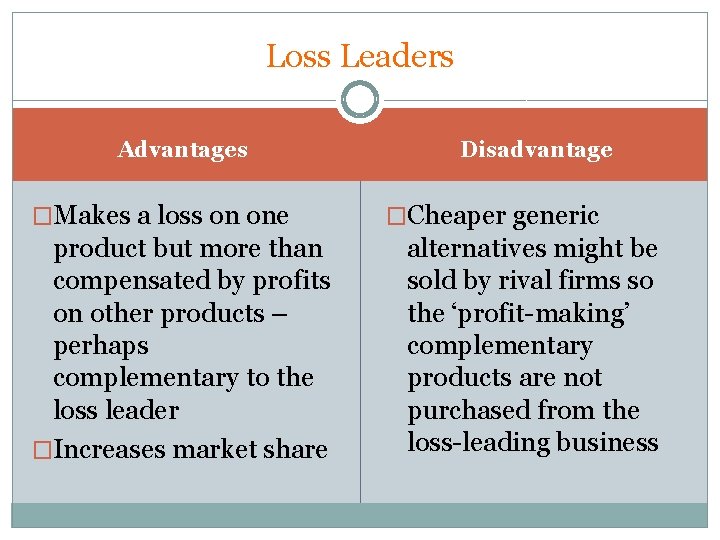
Loss Leaders Advantages �Makes a loss on one product but more than compensated by profits on other products – perhaps complementary to the loss leader �Increases market share Disadvantage �Cheaper generic alternatives might be sold by rival firms so the ‘profit-making’ complementary products are not purchased from the loss-leading business
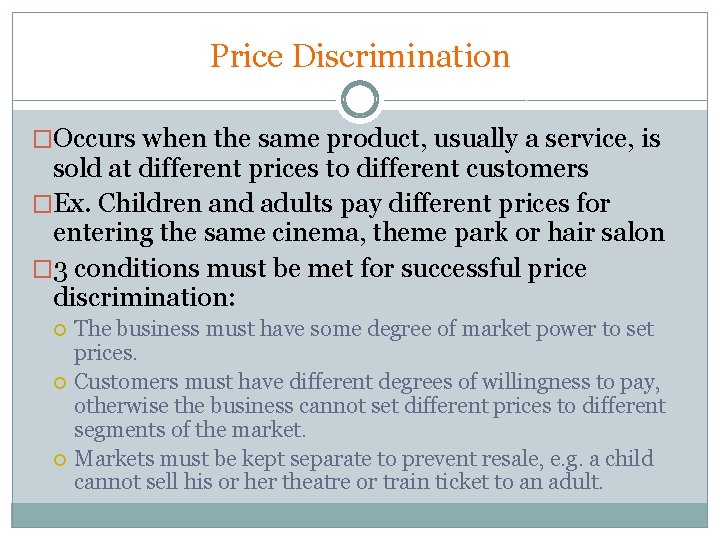
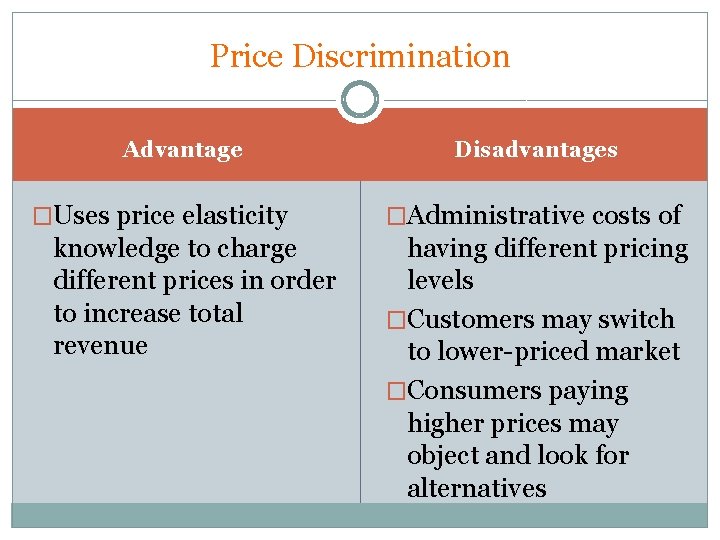
Price Discrimination �Occurs when the same product, usually a service, is sold at different prices to different customers �Ex. Children and adults pay different prices for entering the same cinema, theme park or hair salon � 3 conditions must be met for successful price discrimination: The business must have some degree of market power to set prices. Customers must have different degrees of willingness to pay, otherwise the business cannot set different prices to different segments of the market. Markets must be kept separate to prevent resale, e. g. a child cannot sell his or her theatre or train ticket to an adult.
Price Discrimination Advantage �Uses price elasticity knowledge to charge different prices in order to increase total revenue Disadvantages �Administrative costs of having different pricing levels �Customers may switch to lower-priced market �Consumers paying higher prices may object and look for alternatives
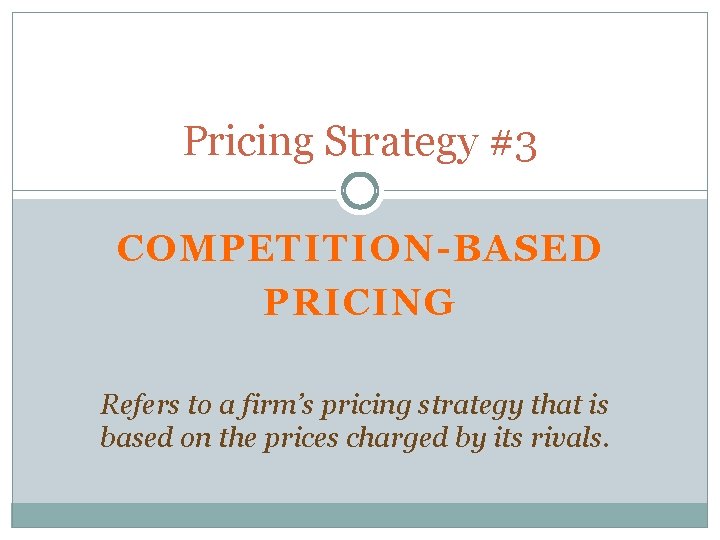
Pricing Strategy #3 COMPETITION-BASED PRICING Refers to a firm’s pricing strategy that is based on the prices charged by its rivals.
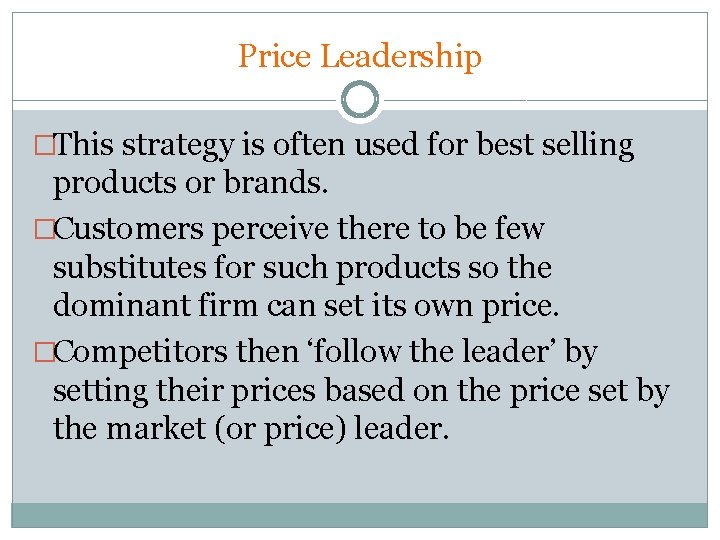
Price Leadership �This strategy is often used for best selling products or brands. �Customers perceive there to be few substitutes for such products so the dominant firm can set its own price. �Competitors then ‘follow the leader’ by setting their prices based on the price set by the market (or price) leader.
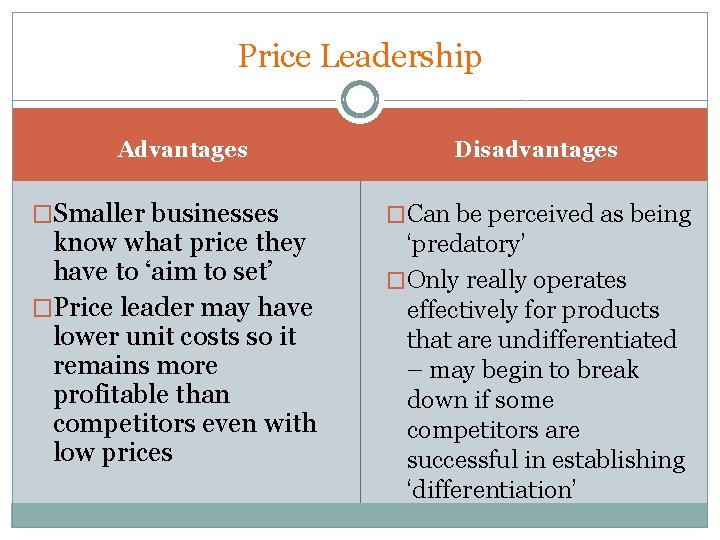
Price Leadership Advantages �Smaller businesses know what price they have to ‘aim to set’ �Price leader may have lower unit costs so it remains more profitable than competitors even with low prices Disadvantages �Can be perceived as being ‘predatory’ �Only really operates effectively for products that are undifferentiated – may begin to break down if some competitors are successful in establishing ‘differentiation’
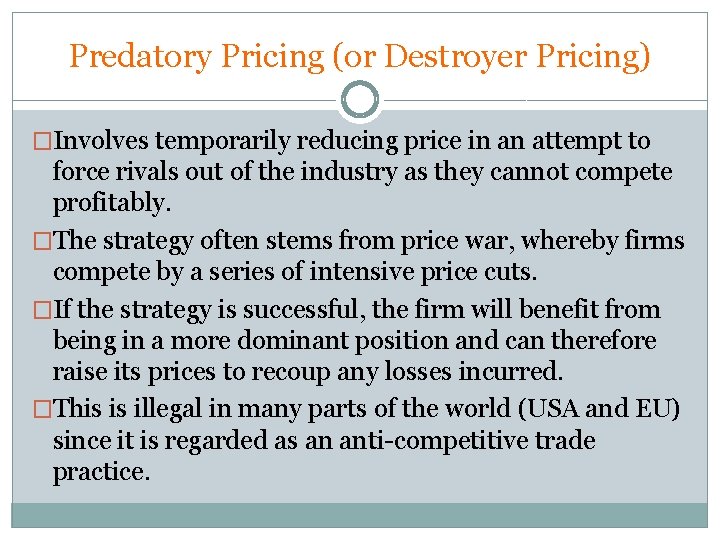
Predatory Pricing (or Destroyer Pricing) �Involves temporarily reducing price in an attempt to force rivals out of the industry as they cannot compete profitably. �The strategy often stems from price war, whereby firms compete by a series of intensive price cuts. �If the strategy is successful, the firm will benefit from being in a more dominant position and can therefore raise its prices to recoup any losses incurred. �This is illegal in many parts of the world (USA and EU) since it is regarded as an anti-competitive trade practice.
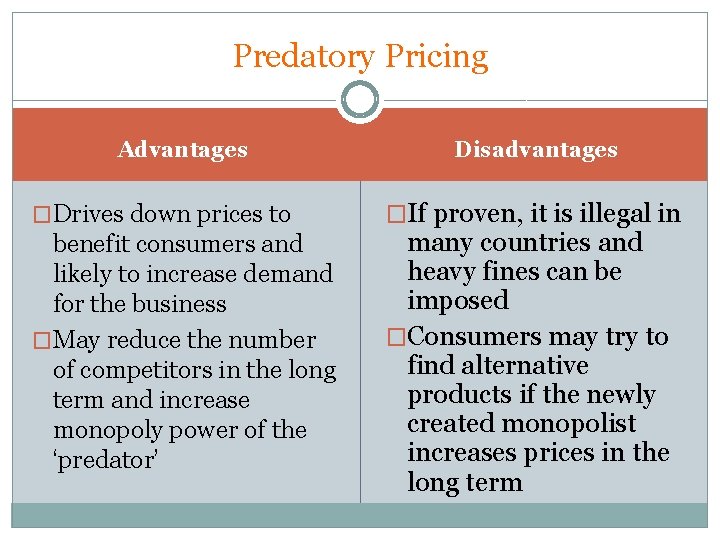
Predatory Pricing Advantages �Drives down prices to benefit consumers and likely to increase demand for the business �May reduce the number of competitors in the long term and increase monopoly power of the ‘predator’ Disadvantages �If proven, it is illegal in many countries and heavy fines can be imposed �Consumers may try to find alternative products if the newly created monopolist increases prices in the long term