
Marketing Mix The four tools a business can
Marketing Mix The four tools a business can use to persuade customers to buy its product or service: Product, Price, Promotion, Place Ms. Marshall 6 th Year Business 1
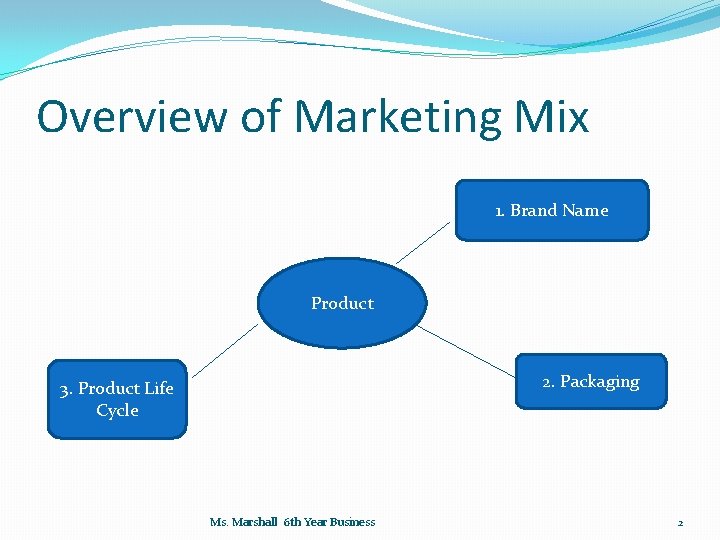
Overview of Marketing Mix 1. Brand Name Product 2. Packaging 3. Product Life Cycle Ms. Marshall 6 th Year Business 2
Brand Name �For this topic you will need to know the definition, the benefits, and some examples of global brands. �Branding means creating an identity for a product that makes it easily identifiable and clearly distinguishes it from competitors. It usually consists of a brand name and logo. E. g. Mc. Donald’s and their Golden Arches. Ms. Marshall 6 th Year Business 3
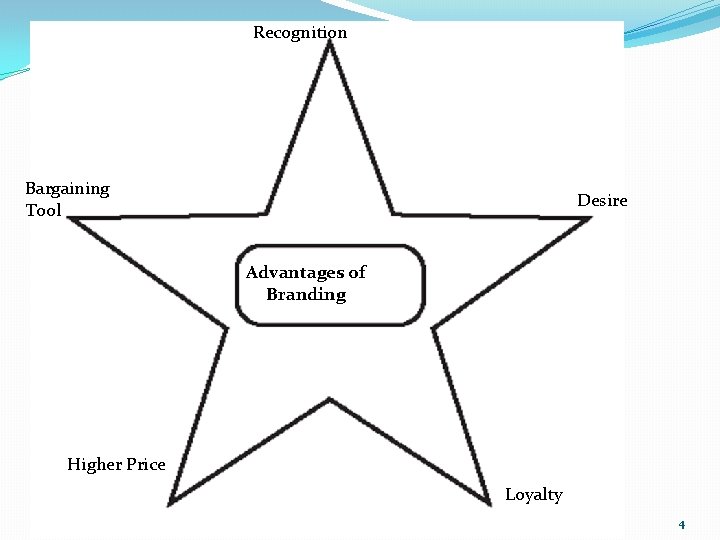
Recognition Bargaining Tool Desire Advantages of Branding Higher Price Loyalty Ms. Marshall 6 th Year Business 4

Benefits of Branding � 1. Recognition: Branding improves recognition of the product and the business name and differentiates them from competitors. This makes it easier to advertise a particular product. It is cheaper and easier to launch new products if they are associated with an existing well-known brand name. e. g. Johnson’s & Johnson’s would be best known for baby care products but have diversified into products for adults too. � 2. Desire: Branding helps to promote a desired image of a product to the target market. E. g. J&J look after sensitive skin… Ms. Marshall 6 th Year Business 5
Benefits of Branding � 3. Loyalty: Easy recognition and familiarity to consumers increases sales and promotes long-term customer loyalty. Brand loyalty occurs when customers repeat-purchase a particular product on a regular basis. They stick with the product even when the price goes up, which helps defend against price wars with competitors. E. g. Coca-Cola has a high level of brand loyalty in the soft drinks market. � 4. Higher Price: Businesses can charge a higher price, thus increasing profits. Many customers perceive branded goods to be of better quality than own brands so they are willing to pay more. E. g. you would pay more for Coca-Cola than Tesco Cola Ms. Marshall 6 th Year Business 6
Branding- Benefits � 5. Bargaining tool: Branding can be used as a bargaining tool against retailers. Businesses can get a good price from shops for their goods because they know customers expect the product to be in stock. Pepsi and Coke will often enter into contracts whereby if you stock one you cannot stock the other, e. g. Coke and Mc Donald’s. Ms. Marshall 6 th Year Business 7
Own Brands �Own Brands: brand names which are registered by retailers rather than manufacturers, e. g. Dunnes Stores (Savida) to put on products which are for sale exclusively in their shops. �Benefits of own brands �Retailers benefit from cheaper products which helps to attract extra customers. �Consumers benefit from lower prices and a greater choice of products. �Producers benefit from extra sales which are achieved with lower manufacturing and marketing costs. �Drawback – lower profit margin Ms. Marshall 6 th Year Business 8
Packaging �Packaging involves designing and making the container or wrapper for the product. �Functions of Packaging: �Protection: products must be protected from damage as they change hands through the channel of distribution. E. g. Tetra Pak makes sure liquids do not spill. �Image: packaging should look good to encourage consumers to buy the product. Design has been referred to as “the silent salesperson” because it can strongly influence sales. E. g. Pepsi carefully researched packaging for Pepsi Max. Research showed that red, blue and silver were the most appealing combination to the young male market. Ms. Marshall 6 th Year Business 9
Packaging �Information: the packaging often contains information on the use of the product or the ingredients. E. g. most food products now display the calorie content on the box. �Convenience: it is used to make the product a convenient size or shape for the consumer. E. g. 2 litre bottle of coke for home, 500 ml for carrying around. Protecting Product Design �Patent: provides legal protection of an invention or a design of a product to the inventor or designer. �Trademarks: are logos that are registered by businesses to distinguish them and their products from competitors. Marshall 6 th Year Business 10
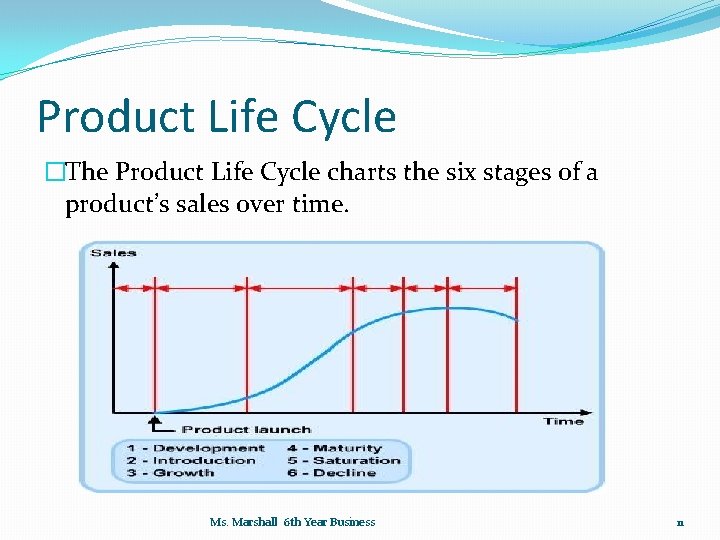
Product Life Cycle �The Product Life Cycle charts the six stages of a product’s sales over time. Ms. Marshall 6 th Year Business 11
Product Life Cycle 1. Development: much time will be spent designing and testing the product concept. A prototype will often be test-marketed, in order to assess the potential sales and profitability of the new product. A decision will then be made whether or not to launch the product based on the market research conducted. The business will, therefore, incur many expenses during the development stage of the product lifecycle and the product will produce a large, negative cashflow. 2. Introduction: this is when the product is first launched. Sales grow very slowly and large amounts must be spent on advertising and promotion. Companies usually are making a loss at this stage. Price Skimming may occur. 3. Growth: The product becomes known and sales and profits begin to increase rapidly. New competition enter the market at this stage. Ms. Marshall 6 th Year Business 12
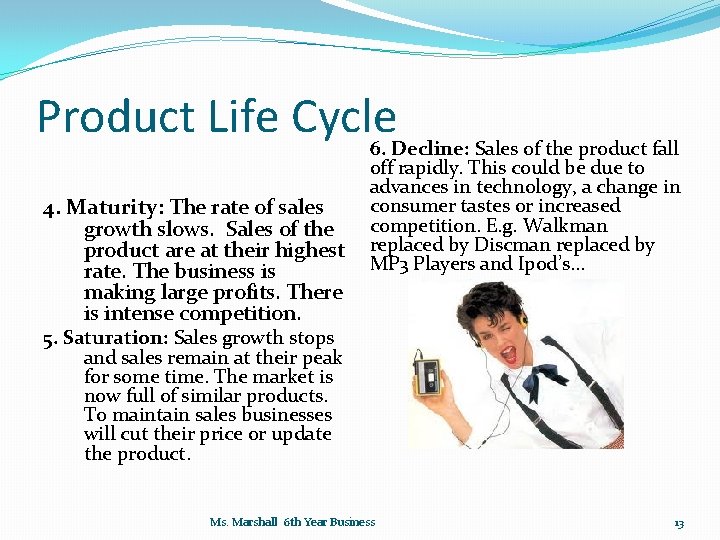
Product Life Cycle 4. Maturity: The rate of sales growth slows. Sales of the product are at their highest rate. The business is making large profits. There is intense competition. 6. Decline: Sales of the product fall off rapidly. This could be due to advances in technology, a change in consumer tastes or increased competition. E. g. Walkman replaced by Discman replaced by MP 3 Players and Ipod’s… 5. Saturation: Sales growth stops and sales remain at their peak for some time. The market is now full of similar products. To maintain sales businesses will cut their price or update the product. Ms. Marshall 6 th Year Business 13
Extension Strategies �Product Development Strategies: seek to modify and revamp the existing product to make it more appealing or to develop the number of products in the product line. “New and improved” �Market Development Strategies: attempt to find new markets or new uses for existing products through market segmentation or niche marketing. E. g. Lucozade used to be given to people who were ill, and when sales began to decline it was targeted at athletes. Ms. Marshall 6 th Year Business 14
Factors that influence the length of a product life cycle �Fashion �Technology �Marketing Ms. Marshall 6 th Year Business 15
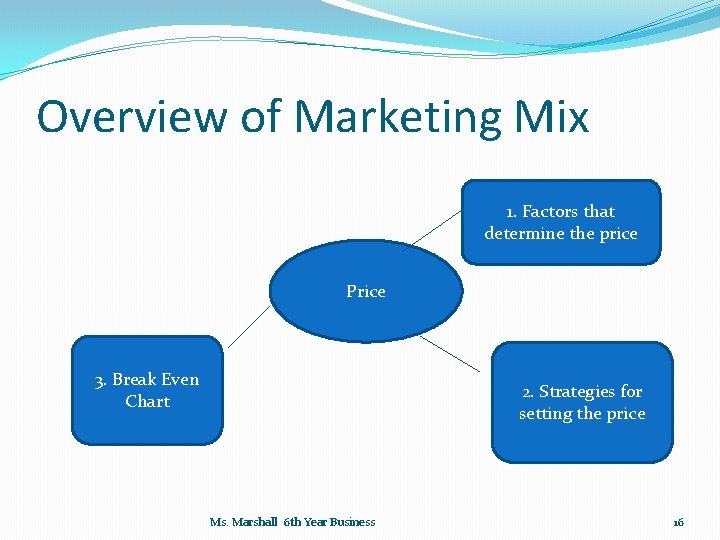
Overview of Marketing Mix 1. Factors that determine the price Price 3. Break Even Chart 2. Strategies for setting the price Ms. Marshall 6 th Year Business 16
Factors that determine the price �The price is the amount of money the business charges the consumer for its product. 1. Cost of the Product: The business must charge a price that is at least equal to the total cost of making and selling the product. This is called the breakeven price. It they charge less than this they will make a loss. 2. Competitors’ Prices: If the competitor has a better quality product, you must charge a lower price. If your product is better, then you can charge a higher price than them. Ms. Marshall 6 th Year Business 17
Factors that determine the price �Consumers’ Perception of Prices: the business must be aware of what consumers are willing to pay for the product. They should be aware that a high price is often associated with high quality and a low price with low quality. �Legal Regulations: The government can set a maximum or minimum price that a company can charge. For example, until March 2006 it was illegal to sell food below cost price. Ms. Marshall 6 th Year Business 18
Strategies for setting the price �Price Skimming Strategy: The business charges a high price for the product when it comes out initially. This helps recoup the cost of developing the product. The price drops later on as competition enters the market. New technology such as phones, Ipod’s, games consoles tend to adopt this strategy. �Penetration Pricing Strategy: the business deliberately charges a low price so that it is cheaper than competitors. The aim is to get as many customers to switch over as possible to increase market share, e. g. Airtricity promise rates 20% lower than Bord Gais if you switch both electricity and gas to them. Ms. Marshall 6 th Year Business 19
Strategies for setting the price �Price Discrimination Strategy: The business charges different prices to different consumers for the same product. E. g. Going to the cinema the price changes depending on whether you are a child, student, adult or OAP. Some cinema’s have now introduced an “unemployed rate” which operates 9 a. m. until 5 p. m. , Monday to Friday. �Loss Leader: The business sells one product at below cost price in order to attract consumers into the shop so they will buy other products. E. g. Supermarkets selling beers below cost price. Ms. Marshall 6 th Year Business 20
Strategies for setting the price �Psychological Pricing: means setting the price based on the expectations of the customers in the target market. Many companies will charge a high price to create a luxurious, exclusive image e. g. for perfume. Setting prices below psychological barriers also exists, e. g. € 9. 99 seeming less than € 10. �Mark-up: Cost-plus pricing, means adding a percentage profit to the cost of sales. Ms. Marshall 6 th Year Business 21
Recent Exam Questions � 2013/2009 �Q 7 Outline the factors a marketing manager might consider in determining the selling price of products at ‘All Weather Wellies Ltd’. (20 marks) � 2012 �Q 7. Within the product element of the marketing mix, evaluate ‘product packaging’. � 2011 �Explain the meaning of the term ‘own brand products’ �(b) Outline two reasons why retailers use ‘own – brand products’ (10 Marks) Ms. Marshall 6 th Year Business 22
Recent Exam Questions � 2011 �Draw and label the ‘product life cycle’ diagram �Illustrate the methods a business could use to extend a product’s life cycle. � 2010 �‘Many businesses spend large sums of money developing a brand name’. Illustrate the benefits of branding for the business and the consumer. (25 marks). � 2007 �Explain four pricing policies that businesses can adopt as part of their marketing strategy and apply one of them to a product of your choice. (30 marks) Ms. Marshall 6 th Year Business 23
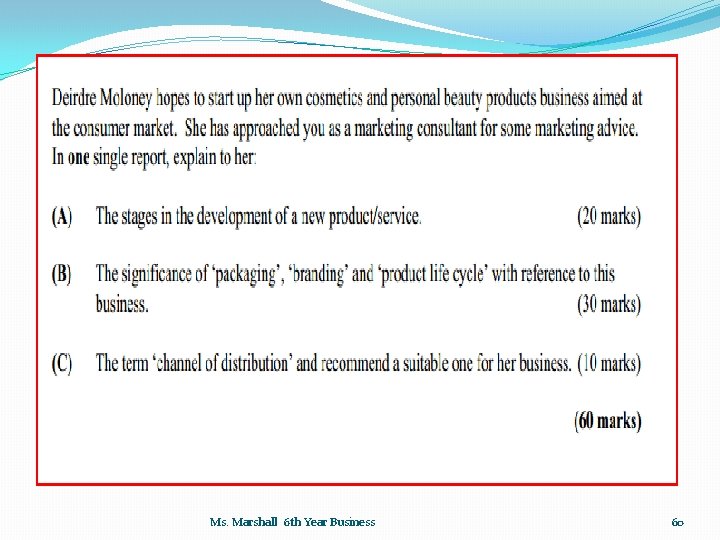
Recent Exam Questions � 2006 �Deirdre Moloney hopes to start up her own cosmetics and personal beauty products business aimed at the consumer market. She has approached you as a marketing consultant for some marketing advice. In a report, explain to her: �The significance of ‘packaging’ ‘branding’ and ‘product life cycle’ with reference to this business. Ms. Marshall 6 th Year Business 24
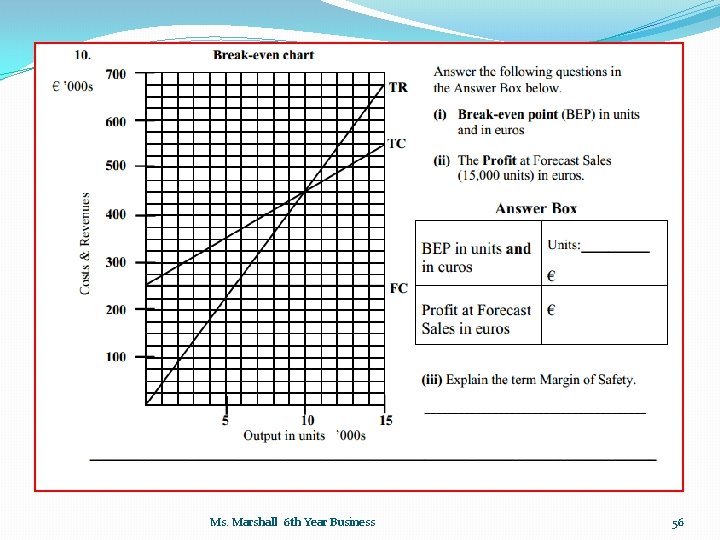
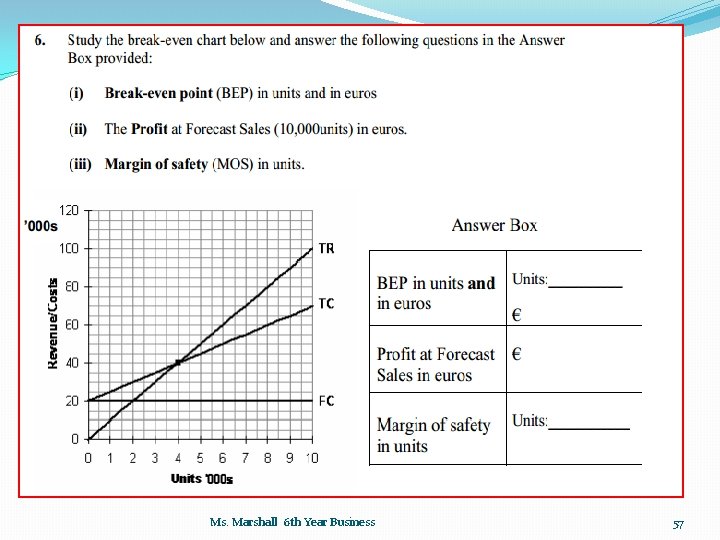
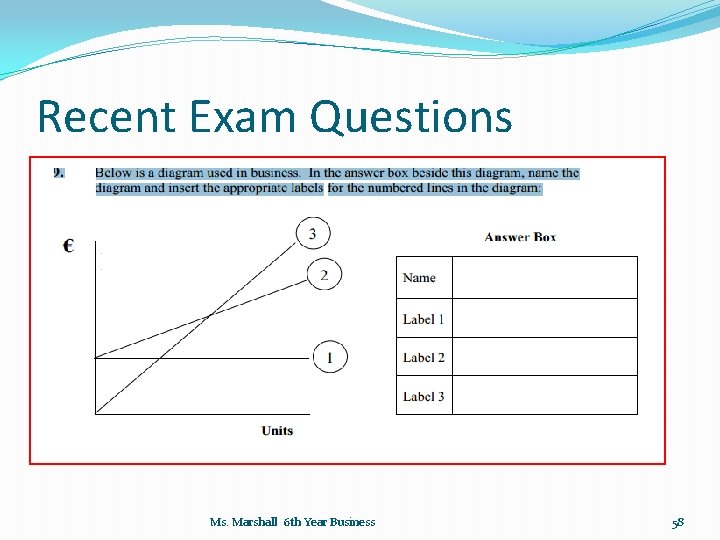
Break-Even Chart �Definitions: �Fixed Costs: are the costs that remain the same, regardless of the number of products produced, e. g. rent, insurance. �Variable Costs: are costs that vary depending on how many units are produced, e. g. raw materials. �The break-even point is the minimum price a business must charge for its product, it shows the amount of sales needed to cover its costs and break even. �The Margin of Safety refers to the amount by which a firm’s sales can drop before reaching the break-even point. Ms. Marshall 6 th Year Business 25
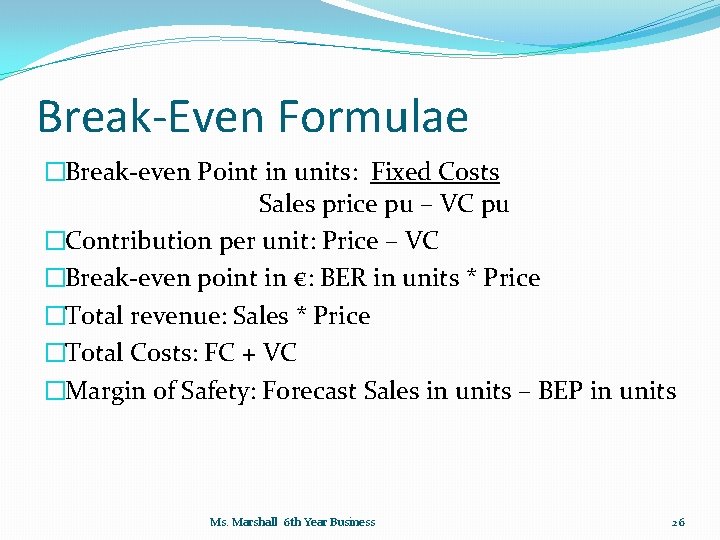
Break-Even Formulae �Break-even Point in units: Fixed Costs Sales price pu – VC pu �Contribution per unit: Price – VC �Break-even point in €: BER in units * Price �Total revenue: Sales * Price �Total Costs: FC + VC �Margin of Safety: Forecast Sales in units – BEP in units Ms. Marshall 6 th Year Business 26
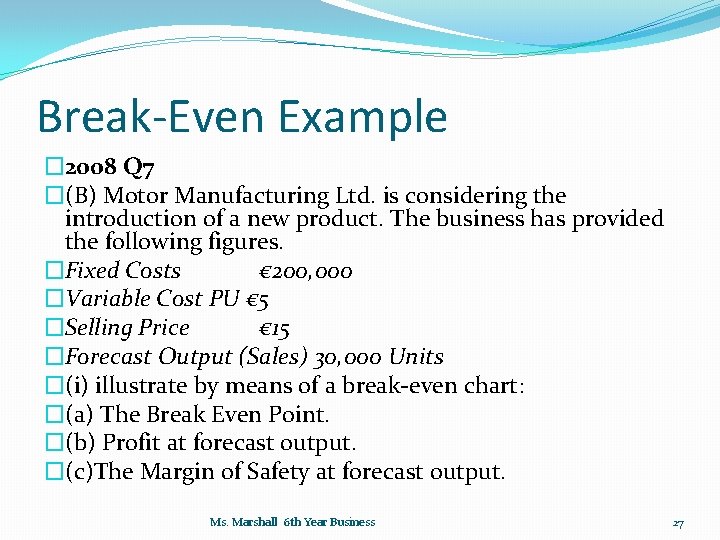
Break-Even Example � 2008 Q 7 �(B) Motor Manufacturing Ltd. is considering the introduction of a new product. The business has provided the following figures. �Fixed Costs € 200, 000 �Variable Cost PU € 5 �Selling Price € 15 �Forecast Output (Sales) 30, 000 Units �(i) illustrate by means of a break-even chart: �(a) The Break Even Point. �(b) Profit at forecast output. �(c)The Margin of Safety at forecast output. Ms. Marshall 6 th Year Business 27
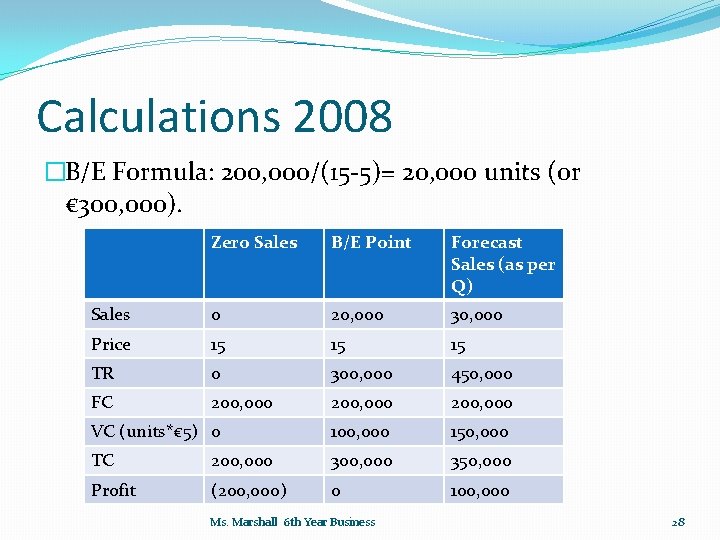
Calculations 2008 �B/E Formula: 200, 000/(15 -5)= 20, 000 units (or € 300, 000). Zero Sales B/E Point Forecast Sales (as per Q) Sales 0 20, 000 30, 000 Price 15 15 15 TR 0 300, 000 450, 000 FC 200, 000 VC (units*€ 5) 0 100, 000 150, 000 TC 200, 000 350, 000 Profit (200, 000) 0 100, 000 Ms. Marshall 6 th Year Business 28
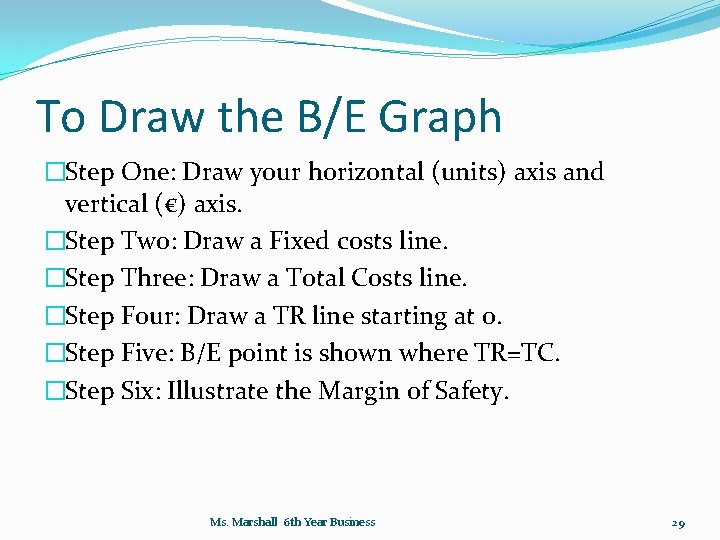
To Draw the B/E Graph �Step One: Draw your horizontal (units) axis and vertical (€) axis. �Step Two: Draw a Fixed costs line. �Step Three: Draw a Total Costs line. �Step Four: Draw a TR line starting at 0. �Step Five: B/E point is shown where TR=TC. �Step Six: Illustrate the Margin of Safety. Ms. Marshall 6 th Year Business 29
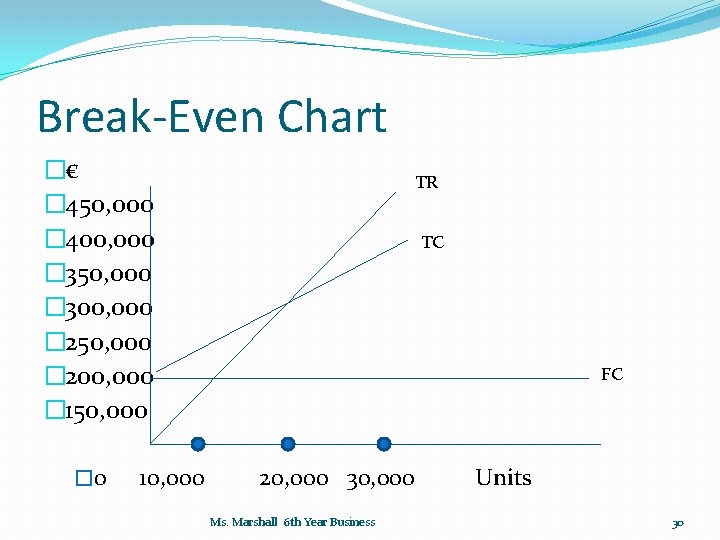
Break-Even Chart �€ � 450, 000 � 400, 000 � 350, 000 � 300, 000 � 250, 000 � 200, 000 � 150, 000 � 0 10, 000 TR TC FC 20, 000 30, 000 Ms. Marshall 6 th Year Business Units 30
Is the Break-Even Chart Useful? �They work out how many products you need to sell to break even. �They give you an idea of the profit or loss expected at different levels of sales. �The Margin of Safety shows you how much sales can drop before you no longer break even. �They can illustrate the effect a change in price would have on profits. �They can illustrate the effect a change in costs would have on profits. Marshall 6 th Year Business 31
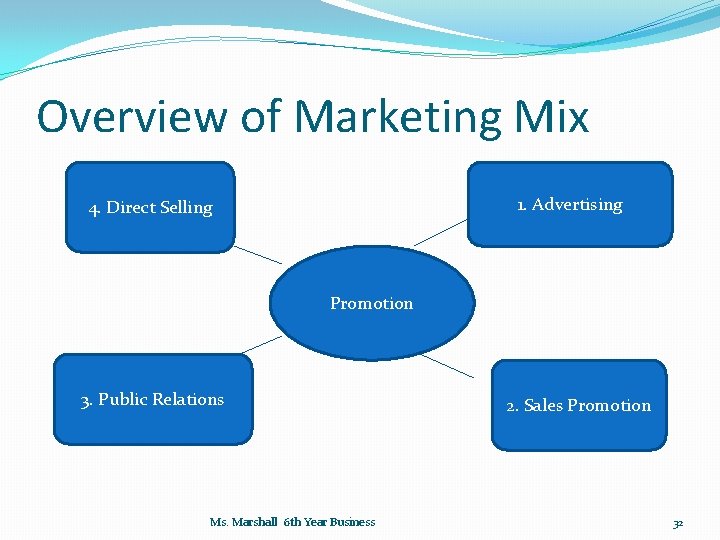
Overview of Marketing Mix 1. Advertising 4. Direct Selling Promotion 3. Public Relations Ms. Marshall 6 th Year Business 2. Sales Promotion 32
Promotion - Advertising � Promotion: refers to all the efforts (excluding price) made by the seller to communicate and influence the target market to buy a product. � Promotion helps with Product Positioning, i. e. creating an image for a product in the mind of the consumers in the target market. � Advertising: consists of messages designed to inform, persuade or remind people to buy a product or service. Functions of Advertising: � To provide information about the product. � To remind consumers that the product is still available. � To persuade consumers to buy the product. � To offset competitors advertising (defensive). � To increase sales and profits. Ms. Marshall 6 th Year Business 33
Types of Advertising �Reminder: keeps the product in the consumer’s mind. E. g. Guinness keep the product in people’s mind through a combination of TV ads, sponsorship and Guinness merchandise. �Informative: gives factual information to the consumer. E. g. the “science bit” of the ad’s for hair products. �Persuasive: convinces the consumer the product will make him/her happier. E. g. “because you’re worth it” from L’Oreal associates the product with being a worthwhile person. �Generic: advertises the product for an industry not just one company, e. g. Buy Irish campaign. �Comparative: the ad directly compares the product to a competitors. E. g. Tesco, Dunnes, Supervalu now show each others prices for the goods they are cheapest for. Ms. Marshall 6 th Year Business 34
What type of promotion? ? �http: //www. youtube. com/watch? v=f. Do. DUC 9 M 0 Sg �http: //www. youtube. com/watch? feature=endscreen& v=Ygf 0 g. RQs. Ub 4&NR=1 �http: //www. youtube. com/watch? v=Wy 52 yue. BX_s �http: //www. youtube. com/watch? v=xwnd. LOKQTDs �http: //www. youtube. com/watch? v=69 Mp. Li. Yhs. Xw �http: //www. youtube. com/watch? v=3 MUVMl 2 a. E 4 E �http: //www. youtube. com/watch? v=YYix. DPf. Tn_c �http: //www. youtube. com/watch? v=Hu. HV 4 gw. SXn 4 �http: //www. youtube. com/watch? v=Lb. HVH 9_EZu 0 Ms. Marshall 6 th Year Business 35
Product Placement �http: //www. youtube. com/watch? v=w. ACBAu 9 co. UU �http: //www. youtube. com/watch? v=na. BRz 1 Y 0 cc 8 Ms. Marshall 6 th Year Business 36
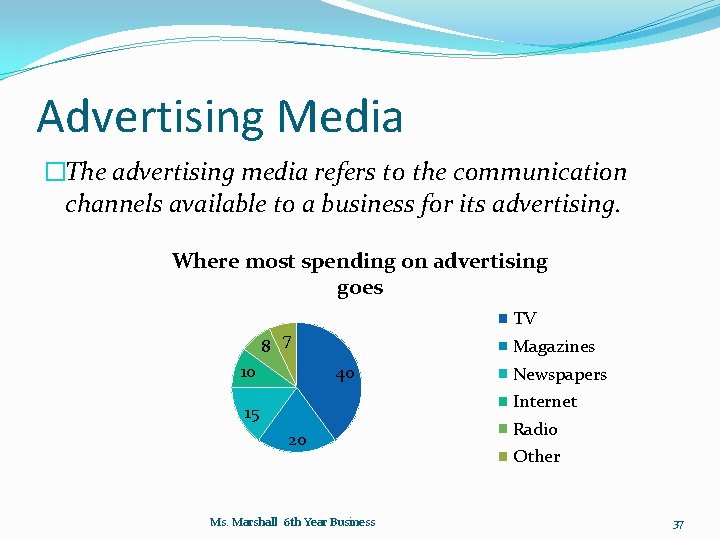
Advertising Media �The advertising media refers to the communication channels available to a business for its advertising. Where most spending on advertising goes TV 8 7 10 Magazines 40 Newspapers Internet 15 20 Ms. Marshall 6 th Year Business Radio Other 37
Advertising Media �TV �Advantages: appeals to sense of sight and sound. Shows the product in action. Watched by a lot of people. Easy to get to target market by choosing what programmes to advertise during. �Disadvantages: very expensive. Less effective now that most people change the channel during ads. �Radio �Advantages: costs less than TV. Can reach people when they are driving or working unlike TV. Good for reaching your target market, e. g. geographic segmentation – advertise on a local station. �Disadvantages: only appeals to sense of hearing. Competing with other radio ads within the same few minutes. Marshall 6 th Year Business 38
Advertising Media �Newspapers �Advantages: good for detailed information, e. g. job ad’s, technical information, e. g. car ad’s. Cost less than TV. Can reach target market, either geographically or by interests – often particular segment in the paper such as “appointments” part of the Independent. �Disadvantages: quality of picture may not be great. Newspaper thrown out after one day. �Magazine: �Advantage: Kept longer than newspaper. Easy to reach target market, e. g. beauty products advertise in women’s magazines. Good quality pictures. �Other media includes billboards, Direct Mail, Internet etc… Ms. Marshall 6 th Year Business 39
Media Mix � The combination of media chosen will depend on: � The Target Market: advertise through media most likely to be seen by your target market. E. g. Toys advertised during a children’s show. � The Nature of the Product: If the product needs to be seen working then TV is the best option. Some products are restricted from advertising on TV, e. g. cigarettes. Alcohol ad’s are banned from portraying the user as being enhanced in some way by the product. � The Message: if the message is detailed or technical a written form of ad may be best. � The Cost: some media are more effective than others in term of cost per 1, 000 customers. E. g. if you are a local shop it is more cost-effective to advertise in your local paper than the Irish Times. Ms. Marshall 6 th Year Business 40
Ethics in Advertising �The Advertising Standards Authority of Ireland (ASAI)is a voluntary organisation set up by people who work in the advertising industry. It does not have the legal powers to stop ads but if an ad is found to be offensive they ask a company to withdraw it. Most companies will comply. E. g. Hunky Dory’s ad with the female rugby players. �National Consumer Agency: a State agency which can ban advertisements that break the Consumer Protection Act 2007 by misleading a consumer. E. g. Irish bakeries were describing some bread as “light” despite the fact all bread is low fat. Ms. Marshall 6 th Year Business 41
Dasani �Coca-Cola would be in the saturation stage of the product life cycle. This is one reason why they have introduced new products. When the market for bottled water was increasing they launched Dasani. However, it later emerged that it was actually tap water which became contaminated at a bottling plant. The product had to be withdrawn from the market, losing Coca-Cola millions in wasted marketing and production expenditure. Ms. Marshall 6 th Year Business 42
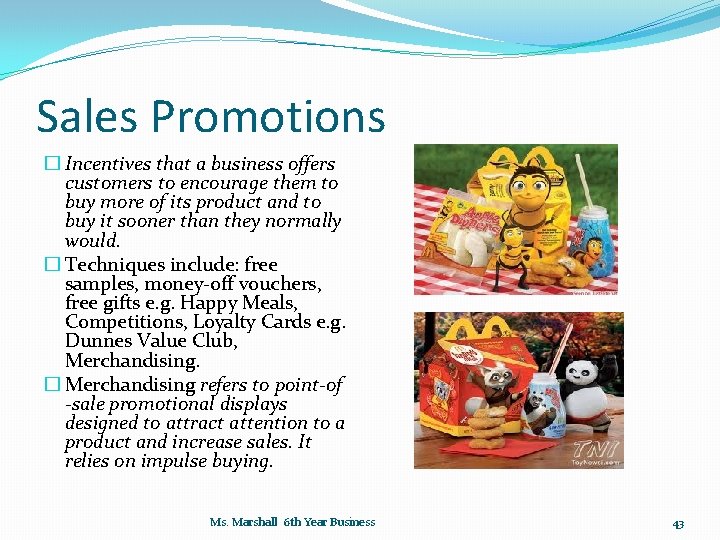
Sales Promotions � Incentives that a business offers customers to encourage them to buy more of its product and to buy it sooner than they normally would. � Techniques include: free samples, money-off vouchers, free gifts e. g. Happy Meals, Competitions, Loyalty Cards e. g. Dunnes Value Club, Merchandising. � Merchandising refers to point-of -sale promotional displays designed to attract attention to a product and increase sales. It relies on impulse buying. Ms. Marshall 6 th Year Business 43
Sales Promotion �Sales promotion techniques involve some contact between the customer and the seller. It lasts for a short period of time and may be repeated at a later date. �Sales Promotion is popular in the large multiples such as Tesco, Dunnes, Superquinn in the current climate in an effort to increase market share. �It adds to the attractiveness �of the product. �It is useful for stimulating sales �It aims to attract new consumers for the product, rewarding loyal consumers and increasing buying frequency among occasional consumers. Ms. Marshall 6 th Year Business 44
Public Relations �PR means communicating with the media using news stories to create good publicity for a firm or its products or to respond to negative publicity. Functions of PR �To attract publicity when launching new products. E. g. Apple when launching the new Iphone. �To target certain customers. �To build an image that reflects well on the company. �To defend the product/ company from bad publicity. Negative product publicity can be a nightmare for businesses e. g. Toyota recall of cars. It can lead to loss in the market share and customers losing trust in the quality of the product/service being offered. Ms. Marshall 6 th Year Business 45
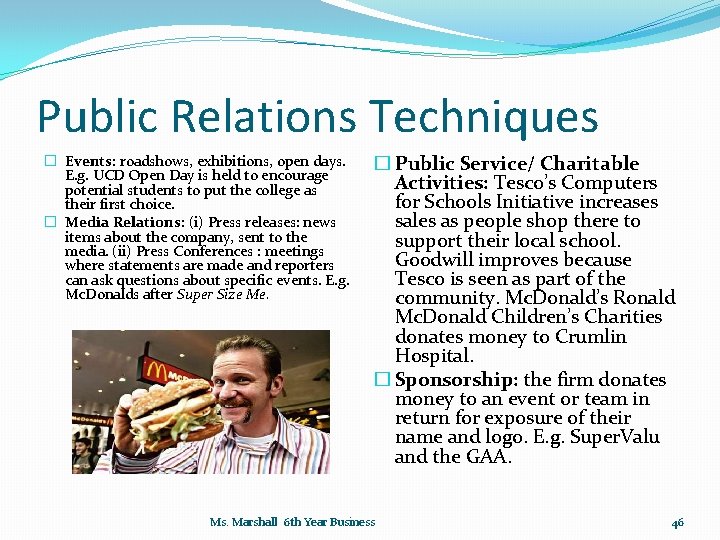
Public Relations Techniques � Events: roadshows, exhibitions, open days. E. g. UCD Open Day is held to encourage potential students to put the college as their first choice. � Media Relations: (i) Press releases: news items about the company, sent to the media. (ii) Press Conferences : meetings where statements are made and reporters can ask questions about specific events. E. g. Mc. Donalds after Super Size Me. � Public Service/ Charitable Activities: Tesco’s Computers for Schools Initiative increases sales as people shop there to support their local school. Goodwill improves because Tesco is seen as part of the community. Mc. Donald’s Ronald Mc. Donald Children’s Charities donates money to Crumlin Hospital. � Sponsorship: the firm donates money to an event or team in return for exposure of their name and logo. E. g. Super. Valu and the GAA. Ms. Marshall 6 th Year Business 46
Direct Selling �Personal Selling: a salesperson meets with the customer face to give them information about a product and to persuade them to buy it. E. g. Representatives from different publishers talk to teachers to get them to try their school books. �Telemarketing: means communicating with customers by telephone to generate sales and deal with customer queries and complaints. �Direct Mail: involves sending promotional messages directly to target customers, door to door leaflets or e-mail. Considered junk mail or spam by many consumers. Marshall 6 th Year Business 47
Place �Place focuses on where customers will be able to access the goods or services. �Channel of Distribution describes the various paths that goods may follow from producer to consumer. �Wholesaler: a business that buys products directly from the manufacturer in huge quantities and then sells them on to the retailer in smaller quantities. This is called breaking bulk. �Retailer: the shop that sells to consumer. �Consumer: buys products/services for their own personal use. Ms. Marshall 6 th Year Business 48
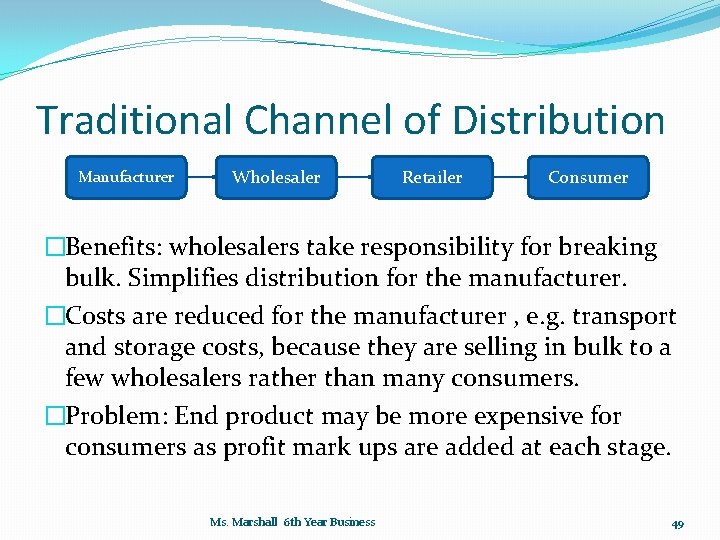
Traditional Channel of Distribution Manufacturer Wholesaler Retailer Consumer �Benefits: wholesalers take responsibility for breaking bulk. Simplifies distribution for the manufacturer. �Costs are reduced for the manufacturer , e. g. transport and storage costs, because they are selling in bulk to a few wholesalers rather than many consumers. �Problem: End product may be more expensive for consumers as profit mark ups are added at each stage. Ms. Marshall 6 th Year Business 49
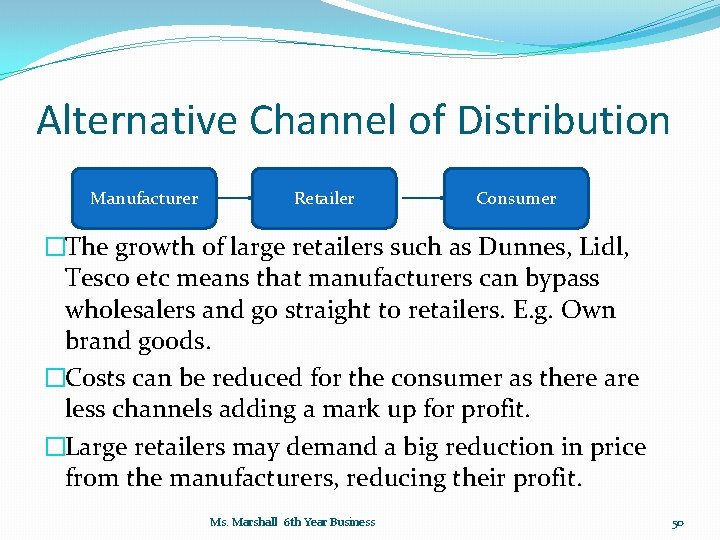
Alternative Channel of Distribution Manufacturer Retailer Consumer �The growth of large retailers such as Dunnes, Lidl, Tesco etc means that manufacturers can bypass wholesalers and go straight to retailers. E. g. Own brand goods. �Costs can be reduced for the consumer as there are less channels adding a mark up for profit. �Large retailers may demand a big reduction in price from the manufacturers, reducing their profit. Ms. Marshall 6 th Year Business 50
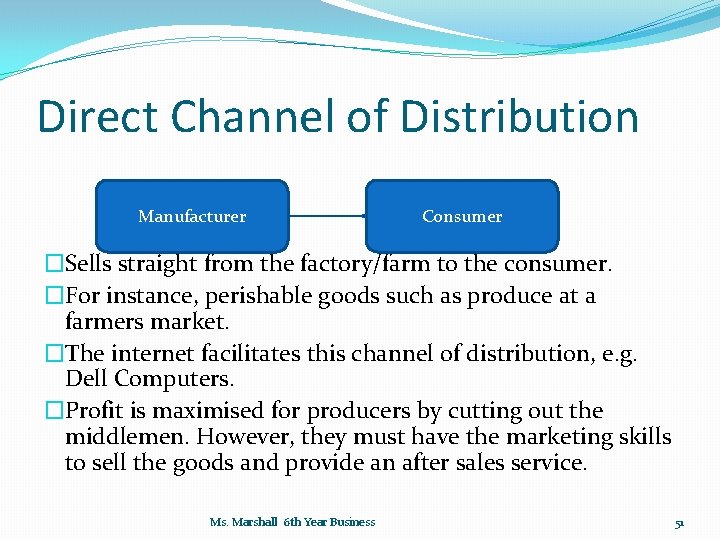
Direct Channel of Distribution Manufacturer Consumer �Sells straight from the factory/farm to the consumer. �For instance, perishable goods such as produce at a farmers market. �The internet facilitates this channel of distribution, e. g. Dell Computers. �Profit is maximised for producers by cutting out the middlemen. However, they must have the marketing skills to sell the goods and provide an after sales service. Ms. Marshall 6 th Year Business 51
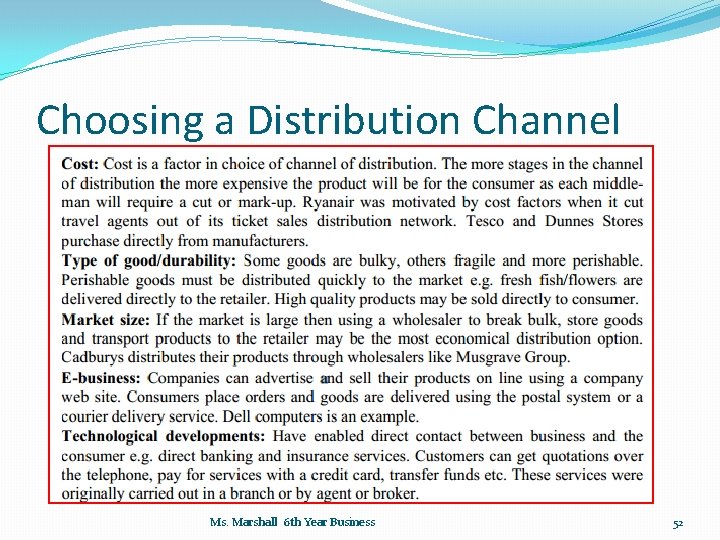
Choosing a Distribution Channel Ms. Marshall 6 th Year Business 52
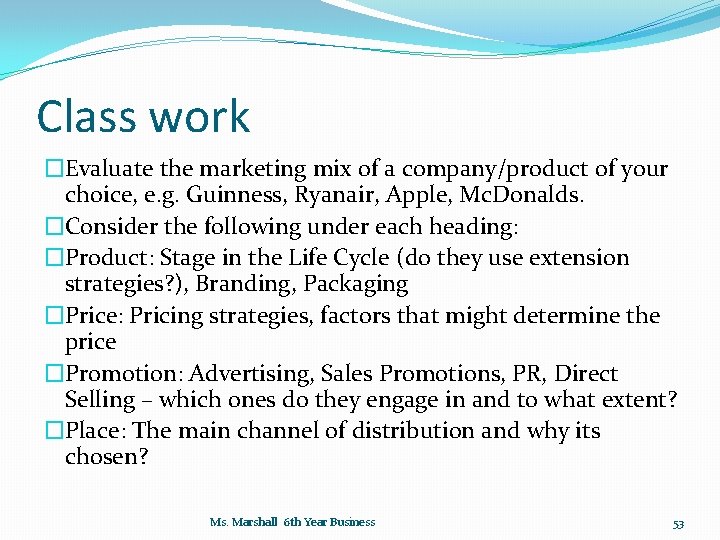
Class work �Evaluate the marketing mix of a company/product of your choice, e. g. Guinness, Ryanair, Apple, Mc. Donalds. �Consider the following under each heading: �Product: Stage in the Life Cycle (do they use extension strategies? ), Branding, Packaging �Price: Pricing strategies, factors that might determine the price �Promotion: Advertising, Sales Promotions, PR, Direct Selling – which ones do they engage in and to what extent? �Place: The main channel of distribution and why its chosen? Ms. Marshall 6 th Year Business 53
Putting together a Promotional Campaign �Step One: Analyse the market situation. �Step Two: Plan the campaign. Identify your target market, set a budget and decide what medium to use. �Step Three: Implement the campaign. �Monitor and review the campaign. Ms. Marshall 6 th Year Business 54
Recent Exam Questions � 2013 �In Break-even analysis a distinction is made between ‘fixed costs’ and variable costs’. Explain these terms, and give one example in each case (10 marks). � 2012 �Outline the factors a business should consider when choosing a suitable Channel of Distribution. Provide examples to illustrate your answer (20 marks). � 2010 �Evaluate ‘Sales Promotion’ and ‘Public Relations’ as forms of promotion (20 marks). Ms. Marshall 6 th Year Business 55
Ms. Marshall 6 th Year Business 56
Ms. Marshall 6 th Year Business 57
Recent Exam Questions Ms. Marshall 6 th Year Business 58
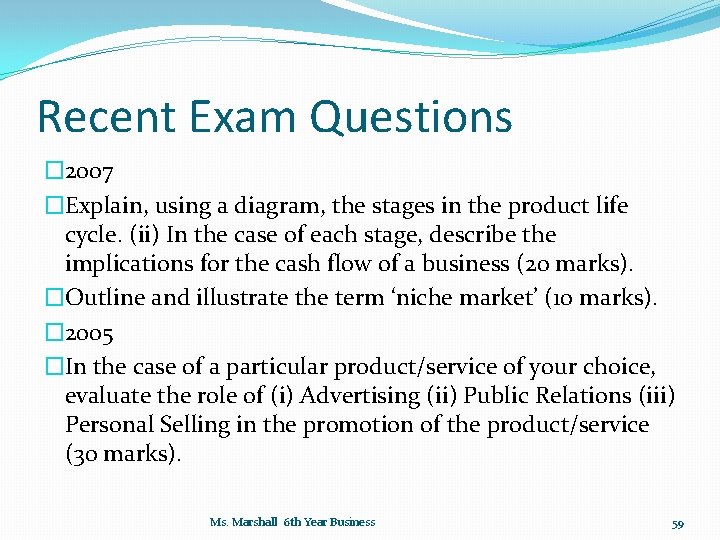
Recent Exam Questions � 2007 �Explain, using a diagram, the stages in the product life cycle. (ii) In the case of each stage, describe the implications for the cash flow of a business (20 marks). �Outline and illustrate the term ‘niche market’ (10 marks). � 2005 �In the case of a particular product/service of your choice, evaluate the role of (i) Advertising (ii) Public Relations (iii) Personal Selling in the promotion of the product/service (30 marks). Ms. Marshall 6 th Year Business 59
Ms. Marshall 6 th Year Business 60
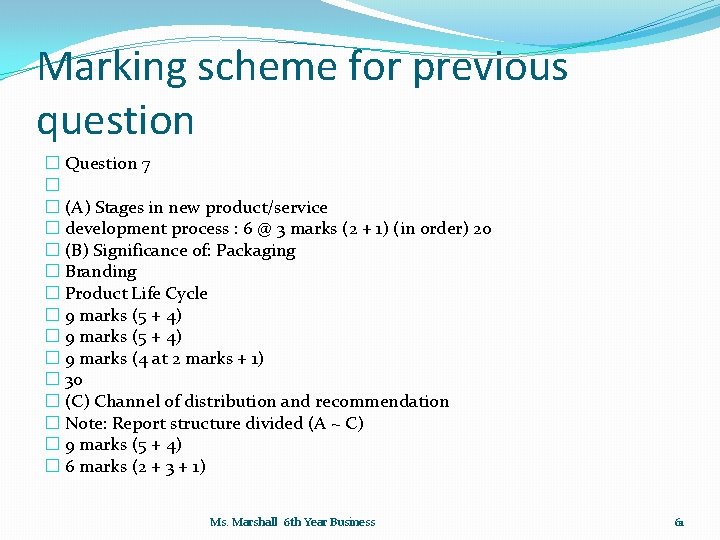
Marking scheme for previous question � Question 7 � � (A) Stages in new product/service � development process : 6 @ 3 marks (2 + 1) (in order) 20 � (B) Significance of: Packaging � Branding � Product Life Cycle � 9 marks (5 + 4) � 9 marks (4 at 2 marks + 1) � 30 � (C) Channel of distribution and recommendation � Note: Report structure divided (A ~ C) � 9 marks (5 + 4) � 6 marks (2 + 3 + 1) Ms. Marshall 6 th Year Business 61
- Slides: 61