
Marketing Marketing is Everything Regis Mc Kenna HBR
Marketing “Marketing is Everything” - Regis Mc. Kenna, HBR, 1991 “The End of Marketing” - Regis Mc. Kenna, Business 2. 0, 2000
An Introduction to Marketing defined: “Marketing is an organizational function and a set of processes for creating, communicating, and delivering value to customers and for managing customer relationships in ways that benefit the organization and its stakeholders. - American Marketing Association (And hereafter regarding definitions)

• • Organizational Functions – What do firms really do? Theories: Economic - Financial Agency - Managerial Resource Allocation -Managerial Competitive Rationality - Marketing Adaptive Organization – Managerial Transaction Function - Economic Knowledge-Based – Cross-Functional – Information Processing – Learning/Teaching • Where is MARKETING in all this?
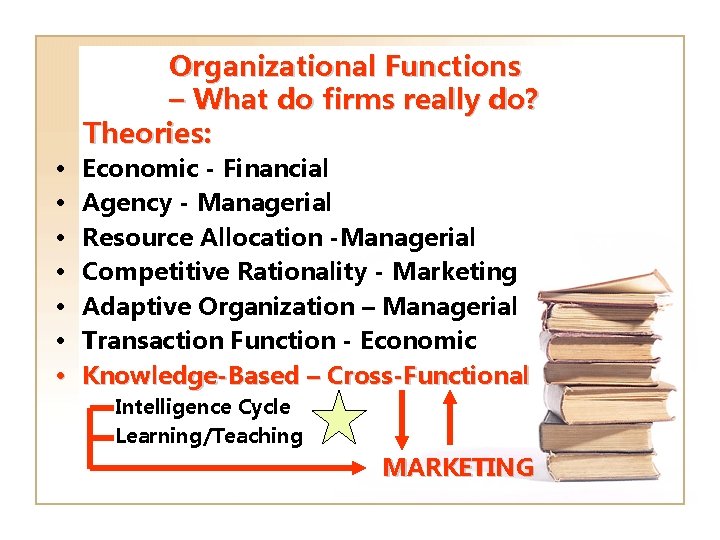
• • Organizational Functions – What do firms really do? Theories: Economic - Financial Agency - Managerial Resource Allocation -Managerial Competitive Rationality - Marketing Adaptive Organization – Managerial Transaction Function - Economic Knowledge-Based – Cross-Functional Intelligence Cycle Learning/Teaching MARKETING

Knowledge-Based Theory of the Firm
An Introduction to Marketing defined: “Marketing is an organizational function and a set of processes for creating, communicating, and delivering value to customers and for managing customer relationships in ways that benefit the organization and its stakeholders.
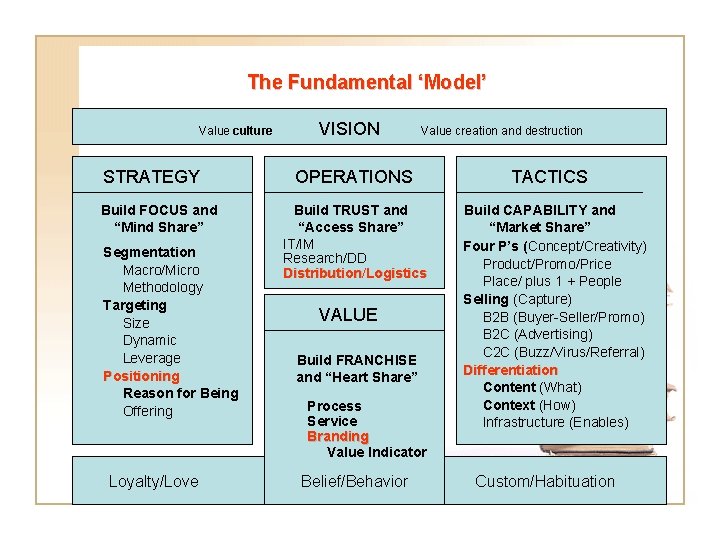
The Fundamental ‘Model’ Value culture STRATEGY Build FOCUS and “Mind Share” Segmentation Macro/Micro Methodology Targeting Size Dynamic Leverage Positioning Reason for Being Offering Loyalty/Love VISION Value creation and destruction OPERATIONS Build TRUST and “Access Share” IT/IM Research/DD Distribution/Logistics VALUE Build FRANCHISE and “Heart Share” Process Service Branding Value Indicator Belief/Behavior TACTICS Build CAPABILITY and “Market Share” Four P’s (Concept/Creativity) Product/Promo/Price Place/ plus 1 + People Selling (Capture) B 2 B (Buyer-Seller/Promo) B 2 C (Advertising) C 2 C (Buzz/Virus/Referral) Differentiation Content (What) Context (How) Infrastructure (Enables) Custom/Habituation
An Introduction to Marketing defined: “Marketing is an organizational function and a set of processes for creating, communicating, and delivering value to customers and for managing customer relationships in ways that benefit the organization and its stakeholders.
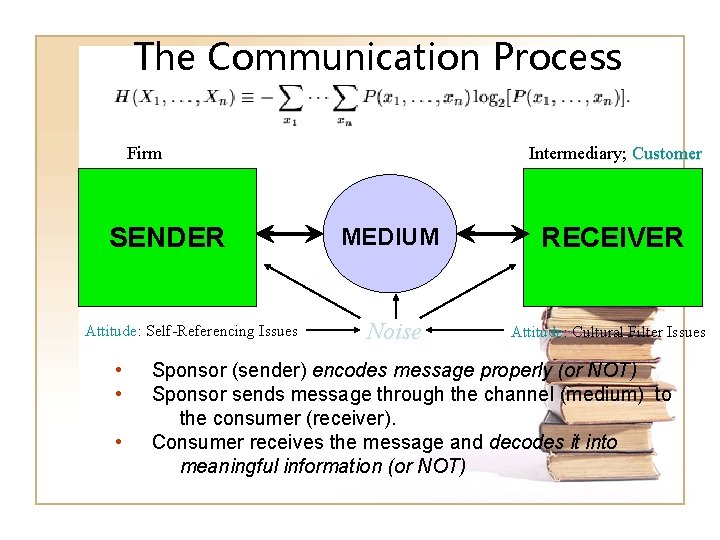
The Communication Process Firm SENDER Attitude: Self-Referencing Issues • • • Intermediary; Customer MEDIUM RECEIVER Noise Attitude: Cultural Filter Issues Sponsor (sender) encodes message properly (or NOT) Sponsor sends message through the channel (medium) to the consumer (receiver). Consumer receives the message and decodes it into meaningful information (or NOT)
An Introduction to Marketing defined: “Marketing is an organizational function and a set of processes for creating, communicating, and delivering value to customers and for managing customer relationships in ways that benefit the organization and its stakeholders.
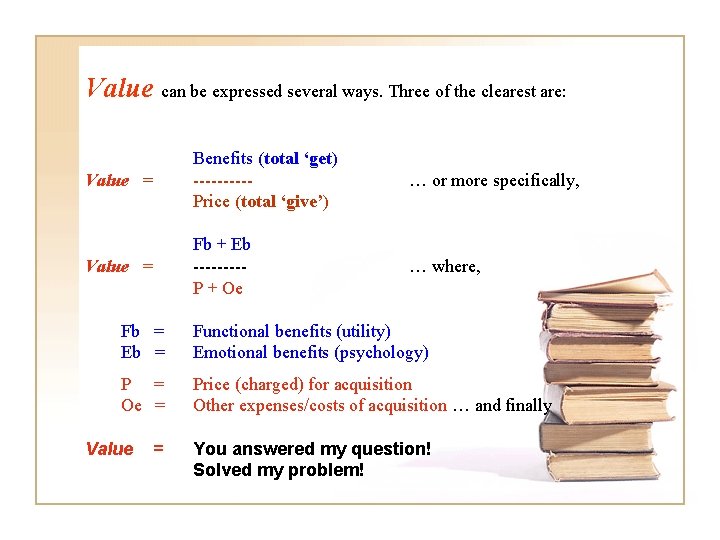
Value can be expressed several ways. Three of the clearest are: Value = Benefits (total ‘get) -----Price (total ‘give’) … or more specifically, Value = Fb + Eb ----P + Oe … where, Fb = Eb = Functional benefits (utility) Emotional benefits (psychology) P = Oe = Price (charged) for acquisition Other expenses/costs of acquisition … and finally Value = You answered my question! Solved my problem!
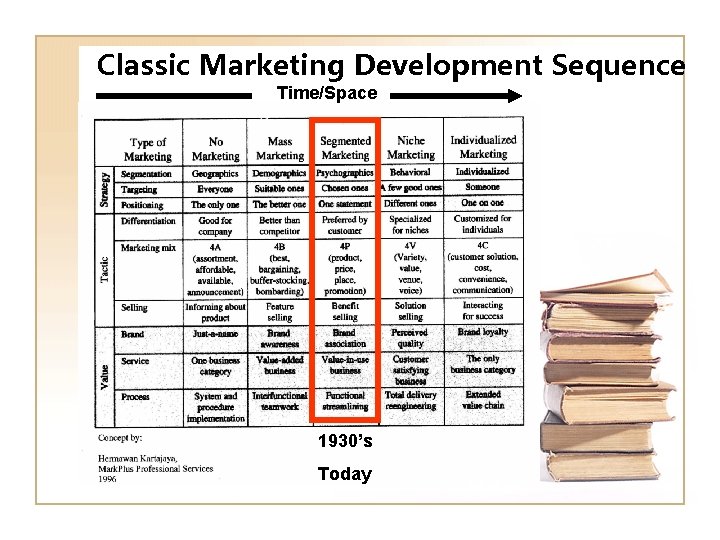
Classic Marketing Development Sequence Time/Space 1930’s Today
An Introduction to Marketing defined: “Marketing is an organizational function and a set of processes for creating, communicating, and delivering value to customers and for managing customer relationships in ways that benefit the organization and its stakeholders.
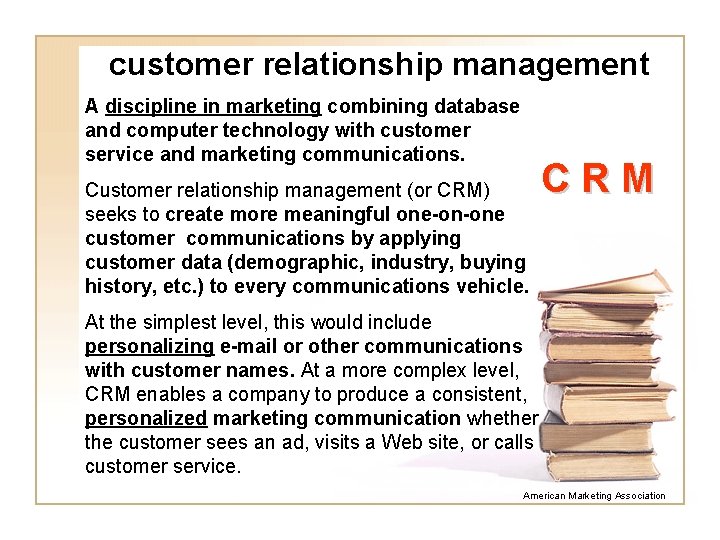
customer relationship management A discipline in marketing combining database and computer technology with customer service and marketing communications. Customer relationship management (or CRM) seeks to create more meaningful one-on-one customer communications by applying customer data (demographic, industry, buying history, etc. ) to every communications vehicle. CRM At the simplest level, this would include personalizing e-mail or other communications with customer names. At a more complex level, CRM enables a company to produce a consistent, personalized marketing communication whether the customer sees an ad, visits a Web site, or calls customer service. American Marketing Association
An Introduction to Marketing defined: “Marketing is an organizational function and a set of processes for creating, communicating, and delivering value to customers and for managing customer relationships in ways that benefit the organization and its stakeholders
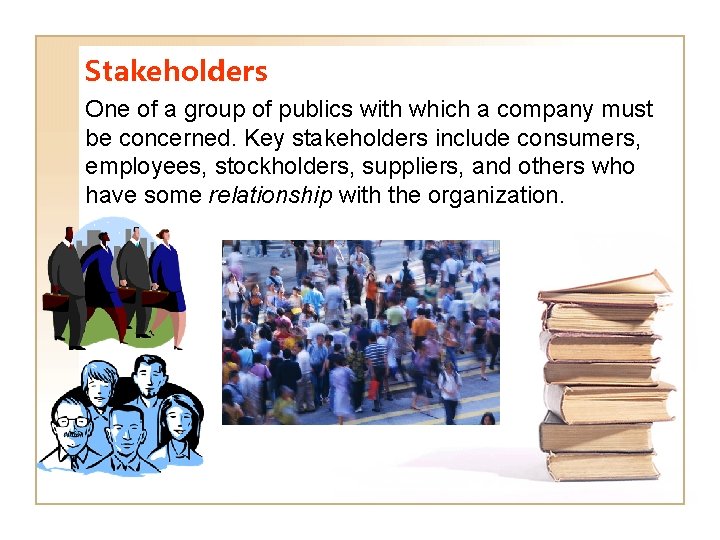
Stakeholders One of a group of publics with which a company must be concerned. Key stakeholders include consumers, employees, stockholders, suppliers, and others who have some relationship with the organization.
Overall Discussion and Questions • • Syllabus and assignments Textbook Objectives What marketing is Who is involved in the course ____________________
- Slides: 17